Blog
Best Damascus Chef Knives & Kitchen Sets: What to Buy (and Skip)

The best Damascus chef knife for most home cooks is an 8 inch blade with a high-carbon cutting core, comfortable handle, and a thin, keen edge, and the best Damascus kitchen set is the smallest one that covers your actual cooking: a chef knife, a paring knife, and one specialist you will really use. Damascus steel earns its place in the kitchen with edge retention and a layered pattern that makes every blade unique. It will not chop for you, and no pattern has ever improved a cook’s knife skills. This guide explains which knives belong in a Damascus set, how to spot quality, who should skip Damascus entirely, and how to keep these blades sharp for decades. Our hand-forged Damascus chef knives and kitchen sets ship from Chicago, IL, and many can be personalized with free engraving.
Why Damascus Steel in the Kitchen?
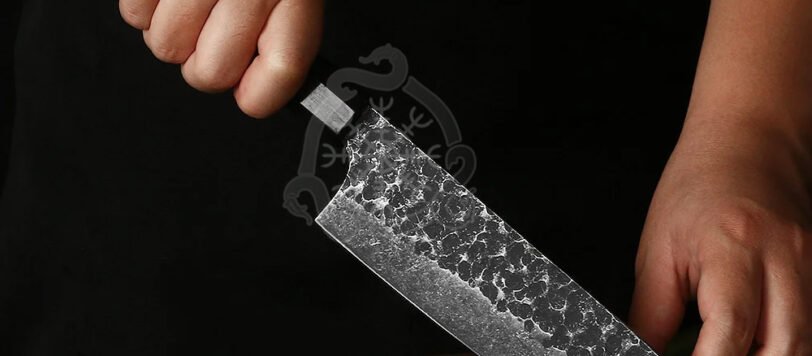
Pattern-welded Damascus layers two or more steels around a hard cutting core. In practice that means an edge that stays sharp through long prep sessions, with visible layering that turns a workhorse tool into something you are proud to leave on the magnetic strip. The trade-off is the same one owners of our Damascus hunting knives accept: most Damascus kitchen knives use high-carbon steel that wants to be washed and dried promptly rather than left in the sink. If low maintenance matters more to you than edge character, read our Damascus steel vs stainless steel guide before buying. It lays out exactly who is better served by each.
The Knives That Actually Matter in a Set
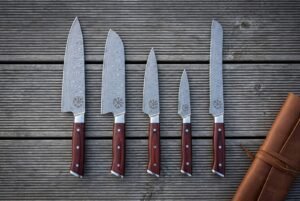
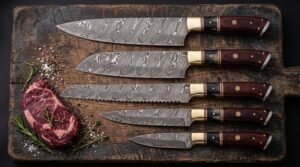 Hornsmith Hand Forged Damascus 5 Piece Chef Knife Set with Buffalo Horn and Pakka Wood Handles and Brass Bolsters and Mosaic Pin & Leather Sheath | Chef and Kitchen Gift | RK-378
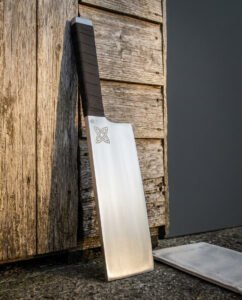
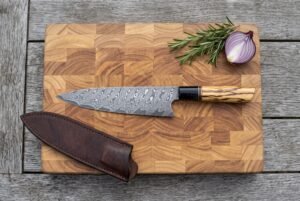 Olivekeen Hand Forged Damascus Chef Knife with Olive Wood Handle & Leather Sheath | Chef Kitchen and Wedding Gift | RK-434
Chef Knife (8 in)
The workhorse: chopping, slicing, dicing, and 80 percent of everything you do on a cutting board. If you buy only one Damascus kitchen knife, buy this one.
Ours are forged from the same billet as our axes and are listed under Viking kitchen knives.
Paring Knife (3 to 4 in)
Peeling, trimming, coring, and in-hand work where a big blade is clumsy. Second priority in any set.
Santoku (6 to 7 in)
A flatter profile and shorter blade favored by cooks who chop with an up-down motion rather than rock-chopping. Choose either a chef knife or a santoku as your primary. Owning both is a luxury rather than a need.
Boning and Fillet Knives
Narrow, semi-flexible blades that follow bone and skin. If you break down whole chickens or fish regularly, this is the specialist worth adding. Anglers should look at a dedicated blade from our fillet knife collection.
Bread Knife and Utility Knife
Useful, but the pieces most often included just to inflate a set’s knife count. A serrated bread knife rarely needs to be Damascus; a utility knife duplicates the paring and chef knives.
Damascus Kitchen Set Sizes Compared
| Set Size | Typical Contents | Best For | Honest Verdict |
|---|---|---|---|
| Single chef knife | 8 in chef knife | First Damascus purchase | Best value per dollar |
| 3-piece set | Chef, paring, utility or santoku | Most home cooks | The sweet spot |
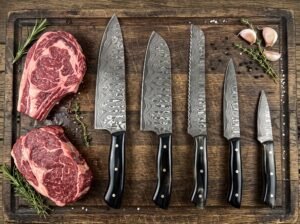
| 5-piece set | Adds boning and slicing knives | Cooks who butcher and roast | Worth it if used weekly |
| 8+ piece set | Full block plus steak knives | Gifts, serious enthusiasts | Impressive, partly redundant |
How to Judge Quality Before You Buy
Blade Construction
Look for a described steel makeup, a high-carbon core with layered cladding, or a full pattern-welded billet, rather than vague “Damascus style” wording. On genuine pattern-welded blades the layers run through the steel: the pattern continues over the spine and into the bevel and cannot polish off.
Thin Edge Geometry
Kitchen performance lives in thinness. A chef knife should taper to a fine edge that glides through an onion rather than wedging it apart. Thick spines are fine; thick edges are not.
Handle and Balance
Wet hands are the kitchen norm. Choose stabilized wood, pakkawood, bone, or resin handles with a shape that locks into a pinch grip. The knife should balance near the bolster, not tip-heavy like a machete.
Full Tang and Fit
On quality knives the tang runs through the handle and the joints are tight, no gaps where water and food can creep in. Gaps are both a hygiene problem and an early warning about overall build quality.
Who Should NOT Buy a Damascus Kitchen Set?
Skip Damascus if your knives live in the dishwasher. Heat, detergent and knocking against racks will ruin any fine blade, and high-carbon steel will corrode fast. Skip it if nobody in the house will dry a blade after use. And skip the jumbo sets if you cook twice a week; a single excellent chef knife serves you better than eight mediocre blades in a block. Damascus rewards cooks who use and care for their tools. It punishes neglect with equal enthusiasm.
Care: Five Rules That Keep Damascus Beautiful
First, hand-wash and towel-dry immediately after use, never the dishwasher. Second, cut on wood or soft plastic boards only; glass and stone boards destroy edges. Third, strop or hone regularly and sharpen on a whetstone when needed. Fourth, wipe a drop of food-safe mineral oil on the blade before long storage. Fifth, store knives on a magnetic strip, in-block, or with edge guards, never loose in a drawer. Follow those five rules and a hand-forged Damascus set becomes a multi-decade tool. More care guides live on the Ransack Viking blog.
Damascus Chef Knife FAQ
Are Damascus chef knives actually better?
They are better at edge retention and cutting feel than budget stainless knives, and every blade has a one-of-a-kind pattern, but they demand basic care: hand washing, prompt drying, and cutting on proper boards. A cook who provides that care gets a superior knife; a cook who will not is better served by ordinary stainless.
What size Damascus chef knife should I buy?
An 8 inch chef knife is the standard recommendation: long enough to slice large vegetables and proteins in one stroke, short enough to control comfortably on a home cutting board. Cooks with smaller hands or small kitchens sometimes prefer a 6 or 7 inch blade or a santoku profile instead.
Is a Damascus knife set worth it?
A small, well-chosen set is worth it because each knife covers a distinct job: a chef knife for board work, a paring knife for hand work, and one specialist you genuinely use. Very large sets are mostly redundant. If the budget is fixed, spend it on fewer, better blades rather than more pieces.
Can Damascus kitchen knives go in the dishwasher?
No, and this is the one rule with no exceptions. Dishwasher detergent is abrasive, the heat cycle is hard on handles, and blades knock against racks and other cutlery, chipping edges. High-carbon Damascus will also corrode in that environment. Hand wash with mild soap, dry immediately, and the knife will reward you for decades.
How often do Damascus kitchen knives need sharpening?
With regular honing or stropping between uses, a quality Damascus chef knife typically needs a true whetstone sharpening every one to three months in a busy kitchen, and less often in a light-use one. The high-carbon core holds its edge noticeably longer than soft budget stainless, so most owners sharpen less than they expect.
Do Damascus chef knives make good gifts?
They are one of the most-gifted knives we sell, especially with engraving. A name, date, or short phrase on the blade or handle turns a kitchen tool into a wedding, housewarming, or graduation keepsake, and we offer free engraving on many chef knives and sets. Add care instructions to the gift so the recipient starts good habits early. A fine knife ruined inside a month is a worse gift than no knife at all.
A hand forged kitchen knife is not maintained like a factory one, and the routine is in the kitchen knife care guide. For what the pattern in the steel actually is, read what Damascus steel is made of, and for the fish specific option see the best Damascus fillet knives. The plain steel fishing option is covered in the best fillet knife for fishing.
For one built to your own measurements, build a custom Damascus knife and choose the pattern, the profile, the handle material and the sheath.
Pieces in the catalogue
The catalogue carries the Hornsmith chef knife and the Rosechef chef knife. So do the Hearthfold chef knife five and the Hearthkeen Viking chef knife.
Shop the range
Hornsmith Hand Forged Damascus 5 Piece Chef Knife Set with Buffalo Horn and Pakka Wood Handles and Brass Bolsters and Mosaic Pin & Leather Sheath | Chef and Kitchen Gift | RK-378Olivekeen Hand Forged Damascus Chef Knife with Olive Wood Handle & Leather Sheath | Chef Kitchen and Wedding Gift | RK-434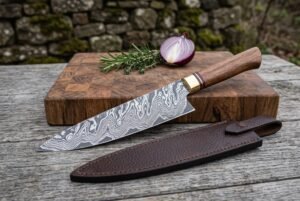 Brasshearth Hand Forged Damascus Chef Knife with Hardwood Handle and Brass Bolster and Fiber Spacers & Leather Sheath | Chef and Housewarming Gift | RK-396