
Blog
Best Damascus Fillet Knives: Flex, Length and Blade Care

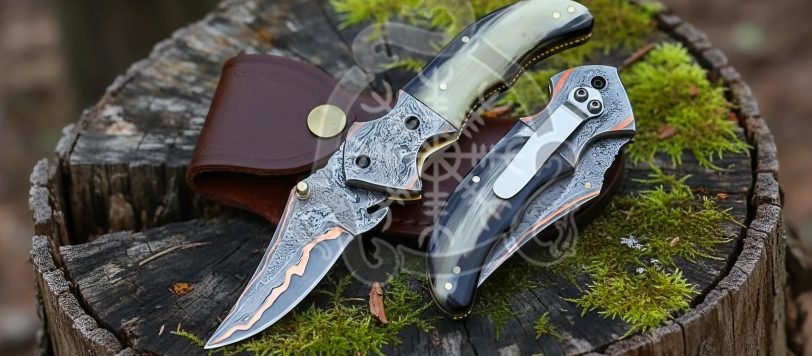
A good Damascus fillet knife is thin, springy and long enough for the fish you actually catch, not the one you talk about. Flex lets the blade follow a rib cage instead of cutting through it. Length is set by the fish, roughly 3.5 inches for panfish and 8 inches for salmon. The catch is care: high carbon Damascus rusts, and salt water and fish acid make that happen fast.
Why a fillet blade is thin and springy
Almost every knife in a kitchen or a tackle box is built to resist bending. A fillet knife is built to do the opposite, and that single difference explains its whole shape.
The job is to follow a curve the blade cannot see. Run it along a rib cage and the steel has to bend around the arc while the edge stays in contact with bone, so nothing edible is left behind on the frame. Turn a fillet skin side down and the blade has to lie almost flat and flex with the skin as you pull, or you take half the flesh off with the skin. A stiff blade cannot do either. It rides over the bone, wastes meat, and forces you to saw.
Flex comes from geometry rather than from soft steel. The blade is ground narrow and kept thin behind the edge, and it is that cross section which lets it bend and spring back. A fillet knife feels alarming in the hand the first time. It is meant to.
How much flex is too much
There is a working range. Too stiff and you lose the ability to trace bone. Too soft and the tip wanders, which is dangerous when your other hand is holding a slippery fish. A blade that returns straight after you flex it against the board, without staying bent, is behaving correctly. A blade that takes a set has been ground too thin or run too soft, and it will not get better with time or with hope.
Hardness matters here more than people expect. Our Damascus is 1095 and 15N20 forge welded at 58 to 60 HRC, which is hard enough that a thin blade springs back rather than deforming, and hard enough to hold a fine edge through a session of fish. If you want the metallurgy behind that, what Damascus steel actually is covers the pattern welding, and Damascus versus plain high carbon compares it with single steel blades.
Length by fish size
Choosing length is the one decision here that is genuinely simple, so enjoy it. Match the blade to the fish you fillet most often, not the biggest fish you have ever caught.
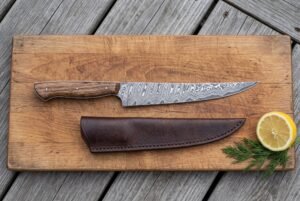 Streamwood Hand Forged Damascus Fish Fillet Knife with Wood Handle & Leather Sheath | Fishing Camping and Anglers Gift | RK-480
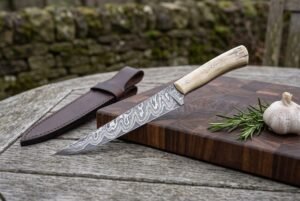 Palebone Hand Forged Damascus Fish Fillet Knife with Natural Bone Handle & Leather Sheath | Fishing Camping and Anglers Gift | RK-422
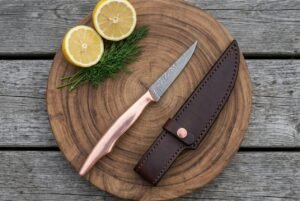 Copperfin Hand Forged Damascus Fish Fillet Knife with Polished Copper Handle & Cowhide Leather Sheath | Fishing Camping and Collector Gift | RK-1011
Around 3.5 inches: panfish, perch, trout, small snapper
A short fillet blade is a precision instrument. The fillet knife in our range built this way runs 8.5 inches overall with a 3.5 inch blade and a five inch handle, at 119 dollars at the time of writing, and prices can change. Short blades give you control at the tip and are easier to work in a small space, on a boat deck or over a sink. They are slow on anything large, because you end up making several passes where a long blade makes one.
Around 7 inches: walleye, bass, mid sized inshore fish
This is the length most people should own if they only own one. Our seven inch blades sit on an eleven inch overall knife with a four inch handle, also at 119 dollars when written. Seven inches reaches across a fish of two to five pounds in a single stroke, which is what produces a clean fillet with no stepping, and it is still short enough to skin without the tip wandering off the board.
Around 8 inches: salmon, big pike, larger saltwater fish
Eight inches of flexible blade on a thirteen inch knife is the long option, and it is the right one if you deal with salmon or anything with a long body. The extra reach means the blade clears the far side of the fish, so the cut is one continuous pull instead of a sequence of saw strokes. On a small perch it is unwieldy, and there is no shame in owning two.
If you want a broader look at how fillet knives compare across the category, the fillet knife buying guide goes through the choice from a fishing angle rather than a steel one.
Why full tang matters less here than on a chopper
Full tang is the usual shorthand for a strong knife, and on a chopping tool it earns that reputation. An axe, a large camp blade or a heavy chef knife takes impact loads straight into the joint between blade and handle, and a full tang spreads that across the whole grip.
A fillet knife never sees those loads. Nothing gets batoned, nothing gets chopped, and the blade is deliberately built to bend rather than resist. The forces are light and mostly along the length of the blade. What actually matters on a fillet knife is the quality of the joint itself, whether the handle is sealed where it meets the steel, and whether water can get in and sit there.
So a full tang on a fillet knife is a nice thing to have and not the deciding factor, whatever the listing leads with. Judge the fit at the bolster and the material of the handle instead. On a chopping tool, reverse that priority. Our hunting knives and Damascus skinners are the range where tang construction genuinely matters, because those blades get worked hard against bone and hide.
Handle material for a wet job
Wood looks best and needs the most attention, because it absorbs water, brine and fish blood over time unless it is kept sealed. Resin and polished copper do not absorb anything, which makes them the low maintenance choice for a boat. Stag horn and bone sit in between and are chosen for looks. None of these is wrong, but if the knife is going to live in a tackle box that is damp for weeks, resin is the sensible pick and wood is a standing commitment.
The care problem, stated honestly
This is the part most listings skip. A high carbon Damascus blade will rust. Salt water and the acids in fish flesh and slime accelerate it, and a fillet knife spends its life in exactly that environment. Leave one wet in a bag overnight after a day on salt water and you will find orange spotting the next morning.
What to do at the dock
Rinse the blade in fresh water before you leave the water, wipe it dry with a cloth, and do not sheath a wet knife. Leather holds moisture against steel, which is worse than open air. If you are still fishing and cannot dry it properly, at least rinse the salt off, because salt left on carbon steel keeps working long after the knife looks clean.
Oiling and storage
At home, wash with warm water and a little soap, dry completely, then wipe the blade with a thin film of food safe mineral oil before it goes away. That film is the whole defence. Store the knife out of the sheath, or in a way that lets air reach it. Our knife care guide covers the routine in more detail and applies to every carbon steel piece we sell.
Patina is not rust
A carbon steel blade darkens with use. Grey and blue tones develop from contact with acids, and that oxide layer is stable and mildly protective. Rust is orange, it is loose, and it pits the surface. Learn the difference and you stop panicking about the first one. Some people force a patina deliberately. There is no need, because fish will do it for you within a season.
We do not sell stainless, and what that means for you
Every blade in this shop is carbon steel. Plain 1095 runs at 54 to 58 HRC and Damascus is 1095 and 15N20 forge welded at 58 to 60 HRC. There is no stainless option, and a stainless fillet knife genuinely is lower maintenance than what we sell. It tolerates being left wet, it survives a careless day, and for someone who fillets fifty fish on a charter boat and hoses the deck down afterwards, that is the practical answer.
What you get in exchange for the extra care is a blade that takes a finer edge, gets it back faster on a stone, and holds it through more cutting. Carbon steel also sharpens with basic equipment rather than needing diamond abrasives. If you will do the drying and the oiling, a carbon Damascus fillet knife is a better cutting instrument. If you know you will not, buy stainless from someone else. We would rather say that than sell you a knife you will ruin in a month.
How to tell a real Damascus fillet knife from a printed one
The category is full of blades with a swirl pattern acid etched or laser printed onto plain stainless and sold at a price that should be the first clue. Real pattern welded steel has the pattern running through the blade because it is two steels folded together, so it appears on the edge bevel and changes as the blade is sharpened. A printed pattern stops at the surface and often runs off the edge in a way that makes no physical sense. Real versus fake Damascus shows the tells with pictures.
The other check is whether the seller will name the two steels and the hardness. Ours are 1095 and 15N20 at 58 to 60 HRC, and our fillet blades are 393 layers. A seller who will not say what is in the steel is telling you something.
Ransack Viking is a US company in Chicago, Illinois. Every piece is handmade in the Czech Republic the old way, then imported, inspected and shipped from Chicago. If you want a name or a rune line cut into the blade or the handle, engraving is chosen inside the add to cart form: text or runes is 19 dollars, a family crest is 49, and the cutting is done in the US after the piece arrives. Details are on the engraving page.
Once you have a fillet knife, the natural next blade is a kitchen knife, since the fish ends up there anyway. Our Damascus chef knives use the same steel and the same hardness with a stiffer grind.
The plain steel alternatives are covered in the best fillet knives for fishing, and the hooked blade that often rides alongside them is explained in the gut hook. Terms like hardness and layer count are defined in our steel and hardness glossary.
Questions people ask
How flexible should a fillet knife be?
Enough to bend visibly under hand pressure and spring straight back on its own. If it stays bent, the blade is too soft or ground too thin and it will never track properly along bone. If it barely moves, you will lose meat on the rib cage and struggle to skin. Longer blades feel more flexible than short ones of the same grind simply because there is more length to bend.
What length fillet knife should I buy first?
Seven inches, unless you know your fishing is all panfish or all salmon. A seven inch blade crosses most freshwater and inshore fish in one stroke and still skins without wandering. Buy 3.5 inches if you mostly clean perch, trout and small snapper, and 8 inches if salmon or pike are the normal catch. Owning a short one and a long one is a common and sensible setup.
Will a Damascus fillet knife rust in salt water?
Yes, if you let it. That is chemistry rather than a defect. High carbon steel and salt do not get along, and fish acid speeds it up further. The routine that prevents it is short: rinse in fresh water, wipe dry, never sheath it wet, and wipe a thin film of food safe mineral oil on the blade before storage. Done consistently, the knife stays clean for years. Skipped for one damp weekend, you will see orange.
Do you sell a stainless fillet knife?
No. Every blade here is carbon steel, either plain 1095 at 54 to 58 HRC or Damascus at 58 to 60 HRC. Stainless is genuinely easier to look after, so if you want a knife that tolerates being left wet in a boat locker, buy stainless elsewhere. Carbon steel is here because it takes and holds a finer edge and sharpens more easily, which is the trade we think is worth making.
Does a fillet knife need to be full tang?
It helps, but it matters far less than on a chopping tool, because a fillet knife never takes impact loads. Bending forces are light and run along the blade. What matters more is how well the handle is sealed where it meets the steel, so water cannot sit in the joint, and what the handle is made from. Judge the bolster fit before you judge the tang.
How do I sharpen a flexible fillet blade?
Support the blade so it cannot flex while you work, either by keeping it flat against the stone with light pressure or by holding it near the section you are sharpening. Use a fine stone and a shallow angle, because the whole point of the blade is a keen edge rather than a durable one. Finish with a strop or a smooth steel. Carbon steel responds quickly, so heavy pressure is the usual mistake and the hardest habit to drop.
If you are buying
If you are shopping rather than reading, the Copperfin fish fillet knife and the Riverstag fish fillet knife are the nearest match. Also worth opening, the Palebone fish fillet knife and the Streamwood fish fillet knife.
Shop the range
Streamwood Hand Forged Damascus Fish Fillet Knife with Wood Handle & Leather Sheath | Fishing Camping and Anglers Gift | RK-480Palebone Hand Forged Damascus Fish Fillet Knife with Natural Bone Handle & Leather Sheath | Fishing Camping and Anglers Gift | RK-422Copperfin Hand Forged Damascus Fish Fillet Knife with Polished Copper Handle & Cowhide Leather Sheath | Fishing Camping and Collector Gift | RK-1011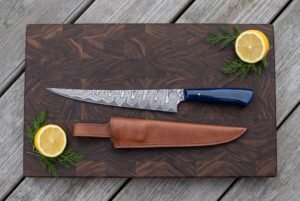 Bluetide Hand Forged Damascus Fish Fillet Knife with Blue Resin Handle & Leather Sheath | Fishing and Anglers Collector Gift | RK-481
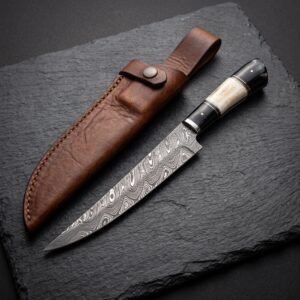 Riverstag Hand Forged Damascus Fish Fillet Knife with Stag Horn Handle and Bone and Acrylic & Leather Sheath | Fishing and Anglers Gift | RK-421