Ragnar Lothbrok belongs to the sagas rather than to the annals, a legendary Danish and Swedish king whose name was attached to raids across ninth century Europe long after any of it could be checked. The axe that has come to be associated with him is a real Norse pattern though, and it is worth knowing why it looks the way it does. A deep beard, an upswept horn, a narrow eye and a haft short enough to use behind a shield. That combination gave a raider an axe he could carry all day, hook a shield rim with, and use to shape a boat repair the next morning. It was never a specialist tool, and that is precisely why it was everywhere. If the name brought you here, our Ragnar axe guide explains what the screen axe really is.
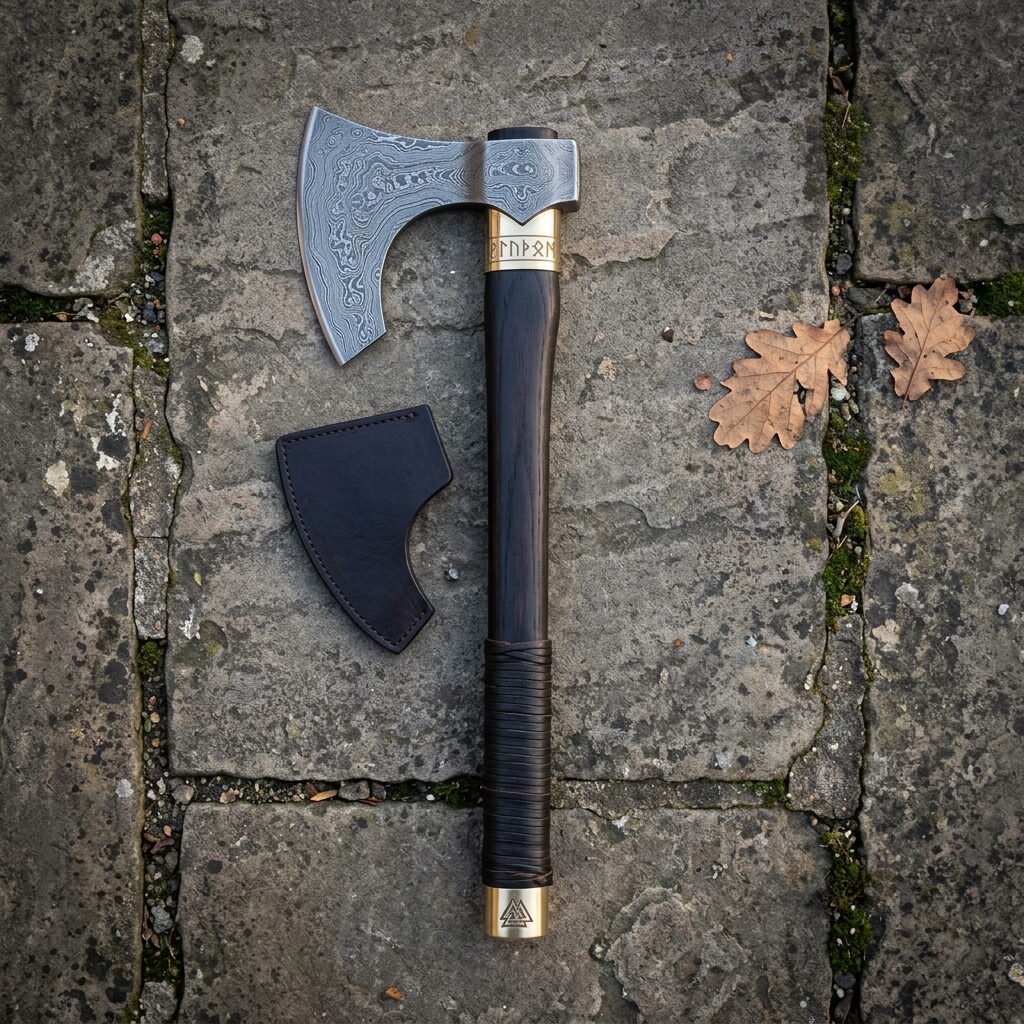
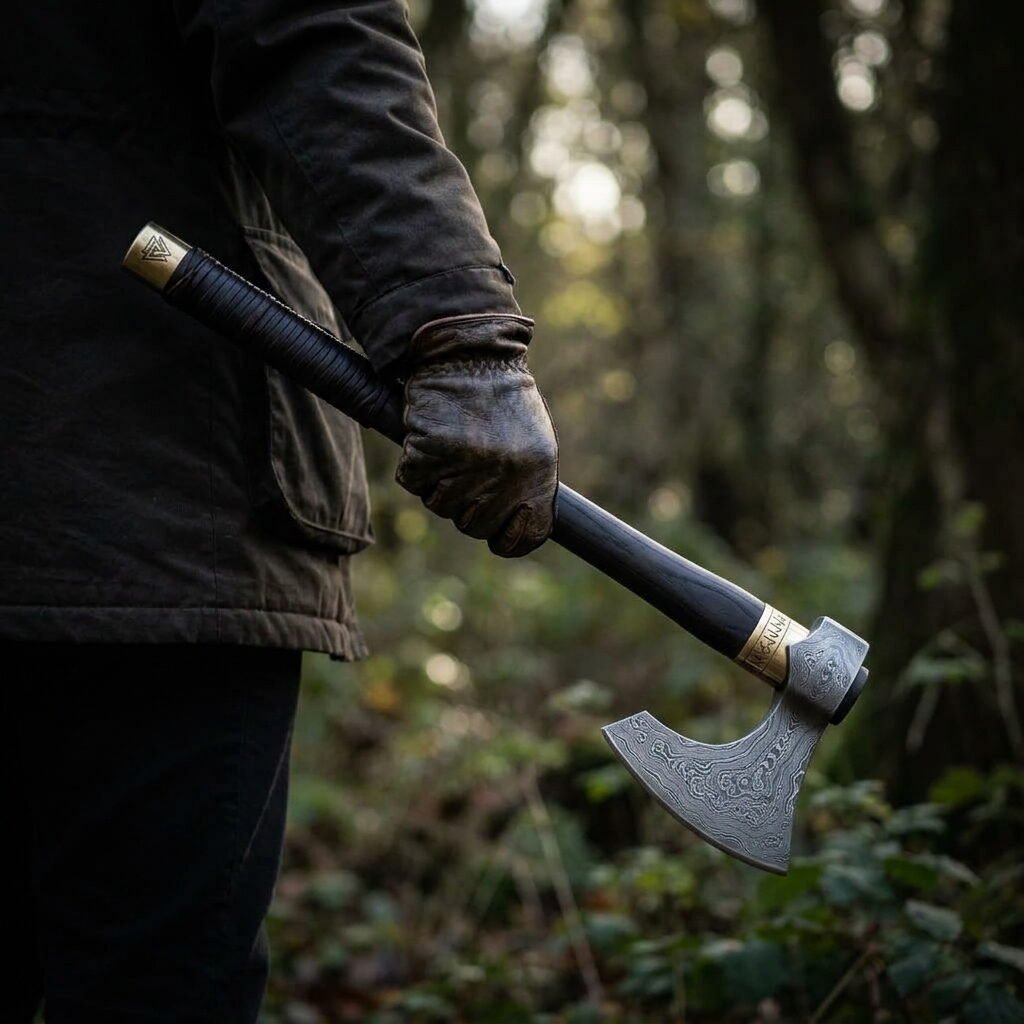
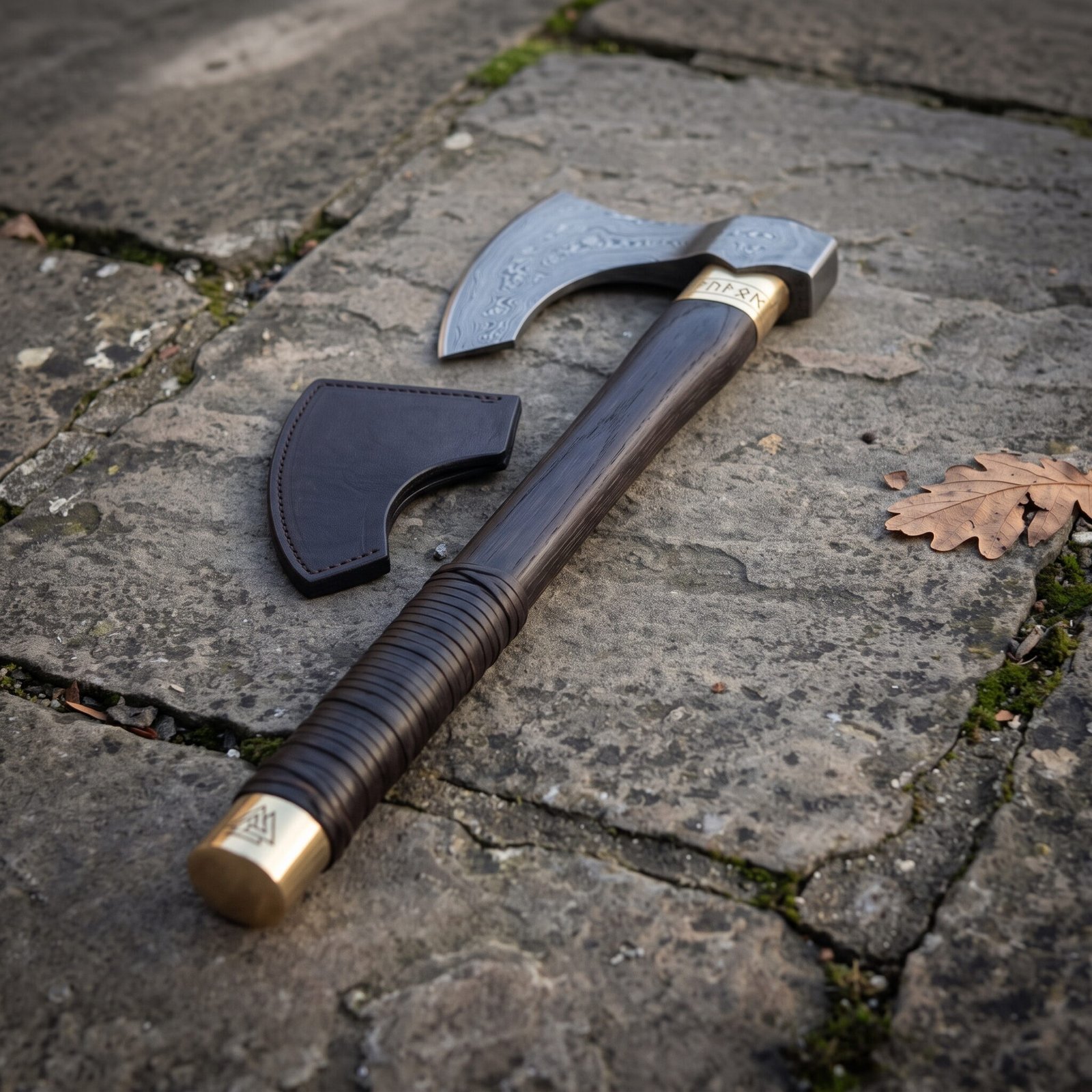
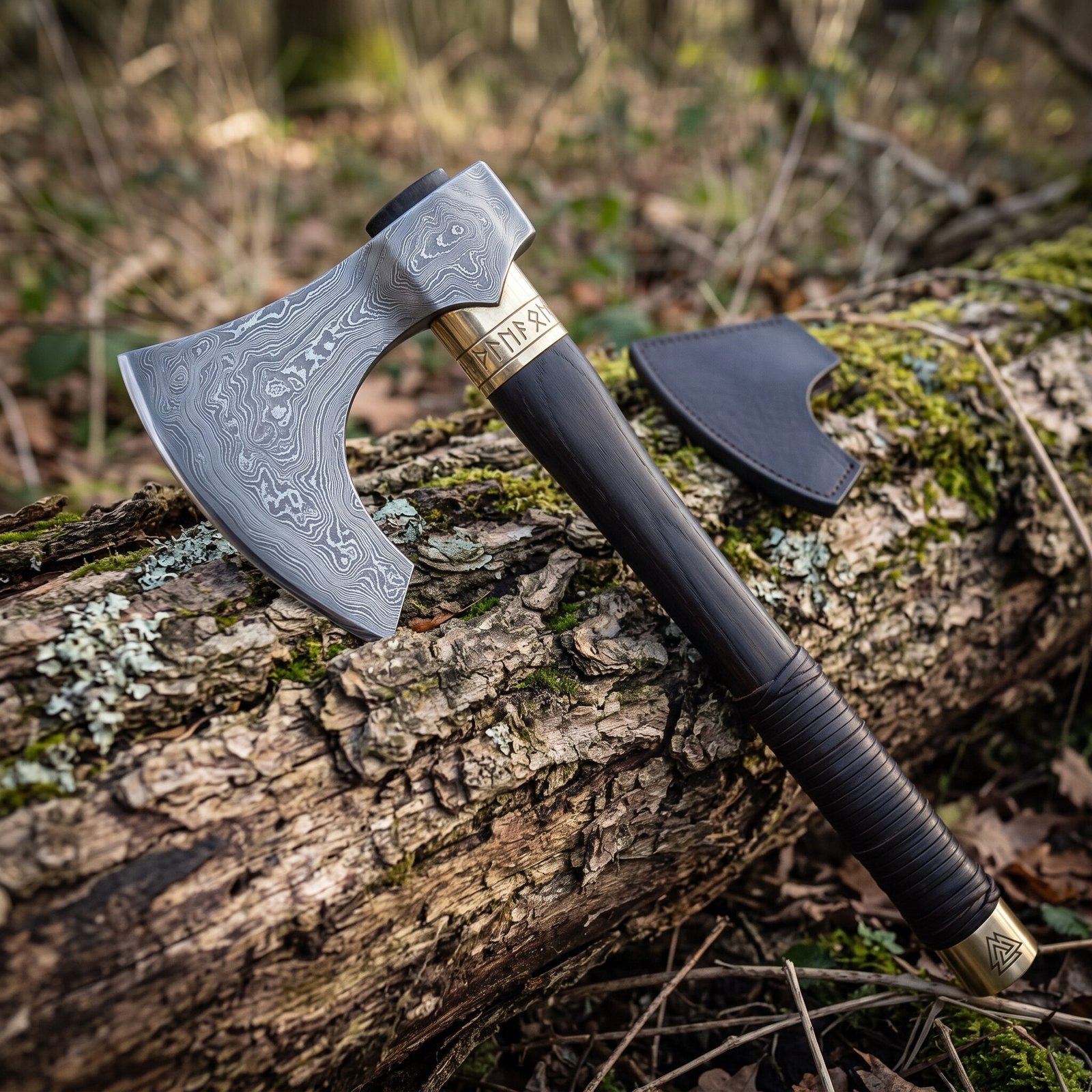
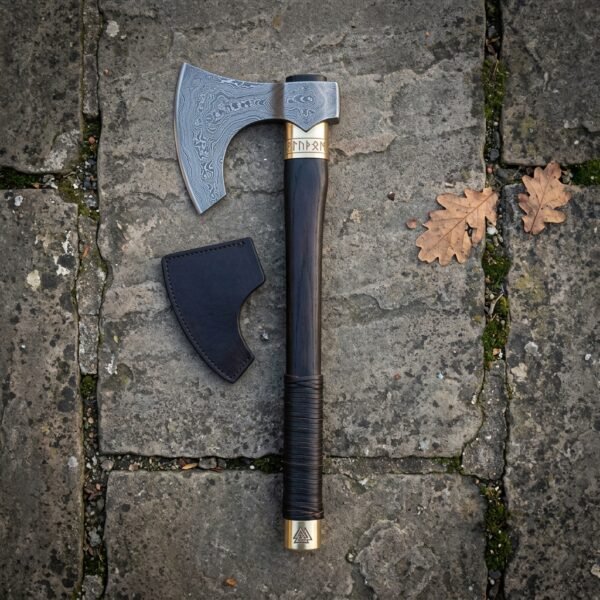
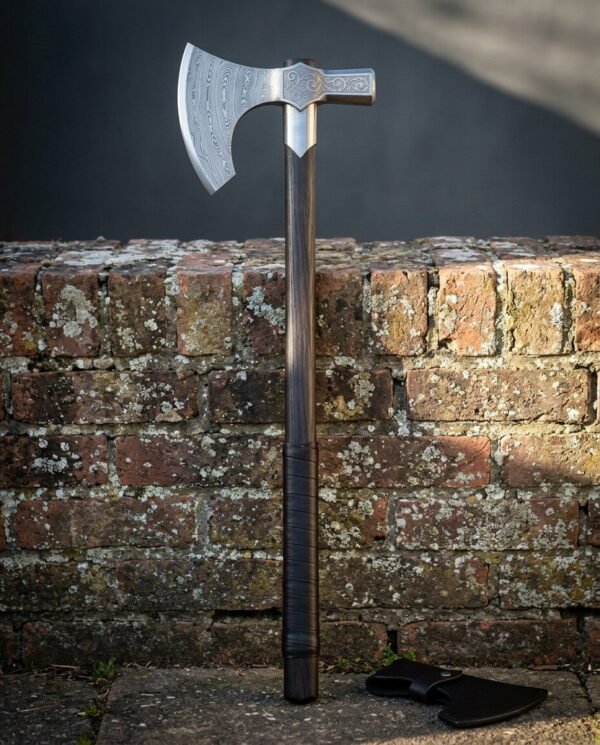
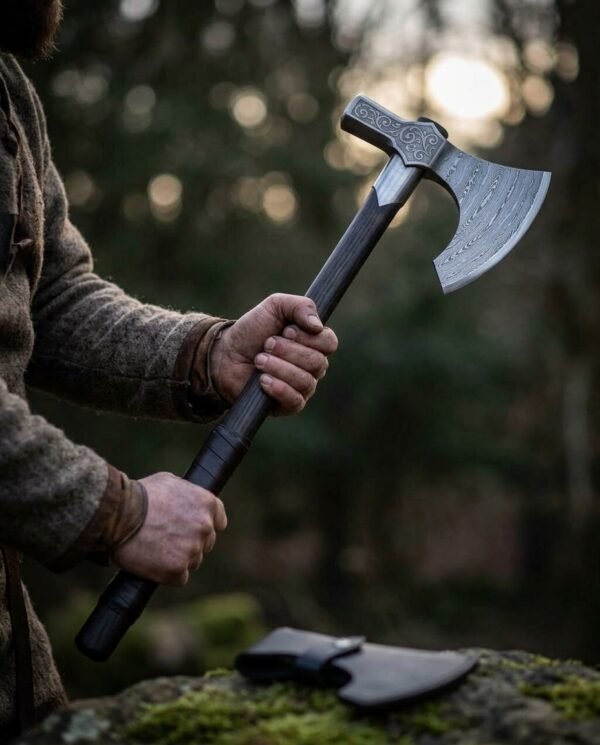
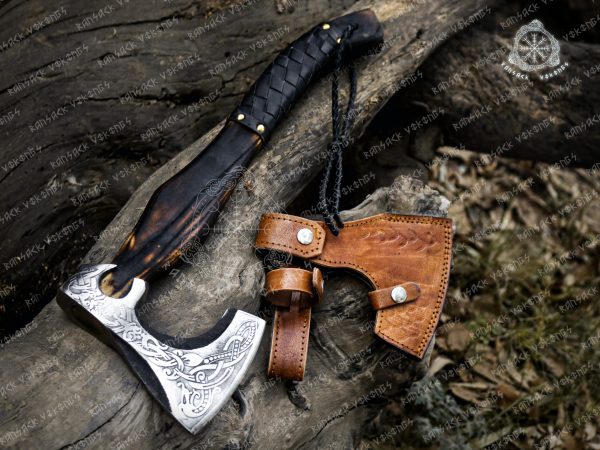
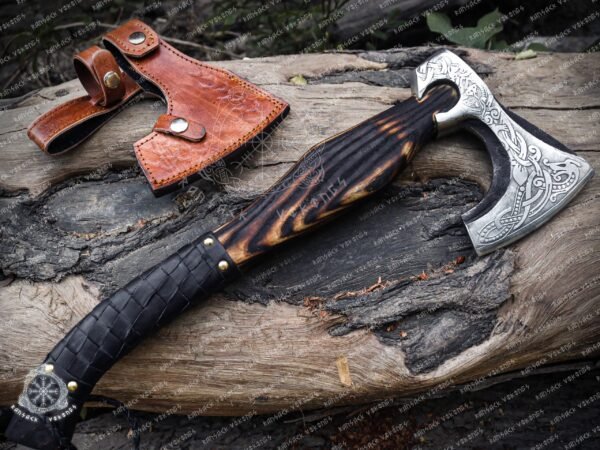
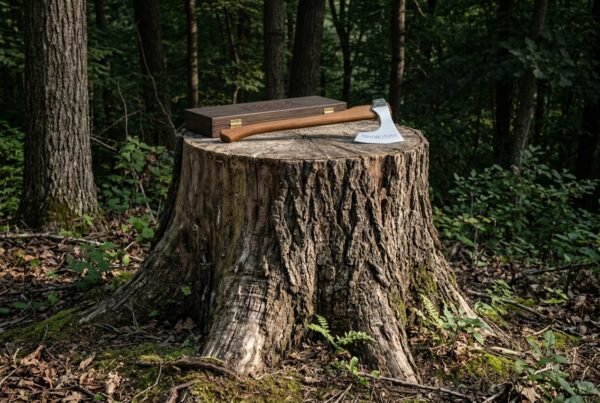
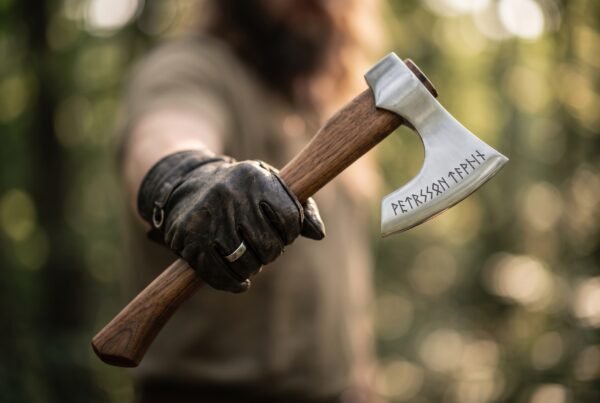
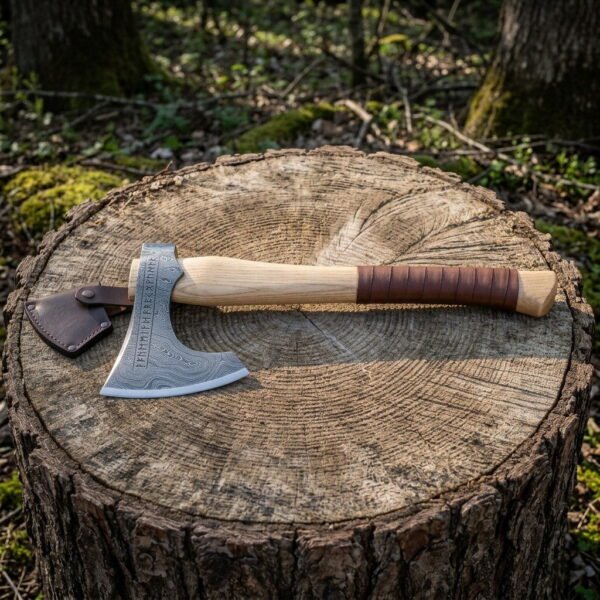
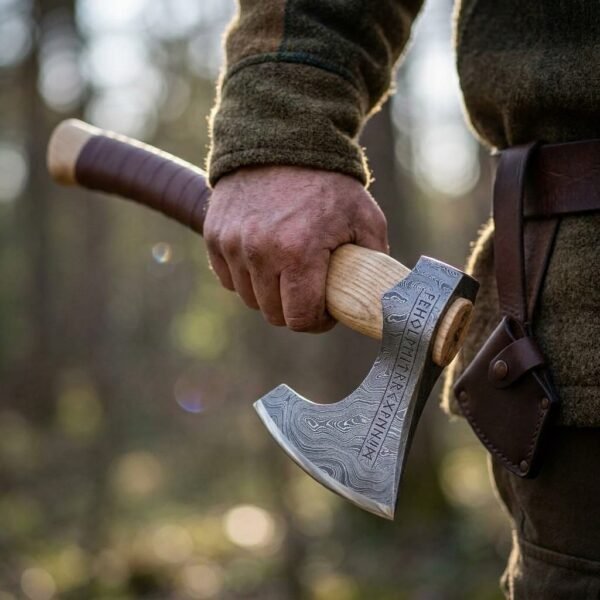
This interpretation is forged and finished in the Czech Republic. The head is layered Damascus steel, forge welded, drawn out and acid etched so the pattern flows with the curve of the beard. The haft is dark hardwood with a brass collar at the eye, a leather wrapped lower grip and a brass end cap, oiled rather than lacquered, and the axe ships in the black leather head sheath shown in the photographs, stitched to fit this head.
Specifications
| Steel | Hand forged 1095 and 15N20 Damascus, acid etched |
|---|
| Layer count | Approximately 200 layers, varies by billet |
|---|
| Hardness | 58 to 60 HRC at the edge, soft eye and poll |
|---|
| Head form | Bearded head with an upswept horn, deep beard and narrow eye |
|---|
| Overall length | 20 inches |
|---|
| Cutting edge | 5 inches from horn to beard tip |
|---|
| Head weight | Approximately 1.8 lb |
|---|
| Haft | Dark hardwood, hand shaped, oil finished, leather wrapped lower grip |
|---|
| Collar | Brass collar at the eye with a line of Elder Futhark runes |
|---|
| End cap | Brass end cap marked with a valknut |
|---|
| Sheath | Black leather head sheath, fitted to the head |
|---|
| SKU | RK-1216 |
|---|
What makes this a raiding axe rather than a woodsman axe
Set it next to a splitting axe and the differences are all in the section. A splitting axe is thick behind the edge because its job is to force wood fibres apart. This head is thin behind the edge, so it slices rather than wedges, and the mass is pulled forward into the bit rather than sitting back at the poll. That makes it fast, and speed is what a one handed axe trades on.
The beard, the long lower lug that drops below the edge, is doing two things at once. It buys five inches of cutting edge on a head that weighs under two pounds, and it opens a hollow behind the steel where the hand can grip right up under the head. That second use is the one people forget. A Norse axe was a boatbuilding tool as much as a fighting axe, and choking up behind the beard turns it into a controllable carving tool. The upswept horn at the top is the hooking end, used to pull a shield rim aside or a branch out of the way.
Why Damascus and not stainless
Damascus is a construction rather than an alloy. Two carbon steels are forge welded, folded and welded again until the billet holds hundreds of layers, then etched so the layer boundaries stand up as pattern. Both steels are chosen because they harden well and because they etch to different tones. Stainless does neither job here. Its chromium content costs toughness at the hardness an axe edge needs, so a stainless axe chips where a carbon steel axe rolls and comes back on a stone, and stainless layers etch flat and grey with almost no contrast. The full comparison is on Damascus versus stainless.
Damascus will rust if it is left wet. A wipe of oil after handling prevents it entirely, and oiling also deepens the contrast in the etch over time.
The dark haft, the brass collar and how to keep them
The haft is a dense dark hardwood, hand shaped to an oval section aligned with the edge so you can feel where the bit is pointing without looking at it. Against a bright etched head the dark wood does something the pale hafts do not, which is push all the visual weight up into the steel. The brass collar at the eye is not only decorative. It braces the shoulder of the haft where the wood is thinnest and takes the abrasion that would otherwise chew the timber just under the head.
Oil the wood once or twice a year with a rag, keep it out of standing water and away from direct heat, and let the brass patinate or bring it back with a metal polish depending on the look you want. Detail is on our wooden handle care page.
Engraving, runes and your own design
Use the rune converter on this page to turn a name, a date or a short phrase into Elder Futhark and we will cut it into the steel or the handle. If you would rather have a Viking pattern than a rune line, choose your own design in the engraving option above the add to cart button and tell us whether it goes on the blade or the handle. Where a piece already carries an engraved design, your chosen engraving replaces it rather than sitting alongside it. On a Damascus head the engraving is cut through the etched surface so it reads as bright metal against the pattern, which is a striking effect for a name or a short saga line. See the engraving page for depth and placement.
Care and sharpening
Dry the head after handling and put a thin film of oil across it before it goes back into the sheath. Leather holds damp against steel, and a Damascus head put away wet will spot within days. If rust does appear do not take a wire wheel to it, because aggressive abrasives flatten the etch contrast that the head was made for. Our steel care page sets out the gentle method.
Sharpen along the existing convex bevel with a coarse puck in small overlapping circles, following the curve from horn to beard rather than trying to flatten it, then refine on a fine stone and strop on leather. The technique in sharpening with a whetstone transfers directly at a more open angle. Sharpening never removes the pattern, because the layers run all the way through the head.
Made in the Czech Republic
The work behind this piece happens in a Czech Republic workshop that has kept to the old methods. Steel is forged and heat treated by hand, the grind is taken down by eye rather than by machine, and the handle, fittings and sheath are cut and finished one at a time. Because of that, every piece carries small marks of the hand that made it.
Ransack Viking is a United States company. We import direct, check each piece when it reaches us, and ship from our Chicago, Illinois warehouse. Engraving is added here in the United States after arrival, so the piece you receive is finished to your order.
A note on handmade variation
This piece is hand forged. It is not machine made and it is not bulk produced, so what arrives will not be a pixel for pixel copy of the photograph. Grain, tone, pattern and exact profile vary because each one is worked by hand from natural materials, and with Damascus that variation is at its most obvious. The layer figure is a record of how your particular billet moved under the hammer, the dark hardwood runs from deep brown to near black, and brass tones differ with polish and age. Dimensions, steel and build are the same every time. The character is not.
Frequently asked questions
Is this an official replica from the television series?
No. It is our own interpretation of the Norse bearded axe pattern that has become associated with the Ragnar legend. It is not licensed by or connected to any film or television production.
Is the Damascus pattern real?
Yes, it is genuine forge welded pattern welded steel. The layers run through the body of the head, which is why sharpening never removes the figure. Printed or laser etched patterns disappear the first time the edge is dressed.
Can I have runes engraved on it?
Yes. Use the rune converter above for Elder Futhark and tell us whether it goes on the head or the haft. On a Damascus head the cut shows as bright steel against the etched pattern.
Will my axe have the same pattern as the photograph?
The style of the pattern and the way it follows the beard will match. The exact figure will be unique to your head, because no two billets move the same way.
What is the difference between this and the plain steel bearded axe?
Geometry and use are close. The difference is the head material and the fittings. This one is layered Damascus with a dark hardwood haft and a brass collar, which is considerably more shop time and carries the higher price.
How long does shipping take?
United States shipping is free. A stock Damascus axe leaves the shop in three to five business days, and engraved orders add one to two weeks of forge time before dispatch.
What is in the box
- One Ravenskegg hand forged Damascus steel Ragnar style Viking bearded axe
- Fitted black leather head sheath
- Damascus care and sharpening card
- Certificate of hand forging with the SKU recorded on it
- Forged and finished in the Czech Republic
Explore the range
See the full bearded axes range, the wider Viking axes selection, the Norse arms collection and our engraved and personalised pieces, or read the guides for Damascus care and sharpening.
If this one is not it
In the same category sits the Hammerbeard bearded axe, forged from 1095. A near match for this one is the Northmark bearded axe, pattern welded Damascus. Closest to this in the range is the Prowshear bearded axe, pattern welded Damascus.
Fitting out further, the Stormpoll Medieval axe belongs with it. Pick the steel, the length and the fittings yourself on the custom Viking axe page.




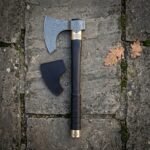
Absolutely blown away by this axe. The wood handle feels amazing and the balance is perfect. Came in a nice gift box which made it feel even more special. Edge retention has been great even after regular use. Love it. Nice touch that it ships from within the US even though it’s crafted in the Czech Republic.
So happy I finally pulled the trigger on this one. Leather sheath is thick and well stitched. Not the cheap stuff you usually get. Came in a nice gift box which made it feel even more special. If you’re on the fence just get it. You won’t regret it.
Five stars isn’t even enough honestly. Edge retention has been great even after regular use. Damascus blade holds a razor edge right out of the box. Fit and finish is museum quality. You can tell real craftsmen made this by hand. I keep coming back to Ransack Viking because it’s always this good. Couldn’t be happier with this.
This axe is fine. Just didn’t wow me. Wouldn’t say no to it but wouldn’t rave about it either.
Best axe I’ve ever owned.