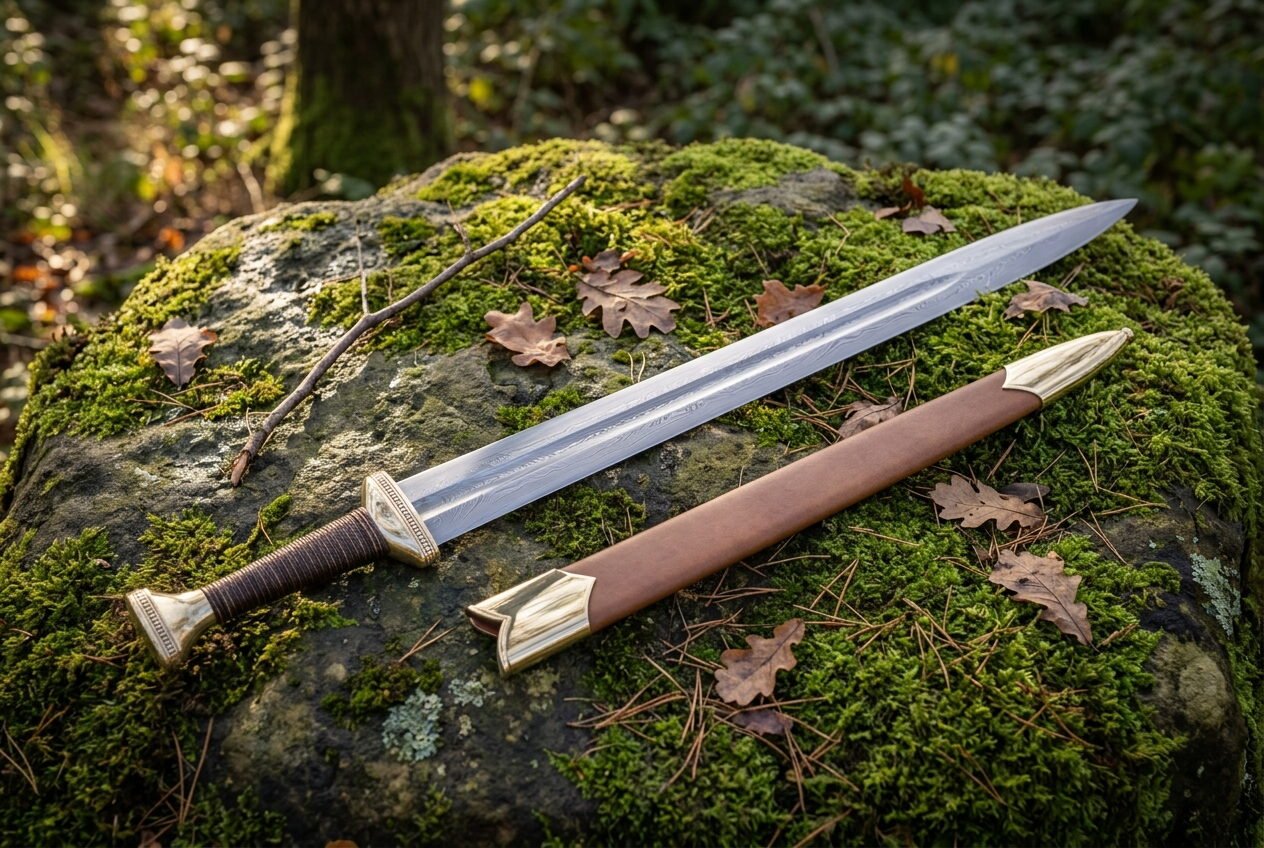
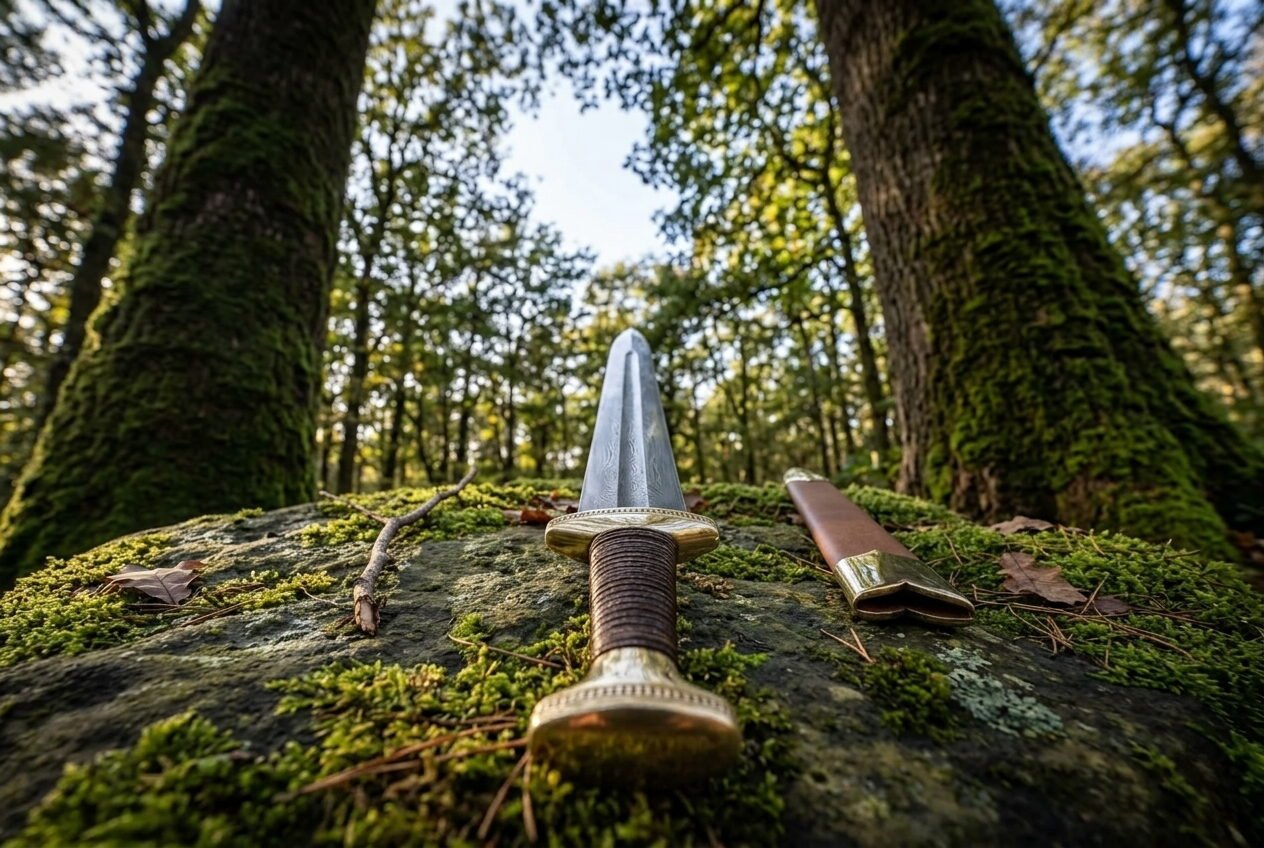
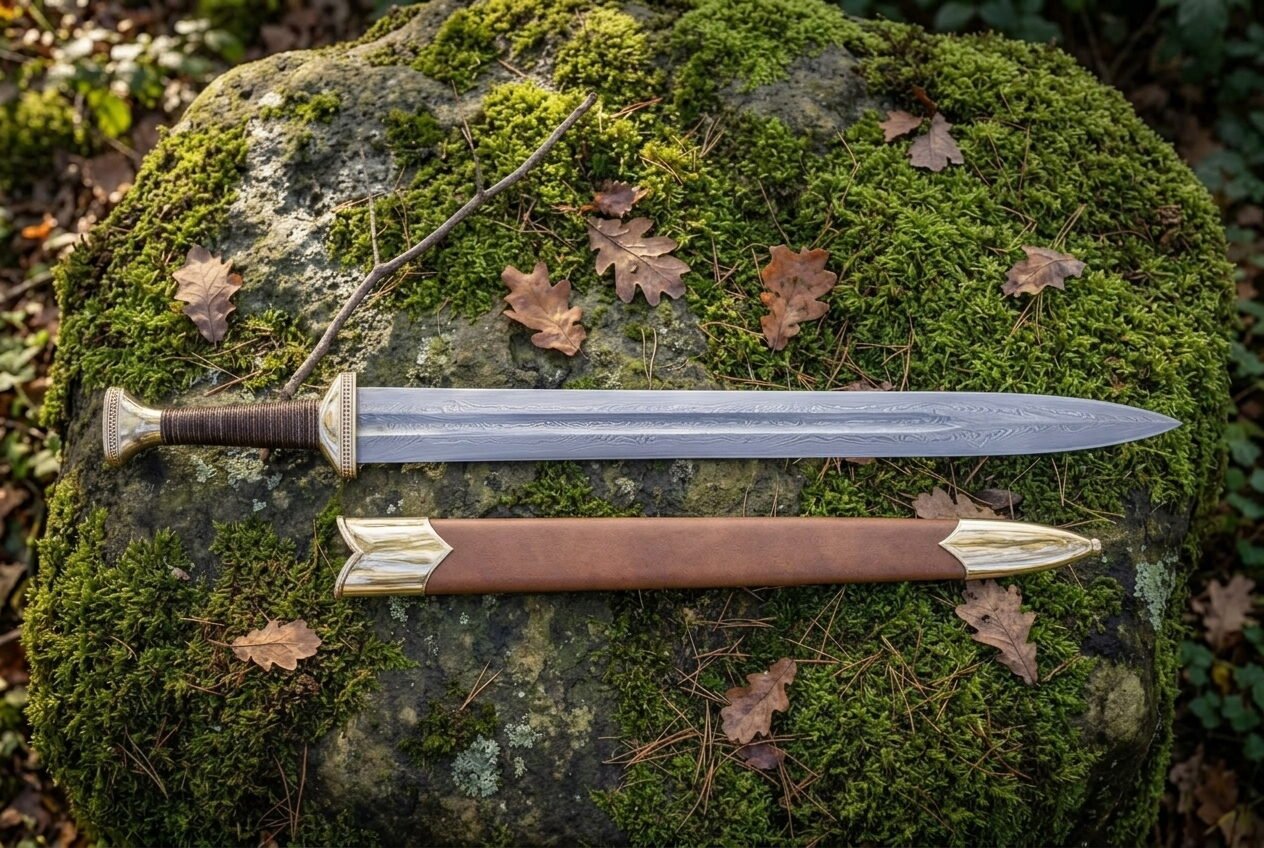
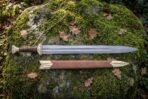
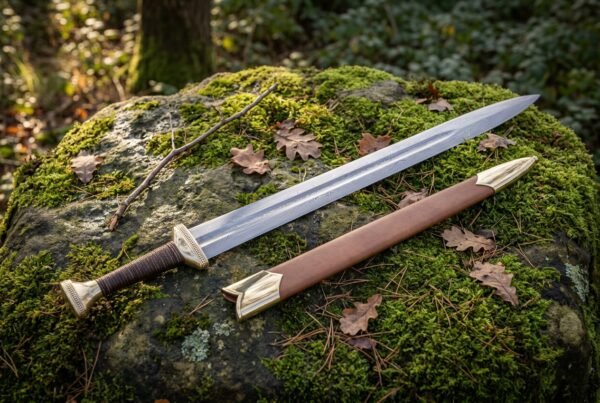
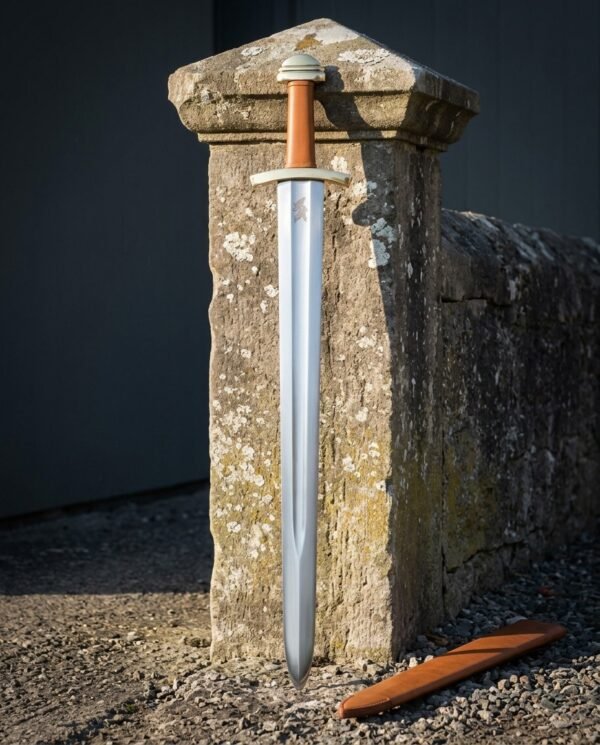
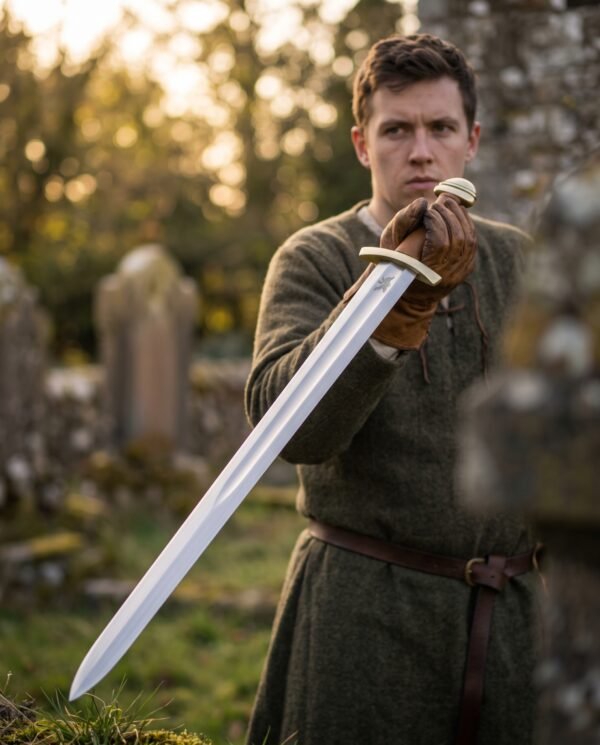
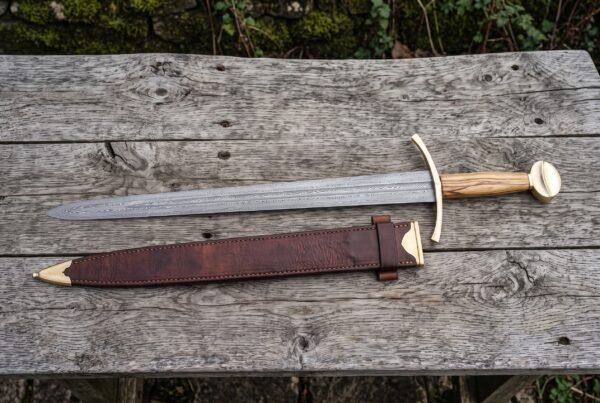
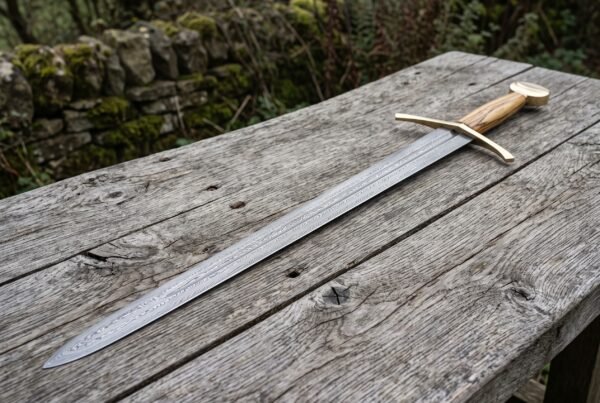
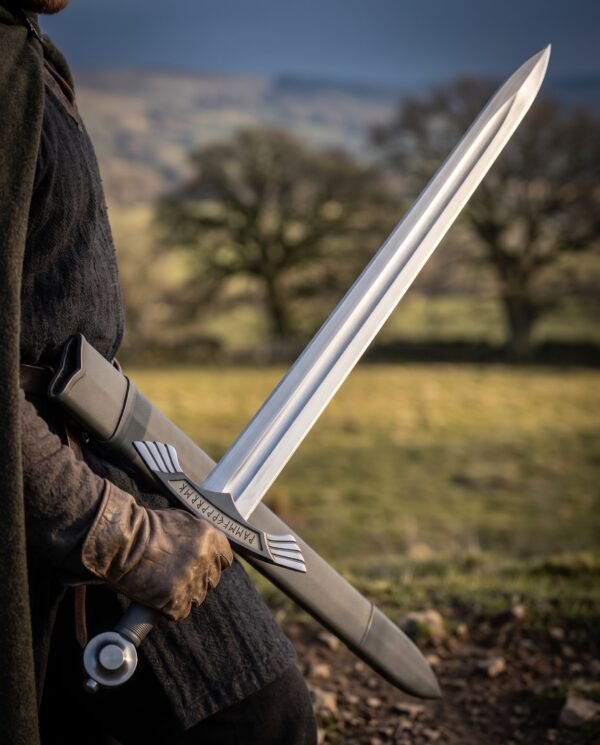
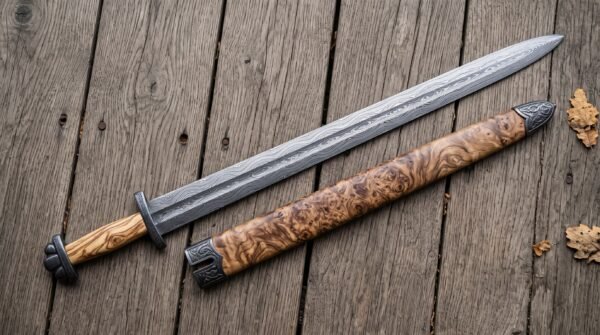
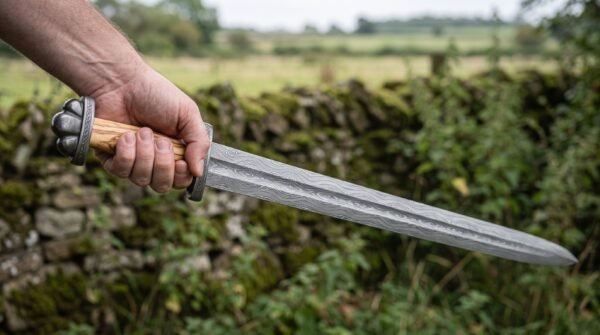
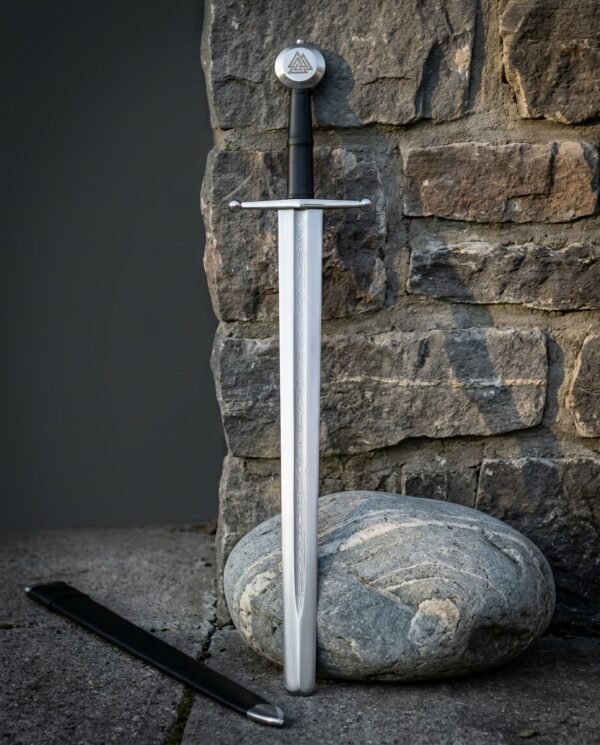
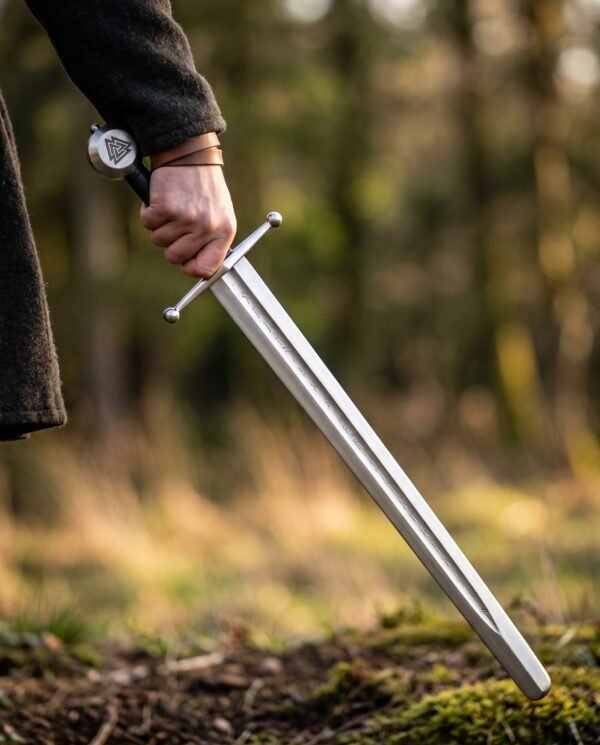
The Wolfmark is a short Viking sword built on the Ulfberht pattern, the best known blade type of the Norse world. It carries a broad fullered blade in layered Damascus steel, a short straight brass guard, and a flared brass cap pommel seated over a cord wrapped grip. Overall it runs 28 inches with a 21 inch blade, a shorter and quicker build than most of the originals recovered from Scandinavian graves and Northern European riverbeds. The historical Ulfberht swords are worth knowing about. Roughly 170 surviving blades carry the iron letters +VLFBERH+T inlaid into the fuller, made across a span of nearly three centuries from about 800 to 1100 AD, which makes that name one of the earliest maker marks in European metalwork and very close to the first branded product on the continent. The finest of them were forged from steel with a carbon content and a slag content that no ordinary Frankish bloomery of the period should have been able to reach, which is why a good number of metallurgists argue the raw stock travelled up the Volga trade route from crucible steel producers far to the east, paid for in furs, amber and silver. The Ulfberht name and the mystery around it are dealt with in the Ulfberht swords.
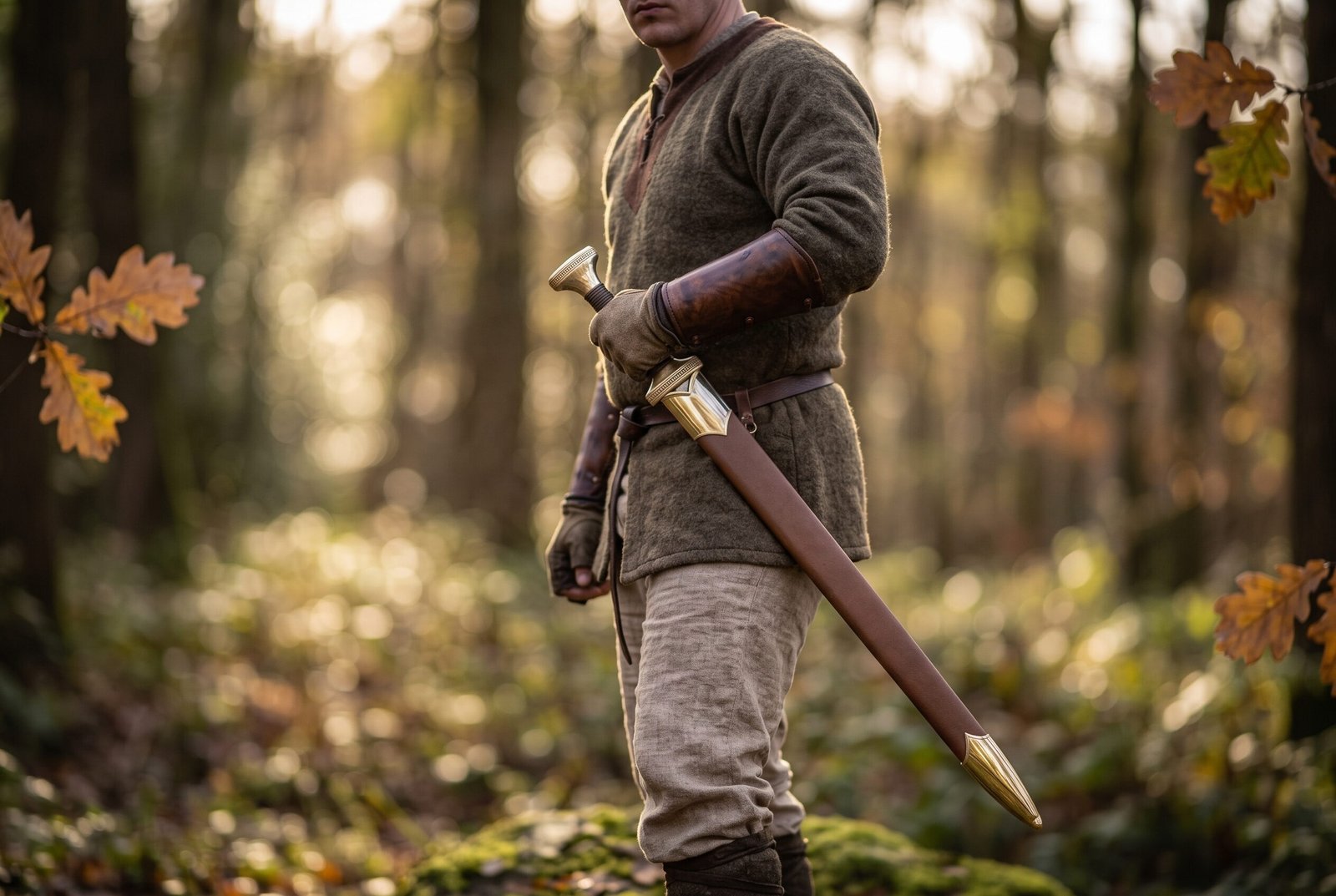
This one is forged and finished by hand in the Czech Republic. The blade is drawn out under the hammer, the fuller is ground in by hand along its full length, the sword is heat treated and tempered in house, and the furniture is fitted and peened rather than glued. It ships with a fitted tan leather scabbard over a wooden core, with a brass throat and chape that match the guard and pommel, and with a leather belt hanger. Shipping inside the United States is free, and the engraving option above the add to cart button is open on every piece we make.
Specifications
| Steel | 1095 and 15N20 forge welded Damascus, hand forged, etched and tempered |
|---|
| Hardness | 58 to 60 HRC |
|---|
| Overall length | 28 inches |
|---|
| Blade length | 21 inches |
|---|
| Blade width at guard | 2.1 inches, tapering through the length |
|---|
| Blade | Double edged Damascus blade with a visible layered pattern, tapering to a point |
|---|
| Fuller | Wide shallow central fuller, hand ground, running most of the blade |
|---|
| Handle | Hardwood core with a tight dark brown cord wrap |
|---|
| Guard | Short straight solid brass guard with a beaded border |
|---|
| Pommel | Flared solid brass cap pommel with a beaded border, peened tang |
|---|
| Scabbard | Tan leather over a wooden core with a brass throat and a pointed brass chape, leather belt hanger |
|---|
| Weight | Approximately 2 lb 12 oz |
|---|
| SKU | RK-1230 |
|---|
What actually makes a blade Ulfberht pattern
People often assume the Ulfberht is defined by the inscription alone. It is not. The whole geometry belongs to a family that arms scholars group under Petersen types X and later, and Oakeshott type X in the medieval numbering. The blade is broad at the guard, close to parallel for the first two thirds, and then draws in to a rounded spear point rather than a needle tip. A wide shallow fuller runs down the centre of both faces for most of the length. That fuller is the reason the sword feels the way it does. Removing steel from the neutral axis costs almost nothing in stiffness but takes real weight out of the forward half, so a 21 inch blade balances only a few inches ahead of the guard and can be recovered from a committed cut without a wrestle.
The guard is short and straight, and the pommel is a flared brass cap peened onto the tang. Those two pieces are not decoration. The pommel is a counterweight, and moving mass behind the hand is what lets a sword this broad move quickly. Norse swords were used with a round shield in the other hand, so the sword itself had to be a one handed instrument that answered instantly, cut through a mail sleeve or a padded coat, and stayed in the fight. The flared cap also gives the heel of the palm somewhere to sit at the end of a hard downward cut. We reproduce the geometry rather than the letters, because the historic inscription was a maker mark belonging to a Frankish workshop and copying it would be a claim we have no business making. If you want lettering, we will cut what you choose into the fuller ourselves.
Why Damascus and not stainless
This blade is Damascus, 1095 and 15N20 forge welded together and etched so the layers show. At 58 to 60 HRC it takes a hard edge and holds it, and the layered build keeps it tough enough to flex and return rather than snap. Stainless steel gets its rust resistance from a high chromium content, and in the sizes and section thicknesses a sword needs, that chromium encourages large carbides and brittleness through a long blade. Stainless swords over about 24 inches are display objects, and cheap ones can fail catastrophically. Damascus made from carbon steels will develop a patina and will spot if you leave it wet, which is the trade you make for a blade that behaves properly. Wipe it, oil it, and it will outlive you. There is a fuller comparison on our Damascus versus stainless page if you want the metallurgy set out side by side.
The grip, the guard and the pommel
The grip is a shaped hardwood core, waisted slightly so the hand indexes the edge without looking. Over that goes a tight wrap of dark brown cord, which gives your fingers a positive stop and stays put in a sweaty hand. The brass guard and pommel are filed and polished by hand and fitted tight to the tang, which is then peened over the pommel button so the assembly is mechanically locked rather than held by adhesive. Brass was a common choice on higher status Viking swords precisely because it polishes bright, resists corrosion better than iron, and reads as wealth at a distance.
There is wood under that cord, so treat it as wood. Do not soak it, do not leave it in a hot car, and give it an occasional wipe with a barely damp cloth followed by a dry one. Our notes on wooden handle care apply directly here, and the leather scabbard is happy with a light conditioner once or twice a year.
Engraving, runes and your own design
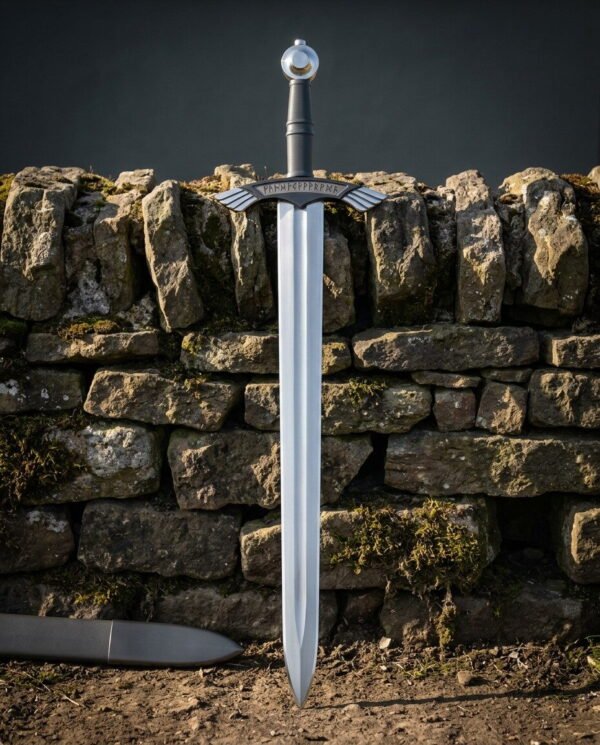
Use the rune converter on this page to turn a name, a date or a short phrase into Elder Futhark and we will cut it into the steel or the handle. If you would rather have a Viking pattern than a rune line, choose your own design in the engraving option above the add to cart button and tell us whether it goes on the blade or the handle. Where a piece already carries an engraved design, your chosen engraving replaces it rather than sitting alongside it. The wide fuller on this sword is the natural home for a rune line and is exactly where the original workshops put their own marks. If you are not sure how a phrase will transliterate or how long a line will fit, the engraving page shows worked examples and the character counts we can hold at this size.
Care and sharpening
Keep it dry and keep it oiled. A light mineral oil or a purpose made blade oil wiped on with a cloth after handling is enough, and it matters more than people expect because fingerprints are mildly acidic and will etch a polished blade within days in a humid room. Do not store the sword long term inside the leather scabbard, since leather holds moisture and the tanning salts will pit a blade over months. Hang it, or lay it on a rack, and keep the scabbard beside it. Our steel care guide covers storage, patina and how to deal with a spot of rust before it becomes a pit.
The edge comes sharp but not razor thin, because a sword edge is ground for durability rather than for shaving. When it dulls, a sword sharpens exactly like any other high carbon blade, just with more length to work through. Take it in sections along a coarse then a fine stone at a consistent angle, and finish with a strop. The method in our guide on sharpening with a whetstone transfers directly, and a long combination stone or a guided rod system both work well on a blade this size.
Made in the Czech Republic
The work behind this piece happens in a Czech Republic workshop that has kept to the old methods. Steel is forged and heat treated by hand, the grind is taken down by eye rather than by machine, and the handle, fittings and sheath are cut and finished one at a time. Because of that, every piece carries small marks of the hand that made it.
Ransack Viking is a United States company. We import direct, check each piece when it reaches us, and ship from our Chicago, Illinois warehouse. Engraving is added here in the United States after arrival, so the piece you receive is finished to your order.
A note on handmade variation
This sword is hand forged. It is not machine made and it is not bulk produced, so what arrives will not be a pixel for pixel copy of the photograph on this page. The tone of the grip cord, the exact tone of the tan scabbard hide, the way the polish catches light along the fuller, the depth of the file work on the brass and the precise line of the point are all worked by hand from natural materials, and every one of them varies a little from piece to piece. The things that do not vary are the ones that matter for fit and function: the steel, the heat treatment, the stated dimensions, the construction and the finish quality are the same every time. The character is what changes, and that is the point of buying something a person actually made.
Frequently asked questions
Is this sword sharp when it arrives?
Yes. It arrives with a working edge, cut and honed by hand, ground for durability rather than for shaving. If you want it blunted for stage work, reenactment or a household with curious children, say so in the order notes and we will finish it with a rounded display edge at no extra cost.
Can I actually cut with it, or is it a display piece?
It is a functional sword. The blade is forge welded 1095 and 15N20 Damascus, tempered to 58 to 60 HRC, with a full tang peened over the pommel, so it will handle target cutting on water bottles, tatami mats and green pool noodles. It is not a sparring sword. Do not use it against another blade, against steel, or against bone and hardwood, and do not throw it.
Can I have Norse runes engraved on it?
Yes. Use the rune converter on this page to turn a name, a date or a phrase into Elder Futhark, and choose the engraving option above the add to cart button to tell us whether the line goes into the fuller or onto the handle furniture. Blade engraving on the fuller is the historically correct placement on this pattern.
Will mine look exactly like the photograph?
Close, but not identical. The dimensions, steel and construction are fixed, while leather tone, wood grain, polish and hand file work vary between pieces because each one is made individually. Expect the same sword with its own character rather than a duplicate.
What is the difference between this and a Carolingian sword?
They overlap heavily. Carolingian usually describes the Frankish swords of the 8th and 9th centuries with a long straight lower guard and a tea cosy or brazil nut pommel, while the Ulfberht pattern is the Norse and Frankish blade family that grew out of them, with a broader fuller and a range of pommel shapes. Both were carried by Vikings, because a great many Viking swords were Frankish exports.
How long does shipping take?
Shipping inside the United States is free. If the piece is on the rack it goes out within two business days. If it is being forged to order, allow two to three weeks of bench time first, plus a few days more for custom engraving. You will get a tracking number the day it leaves the shop.
What is in the box
- One Wolfmark Ulfberht style Viking sword, 28 inches overall with a 21 inch Damascus steel blade
- Fitted tan leather scabbard over a wooden core with brass throat and chape
- Leather belt hanger with buckle
- Cloth and a small bottle of blade oil for first storage
- Care and sharpening card
- Forged and finished in the Czech Republic
Explore the range
See the rest of the Viking swords, the wider swords collection, the Norse arms range and the scabbards and sheaths we make to fit them. Background reading on steel, patina and edge geometry sits in the guides.
Compare it with these
For a straight comparison, see the Emberhilt Viking sword, forged from 1095. Worth putting side by side with this is the Stavesong Viking sword, 35 inches overall. In the same category sits the Bonecrest Viking sword, 36 inches overall.
From the same corner of the shop, there is the Runecrest sabre. Pick the steel, the length and the fittings yourself on the custom Viking sword page.


Bought this on a whim and it turned out to be one of my favorite purchases this year. Even the small engravings are crisp and clean. Already telling my friends to check this out.
This sword fell a little short for me. Handle had some rough edges that needed sanding down myself. Just an average purchase. Wouldn’t rush to buy again.
Solid sword. Glad I ordered it. Glad I made this purchase.