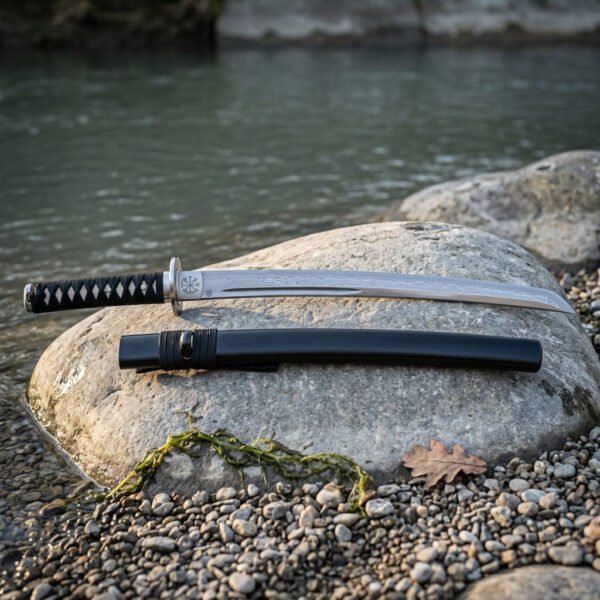
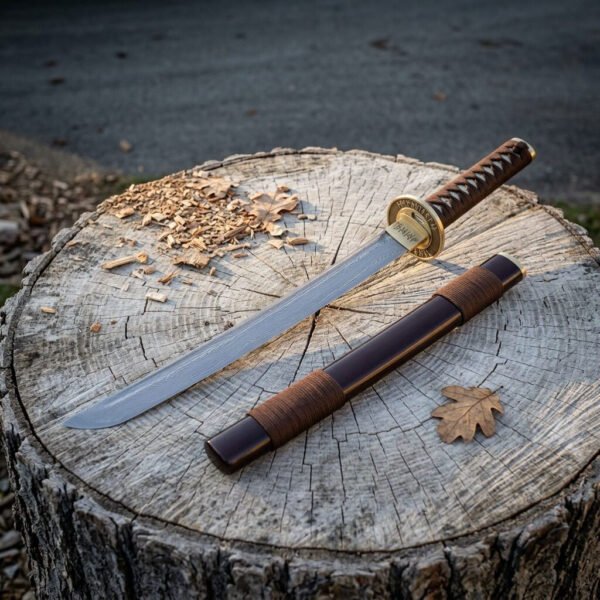
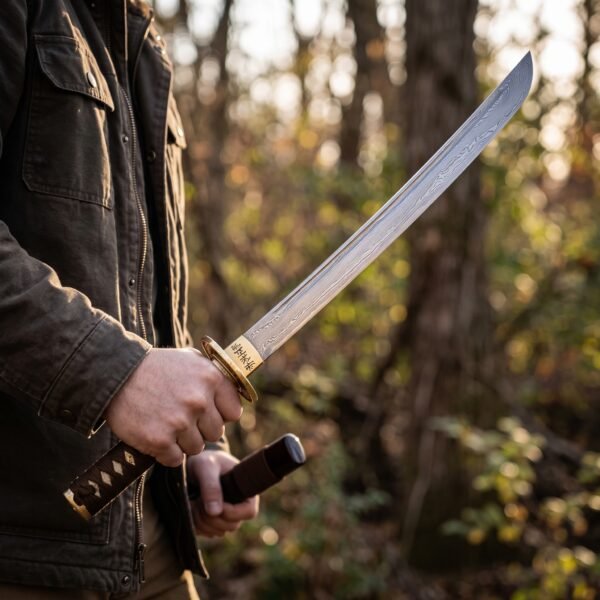
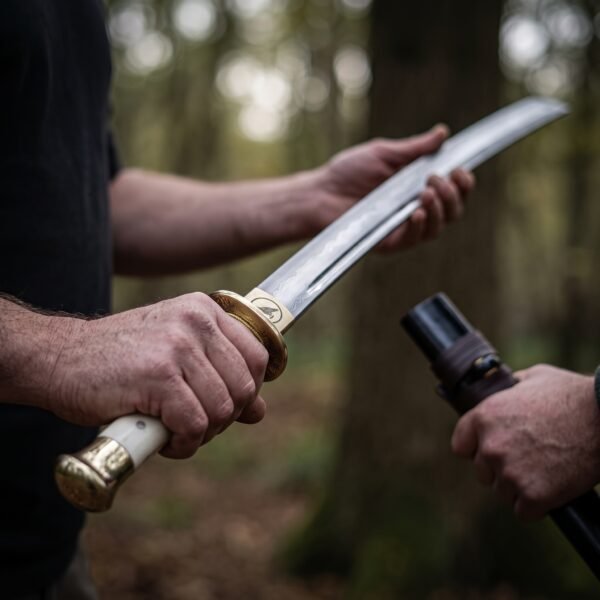
The wakizashi was the sword people actually lived with. A katana was left at the door when a samurai entered a house, hung on a rack in the entrance hall, and the shorter blade stayed on the belt. It went indoors, it went to bed near the pillow, and in a corridor or a room where a long sword could not be drawn without hitting a wall it was the only one of the pair that could be used at all. It was also, under the sword laws of the Edo period, the longest blade a merchant or a farmer was permitted to carry, so a great deal of the surviving craftsmanship in Japanese swordsmithing went into wakizashi rather than katana. Riverstone follows that pattern in 1095 high carbon steel hardened to 54 to 58 HRC, with a 19.5 inch blade. The short sword that sat beside the katana has its own logic, explained in what a wakizashi is.
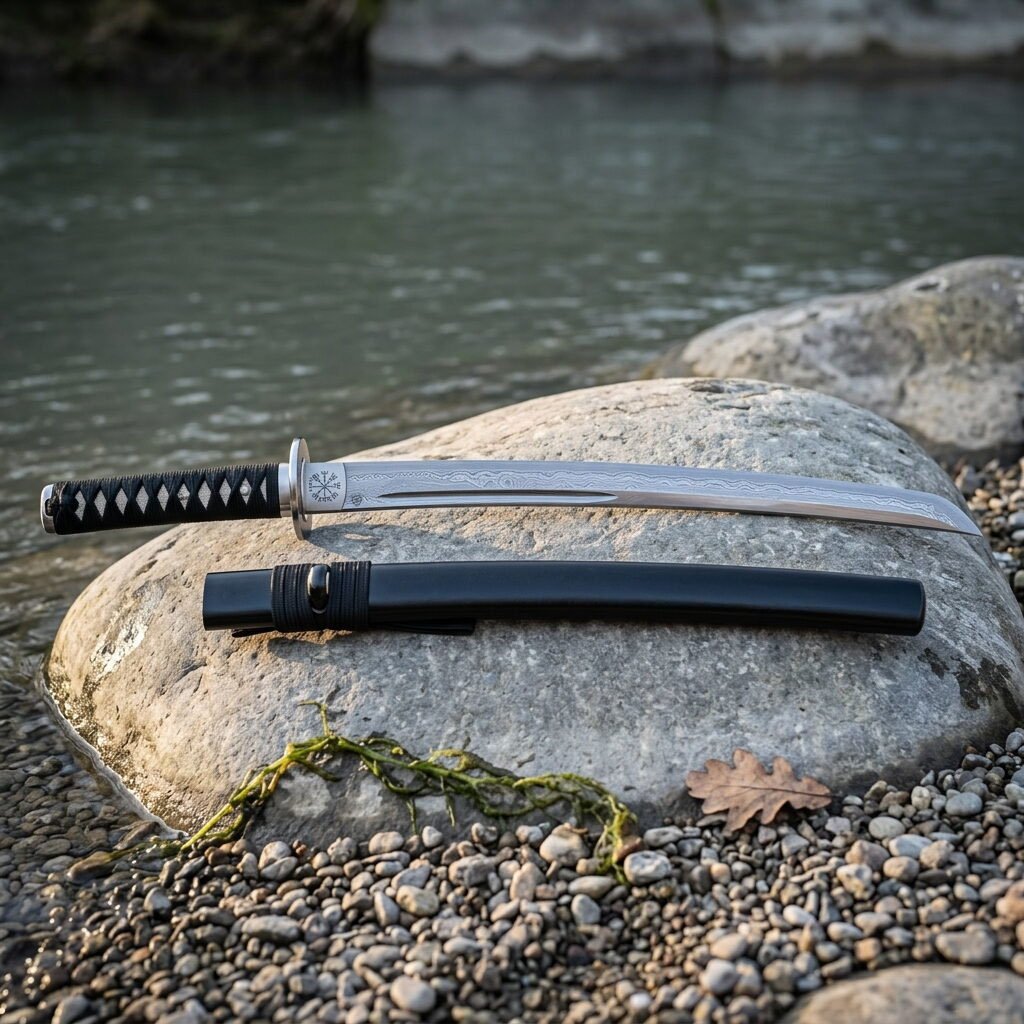
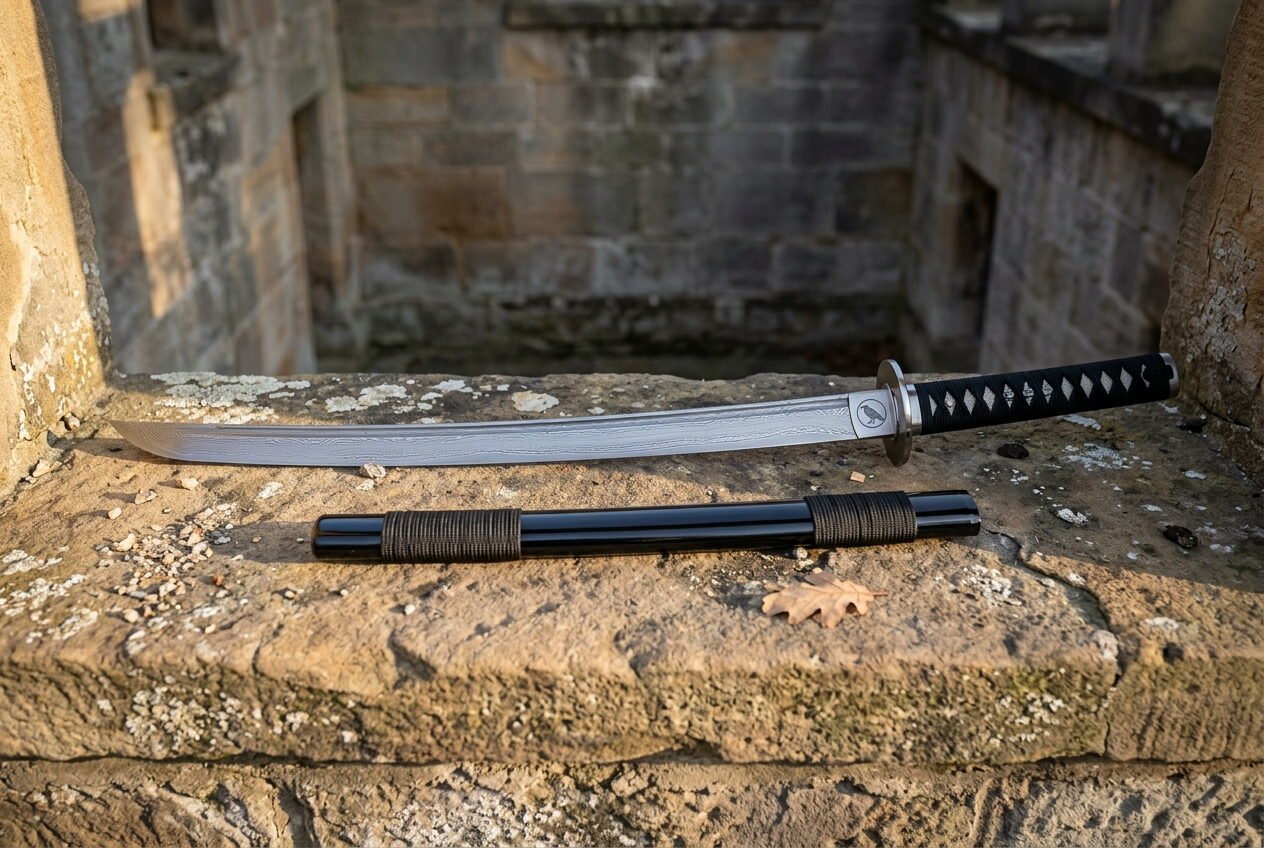
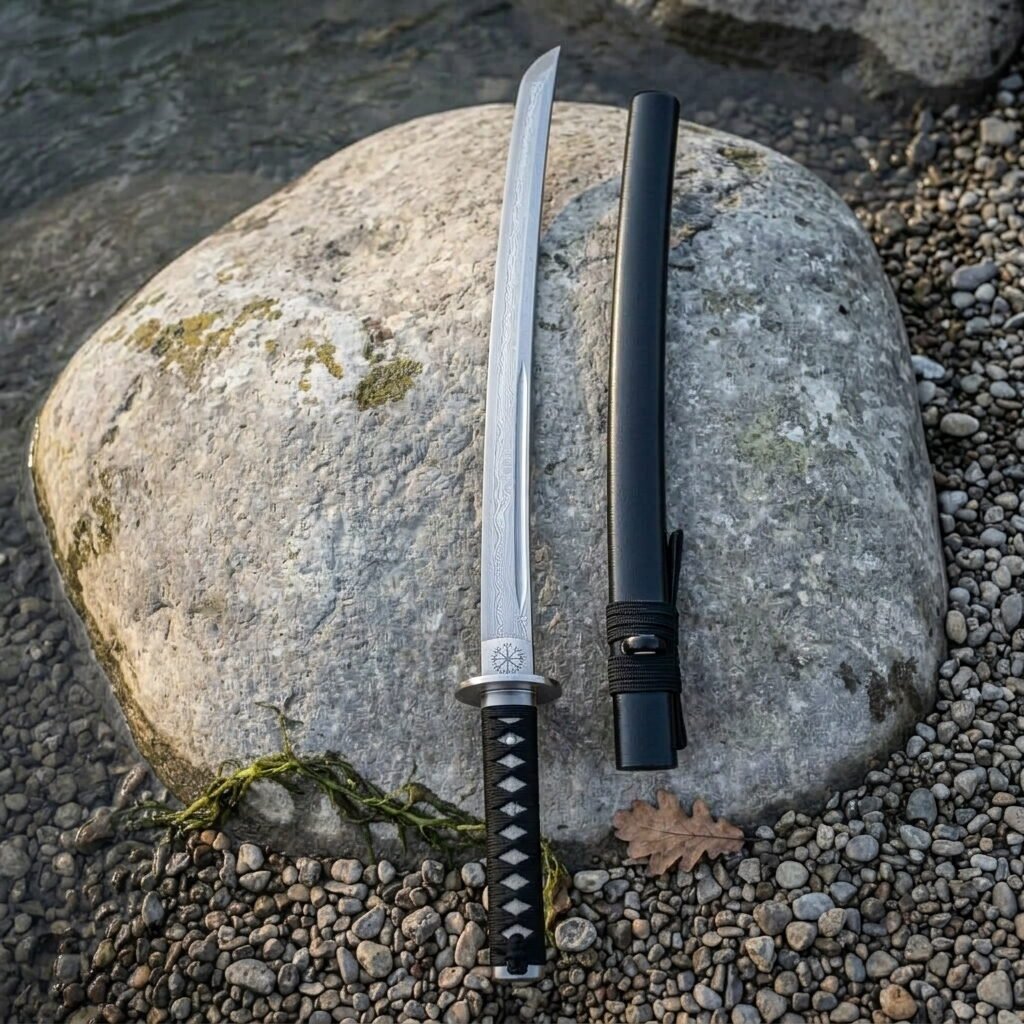
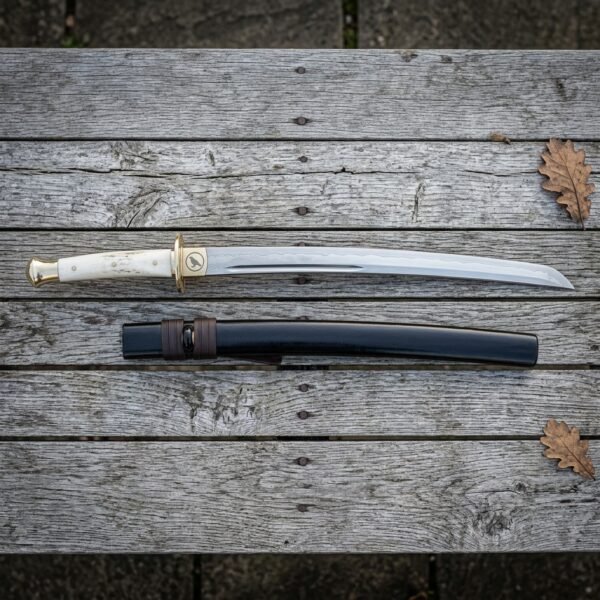
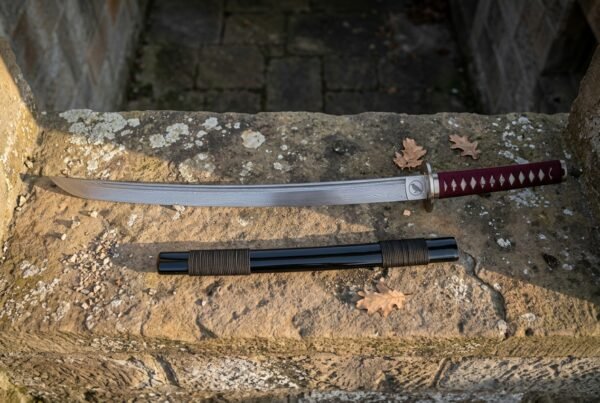
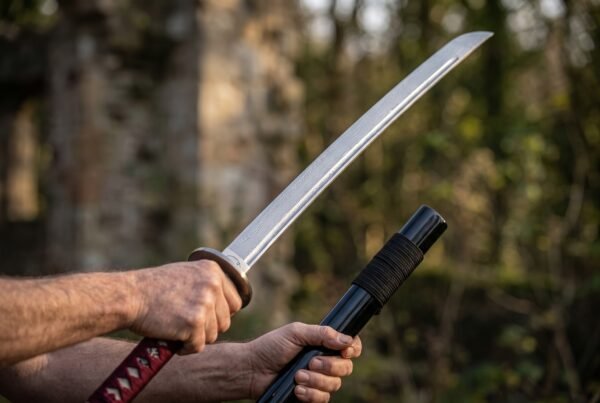
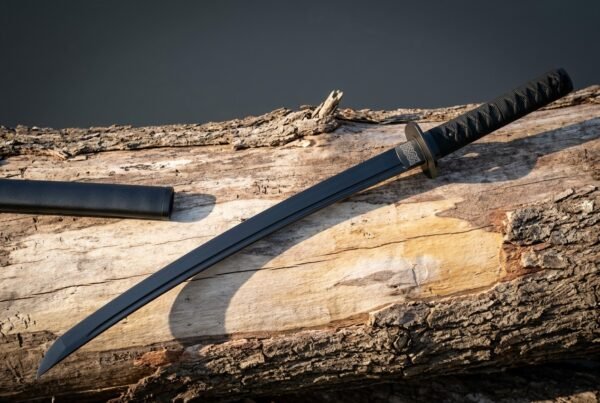
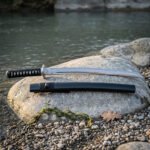
Forged, ground, heat treated and mounted by hand by hand in the Czech Republic. It ships with the black lacquered wooden saya shown, a cord sageo and a light protective coat of oil. Shipping inside the United States is free.
Specifications
| Steel | 1095 high carbon steel |
|---|
| Hardness | 54 to 58 HRC |
|---|
| Overall length | 28 inches |
|---|
| Blade length | 19.5 inches |
|---|
| Blade profile | Shinogi zukuri with shallow sori and a broad kissaki, satin hand polish |
|---|
| Handle | 7.5 inch hardwood tsuka wrapped in black cord over black same |
|---|
| Guard | Dark iron tsuba with brass seppa and habaki |
|---|
| Scabbard | Black lacquered wooden saya with cord sageo |
|---|
| Weight | Approximately 1.6 pounds bare, 2.2 pounds in the saya |
|---|
| SKU | RK-1274 |
|---|
Why a short blade is not just a small katana
Shortening a sword changes more than its reach. Cut a katana blade down by nine inches and you move the balance point back towards the hand, drop the moment of inertia sharply, and end up with a blade that starts and stops far faster than it cuts deep. The wakizashi is built to take advantage of that rather than to apologise for it. The sori is deliberately shallower than on a long sword, because a pronounced curve is what turns a long slow arc into a draw cut and a short blade is not making long slow arcs. It is making tight, close, fast movements in a confined space, and a straighter edge points more accurately for a thrust.
The kissaki is broad for the same reason. On a short blade the last three inches do a disproportionate share of the work, so the cutting edge is carried well up towards the point and the point itself is left with enough steel behind it to be thrust with confidence. The result handles like a very large knife rather than a small sword, which is exactly what it was for. In a room, at arm reach, against someone who has not been able to draw a long sword at all, that is the whole argument.
Why 1095 high carbon steel and not stainless
1095 is plain iron carrying just under one percent carbon and almost nothing else. There is no chromium in it competing for that carbon, so it is all available to form the fine hard structures that let the edge be taken genuinely keen, and it comes back keen on an ordinary whetstone without diamond plates or special compounds.
Stainless steel resists rust because chromium forms a protective oxide skin on the surface, but the same chromium ties carbon up in coarse carbides. That limits how fine an edge the steel can hold, and in a longer section it makes the blade prone to breaking rather than bending. The cost of 1095 is that it will rust if you leave it wet or covered in fingerprints, which is what oil and a cloth solve. The full comparison is in our steel and hardness notes.
The tsuka and the saya
A hardwood core is fitted in two halves around the full length tang, covered in black same for texture, and wrapped in black cord in alternating diamonds so each turn locks the last. A bamboo mekugi pins the handle to the tang and can be replaced with a scrap of dowel and a knife. The saya is hollowed from wood and lacquered black, cut so that the brass habaki carries the fit rather than the polished blade, which is why it holds with a click and releases with a thumb push.
Both the handle core and the scabbard are wood. Keep them out of long damp and out of direct sun, wipe rather than soak, and let a wet saya dry slowly rather than near a radiator. Everything in handle and sheath care applies here.
Engraving, runes and your own design
Use the rune converter on this page to turn a name, a date or a short phrase into Elder Futhark and we will cut it into the steel or the handle. If you would rather have a Viking pattern than a rune line, choose your own design in the engraving option above the add to cart button and tell us whether it goes on the blade or the handle. Where a piece already carries an engraved design, your chosen engraving replaces it rather than sitting alongside it. Depth, placement and how a longer line is laid out are covered on the engraving page.
Care and sharpening
Wipe the blade after handling and before it goes back in the saya. Skin leaves salt behind and 1095 will take a fingerprint into the polish inside a day in humid air. Light mineral oil on a cloth prevents it. In a damp room store the blade out of the scabbard, because wood holds moisture against steel.
The edge takes a normal whetstone at the angle it was ground. Work along the curve rather than across it, finish on a fine stone and strop it, and leave the coarse stone for genuine damage. Both jobs are described in steel care and sharpening with a whetstone.
Made in the Czech Republic
The work behind this piece happens in a Czech Republic workshop that has kept to the old methods. Steel is forged and heat treated by hand, the grind is taken down by eye rather than by machine, and the handle, fittings and sheath are cut and finished one at a time. Because of that, every piece carries small marks of the hand that made it.
Ransack Viking is a United States company. We import direct, check each piece when it reaches us, and ship from our Chicago, Illinois warehouse. Engraving is added here in the United States after arrival, so the piece you receive is finished to your order.
A note on handmade variation
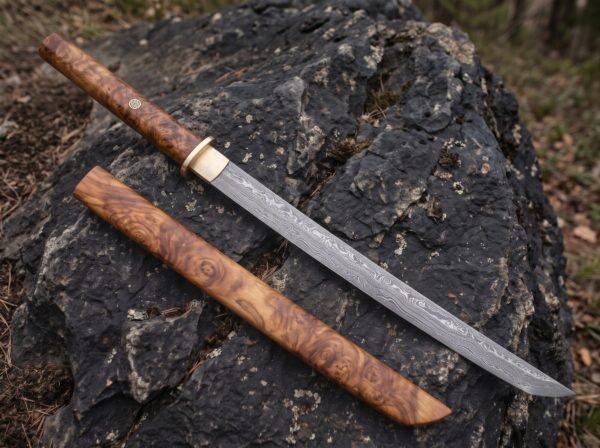
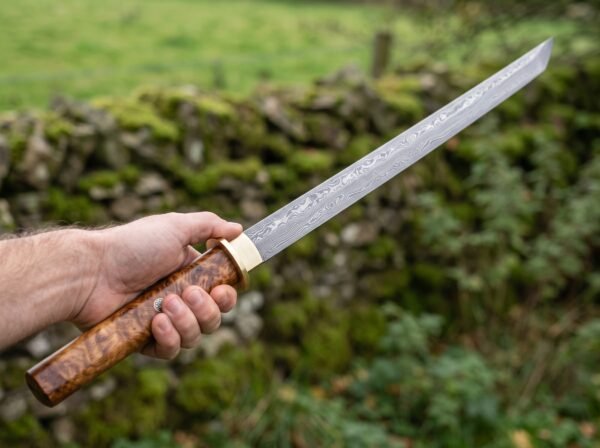
Riverstone is hand forged. It is not machine made and it is not bulk produced, so what arrives will not be a pixel for pixel copy of the photograph. The polish carries light in its own way, the temper line follows where the clay took it, the grain and tone of the wood in the handle core and the saya belong to that piece of timber, and the exact profile of the curve varies a little because it is set in the quench rather than pressed. The dimensions, the steel and the build are the same every time. The character is not.
Frequently asked questions
Is it sharp when it arrives?
Yes, sharpened and ready to use. If you want it blunt for display, or for a household or venue where a sharp edge is a problem, ask in the order notes and we will send it unsharpened at no extra cost.
What is the difference between a wakizashi and a katana?
Length and role. A katana runs around 40 inches overall and is used with two hands in open space. A wakizashi at 28 inches is a one handed companion blade that works indoors and at close range. Worn together they form the daisho pair, and many people buy them as a set over two orders.
Can I cut with it?
On soft targets, yes. Water bottles, rolled mats and light bamboo suit it well, and the short blade makes it easier to control than a full length sword. Keep it off hard targets, metal, wood and sand cores, and never use it against another blade.
Can I have runes engraved on it?
Yes. Use the rune converter on this page for Elder Futhark, or pick your own Viking pattern in the engraving option above the add to cart button. Tell us whether it goes on the blade or the tsuka.
Will mine look like the photographs?
Same steel, same dimensions, same black wrap and dark iron tsuba. The polish, the temper line and the figure of the wood are individual to each blade.
How long does shipping take?
Free within the United States. One to two weeks in the shop, longer if you have added engraving, then two to five days in transit.
What is in the box
- Riverstone hand forged 1095 high carbon steel wakizashi
- Black lacquered wooden saya with cord sageo
- Spare bamboo mekugi peg
- Protective oil coat on the blade
- Care and sharpening card
- Elder Futhark rune engraving where selected
- Forged and finished in the Czech Republic
Explore the range
See the rest of the wakizashi, pair it with a katana, look at the straight bladed short swords, or read the guides.
Compare it with these
Another in the same line is the Twinsaya wakizashi, forged from 1095. Next along the rack is the Moonwake wakizashi, 26 inches overall. For a straight comparison, see the Trinehilt wakizashi, pattern welded Damascus.
The Rhinewarden Viking sword covers the other half of the same kit. Pick the steel, the length and the fittings yourself on the design your own page.

My husband was speechless when he opened this. Feels way more premium in person than the listing photos. The craftsmanship really shows in the small details. Packaging was excellent and it arrived in perfect condition. 10/10 would buy again.
Knew this piece was special the second I opened the box. Feels way more premium in person than the listing photos. Love it.
Bought this on a whim and it turned out to be one of my favorite purchases this year. The craftsmanship really shows in the small details. Feels way more premium in person than the listing photos. Beyond happy with how this turned out.
Been eyeing this piece for months and it did not disappoint. Ransack Viking’s attention to detail is honestly unmatched. Nice touch that it ships from within the US even though it’s crafted in the Czech Republic.
This is exactly what I wanted and then some. Feels way more premium in person than the listing photos. The craftsmanship really shows in the small details. Packaging was excellent and it arrived in perfect condition. This is going straight into my display case.
This piece is fine. Just didn’t wow me.
Average quality for the price honestly. It’s fine for the price. Nothing that stood out. Not bad, not amazing either. It’s Czech made and US shipped. Packaging was just okay though.
Best piece I’ve ever owned. Great buy overall.
This piece is a genuine work of art. The craftsmanship really shows in the small details. Shipping was fast and everything arrived well packaged.
Can’t stop showing this off to everyone who comes over. Love that this is Czech craftsmanship and shipping from the US meant it showed up in just a few days. Packaging was excellent and it arrived in perfect condition. Feels way more premium in person than the listing photos. Great buy overall.