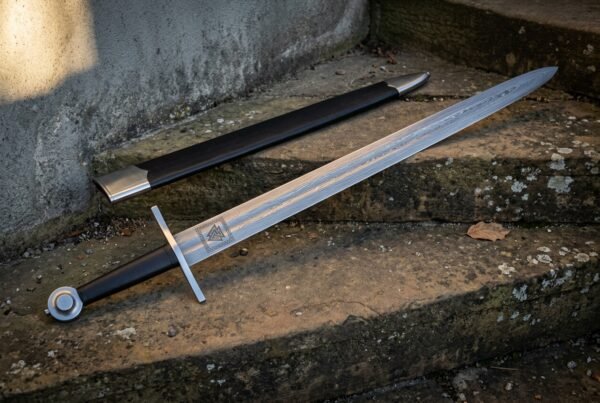
The Damascus arming sword sits at the centre of the whole European sword tradition. Take a straight double edged blade about thirty inches long, put a simple cross guard at one end and a heavy round pommel at the other, and you have the sword that carried on almost unchanged from the ninth century Viking sword through the knightly single hander of the high middle ages. Ewart Oakeshott built his entire typology around blades of this family, and the reason it lasted so long is that there is very little left to improve. It cuts, it thrusts, it parries, and it does all three without asking you to choose in advance. Whether layered steel is worth the difference over plain carbon is answered in Damascus against plain high carbon.
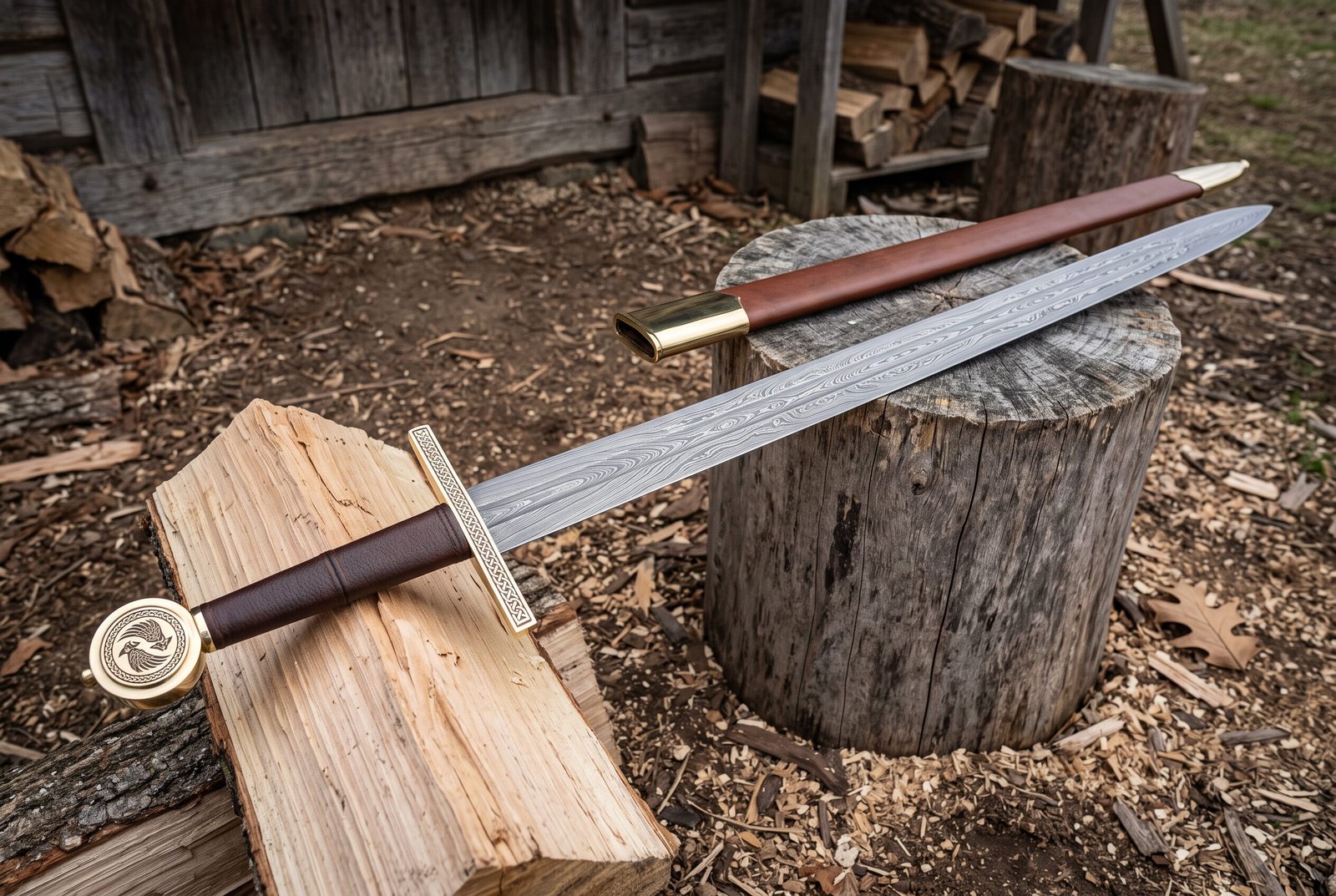
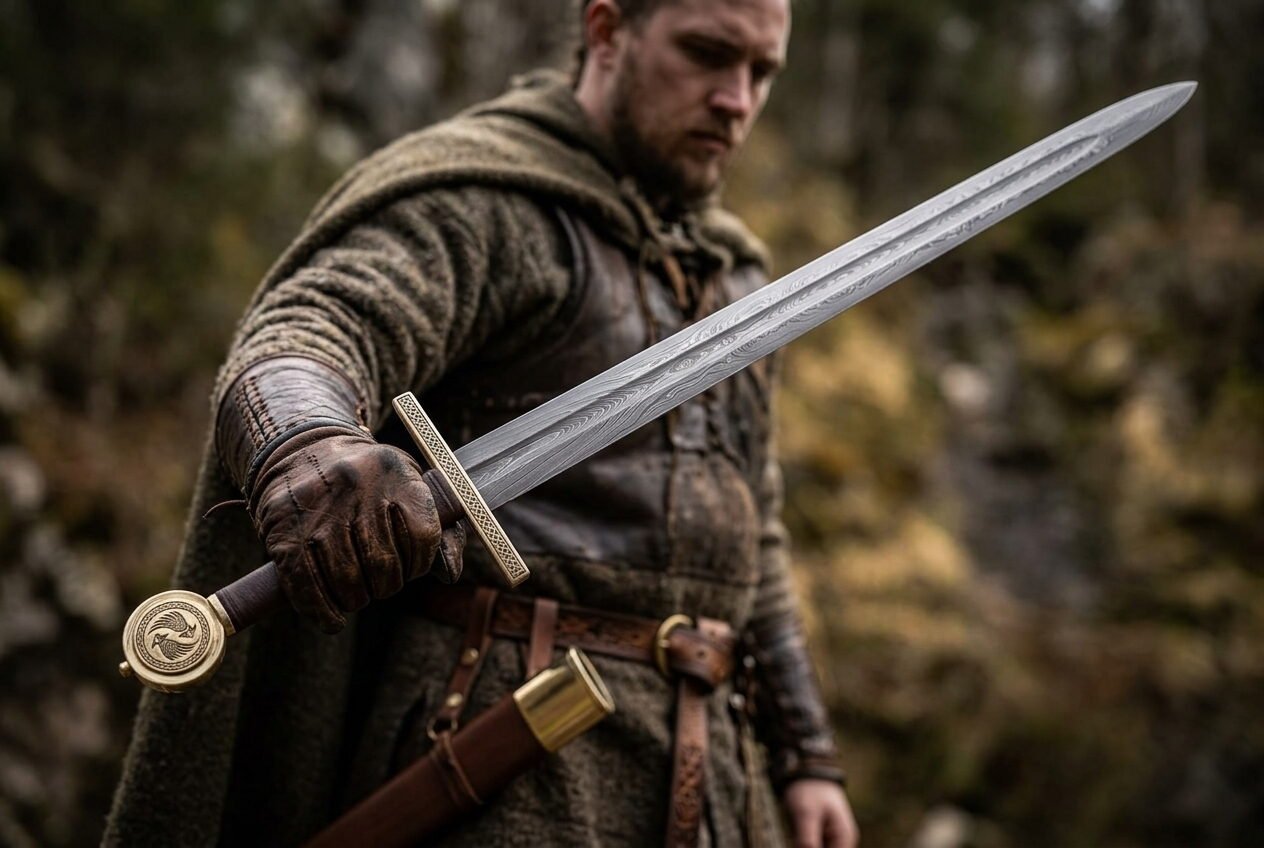
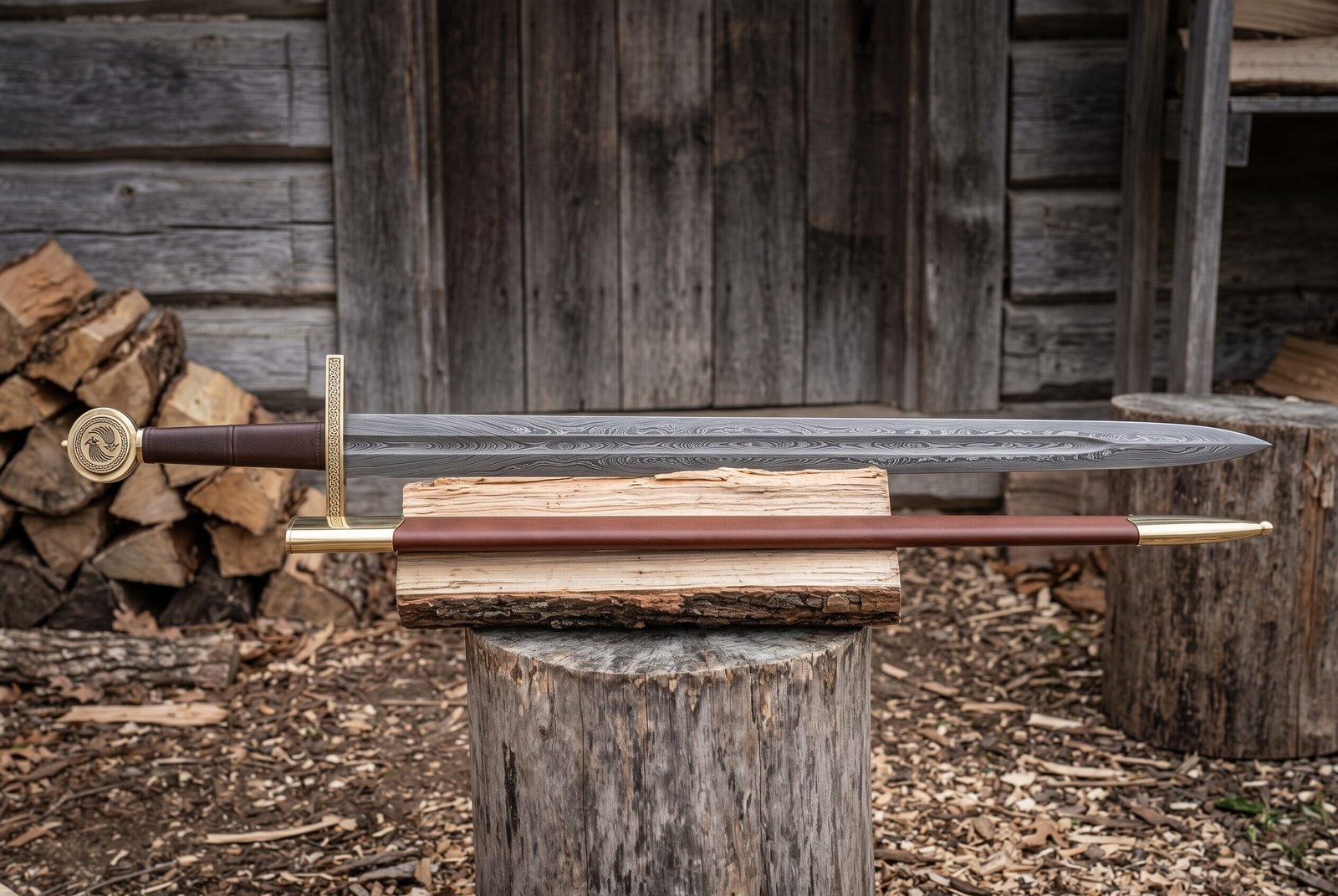
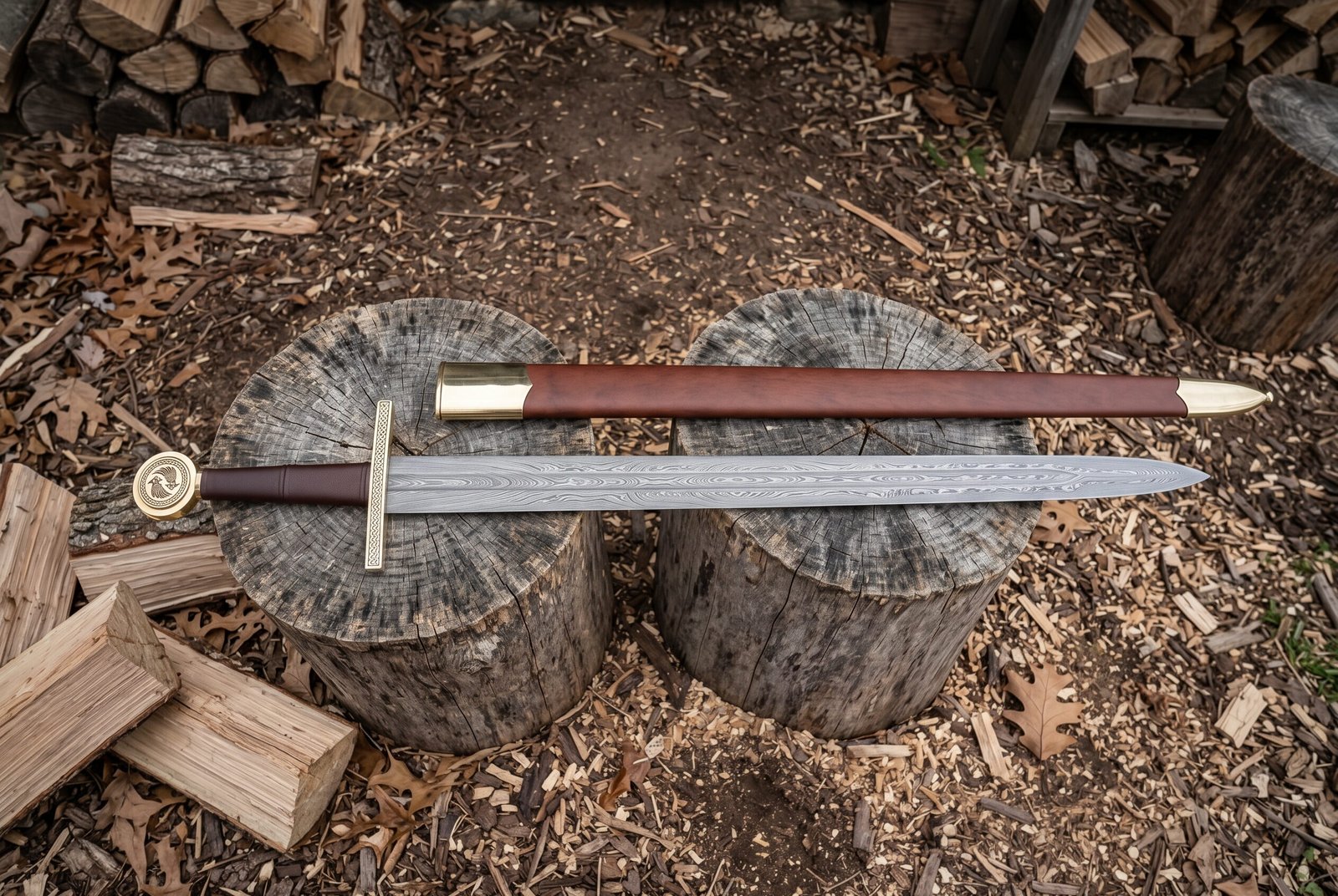
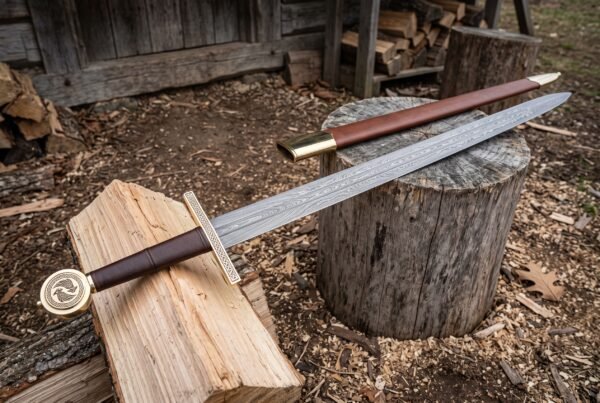
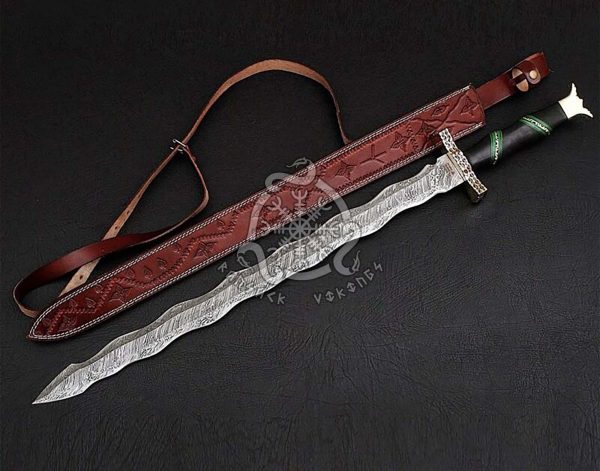
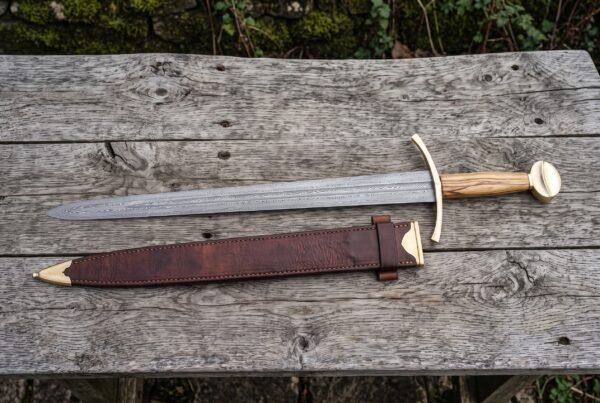
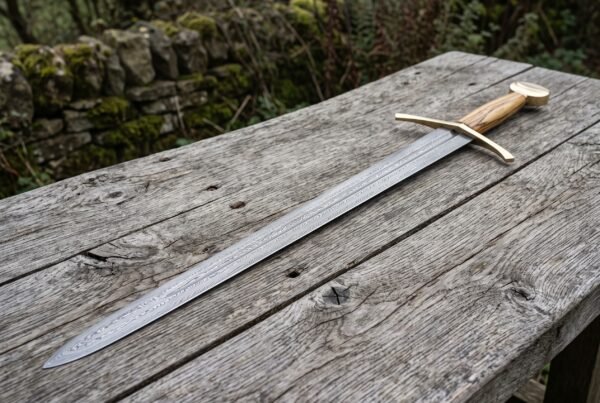
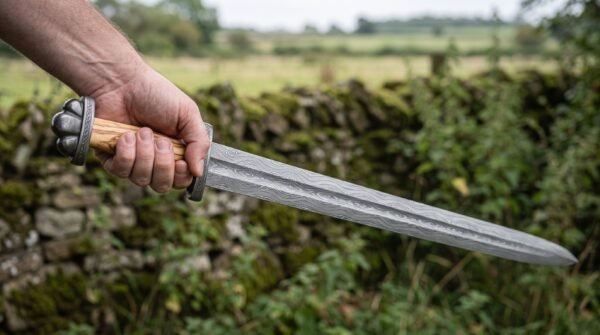
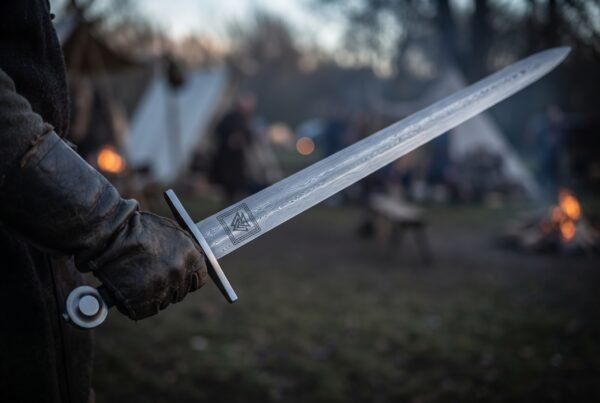
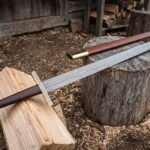
This one is built from forge welded Damascus. The billet is 1095 and 15N20 welded in alternating layers, drawn out and folded, then forged into a blade with a broad central fuller and hardened to 58 to 60 HRC. The pattern runs the full thickness of the steel. Everything is made by hand in the Czech Republic. The hilt is a straight brass cross engraved with knotwork, a dark brown leather wrapped grip and a large brass disc pommel engraved with two ravens. It ships in a leather scabbard, and shipping inside the United States is free.
Specifications
| Steel | 1095 and 15N20 forge welded Damascus |
|---|
| Hardness | 58 to 60 HRC |
|---|
| Overall length | 37 inches |
|---|
| Blade length | 30 inches |
|---|
| Blade width | 2 inches at the guard |
|---|
| Blade detail | Double edged with a central fuller and an etched layered pattern |
|---|
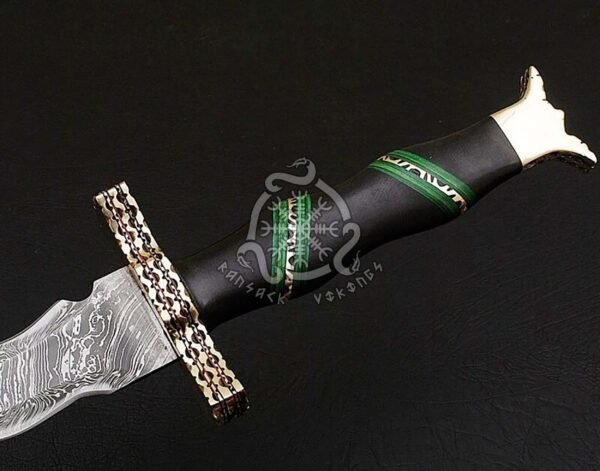
| Guard | Straight brass cross engraved with a knotwork band |
|---|
| Grip | Dark brown leather wrap with a raised centre band, 7 inch hilt |
|---|
| Pommel | Large brass disc engraved with two ravens inside a knotwork ring |
|---|
| Scabbard | Brown leather with a brass throat and chape |
|---|
| Weight | Approximately 2 pounds 14 ounces |
|---|
| SKU | RK-1301 |
|---|
What the fuller does, and what it does not
The groove running down the centre of this blade is a fuller. It is not a blood groove, and it has nothing to do with suction, breaking a vacuum or any of the other stories that circulate. It is a stiffening rib in reverse, and the principle is exactly the same as the one behind an I beam.
When a blade bends, the steel at the surfaces does almost all the work in tension and compression, while the steel in the middle of the section contributes very little. Hollowing out that middle takes away weight without taking away much strength. A fullered blade of the same width and length as a flat one is significantly lighter and only slightly less stiff, which means it accelerates faster and recovers quicker. On a pattern welded blade the fuller does something else as well. Grinding into the layers exposes them at a shallow angle, so the pattern gathers into swirls and eyes along the groove where the flats show straighter banding. What you are seeing is the internal geometry of the billet made visible.
Why Damascus and not stainless
Two steels are used in this workshop. Plain blades are 1095 high carbon steel at 54 to 58 HRC. Damascus blades like this one are 1095 and 15N20 forge welded and taken to 58 to 60 HRC. There is nothing else.
The pairing works because the two steels weld cleanly to one another and behave differently in acid. 1095 darkens in the etch and 15N20, with roughly two percent nickel, stays bright, so the layers separate visually. The nickel also toughens the billet, which is what allows the extra couple of points of hardness over a plain blade without making the sword fragile. Stainless steel cannot be used. Its chromium content prevents a sound forge weld, it will not etch into contrast, and in a thirty inch blade the chromium carbides are a real fracture risk. The price of choosing carbon steel is that it will rust if it is neglected. See Damascus versus stainless.
The leather grip and disc pommel
The grip is wrapped in dark brown leather with a raised band at the middle, and it sits on the tang between the brass cross and a large brass disc pommel. The disc is deliberately heavy. On a thirty inch blade the pommel is what pulls the balance point back toward the hand, and without enough mass there the sword would feel nose heavy and slow. With it, the point comes back on line almost by itself.
Keep the leather out of direct sun and away from dry heat, and give it a little leather balm once or twice a year so it does not dry out and crack. Our wooden handle care guide has the routine.
Engraving, runes and your own design
Use the rune converter on this page to turn a name, a date or a short phrase into Elder Futhark and we will cut it into the steel or the handle. If you would rather have a Viking pattern than a rune line, choose your own design in the engraving option above the add to cart button and tell us whether it goes on the blade or the handle. Where a piece already carries an engraved design, your chosen engraving replaces it rather than sitting alongside it. On a fullered Damascus blade the usual place for a rune line is the flat beside the fuller, where the cut reads bright against the etched pattern. See the engraving page.
Care and sharpening
Etched Damascus wants a light film of oil at all times, because the acid that reveals the pattern also opens the surface slightly. Wipe the blade after handling and pay attention to the fuller, where oil and dust collect. Never use abrasive polish, wire wool or a rust eraser on the flats, as that will lift the etch and flatten the pattern permanently. Our steel care page explains how to deal with spots safely.
Sharpening does not touch the pattern on the flats. Work in sections along each edge on a medium stone, keeping the existing bevel and counting passes so both sides stay symmetrical, then refine on a fine stone and remove the burr. Go carefully at the point where the edges converge. See sharpening with a whetstone.
Made in the Czech Republic
The work behind this piece happens in a Czech Republic workshop that has kept to the old methods. Steel is forged and heat treated by hand, the grind is taken down by eye rather than by machine, and the handle, fittings and sheath are cut and finished one at a time. Because of that, every piece carries small marks of the hand that made it.
Ransack Viking is a United States company. We import direct, check each piece when it reaches us, and ship from our Chicago, Illinois warehouse. Engraving is added here in the United States after arrival, so the piece you receive is finished to your order.
A note on handmade variation
This sword is hand forged. It is not machine made and it is not bulk produced, so what arrives will not be a pixel for pixel copy of the photograph. The Damascus figure is unique to each billet, so the swirls along your fuller and the banding on your flats belong to your sword alone. Leather tone, the cut of the brass engraving and the exact profile of the point vary too, because every part is worked by hand from natural materials. Dimensions, steel, layer count and hardness stay the same. The character does not.
Frequently asked questions
Is the Damascus genuine forge welded steel?
Yes. The blade is made from a billet of 1095 and 15N20 welded, drawn and folded, so the pattern goes through the full thickness. Grinding into it would show more of the same structure.
Is it sharp and can it cut?
It arrives sharp on both edges and it is a working sword, full tang and peened at the pommel. Tatami, bottles and light green wood are all within its range. It is not built for steel to steel sparring.
Is the groove a blood groove?
No. It is a fuller, and its job is to remove weight from the middle of the section where the steel does least work, in the same way an I beam is hollow in the web. It makes the sword lighter and faster.
Can I have runes cut into the blade?
Yes. Use the rune converter above for Elder Futhark or choose your own Viking pattern in the engraving option, and tell us whether you want it on the blade or the grip.
Will my pattern match the photograph?
It will be the same style and contrast, but the exact figure is unique to each billet. Layer count, dimensions and hardness are consistent every time.
How long does delivery take?
Shipping is free within the United States and stock pieces arrive five to seven business days after dispatch. A fullered Damascus sword takes four to five weeks in the shop before it ships.
What is in the box
- One hand forged 1095 and 15N20 Damascus arming sword, 37 inches overall
- One leather scabbard
- Care card written specifically for etched Damascus
- Your Elder Futhark rune line or chosen pattern, if engraving was ordered
- Forged and finished in the Czech Republic
Explore the range
See the rest of the Damascus swords, the bastard swords, the messers and the full sword range, or read the guides.
If this one is not it
Another in the same line is the Nightflame flamberge sword, pattern welded Damascus. Next along the rack is the Bronzetide gladius, 27 inches overall. For a straight comparison, see the Brambleguard Damascus sword, 40 inches overall.
The Sunwake Viking sword covers the other half of the same kit. Pick the steel, the length and the fittings yourself on the custom Viking sword page.
For partner drills and sparring we carry the Norvakt rondel dagger trainer, and our intro to HEMA is a good place to start.


Did not expect this level of quality for the price. Weight and balance make it feel like a real functional piece not some cheap replica. 10/10 would buy again.