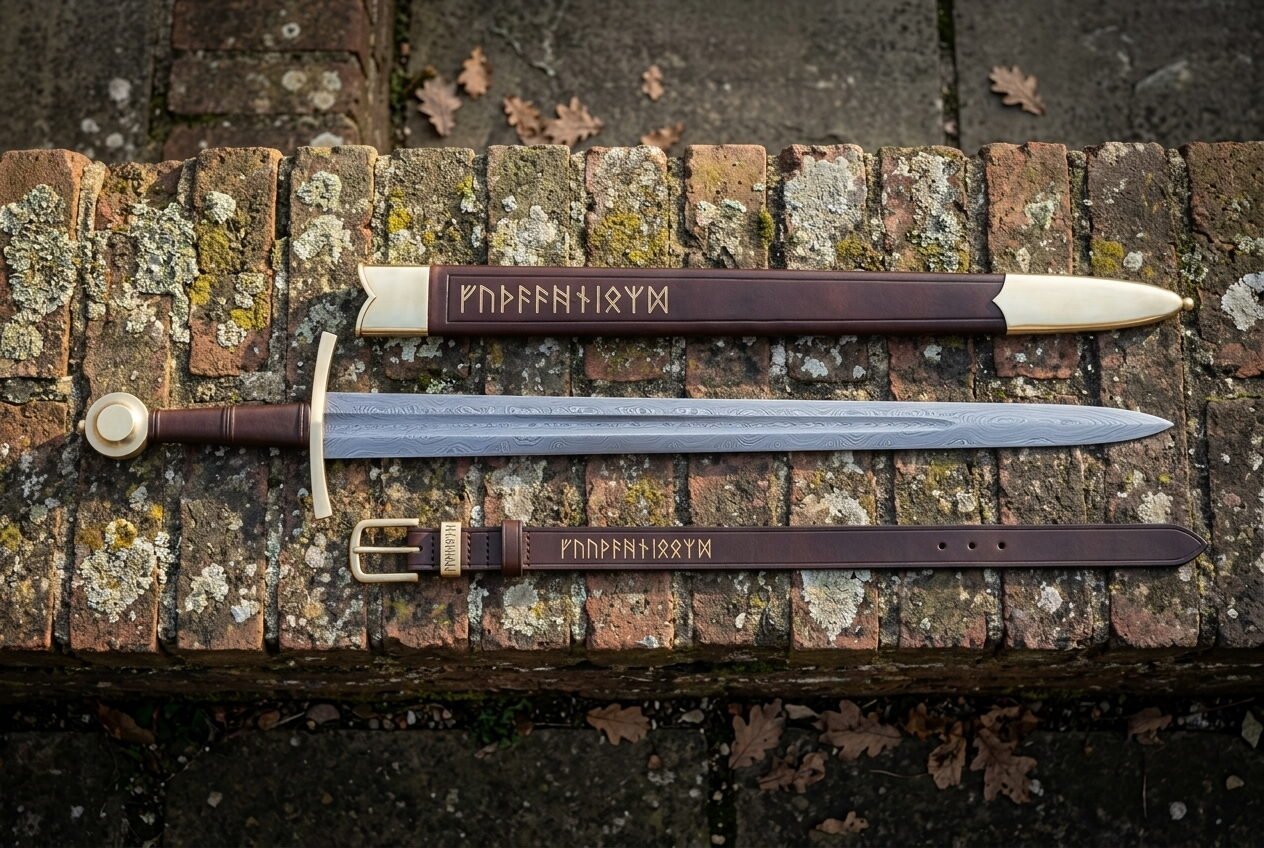
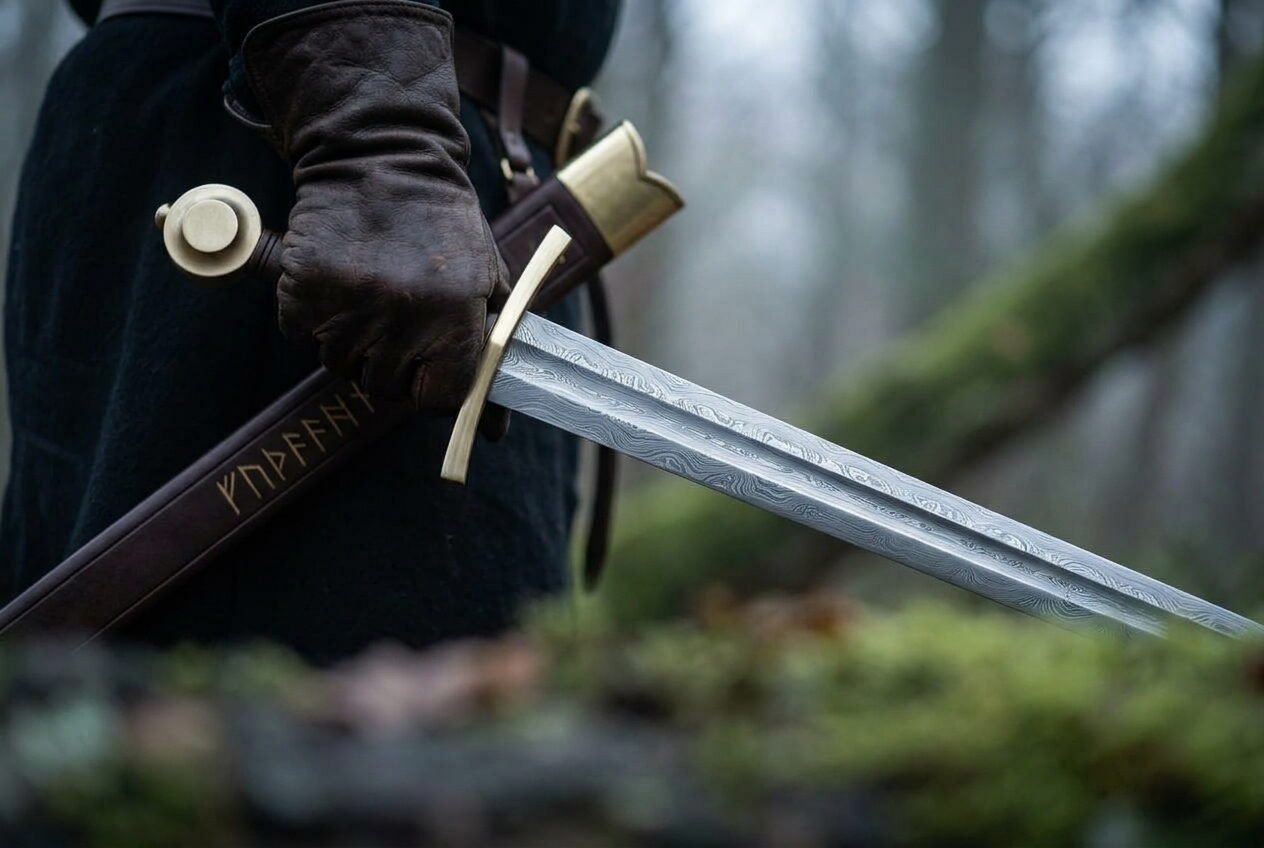
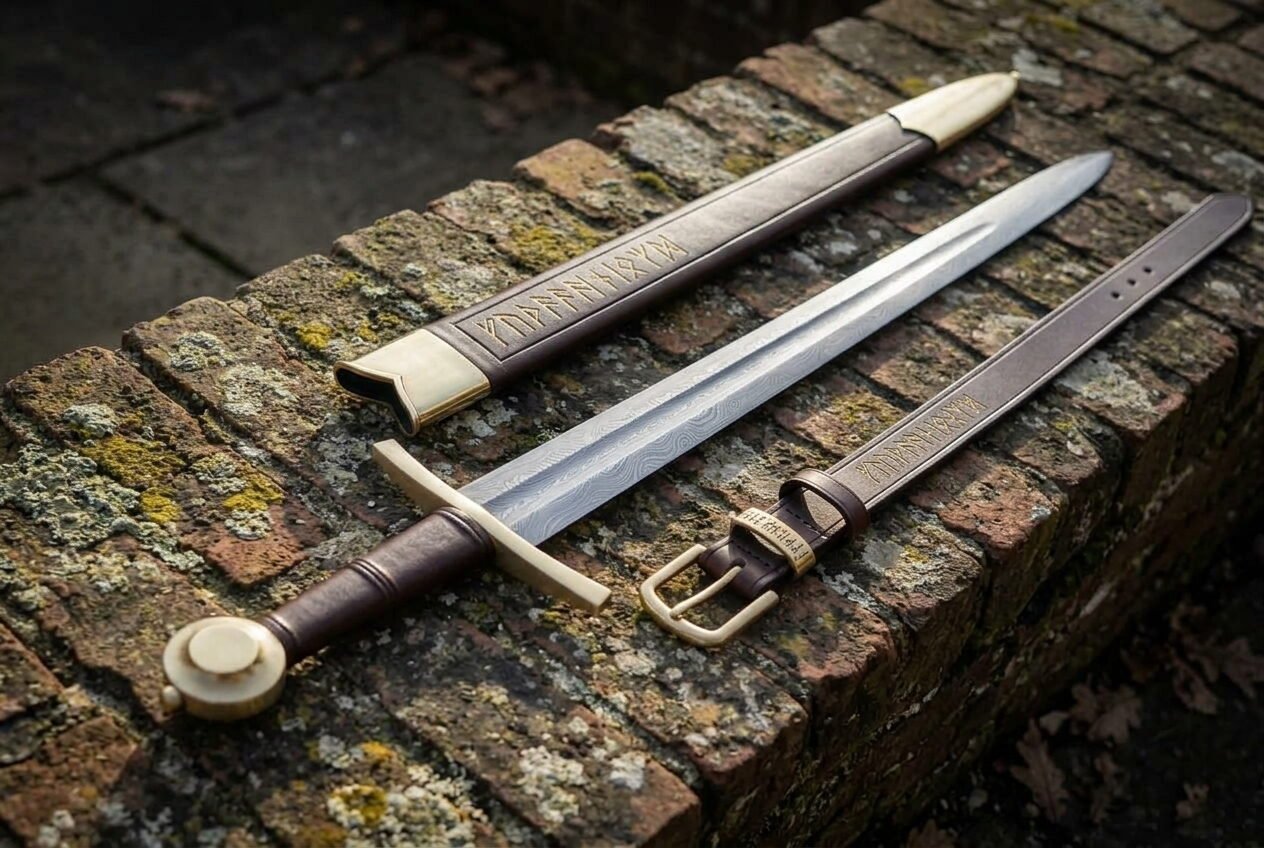
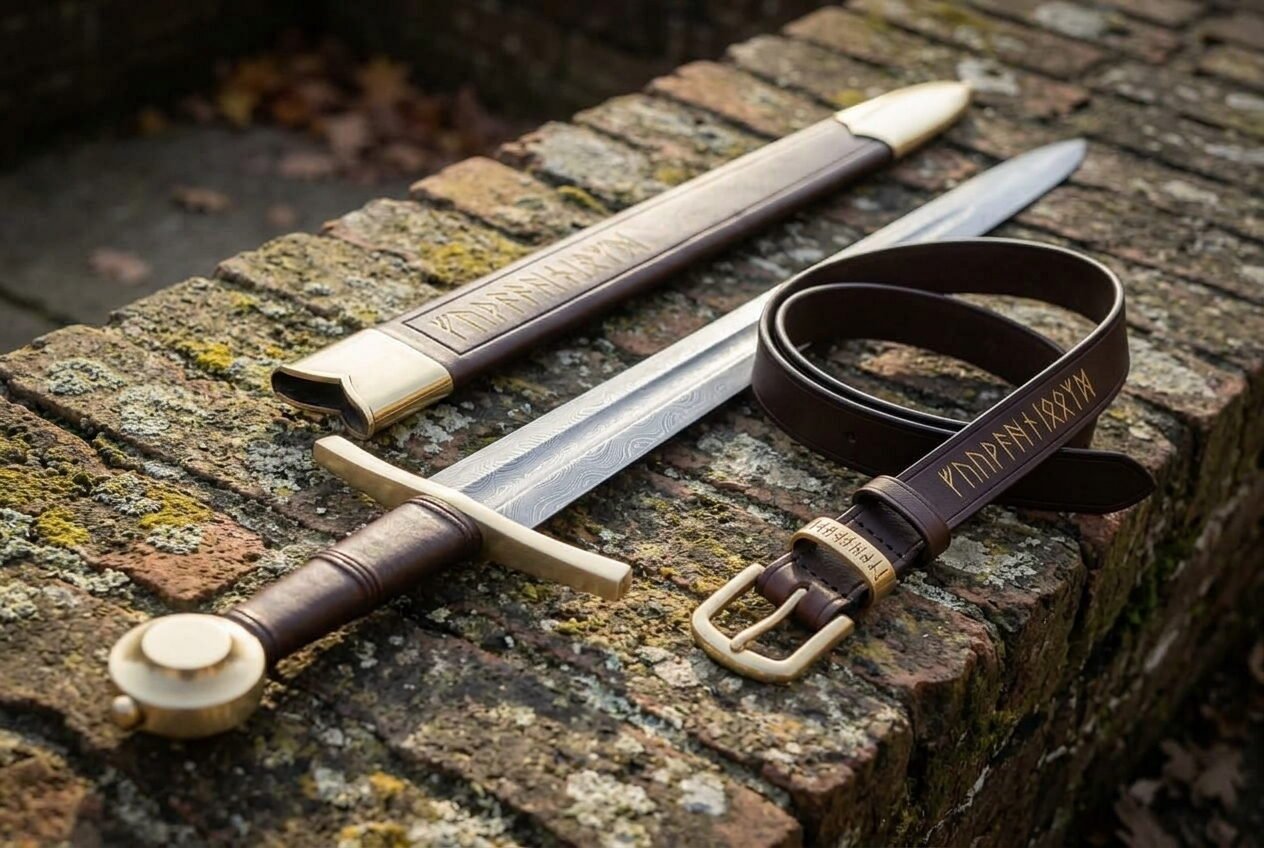
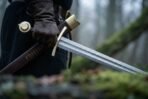
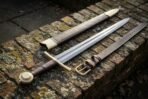
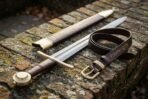
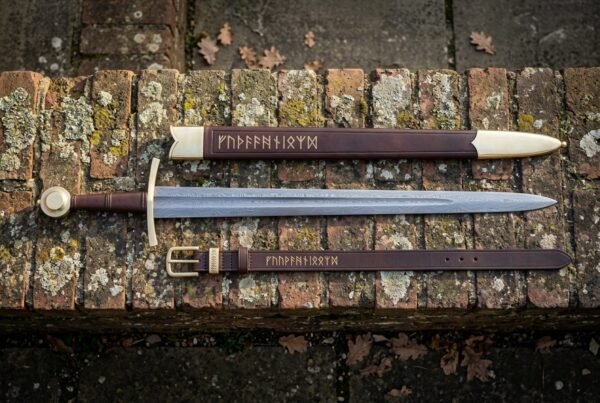
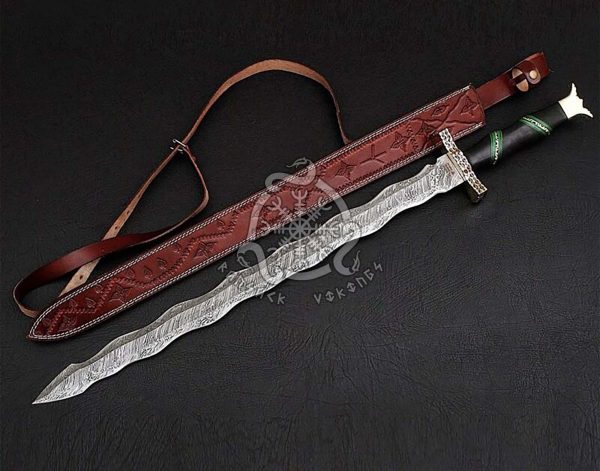
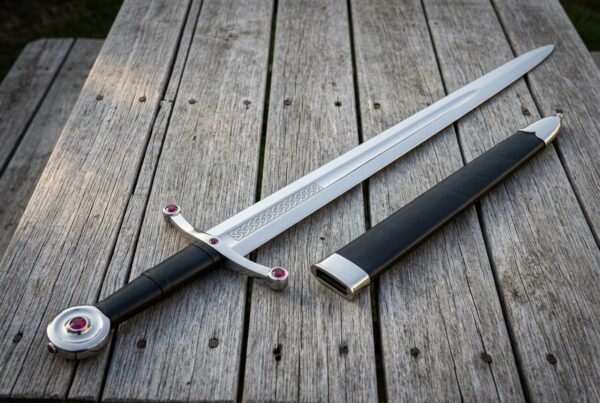
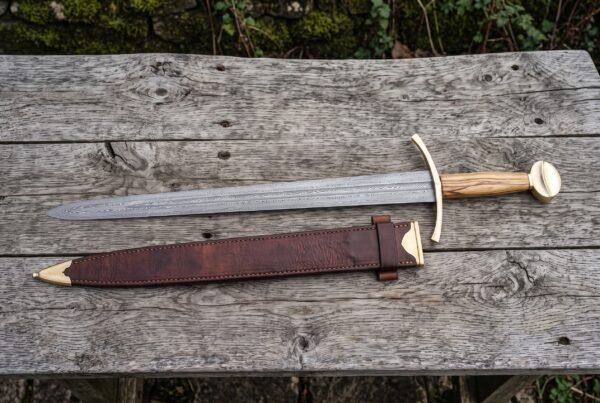
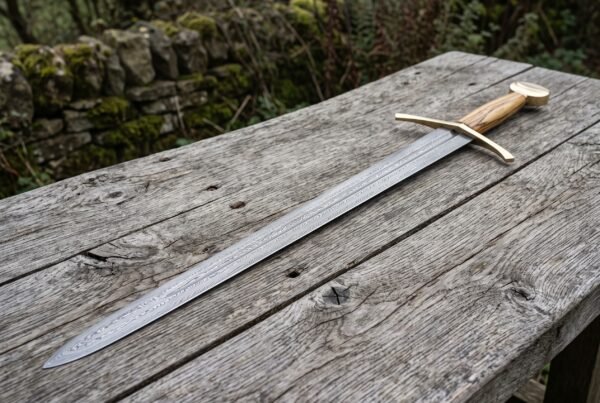
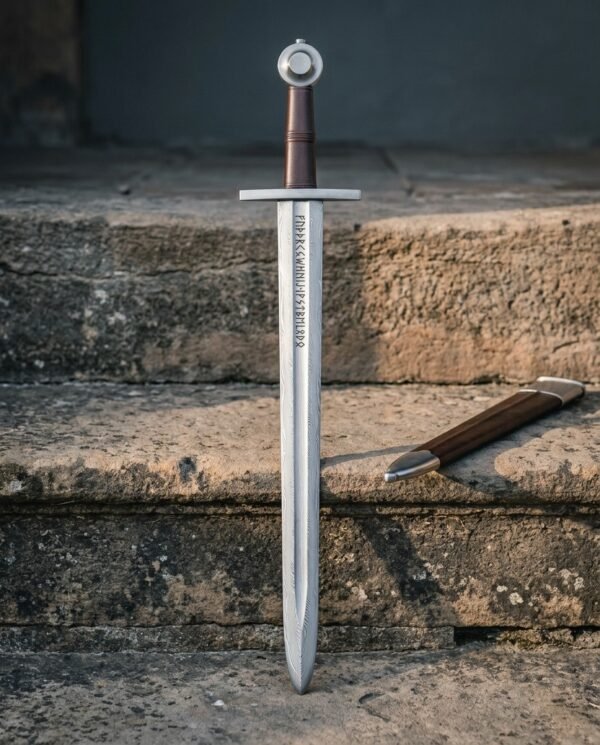
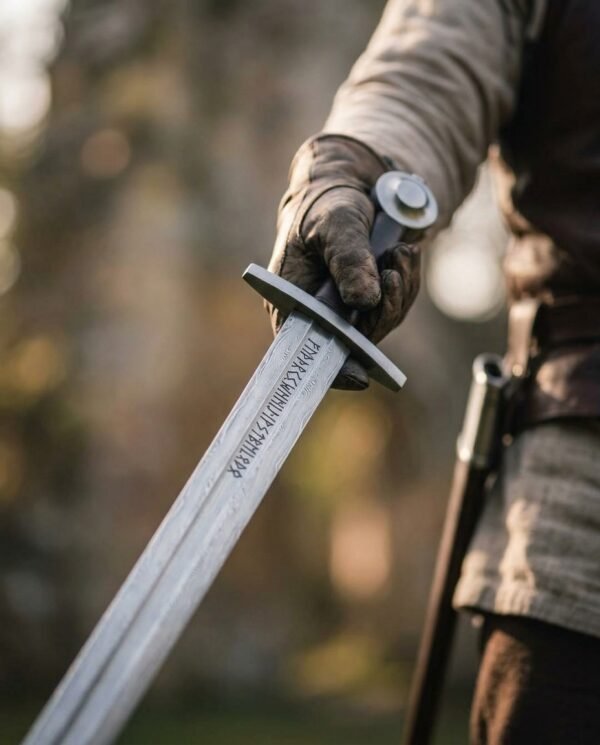
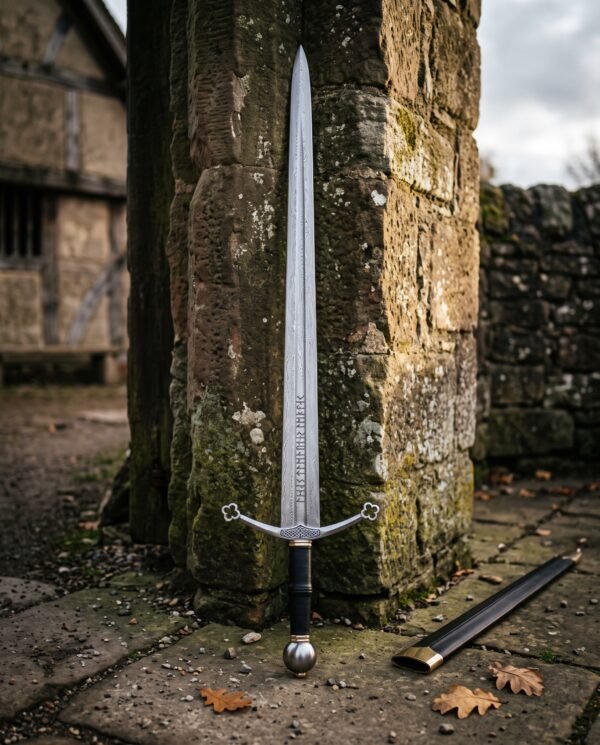
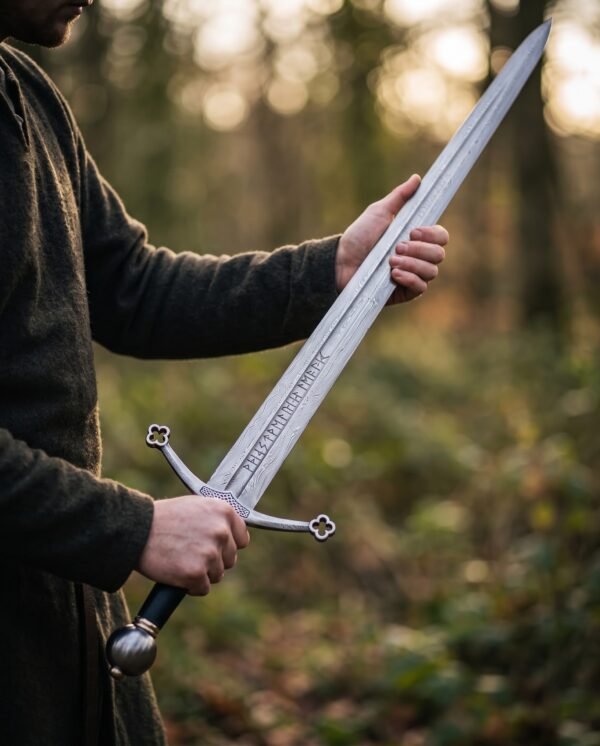
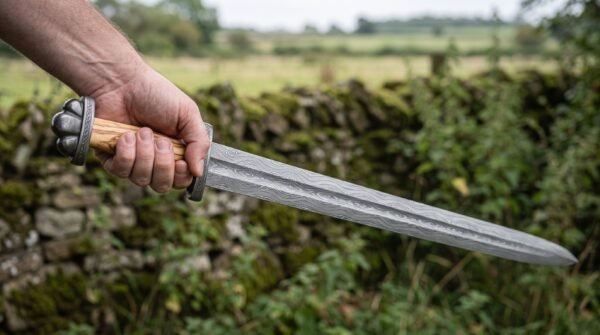
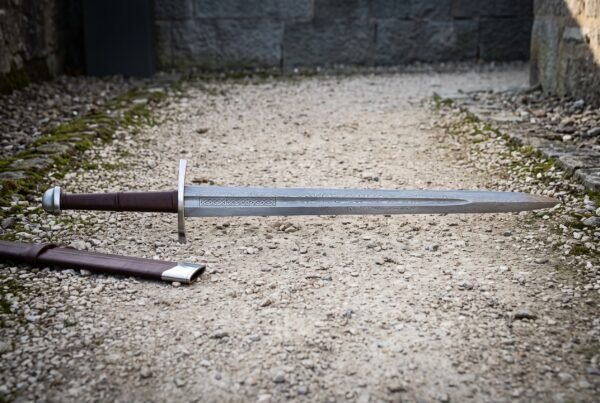
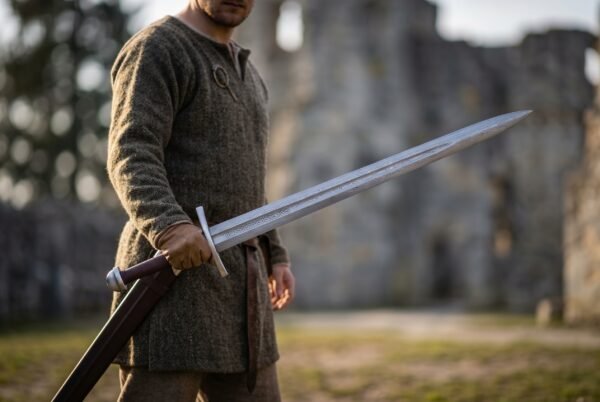
This is a full knightly rig, a Damascus arming sword with a matching scabbard and sword belt, all three carrying the same Elder Futhark line tooled into the leather. The blade is forge welded from 1095 and 15N20 on the Oakeshott type XII outline, broad at the shoulder, tapering evenly and cut with a long central fuller. There is a genuine historical reason a pattern welded blade sits so naturally in a Norse and early medieval rig. Before bloomery smiths could reliably make a large homogeneous bar of good steel, they got there by welding together strips of different iron and steel, and by the sixth century the twisted composite blades of northern Europe were being made that way deliberately, for looks as much as for structure. The etched surface of a pattern welded sword was described in Old English poetry as wave patterned and snake patterned. The wave figure on this blade is a direct nod to that vocabulary.
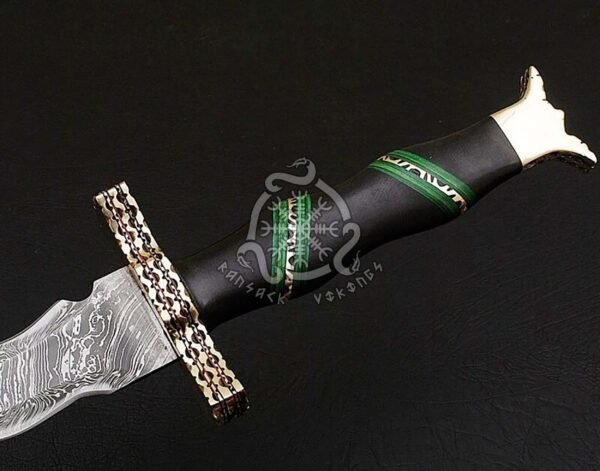
Every part is made by hand in the Czech Republic. The billet is stacked, welded, drawn and etched here, the hilt is fitted with a dark leather grip between an arched bone cross and a bone disc pommel, and the leatherwork is cut, tooled, dyed and stitched in the same building. It ships with a dark brown scabbard with bone throat and bone chape and a matching tooled belt with a brass buckle. Shipping inside the United States is free.
Specifications
| Steel | 1095 and 15N20 forge welded Damascus, hand etched wave pattern |
|---|
| Hardness | 58 to 60 HRC |
|---|
| Overall length | 36 inches |
|---|
| Blade length | 30 inches |
|---|
| Blade profile | Oakeshott type XII, broad shouldered with a long central fuller |
|---|
| Cross | Arched bone cross, the arms curving toward the blade |
|---|
| Grip | Dark brown leather wrap over a wooden core with two raised risers |
|---|
| Pommel | Bone wheel pommel with a raised centre boss and peened tang button |
|---|
| Scabbard | Dark brown leather tooled with an Elder Futhark line, bone throat and bone chape |
|---|
| Belt | Matching rune tooled dark brown leather with brass buckle and keeper, adjustable to about 44 inches |
|---|
| Tang | Full length, peened over the pommel |
|---|
| SKU | RK-1336 |
|---|
Why a type XII blade suits a wave pattern
Oakeshott classified medieval blades by their profile, their fuller and their proportions, and the type XII is the broad flat evenly tapering blade of the twelfth to mid fourteenth century, with a fuller that runs about two thirds of its length. It is a wide canvas, and that matters for a pattern welded sword. A narrow late medieval thrusting blade leaves almost no flat surface to show a figure. A type XII gives you an inch and a half of polished steel either side of the fuller for the whole cutting section.
The wave figure itself is made by taking a flat stack of layers and pressing or grinding a series of shallow scallops across the face before the final flattening. That distorts the layers downward in a repeating rhythm, and when the surface is ground back level the layers are cut through at an angle, so what you see is a row of nested arcs marching along the blade. Set that against the straight line of the fuller and the eye reads the whole length of the sword at once. It also means the pattern is denser near the edges, where the steel was moved most, and looser up the centre.
Why Damascus and not stainless
Damascus here means forge welded, not a printed finish. We stack alternating layers of 1095 and 15N20, weld them under the hammer, fold and reweld, and the pattern appears when ferric chloride darkens the 1095 while the nickel in the 15N20 resists it and stays bright. It is a carbon steel laminate, which means it takes a patina and will rust if you neglect it, and in exchange the folding refines the grain and the finished blade runs at 58 to 60 HRC with long edge life. Stainless steels get their corrosion resistance from heavy chromium, which at sword length costs toughness at the shoulder and tang, and stainless will not etch to a pattern at all, so any stainless Damascus is a surface effect. The argument is set out in Damascus versus stainless.
The bone furniture, the grip and the leather
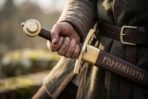
The cross and the disc pommel on this sword are bone rather than steel or brass. Bone was used for hilt furniture across the Norse and early medieval world, and it has two practical virtues. It is light, so a bone pommel and cross let the blade stay lively rather than being weighed down, and it is warm to the touch in a way that metal is not. It also ages beautifully, taking on a soft ivory tone with handling. The grip between them is leather wrapped over a shaped wooden core, which is the standard medieval construction and the reason a sword grip stays comfortable when your hands are sweating.
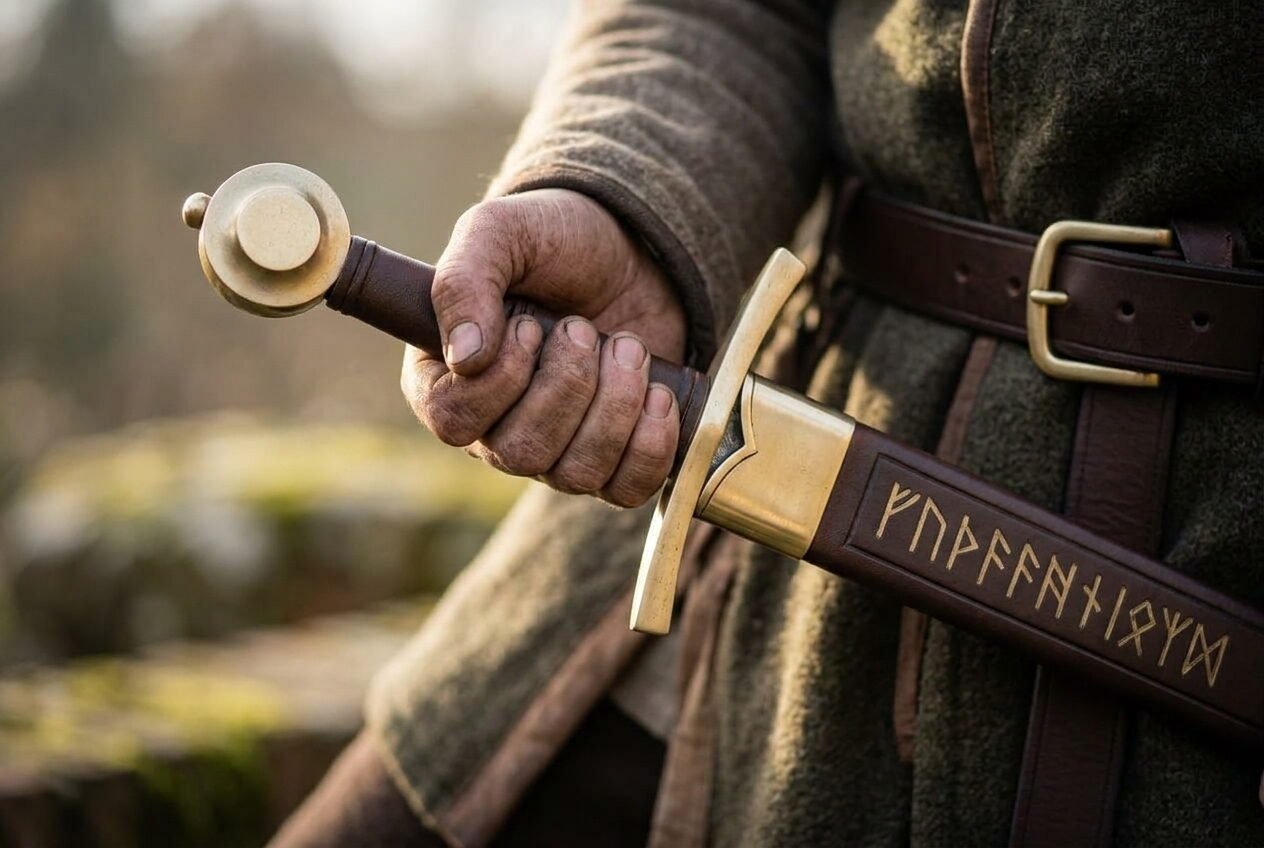
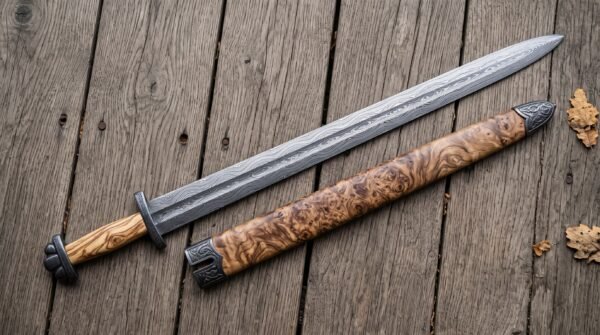
The scabbard is a wooden core covered in dark brown leather, tooled with an Elder Futhark line and closed with a bone throat and a bone chape. The belt is cut from the same hide, tooled with the same line and fitted with a brass buckle. Give both a light leather balm once or twice a year, keep them out of direct sun and do not let them get soaked. Bone furniture needs nothing beyond a wipe with a dry cloth, but keep it away from radiators and hot cars, because sharp changes in humidity are what crack it.
Engraving, runes and your own design
Use the rune converter on this page to turn a name, a date or a short phrase into Elder Futhark and we will cut it into the steel or the handle. If you would rather have a Viking pattern than a rune line, choose your own design in the engraving option above the add to cart button and tell us whether it goes on the blade or the handle. Where a piece already carries an engraved design, your chosen engraving replaces it rather than sitting alongside it. On this rig that means your rune line is tooled into the scabbard and belt in place of the standard one, at no extra cost, and we will send a proof of the rune row before we cut it. Details are on the engraving page.
Care and sharpening
Etched Damascus wants a little more care than plain steel because the acid has opened the surface slightly. Dry the blade after handling, wipe it with light machine oil or a hard paste wax and do not leave fingerprints on it in a humid room. Never store the sword sheathed for long periods. Vegetable tanned leather holds moisture and tanning salts against steel, and a beautiful Damascus blade will bloom rust inside a scabbard faster than anywhere else. Hang the sword and keep the scabbard for carrying. Read steel care before the first outing. Sharpen with a coarse then fine stone at a shallow angle as described in sharpening with a whetstone, then re oil, because a stone strips the protective film.
Made in the Czech Republic
This piece is made by hand in the Czech Republic, in a workshop that still works the old way. The steel is forged, ground, heat treated and finished by smiths who learned the trade from the people before them, and the wood, horn and leather are cut and fitted by hand rather than pressed out on a line. That is also why no two pieces come out exactly the same.
Ransack Viking is a United States company. We import these pieces ourselves, check every one when it lands and ship from our warehouse in Chicago, Illinois. Engraving is done here in the United States after the piece arrives, so your runes or your own design go on before it leaves for you.
A note on handmade variation
This rig is hand forged. It is not machine made and it is not bulk produced, so what arrives will not be a pixel for pixel copy of the photograph. The Damascus figure is unique to the billet and differs between the two faces of the same blade. Bone varies in tone and grain from piece to piece, leather takes dye differently from hide to hide, and the exact depth of the tooling varies because it is cut by hand. The dimensions, the steel and the build are the same every time. The character is not, and that is the point of buying a forged sword rather than a manufactured one.
Frequently asked questions
Do the runes on the scabbard and belt mean anything?
The stock row is an Elder Futhark transliteration and we are happy to tell you what it says. If you want your own name, a date or a short phrase instead, use the rune converter above the add to cart button and we will tool that line into both the scabbard and the belt at no extra charge.
Is the pattern on the blade real Damascus?
Yes. It is a forge welded stack of 1095 and 15N20 and the layers run right through the steel. Grinding into the blade would show the same pattern underneath. The acid only develops contrast that is already there.
Is it sharp?
Yes, it ships with a keen working edge. Ask in the order notes for a blunt display or reenactment edge and we will leave a rounded quarter inch instead at no extra cost.
Will the bone cross and pommel hold up?
For display, carry and light soft target cutting, yes. Bone is stronger in compression than most people expect and the tang is peened through the whole assembly. It is not the right choice for hard contact work, and we would steer you to a steel hilted sword if you intend to hit things with it.
How is this different from the plain steel rig?
Same length, same geometry and the same belt and scabbard construction. The Damascus blade is harder, holds an edge longer, carries a forge welded wave figure and takes several times the forge work, which is what the price reflects. The bone furniture on this one is lighter and warmer in the hand than steel.
How long does shipping take?
Free inside the United States. Fourteen to eighteen working days in the shop for a full Damascus rig, then two to five days in transit, plus about a week if you order custom rune tooling.
What is in the box
- One hand forged 1095 and 15N20 Damascus type XII arming sword, 36 inches overall
- Rune tooled dark brown leather scabbard with bone throat and bone chape
- Matching rune tooled leather sword belt with brass buckle
- Light protective oil coat on the blade for transit
- Care and sharpening card for pattern welded steel
- Forged and finished in the Czech Republic
Explore the range
Browse the rest of the arming swords, every pattern welded blade in Damascus swords, our scabbards and sheaths and everything under swords. Background reading is in the guides.
Close to this one
Another in the same line is the Oathgird sheath, 36 inches overall. Next along the rack is the Thornhelm sheath, 36 inches overall. For a straight comparison, see the Knotwelt sheath.
The Runepein blacksmith tool covers the other half of the same kit. Nothing here exactly right, build one to your own spec on the design your own page.
For partner drills and sparring we carry the Mirlaug blunt arming sword, and our blunt versus sharp guide is a good place to start.


Reviews
There are no reviews yet