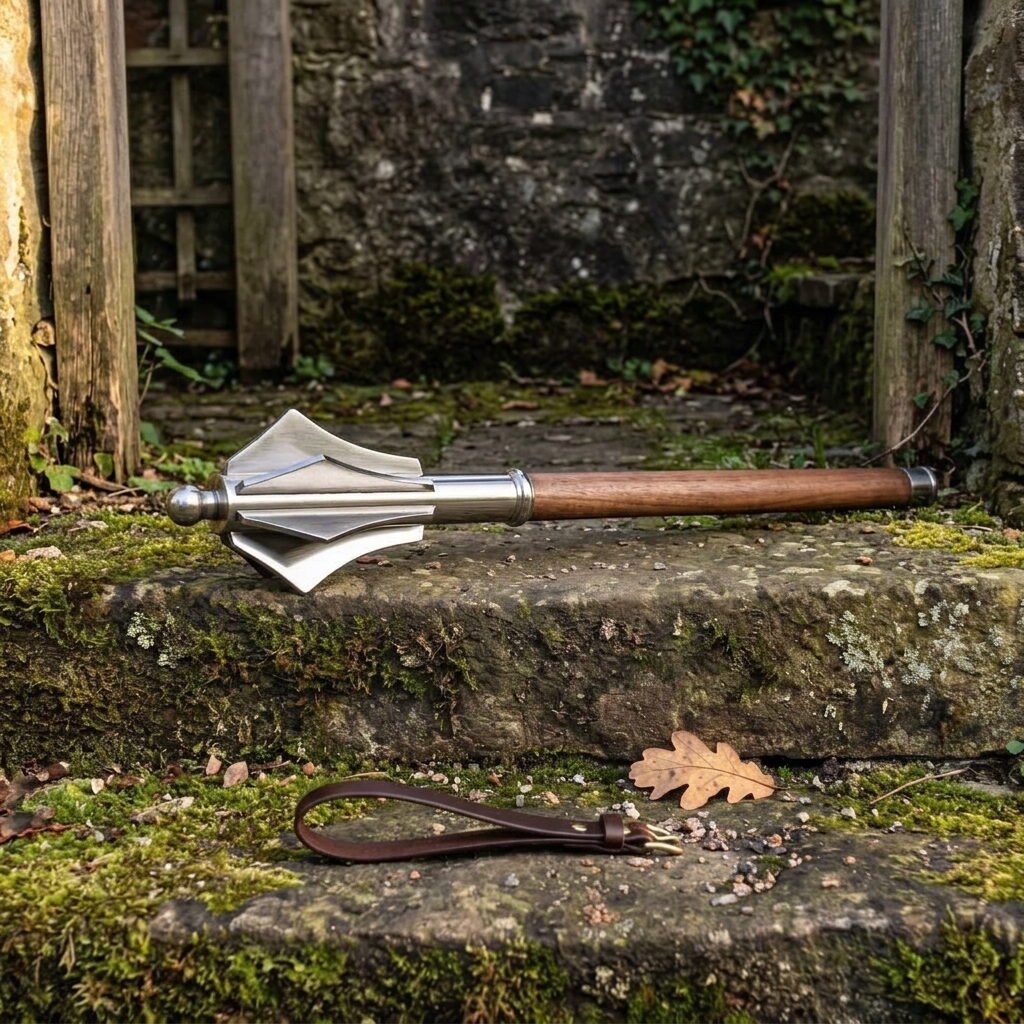
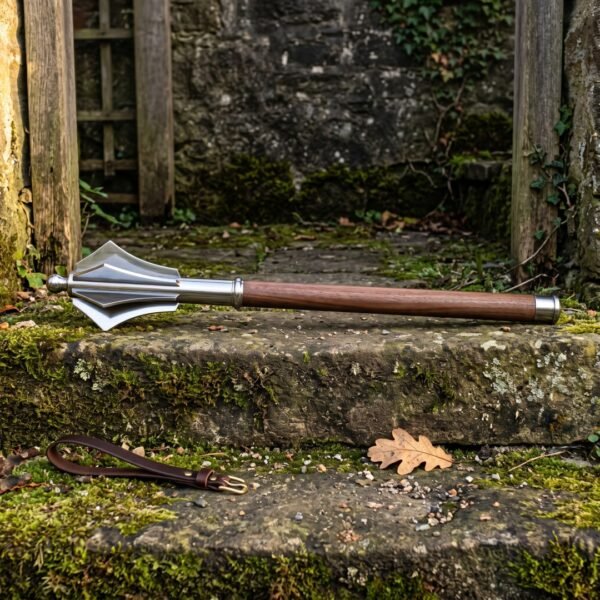
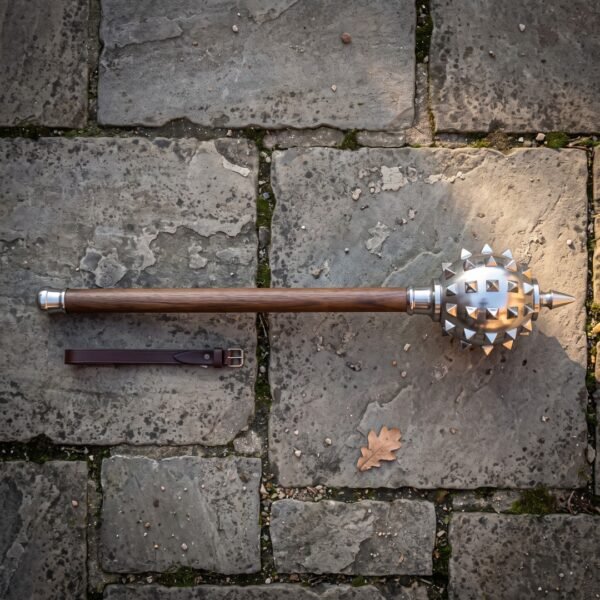
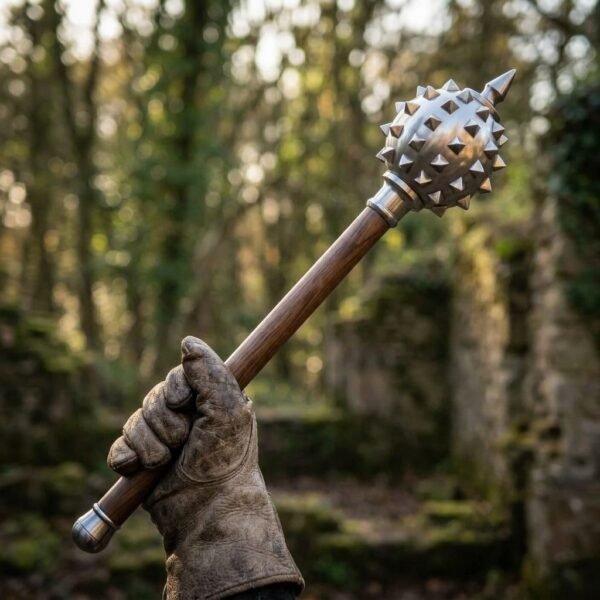
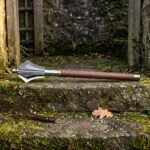
A flanged mace is built on one idea, which is to concentrate the force of a blow onto a narrow line instead of spreading it across a round surface. This one carries six flanges forged from 1095 high carbon steel and set around a domed head, each standing proud of the body so that an edge lands first and the mass follows it. Flanged maces appear in European art from the twelfth century onward and had largely displaced the plain knobbed mace by the fourteenth, and the reason was armour. Against mail a round head does its work. Against a plate harness a round head skids off the curve, while a flange bites, stays put and transfers the shock through the plate into what is underneath it.
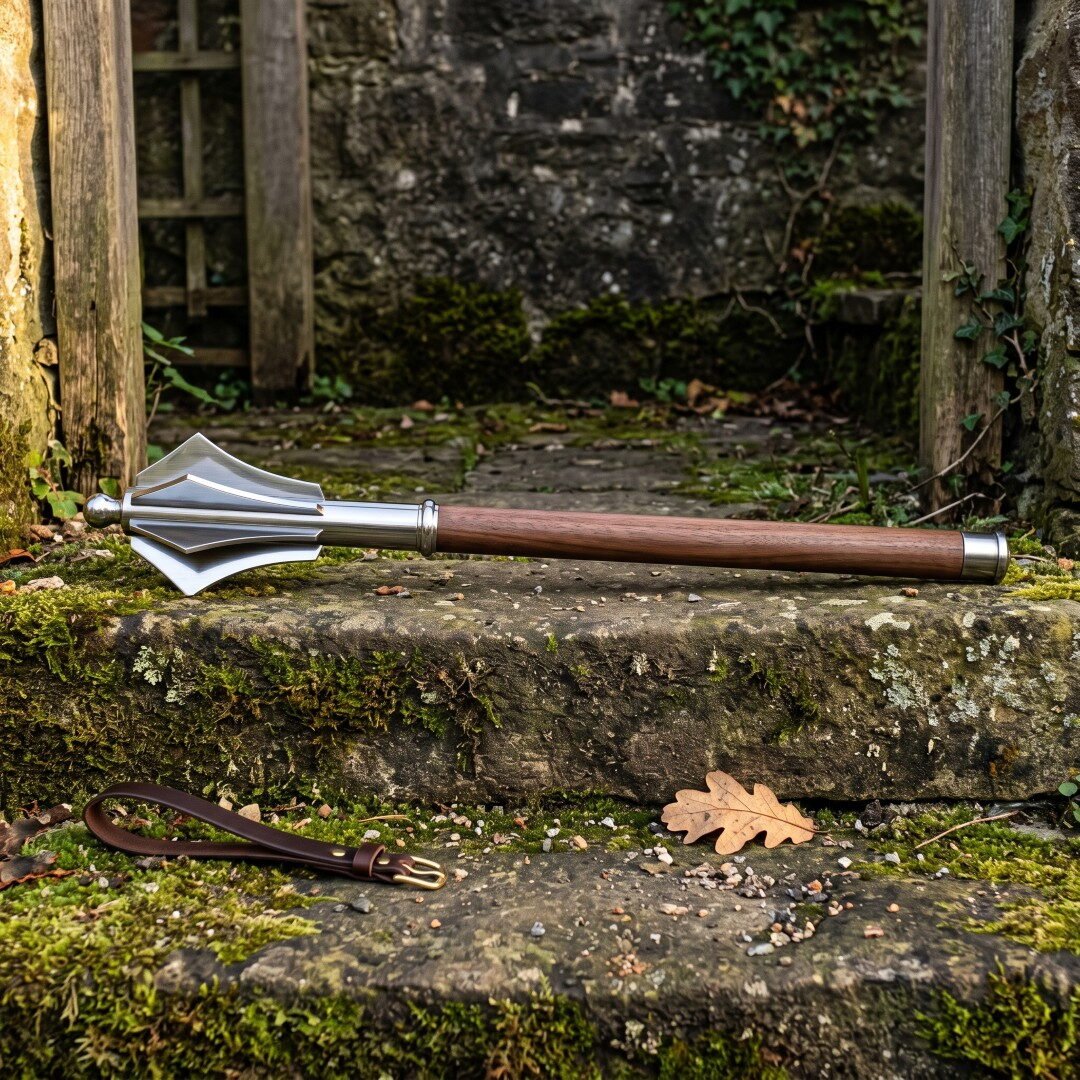
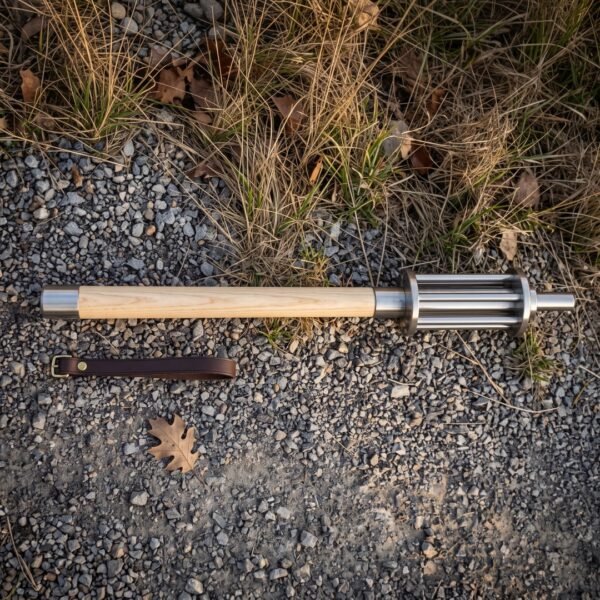
It is forged, heat treated and finished by hand in the Czech Republic, hardened and drawn to 54 to 58 HRC and polished bright. It ships with the leather wrist strap shown in the photograph, free anywhere in the United States, and it can be engraved with Elder Futhark runes or a Viking pattern of your choosing before it leaves the bench.
Specifications
| Steel | 1095 high carbon steel, polished |
|---|
| Hardness | 54 to 58 HRC |
|---|
| Overall length | 26 inches |
|---|
| Head length | 5.5 inches, six flanges |
|---|
| Head width | About 4.5 inches across the flanges |
|---|
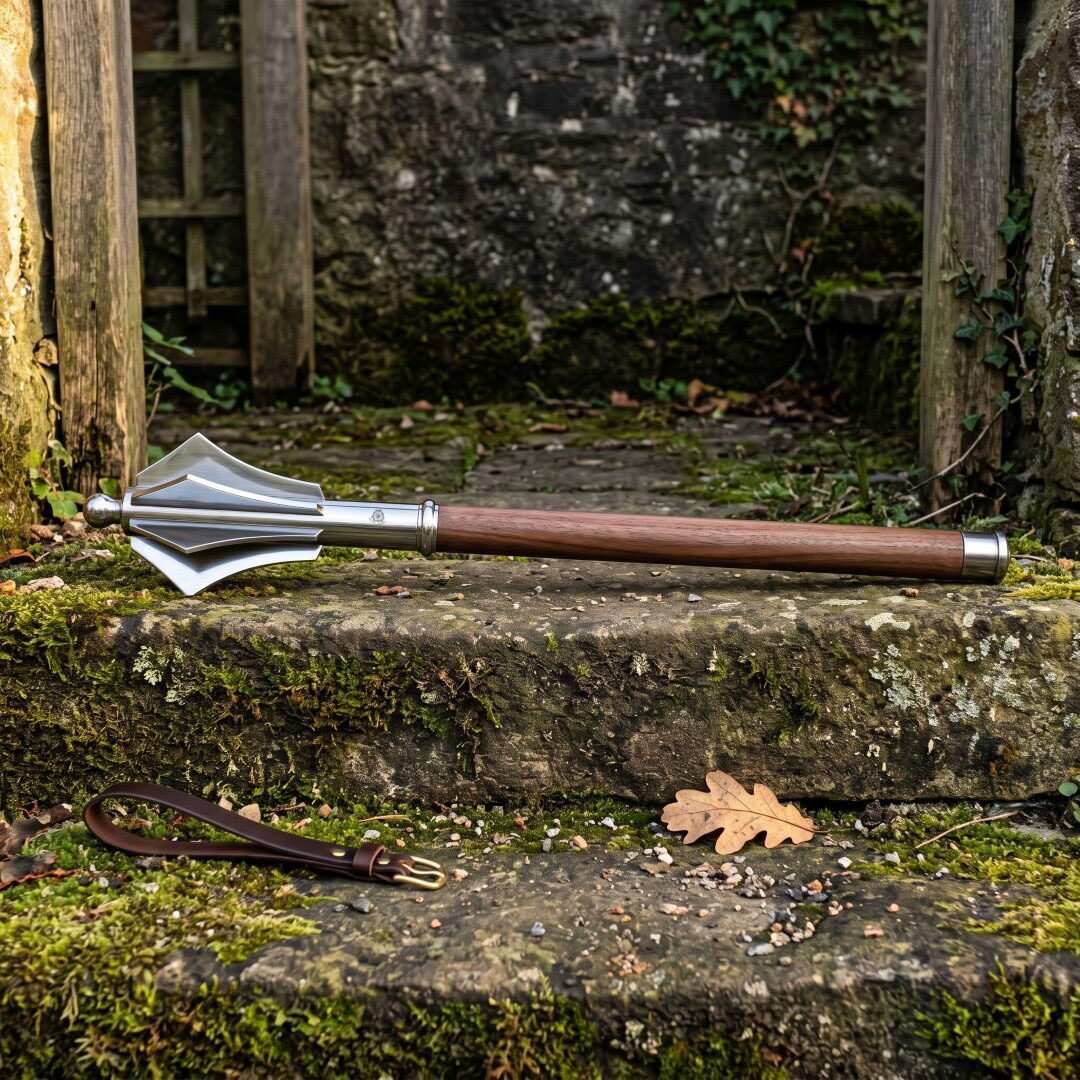
| Head | Six pointed flanges with a polished steel ball finial on top |
|---|
| Socket | Polished steel socket tube with a collar ring where the head meets the haft |
|---|
| Haft | American walnut |
|---|
| End cap | Polished steel end cap |
|---|
| Strap | Brown leather wrist strap with a buckle |
|---|
| Sheath | None |
|---|
| SKU | RK-1350 |
|---|
What the flanges actually do
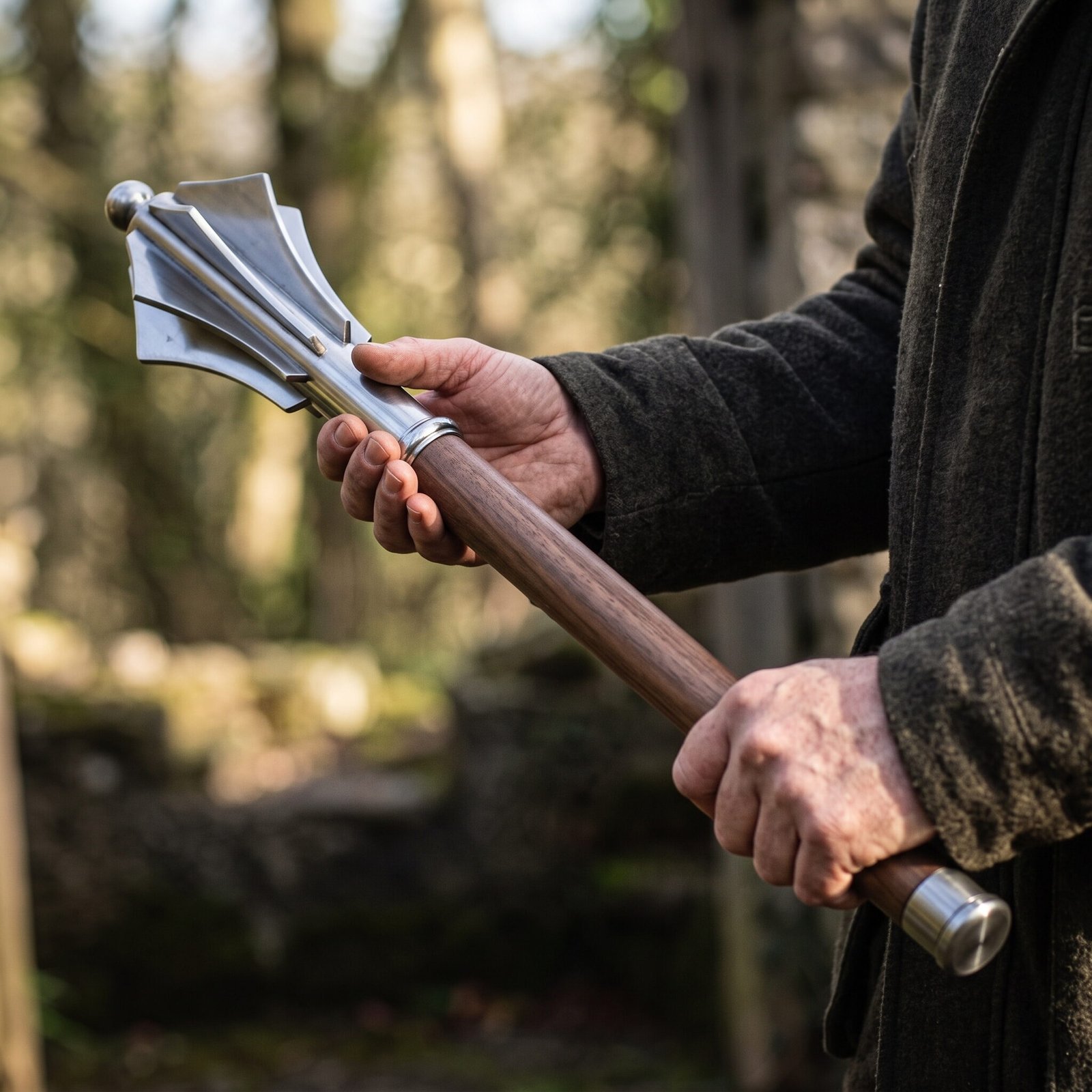
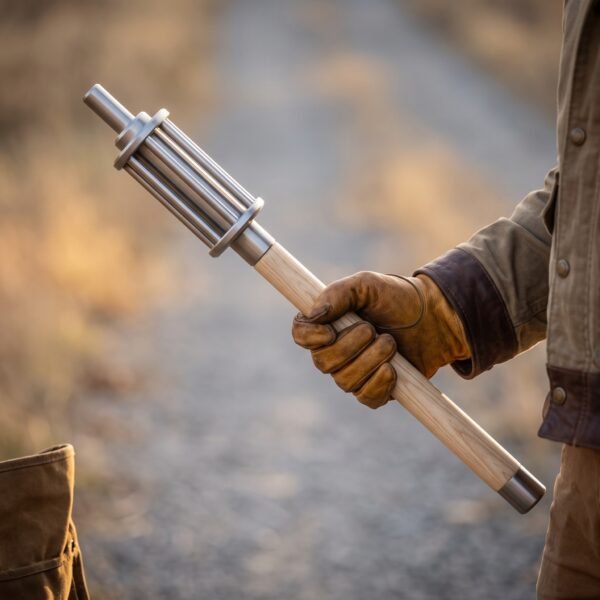
Look at the head from the end and you are looking at a six pointed star rather than a circle. Every one of those six points is a narrow ridge of steel running from the collar to the crown, and every one of them presents a line rather than an area. The physics is the same as the reason a chisel cuts and a hammer does not. Force divided by a smaller contact patch is a larger pressure, and pressure is what deforms a helmet or a plate.
The second thing the flanges do is stop the head walking. A smooth ball landing on a curved surface at anything other than a perfect right angle will slide, and the energy goes sideways instead of down. A flange catches. That is why the shape survived four hundred years of European warfare with very little modification and why it turns up again in cavalry batons and in the ceremonial maces still carried in legislatures, which are the direct descendants of the fighting article.
The third is balance. Six flanges weigh less than a solid head of the same diameter, so the mass sits closer to the hand and the piece comes back to centre quickly after a swing. Our head is forged and dressed rather than cast, which means the grain of the steel follows the flange out to its edge rather than running across it.
Why 1095 high carbon steel and not stainless
Every plain steel piece in this group is forged from 1095, a simple high carbon steel with roughly one percent carbon and very little else in it. That plainness is the point. A steel with nothing but iron and carbon to argue about moves predictably under the hammer, takes a clean quench, and comes back to a hardness a smith can actually hold to. These are hardened and drawn to 54 to 58 HRC, which is deliberately a touch softer than a kitchen knife. A head that has to survive impact wants to bend and rebound rather than chip, and 1095 in that range absorbs a bad hit instead of losing a piece of itself.
Stainless alloys buy their rust resistance with chromium, and above about thirteen percent that chromium ties up carbon in carbides that make the steel harder to forge and more brittle at the edge. On a small folding knife that trade is fine. On a head that lands with the weight of a haft behind it, it is not. The cost of choosing 1095 is that it will rust if you leave it wet. Wipe it, oil it, and it will outlast you. There is more on that trade in our guide to Damascus versus stainless.
The hardwood haft
The haft is close grained hardwood, turned to a slight taper so the hand finds the same place on it every time and sanded through the grits before it takes its oil finish. Dense hardwood is chosen over a softwood for a reason that has nothing to do with looks. A dense stave carries the shock of a heavy head into the wood rather than letting it stop at your palm, and it holds a ferrule or a langet tight for years instead of shrinking away from the fitting after one dry winter.
The finish is oil, not lacquer, which is a deliberate choice. Lacquer looks perfect until it chips, then water gets under it and you cannot fix it without stripping the whole handle. Oil wears gradually and is repaired by wiping more oil on. Once or twice a year, a thin coat of boiled linseed or a proprietary handle oil, twenty minutes to soak, then wipe off what has not gone in. See wooden handle care.
Engraving, runes and your own design
Use the rune converter on this page to turn a name, a date or a short phrase into Elder Futhark and we will cut it into the steel or the handle. If you would rather have a Viking pattern than a rune line, choose your own design in the engraving option above the add to cart button and tell us whether it goes on the blade or the handle. Where a piece already carries an engraved design, your chosen engraving replaces it rather than sitting alongside it.
Engraving is cut by hand after the piece is finished and before final oiling, so keep the line short and let it sit where the eye already goes. Names, dates, a line of a poem, a maker mark, a unit or a crew number all work. If you are unsure where a line should sit, send us the text and we will suggest a placement before we cut. Full details and examples are on the engraving page.
Care and sharpening
Carbon steel rusts. That is the only demanding thing about owning it. Wipe the steel down after handling, because fingerprints are salt and moisture and they will etch a bright surface in a week if you let them sit. A thin film of mineral oil, gun oil or paste wax on the metal is enough to keep it stable indoors. If the piece lives on a wall in a room that swings between damp and dry, check it every few months and re oil. Left alone in a garage or a basement it will spot, and once it spots the mark is permanent even after the rust is removed.
The flanges are dressed blunt and need no sharpening. If one picks up a burr from a knock, a few light passes with a fine file or stone will tidy it. Do not take a powered grinder to it. Our guides cover steel care and sharpening with a whetstone in more detail.
Made in the Czech Republic
The work behind this piece happens in a Czech Republic workshop that has kept to the old methods. Steel is forged and heat treated by hand, the grind is taken down by eye rather than by machine, and the handle, fittings and sheath are cut and finished one at a time. Because of that, every piece carries small marks of the hand that made it.
Ransack Viking is a United States company. We import direct, check each piece when it reaches us, and ship from our Chicago, Illinois warehouse. Engraving is added here in the United States after arrival, so the piece you receive is finished to your order.
A note on handmade variation
This is hand forged. It is not machine made, not cast and not bulk produced, so what arrives will not be a pixel for pixel copy of the photograph on this page. The grain of the wood, the tone the steel takes from the fire and the oil, the exact run of a pattern, the precise curve of a profile, all of it shifts a little from one piece to the next because each one is worked by hand from natural materials. Two hafts cut from the same board will not read the same. Two etched blades from the same billet will not carry the same swirl.
What does not change is the specification. Dimensions, steel, hardness, fittings and build are the same every time. The character is the part that is yours alone, and it is the reason to buy something forged rather than something stamped.
Frequently asked questions
Are the flanges sharpened?
No. The flange edges are dressed to a blunt working profile of about a sixteenth of an inch, which is historically correct. A mace crushes, it does not cut, and a sharpened flange would chip on the first hard contact. We can leave them thinner on request.
Can this be used for reenactment or sparring?
Not against a person. It is a live steel piece with real mass on a hardwood haft and it will break bone through padding. It is built for collectors, display and film or stage work where no one is being struck.
Can I have runes engraved on it?
Yes. Use the rune converter on this page for Elder Futhark, or pick your own Viking pattern in the engraving option. On a flanged mace the usual placements are along one flange face or around the ferrule.
Will mine look exactly like the photograph?
Close, but not identical. The dimensions and steel are fixed. The walnut grain and the exact polish will differ because each haft is turned from a different piece of timber and each head is dressed by hand.
What is the difference between this and a bar mace?
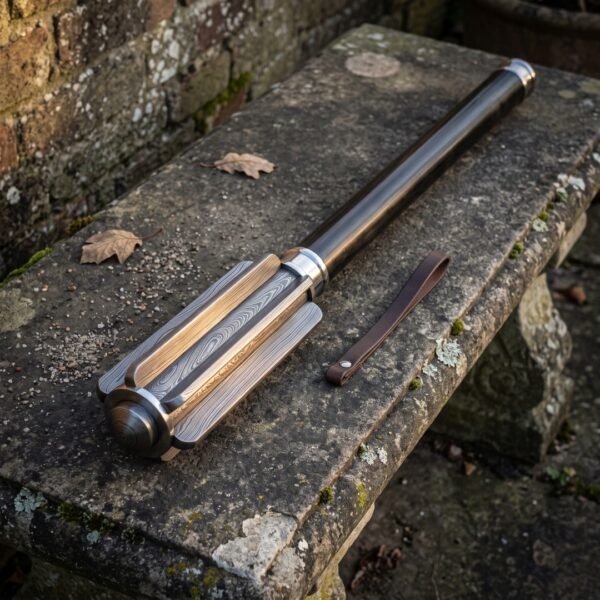
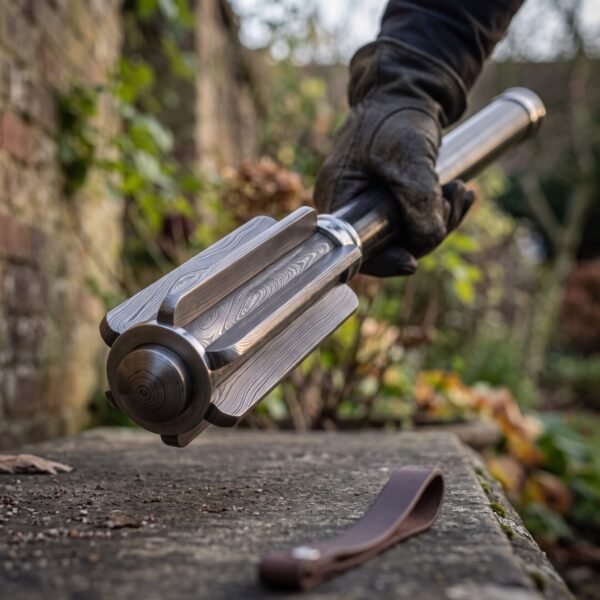
A bar mace has straight parallel bars or flutes running the length of a cylindrical head, so it strikes with several lines at once and carries more mass. A flanged mace has fewer, deeper edges and is faster in the hand.
How long does shipping take?
Two to three business days to leave the shop if it is in stock, two to three weeks if it is being made or engraved. Shipping inside the United States is free and we send tracking as soon as it goes out.
What is in the box
- One hand forged flanged mace in 1095 high carbon steel
- American walnut haft with polished steel ferrules
- Leather wrist strap
- Care and oiling notes
- Forged and finished in the Czech Republic
Explore the range
More in maces, flails, poleaxes and Norse arms, and read the guides.
If this one is not it
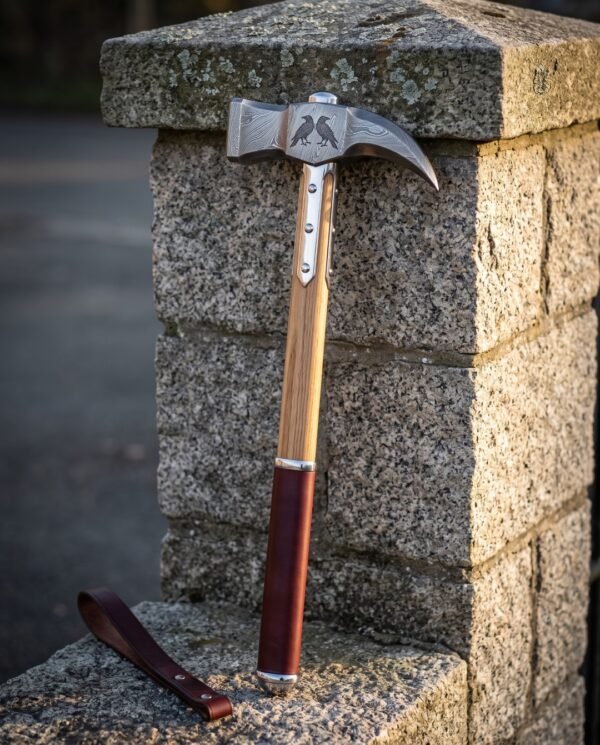
Another in the same line is the Ravenbeak mace, pattern welded Damascus. Next along the rack is the Ashcudgel mace, 27 inches overall. For a straight comparison, see the Starthorn mace, 26 inches overall.
The Brassmaul poleaxe covers the other half of the same kit. Pick the steel, the length and the fittings yourself on the custom Norse arms page.


Got this as a birthday gift and the reaction was priceless. Packaging was excellent and it arrived in perfect condition. Love it.