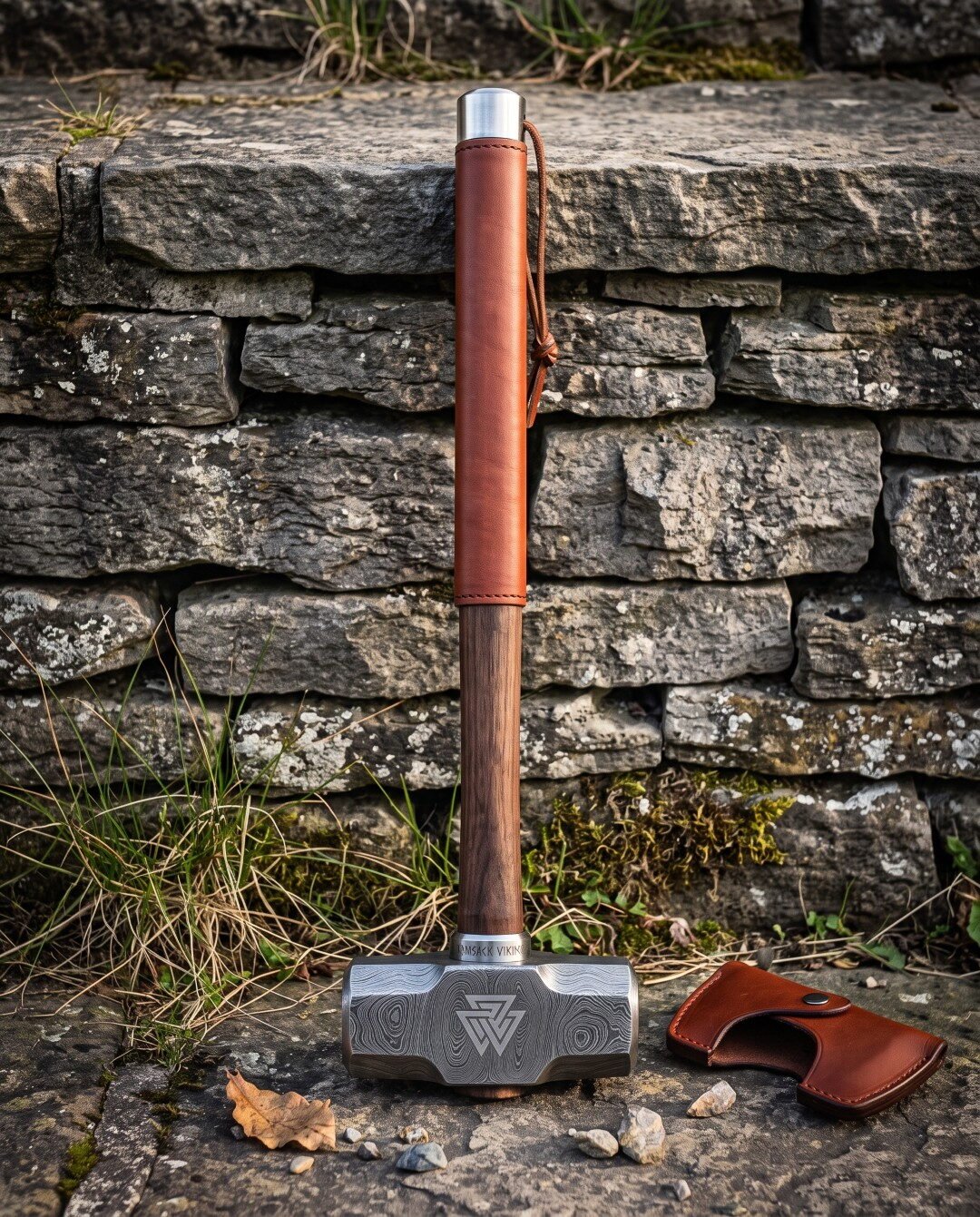
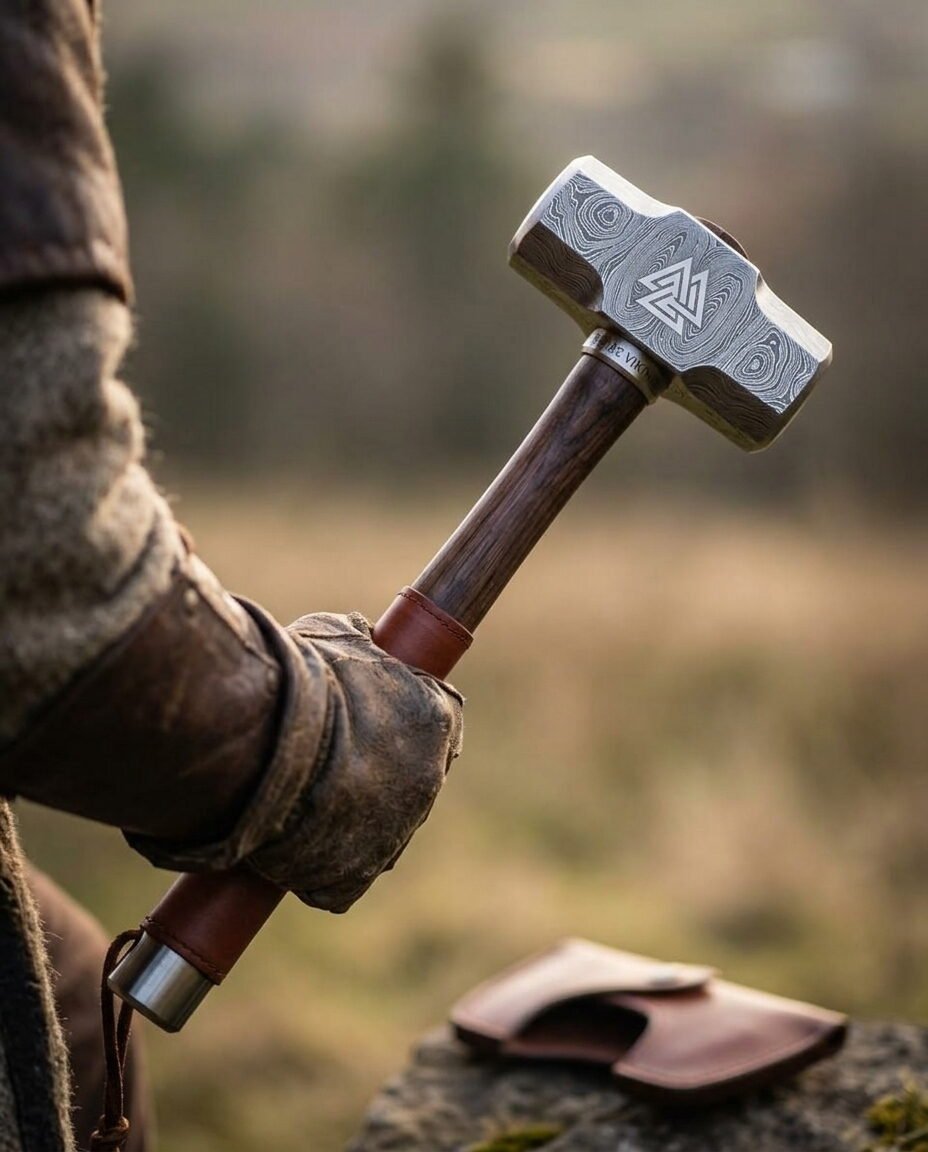
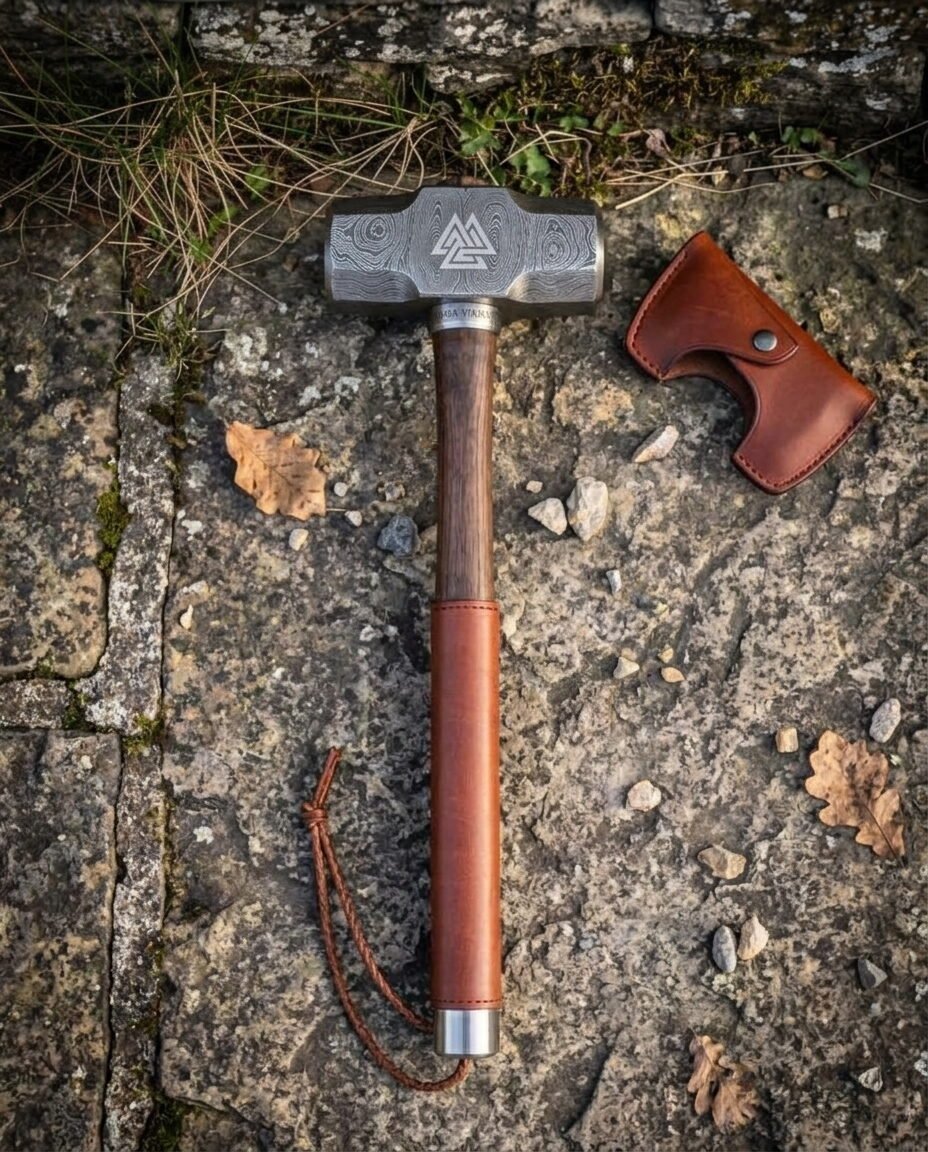
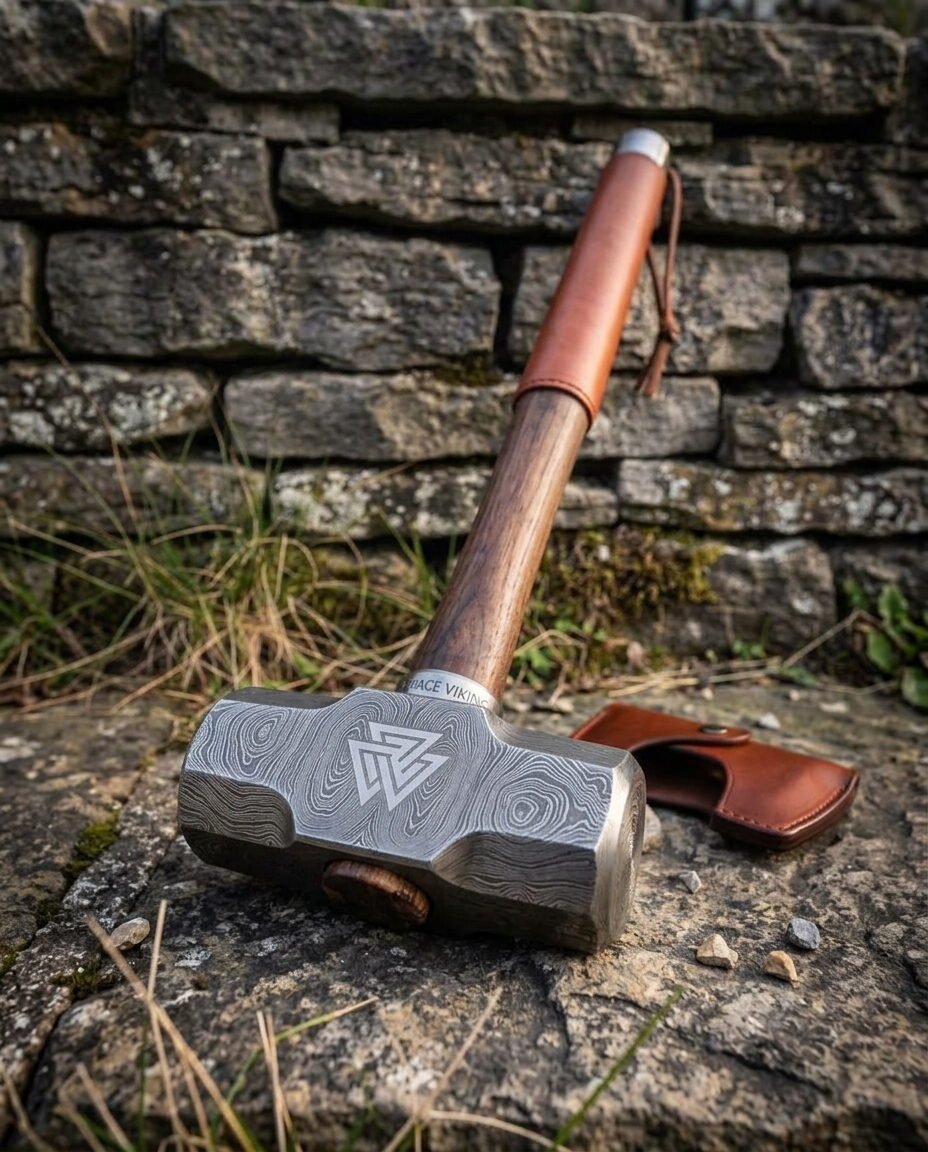
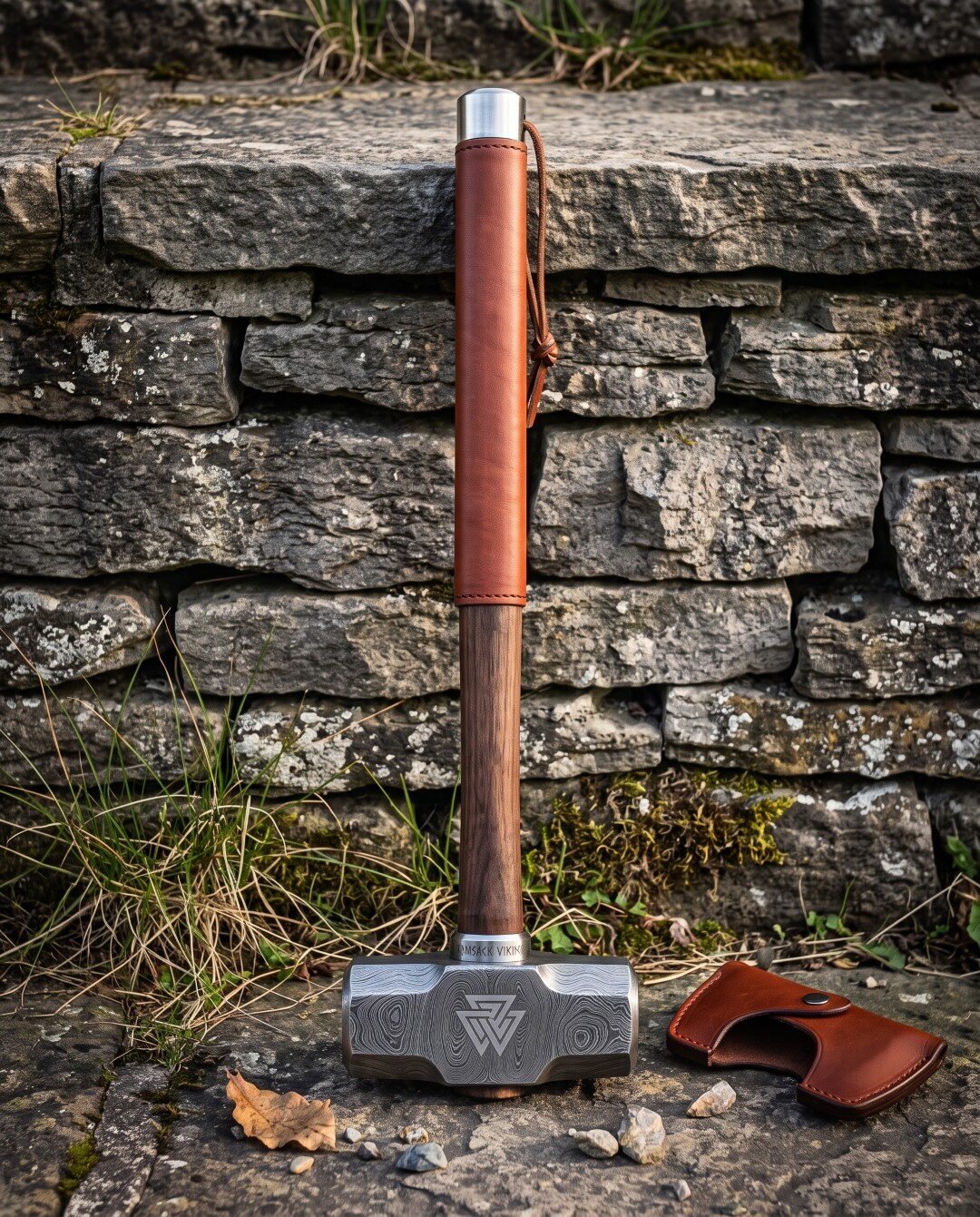
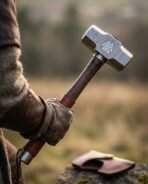
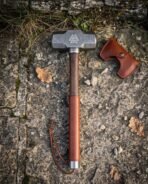
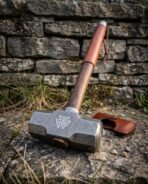
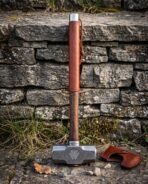
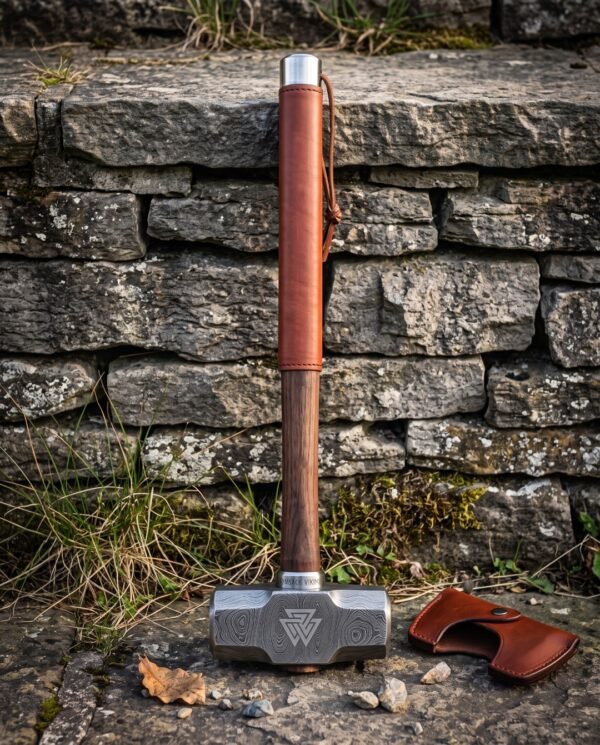
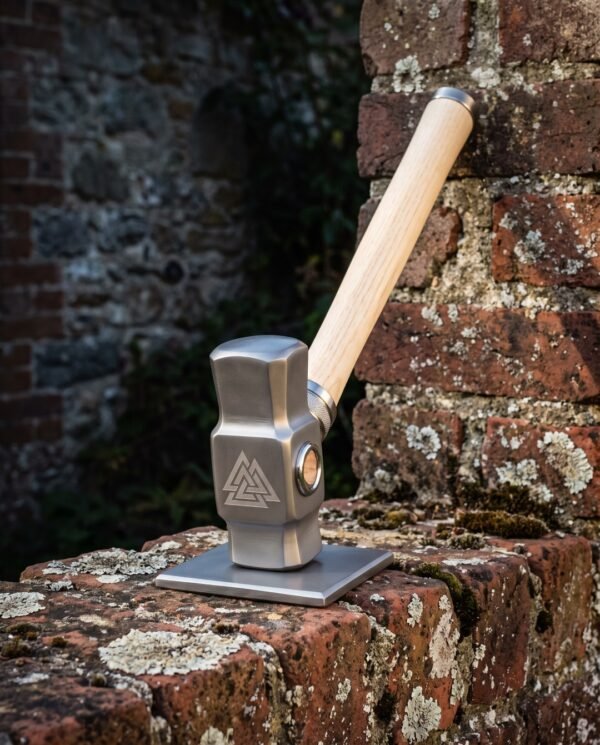
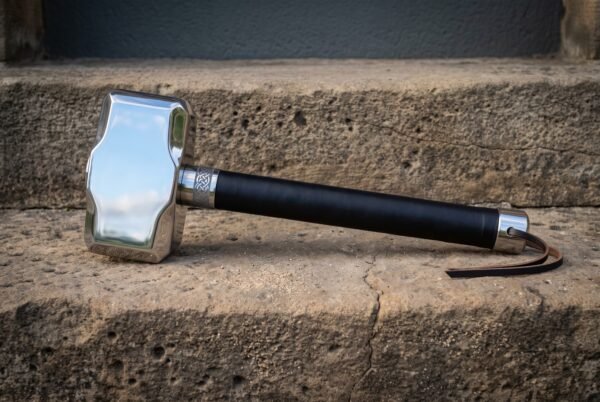
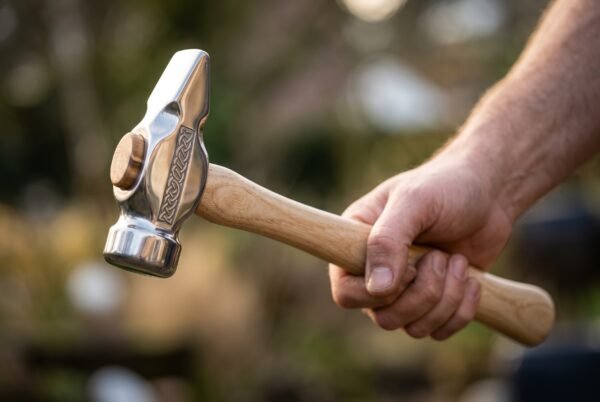
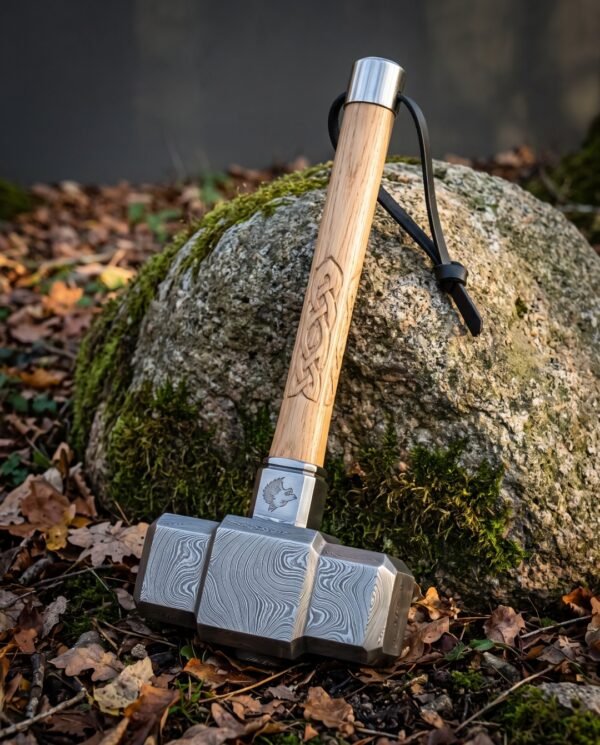
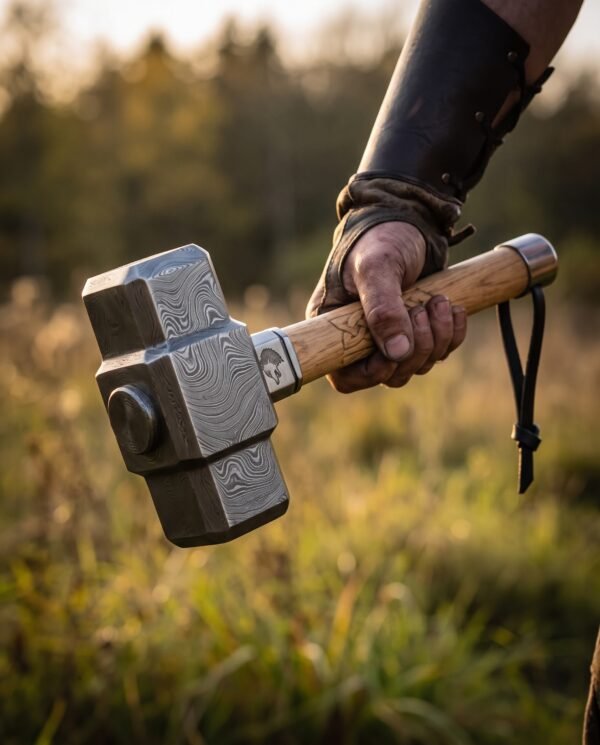
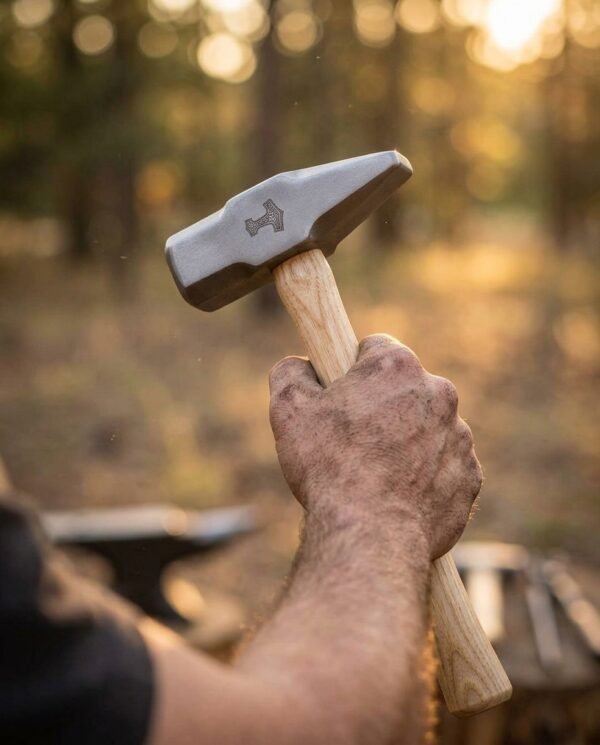
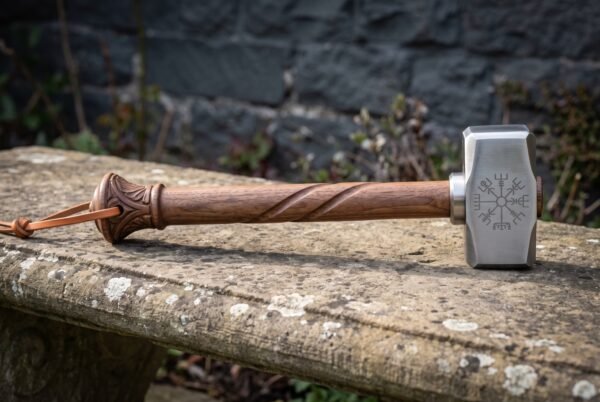
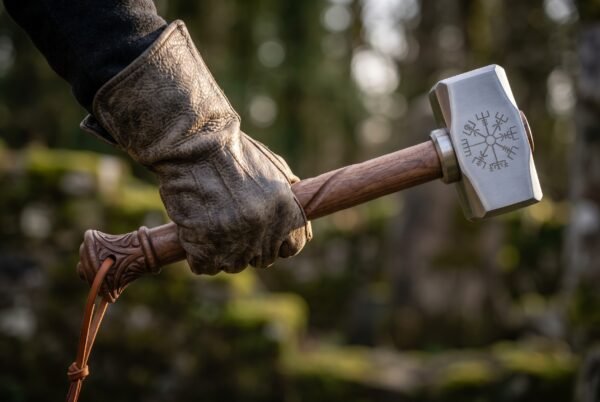
Anvilsong is a hand forged blacksmith hammer with a heavy double faced head, forge welded from 1095 and 15N20 in a pattern welded billet, etched to bring the layers up and cut across the cheek with a valknut. The head is hung on a long hardwood handle that is wrapped in leather over its upper half and finished with a steel collar and a wrist thong, and it ships with a fitted leather head cover.
Pattern welded steel is far older than the trade name Damascus that gets attached to it. Swords made by forge welding bundles of iron and steel rods together turn up across northern Europe from the Roman iron age onward, and Scandinavian smiths were producing pattern welded blades of extraordinary complexity through the Migration period and into the Viking age. They did it because early bloomery iron was inconsistent, and welding many pieces together averaged out the bad spots. The pattern was a consequence. It only became the point later. This one is forged, welded, etched, heat treated, hung and engraved in a Czech Republic workshop. The three locked triangles are the valknut, and where it appears and what we actually know is worth reading before you carry it.
Specifications
| Head material | 1095 and 15N20 pattern welded Damascus, forge welded and etched |
|---|
| Hardness | 58 to 60 HRC |
|---|
| Head type | Double faced sledge form with chamfered octagonal cheeks and slightly domed faces |
|---|
| Engraving | Valknut cut into the cheek, maker mark stamped on the top face |
|---|
| Collar | Steel collar where the handle meets the head |
|---|
| Handle | Dark hardwood with a hand stitched tan leather sleeve over the rear half |
|---|
| Butt | Polished steel end cap with a leather wrist thong |
|---|
| Hang | Wedged in the eye with a wood wedge and a steel cross wedge |
|---|
| Finish | Deep etch on the head, oiled handle, hand stitched leather |
|---|
| Supplied with | Fitted tan leather head cover with snap strap |
|---|
| Intended use | Collector piece, forge display and light bench work |
|---|
| SKU | RK-1444 |
|---|
How a pattern welded billet is actually made
This is worth understanding because a great many things sold as Damascus are not. Real pattern welded steel starts with a stack of alternating bars of two different alloys. Here that is 1095, a simple high carbon steel, and 15N20, which is a carbon steel carrying around two percent nickel and which was originally made for bandsaw blades.
The stack is brought to welding heat, somewhere above two thousand degrees Fahrenheit at a bright yellow heat, fluxed, and struck or pressed until the surfaces fuse into a single solid bar. That bar is then drawn out, cut, folded back on itself and welded again, and each cycle doubles the layer count. Five folds from a seven bar stack gets you well over two hundred layers. Manipulating the billet, twisting it, drilling into it, grinding waves into the surface before flattening it, is what turns straight lines into the flowing patterns you can see across this head.
The pattern only becomes visible at the very end. Finished and polished, a pattern welded bar looks like plain grey steel. It goes into an acid etch, and because the nickel in the 15N20 resists the acid far better than the plain 1095 does, the 1095 layers are eaten back and go dark while the 15N20 stands proud and stays bright. That contrast is the pattern, and it runs all the way through the thickness of the head rather than sitting on the surface. Grind this head down and you would find the same layers underneath.
The hardness, and the honest limits of a Damascus hammer
The head is heat treated to 58 to 60 HRC, which is our blade hardness. That is what a pattern welded high carbon head is heat treated to, and it produces a face that will never mushroom and an etch that holds its crispness for a lifetime.
It also means we have to be straight with you about how to use it. A steel face at 58 to 60 HRC is hard, and hard steel chips rather than deforming. This is a collector piece and a forge display hammer, and it will do light bench work happily, setting rivets, drawing small stock on hot metal, tapping a punch. What it is not is a production striking hammer for daily heavy work, and it must never be struck against hardened steel, against another hammer face, or against masonry. That is how chips happen, and a chip off a hard face leaves at speed. If you want a hammer for hours of hard forging, buy a plain carbon head drawn back into the low fifties, which is what a working smith actually wants for that job. We would rather sell you the right hammer than the prettiest one.
The handle is hardwood, hung with a wood wedge and a steel cross wedge in a flared eye, which is the proper way to hang a striking tool. The upper half is wrapped in hand stitched leather for grip and the butt carries a steel collar and a wrist thong.
Engraving, runes and your own design
Use the rune converter on this page to turn a name, a date or a short phrase into Elder Futhark and we will cut it into the steel or the leather. If you would rather have a Viking pattern than a rune line, choose your own design in the engraving option above the add to cart button and tell us where it goes. Where a piece already carries an engraved design, your chosen engraving replaces it rather than sitting alongside it. On this hammer the cheek of the head is the engraving field, so a name, a date or a shop mark takes the place of the valknut. We can also cut into the leather of the handle wrap or into the head cover instead, which is a good option for a retirement or anniversary gift. See the engraving page.
Mounting and display
This hammer was made to be looked at as much as used, and it rewards being displayed properly. Hang it head up on a wall bracket or a French cleat with the etched cheek facing out, and put a light on it from one side rather than from above. A pattern welded surface under flat overhead light collapses into grey. Under raking light the layers come alive and the whole pattern moves as you walk past it.
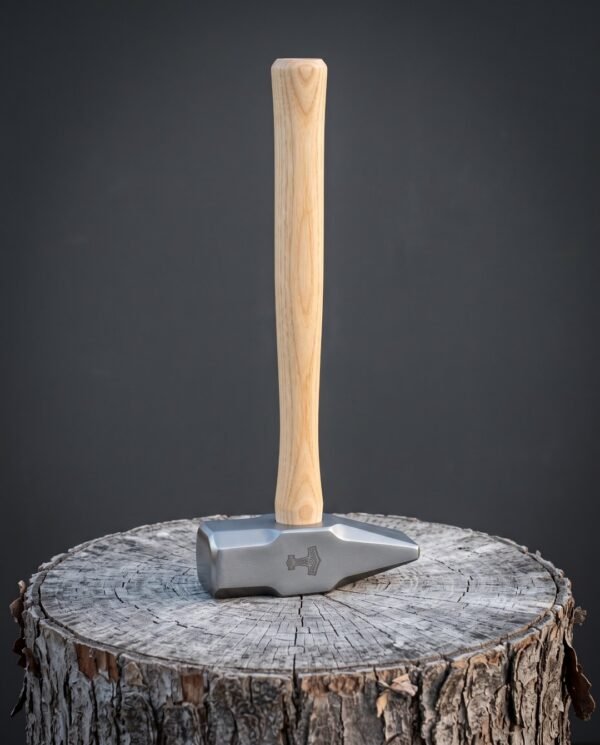
On a bench or a shelf it stands well on its head with the handle vertical, which is how it is shown in the photographs, and the leather head cover keeps dust and knocks off the faces when it is not on show. If it is going into a working forge rather than a study, keep it on a rack rather than in a drawer with other tools, since the thing most likely to mark this head is another piece of hardened steel rattling against it.
Care
Pattern welded steel rusts more visibly than plain steel does, because rust attacks the two alloys at different rates and can blotch the pattern. Wipe the head down after every handling, keep the leather cover on it, and maintain a film of light oil or a hard paste wax over the whole head. In a humid shop, check it monthly rather than annually.
If rust does appear, take it off gently with fine steel wool and oil rather than with a wheel or a coarse abrasive, because an aggressive cut will remove the etched relief and flatten the pattern. A hammer that has lost its etch can be re etched, but it is a job. The leather wrap wants an occasional light conditioning and should be kept away from solvent. Full guidance is on the steel care page. Etched steel wants its own routine, which is on the Damascus care page.
Made in the Czech Republic
Every piece we sell is made by hand in the Czech Republic. The smiths there work the way the trade has been worked for a long time, heating and hammering the steel, taking the bevels down by eye, and fitting the handle and the leather one at a time. There is no automated line anywhere in it, so small differences from one piece to the next are normal and expected.
Ransack Viking is a United States company based in Chicago, Illinois. We bring the pieces in ourselves, inspect them on arrival and ship them from our own warehouse. If you add engraving, that is carried out here in the United States before your order goes out.
A note on handmade variation
This is hand made rather than machine made or bulk produced, so what arrives will not be a pixel for pixel copy of the photograph. No two pattern welded billets ever produce the same figure, so the layer pattern on your head will be its own. Etch depth, the tone of the leather, the grain of the handle and the depth of the cut valknut all vary. The dimensions, the material and the build are the same every time. The character is not.
Frequently asked questions
Is this real Damascus or an etched pattern
It is real pattern welded steel, 1095 and 15N20 forge welded, folded and drawn into a billet. The pattern runs through the full thickness of the head rather than sitting on the surface, which is the difference between pattern welding and a printed or etched imitation.
Can I forge with it every day
We would not. At 58 to 60 HRC the face is hard, and hard faces chip under heavy repeated striking. This is a collector and display hammer that will handle light bench work comfortably. For hours of production forging you want a plain carbon head drawn back softer.
Can I strike a hardened punch or another hammer with it
No, and please do not. Hard steel against hard steel is how faces chip, and a chip from a face at this hardness comes off fast enough to injure. Use it on hot stock and soft material only.
What does the valknut mean
Three interlocked triangles found on Gotland picture stones and the Oseberg burial timbers, consistently in scenes tied to Odin and the dead. The precise meaning is not recorded anywhere, and the word valknut itself is a modern Norwegian coinage rather than a Norse term.
Is the leather head cover included
Yes. A fitted leather cover comes with the hammer and it is worth using. It keeps the etched faces off other tools and keeps dust and moisture away from the pattern between showings.
How long does it take to make
Processing is one to two weeks because the billet is welded, the head forged and treated and the handle hung to order, then shipping is free within the United States. Returns are accepted within seven days. Custom engraving adds a few days.
What is in the box
- One hand forged pattern welded Damascus blacksmith hammer, hung and wedged
- Hardwood handle with hand stitched leather wrap, steel collar and wrist thong
- Fitted leather head cover
- Care card with etching and oiling notes
- Forged and finished in the Czech Republic
Explore the range
See more in blacksmith tools, splitting and felling axes and engraved and personalized, or read the guides.
Others in the same line
If this one is not quite right, there is the Wayrune blacksmith tool, forged from 1095. Also in this group is the Runepein blacksmith tool, forged from 1095. Sitting beside it in the catalogue is the Thunderpein blacksmith tool, forged from 1095.
From the same corner of the shop, there is the Oakhewn sword stand. You can have this made your way instead on the design your own page.


This thing is a beast in the best way. The craftsmanship really shows in the small details. Can’t recommend this enough.
My husband was speechless when he opened this. Exactly as described and clearly made with care. This will be a family heirloom for sure.
Perfect gift. Perfect quality. No complaints. The craftsmanship really shows in the small details. So worth it.
Perfect gift. Perfect quality. No complaints. Nice touch that it ships from within the US even though it’s crafted in the Czech Republic. Already telling my friends to check this out.
Photos don’t do this piece justice at all. The craftsmanship really shows in the small details. Worth every penny.