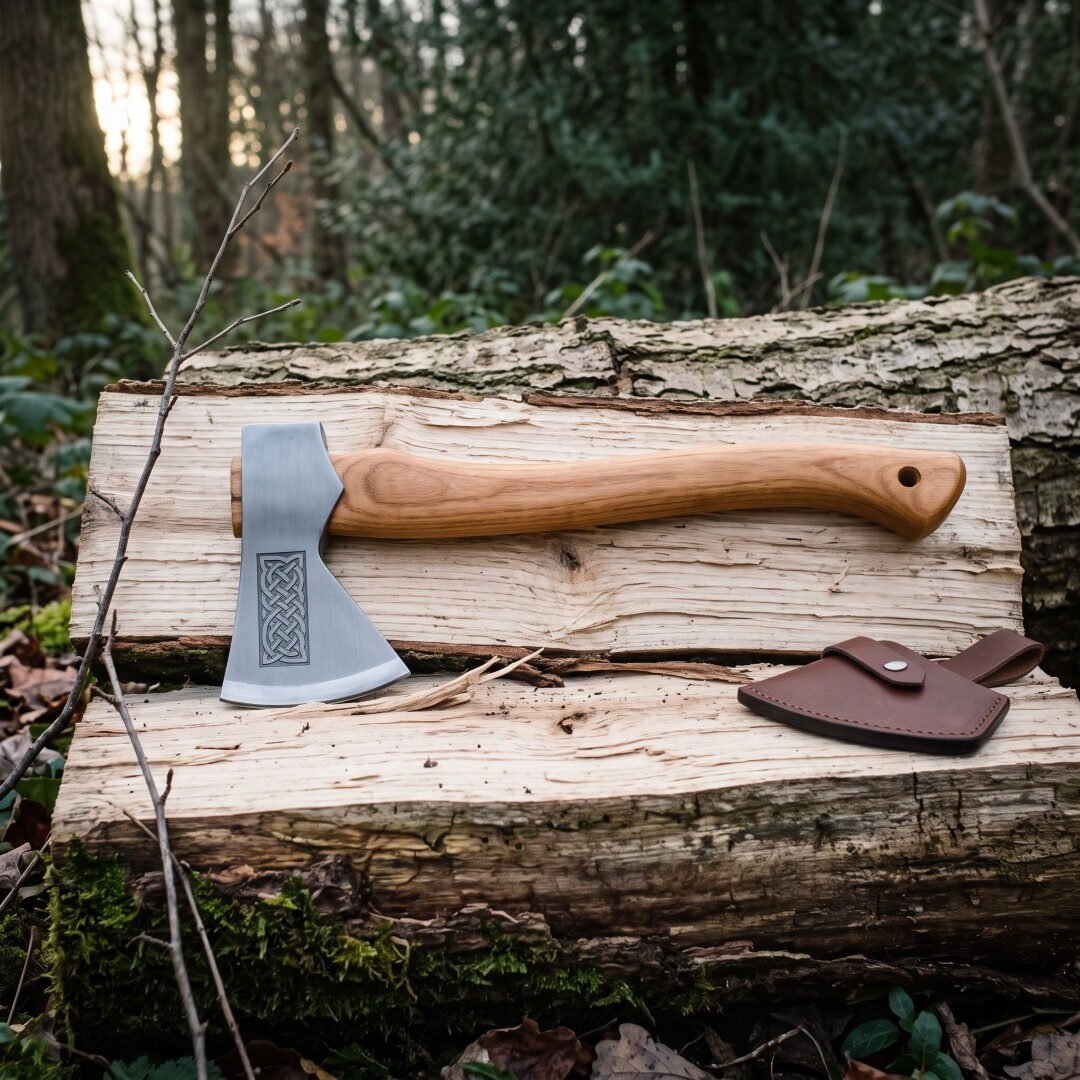
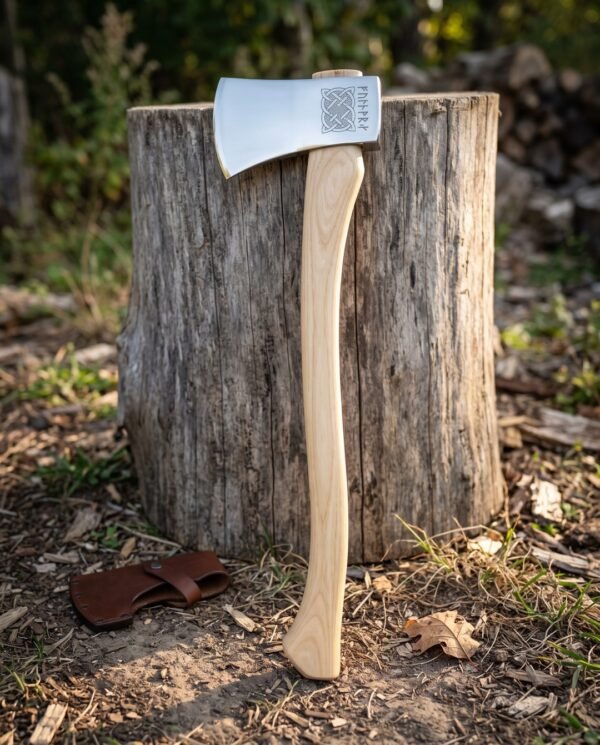
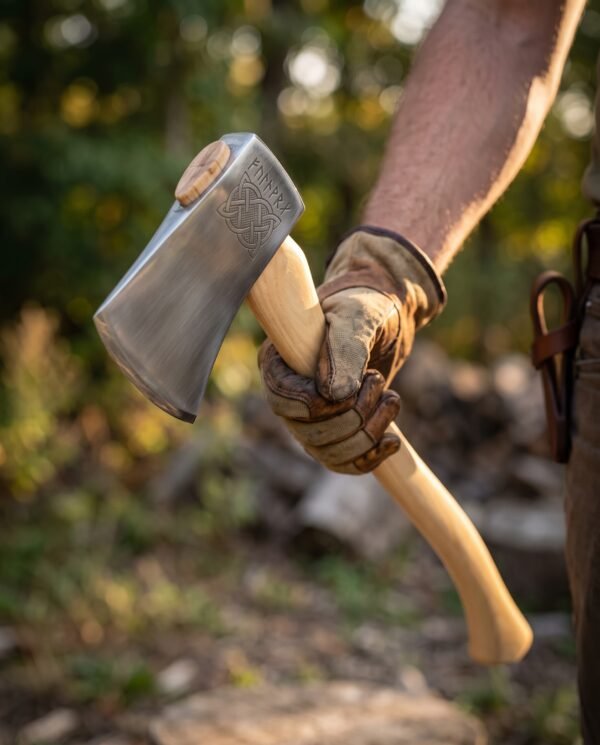
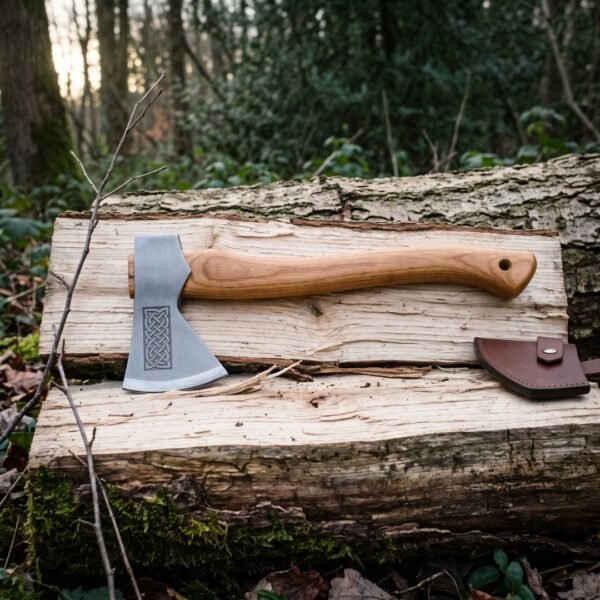
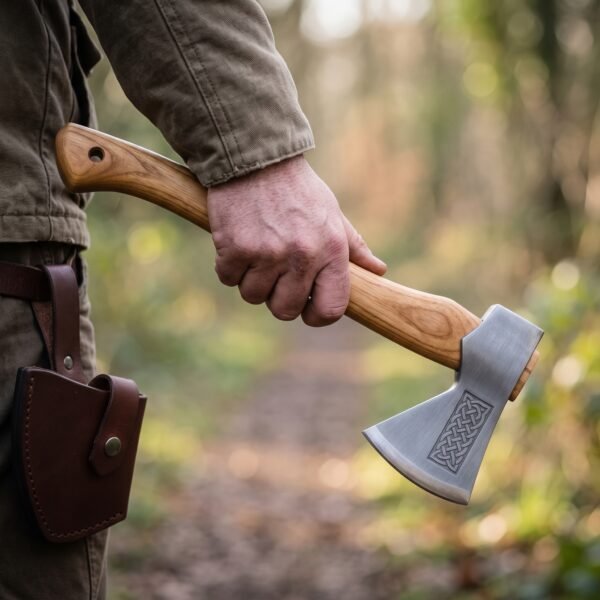
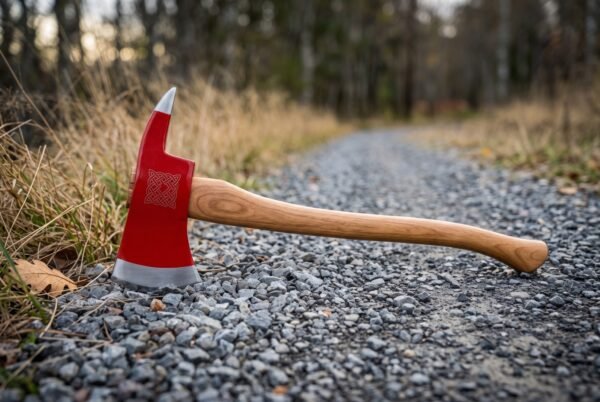
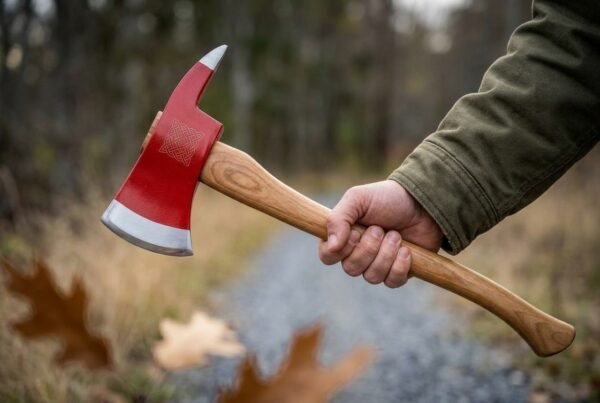
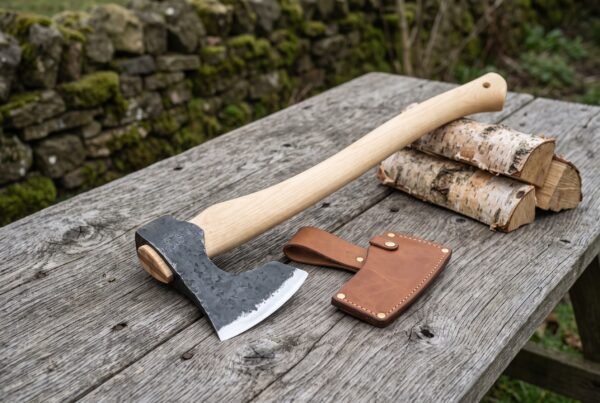
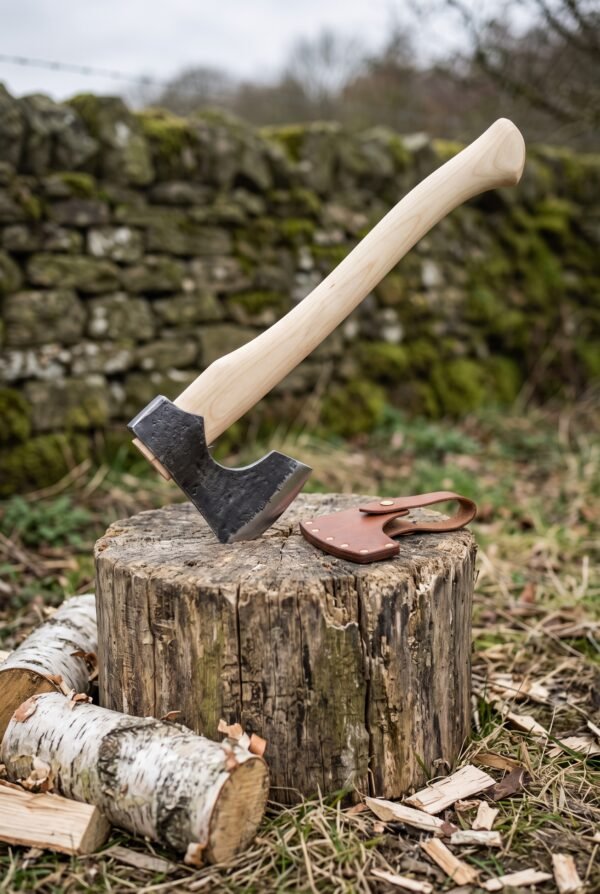
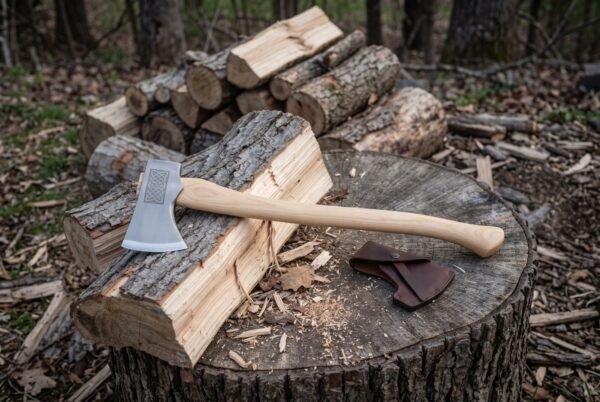
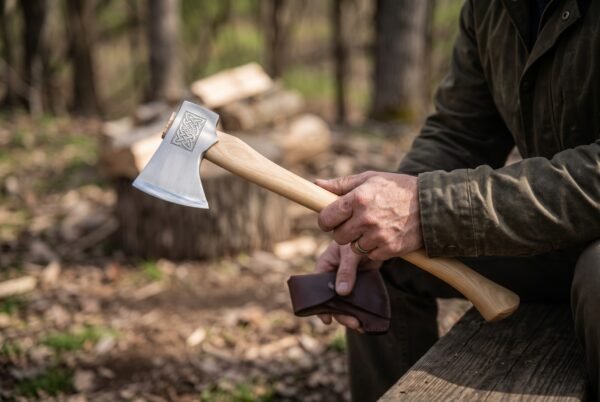
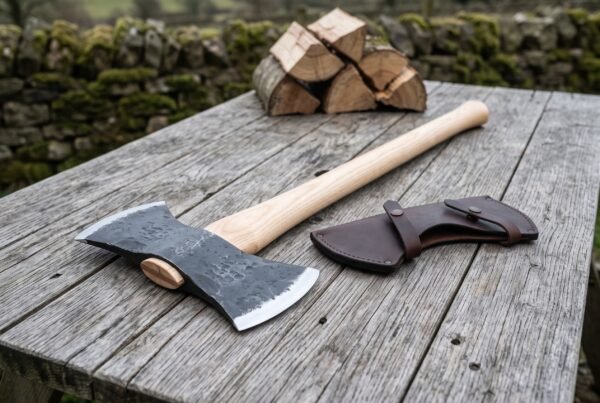
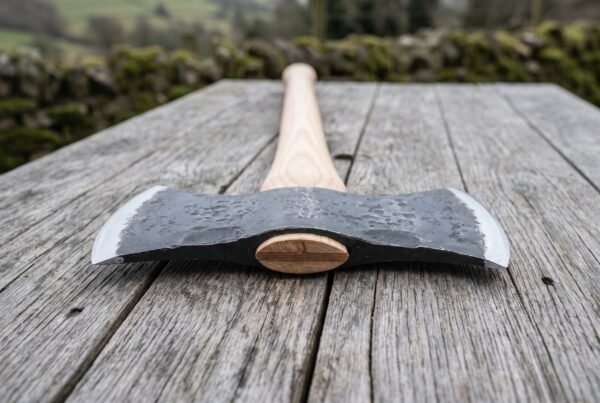
A one hand felling and camp axe with a drifted eye, a high centred bit and a long sweeping beard under the edge, hung on a slim curved hickory handle with a lanyard hole through the swell. The cheek carries a panel of cut knotwork and the edge travels in a fitted leather mask. It is the size of axe that lives in a truck or on a pack rather than in a woodshed, long enough in the handle to fell a standing sapling or limb a downed trunk, short enough to swing one handed while you hold the wood with the other.
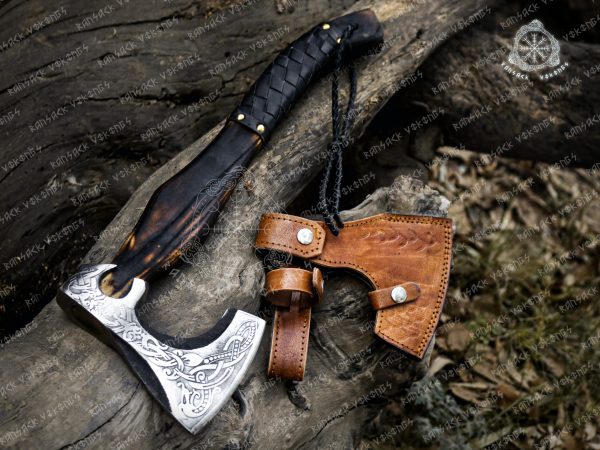
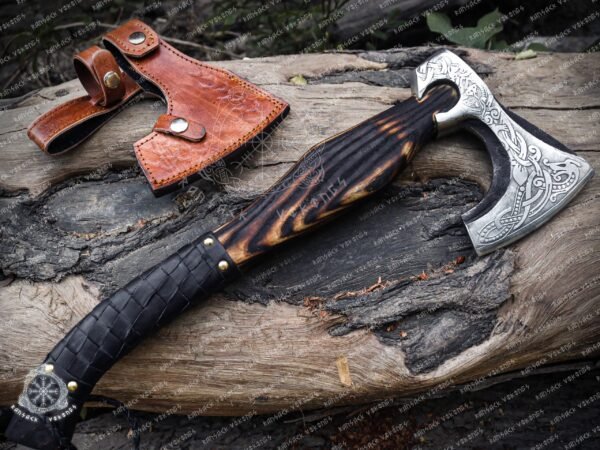
Something worth knowing about the ancestors of this shape. Viking age axe heads are usually far lighter than people expect, often only one to two pounds, because iron was expensive and a smith made the body from cheap wrought iron and forge welded a narrow strip of harder steel into the edge where it actually mattered. The result was a fast axe on a long haft that cut well above its weight. We do not need to save steel any more, so this head is one piece of 1095 through and through, but the profile still follows that logic of putting the mass where the work happens. Forged, ground, heat treated, hung and finished in the Czech Republic. The log, the woodland and the twigs in the photograph are scenery. Head weight, haft length and what each shape is for are set out in how to choose a Viking axe.
Specifications
| Head material | 1095 high carbon steel, hardened and tempered to 54 to 58 HRC at the edge |
|---|
| Head weight | Approximately 1.5 to 1.75 pounds |
|---|
| Cutting edge | Approximately 4 to 4.5 inches from beard to top corner |
|---|
| Handle | American hickory, approximately 20 inches, curved with a swell and a lanyard hole |
|---|
| Hang | Drifted tapered eye, wood wedge and a steel cross wedge |
|---|
| Finish | Satin ground bit with a lightly hammered upper cheek |
|---|
| Decoration | Engraved interlaced knotwork panel on the cheek |
|---|
| Sheath | Vegetable tanned leather blade mask with a stud strap |
|---|
| Overall length | Approximately 20 to 21 inches |
|---|
| SKU | RK-1515 |
|---|
Why the eye is tapered and what the wedges do
The single most important part of an axe is the hole. The eye on this head is drifted, which means it was punched hot and then driven open with a tapered steel drift rather than drilled, so the grain of the steel flows around the opening instead of being cut through. That is why a forged eye survives a lifetime of impact where a machined one can start a crack at a corner.
The eye is also not a parallel tube. It is wider at the top than at the bottom. The handle is driven up through it from below, so the wood sits in a wedge shaped socket and cannot travel downward under a swing. Then a wooden wedge is driven into the kerf in the end grain to spread the wood sideways and fill the eye completely, and a steel cross wedge goes in at an angle to spread it the other way. Between the taper and the two wedges the head is locked in three directions, which is why a properly hung axe stays on the handle for decades and why a loose head is always a symptom of dried out wood rather than a bad design.
The long beard under the edge is not styling either. It gives you somewhere to choke up and grip the head safely for fine carving work, and it adds edge length for the same head weight, which is exactly what you want in an axe used for limbing rather than splitting.
The steel and the geometry
The head is 1095 high carbon steel, hardened and drawn back to 54 to 58 HRC at the edge. On an axe you do not want the same hardness you would put on a knife. An axe edge meets frozen knots, buried grit and the occasional nail, and glass hard steel chips out of that where slightly softer steel dents and comes back with a file. This window holds an edge through a day of limbing and can still be brought back on a stone in ten minutes.
The bit is ground with a slight convexity behind the edge rather than a flat bevel. That convex cheek is what pops a chip out of the cut instead of letting the axe bury itself and stick, and it is the difference between an axe that throws chips and one that wedges. Because this is a felling and limbing profile rather than a splitting profile, the cheeks are relatively thin, so use it for cutting across the grain and use a maul or a splitting axe for rounds.
Engraving, runes and your own design
Use the rune converter on this page to turn a name, a date or a short phrase into Elder Futhark and we will cut it into the steel or the leather. If you would rather have a Viking pattern than a rune line, choose your own design in the engraving option above the add to cart button and tell us where it goes. Where a piece already carries an engraved design, your chosen engraving replaces it rather than sitting alongside it. On this axe the cheek panel is the natural spot, and a rune line along the leather mask is a good second choice if you want to keep the knotwork on the steel. Photographs are on the engraving page.
Mounting, storage and display
This is a working axe rather than a wall piece, but it hangs well from the lanyard hole on a peg with the mask fitted. If you do display it, keep it out of direct sun and away from a heat source, because a hickory handle that dries out is a handle that shrinks in the eye, and a loose head on a display axe is just as dangerous as a loose head on a working one. Check the hang before every session by holding the handle and tapping the poll on a block. A dead thump is right, a rattle or a ring means stop and re wedge it.
Care
Wipe the head after use, especially after cutting green wood, because sap is acidic and will spot bare steel overnight. Keep a light film of oil on the bit and store it in the mask only when both are dry. Oil the handle two or three times a year with boiled linseed, working it into the end grain at the eye where the wood loses moisture fastest. Sharpen with a file and a puck rather than a powered wheel, since a grinder can draw the temper out of an edge in seconds and undo the heat treat. The oiling and rust notes on steel care apply to the head. Sharpening starts with a file, and how to sharpen an axe takes it through to the strop.
Made in the Czech Republic
This is a handmade piece from the Czech Republic, made in a workshop that still forges, grinds and finishes by hand instead of stamping parts out. The smiths there have kept the older way of working, and the wood, horn and leather are shaped and fitted by hand as well. Two pieces of the same design will never be identical, and that is part of what you are buying.
Ransack Viking is a United States company. We handle the import ourselves, look over every piece when it lands and ship from our warehouse in Chicago, Illinois. Engraving is done in the United States after the piece arrives, so your design goes on before we send it out.
A note on handmade variation
This is hand made, not machine made or bulk produced, so what arrives will not be a pixel for pixel copy of the photograph. Hickory grain and colour run from near white to warm honey and no two handles match, the hammer texture on the cheek is different every time, and the exact sweep of the beard is set by hand. The dimensions, the material and the build are the same every time. The character is not.
Frequently asked questions
Is this a felling axe or a splitting axe
A felling and limbing axe. The cheeks are relatively thin and the bit is ground to slice across the grain. For splitting rounds you want a fatter wedge shaped head, and using this one on a big round will just have it stick.
Is it sharp out of the box
Yes, shaving sharp at the edge and ready to cut. The leather mask is fitted for that reason, so keep it on whenever the axe is not in your hand.
Can I use it one handed
Yes, that is what a 20 inch handle is for. Choke up behind the beard for carving and feathering, and hold at the swell for limbing. The lanyard hole takes a wrist loop if you are working above ground.
What if the head loosens
It usually means the handle has dried out, and it is fixable. Oil the eye and the end grain, and if it does not take up, send it back and we will re wedge or re hang it. That is covered under the warranty.
Will it rust
1095 is not stainless and it will spot if you leave sap or damp on it. A wipe and a thin oil film after every use keeps it clean, and light surface rust comes off with oil and a nylon pad.
How long does it take to ship
Processing is one to two weeks because every head is forged and hung to order, then shipping is free inside the United States.
What is in the box
- One hand forged 1095 axe head, hung and wedged
- Curved American hickory handle with a lanyard hole
- Fitted vegetable tanned leather blade mask
- Care and sharpening sheet
- Lifetime warranty against defects in forging, grind, heat treat and hang
- Forged and finished in the Czech Republic
Explore the range
See more in splitting and felling axes, viking axes, battle axes and blacksmith tools, or read the guides on sharpening and hanging.
Worth a look beside this
If this one is not quite right, there is the Emberbite felling axe, forged from 1095. Also in this group is the Twinbite felling axe, forged from 1095. Sitting beside it in the catalogue is the Ashfell felling axe, forged from 1095.
From the same corner of the shop, there is the Twincrescent double headed axe. Or start from a blank sheet on the custom Viking axe page.


Been eyeing this axe for months and it did not disappoint. The wood handle feels amazing and the balance is perfect. Weight and balance make it feel like a real functional piece not some cheap replica. Shipping was fast and everything arrived well packaged.
My husband was speechless when he opened this. 1095 Steel blade holds a razor edge right out of the box. Fit and finish is museum quality. You can tell real craftsmen made this by hand. This shop clearly takes pride in their work.
This axe beat every expectation I had. Weight and balance make it feel like a real functional piece not some cheap replica. This will be a family heirloom for sure.