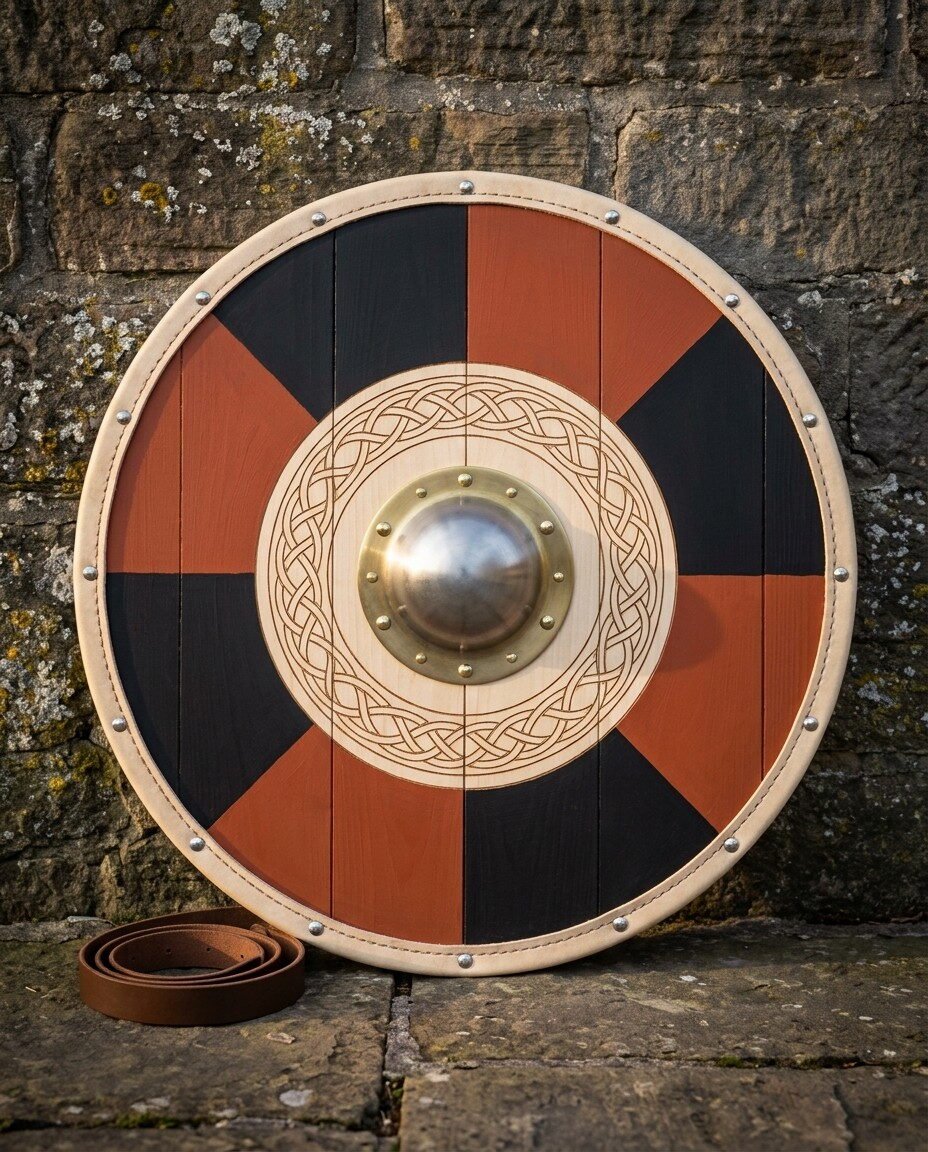
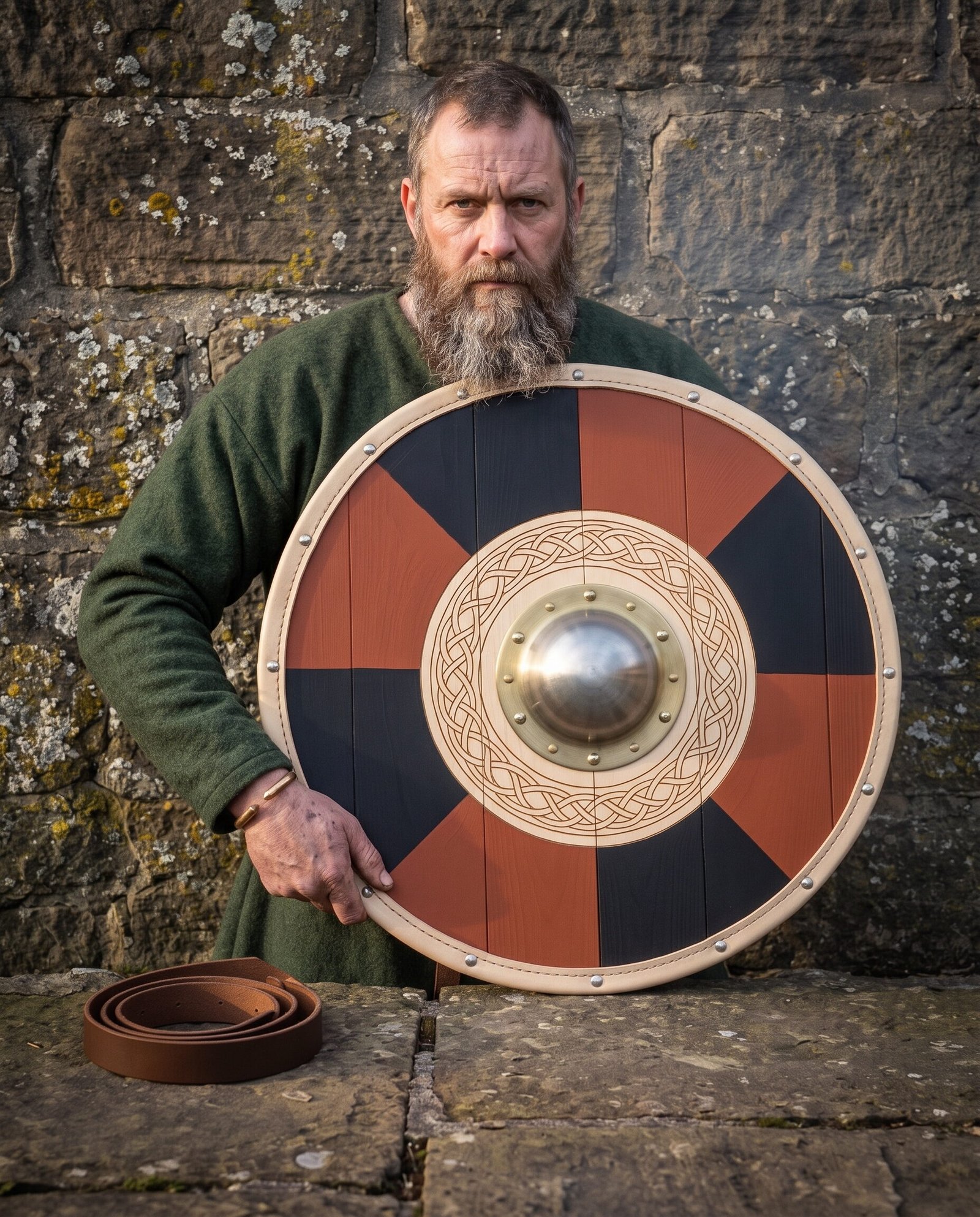
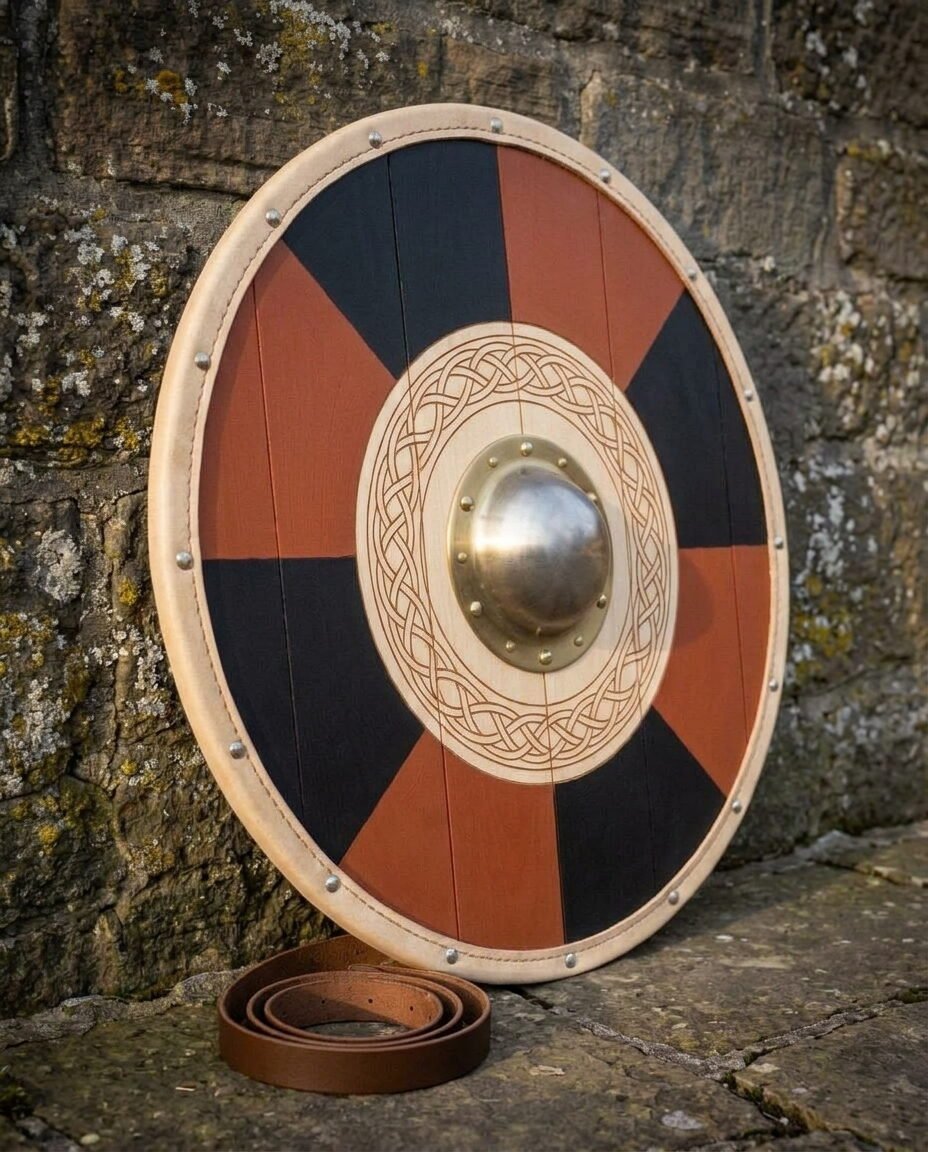
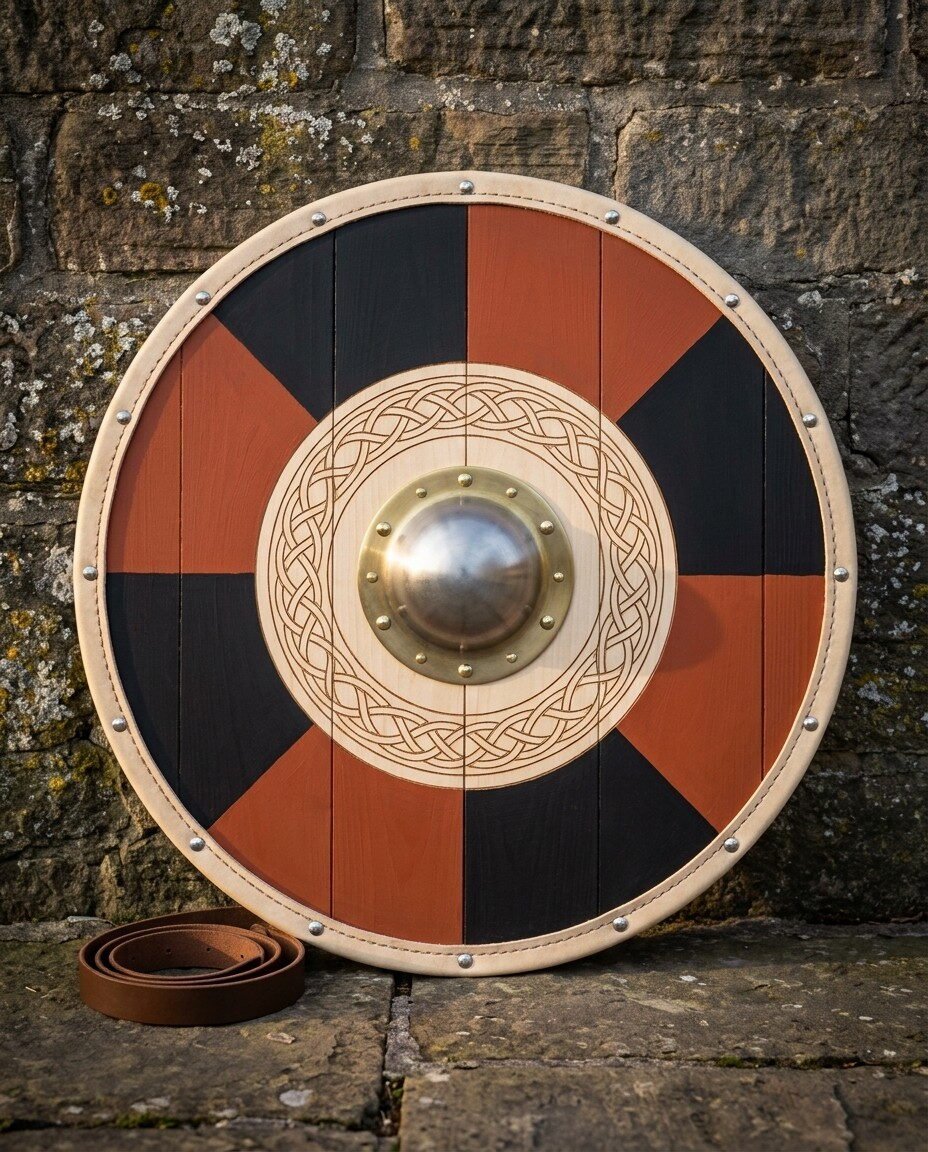
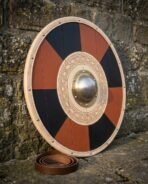
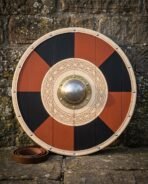
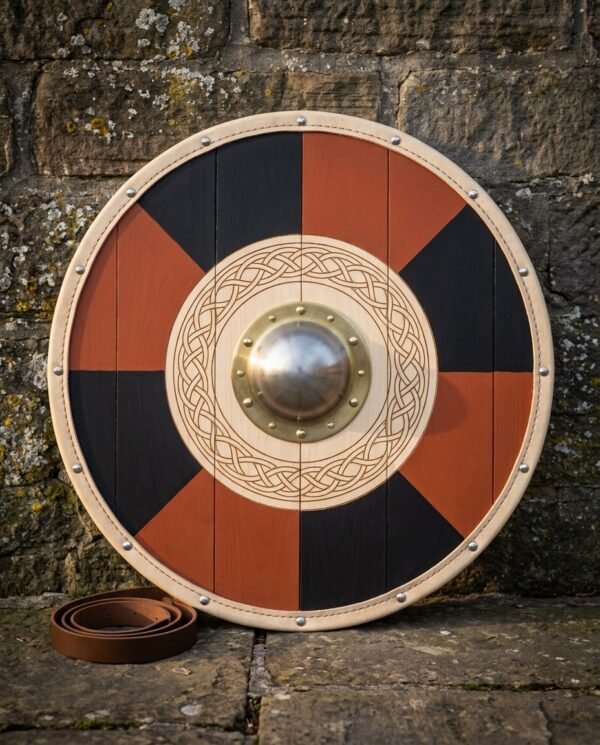
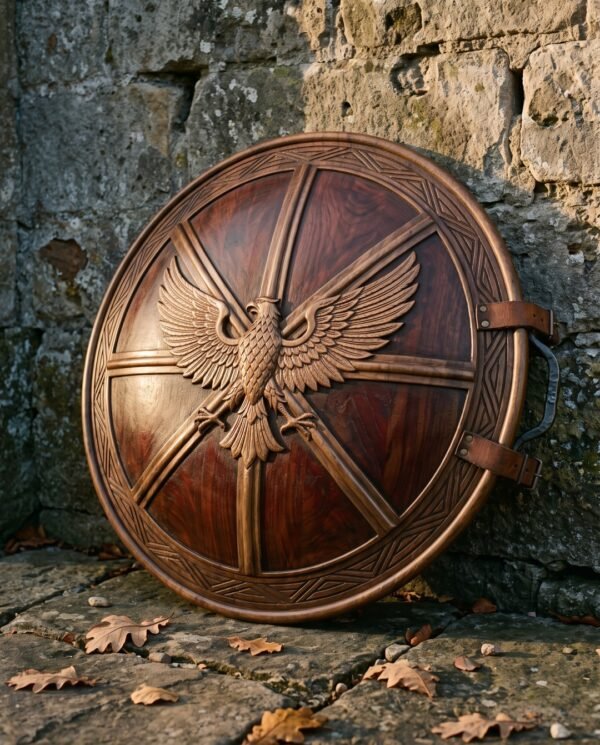
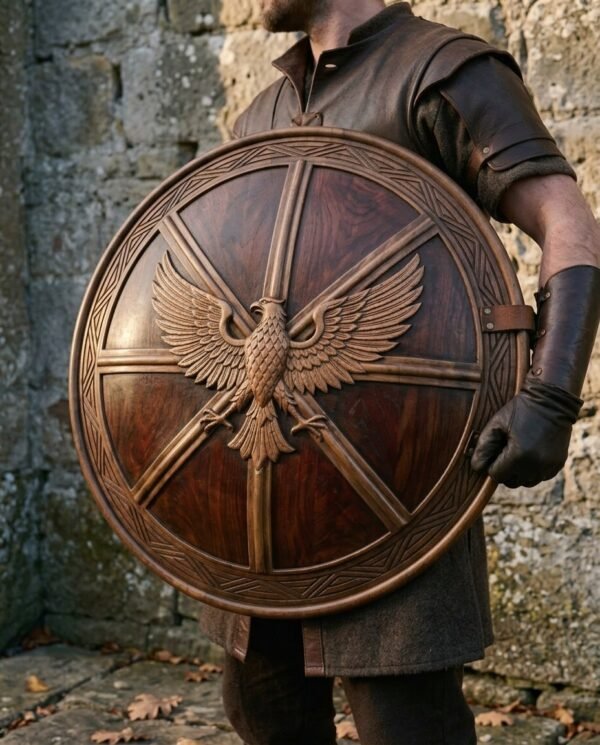
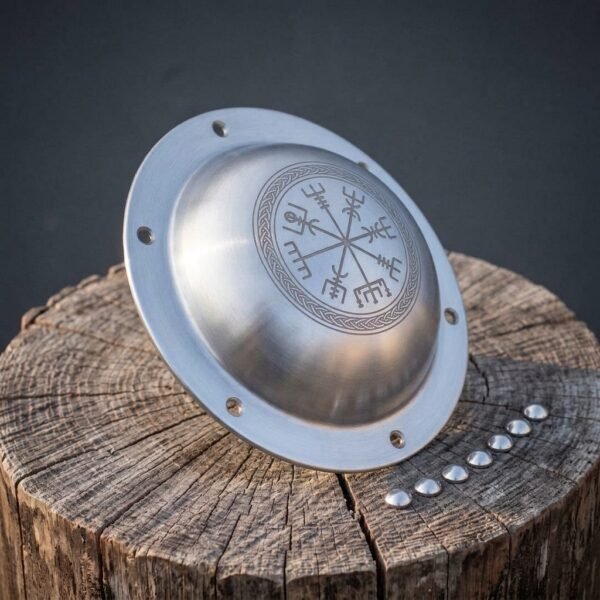
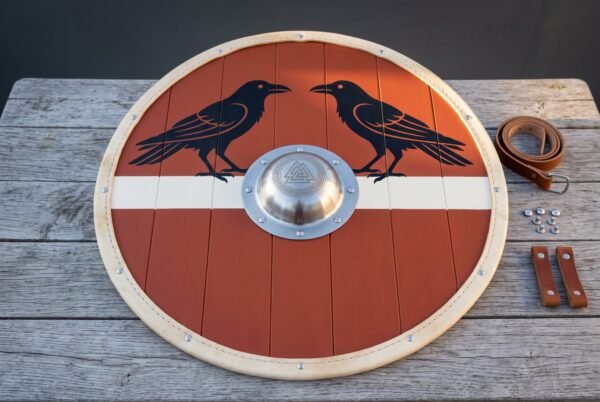
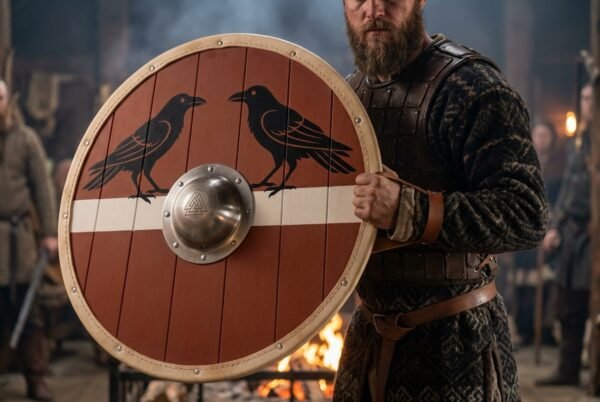
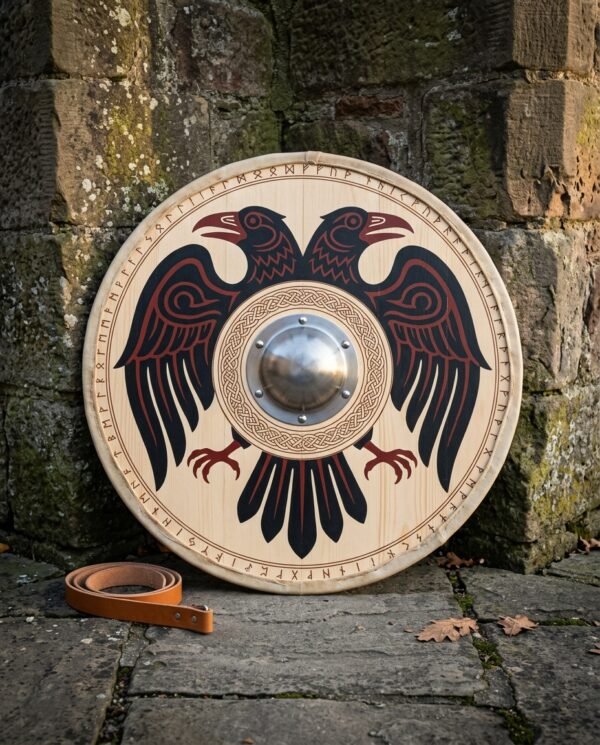
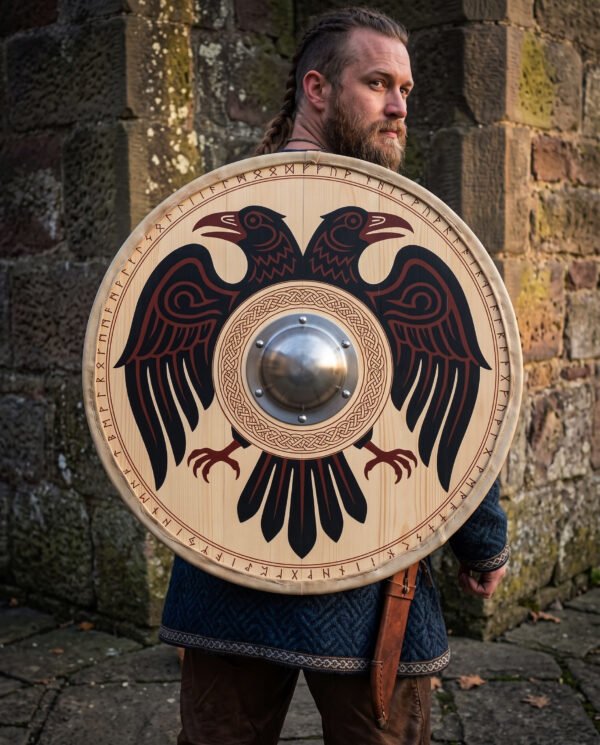
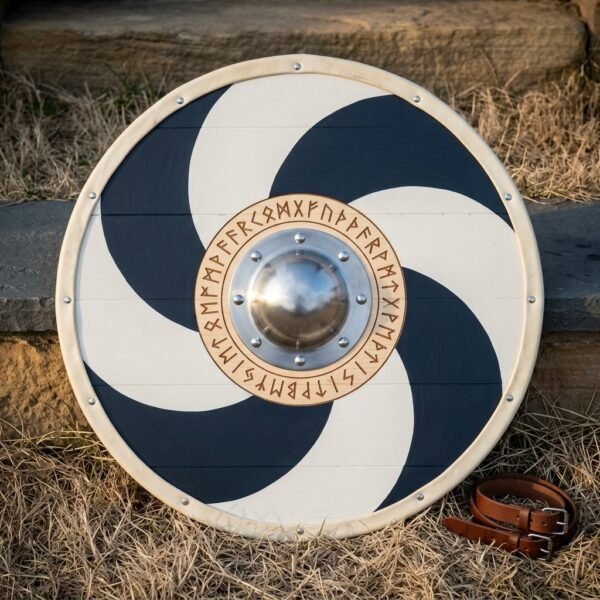
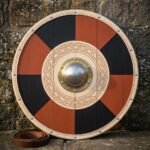
A planked round shield built the way the finds show, boards glued edge to edge across the face rather than a sheet of plywood, painted in eight alternating segments of oxide red and charcoal black, with a ring of carved knotwork circling the centre and a domed steel boss on a brass flange riveted over the hand hole. The rim is bound in rawhide and pinned with studs all the way round. On the back is a single wooden grip bar across the hand hole and a leather arm strap, which is how a Viking shield is carried and why the boss exists at all.
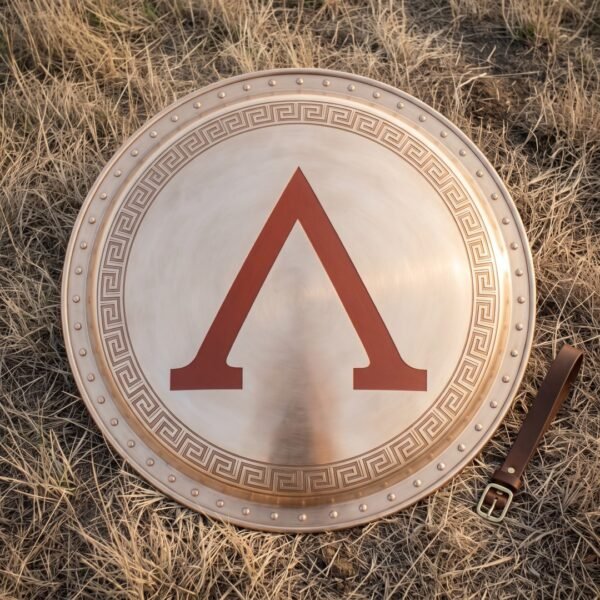
The best evidence we have for what these looked like came out of a burial mound at Gokstad in Norway in 1880. Sixty four shields were found hung in overlapping rows along the gunwales of the ship, painted alternately yellow and black, about 37 inches across, and built from boards that were only around 7 mm thick. That is thinner than most people believe possible. A Viking shield was not a slab, it was a light disc meant to be moved, and thinness was a feature rather than a compromise, because a shield you can throw across your body fast beats a heavy one you have to lever into place. Ours is built a little thicker than the originals and a little smaller across so that it survives modern handling. Cut, planked, painted, carved and fitted in the Czech Republic. The loose leather strap on the ground in the photograph is a studio prop and is not part of the order. How these were planked, faced and gripped is in our guide to Viking shields.
Specifications
| Diameter | Approximately 30 inches, other sizes built to order |
|---|
| Board | Linden planks glued edge to edge, approximately 12 mm thick |
|---|
| Face | Eight alternating segments of oxide red and charcoal black around an unpainted central ring |
|---|
| Carving | Interlaced knotwork band carved into the natural wood ring around the boss |
|---|
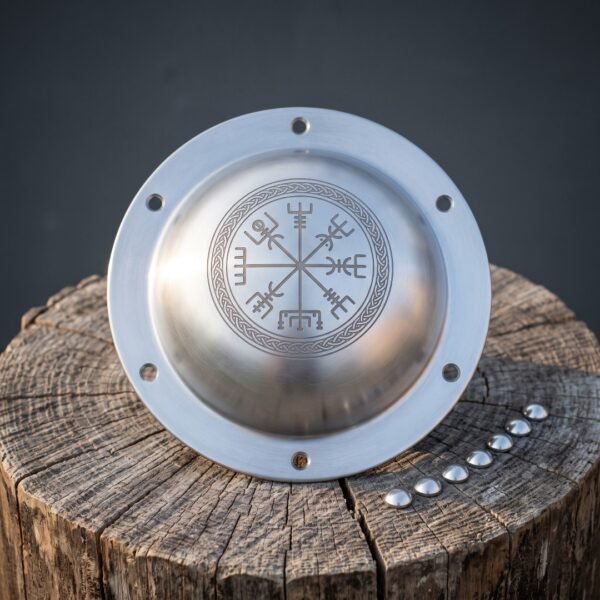
| Boss | Domed polished steel boss on a brass flange with brass rivets, over a cut hand hole |
|---|
| Rim | Pale rawhide binding, stitched and pinned with studs around the circumference |
|---|
| Back fittings | Wooden grip bar across the hand hole and a leather arm strap |
|---|
| Weight | Approximately 9 to 11 pounds |
|---|
| Use | Display, living history, film, stage and light contact |
|---|
| SKU | RK-1521 |
|---|
What the boss is actually for
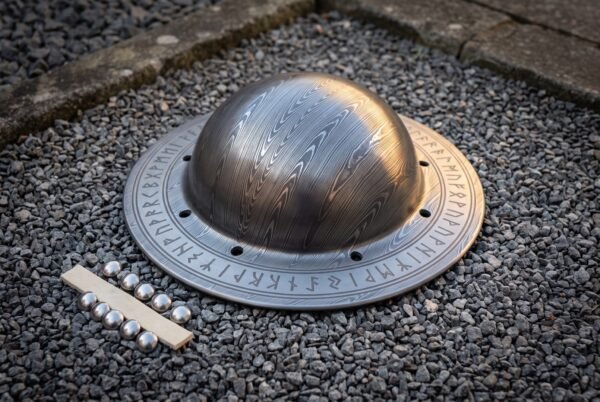
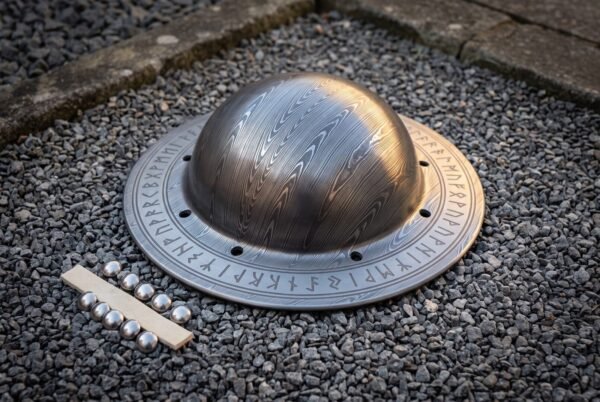
People assume the dome in the middle of a Viking shield is armour for the shield. It is not. It is armour for your hand. Cut a hole through the centre of the board and put a bar across the back of it, and you have a grip that lets the shield rotate freely in your fist, which is what makes this kind of shield so quick. But you have also left your knuckles sitting in an open hole in the middle of the thing everyone is aiming at. The boss is the iron or brass cap that covers that hole, and it is why the centre grip design works at all.
It does three other things along the way. Its flange spreads any blow that lands centrally into the boards rather than letting it punch through. It is a hard convex surface, so a strike that hits it is deflected outward instead of stopping. And it can be used offensively, punching with the shield to knock a blade or an opponent aside, which the sagas describe and which every reenactor discovers within an hour of picking one up.
Compare that with the later kite and heater shields, which are strapped flat to the forearm and have no boss, because their grip is not in the middle and there is no hole to protect. When you see a boss, you are looking at a centre gripped shield, and the two facts always travel together.
The board, the paint and the rim
The face is planked linden, the wood the Norse actually used, glued edge to edge so the grain of adjacent boards alternates. That alternation is what stops the disc cupping as it ages. Linden is chosen because it is light for its stiffness and because it is forgiving. It takes a cut and closes around it rather than splitting along the grain the way oak does, which is exactly what you want in something designed to be hit.
The rawhide rim is the most important part after the boss and the one most cheap shields leave off. A shield fails at its edge. A blow to the rim of an unbound board splits it inward along the glue lines, and a rawhide binding shrinks tight as it dries and holds the whole circumference in compression so the board cannot open. It is the reason a thin shield can survive at all. The paint is a matt oxide finish rather than a gloss, so it reads correctly in daylight and photographs without a plastic sheen.
Engraving, runes and your own design
Use the rune converter on this page to turn a name, a date or a short phrase into Elder Futhark and we will cut it into the steel or the leather. If you would rather have a Viking pattern than a rune line, choose your own design in the engraving option above the add to cart button and tell us where it goes. Where a piece already carries an engraved design, your chosen engraving replaces it rather than sitting alongside it. On a shield we carve into the wooden face rather than engrave metal, so your line can run around the boss ring where the existing knotwork sits, or across a painted segment, and we can also engrave the boss itself. See the engraving page.
Mounting and display
Hung on a wall this needs two points rather than one. A single nail through the arm strap will bow the strap and eventually tear the leather, so use a pair of flat hooks that carry the rim, or a plate hanger sized to the diameter. Keep it off an outside wall that runs cold and damp behind, because a shield sitting against condensation will swell along the glue lines. Away from a fireplace or a radiator for the same reason in reverse, since dry heat will shrink the boards and open a seam.
If you are carrying it rather than hanging it, adjust the arm strap so the grip bar sits in your fist with the boss centred over your knuckles, and set the strap so it takes the weight when you drop your arm. A shield hung on a shoulder strap all day will feel half its weight.
Care
Wood and rawhide both move with humidity, so keep it indoors and out of direct sun, which fades oxide paint faster than anything else. Wipe the steel dome now and then with a lightly oiled cloth, and let the brass flange mellow or bring it up with metal polish if you prefer it bright. Feed the leather arm strap once or twice a year with a neutral dressing. Do not oil the rawhide rim, it wants to stay dry and tight. If a rim stud works loose, tap it home. If the board takes a real cut in use, that is what shields are for, and we will rebind or repair it for you. The oiling notes on steel care cover the metal fittings. If it is going on a wall rather than into a line, choosing a shield for display covers size and mounting.
Made in the Czech Republic
Every piece we sell is made by hand in the Czech Republic. The smiths there work the way the trade has been worked for a long time, heating and hammering the steel, taking the bevels down by eye, and fitting the handle and the leather one at a time. There is no automated line anywhere in it, so small differences from one piece to the next are normal and expected.
Ransack Viking is a United States company based in Chicago, Illinois. We bring the pieces in ourselves, inspect them on arrival and ship them from our own warehouse. If you add engraving, that is carried out here in the United States before your order goes out.
A note on handmade variation
This is hand made, not machine made or bulk produced, so what arrives will not be a pixel for pixel copy of the photograph. The plank lines fall differently on every board, the paint is brushed rather than sprayed so the segments have their own edges, the carving is cut by hand and the brass will already be finding its own tone. The dimensions, the material and the build are the same every time. The character is not.
Frequently asked questions
Can I fight with this
It is built for display, living history, film, stage and light contact. It is not certified for full contact steel combat, where groups usually require specific board thickness, edge treatment and boss standards. Tell us your group rules before ordering and we will say honestly whether we can build to them.
Is it plywood
No. It is linden planks glued edge to edge with alternating grain, which is how the originals were made. Plywood is stiffer and heavier and it delaminates when it is cut, and we do not use it here.
Can I choose different colours
Yes. Quarters, halves, a spiral, a segmented rim or a plain field, in oxide red, black, ochre, white, blue or green. Describe what you want in the order notes and we will send a sketch before we paint.
Is the boss steel or brass
Both. The dome is steel and it sits on a brass flange riveted through the board. Period bosses were usually plain iron, and we make an iron one to order if you want strict accuracy.
How heavy is it to hold
Around nine to eleven pounds, and it feels lighter than that because it is centre gripped and pivots in the hand instead of hanging off the forearm.
How long does it take to build
One to two weeks of processing because the board is planked, carved and painted to order, then shipping is free inside the United States.
What is in the box
- One planked linden round shield of about 30 inches
- Domed steel boss on a brass flange, riveted over the hand hole
- Rawhide bound and studded rim
- Wooden grip bar and leather arm strap, fitted
- Care sheet for painted wood and rawhide
- Lifetime warranty against defects in board work, fittings and binding
- Forged and finished in the Czech Republic
Explore the range
See more in round shields, viking shields, shield bosses and kite shields and bucklers, or read the guides.
Others in the same line
Sitting beside it in the catalogue is the Huginward round shield. Another in the same line is the Boarshield round shield. Next along the rack is the Starguard round shield.
Fitting out further, the Crossmarch buckler belongs with it. You can have this made your way instead on the design your own page.


Perfect gift. Perfect quality. No complaints. Rivets and trim are all solid. Nothing feels flimsy. Looks incredible with the rest of my reenactment kit. Exactly the look I wanted for my collection. This is going straight into my display case.