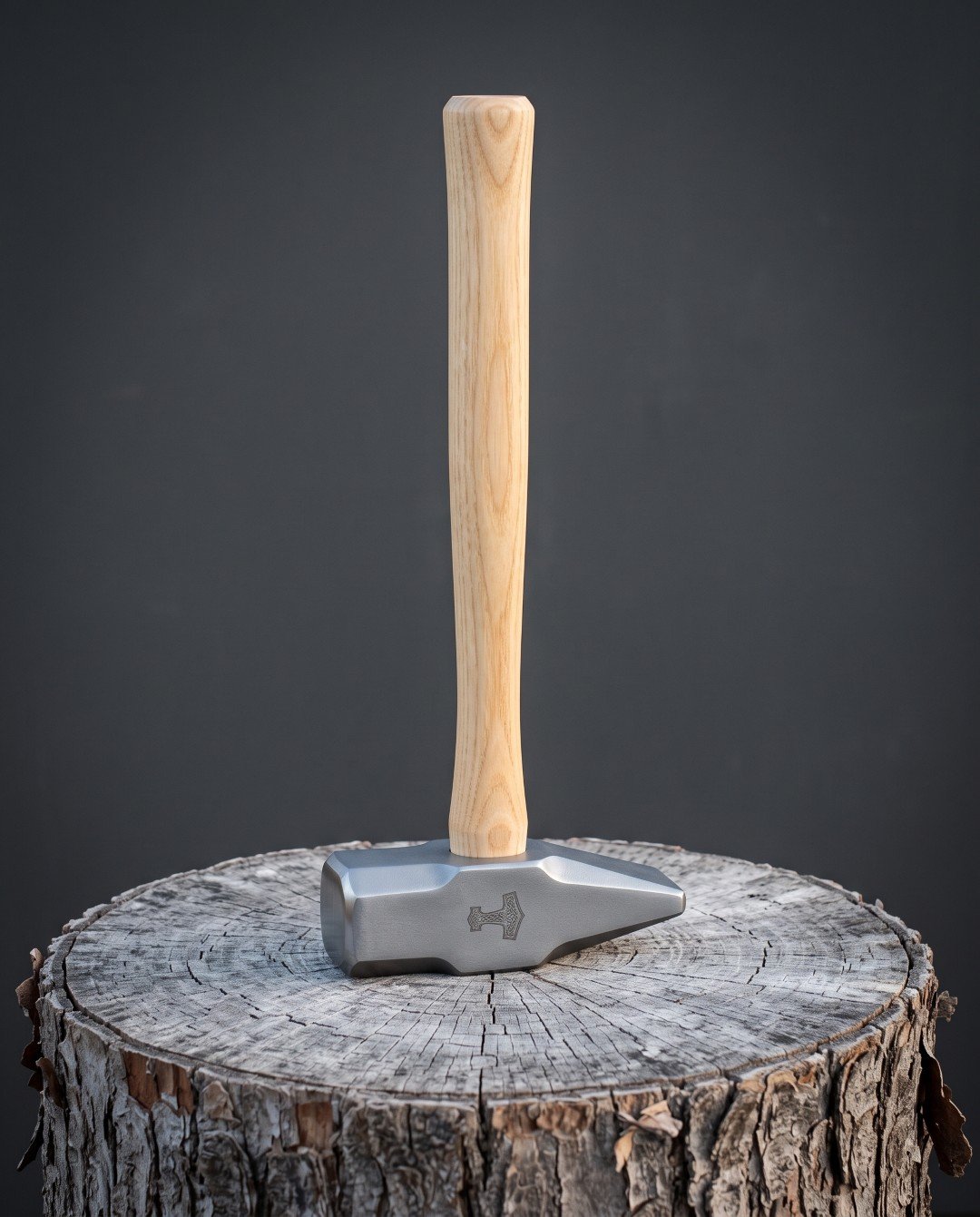
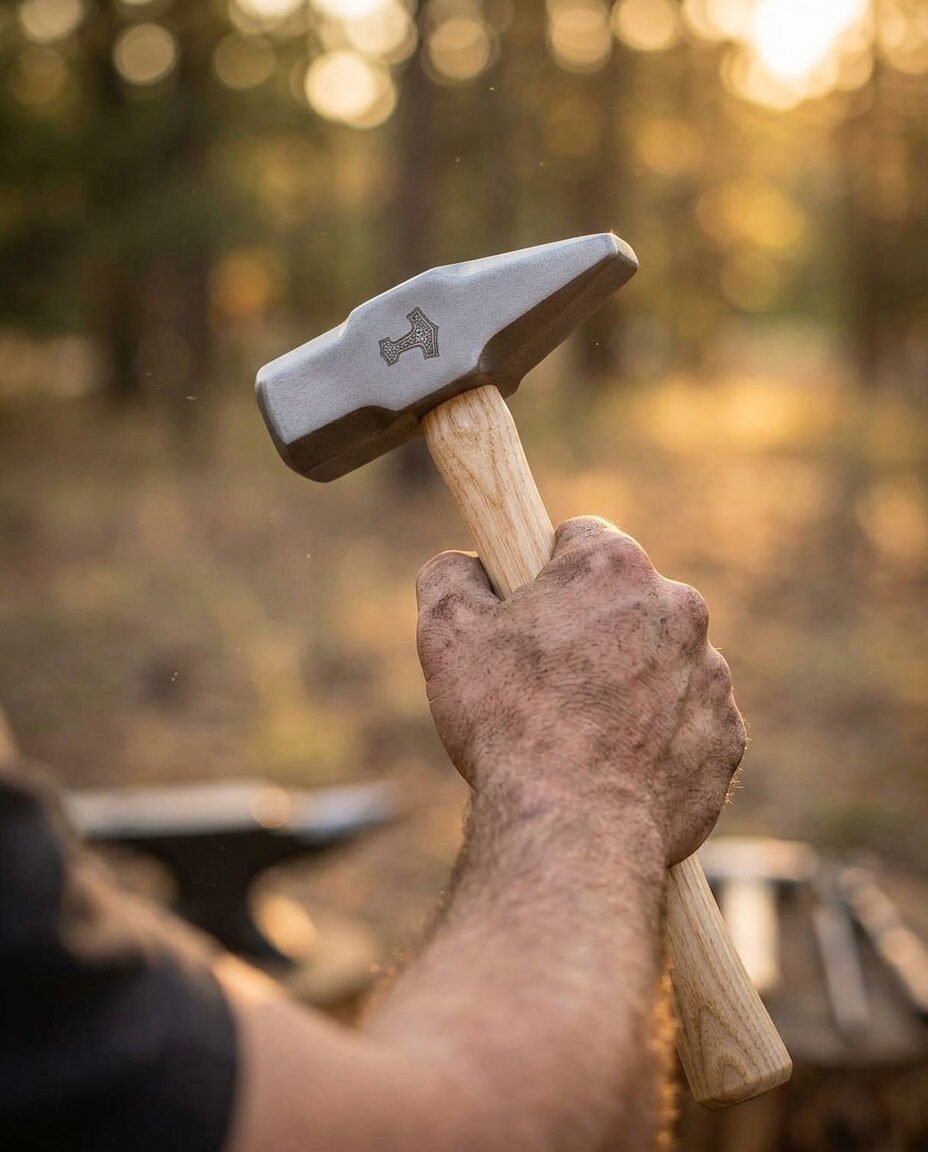
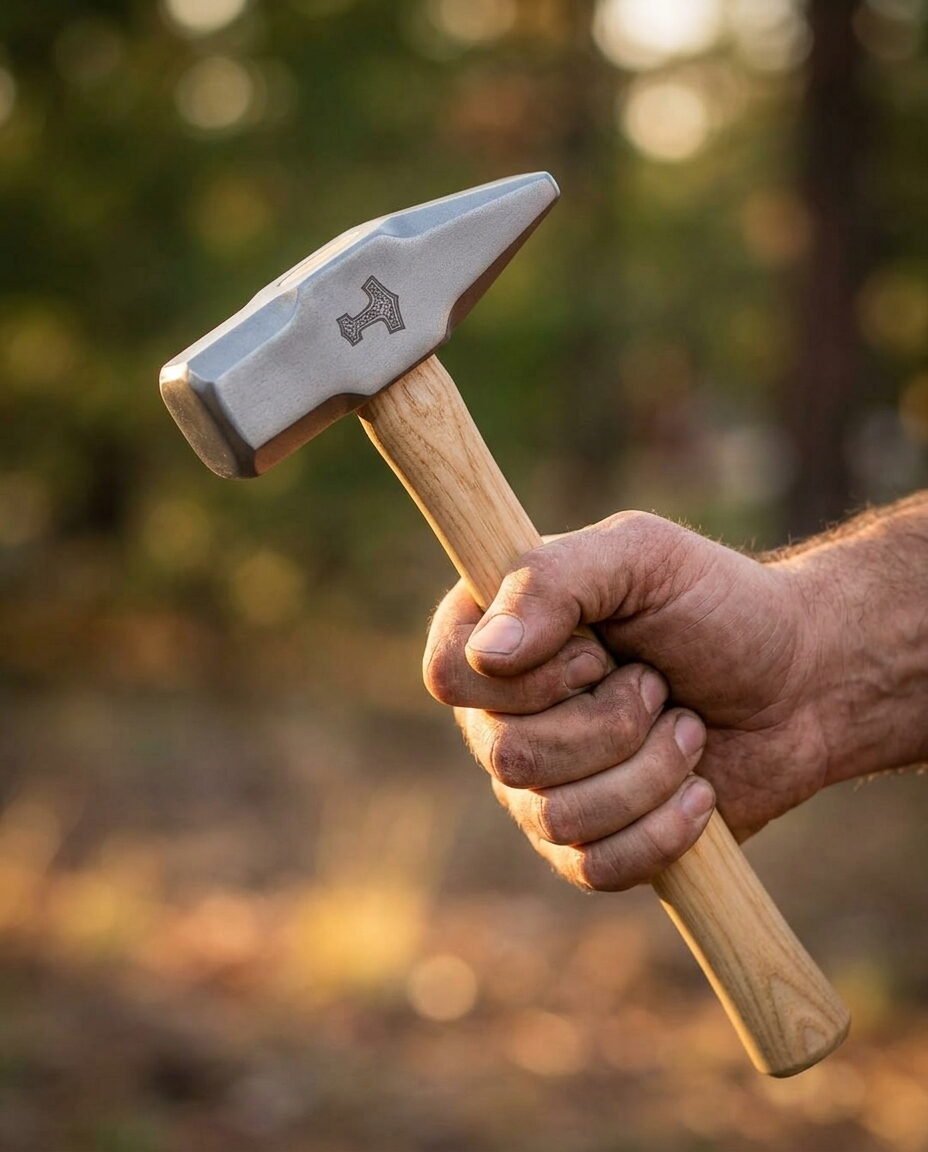
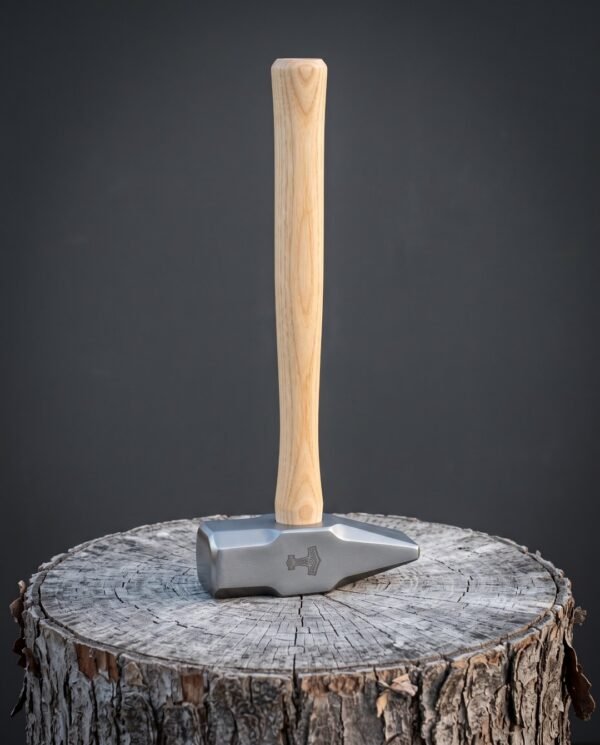
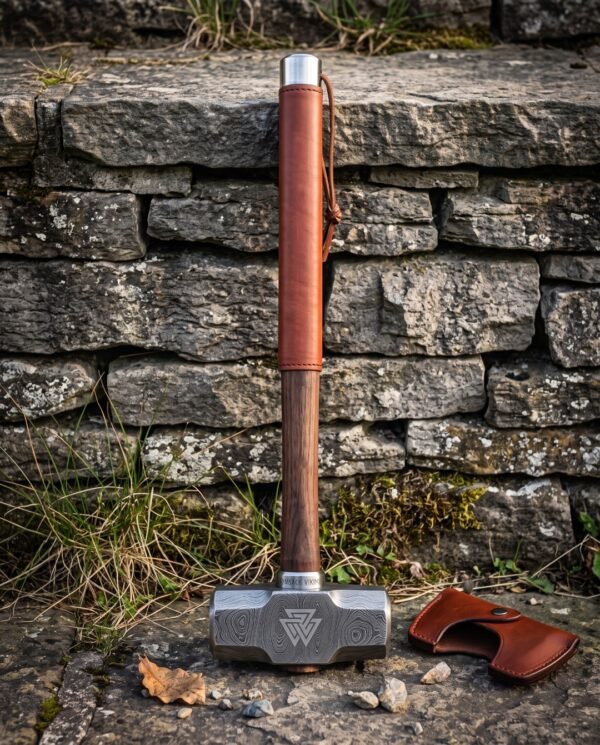
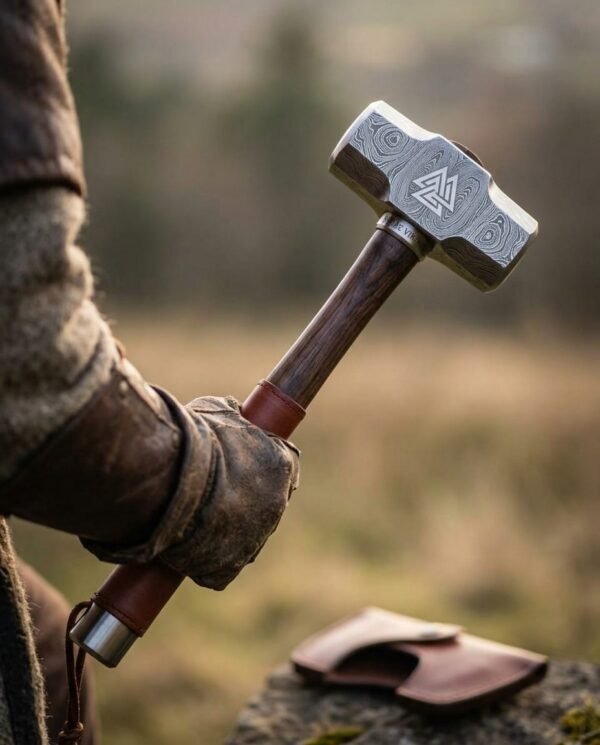
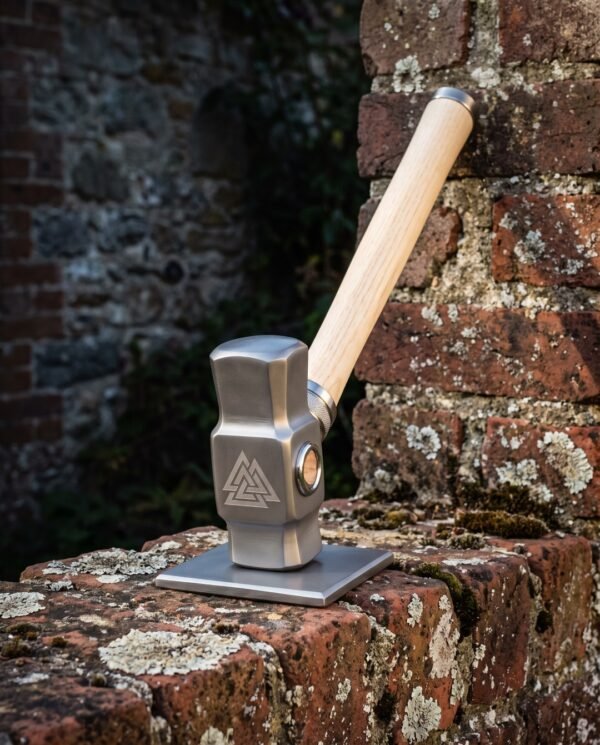
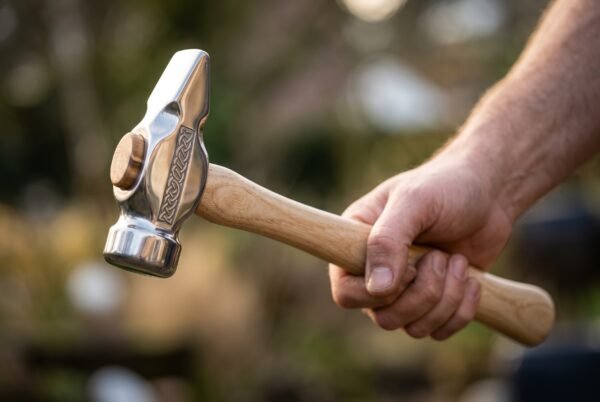
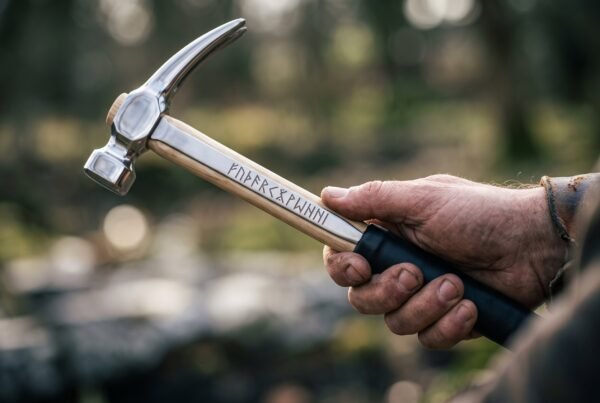
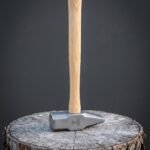
This is the hammer a smith reaches for first. A cross pein head forged from 1095, with a broad flat face at one end, a long tapered pein at the other, heavy chamfers cut down every corner so nothing catches on the work, and a Mjolnir engraved into the cheek. The cross pein is the oldest surviving hammer pattern in European smithing and it was already old in the Viking Age. Hammers of essentially this shape came out of the Mastermyr chest, a Gotland tool find of the tenth or eleventh century that turned up in a bog in 1936 with a whole working smith kit inside it, and the pattern has barely changed since because there is nothing left to improve.
Forged, dressed, heat treated and engraved in a Czech Republic workshop, hung on a straight ash handle turned and wedged here. It ships as a complete hammer. The stump it is standing on is a studio prop. Thor’s hammer was an amulet long before it was a shape on a tool, and the meaning of Mjolnir covers that.
Specifications
| Type | Cross pein blacksmith and forging hammer |
|---|
| Head material | 1095 high carbon steel |
|---|
| Hardness | 54 to 58 HRC at face and pein |
|---|
| Head weight | Approximately 2.5 lb |
|---|
| Overall length | Approximately 15 in |
|---|
| Head | Heavily chamfered on every corner, drifted eye |
|---|
| Face | Broad, lightly crowned, fully chamfered edge |
|---|
| Pein | Long cross pein, tapered and radiused |
|---|
| Handle | Pale ash, straight with a slight swell at the butt, wedged in the eye |
|---|
| Engraving | Mjolnir cut into the cheek |
|---|
| Finish | Satin steel head, oiled ash |
|---|
| SKU | RK-1536 |
|---|
Why the pein runs across the handle
Hold the hammer as you would to strike and look at the pein. It lies at ninety degrees to the handle, which means when you hit a bar lying along the anvil, the pein spreads that bar sideways, across its width, not along its length. That is the whole point. Drawing out with a flat face is slow, because the metal moves in every direction and half your effort goes into widening something you wanted to lengthen. Turn the hammer over, work the pein along the bar, and the metal moves fast in one direction. Then flip back to the flat face and planish the ridges out. Draw with the pein, finish with the face. Every taper, every point, every leaf and every scroll starts that way.
The chamfers matter more than they look. A hammer with sharp arrises at the cheeks will cut a line into hot steel every time you land at an angle, and those lines become cold shuts that split later. Chamfer the corners and a slightly off blow leaves a smooth mark you can planish out.
1095 at 54 to 58 HRC and why not harder
The head is 1095 taken to 54 to 58 HRC. That is the correct hardness window for a struck tool and it is deliberately below what you would use on a knife. A hammer face at 60 HRC or above can spall, throwing a chip of hardened steel across a shop at speed, and that is the single most common serious injury in amateur forging. In this window the face resists mushrooming under thousands of blows, and any damage that does occur shows itself as a slow flattening or a rolled edge that you can see coming and dress back with a file.
The eye and the cheeks are left softer than the striking surfaces, which is standard practice on a good forging hammer. A fully hardened head is a crack waiting for a reason, and the eye is where the stress concentrates when the handle flexes.
Engraving, runes and your own design
Use the rune converter on this page to turn a name, a date or a short phrase into Elder Futhark and we will cut it into the steel or the leather. If you would rather have a Viking pattern than a rune line, choose your own design in the engraving option above the add to cart button and tell us where it goes. Where a piece already carries an engraved design, your chosen engraving replaces it rather than sitting alongside it, which on this hammer means your rune line takes the place of the Mjolnir on the cheek. A name and the year somebody lit their first forge fits comfortably in that space.
Full detail is on the engraving page.
Bench and rack mounting
Keep it in a rack at the anvil, head down, with the pein pointing away from where your hand comes in. If it is going on a wall as a gift, hang it under the head from two pegs rather than through the eye, and keep it off an exterior wall where condensation collects. A shop hammer that lives outdoors will pit, so if it is going to sit for a season, oil the head and bag the whole thing loosely with a desiccant sachet rather than sealing it wet.
Care
Dress the face when it needs it. As soon as the edge of the face starts leaving crescent marks in hot steel, take a file to the crown and put the chamfer back. Do not let it get hot enough to change colour while you dress it, since that softens the layer you rely on. Wipe scale off the head after a session, and oil it before it goes away for any length of time. Rub the ash with boiled linseed once a year and check the wedge every few months. A loose head is not a job for later. Refit it or stop using it. There is more in our guide to steel care. Tool steel rusts like any other, and taking rust off a forged head covers the fix.
Made in the Czech Republic
This is a handmade piece from the Czech Republic, made in a workshop that still forges, grinds and finishes by hand instead of stamping parts out. The smiths there have kept the older way of working, and the wood, horn and leather are shaped and fitted by hand as well. Two pieces of the same design will never be identical, and that is part of what you are buying.
Ransack Viking is a United States company. We handle the import ourselves, look over every piece when it lands and ship from our warehouse in Chicago, Illinois. Engraving is done in the United States after the piece arrives, so your design goes on before we send it out.
A note on handmade variation
This is hand made, not machine made or bulk produced, so what arrives will not be a pixel for pixel copy of the photograph. A drifted eye leaves its own signature, ash grain runs differently in every handle, and the length and radius of the pein shift slightly from head to head because it is drawn under a hammer rather than pressed in a die. Grain, tone, hammer texture and exact profile vary because each one is worked by hand from natural materials. The dimensions, the material and the build are the same every time. The character is not.
Frequently asked questions
Is this heavy enough for real forging?
Approximately two and a half pounds is a genuine general purpose forging weight. It will draw stock, planish, and set rivets all day. If you are moving heavy bar you would pair it with a sledge and a striker.
What is the difference between this and a ball pein?
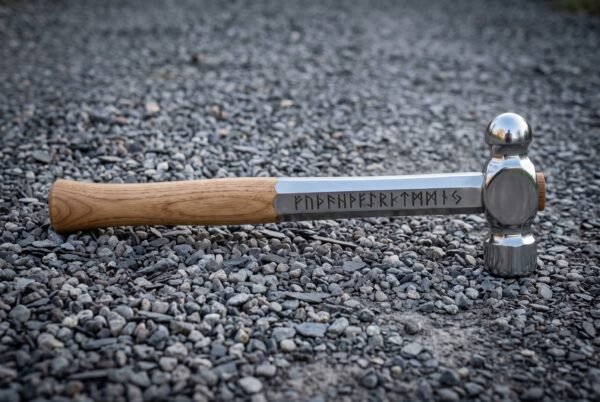
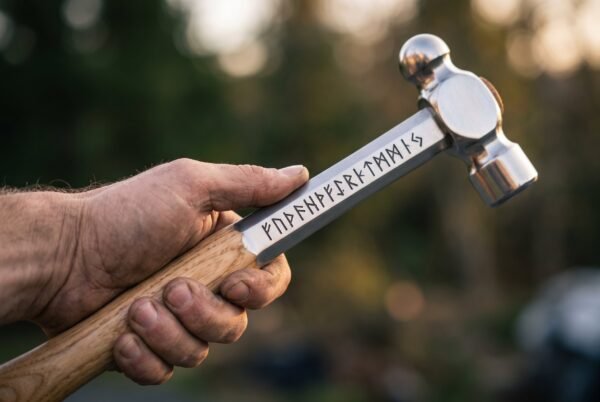
A ball pein spreads metal in all directions from a small point and is the machinist and riveting tool. A cross pein drives metal along one axis and is the forging tool. Most smiths own both.
Can I rehandle it myself?
Yes. The eye is drifted to a standard oval, so a shop bought ash handle will fit with a little fitting. Wedge it properly and check it after the first hour of work.
Will the engraving wear off?
The Mjolnir is cut into the cheek, which is not a striking surface, so it stays. Engraving on a face would disappear with the first dressing, which is why it is not put there.
Is it a display piece or a tool?
A tool, heat treated and dressed for work. It is finished well enough to hang on a wall, but it is built to be used and it will look better for being used.
How long before it ships?
Processing is one to two weeks because each head is forged to order, then free shipping within the United States. Returns are accepted within seven days.
What is in the box
- 1095 steel cross pein forging hammer, dressed and heat treated
- Straight ash handle, fitted and wedged in the eye
- Mjolnir engraved on the cheek, or your rune line or design if selected
- Care card and lifetime warranty against defects
- Forged and finished in the Czech Republic
Explore the range
See more in blacksmith tools, engraved and personalised pieces, splitting and felling axes and Viking axes, or read the guides.
Worth a look beside this
Sitting beside it in the catalogue is the Nailward blacksmith tool. Another in the same line is the Thundergrain blacksmith tool, pattern welded Damascus. Next along the rack is the Runepein blacksmith tool, forged from 1095.
Fitting out further, the Runegird sheath belongs with it. Or start from a blank sheet on the design your own page.


Incredible craftsmanship on this one. Exactly as described and clearly made with care. Will definitely order again for another gift.
Can’t stop showing this off to everyone who comes over. Exactly as described and clearly made with care. The craftsmanship really shows in the small details. Packaging was excellent and it arrived in perfect condition. Made overseas in the Czech Republic yet shipped from a US location so no long customs wait. Highly recommend this one.
Nice piece for the price. Solid piece. Packaging could’ve been a bit sturdier. Good overall quality. Just a couple very minor details off. Still very happy with it and would recommend.
Average quality for the price honestly. It’s fine for the price. Nothing that stood out. Wouldn’t say no to it but wouldn’t rave about it either.
This is exactly what I wanted and then some. Couldn’t be happier with this. This is my third order from Ransack Viking and they never disappoint.
Perfect gift. Perfect quality. No complaints. 10/10 would buy again.
Feels way more premium than the price suggests. Feels way more premium in person than the listing photos. This is going straight into my display case.
Solid piece. Glad I ordered it. Good overall quality. Just a couple very minor details off. Glad I made this purchase.
My husband was speechless when he opened this. Nice touch that it ships from within the US even though it’s crafted in the Czech Republic. The craftsmanship really shows in the small details. 10/10 would buy again.
Been eyeing this piece for months and it did not disappoint. Exactly as described and clearly made with care. Great buy overall. This is my third order from Ransack Viking and they never disappoint.