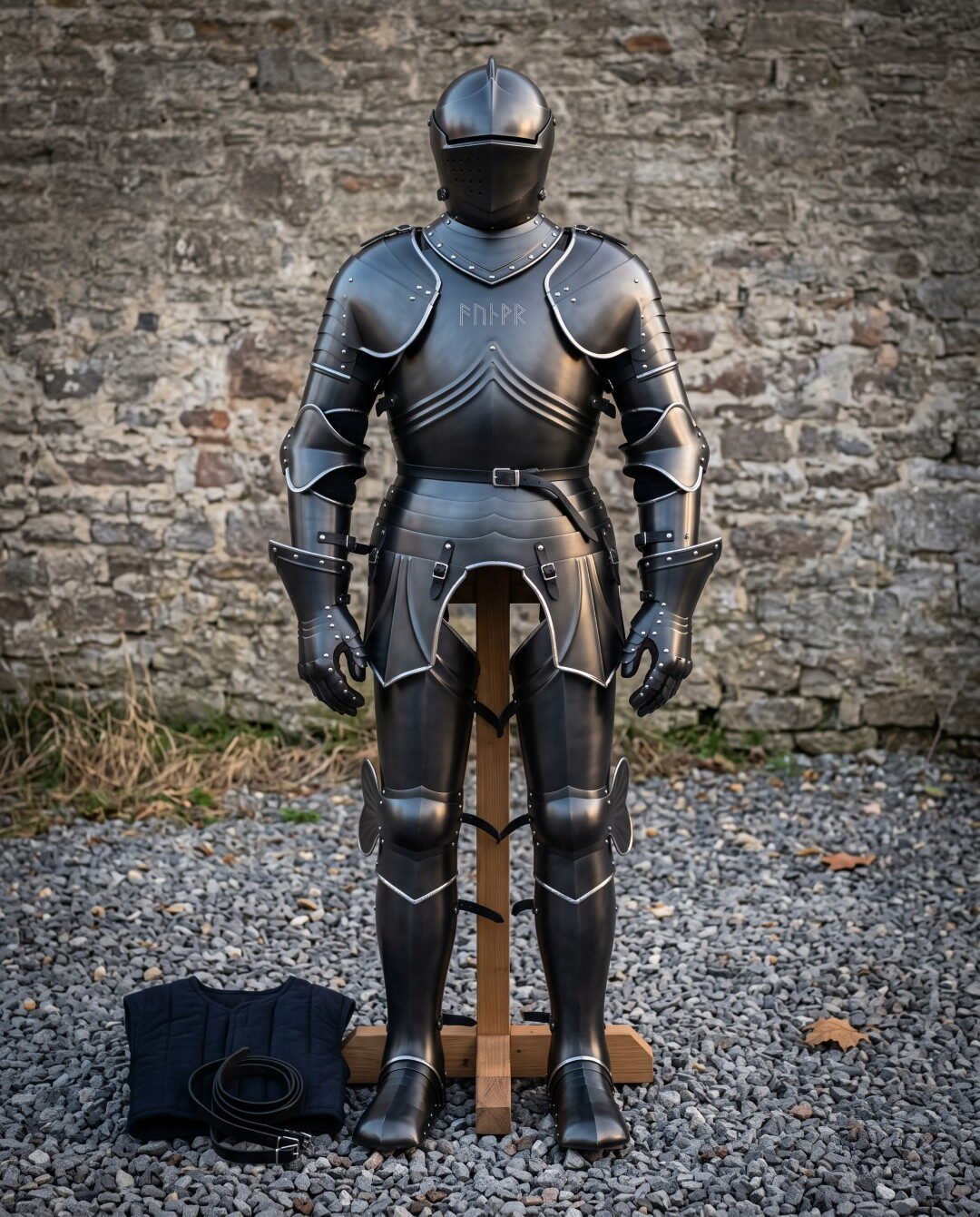
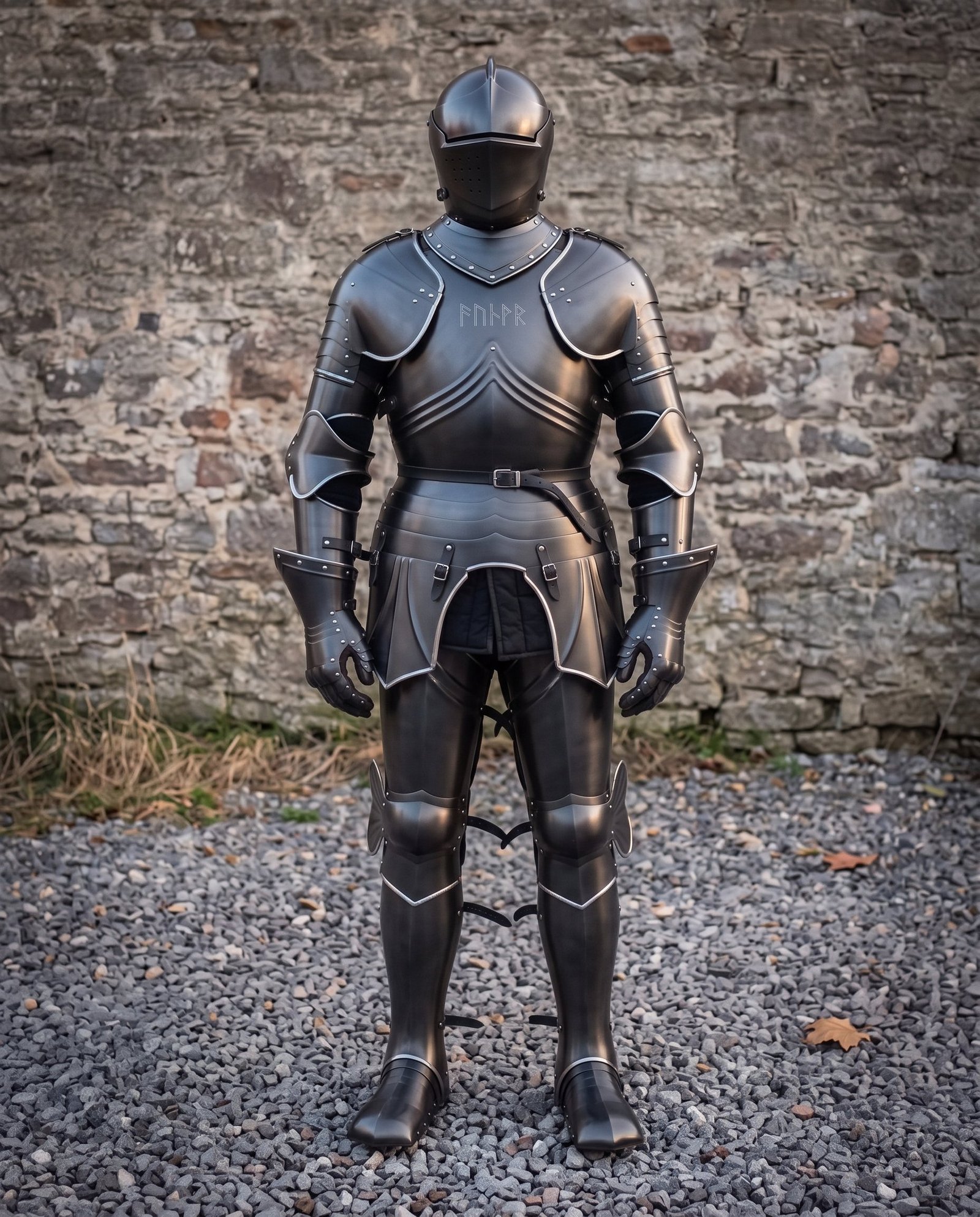
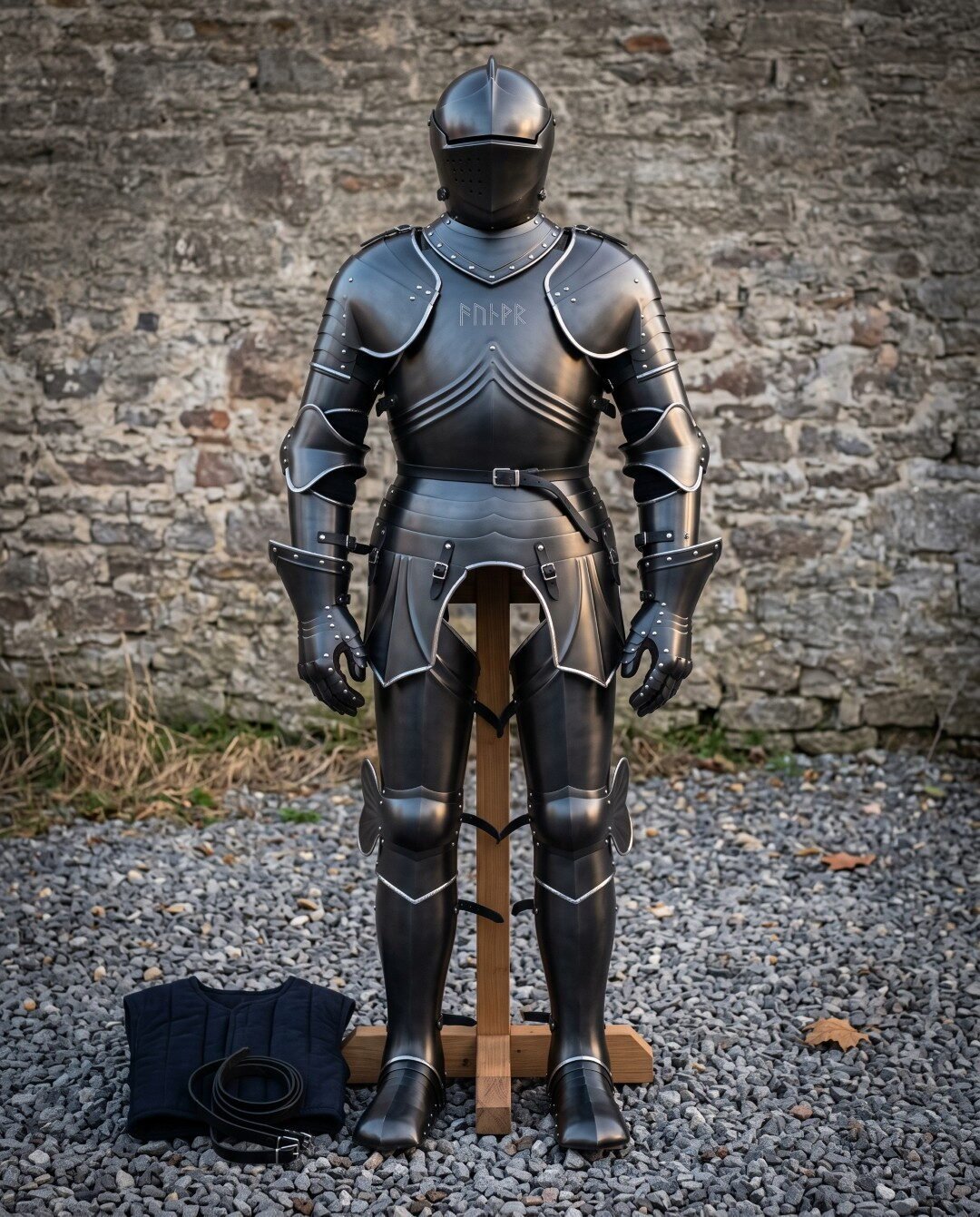
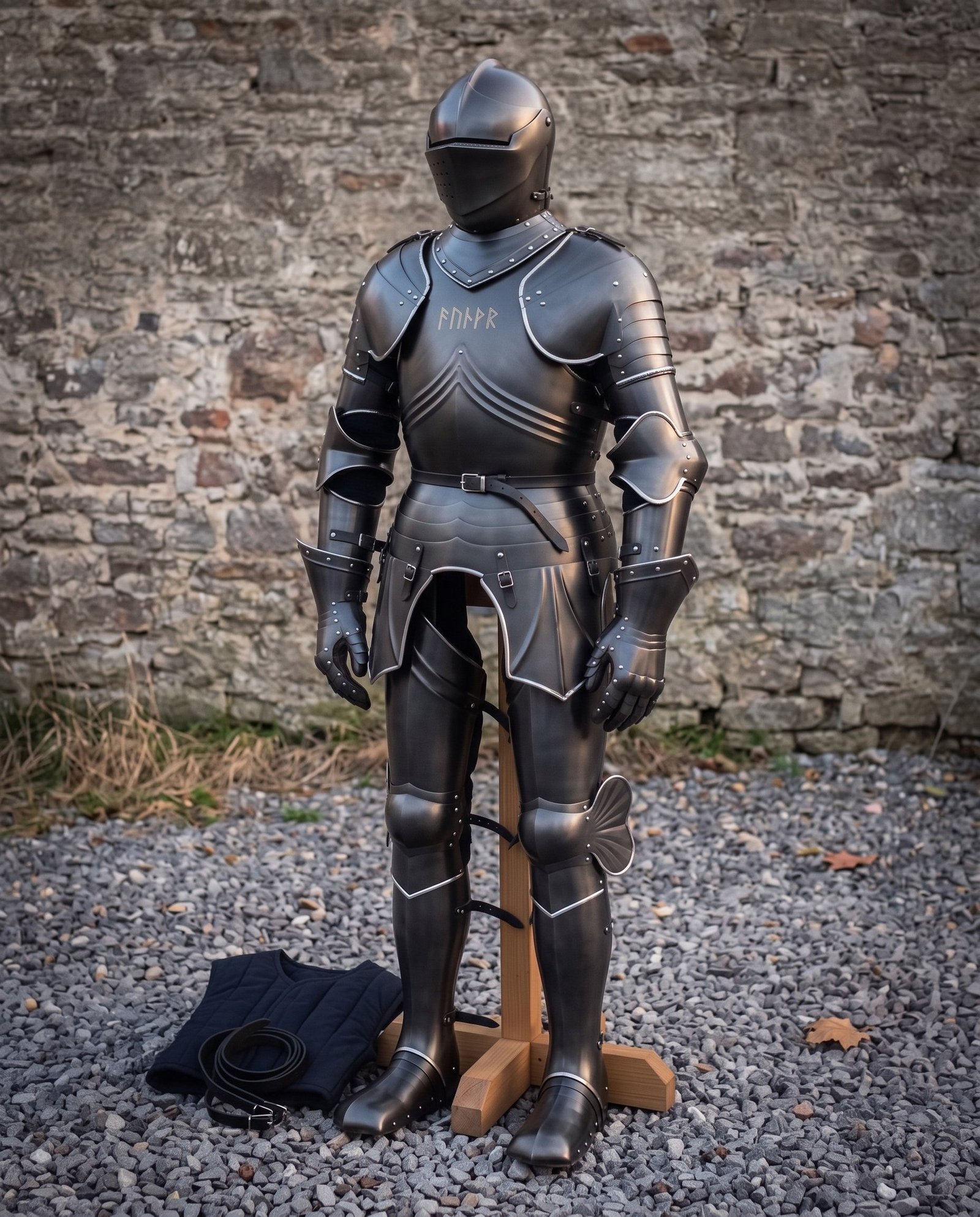
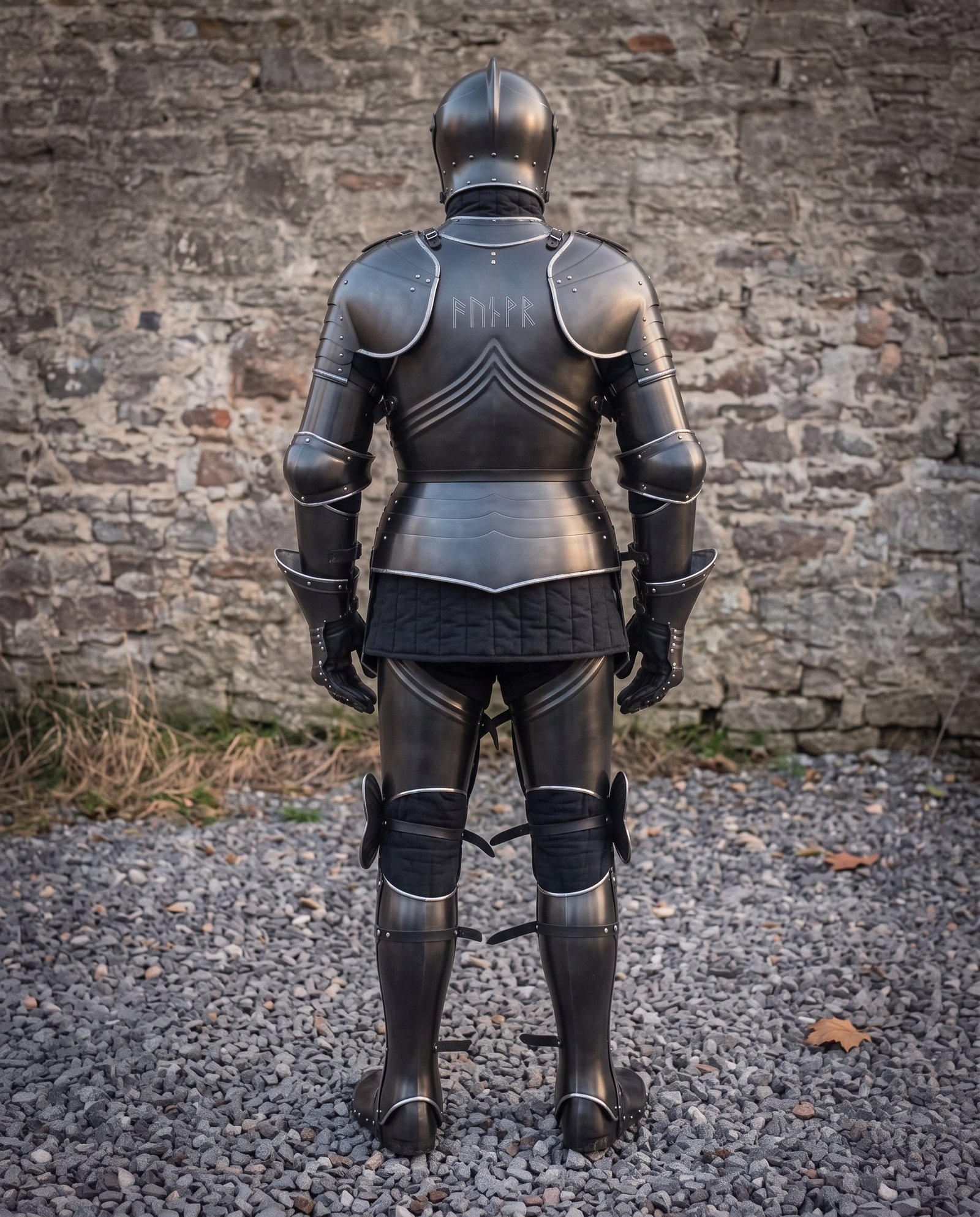
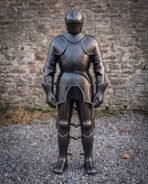
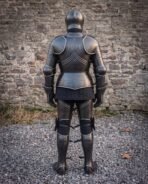
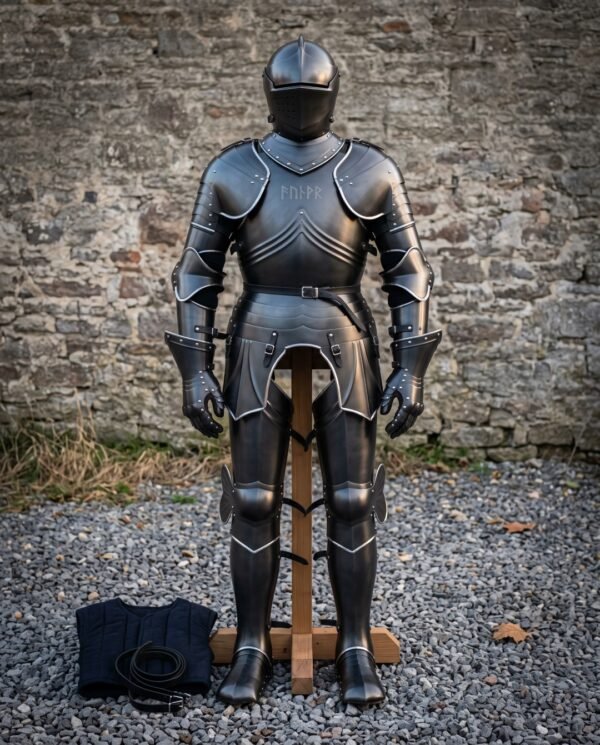
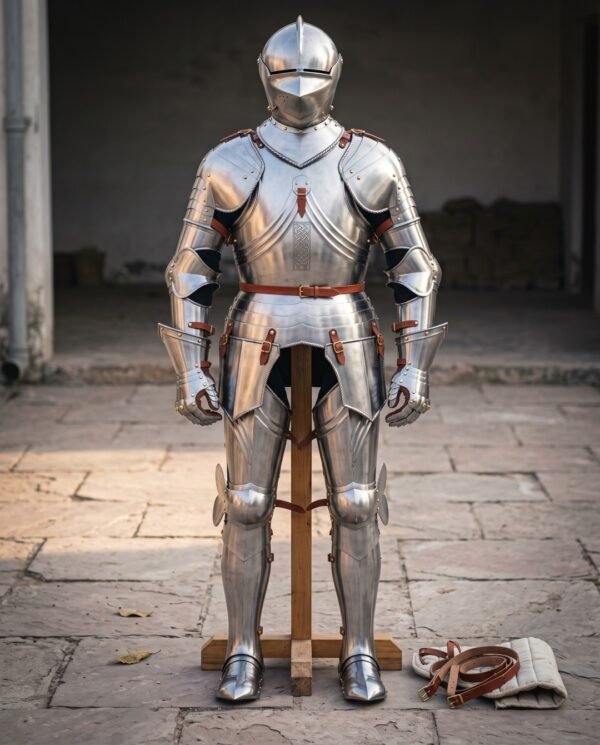
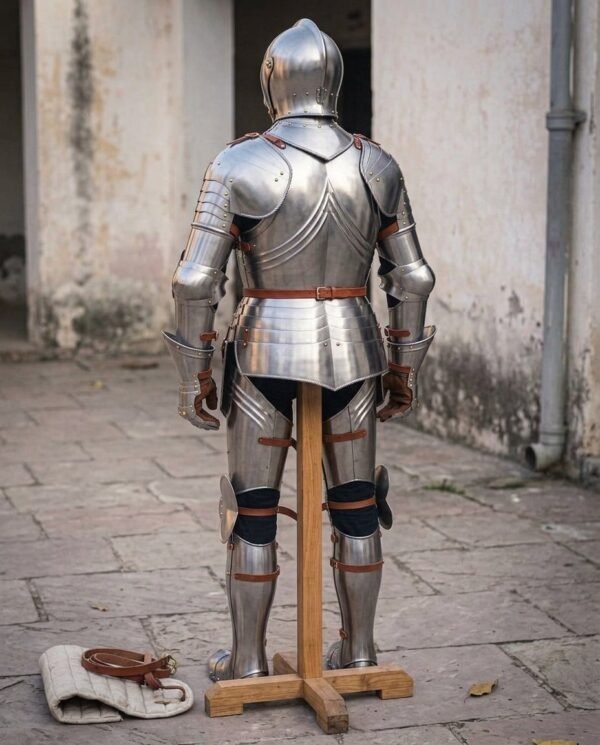
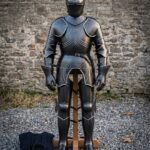
This is a complete head to foot harness in blackened steel. It runs from a closed helm with a hinged visor down through a gorget, spaudler style pauldrons, rerebraces, couters and vambraces to five finger articulated gauntlets, then a fluted breastplate carrying a short Elder Futhark rune line, a waist belt, a fauld with hanging tassets, cuisses, wing shaped poleyns, greaves and long toed sabatons. Every joint that has to move on a real harness moves here: the elbows, the knees, the fingers and the toes are all built on overlapping lames rather than being formed as one dead plate.
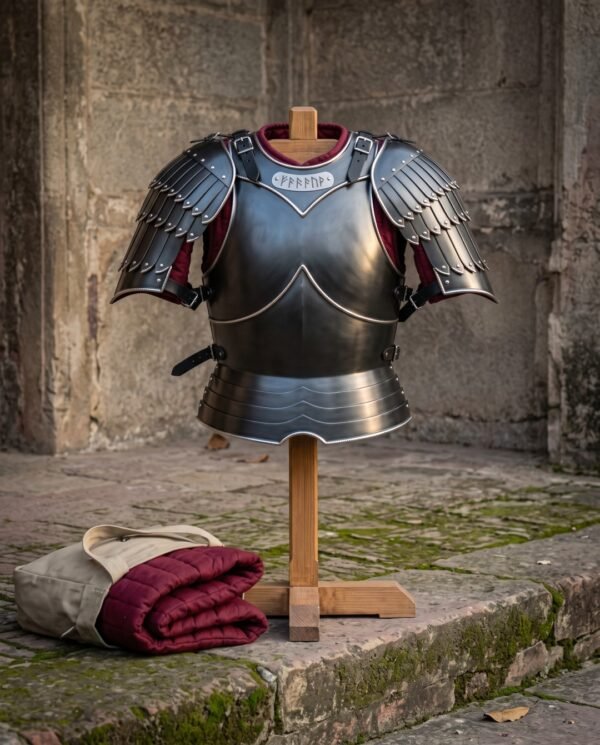
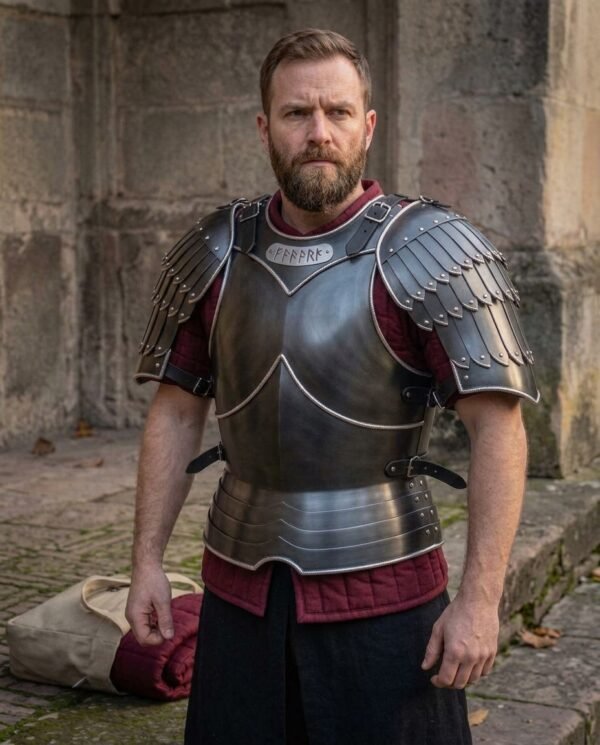
The V shaped flutes across the chest are not decoration for its own sake. Fluting is one of the oldest tricks in armouring: a corrugated sheet is far stiffer than a flat one of the same thickness, and the ridges also catch and turn a point that slides across the chest instead of letting it run straight up into the throat. German armourers built entire styles around that idea in the late fifteenth century. This harness is forged, blackened, engraved and assembled in the Czech Republic, and it ships in sections in a fitted crate with the arming points and buckles already set. Where plate sits against mail and lamellar is laid out in chainmail versus plate versus lamellar.
Specifications
| Material | Mild steel, formed and blackened, with polished bright edges |
|---|
| Gauge | 18 gauge throughout, display and light reenactment weight |
|---|
| Helm | Closed helm with a hinged visor and breath holes on the right side |
|---|
| Upper body | Gorget, pauldrons, fluted breastplate with backplate, waist belt |
|---|
| Arms | Rerebraces, couters and vambraces on sliding lames |
|---|
| Gauntlets | Fingered gauntlets of riveted plates over black leather gloves |
|---|
| Lower body | Fauld with hanging tassets on straps, cuisses, winged poleyns, greaves and pointed sabatons |
|---|
| Decoration | Chevron flutes across the breastplate, engraved Elder Futhark rune line across the upper chest |
|---|
| Size or fit | Standard adult, roughly 38 to 44 inch chest and 5 ft 8 in to 6 ft 1 in height |
|---|
| Weight | Approximately 50 lb complete |
|---|
| Lining | Leather edging and internal arming straps, no padded garment included |
|---|
| Fittings | Steel rivets, leather straps, roller buckles, waist belt |
|---|
| SKU | RK-1551 |
|---|
How a harness is articulated
The thing that separates a real harness from a costume is what happens at the joints. Look at the elbow on this suit. It is not a single cup. It is a couter with a lame above it and a lame below it, each riveted through a sliding rivet that runs in a short slot. When you bend your arm, the lames slide over one another and the gap never opens. Straighten the arm and they close back down. The same principle runs through the knee, the shoulder, the waist and the foot.
The fauld and tassets work the same way in the other direction. The fauld is a set of hoops around the hips that lets you bend forward at the waist, and the tassets hang from it on straps so that your thighs can swing without the plate binding. The gauntlets are the fussiest part of any harness: each finger is built from small overlapping plates on a leather glove so that the hand can close around a haft. That is a lot of individual pieces, and it is the main reason a full harness costs what it does.
The closed helm rotates on a pair of pivots at the temples so the visor lifts clear of the face. The breaths on the right side of the visor are cut heavier than the left because in a mounted context the left side of the head faces the opponent. That asymmetry is genuine and it is easy to miss.
Steel, gauge and the blackened finish
Every plate here is mild steel at 18 gauge, roughly 1.2 mm. That is the standard weight for a display and light reenactment harness. It is heavy enough to hang and move correctly on a stand or on a body, and light enough that a person can actually stand up in it for a few hours. It is not full contact armour. A harness built for a combat league that permits steel on steel blows is made in 14 or 16 gauge, sometimes with spring steel in the helm, and it weighs half again as much. If you are buying to fight in, ask your group what they certify before you order.
The black is a heat and chemical blackening worked into the surface, then knocked back on the raised edges so that the bright steel shows along every border. That is why the suit reads as dark from a distance and picks out every plate line up close. It is a finish, not a coating that sits on top, so it will not chip the way paint does, but it will wear brighter on the high points over years of handling, which most owners come to like.
Engraving, runes and your own design
Use the rune converter on this page to turn a name, a date or a short phrase into Elder Futhark and we will cut it into the steel or the leather. If you would rather have a Viking pattern than a rune line, choose your own design in the engraving option above the add to cart button and tell us where it goes. Where a piece already carries an engraved design, your chosen engraving replaces it rather than sitting alongside it. On this harness the rune line already sits across the upper breastplate, so a custom line takes that place. Details are on the engraving page.
Fit and sizing
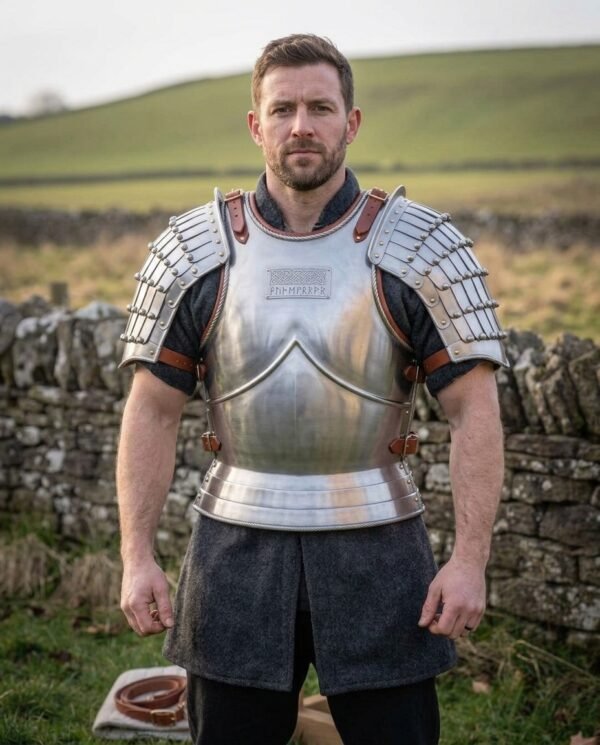
This is built to one standard adult size and it is honest to say that a full harness is the hardest thing in the shop to fit. It suits roughly a 38 to 44 inch chest and a height between about 5 ft 8 in and 6 ft 1 in. Chest measurement matters most for the cuirass, height matters most for the legs, and what you wear underneath changes both.
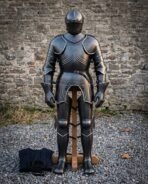
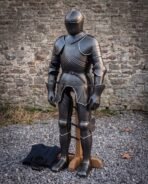
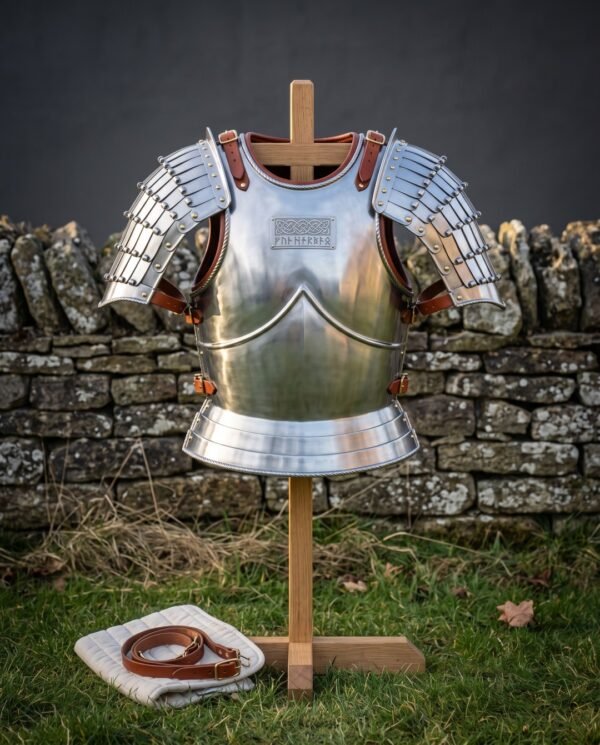
You need a padded garment under this. A gambeson or arming doublet takes up between half an inch and a full inch all round, and it is what stops the plate from bearing directly on your collarbones and hips. Measure over the padding you intend to wear, not over a shirt. The folded padded garment, the loose belt and the wooden stand in the photograph are studio props and are not included, so plan for a stand if you intend to display the suit rather than wear it.
Care
Blackened steel wants the same care as bright steel. Wipe every piece dry after wearing, because sweat is more aggressive than rain. Once a month give the plates a thin film of light machine oil or a metal wax, paying attention to the inside faces and the rivet heads where moisture collects and nobody looks. Work the leather straps with a leather conditioner twice a year so they stay flexible and do not crack at the buckle holes. Store the harness assembled on a stand or laid out on a shelf in a dry room rather than stacked in a bin, and never seal it in plastic. Our notes on protecting steel are on the steel care page. Steel armour wants oiling and dry storage, which we cover in caring for chainmail and steel armour.
Made in the Czech Republic
Every piece we sell is made by hand in the Czech Republic. The smiths there work the way the trade has been worked for a long time, heating and hammering the steel, taking the bevels down by eye, and fitting the handle and the leather one at a time. There is no automated line anywhere in it, so small differences from one piece to the next are normal and expected.
Ransack Viking is a United States company based in Chicago, Illinois. We bring the pieces in ourselves, inspect them on arrival and ship them from our own warehouse. If you add engraving, that is carried out here in the United States before your order goes out.
A note on handmade variation
This harness is hand made, not machine made or bulk produced. What arrives will not be a pixel for pixel copy of the photograph. The blackening sits deeper on some plates than others depending on how the steel took it, the bright edges break through at slightly different widths, and the hammer work behind the flutes varies across the chest. The dimensions, the material and the build are the same every time. The character is not, because a person worked each plate over a stake rather than a press stamping them all identically.
Frequently asked questions
Is this a display suit or can I wear it?
You can wear it, and people do, for events, weddings, photography and non contact reenactment. What it is not is certified armour. It carries no combat rating, it has not been proof tested, and it should never be used where anyone is striking at you.
Can I fight in it?
Not in a full contact league. At 18 gauge the plate will deform under repeated hard blows and the helm is not built to a combat head protection standard. Buy heavier gauge purpose built armour for that and keep this for display and light use.
Does it come with the stand?
No. The wooden stand in the photograph is a studio prop. So are the folded padded garment and the loose belt on the ground. The harness itself, including its own waist belt and all internal straps, is what ships.
What do I wear under it?
A padded gambeson or arming doublet, and padded hose or heavy trousers under the legs. Without padding the plate bruises you at the collarbone, the hip and the inside of the knee, and the whole harness sits badly.
Can I buy just the cuirass or just the helm?
This listing is for the complete harness. Individual pieces can be ordered on their own, so contact us with what you want and we will quote it separately.
How long does it take and how does it ship?
Processing is one to two weeks. It ships in sections in a fitted crate, free inside the United States. Returns are accepted within seven days, and a harness this size needs its original packing to travel back safely.
What is in the box
- Closed helm with hinged visor
- Gorget, pauldrons, rerebraces, couters and vambraces
- Pair of articulated five finger gauntlets
- Fluted and rune engraved breastplate with backplate, waist belt, fauld and tassets
- Cuisses, poleyns, greaves and sabatons
- Care and warranty card
- Forged and finished in the Czech Republic
Explore the range
See the rest of the plate armour, the medieval helmets, the gambesons and brigandines that go under it, and the guides.
Near neighbours in the shop
Sitting beside it in the catalogue is the Skaldplate plate armor. Another in the same line is the Nightplate plate armor. Next along the rack is the Runeheart plate armor.
Fitting out further, the Silkscale lamellar armor belongs with it. You can have this made your way instead on the design your own page.

Did not expect this level of quality for the price. Feels way more premium in person than the listing photos. Packaging was excellent and it arrived in perfect condition. This shop clearly takes pride in their work.