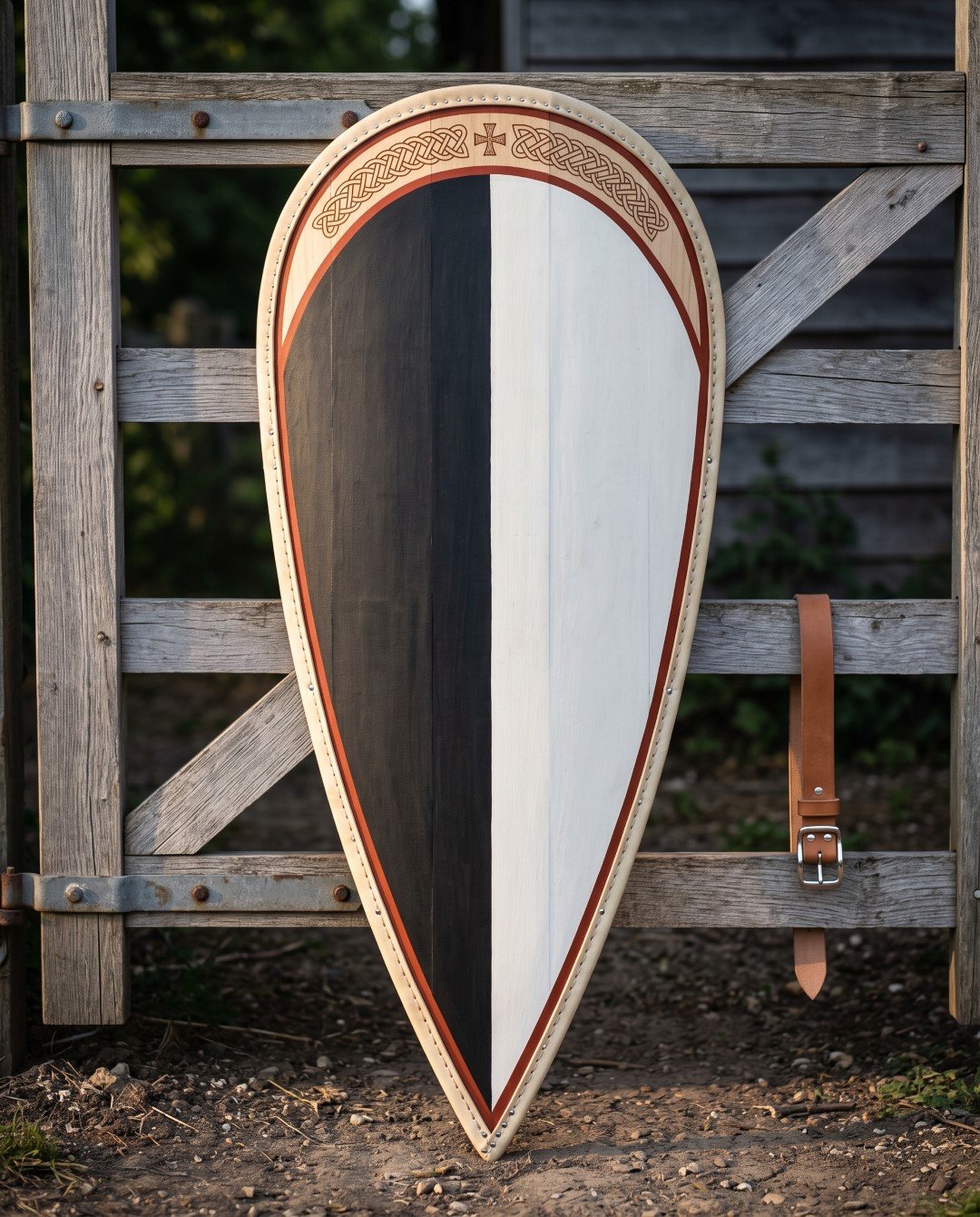
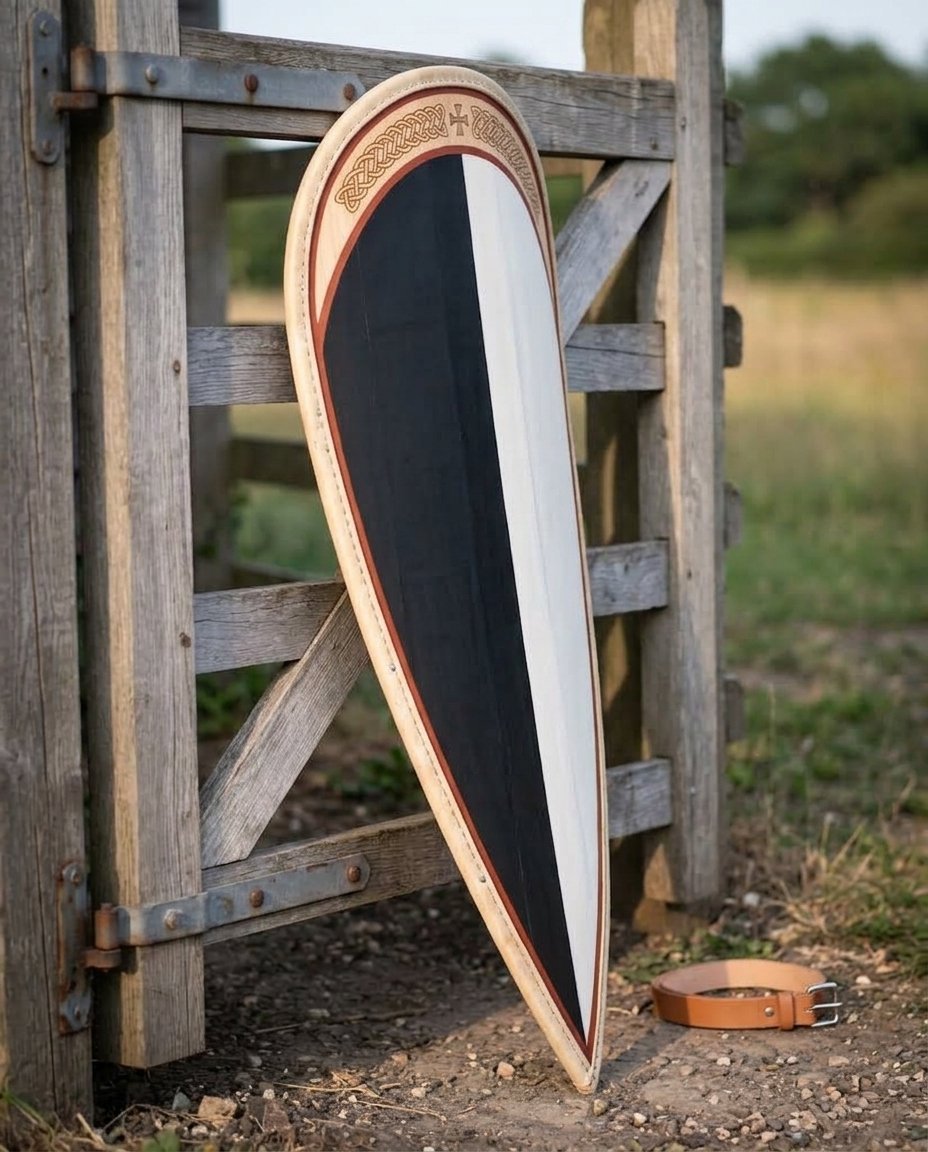
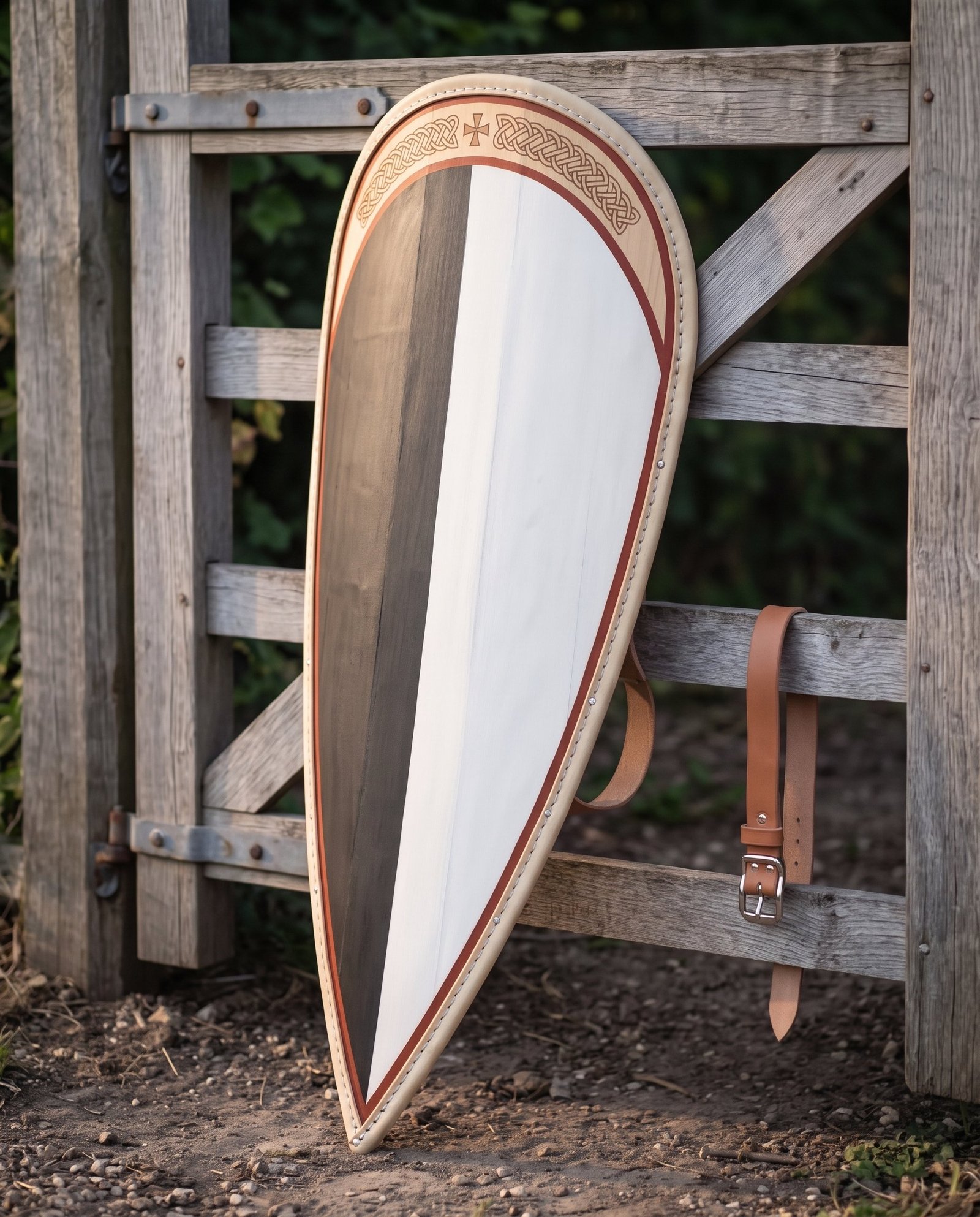
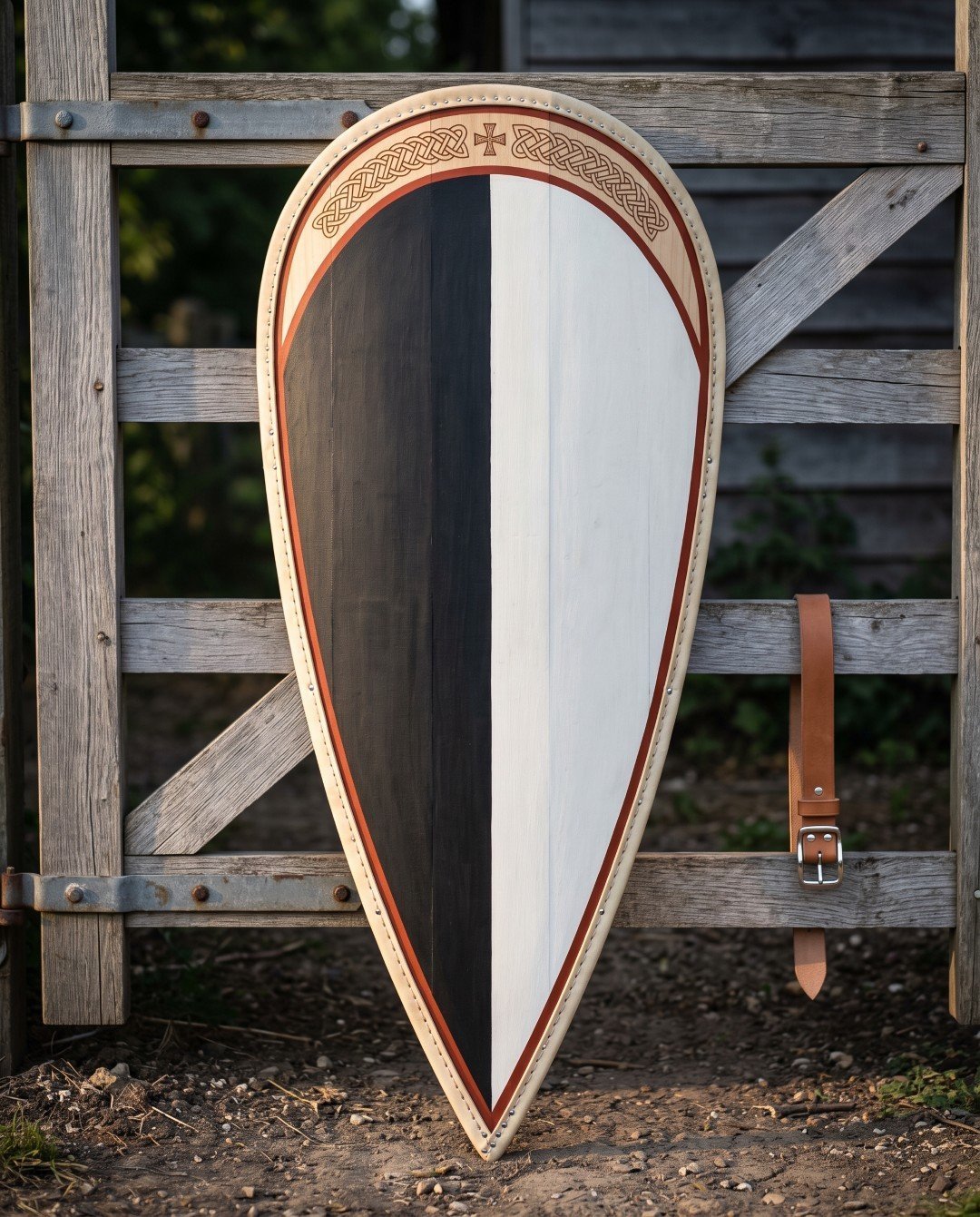
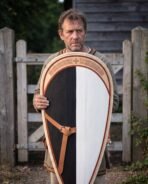
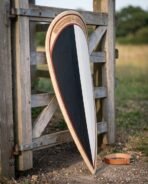
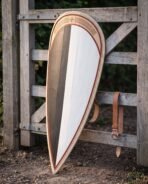
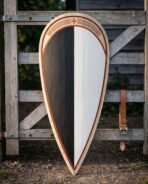
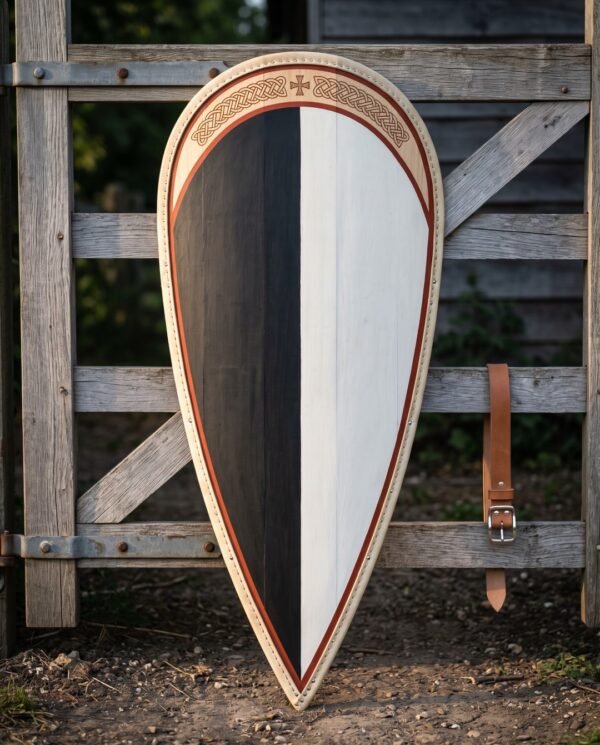
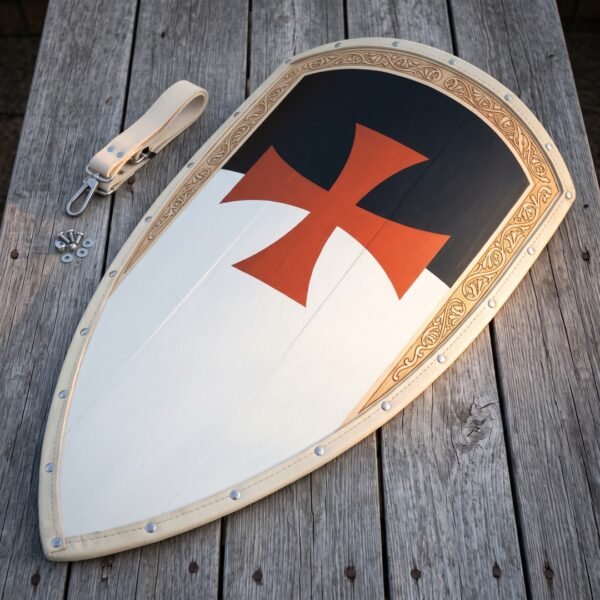
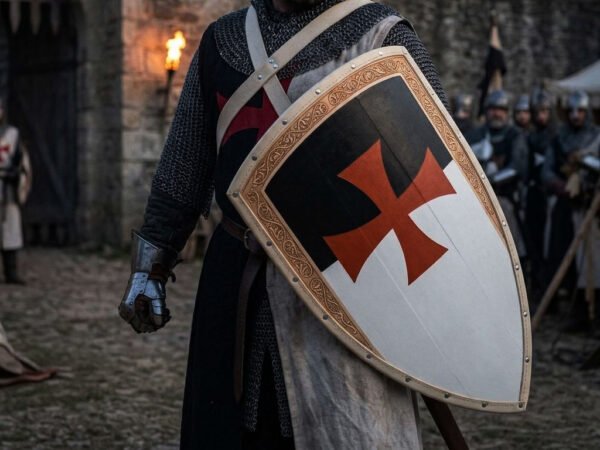
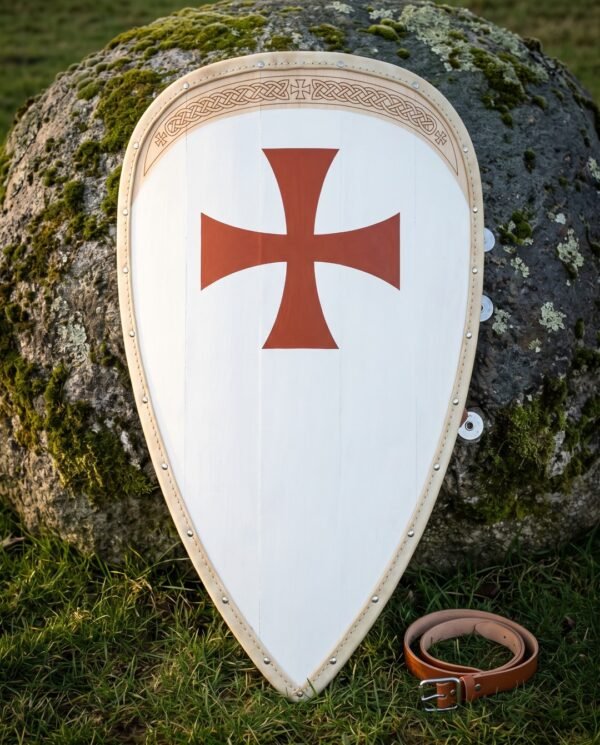
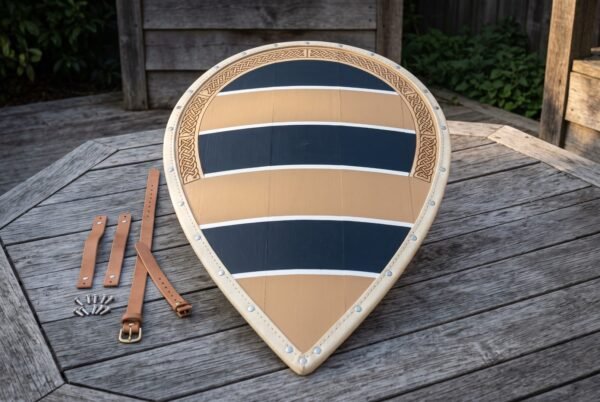
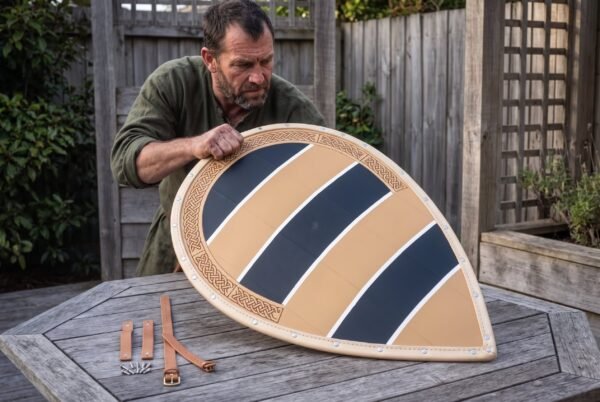
A full sized kite shield built from timber planks glued edge to edge, rounded across the top and drawn down to a long point, painted in black and off white divided straight down the centre with a rust red line inside a pale rawhide rim. The rim is riveted right around the outline, and a band of engraved knotwork runs across the top of the face with a cross set at its centre.
The kite shape exists because of horses. A round shield works perfectly well on foot, where your legs are behind your own feet and largely out of reach, but the moment you put a man on a horse his left thigh and shin are the most exposed part of him and a round shield cannot reach them without becoming absurdly heavy. Drawing the bottom of the shield down into a long point covers the leg with very little extra weight, and rounding the top keeps the head covered without blocking the view. That is why the kite appears across eleventh century Europe at exactly the moment heavy cavalry becomes the decisive arm, and why the Bayeux Tapestry shows Norman riders carrying it while the English shield wall still carries round boards. This one is cut, planked, painted, edged and engraved in the Czech Republic. Why the shape changed from round to kite is set out in round shield versus kite shield.
Specifications
| Height | Approximately 40 inches |
|---|
| Width | Approximately 22 inches at the shoulder |
|---|
| Shape | Rounded top drawn down to a long point, Norman kite form |
|---|
| Material | Glued plank softwood board, painted face |
|---|
| Board thickness | Approximately 12 mm |
|---|
| Rim | Pale rawhide edging, riveted around the full outline |
|---|
| Decoration | Black and off white per pale with a rust red line inside the rim, engraved knotwork band across the top with a cross at its centre |
|---|
| Straps | Leather forearm and hand straps fitted to the reverse |
|---|
| Weight | Approximately 11 lb |
|---|
| SKU | RK-1561 |
|---|
Strapped, not centre gripped
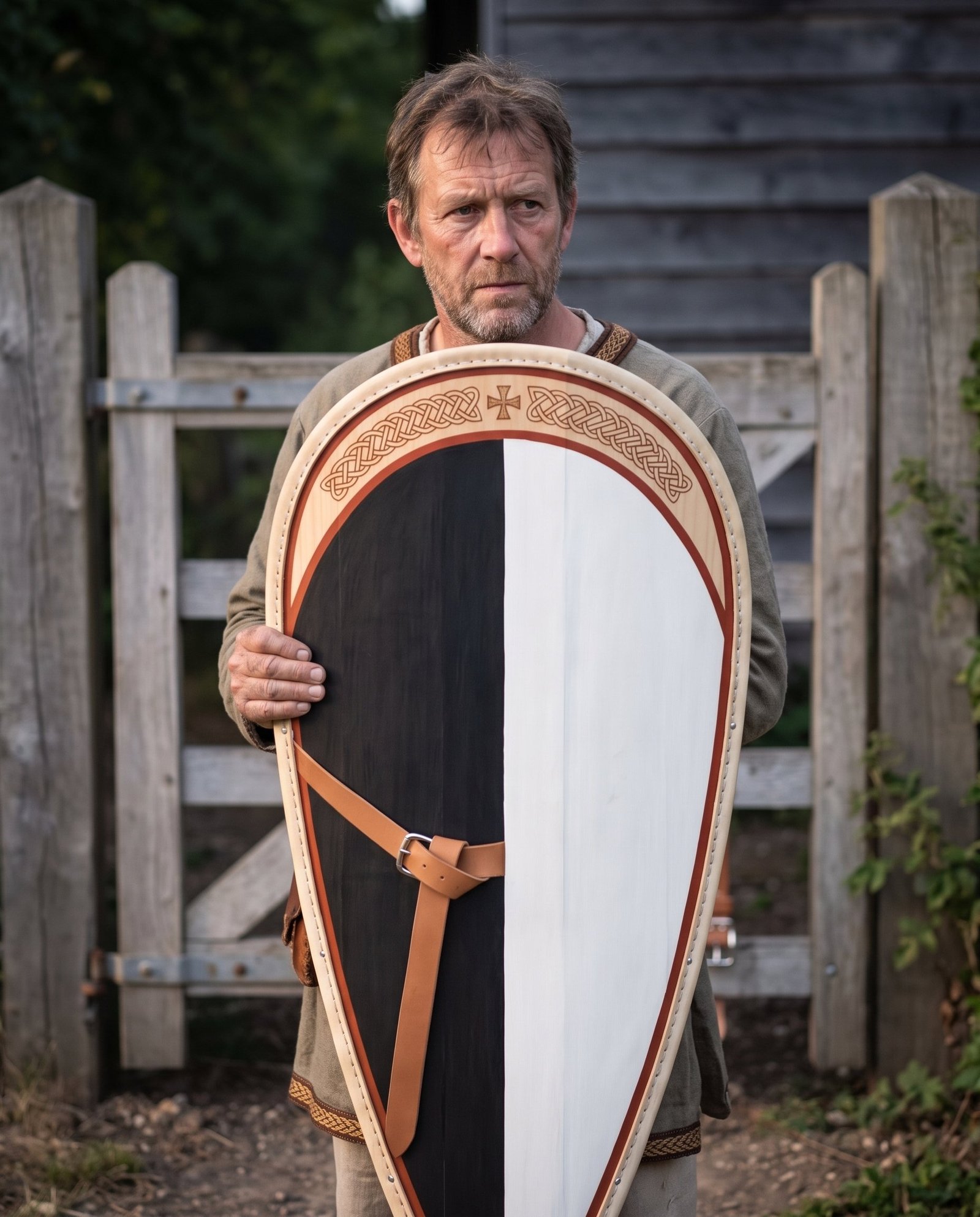
This is the single biggest difference between a kite shield and the Viking round shield it replaced, and it changes everything about how the thing is used. A round shield has a hole through the middle and your fist closes on a bar behind the boss. A kite shield has no hole and no boss to cover one. Instead it carries a pair of leather loops on the back, called enarmes, and your forearm goes through one while your hand grips the other.
Strapping the shield to the arm buys you two things. It takes the weight off your fingers, which is what makes a shield this size possible at all, and it frees your hand to hold reins. A centre gripped shield needs a closed fist, and a closed fist cannot ride a horse and carry a shield at the same time. The cost is agility: a strapped shield cannot be spun and angled the way a centre gripped one can, and you present it by moving your whole arm and shoulder rather than flicking your wrist.
Many originals also carried a third strap, a guige, running over the shoulder so the shield could hang on the back on the march or be slung while both hands were on a lance. If you want one fitted, ask us before you order.
Board, paint and rim
The board is straight planks glued edge to edge and worked to around 12 mm. Period kite shields were usually built from planks with a hide or linen facing glued over the front, because the facing binds the plank joints and stops a split from running. Ours relies on the glue line and the rawhide rim for that job, which is stronger than a period board and heavier for it.
The face is painted rather than printed, so the division down the centre has a real brushed edge and the rust red trim sits slightly proud where it meets the white. The knotwork band across the top is engraved into the timber and darkened, not transferred. The rawhide rim goes on wet and shrinks hard as it dries, gripping the plank ends the way a steel band grips a wheel, and it is riveted through at intervals so it cannot creep.
What this shield is for is display, costume, photography, drill and light non contact reenactment. It is not a full contact combat shield. A shield built for a hard hitting line needs a heavier board and a steel or very heavy rawhide rim, and it is treated as a consumable that gets replaced. Ask your group what they certify before buying any shield for the line.
Engraving, runes and your own design
Use the rune converter on this page to turn a name, a date or a short phrase into Elder Futhark and we will cut it into the steel or the leather. If you would rather have a Viking pattern than a rune line, choose your own design in the engraving option above the add to cart button and tell us where it goes. Where a piece already carries an engraved design, your chosen engraving replaces it rather than sitting alongside it. On this shield that means the knotwork band across the top gives way to your line, which at 22 inches across is enough room for a full name and a date. See the engraving page.
Mounting and display
A kite shield wants height. Hung with the shoulder at eye level the point drops to about waist height, which is how it reads correctly, and it needs roughly four feet of clear wall. Hang it from two hooks bearing on the enarme straps on the back rather than from a single hook through the rim, which loads one rivet with eleven pounds and will eventually tear out.
Keep it out of direct afternoon sun. Paint fades and rawhide dries, shrinks and eventually cracks under UV faster than most people expect, and a shield hung opposite a west facing window will show it within two summers. In a garage or an unheated barn the board will move with humidity and the rawhide will tighten and loosen with the seasons, which is normal. The leather belt hanging on the gate in the photograph is a studio prop and is not included.
Care
Dust the face with a dry cloth and leave solvents alone. Feed the rawhide rim once or twice a year with a neutral leather conditioner, working it around the rivets, which is where a rim always fails first. Check the rivets each season and tighten any that have worked loose, because a loose rim lets the plank ends move and that is how a board splits. Condition the enarme straps at the same time so they stay flexible at the fold. If the shield gets wet, dry it slowly and flat rather than propped on its point. Our notes on protecting metal fittings are on the steel care page. If it is going on a wall rather than into a line, choosing a shield for display covers size and mounting.
Made in the Czech Republic
This is a handmade piece from the Czech Republic, made in a workshop that still forges, grinds and finishes by hand instead of stamping parts out. The smiths there have kept the older way of working, and the wood, horn and leather are shaped and fitted by hand as well. Two pieces of the same design will never be identical, and that is part of what you are buying.
Ransack Viking is a United States company. We handle the import ourselves, look over every piece when it lands and ship from our warehouse in Chicago, Illinois. Engraving is done in the United States after the piece arrives, so your design goes on before we send it out.
A note on handmade variation
This shield is hand made, not machine made or bulk produced. What arrives will not be a pixel for pixel copy of the photograph. The plank joints fall in different places, the painted division down the centre is brushed rather than masked so it carries a slightly different edge every time, the rawhide takes colour unevenly across a hide, and the engraved knotwork bites deeper in softer grain. The dimensions, the materials and the build are the same every time. The character is not.
Frequently asked questions
Is this centre gripped like a Viking round shield?
No. It is strapped to the forearm with two leather loops on the back. That is what makes a shield this size carryable and what lets a rider keep a hand free for reins.
Can I use it in full contact reenactment?
No. It is built for display, drill and light non contact use. A combat line shield needs a heavier board and a much heavier rim and is expected to be destroyed and replaced. Check with your group before buying any shield to fight with.
How heavy is it on the arm?
Around eleven pounds, carried on the forearm rather than the fingers. That is comfortable for a good while standing and tiring quickly if you hold it away from the body.
Can you fit a shoulder strap?
Yes. A guige strap over the shoulder was common on originals and we can fit one before shipping. Ask us before you order rather than after.
Can I have my own heraldry painted on it?
The listing is for the black and white division shown. Custom heraldry is quoted separately, so send us what you want and we will price it.
How does something this size ship?
Flat in a fitted board box, free inside the United States. Processing is one to two weeks and returns are accepted within seven days in the original packing.
What is in the box
- One 40 inch planked and painted kite shield
- Riveted rawhide rim around the full outline
- Engraved knotwork band and cross across the face
- Leather forearm and hand straps fitted to the reverse
- Care and warranty card
- Made and finished by hand in the Czech Republic
Explore the range
See the rest of the kite shields and bucklers, the round shields, the medieval helmets, and the guides.
Also in this part of the catalogue
Sitting beside it in the catalogue is the Wavewarden buckler. Another in the same line is the Palecross buckler. Next along the rack is the Quarterfell buckler.
Fitting out further, the Kiteward Viking shield belongs with it. Or start from a blank sheet on the design your own page.

It’s okay. Not great not bad. It’s okay for the price. It’s Czech made and US shipped. Packaging was just okay though.
No regrets on this purchase at all. Looks incredible with the rest of my reenactment kit. If you’re on the fence just get it. You won’t regret it.
Not quite what I was hoping for. Fit was off from the sizing chart listed. Might work for someone less picky than me.