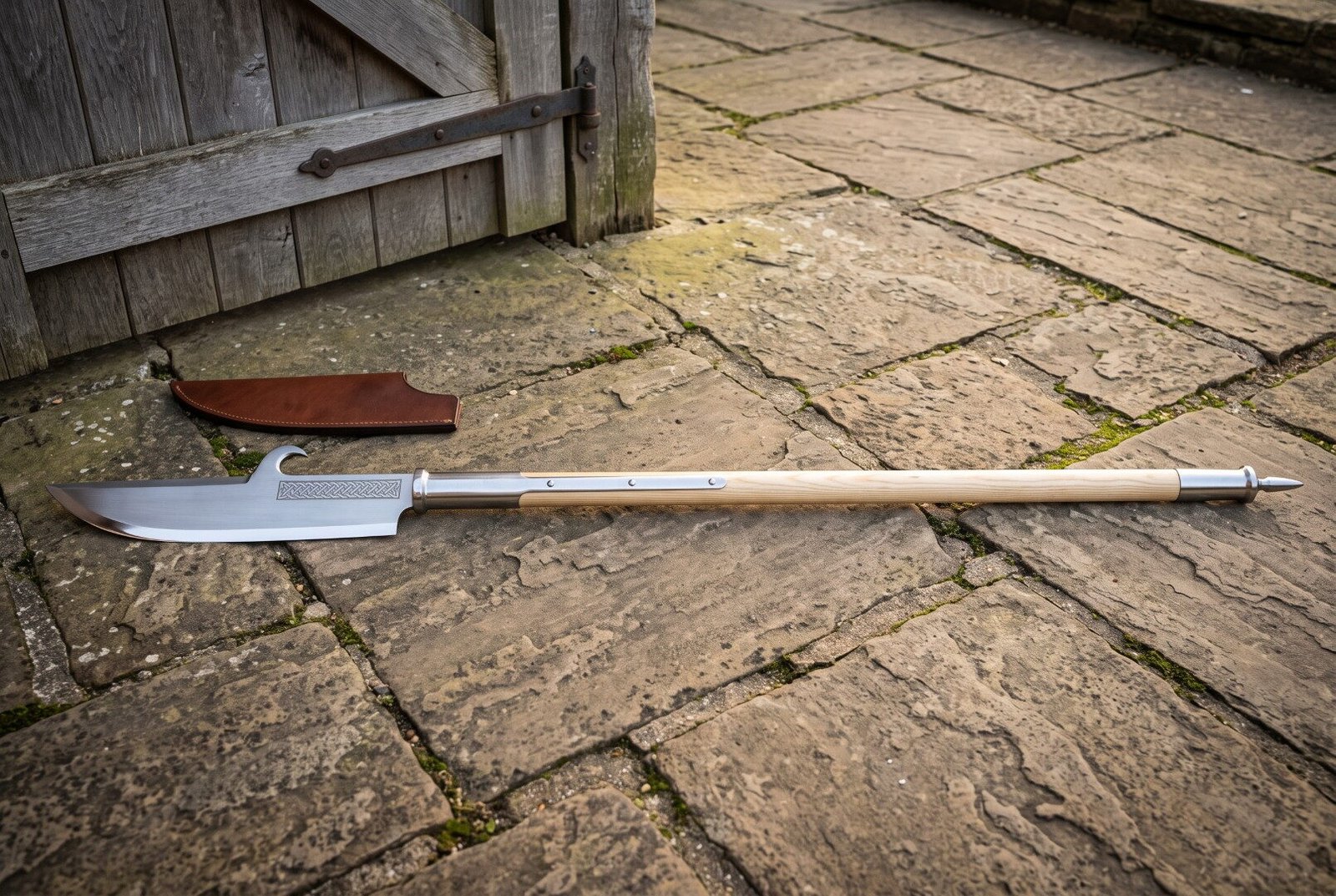
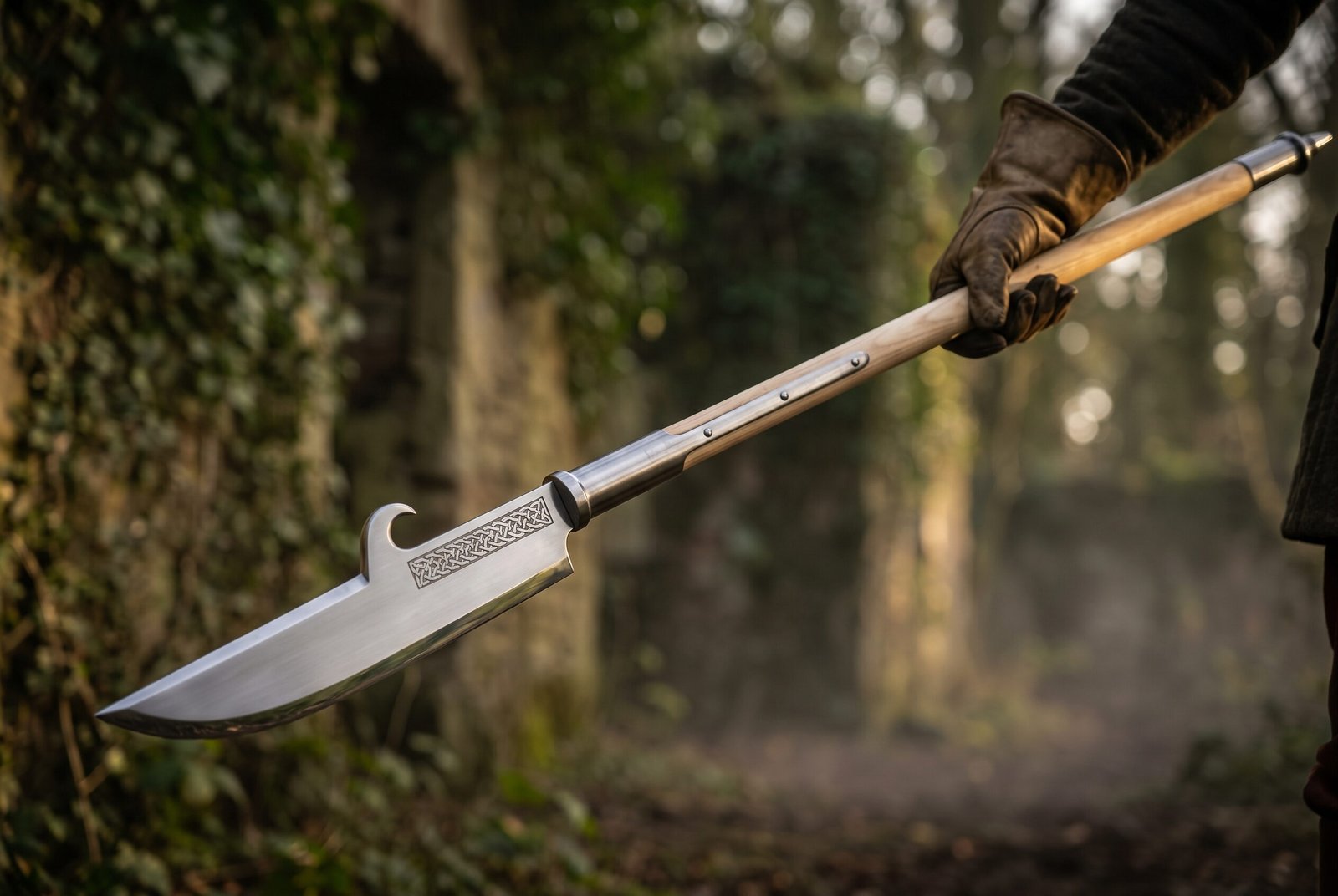
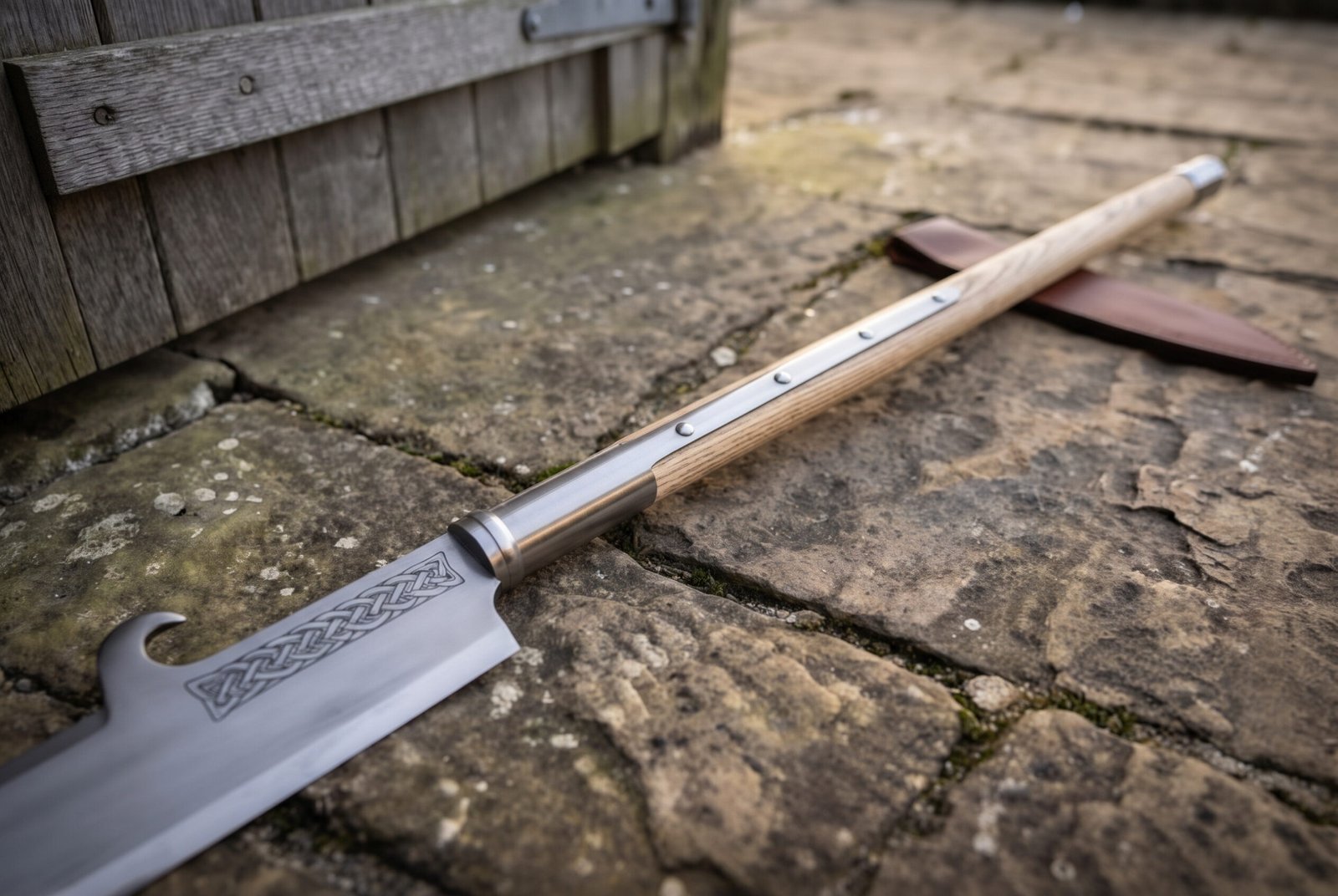
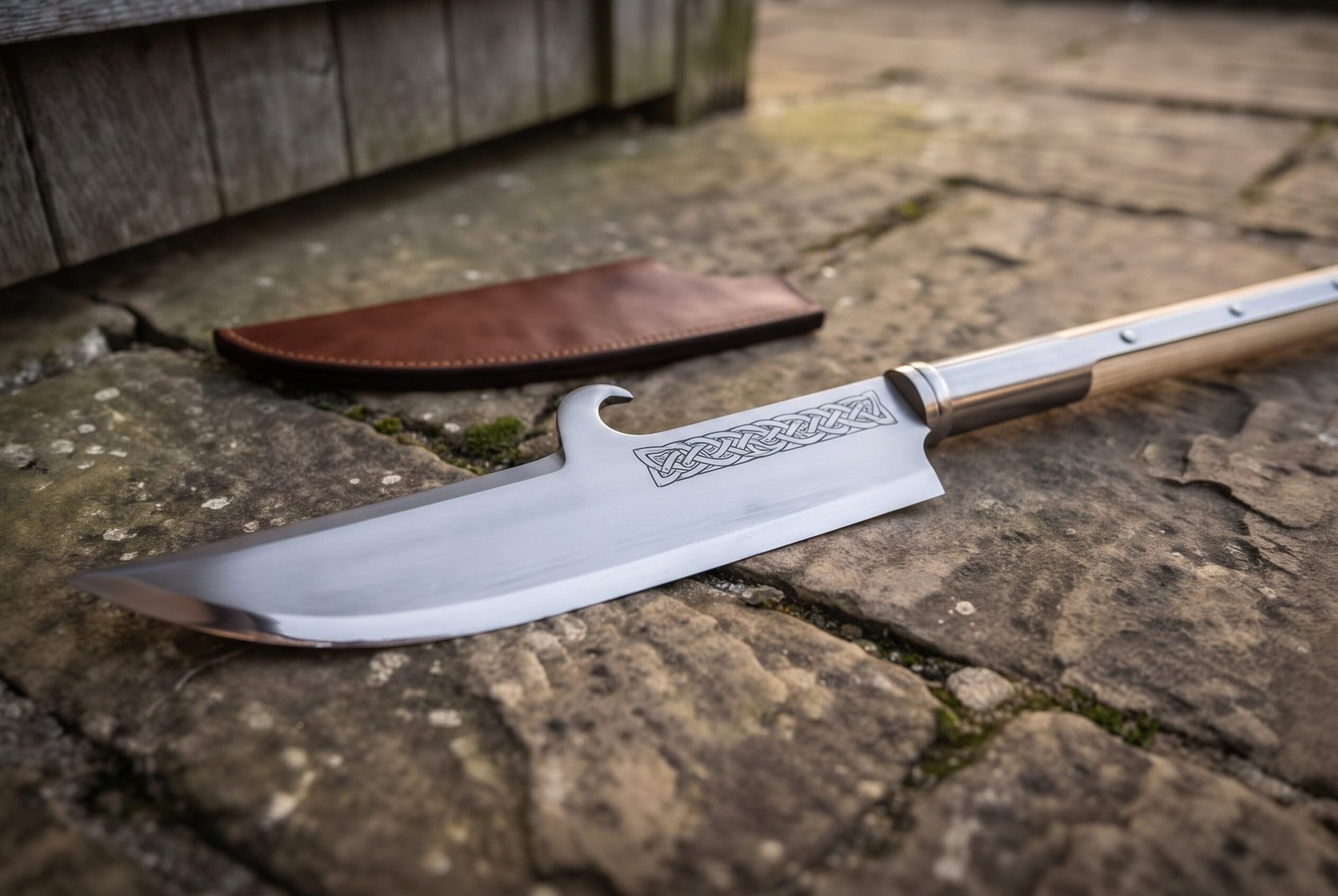
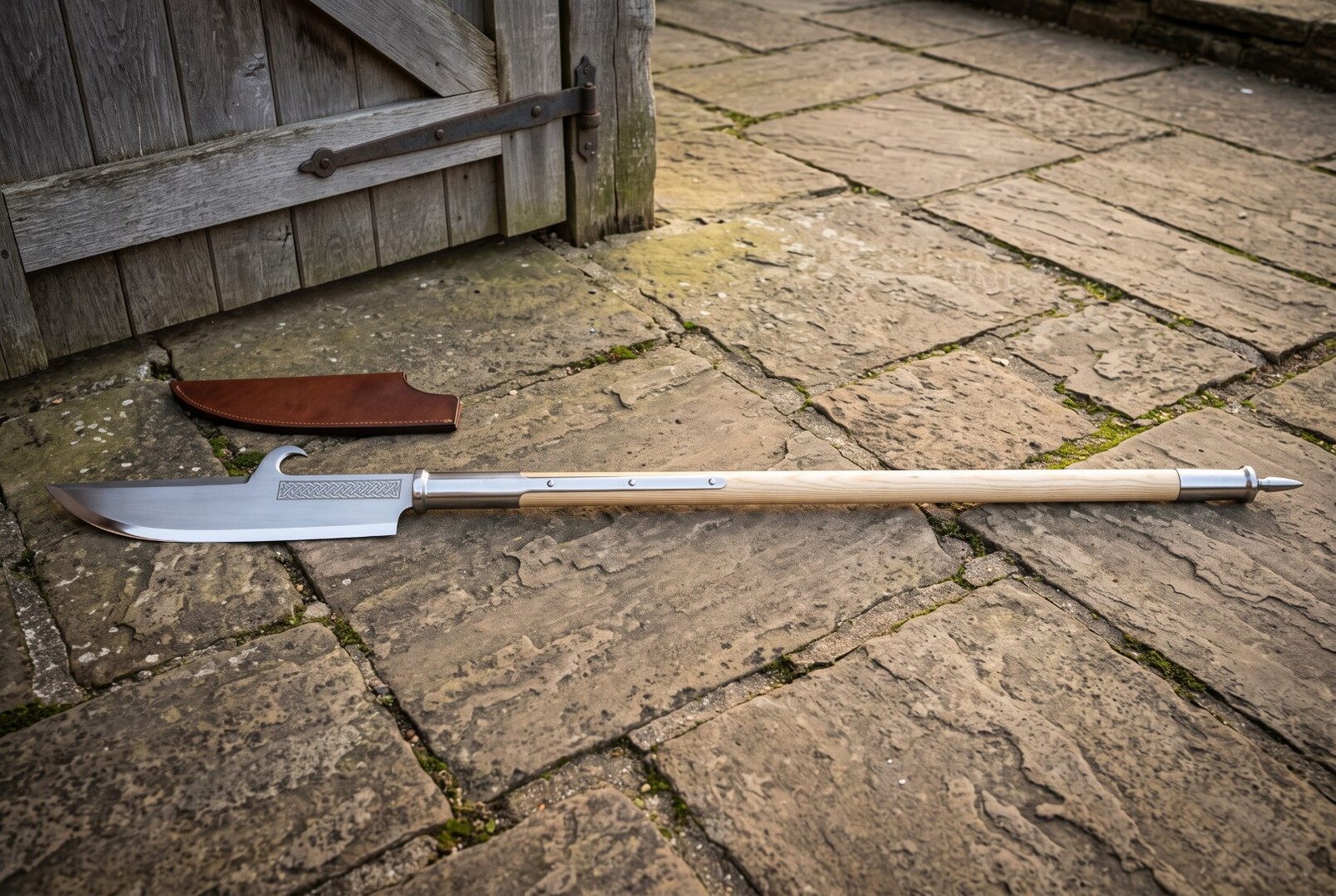
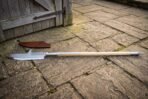
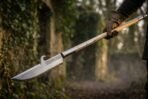
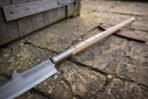
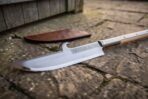
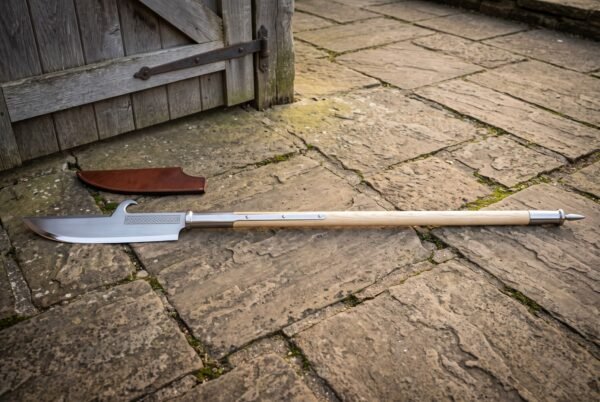
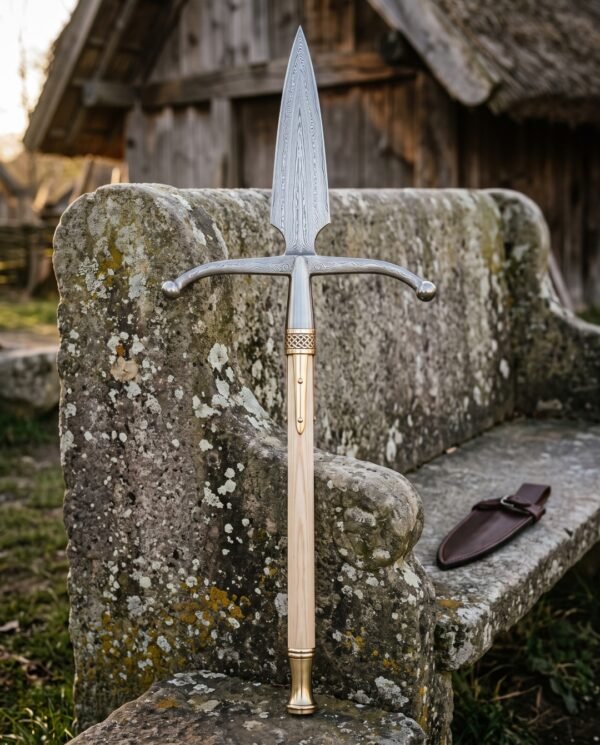
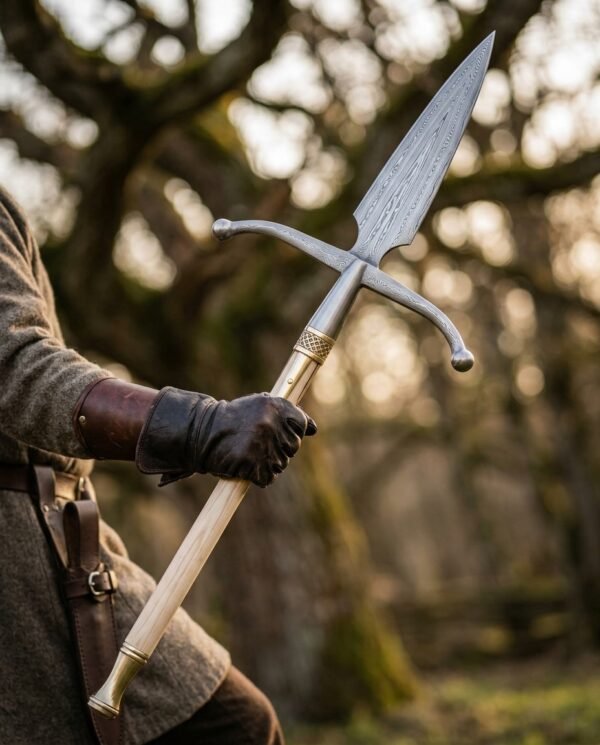
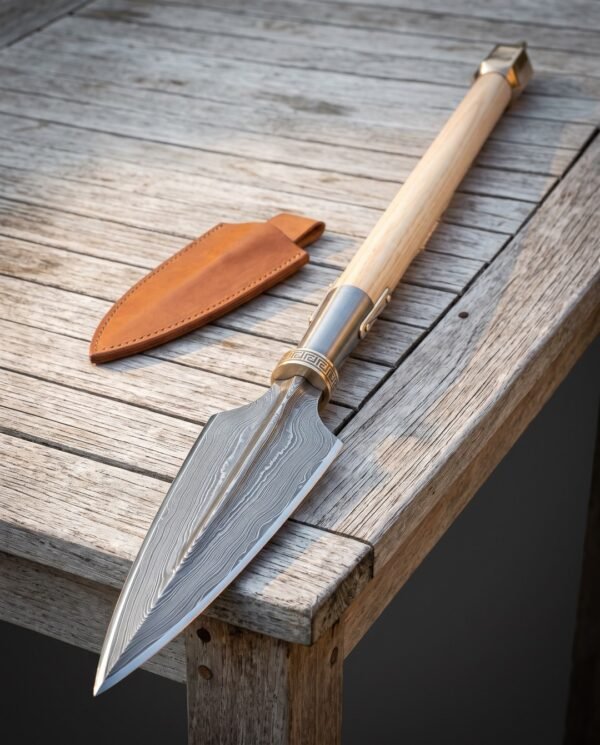
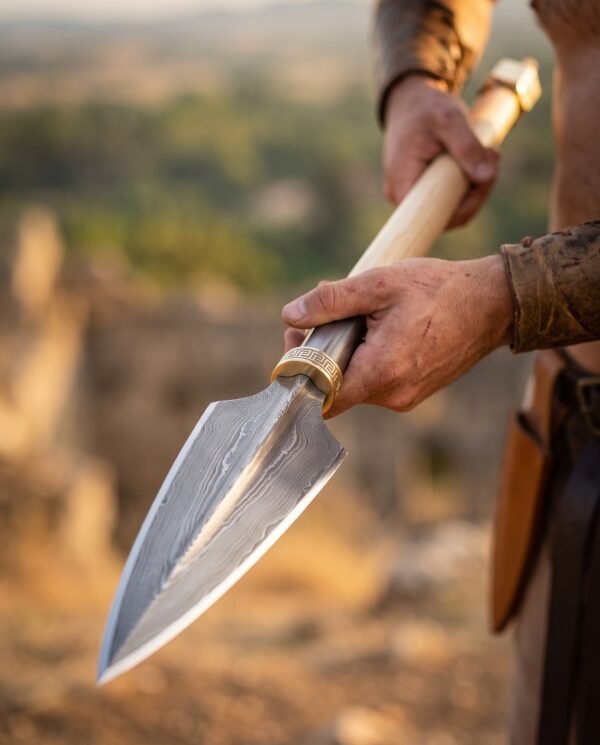
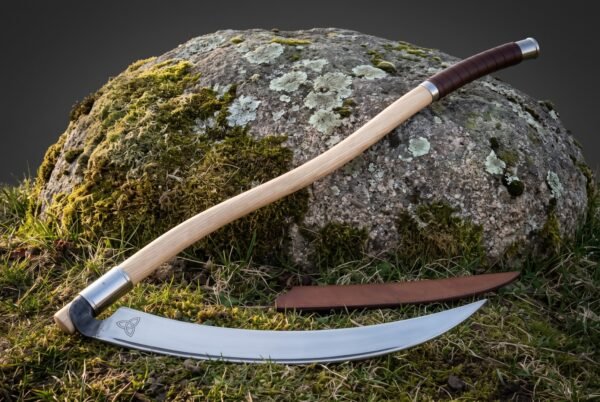
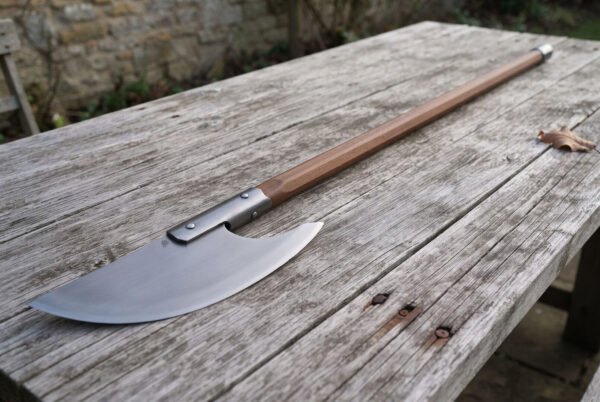
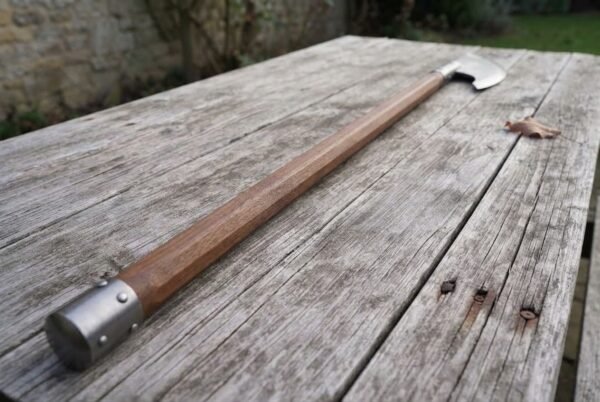
This is a glaive, a single edged polearm with a broad cleaver of a head set on a long haft. The head is forged with a deep belly and a sweeping upswept point, and a heavy rearward hook rises off the spine behind the edge. A band of engraved knotwork runs along the flat where the blade meets the socket. The head sits on a straight ash haft held by steel langets and rivets, and the heel of the haft is capped with a steel spike. A leather sheath covers the edge for storage.
Almost every polearm in Europe started life as a farm tool, and the glaive is the clearest case of all. It is a billhook, the tool used for centuries to lay a hedge and trim a coppice, put on a longer stick by people who needed something to fight with and already owned one of these. The hook that a hedger used to pull a cut branch out of the way turned out to be equally good at pulling a rider off a horse. Once armies noticed, the smiths stopped pretending and started forging them for war from the start, thickening the spine, adding langets and putting a spike on the butt.
Forged, ground, heat treated, engraved and hafted by hand in the Czech Republic, and shipped with its leather blade sheath. Look for it with the glaives and polearms, and take in the Viking spears on the way past.
Specifications
| Head steel | 1095 high carbon, hardened to 54 to 58 HRC |
|---|
| Overall length | 50 inches nominal |
|---|
| Head length | 18 inches nominal including the socket |
|---|
| Head profile | Broad single edged blade with a bellied edge sweeping up to the point and a hooked spur rising off the spine |
|---|
| Engraving | Knotwork panel along the flat above the socket |
|---|
| Haft | Straight ash, sanded and oiled |
|---|
| Fittings | Steel socket with a dark collar ring, riveted steel langets down the haft, pointed steel butt spike |
|---|
| Finish | Satin polished head, natural oiled ash, brushed steel fittings |
|---|
| Sheath | Brown leather blade sheath |
|---|
| SKU | RK-1776 |
|---|
What the hook on the back is for
The spur rising off the spine behind the edge is the single most useful part of this polearm and the part people most often mistake for decoration. It does three things that the edge cannot.
It catches. Hooked around a shield rim, a bridle, a stirrup or the edge of a breastplate, it lets a footman pull. That is why polearms with hooks proliferated in exactly the period when heavy cavalry dominated the field. You cannot cut through a mounted man in plate, but you can drag him off his horse, and once he is on the ground the fight is a very different one.
It binds. Set against another haft, the hook stops an opposing polearm sliding past and gives you a moment of control.
And it protects the edge. A hook takes the impact of a bind at the spine rather than the cutting edge, which is why glaives with hooks tend to survive with less edge damage than those without.
The hook is forged as part of the head, drawn out of the same billet rather than welded on. A welded hook is a hook that comes off.
Langets, and why they matter more than the rivets
The two steel straps running down the haft from the socket are langets. They exist because of a specific and very old problem. A long wooden shaft with a cutting head on it invites an opponent to attack the shaft, and a hand axe will take a glaive haft off in two blows if there is nothing but wood there.
Langets armour the first eight or ten inches below the head, exactly where a cut would land. They also stiffen the joint enormously. Without them the head levers against the socket every time the blade bites and slowly works the wood loose. With them the load spreads down the shaft, and the rivets stop being the only thing holding the assembly together.
Look at any museum polearm and you will find langets on nearly all of them. It is one of those details that separates a polearm built by someone who understood the problem from a costume piece built from a photograph.
1095 head and an ash haft
The head is 1095 high carbon steel, hardened to between 54 and 58 HRC. A glaive head is a heavy chopper and it needs toughness above all, because the mass and the leverage of a long haft put more force behind the edge than any hand held blade can generate. In that hardness range the steel takes a bite out of a target rather than chipping.
The haft is ash, which is what hafts have been made of in northern Europe since before anyone was writing things down. Ash has long straight fibres, high shock absorption and a habit of bending a very long way before it fails. Oak is stiffer and heavier and transmits every impact into your palms. Ash gives.
Engraving, runes and your own design
Use the rune converter on this page to turn a name, a date or a short phrase into Elder Futhark and we will cut it into the steel, the leather or the wood. If you would rather have a Viking pattern than a rune line, choose your own design in the engraving option above the add to cart button and tell us where it goes. Where a piece already carries an engraved design, your chosen engraving replaces it rather than sitting alongside it.
This head already carries a knotwork band above the socket, so an engraving ordered in that position takes its place. The broad flat of the blade behind the edge is the other obvious canvas, and it holds a longer rune line than almost anything else we make. Details on the engraving page.
Handling and balance
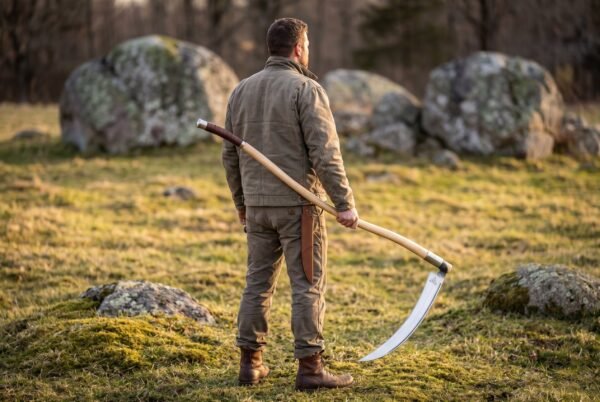
A glaive is held with the hands well apart, front hand roughly a third up the haft and rear hand near the butt. The head is heavy and it wants to lead, so the glaive is steered by pushing with the rear hand rather than pulling with the front. The steel butt spike balances a little of that weight back and gives you a second working end.
The head arrives sharpened. This is a real forged cutting head on a real haft and it deserves the caution you would give any large blade. We do not sell it for full contact sparring or reenactment combat, which need blunt heads made for the purpose. It is made for collecting, for wall display and for careful controlled cutting where there is nothing within reach of the swing.
Store it head up, and be honest with yourself about your ceiling height before you pick it up indoors.
Care
Wipe the head after handling and keep a light film of oil on it. 1095 has no chromium and a fingerprint left for a fortnight etches. Our steel care notes cover the routine and apply to any plain carbon blade.
The ash haft wants a wipe and an occasional rub of linseed or hardwood oil, worked in and buffed off. Never varnish a haft, because varnish goes slippery in a warm hand and chips at the langets. Check the rivets once a year and let us know if anything has moved. Feed the leather sheath twice a year and do not store the head sheathed in a damp basement.
Made in the Czech Republic
This piece is made by hand in the Czech Republic, in a workshop that still works the old way. The steel is forged, ground, heat treated and finished by smiths who learned the trade from the people before them, and the wood, horn and leather are cut and fitted by hand rather than pressed out on a line. That is also why no two pieces come out exactly the same.
Ransack Viking is a United States company. We import these pieces ourselves, check every one when it lands and ship from our warehouse in Chicago, Illinois. Engraving is done here in the United States after the piece arrives, so your runes or your own design go on before it leaves for you.
A note on handmade variation
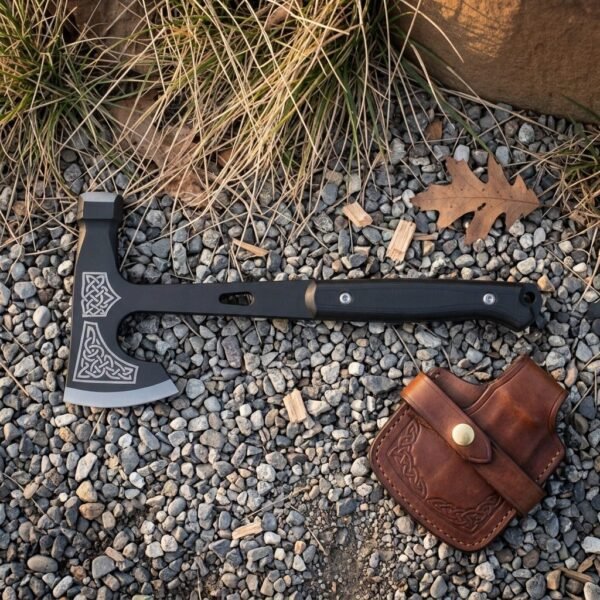
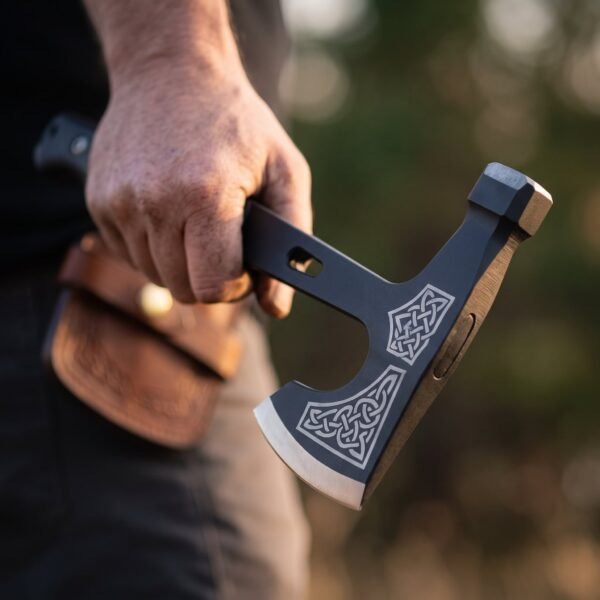
This glaive is hand made rather than machine made or bulk produced, so what arrives will not be a pixel for pixel copy of the photograph. Every ash stave has its own grain, its own streaking and its own tone anywhere between pale cream and warm honey. The hook is drawn out by hand, so its exact sweep varies slightly, and the knotwork is cut rather than printed so its rhythm is a person’s rather than a machine’s.
The steel, the hardness, the length and the build are the same every time. The character is not. You can carry on with the Norse gods, or look at how to hang a blade on a wall while you are there.
Frequently asked questions
How long is it really?
Around 50 inches assembled. It is a genuine polearm and it needs a room with the space for it. Measure your wall before you order.
Does it ship in one piece?
Yes, assembled, in a long box. Check that your delivery address can take a package of that length, because apartment lobbies sometimes cannot.
Is the hook sharp?
The inside of the hook is left blunt and the main edge is sharpened. A sharpened hook catches on everything and cuts nobody, which is not a useful combination.
Is this display only or usable?
It is a functional forged head on a functional haft, so it will cut. It is not sold for sparring or reenactment combat against another person.
Can the haft be cut shorter?
Ask us before ordering. We can shorten the haft and refit the butt spike here, which is much easier than doing it at home once the langets are riveted.
Can I get runes cut into the blade?
Yes. The broad flat behind the edge takes a long line, and it is one of the best canvases in the whole range for a full phrase.
What is in the box
- Reaphook glaive, assembled, sharpened and hafted
- Brown leather blade sheath
- Light protective oil coat on the head
- Steel, wood and leather care card
- Forged and finished in the Czech Republic
Explore the range
Browse the glaives and polearms, the Viking spears, the wider Norse arms, and the guides.
Other pieces in this group
For a straight comparison, see the Wildcleave polearm, 60 inches overall. Worth putting side by side with this is the Harrowsweep polearm, forged from 1095. In the same category sits the Reapcurve polearm, pattern welded Damascus.
From the same corner of the shop, there is the Ashmaul poleaxe. Nothing here exactly right, build one to your own spec on the custom Norse arms page.
Reviews
There are no reviews yet