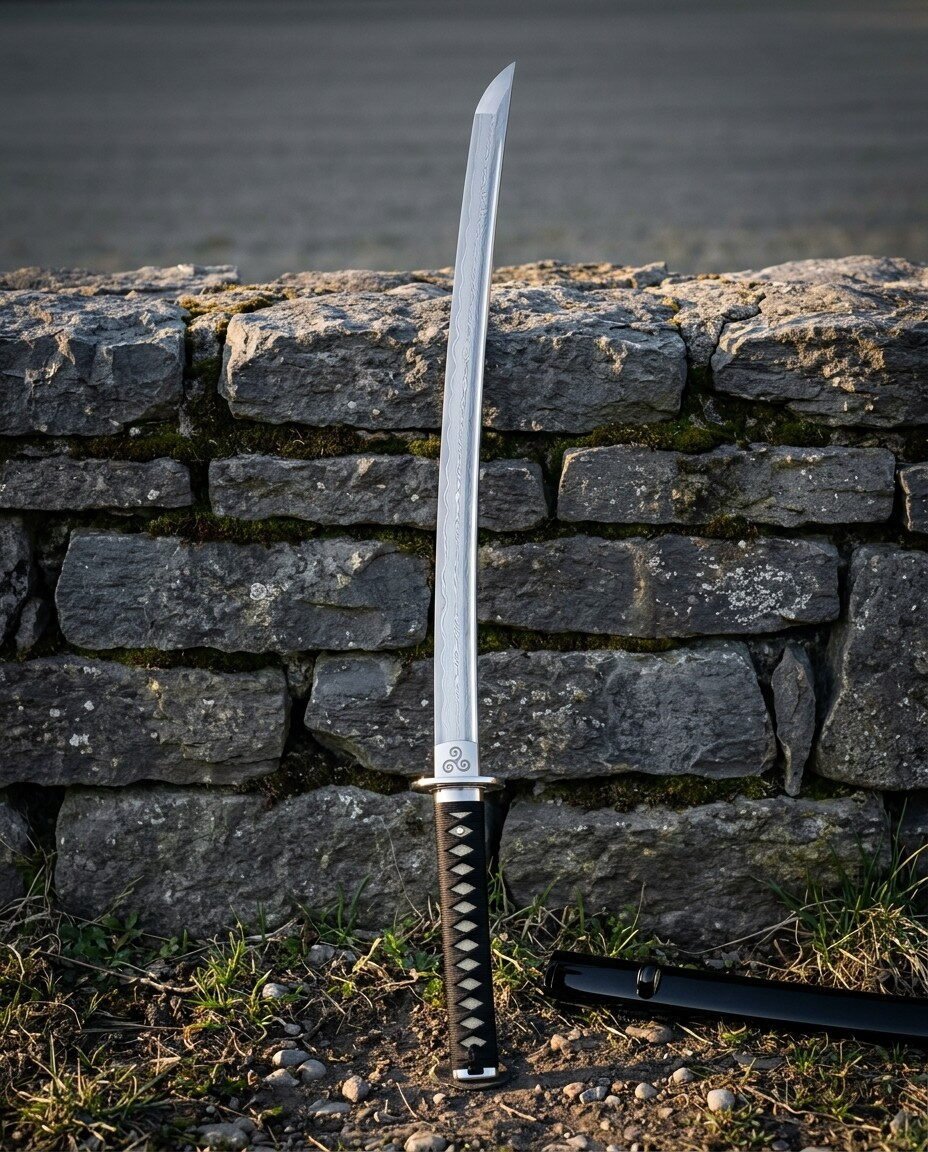
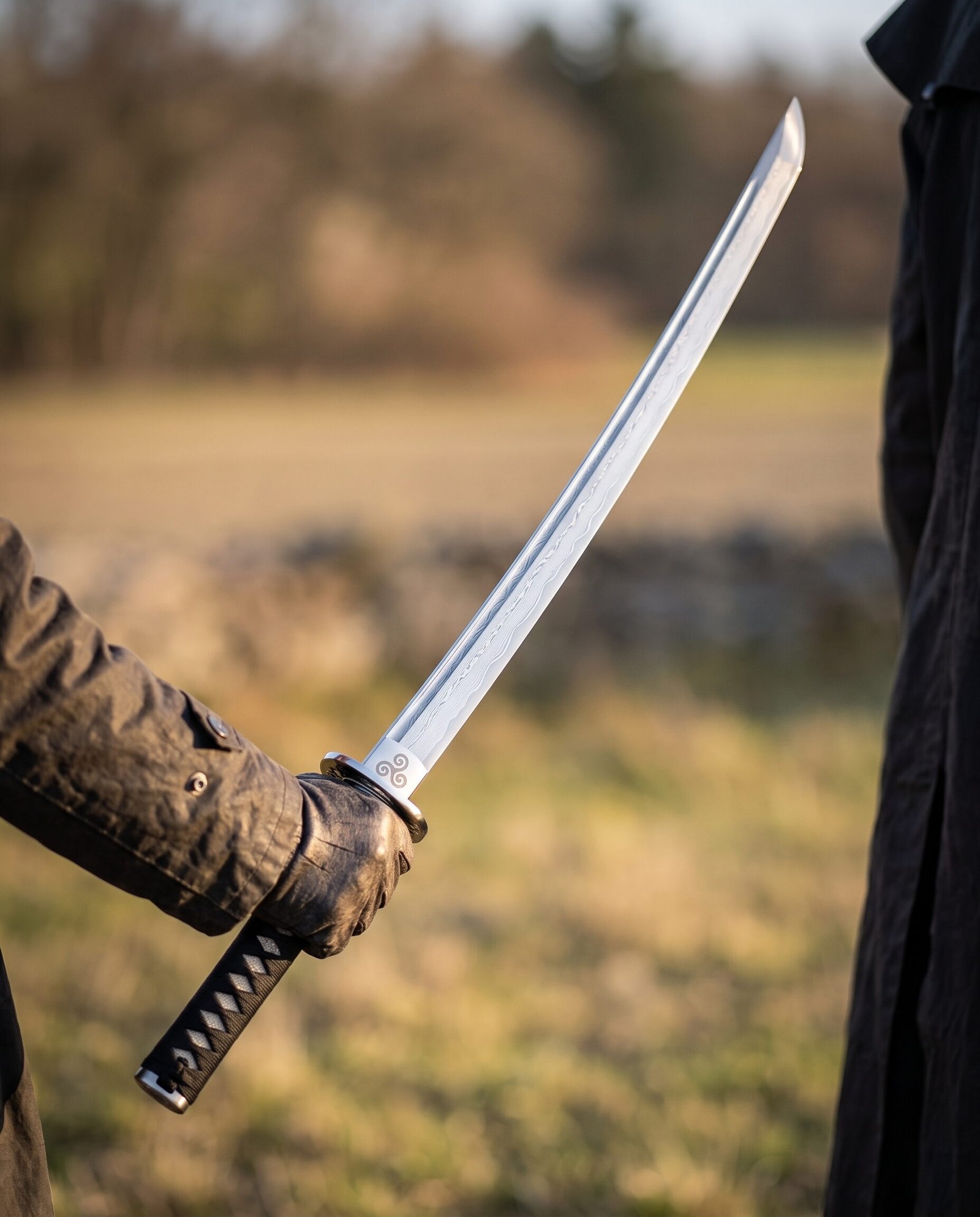
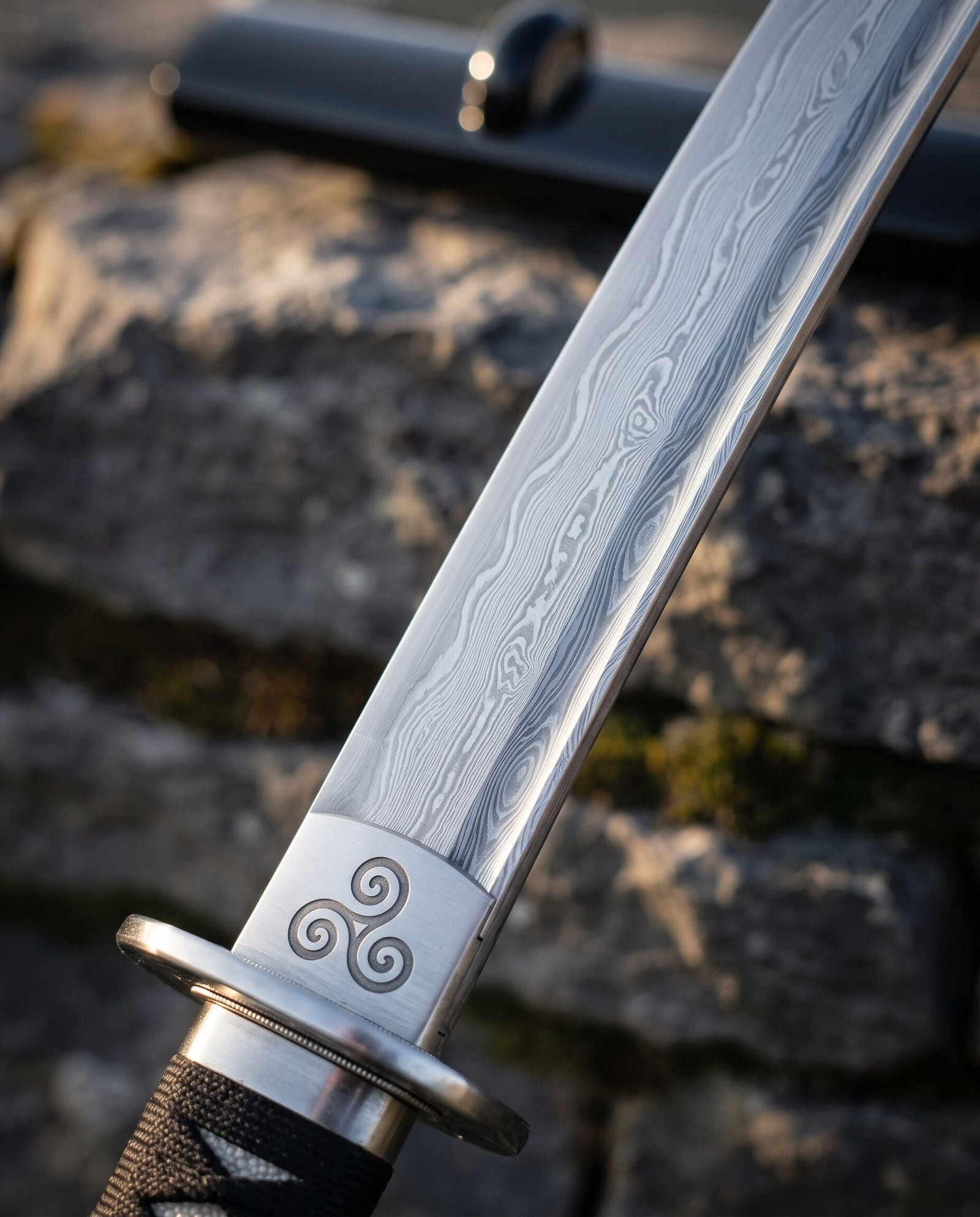
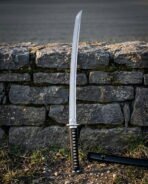
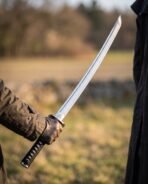
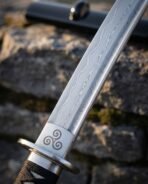
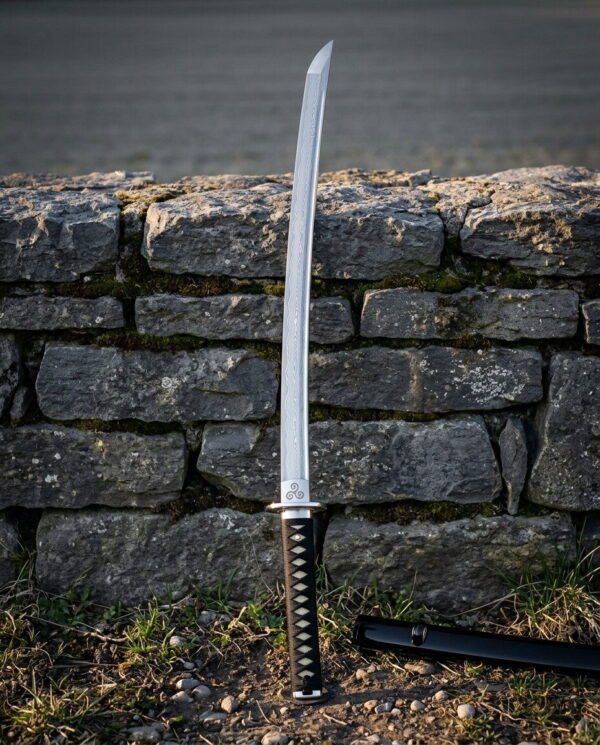
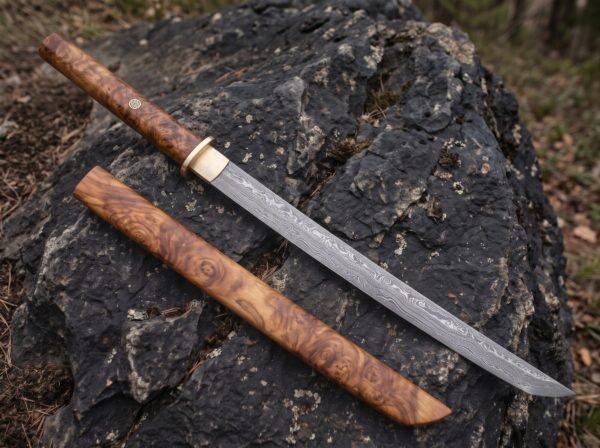
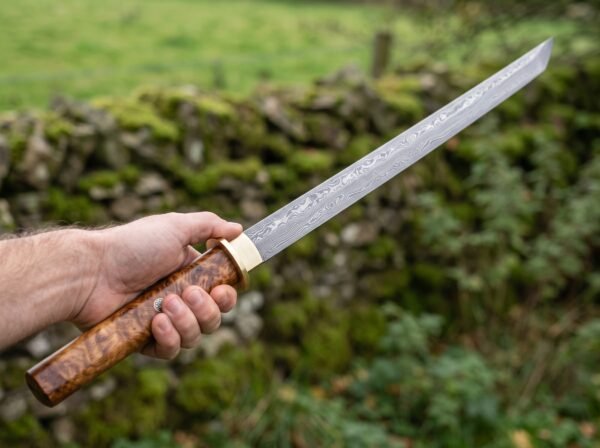
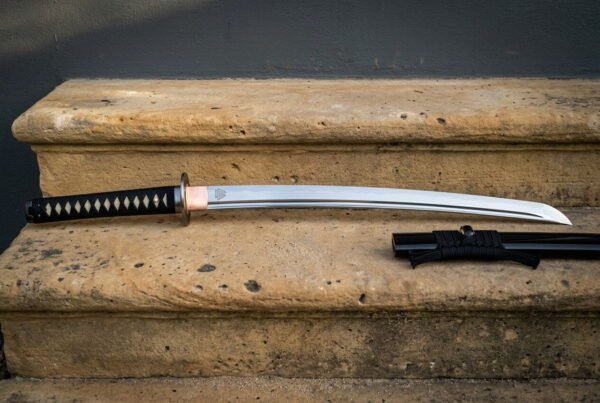
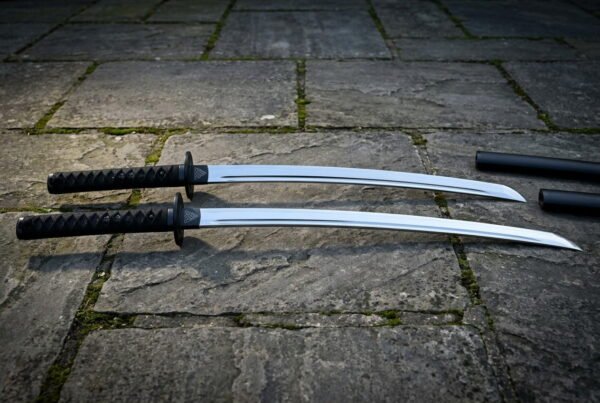
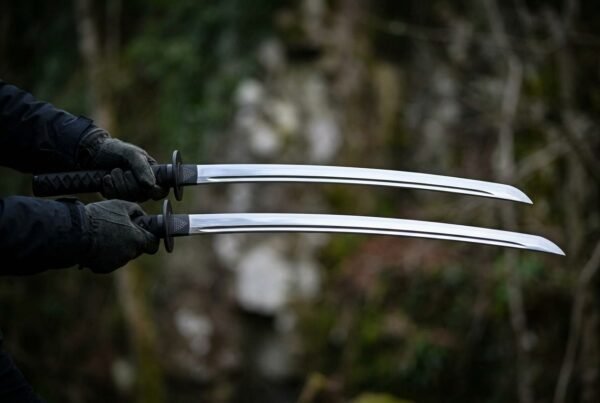
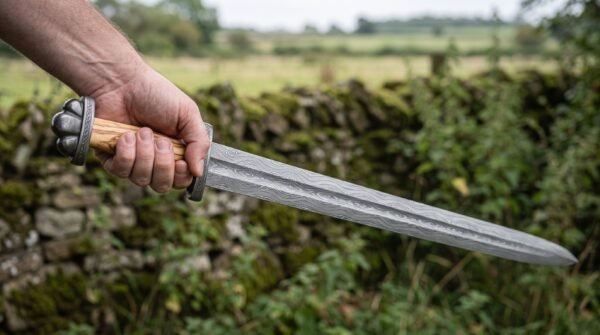
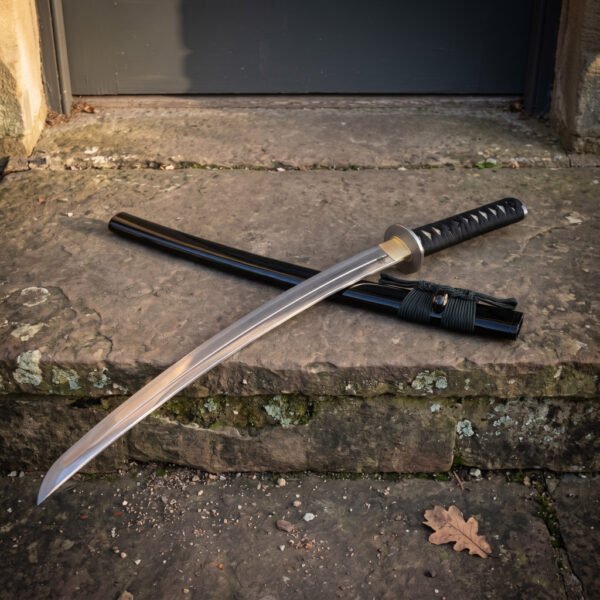
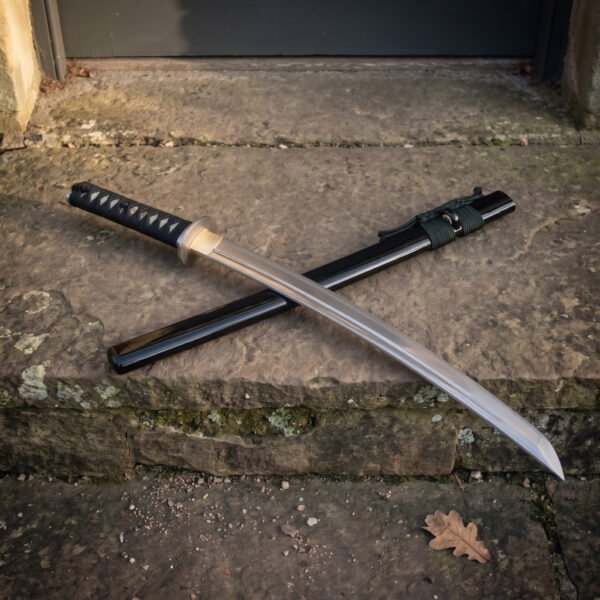
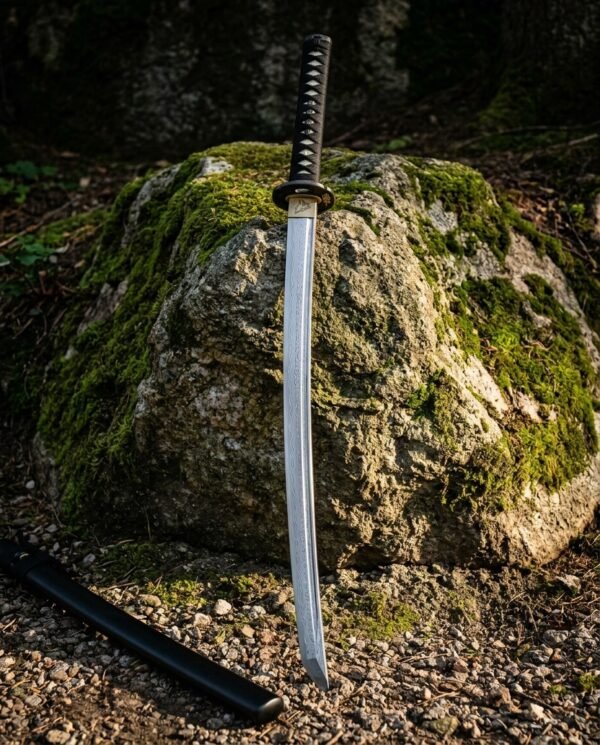
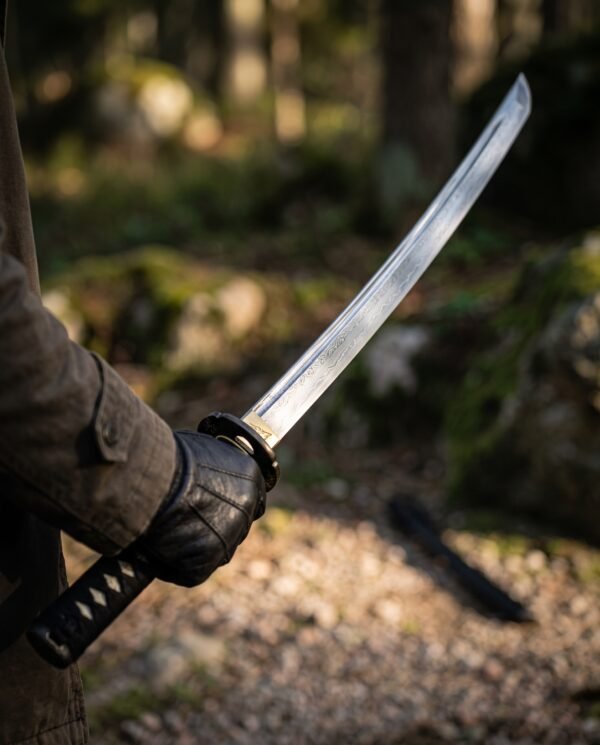
Spiralcrest is a hand forged Damascus katana with a gently curved single edged blade, a clipped straight tip and a wave figure running the length of the flat where the folded layers come up under the etch. A triskelion is cut into a polished steel habaki at the base of the blade, the tsuba is a plain oval, and the tsuka is wrapped in black cord over pale rayskin so the diamonds show through. A black saya ships with it.
The triskele on the blade is far older than any sword. Three spirals turning from a common centre are carved into the entrance stone at Newgrange in Ireland, cut around three thousand two hundred years before the common era, which puts them roughly a thousand years ahead of Stonehenge and five thousand years ahead of the Viking age. The same three fold turning motif surfaces again in Iron Age Celtic metalwork, on Sicilian coins, in Norse ornament as three interlinked horns, and it has never fully gone away. Nobody can tell you what the Newgrange carvers meant by it, only that it mattered enough to cut into granite with stone tools.
Forged, folded, etched, ground and mounted in the Czech Republic. It ships with the black saya, a light protective oil on the blade and a care card for etched Damascus. Free shipping inside the United States and one to two weeks of processing while the billet is folded and drawn out. You will find it filed with the Japanese swords, along with the rest of the tanto knives.
Specifications
| Blade material | 1095 and 15N20 Damascus, 58 to 60 HRC |
|---|
| Pattern | Hand folded and acid etched, wave figure along the flat |
|---|
| Blade shape | Gently curved, single edged, with an angled straight tip |
|---|
| Overall length | Approximately 40 inches |
|---|
| Blade length | Approximately 27 inches |
|---|
| Tsuka length | Approximately 11 inches |
|---|
| Habaki | Polished steel, cut with a triskelion |
|---|
| Tsuba | Small plain oval in polished steel |
|---|
| Fuchi and kashira | Bright polished steel |
|---|
| Tsuka | Black cord wrapped over pale rayskin |
|---|
| Saya | Black gloss lacquered saya, included |
|---|
| SKU | RK-1821 |
|---|
Where the curve comes from, and what the wave is not
A traditional Japanese blade gets its curve from the quench rather than from the hammer. The smith coats the spine in a thick layer of clay and the edge in a thin one, so when the blade goes into water the edge cools fast and transforms into hard martensite while the spine cools slowly and stays softer. Martensite occupies more volume than the steel it came from, the edge tries to grow, and the blade bends backward into its curve on its own. The visible boundary between the two structures is the hamon.
This blade is made differently and it is worth saying so plainly. The curve is forged and ground in, and the wave you see along the flat is the Damascus pattern brought up by acid, not a hamon. Folded Damascus and a clay quench are two separate traditions and combining both cleanly on one blade is rarely done well. We would rather give you honest Damascus than a printed line pretending to be a temper line.
The steel
The billet is 1095 and 15N20 forge welded and folded. The 1095 is a plain high carbon steel that hardens deep. The 15N20 carries nickel, resists the acid and stays bright, and that difference in etching response is the entire reason the pattern is visible. Nothing is dyed, plated or printed. After forging the blade is normalised, hardened and tempered to 58 to 60 HRC, then ground, etched and neutralised.
The habaki is polished steel and carries the cut triskelion. It is fitted to the blade and the saya mouth, and it wedges the blade in place so it does not rattle in the scabbard.
Engraving, runes and your own design
Use the rune converter on this page to turn a name, a date or a short phrase into Elder Futhark and we will cut it into the steel. If you would rather have a Viking pattern than a rune line, choose your own design in the engraving option above the add to cart button and tell us where it goes. Where a piece already carries an engraved design, your chosen engraving replaces it rather than sitting alongside it. On this katana your chosen mark takes the place of the triskelion on the habaki. Etched Damascus takes a cut line well because the layers give it contrast. See the engraving page.
Handling and balance
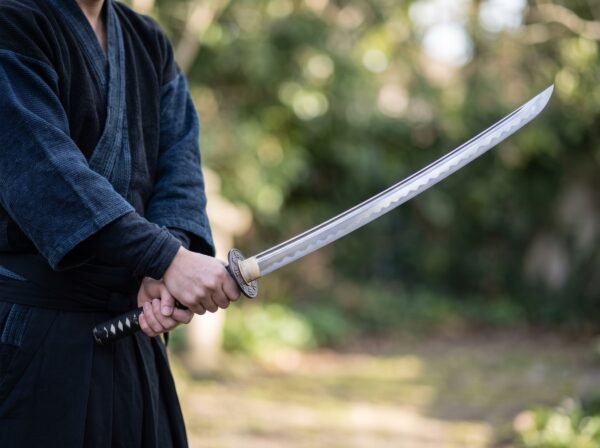
A long tsuka on a moderate blade puts the balance close in, around four inches ahead of the tsuba. The sword turns easily and the two handed grip gives real control, which is the point of the format. Hold with the left hand at the kashira end and the right hand up near the tsuba, and let the wrists rather than the arms do the work.
This is a collector and display katana with a genuine Damascus blade and a proper heat treat. It is not sold for sparring and it should not be used in contact work against another person or another blade. If you intend to cut targets, mats and bottles are within reason and bamboo and hardwood are not.
Care
Damascus is high carbon steel and will rust if left wet or fingerprinted. Wipe the blade after every handling and put a thin film of mineral or camellia oil on it. Camellia oil is the traditional choice for Japanese blades and it is a genuinely good one, being non drying and neutral. Never store the blade in the saya long term in a humid room, because a wooden scabbard holds moisture against steel. Full routine on the steel care page.
The cord wrap can be brushed dry and should not be soaked. Wipe the saya with a dry cloth and keep it out of direct sun, which fades and cracks a lacquered finish over years.
Made in the Czech Republic
This is a handmade piece from the Czech Republic, made in a workshop that still forges, grinds and finishes by hand instead of stamping parts out. The smiths there have kept the older way of working, and the wood, horn and leather are shaped and fitted by hand as well. Two pieces of the same design will never be identical, and that is part of what you are buying.
Ransack Viking is a United States company. We handle the import ourselves, look over every piece when it lands and ship from our warehouse in Chicago, Illinois. Engraving is done in the United States after the piece arrives, so your design goes on before we send it out.
A note on handmade variation
This katana is hand made, not machine made or bulk produced, so what arrives will not be a pixel for pixel copy of the photograph. Damascus figure is drawn out under the hammer and it moves differently in every billet, so the wave along your blade will run its own way and no two are alike. Rayskin is a natural material and the size and spacing of its nodes vary panel to panel, which changes how the diamonds read through the wrap. The triskelion is cut by hand. The dimensions, the steel and the build are the same every time. The character is not. More on how the Japanese blade lengths line up elsewhere on the site, along with the gap between a display sword and a battle ready one.
Frequently asked questions
Is the wave along the blade a hamon
No, and we will not call it one. It is the folded Damascus pattern brought up by acid. A hamon is a hardening boundary produced by a clay quench, which is a different process entirely.
Is the Damascus real
Yes, forge welded from 1095 and 15N20. The pattern runs through the blade rather than sitting on the surface, so sharpening and polishing will never remove it.
Does it come sharp
Yes, with a keen cutting edge. Tell us in the order notes if you want it left unsharpened for display and we will do that at no extra cost.
Can I use it for tameshigiri
Rolled mats and water bottles, yes, with proper training and space. Bamboo, hardwood and anything with a hidden nail in it, no. Impact damage from unsuitable targets is not a manufacturing defect.
Is the tsuka wrapped over real rayskin
Yes, pale rayskin under the cord, which is what produces the diamonds you can see through the wrap. It also gives the cord something to bite into so the wrap does not creep.
How long before it ships
One to two weeks of processing while the billet is folded and the sword is mounted, then free shipping inside the United States.
What is in the box
- One Spiralcrest Damascus katana with cut triskelion
- Black saya
- Protective oil film on the blade
- Care card for etched Damascus and cord wrapped handles
- Forged and finished in the Czech Republic
Explore the range
See more in katana and Japanese swords, damascus swords and swords, or read the guides on hamon, Damascus and how to tell them apart.
Also in this part of the catalogue
If this one is not quite right, there is the Stormfold Japanese sword, pattern welded Damascus. Also in this group is the Tidefold Japanese sword, 40 inches overall. Sitting beside it in the catalogue is the Emberfold Japanese sword, 40 inches overall.
From the same corner of the shop, there is the Rosewarden sword. Or start from a blank sheet on the design your own page.

Reviews
There are no reviews yet