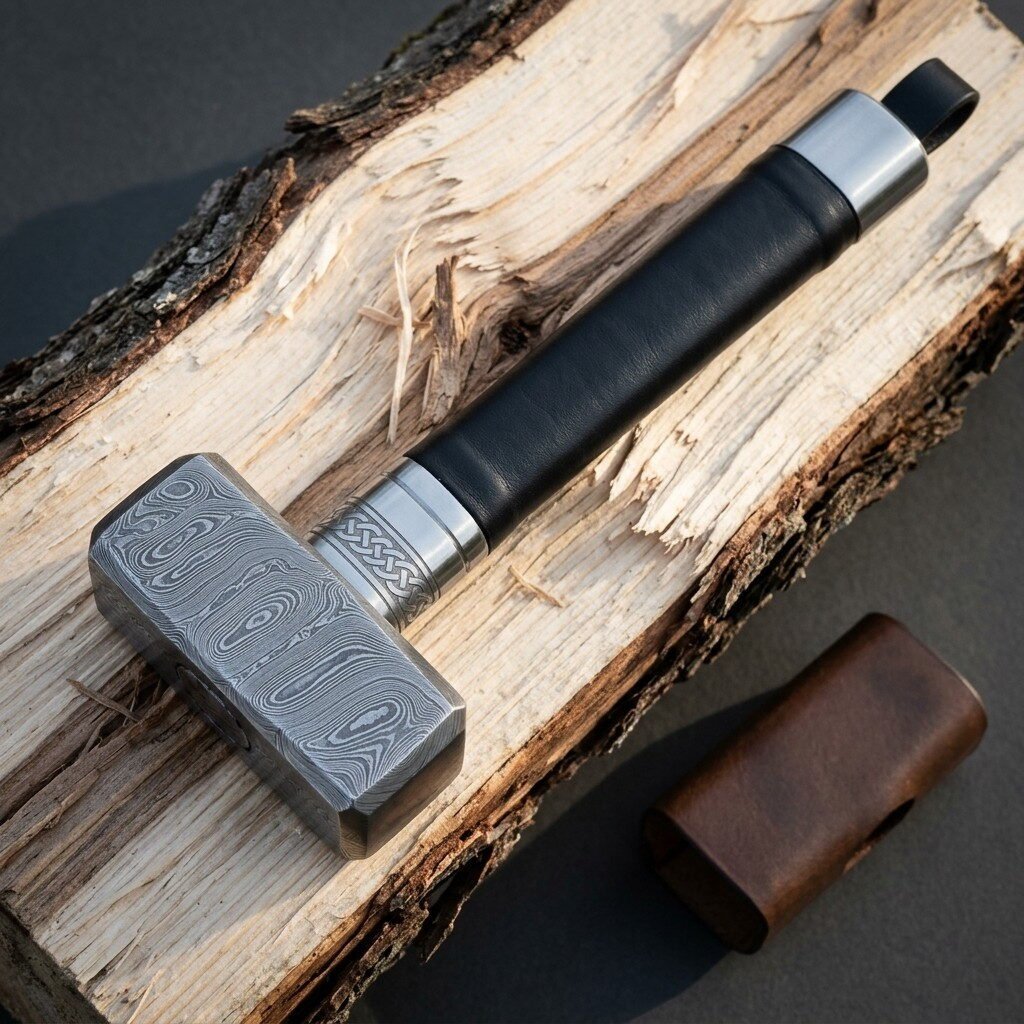
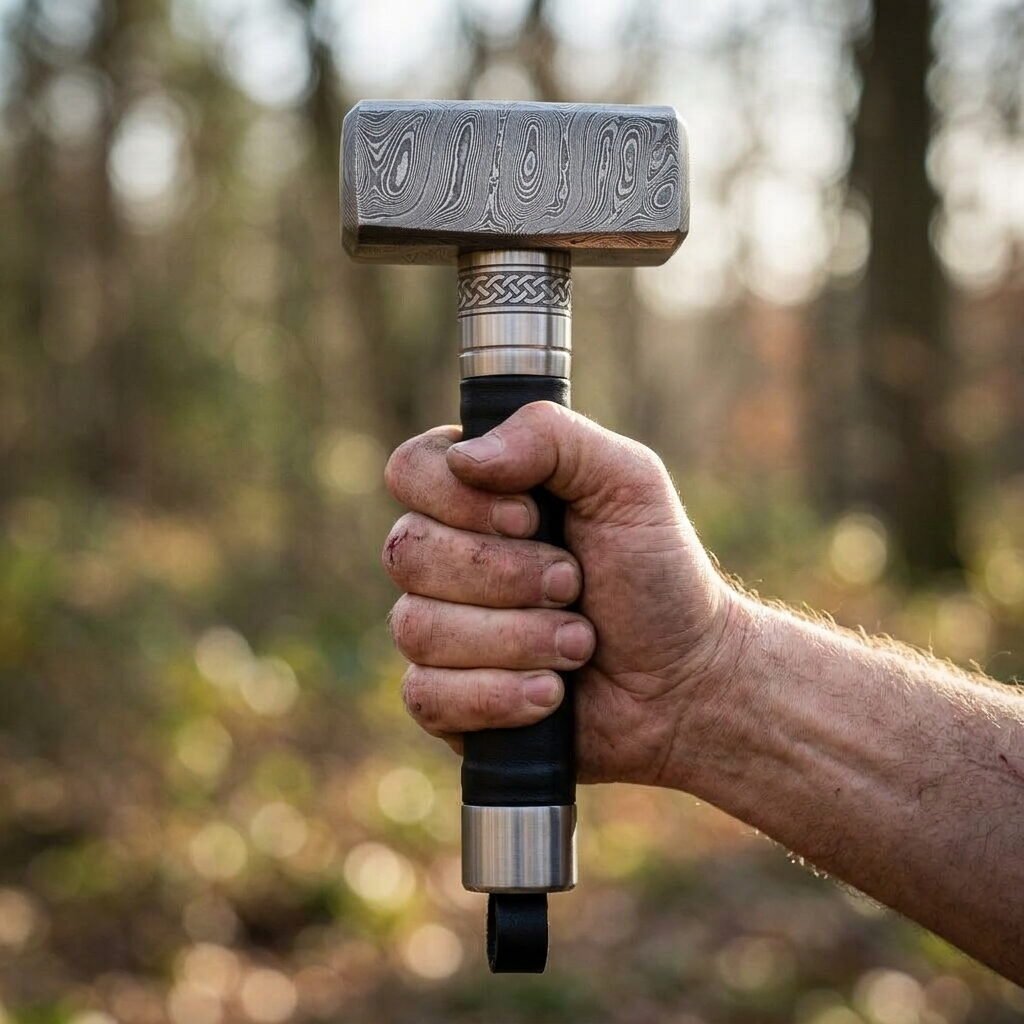
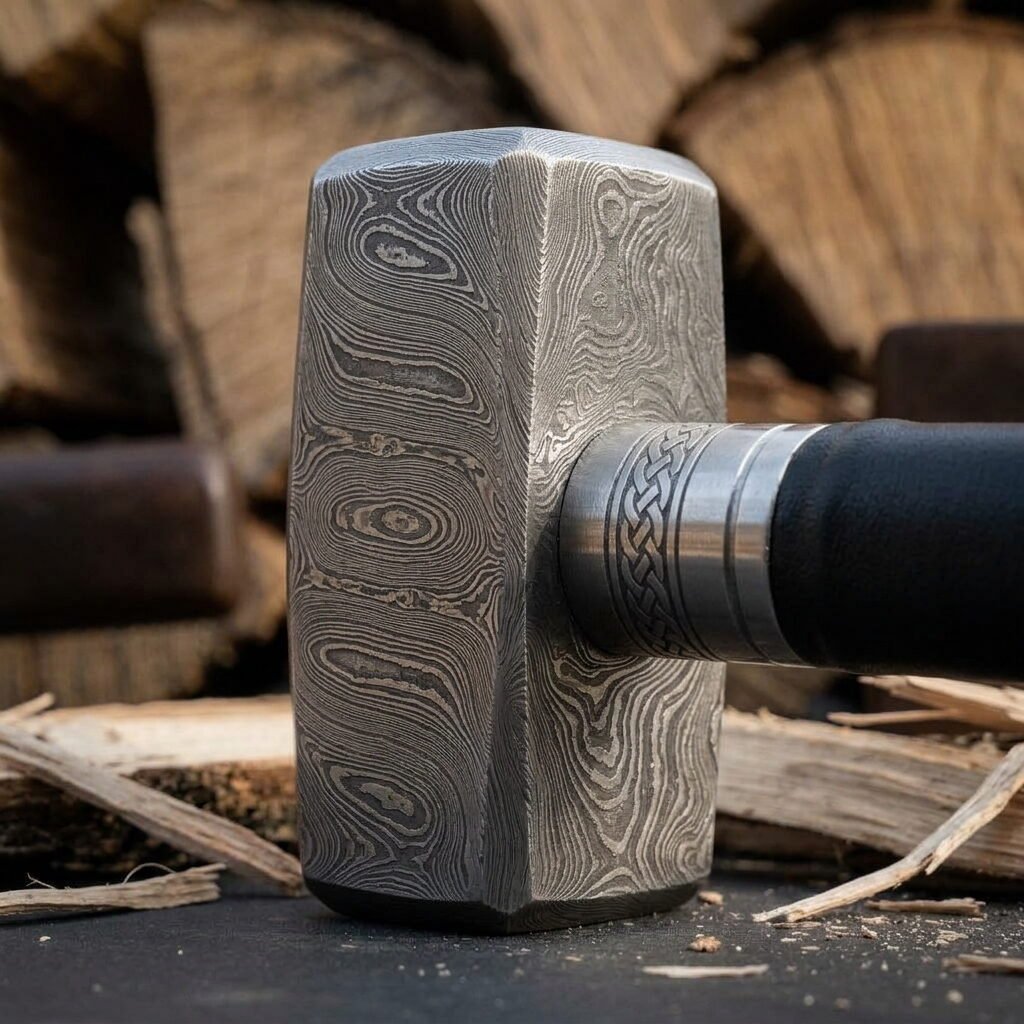
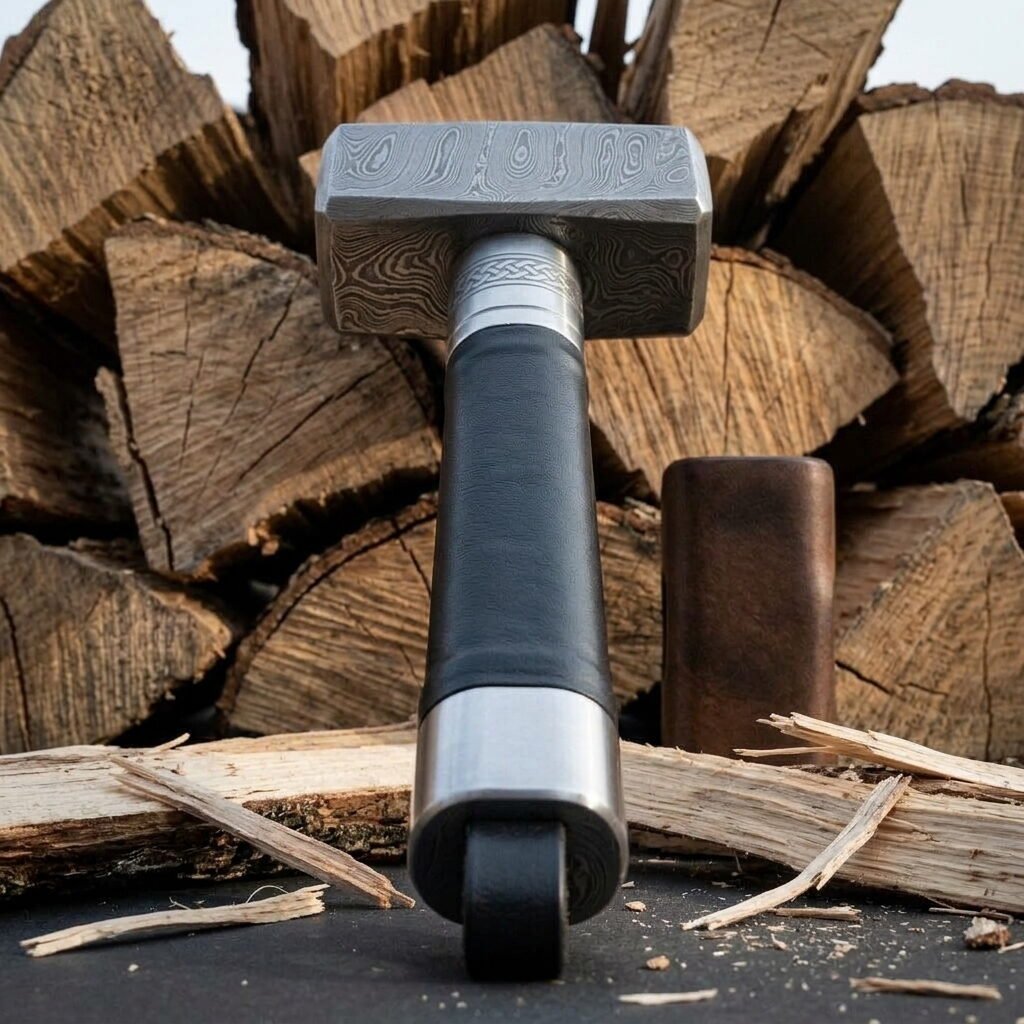
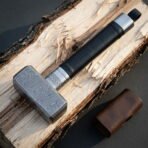
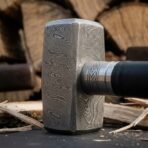
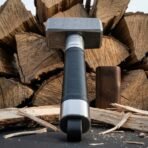
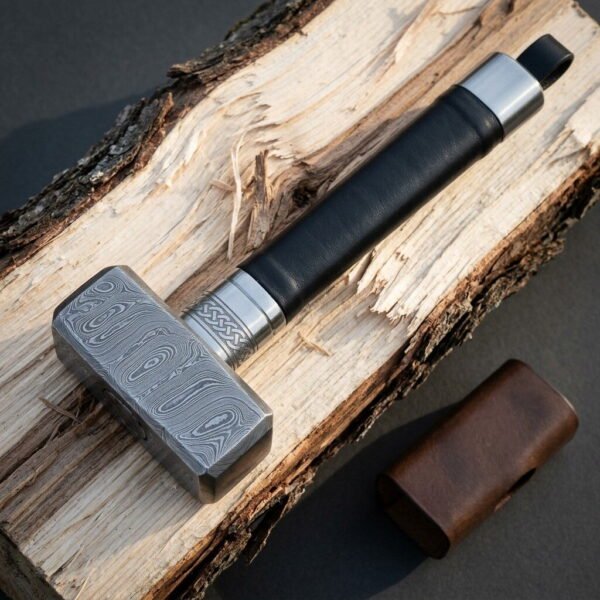
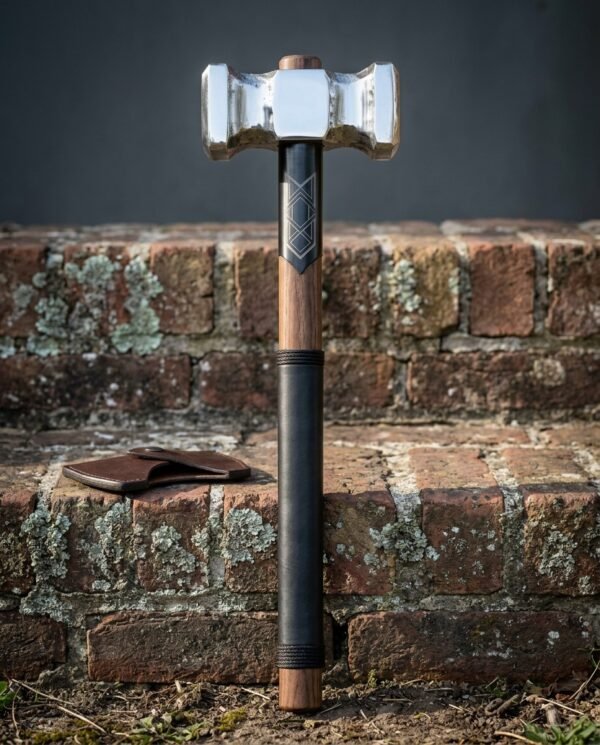
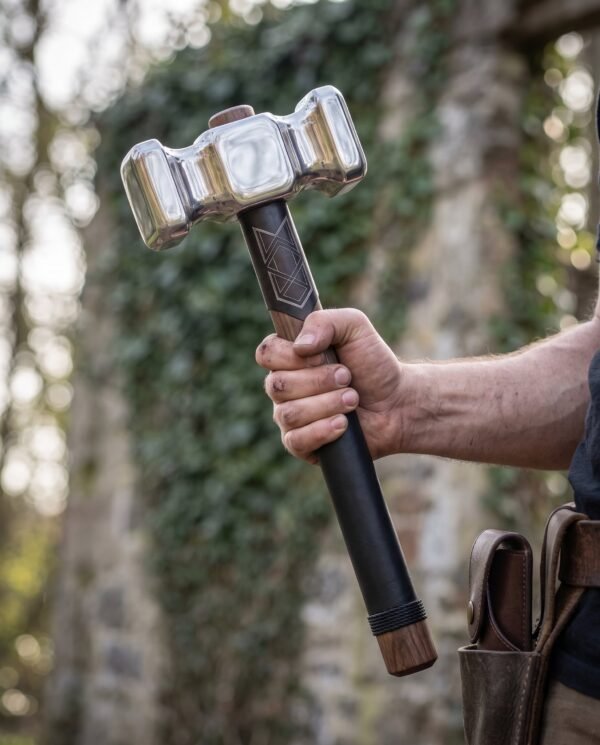
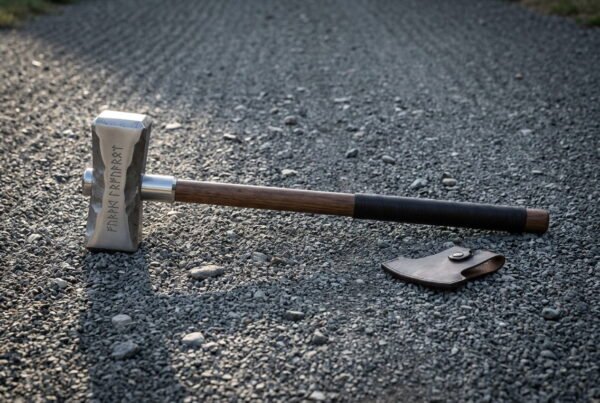
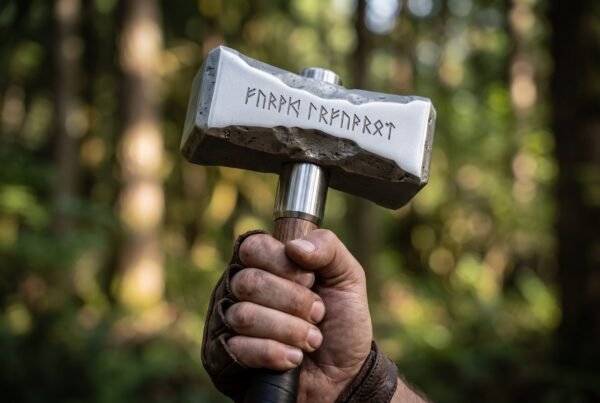
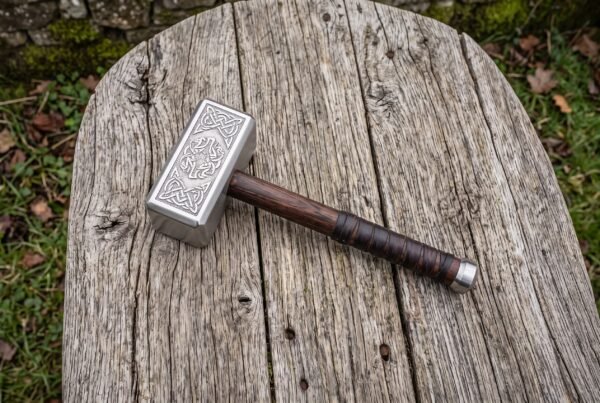
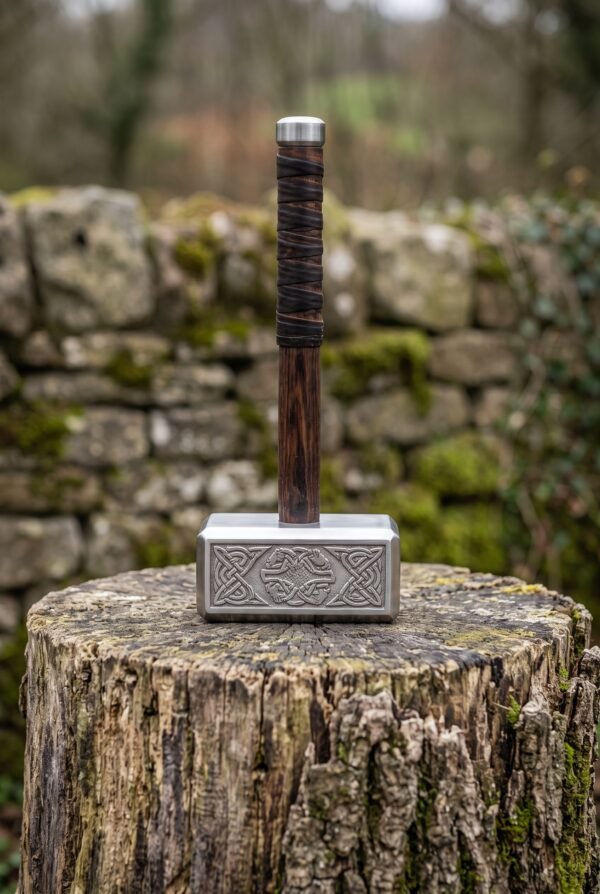
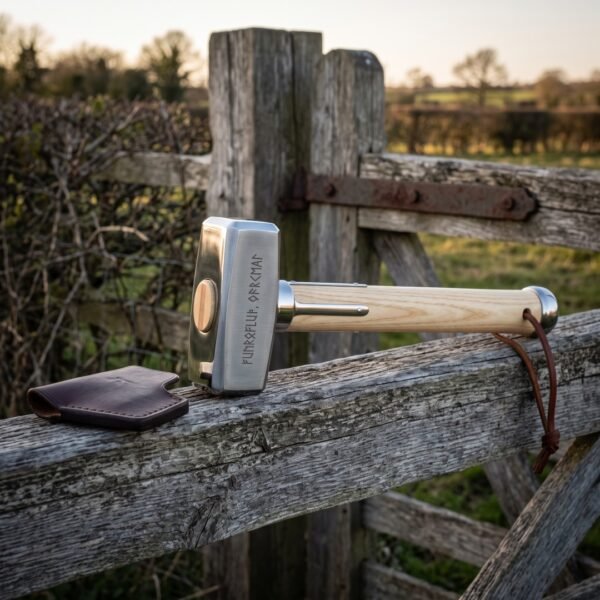
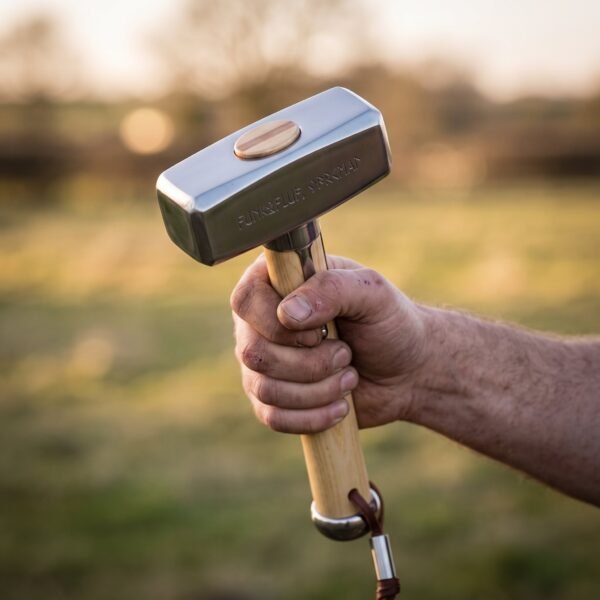
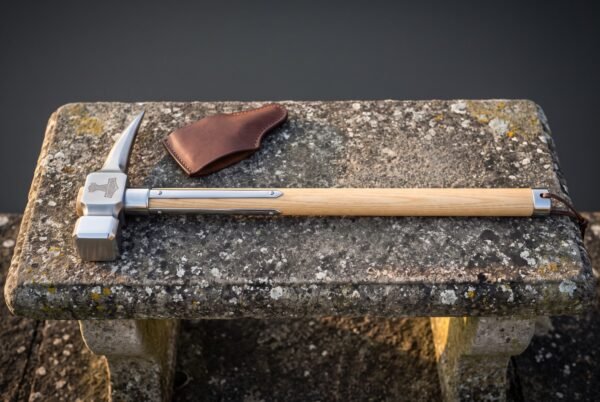
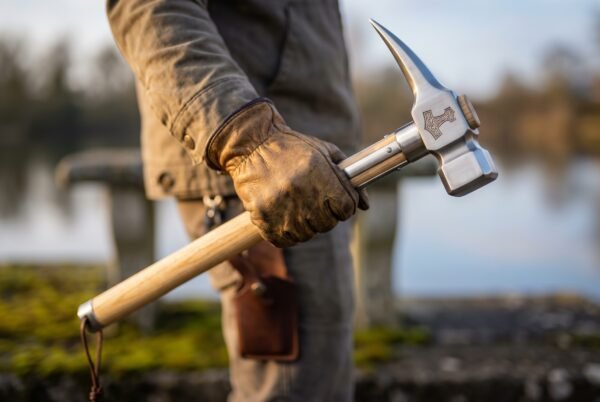
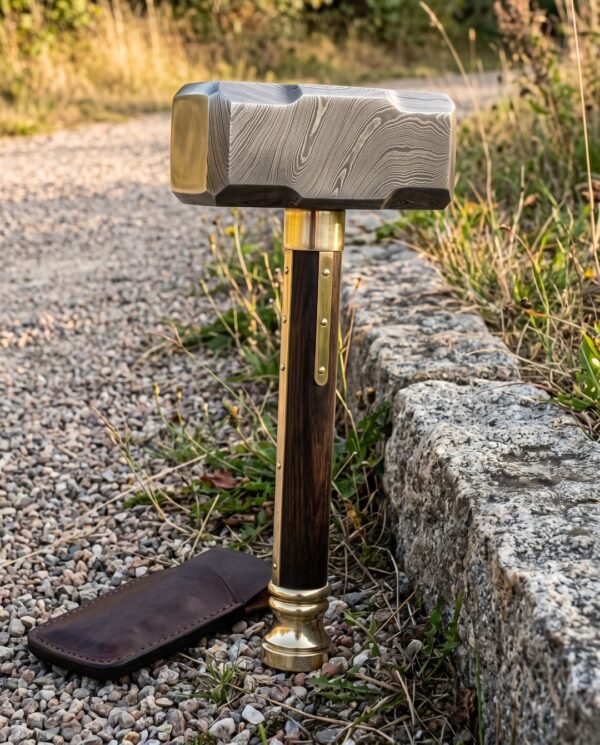
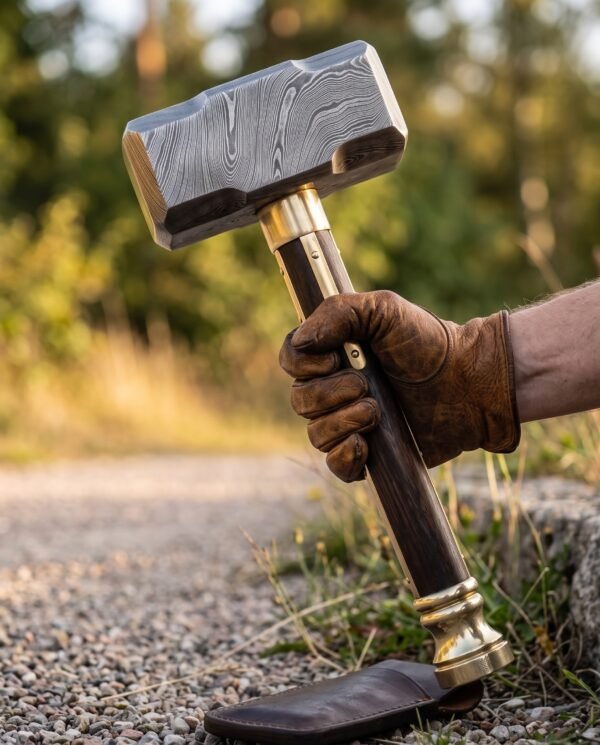
The Ladderpeen is a Mjolnir hammer with a pattern welded head. The Damascus reads as bold rungs and rings across the full depth of the block, the collar below it is polished steel cut with interlaced knotwork, and the haft is wrapped in black leather with a steel butt cap and a black leather loop. A brown leather head cover comes with it.
Small hammer pendants are one of the most common finds from the late Viking age. More than a thousand have been catalogued across Scandinavia, Iceland, the Danelaw and the Rus trade routes, and what is interesting is when they appear. They are rare in the eighth and ninth centuries and then they become common in the tenth, exactly as Christian missions push north and crosses start turning up in the same graves and hoards. The strongest single piece of evidence is a soapstone mould from Trendgarden in Denmark, cut so that a smith could cast a Thor hammer and a Christian cross side by side in the same block of stone. Somebody in the tenth century was serving both markets from one bench, and the hammer amulet as we know it looks very much like a deliberate answer to the cross rather than an ancient tradition. This one is stacked, welded, laddered, forged, hardened and etched by hand in the Czech Republic. If the Thor’s hammers brought you here, the Mjolnir pendants are the obvious next stop.
Specifications
| Head material | 1095 and 15N20 pattern welded Damascus, hardened to 58 to 60 HRC |
|---|
| Pattern | Ladder and ring figure carried through the full depth of the head, hand etched |
|---|
| Head form | Squared Mjolnir block with chamfered corners and two flat faces |
|---|
| Overall length | Approximately 10 inches |
|---|
| Collar | Polished steel ferrule with an interlaced knotwork band and plain stepped rings |
|---|
| Haft | Smooth black leather over a hardwood core |
|---|
| Butt | Polished steel butt cap with a black leather loop |
|---|
| Included | Hammer and brown leather head cover |
|---|
| SKU | RK-1843 |
|---|
Why a pattern welded block is harder than a pattern welded blade
Most Damascus you see is on a blade, and a blade is a thin slice. It shows you one plane through the billet and nothing else. Grind the surface, etch it, and whatever figure appears is the figure you get, and it only has to look right from one angle.
A hammer head is a solid block, and it shows the pattern on six faces at once. Every one of them is a different cut through the same welded structure, and they all have to relate to each other, because a person holding the hammer will turn it over. The faces at the ends cut across the layers and read as end grain. The flanks cut along them and read as rungs. The chamfers at the corners cut obliquely and show the transition between the two. Getting that to look deliberate rather than accidental means the billet has to be oriented correctly before the block is ever forged to shape, and there is no correcting it afterwards.
There is a second reason a block is unforgiving. In a blade, a poor weld somewhere in the middle of the billet is usually ground away or ends up in the tang. In a block, nothing is ground away. Every layer that went into the billet is still in there, and any place where two layers did not take is a void inside a lump of steel that will be hit with. That is why we work a hammer billet at a higher weld heat and more passes than a blade billet, and why more of them go in the scrap bin.
The two steels and the knotwork collar
The head is alternating layers of 1095 and 15N20. Both are high carbon steels and both harden, so the finished block is uniformly hard rather than a sandwich of hard and soft. The visible difference is nickel content: 15N20 carries about two percent, and nickel resists the acid we etch with, so those layers stay bright while the plain carbon layers darken. The pattern is not two metals of different colours. It is one etched surface in two states.
We take the head to 58 to 60 HRC. That is high for a striking tool and the laminated structure is what allows it, because a layered block resists a crack running through it far better than a single steel of the same hardness. A crack that starts in a hard layer has to cross a weld interface to keep going, and interfaces blunt cracks.
The collar is polished plain steel rather than Damascus, cut with an interlaced band. That is a deliberate contrast. Put pattern next to pattern and both get lost; a plain polished ring between the etched head and the black leather is what lets the Damascus read.
Engraving, runes and your own design
Use the rune converter on this page to turn a name, a date or a short phrase into Elder Futhark and we will cut it into the steel, the leather or the wood. If you would rather have a Viking pattern than a rune line, choose your own design in the engraving option above the add to cart button and tell us where it goes. Where a piece already carries an engraved design, your chosen engraving replaces it rather than sitting alongside it, which here means the knotwork band on the collar. We would usually suggest putting a rune line into the leather of the head cover instead, so the etched pattern on the head stays unbroken. The engraving page shows how a cut looks against etched Damascus and against leather.
Handling and balance
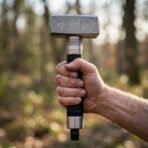
Short haft, dense head, and effectively all the weight at one end. The balance point sits at the collar, which makes the hammer feel like a single solid object rather than a tool with a handle attached. At around ten inches it is a one handed piece and it is not built for long swings.
The leather loop through the butt cap is worth using rather than admiring. On anything this head heavy with a handle this short, a hand that is cold, wet or gloved can lose it, and the loop is what keeps the hammer attached to you. Put your hand through before you lift it, not after.
Care
Damascus asks for more attention than plain steel, because the etch that reveals the pattern and the rust that ruins it are the same process at different speeds. Wipe the head after every handling and leave a thin film of oil on it. Do not put a damp head inside the leather cover. If the figure begins to look grey and flat, the steel is not damaged, it has simply lost etch contrast, and a light re-etch brings it back; we will do that for you at any point. Do not use abrasive polish on the etched surface, since it removes the relief that makes the pattern visible. Feed the leather haft, loop and cover with a neutral conditioner once or twice a year. Our page on steel care sets out etching, oiling and rust removal.
Made in the Czech Republic
This piece is made by hand in the Czech Republic, in a workshop that still works the old way. The steel is forged, ground, heat treated and finished by smiths who learned the trade from the people before them, and the wood, horn and leather are cut and fitted by hand rather than pressed out on a line. That is also why no two pieces come out exactly the same.
Ransack Viking is a United States company. We import these pieces ourselves, check every one when it lands and ship from our warehouse in Chicago, Illinois. Engraving is done here in the United States after the piece arrives, so your runes or your own design go on before it leaves for you.
A note on handmade variation
This hammer is hand made rather than machine made or bulk produced, so what arrives will not be a pixel for pixel copy of the photograph. With Damascus that is not a caveat, it is the whole appeal. The rungs are cut into the billet by hand and the block is forged from it by eye, so the figure on your hammer exists once and will not be repeated. The six faces relate to each other differently on every one. The etch strikes at its own contrast. Leather takes colour unevenly. The head weight, the steels, the heat treat and the build are the same every time. The character is not. There is more on that in what Mjolnir meant, and in the Norse gods if you want the background.
Frequently asked questions
Is the Damascus real or is the pattern applied to the surface
It is real forge welded steel. The layers run through the entire head, which is why the pattern appears on every face including the chamfers at the corners.
Is this functional or is it for display
The head is genuinely forged and hardened and the haft is a wedged hardwood core, so it works as a hammer. Most owners display it and pick it up rather than putting it to work, and it suits both.
Can I throw it
No. A leather wrapped haft, a steel butt cap and an etched head will all be damaged, and so will whatever it hits.
Will the pattern fade over time
The pattern is structural and cannot fade, but the etch contrast dulls with handling and oil. Re-etching restores it and we are happy to do it.
Can I have runes on it
Yes. We usually recommend the leather head cover rather than the head itself, so the Damascus stays unbroken, but we will cut into the steel if you prefer.
How long until it ships
One to two weeks of processing, then free shipping inside the United States. Engraved orders sit at the longer end.
What is in the box
- Ladderpeen Mjolnir hammer with a 1095 and 15N20 Damascus head
- Black leather wrapped haft with a knotwork collar, steel butt cap and leather loop
- Brown leather head cover
- Care card covering Damascus oiling, etching and leather conditioning
- Lifetime warranty against defects in forging, grind, heat treat and fittings
- Forged and finished in the Czech Republic
Explore the range
See the other Thors hammers, the small Mjolnir pendants, the Damascus range, or read the guides for how a pattern welded billet is stacked and welded.
Other pieces in this group
In the same category sits the Thunderhide Thor hammer, 16 inches overall. A near match for this one is the Anvilwake Thor hammer, forged from 1095. Closest to this in the range is the Runestrike Thor hammer.
Fitting out further, the Nightthorn mace belongs with it. Nothing here exactly right, build one to your own spec on the custom Norse arms page.

Showed up right on time and looked even better than the photos. Packaging was excellent and it arrived in perfect condition. Can’t recommend this enough.