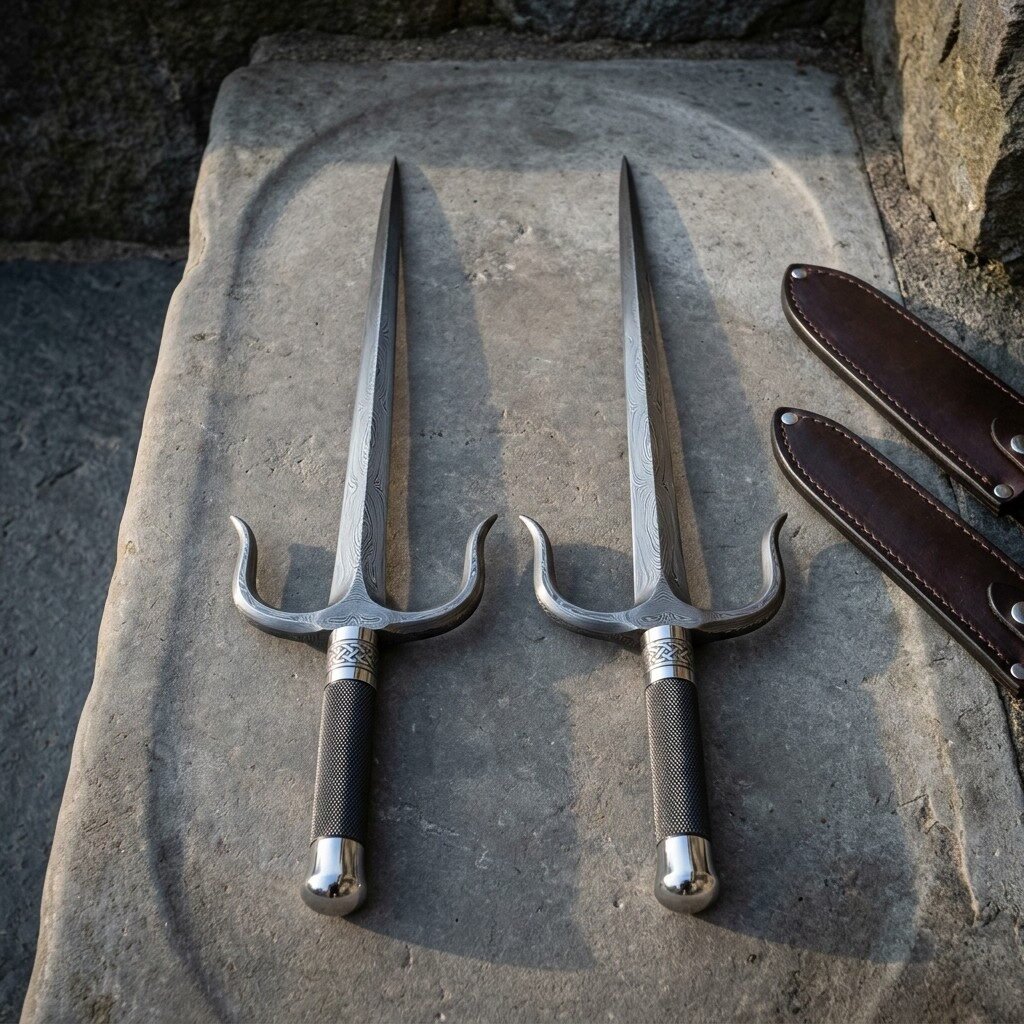
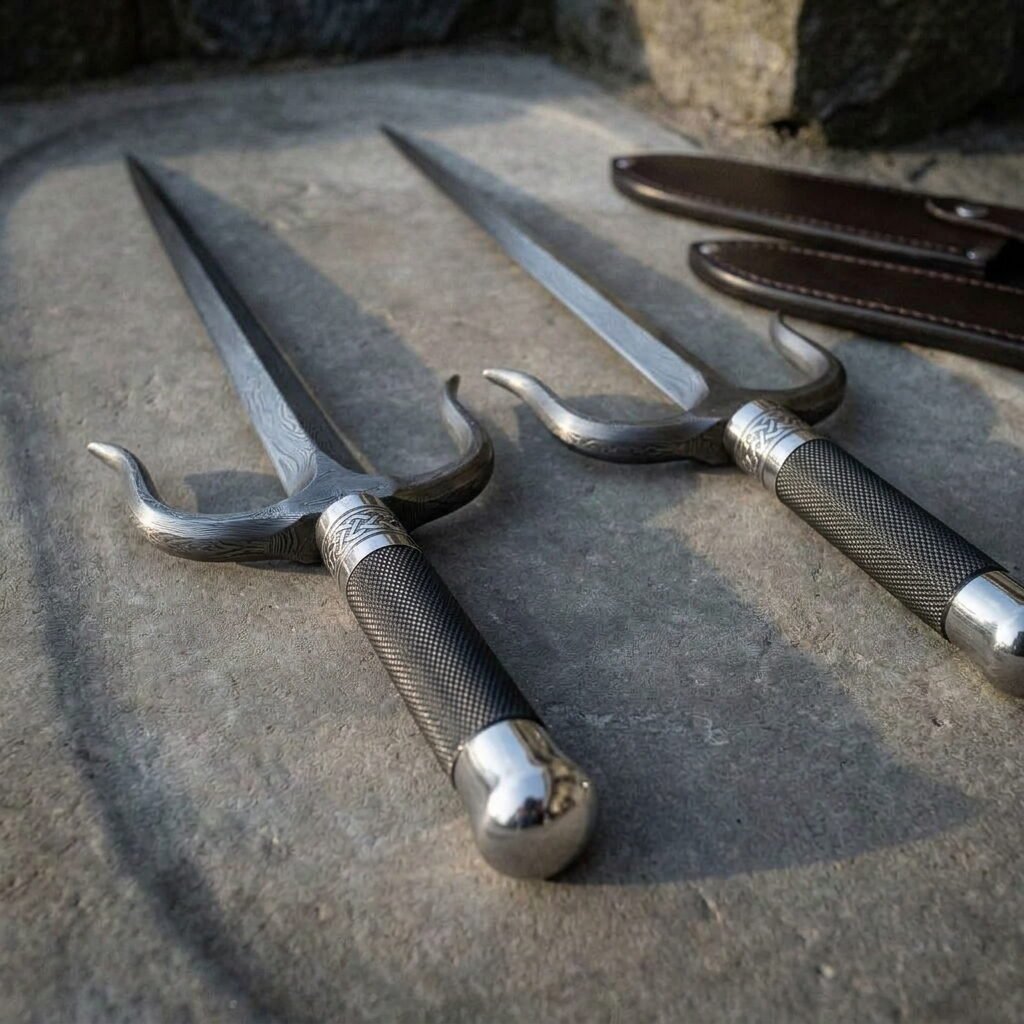
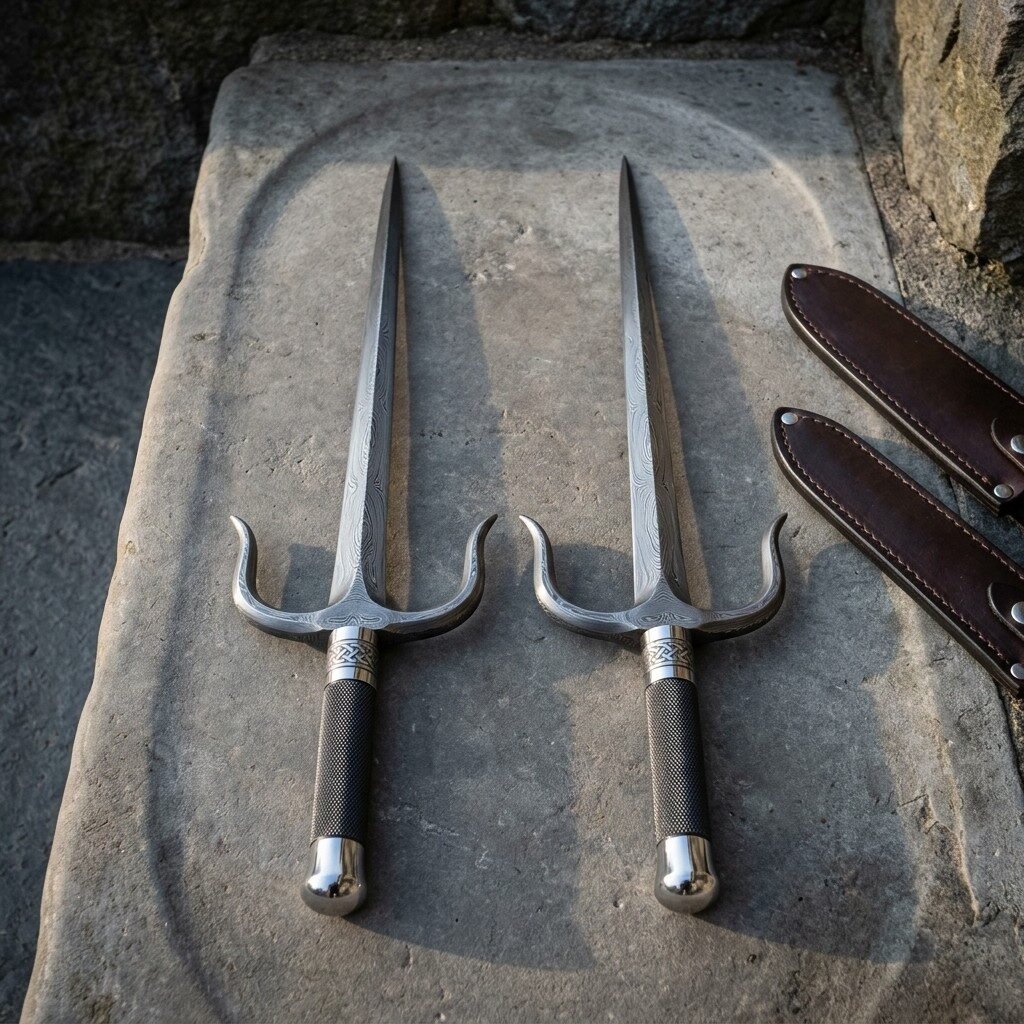
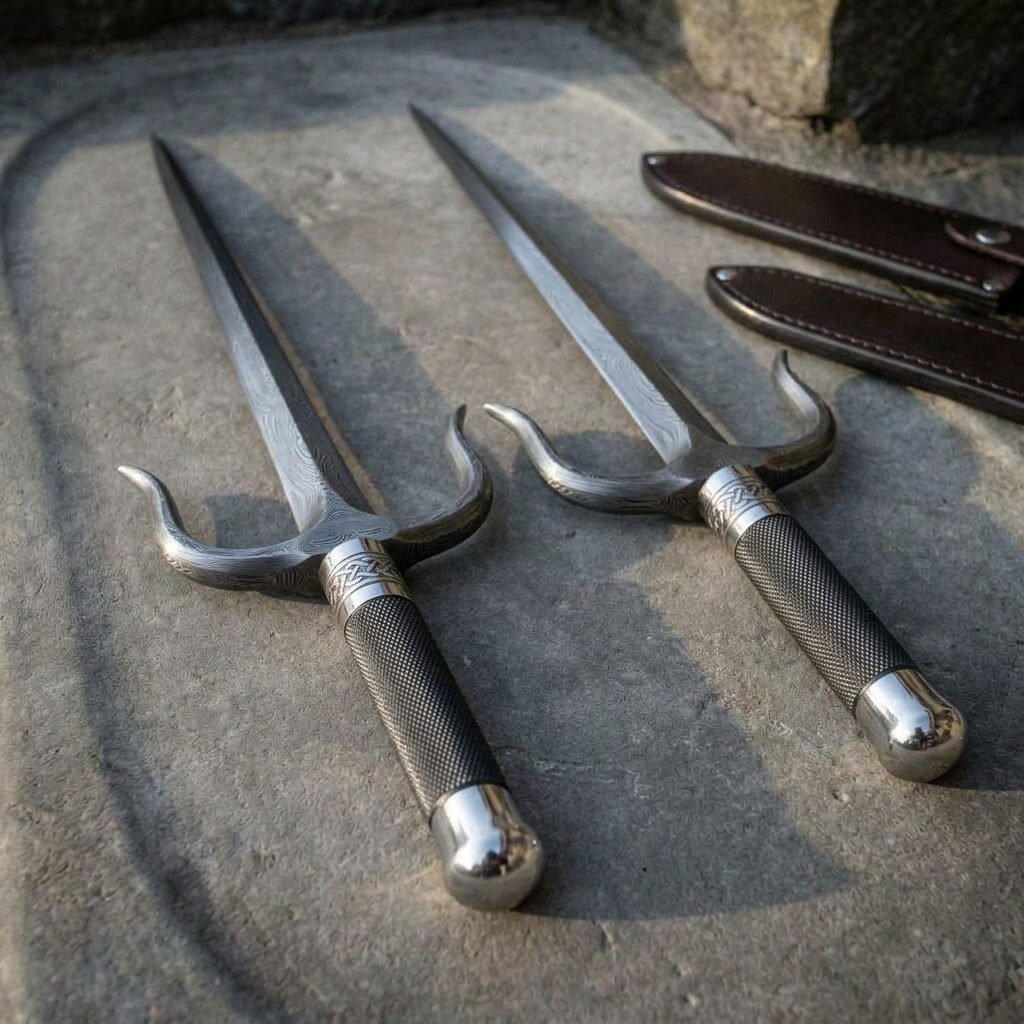
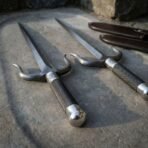
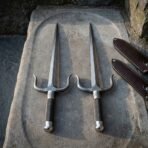
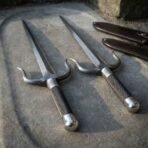
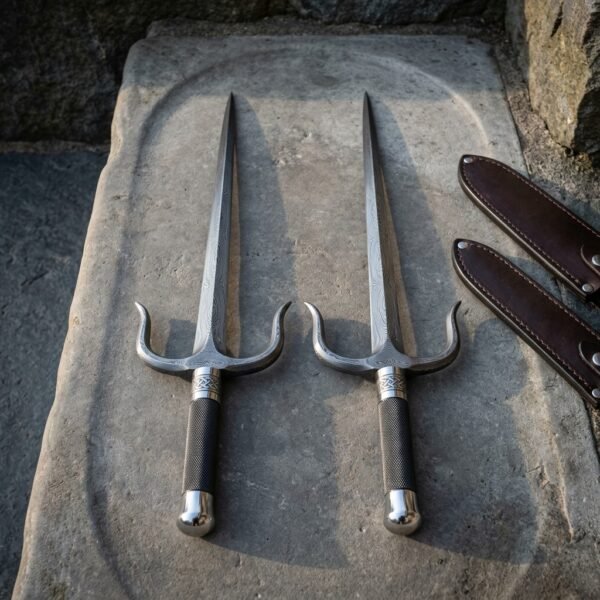
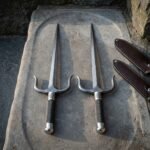
The Twinfork is a matched pair, two pieces in one set, each with a long tapered Damascus blade flanked by a pair of upswept side prongs. The grips are knurled steel finished in black, the collars where grip meets prong carry a cut band of interlace, and each piece ends in a polished steel knob. Two brown leather sheaths are included, one for each. This is a set and it is priced and sold as a set.
The form comes from Okinawa, where the sai was carried in pairs by law enforcement and later folded into the civilian martial traditions. The traditional sai has no edge at all. It is a blunt steel rod, and every technique in the old system is built around that fact, striking with the shaft, hooking with the prongs and turning the whole thing on the pommel to change from a forward grip to a reverse one. This pair is a bladed interpretation of that shape rather than a traditional blunt training sai, and it is worth saying so plainly. Both pieces are forged, ground, etched, hardened and fitted in the Czech Republic. It lands in the daggers, with the Viking knives close enough that people usually look at both.
Specifications
| Set contents | Two matched pieces and two leather sheaths |
|---|
| Blade steel | Pattern welded 1095 and 15N20 Damascus, hardened to 58 to 60 HRC |
|---|
| Blade finish | Acid etched flowing pattern on both pieces |
|---|
| Overall length | Approximately 19 inches each |
|---|
| Main blade | Approximately 13 inches, tapered to a point |
|---|
| Side prongs | Upswept, approximately 5 inches, one to each side |
|---|
| Grip | Knurled steel finished in black |
|---|
| Collar | Steel, cut with a band of Norse interlace |
|---|
| Pommel | Polished steel knob |
|---|
| Sheaths | Two brown leather sheaths, stitched |
|---|
| SKU | RK-1862 |
|---|
What the side prongs are for
The two arms flanking the central blade are called the yoku, and they are not decoration or a stylised guard. They do three separate jobs. The first is trapping. A blade or a staff driven into the fork can be caught between a prong and the shaft and levered aside, which is the whole basis of the traditional paired form. The second is protection. With the sai held along the forearm in a reverse grip, the prongs sit over the back of the hand and cover the knuckles. The third is orientation, because the moment your hand closes on the grip the prongs tell you which way the point is facing.
The knob at the butt is called the tsukagashira and it matters more than it looks. Rest a thumb on it and the whole piece pivots around that point, so a forward grip becomes a reverse grip with a flick of the wrist and no regripping. The weight of that knob is what makes the spin controllable. Take it off and the piece flails.
Because these two came from the same billet and were finished together, the balance and the weight are matched, which is the only way a paired set works. Two pieces that feel different in the two hands are two pieces, not a pair.
Damascus steel and the knurled grip
The blades are 1095 and 15N20 forge welded together and drawn out, then etched so the nickel bearing layers stay bright and the plain carbon layers go dark. Both harden in the same quench, and the finished blades sit at 58 to 60 HRC. That is a hard, edge holding heat treat, which is worth noting because it is what makes this a sharp piece rather than a training tool.
The grips are knurled steel rather than wrapped cord or leather. Knurling is a rolled diamond texture cut into the surface of the bar, and it grips without being abrasive, holds when a hand is warm, and never comes loose the way a wrap eventually does. It also makes the grips heavier than a wrapped grip would be, which is what pulls the balance back toward the hand on a nineteen inch piece.
Engraving, runes and your own design
Use the rune converter on this page to turn a name, a date or a short phrase into Elder Futhark and we will cut it into the steel, the leather or the wood. If you would rather have a Viking pattern than a rune line, choose your own design in the engraving option above the add to cart button and tell us where it goes. Where a piece already carries an engraved design, your chosen engraving replaces it rather than sitting alongside it. On this set the interlace collar is that design, and a rune line will be cut in its place on both pieces so the pair stays matched. Tell us if you would rather have it on one only. See the engraving page.
Handling and balance
Each piece balances close to the collar, just ahead of the hand, which is deliberate. A trapping fork has to be steered rather than swung, and weight out at the point makes the fork slow to bring back onto line. Held in a reverse grip along the forearm the balance falls almost at the wrist and the pair feel weightless. Held forward the point leads cleanly.
These blades are sharpened. That makes them a collector and display set rather than practice equipment. Do not use bladed sai for partner drills or for trapping a training partner, and do not treat them as a substitute for blunt training sai.
Care
Wipe both blades dry after handling and keep a light film of mineral oil on the steel, because neither steel in the billet is stainless and etched Damascus shows fingerprints quickly. Get oil into the knurling with a brush, since the diamond pattern traps moisture and salt from a hand. The cut collars need the same attention. Do not leave the pieces in the leather sheaths for long periods, and feed the leather once or twice a year. Our steel care page covers oiling, spotting and bringing a dull etch back.
Made in the Czech Republic
This piece is made by hand in the Czech Republic, in a workshop that still works the old way. The steel is forged, ground, heat treated and finished by smiths who learned the trade from the people before them, and the wood, horn and leather are cut and fitted by hand rather than pressed out on a line. That is also why no two pieces come out exactly the same.
Ransack Viking is a United States company. We import these pieces ourselves, check every one when it lands and ship from our warehouse in Chicago, Illinois. Engraving is done here in the United States after the piece arrives, so your runes or your own design go on before it leaves for you.
A note on handmade variation
This set is hand made, not machine made and not bulk produced, so what arrives will not be a pixel for pixel copy of the photograph. The two pieces are matched to each other in weight and balance, but the Damascus figure on each will be its own and the two will not mirror one another exactly. The depth of the cut collars, the sweep of the prongs and the tone of the leather all vary. The dimensions, the steels and the build are the same every time. The character is not. For the detail behind that, see the blade shapes guide, and the knife laws by state alongside it.
Frequently asked questions
How many pieces come in this set?
Two, plus a leather sheath for each. The price shown is for the complete pair.
Are these traditional training sai?
No. Traditional sai are blunt steel rods. These have sharpened Damascus blades, which makes them a collector and display set rather than practice equipment.
Are they identical to each other?
They are matched in length, weight and balance. The Damascus pattern on each is its own, so they are a pair rather than two copies.
Will the Damascus rust?
It can. Both steels are carbon steels. Keep them dry and oiled, especially in the knurling.
Can I get a rune line on both?
Yes. By default a chosen inscription is cut on both collars so the pair stays matched. Say so if you want it on one only.
How long until they ship?
One to two weeks of processing while the pair is made and matched, then free shipping inside the United States.
What is in the box
- Two matched Twinfork Damascus sai daggers in 1095 and 15N20
- Two stitched brown leather sheaths
- A light protective oil film on both blades
- Forged and finished in the Czech Republic
Explore the range
More in daggers, Norse arms and engraved and personalised pieces, with steel and care notes in the guides.
Other pieces in this group
Closest to this in the range is the Bonewhorl dagger knife, 14 inches overall. If this one is not quite right, there is the Runechain dagger knife, forged from 1095. Also in this group is the Trenchknot dagger knife, 15 inches overall.
If you are putting a set together, the Foldcurve kukri knife sits alongside it. Nothing here exactly right, build one to your own spec on the custom Damascus knife page.
I collect stuff like this and this knife is on another level. Weight and balance make it feel like a real functional piece not some cheap replica. This is my third order from Ransack Viking and they never disappoint. Damascus blade holds a razor edge right out of the box. Love it.
Five stars isn’t even enough honestly. Came in a nice gift box which made it feel even more special. Will definitely order again for another gift.
It’s a decent knife. Nothing extraordinary though. It’s okay for the price.
Can’t stop showing this off to everyone who comes over. Ransack Viking’s attention to detail is honestly unmatched.
This knife is a genuine work of art. Fit and finish is museum quality. You can tell real craftsmen made this by hand. If you’re on the fence just get it. You won’t regret it.