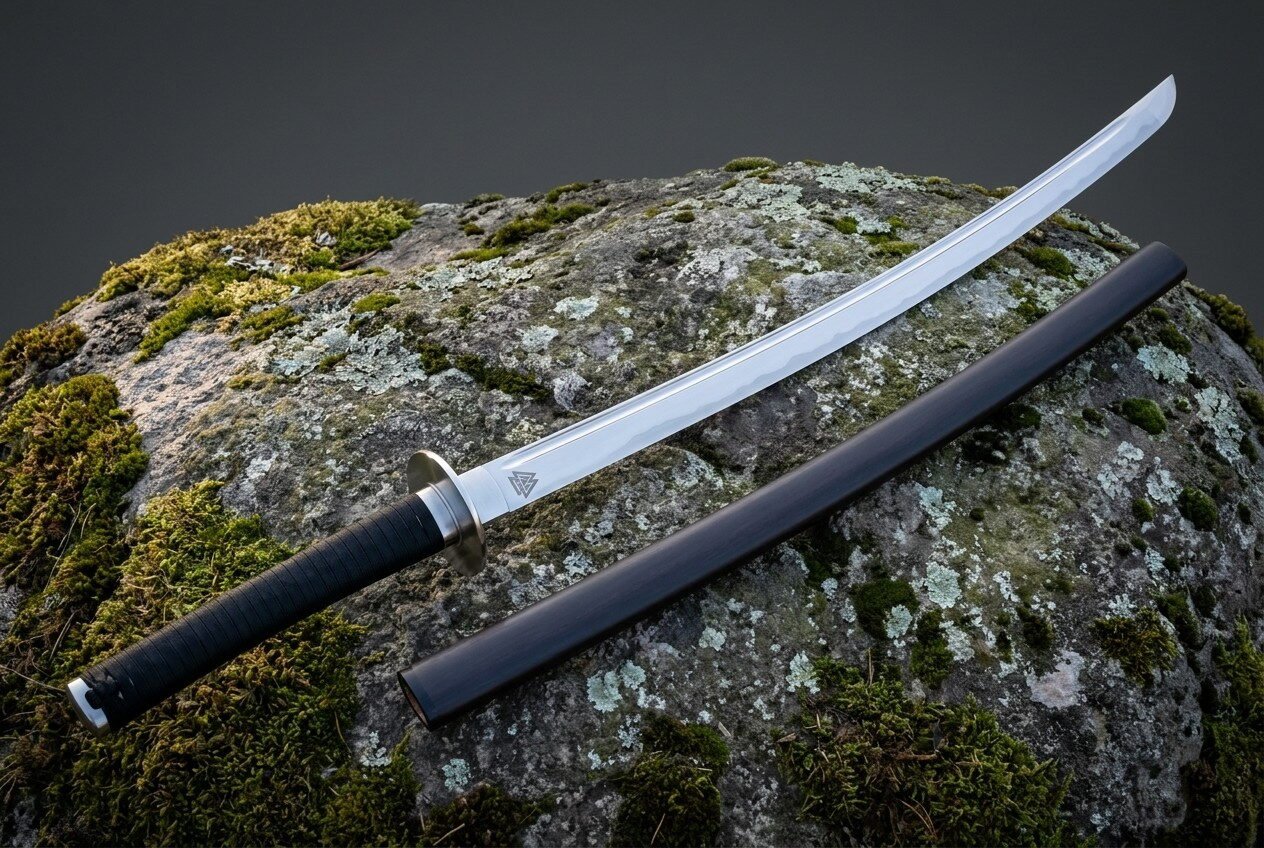
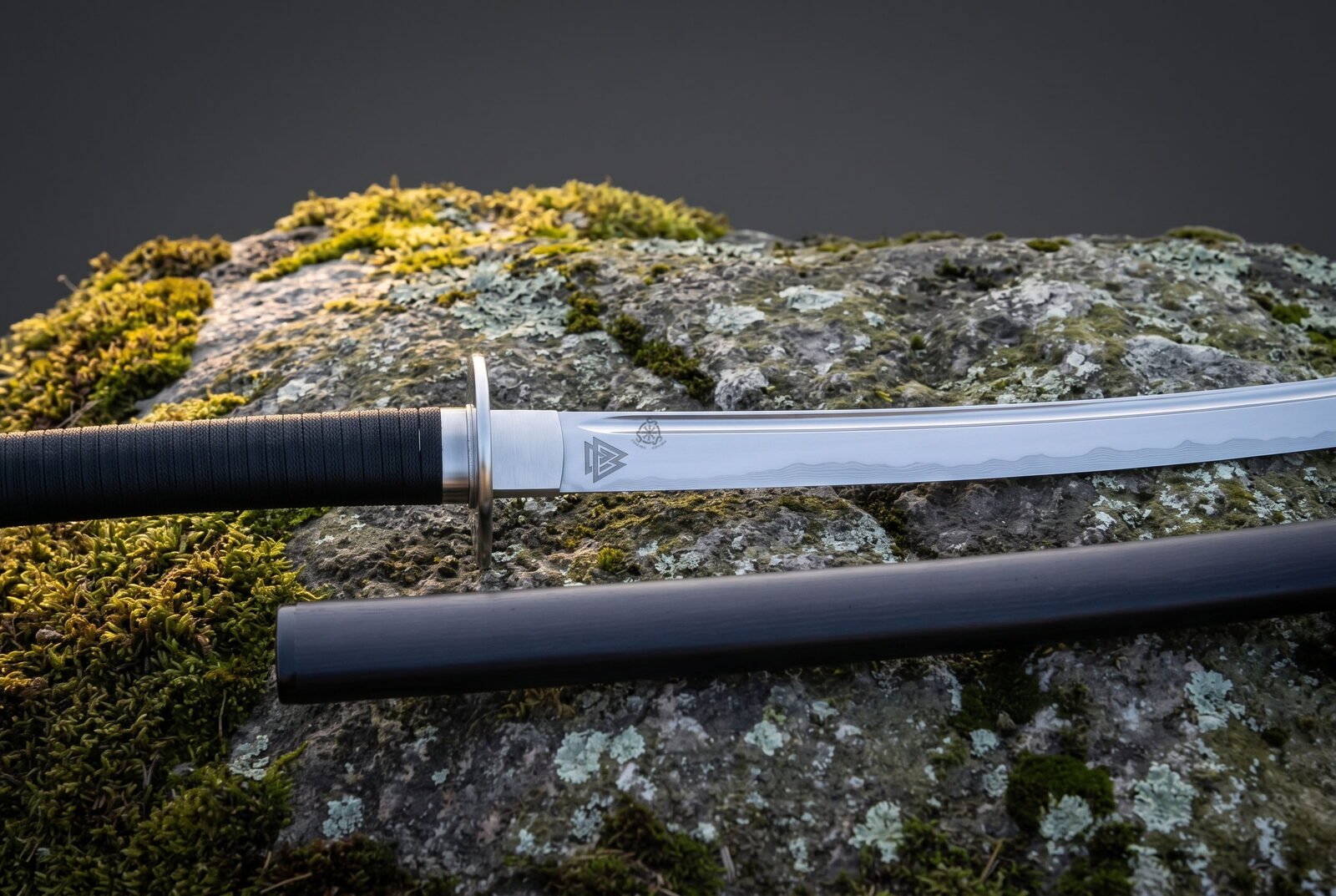
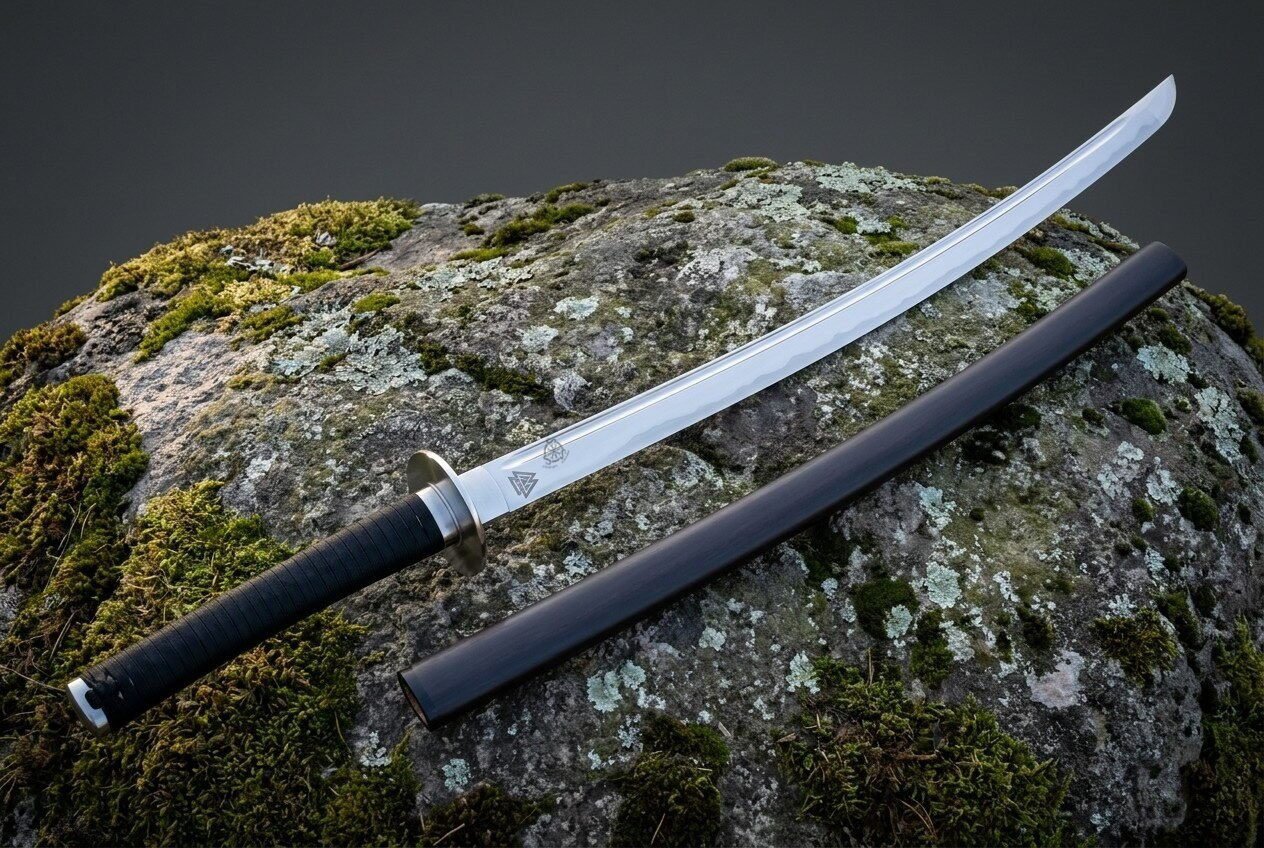
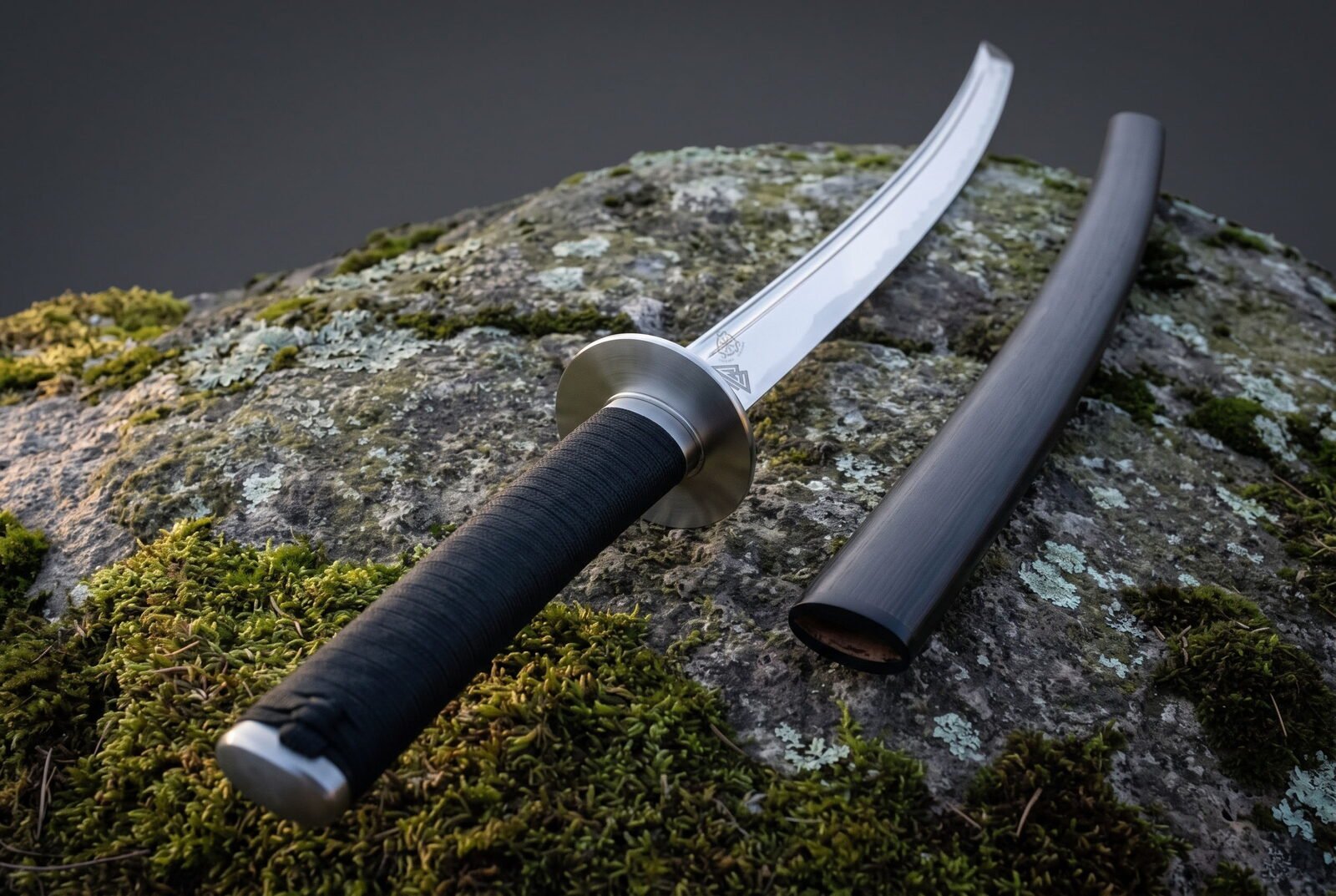
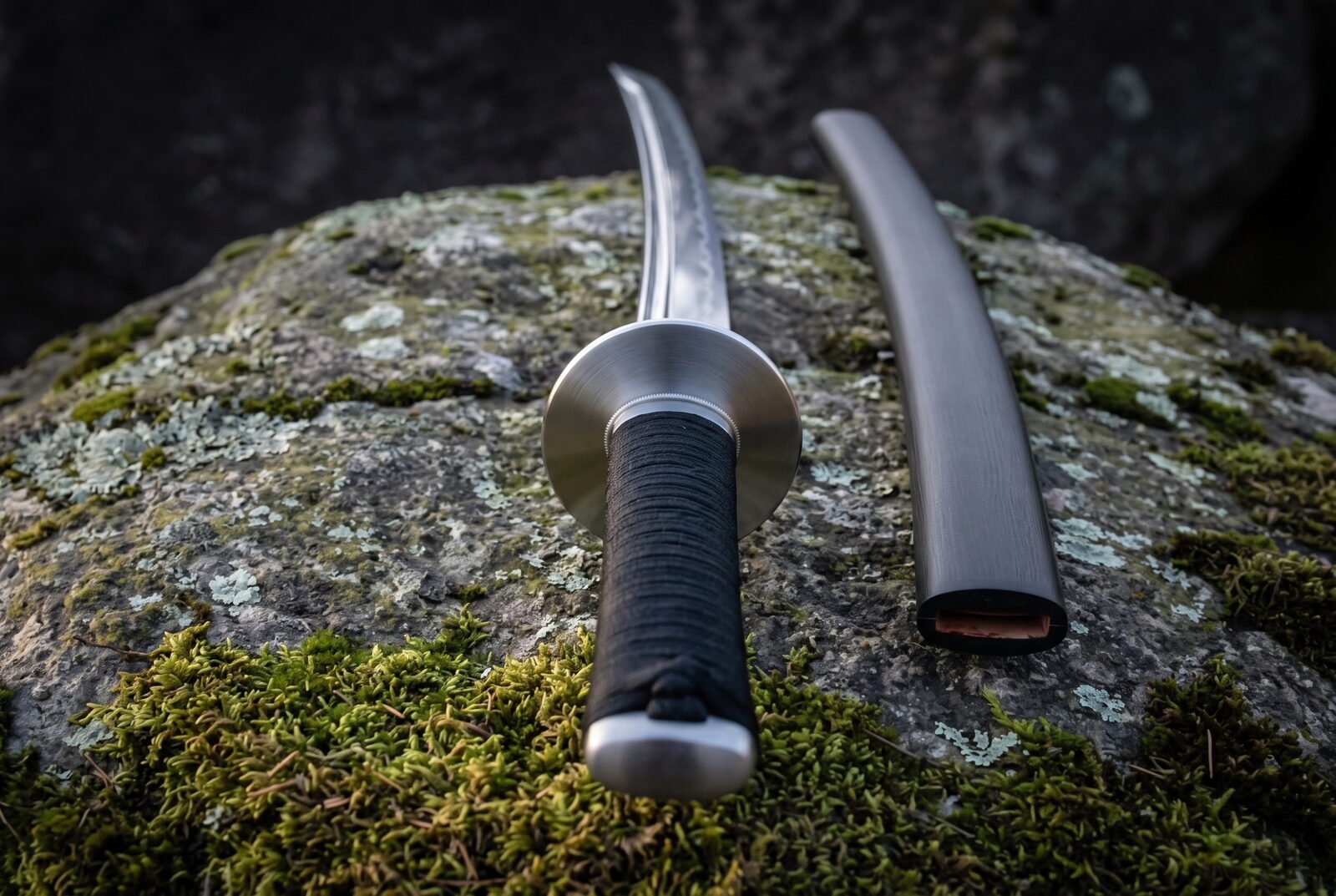
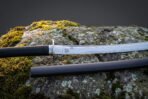
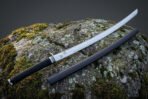
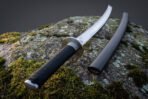
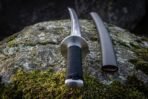
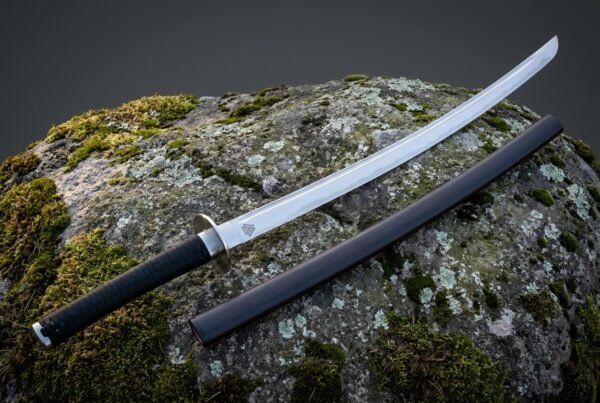
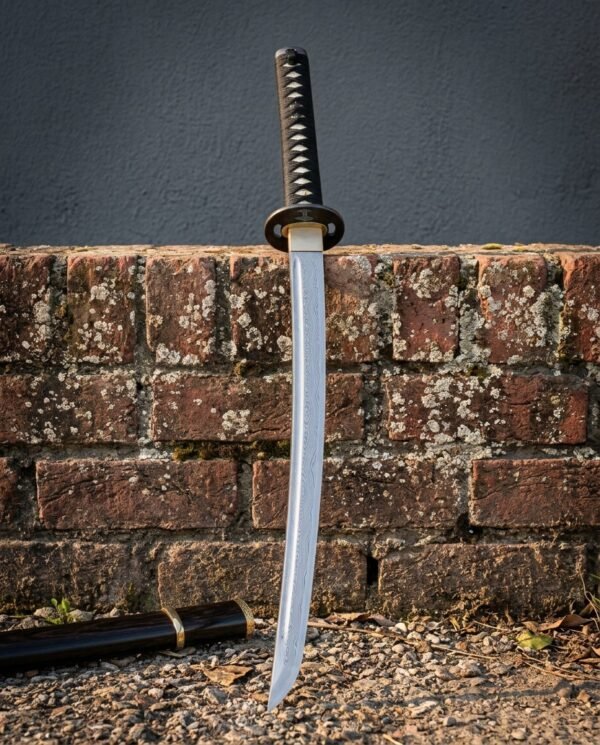
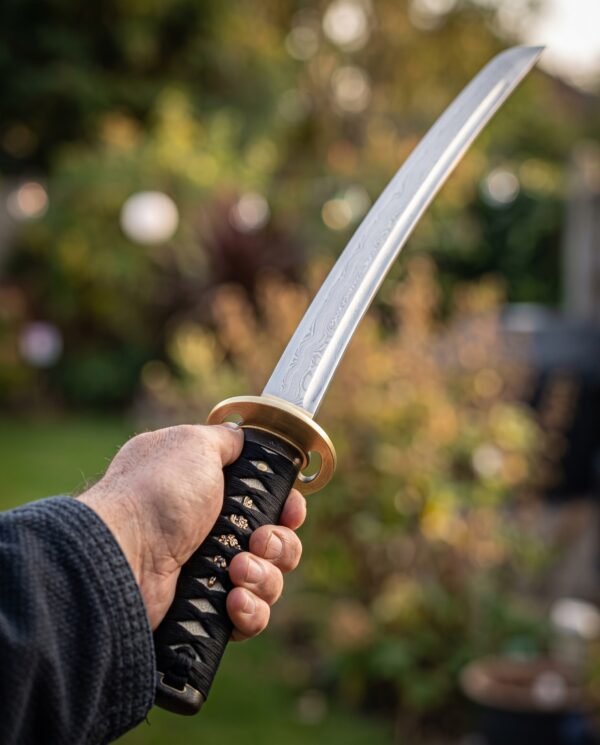
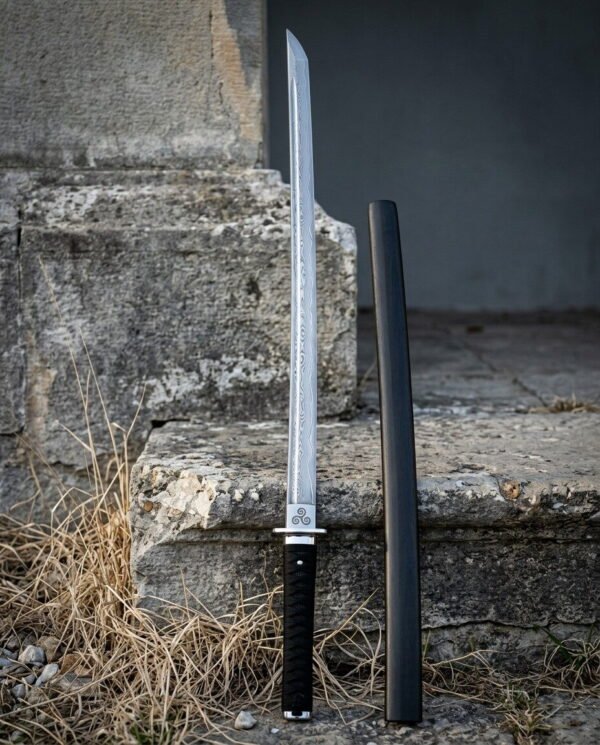
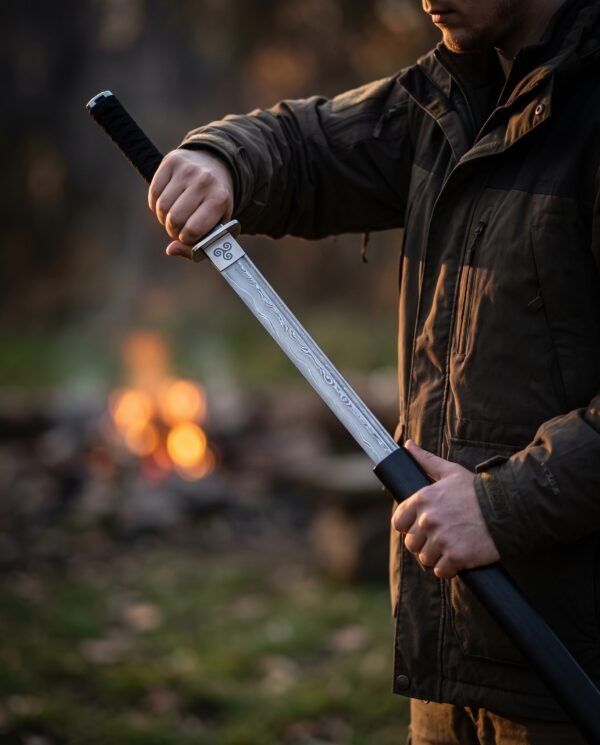
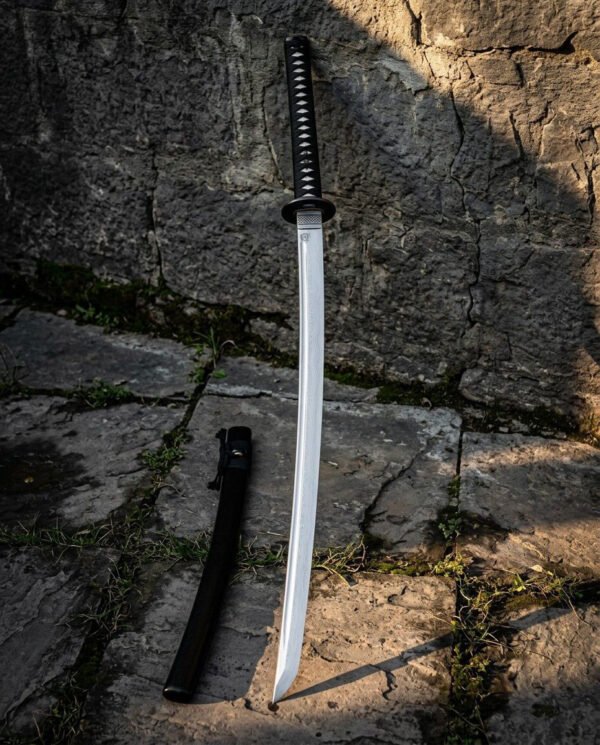
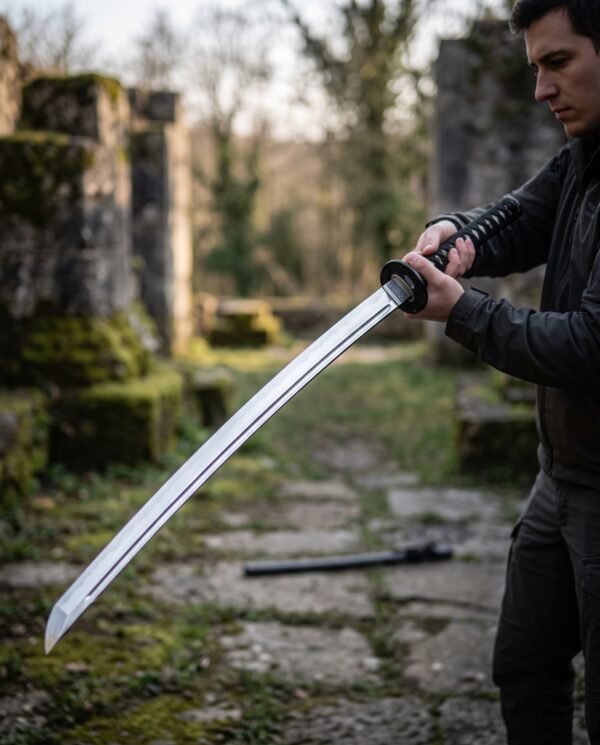
Valkcurve is a full length katana carrying Norse work. The blade is 1095 high carbon steel, single edged with a long even curve and a bright satin polish, and a Valknut is etched into the flat just above the steel habaki. The tsuka is wrapped in black leather laid in overlapping turns, the tsuba is a plain round steel disc with no ornament to compete with the blade, and the saya is a deep charcoal lacquer. It is the piece we build for people who want a Japanese sword that says something Norse.
The Valknut is three triangles locked together so that no one of them can be lifted free without the others, and it appears carved on the Stora Hammars stones in Gotland and on a bed post from the Oseberg ship burial. In both cases it sits beside scenes involving death and the passage out of life, and it is closely associated with Odin. No surviving text explains it, so anyone who gives you a confident single meaning is filling in a gap. Valkcurve is forged, ground, heat treated, etched, mounted and finished by hand in the Czech Republic.
Curve, temper line and furniture all have names, and what a katana is goes through the parts. The valknut is the three interlocked triangles, and what we actually know about the valknut is a shorter list than the internet suggests. The tanto knives carry the same furniture at knife length.
Specifications
| Blade material | 1095 high carbon steel |
|---|
| Hardness | 54 to 58 HRC |
|---|
| Overall length | 40 inches in the saya |
|---|
| Blade length | 28 inches measured from the habaki |
|---|
| Blade finish | Bright satin polish with an etched Valknut above the habaki |
|---|
| Tsuka | 11 inches, black leather wrapped in overlapping turns |
|---|
| Tsuba | Plain round steel disc |
|---|
| Habaki | Polished steel blade collar, filed to fit this blade |
|---|
| Fuchi and kashira | Polished steel collar and butt cap |
|---|
| Saya | Charcoal lacquered wood |
|---|
| Weight | Approximately 2 lb 6 oz without the saya |
|---|
| SKU | RK-1900 |
|---|
Where the curve in a katana comes from
Most people assume a curved sword is bent to shape. On a Japanese blade the curve largely arrives on its own, during the quench, and understanding why explains the whole design. The blade goes into the water nearly straight. The edge, being thinner, cools first and transforms into martensite, which occupies slightly more volume than the steel it came from. That expansion along the edge pushes the blade into a curve away from the edge, then the spine cools and pulls some of it back, and the sword settles at its final sori. A smith controls the amount by how thick the blade is, how the clay is laid on, and how hot the quench water runs. Valkcurve is set up for an even curve through the whole length rather than a curve concentrated near the tang.
The steel and the leather wrap
1095 at about one percent carbon is straightforward to work and gives a blade that takes a keen edge and bends rather than snapping. We normalise three times, quench in warm oil, and temper to 54 to 58 HRC, tough rather than glass hard, because a twenty eight inch blade sees lateral load in any handling. The tsuka is wrapped in leather rather than the more common cotton or silk cord. Leather is thicker, so the wrap sits fuller in the hand, and it grips better in a warm palm, at the cost of the open diamond windows that a cord wrap gives. It is stretched damp and laid in overlapping turns so it shrinks tight onto the underlay as it dries.
Engraving, runes and your own design
Use the rune converter on this page to turn a name, a date or a short phrase into Elder Futhark and we will cut it into the steel. If you would rather have a Viking pattern than a rune line, choose your own design in the engraving option above the add to cart button and tell us where it goes. Where a piece already carries an engraved design, your chosen engraving replaces it rather than sitting alongside it. On Valkcurve that means your line takes the position the Valknut currently occupies above the habaki, and the Valknut is left off that blade. See the engraving page for lettering and sizes.
Handling and balance
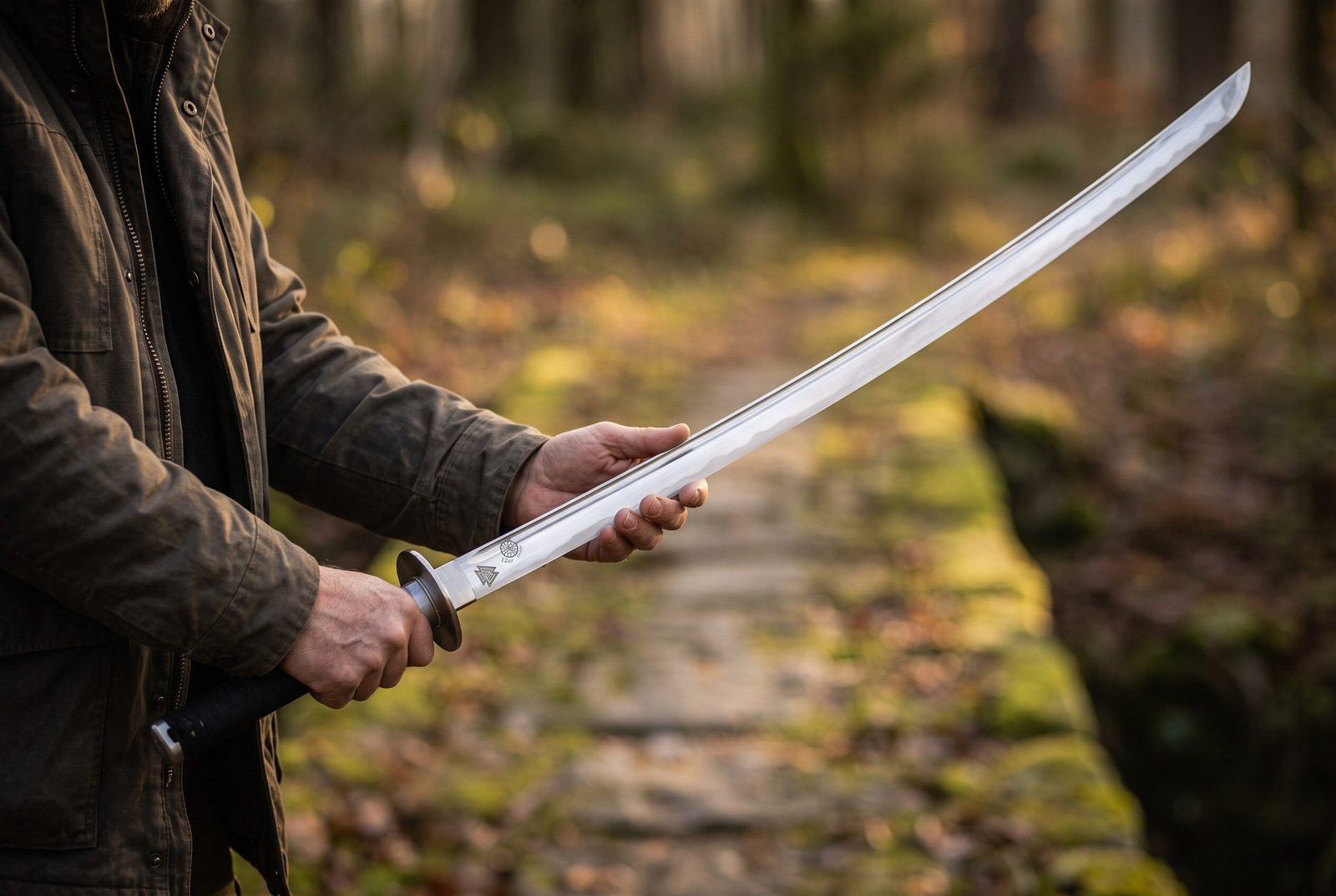
The balance point sits about five inches ahead of the tsuba, which is normal for a katana of this length and gives the blade its characteristic feeling of wanting to continue through a cut. The eleven inch tsuka takes two hands with a clear gap between them, and that gap is the mechanism. The forward hand steers and the rear hand pulls, so the sword rotates around a point between them rather than around the wrist. The blade is sharpened. Valkcurve is sold for collecting, display and dry handling, and we do not sell it for full contact sparring or for cutting hard targets.
Care
Never handle the polished blade with bare fingers. A fingerprint on a satin polish etches in within a few days and it will sit exactly where the eye lands. Wipe with a soft clean cloth and keep a very thin oil film on the steel, applied by cloth rather than sprayed, so the saya interior stays dry. Do not store the sword with oil pooled on the blade or the lacquer lining will go tacky. The leather wrap wants keeping dry and can take a light neutral cream once a year. Do not use metal polish on the etched Valknut, since polish will lift the etch. Notes on rust are in the guide to steel care.
A curve like this does not sharpen the way a straight edge does, and sharpening a curved blade works through the stroke.
Made in the Czech Republic
The work behind this piece happens in a Czech Republic workshop that has kept to the old methods. Steel is forged and heat treated by hand, the grind is taken down by eye rather than by machine, and the handle, fittings and sheath are cut and finished one at a time. Because of that, every piece carries small marks of the hand that made it.
Ransack Viking is a United States company. We import direct, check each piece when it reaches us, and ship from our Chicago, Illinois warehouse. Engraving is added here in the United States after arrival, so the piece you receive is finished to your order.
A note on handmade variation
This katana is hand made, not machine made or bulk produced, so what arrives will not be a pixel for pixel copy of the photograph. The exact sori arrives in the quench and differs by a fraction between blades, the Valknut etch sits at its own depth, the leather wrap has its own tension and grain, and the lacquer holds its own sheen. The dimensions, the steel, the heat treat and the build are the same every time. The character is not.
Frequently asked questions
Is the Valknut etched or engraved?
Etched into the surface of the blade, which gives a clean crisp line without removing enough steel to weaken the flat. It sits above the habaki where the eye finds it as the sword is drawn.
Why a leather wrap instead of cord?
Because it suits this sword. Leather sits fuller in the hand and grips better when warm, at the cost of the diamond windows a cord wrap gives. If you want cord instead, ask us before ordering.
Is the blade full tang?
The tang runs the full length of the tsuka and is secured through the handle in the traditional way. It is not a partial or welded tang.
Can I display it edge down?
You can, but the traditional orientation on a stand is saya down with the edge upward, which is also how it was worn through the sash. Edge down puts the edge against the cradle.
Will the charcoal lacquer scratch?
Any lacquer will mark if it is drawn across grit. Keep the saya off rough surfaces and wipe it with a damp cloth. A charcoal finish hides light marks better than gloss white.
How long does it take to arrive?
One to two weeks of processing, then free shipping inside the United States. The habaki fitting and the lacquer coats set the timeline.
What is in the box
- Valkcurve Viking katana in 1095 high carbon steel with an etched Valknut
- Charcoal lacquered saya
- Care card covering handling a polished blade and looking after a leather wrap
- Lifetime warranty against defects in forging, grind, heat treat and fittings
- Forged and finished in the Czech Republic
Explore the range
See the rest of the katana and Japanese swords, the wakizashi, the engraved and personalised pieces, and the guides.
If this one is not it
Closest to this in the range is the Valkgleam Japanese sword, forged from 1095. If this one is not quite right, there is the Duskwake Japanese sword, 40 inches overall. Also in this group is the Nightbraid Japanese sword.
If you are putting a set together, the Ragnar sword sits alongside it. Pick the steel, the length and the fittings yourself on the design your own page.



Five stars isn’t even enough honestly. Fit and finish is museum quality. You can tell real craftsmen made this by hand. This shop clearly takes pride in their work.
Perfect gift. Perfect quality. No complaints. Edge retention has been great even after regular use. Already telling my friends to check this out.
Got this as a gift and now I want one for myself too. Fit and finish is museum quality. You can tell real craftsmen made this by hand. Leather sheath is thick and well stitched. Not the cheap stuff you usually get. Weight and balance make it feel like a real functional piece not some cheap replica. This shop clearly takes pride in their work.
I collect stuff like this and this sword is on another level. 1095 Steel blade holds a razor edge right out of the box. So worth it. This is my third order from Ransack Viking and they never disappoint.
Got this as a birthday gift and the reaction was priceless. 1095 Steel blade holds a razor edge right out of the box. This will be a family heirloom for sure. I keep coming back to Ransack Viking because it’s always this good.
So happy I finally pulled the trigger on this one. The wood handle feels amazing and the balance is perfect. Leather sheath is thick and well stitched. Not the cheap stuff you usually get. So worth it.
This sword beat every expectation I had. Weight and balance make it feel like a real functional piece not some cheap replica. Love that this is Czech craftsmanship and shipping from the US meant it showed up in just a few days. This is going straight into my display case.
Did not expect this level of quality for the price. Weight and balance make it feel like a real functional piece not some cheap replica. Love that this is Czech craftsmanship and shipping from the US meant it showed up in just a few days. Even the small engravings are crisp and clean. So worth it.
I collect stuff like this and this sword is on another level. The wood handle feels amazing and the balance is perfect. Weight and balance make it feel like a real functional piece not some cheap replica. Love it.
Five stars isn’t even enough honestly. The wood handle feels amazing and the balance is perfect. Can’t recommend this enough.