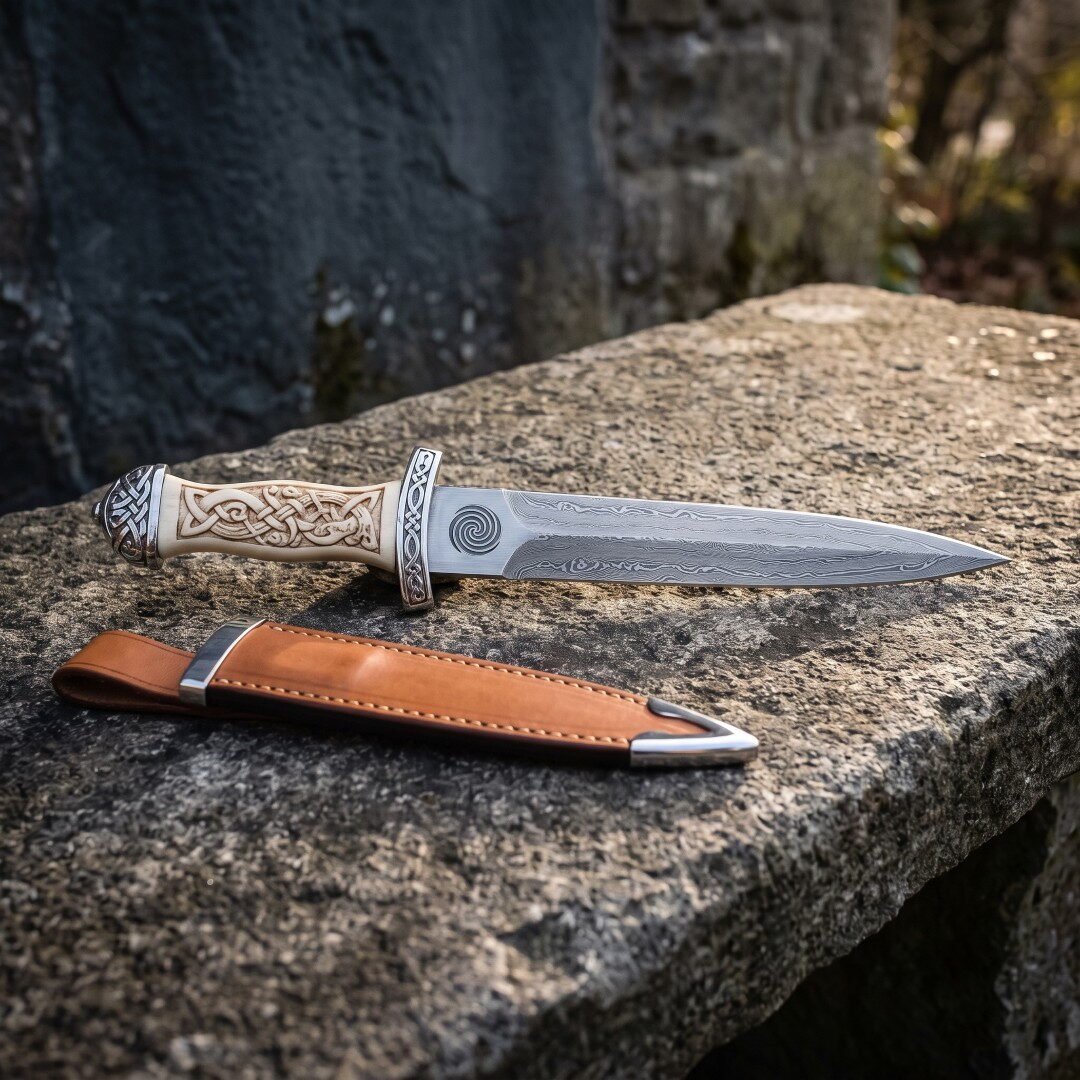
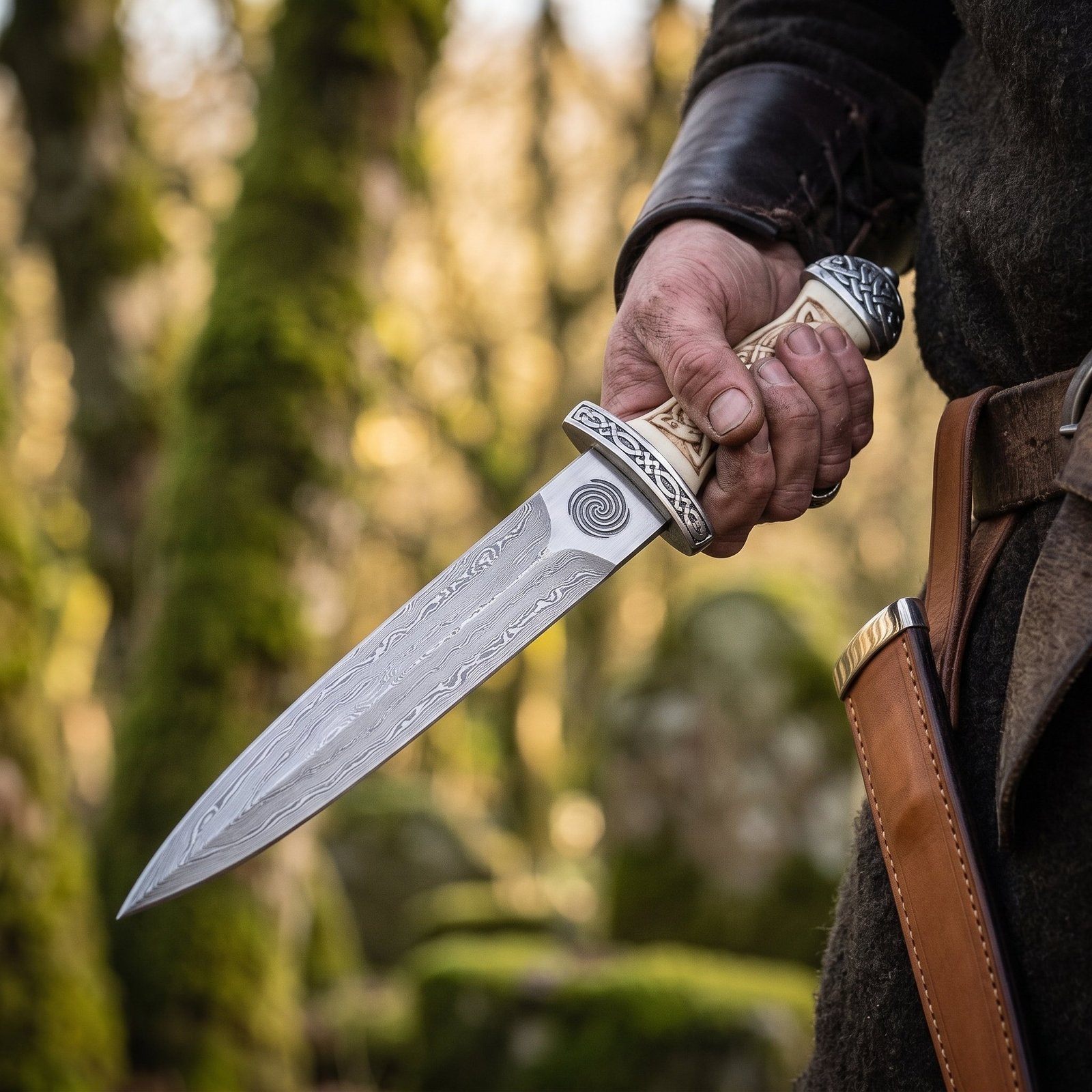
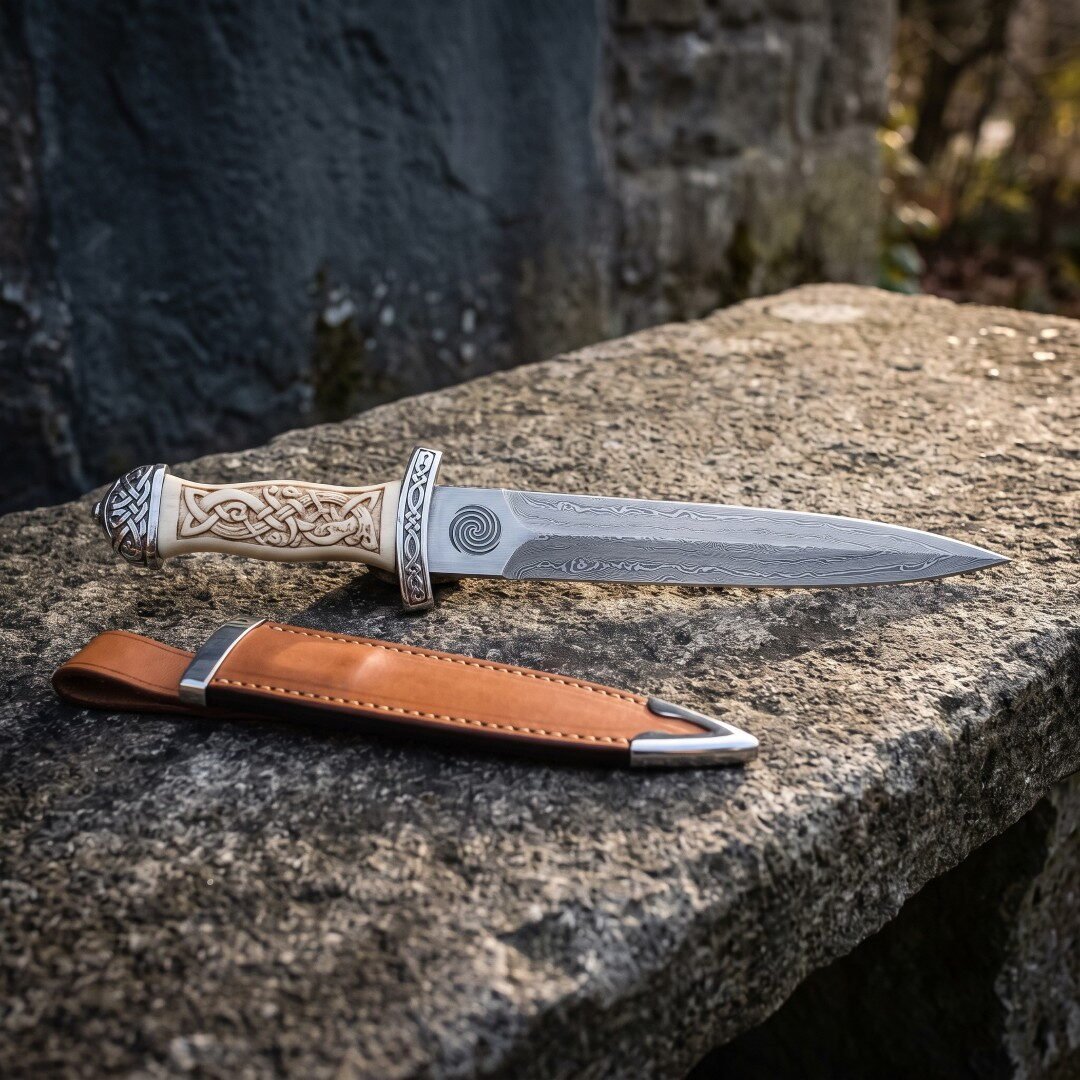
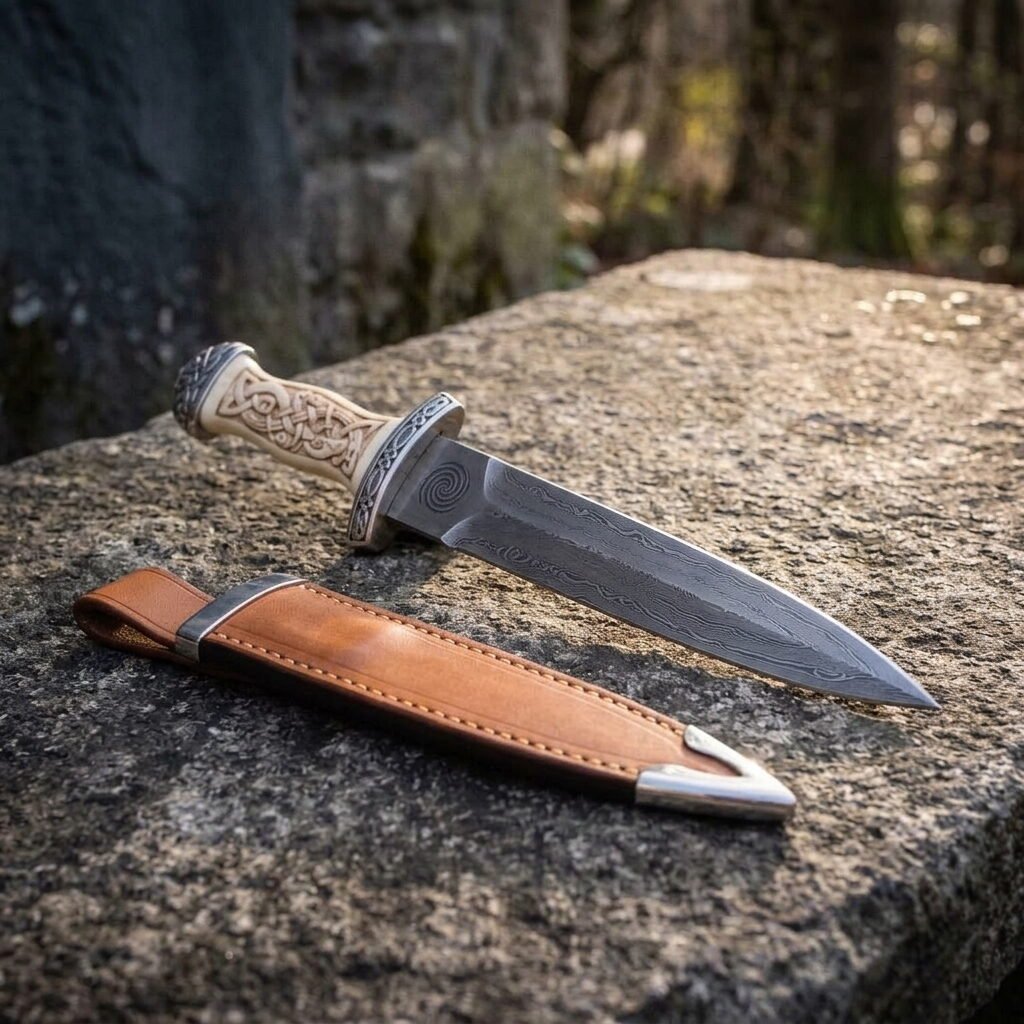
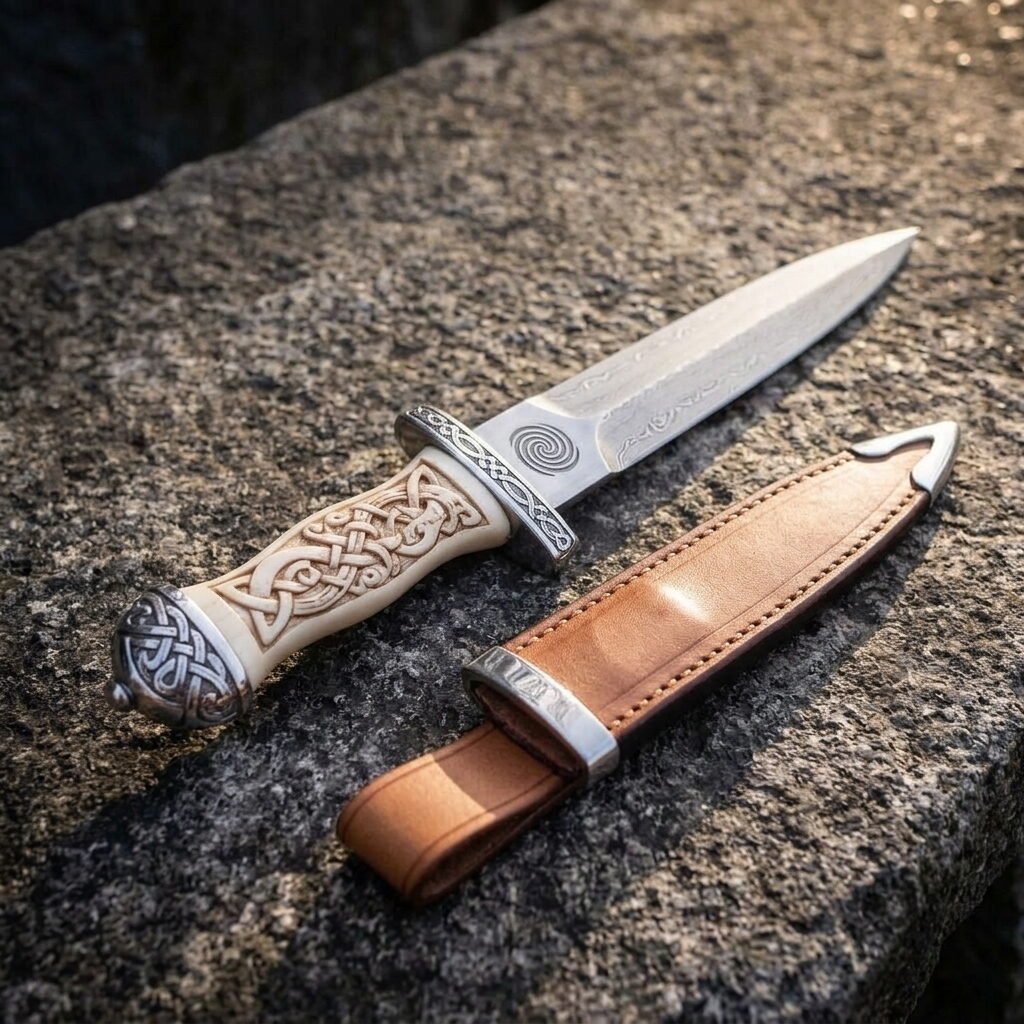
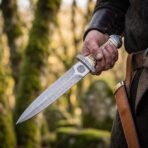
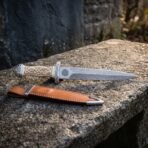
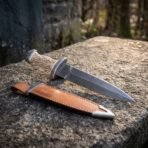
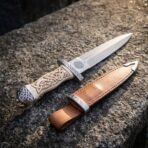
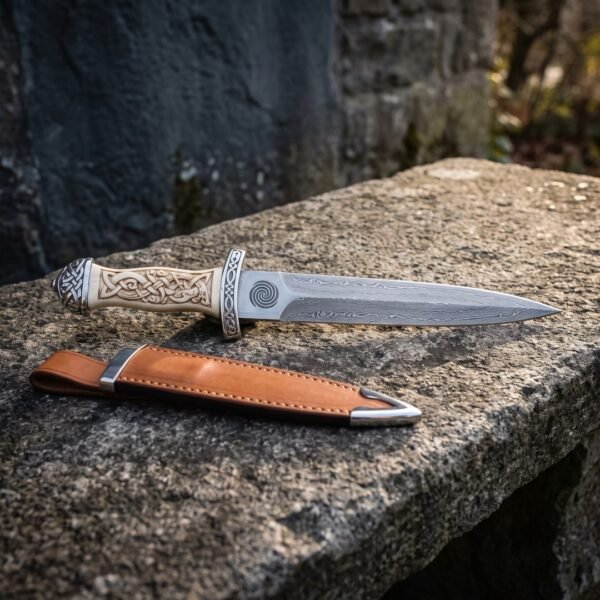
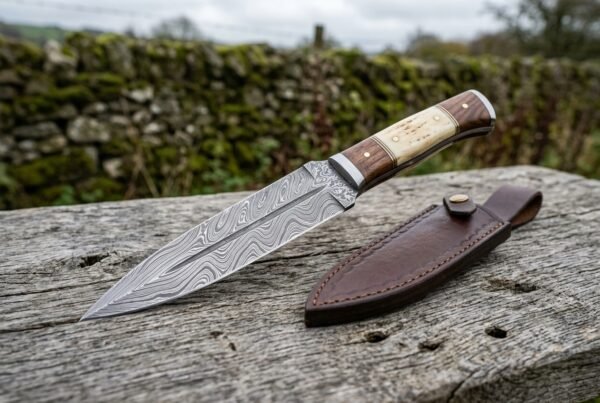
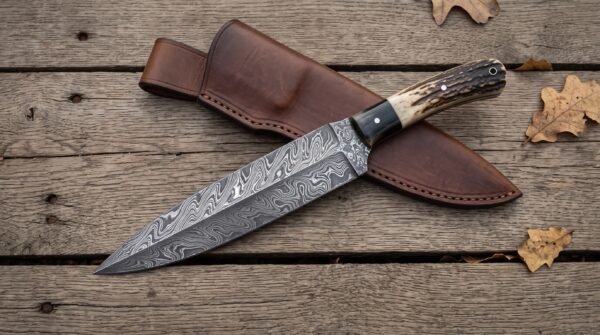
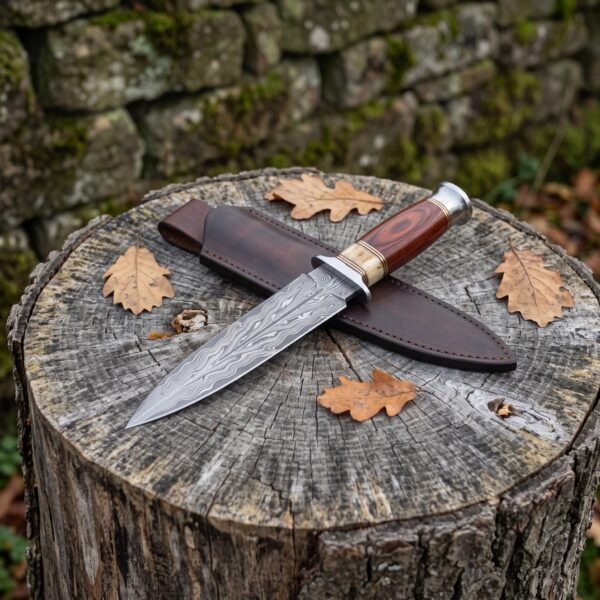
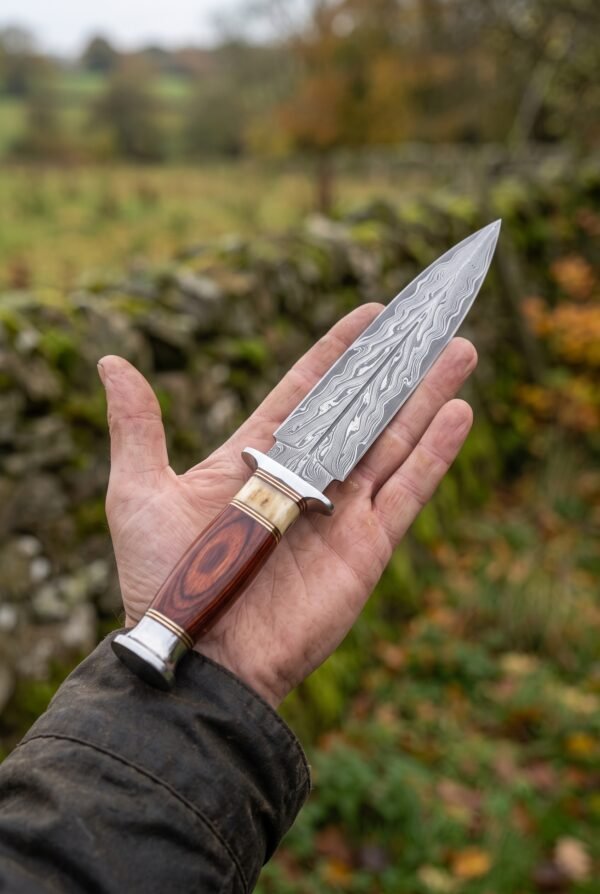
The Knotbone is a double edged dagger in the Scottish and Irish dirk tradition, with a long tapering Damascus blade, a carved bone handle covered edge to edge in interlace, and bright fittings at the pommel cap and the guard. A single spiral is cut into the flat of the blade just above the guard. It ships in a tan leather sheath dressed with a polished throat and a pointed chape.
The dirk is one of the few blades that survived the collapse of the culture that made it. When the Disarming Act of 1746 stripped the Highlands of broadswords and targes, the dirk stayed, partly because it doubled as an eating knife and partly because it was too useful to give up. It went on to become the formal sidearm of Highland regiments and it is still worn with full dress today, which is why the shape is so familiar even to people who have never handled one. This dagger is forged, ground, heat treated and finished in the Czech Republic.
Daggers vary more than people expect, and a run through the dagger types is a run through the main ones. Insular knotwork travelled with the Norse and came back changed, and the symbols guide covers the shapes that recur. The throwing knives sit nearby if you want something to put in a stump.
Specifications
| Material | 1095 and 15N20 pattern welded Damascus, hardened to 58 to 60 HRC |
|---|
| Overall length | 14 inches |
|---|
| Blade length | 9 inches, double edged with a long taper |
|---|
| Blade finish | Acid etched and hand polished, visible Damascus pattern, with a cut spiral in a dark roundel above the guard |
|---|
| Handle | Carved bone with deep cut interlace, about 4.5 inches |
|---|
| Guard | Small oval guard in bright finished steel, engraved with knotwork |
|---|
| Pommel | Domed bright finished steel pommel cap engraved with knotwork, with a matching collar |
|---|
| Sheath | Tan stitched leather with a polished steel throat and a pointed steel chape |
|---|
| Weight | About 11 oz |
|---|
| Included | Dagger and fitted sheath |
|---|
| SKU | RK-1943 |
|---|
How an interlace panel is actually built
Knotwork looks freehand and it is nothing of the kind. Insular interlace, the kind on the Book of Kells and on the carved crosses of Ireland and western Scotland, is built on a grid. The carver or scribe sets out a field of dots, connects them with a repeating unit, and then makes decisions about where the line crosses over and where it crosses under. Change one crossing and the whole knot changes character. Get one crossing wrong and the pattern reads as broken to anyone who knows what they are looking at, which is why the same errors turn up on modern imitations again and again.
The rule that governs the whole thing is alternation. A correctly drawn interlace crosses over, then under, then over, without exception, all the way around. Follow the line on this handle with a fingernail and it will alternate every time. That is what makes the pattern read as a single continuous cord rather than as a pile of ribbons.
Carving it into bone rather than drawing it adds a further constraint. Every crossing is a place where you have to cut away material under a ribbon that stays proud, and bone is brittle. Cut too deep at a crossing and the ribbon above it snaps out. That is the reason the panels on a piece like this are laid out with slightly wider ribbons than a manuscript version would use, and it is a good quick test of whether a carved handle was cut or moulded. A moulded handle has undercuts that are physically impossible to carve.
1095 and 15N20 Damascus and the bone handle
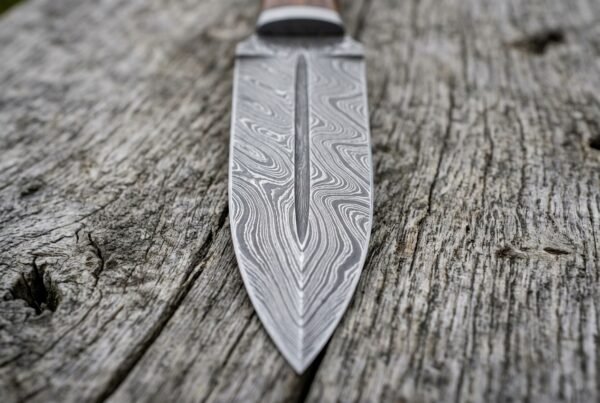
The blade is welded from alternating layers of 1095 and 15N20 and hardened to 58 to 60 HRC. The 15N20 contains nickel and resists the etching acid, the 1095 does not and darkens, and the pattern you see is the layered structure of the billet cut through by the grind. It is not printed, laser marked or stencilled. On a dagger the pattern is particularly clear because a double edged blade is ground symmetrically from both sides, which slices the layers at a consistent angle down the whole length.
The handle is bone. That means it is a natural material with everything that implies. Colour runs from cream to a warmer ivory tone, and pieces frequently show faint darker flecks or fine lines, which are natural and are not flaws. Bone is not ivory, we do not use ivory, and any seller offering ivory handled knives should be asked some hard questions about provenance.
Bone is stable, it takes a very crisp cut and it warms in the hand rather than staying cold the way metal does, which is why it was used for handles for as long as knives have existed. It is harder than antler and less flexible, so it wants to be kept out of extremes of heat and dryness.
Engraving, runes and your own design
Use the rune converter on this page to turn a name, a date or a short phrase into Elder Futhark and we will cut it into the steel, the leather or the wood. If you would rather have a Viking pattern than a rune line, choose your own design in the engraving option above the add to cart button and tell us where it goes. Where a piece already carries an engraved design, your chosen engraving replaces it rather than sitting alongside it, so runes on the blade take the place of the spiral above the guard. The carved bone panels are not a surface we will overcut, because carving into an existing interlace destroys it. The leather of the sheath takes a stamped name very cleanly if you want one. See the engraving page.
Handling and balance
The dagger balances almost exactly at the guard, which is where a double edged blade of this length should sit. That makes it feel neutral in the hand, neither tip heavy nor butt heavy, and it is why a dirk of this shape is comfortable to wear all day.
The carved handle is not just decoration in use either. Deep cut interlace gives the palm something to key into, in the same way a checkered grip does, so the handle stays put in a damp hand without needing to be gripped hard.
This is a sharp collector and display piece with a genuine forged blade. It is not sold for combat, for sparring or for contact work of any kind. It is a knife, so treat it as one and keep it away from children.
Care
Wipe the blade after handling and keep a very light film of mineral oil or camellia oil on it. Etched Damascus is slightly porous in the dark layers and holds moisture, so a blade put away damp will spot faster than a plain polished one.
Bone wants a dry cloth and nothing else. Do not soak it, do not put it near a radiator and do not treat it with oil, because oiling bone darkens it unevenly and cannot be undone. If it ever looks dull, a very small amount of a hard wax on a cloth will bring the shine back without soaking in.
Feed the leather sheath twice a year with a neutral balm and do not store the dagger sheathed for months on end. Full guidance is on our steel care page.
Damascus wants oil more than plain steel does, because the etch that shows the pattern also opens the surface, and caring for a Damascus pattern covers what to use.
Made in the Czech Republic
Every piece we sell is made by hand in the Czech Republic. The smiths there work the way the trade has been worked for a long time, heating and hammering the steel, taking the bevels down by eye, and fitting the handle and the leather one at a time. There is no automated line anywhere in it, so small differences from one piece to the next are normal and expected.
Ransack Viking is a United States company based in Chicago, Illinois. We bring the pieces in ourselves, inspect them on arrival and ship them from our own warehouse. If you add engraving, that is carried out here in the United States before your order goes out.
A note on handmade variation
This dagger is hand made rather than machine made or bulk produced, so what arrives will not be a pixel for pixel copy of the photograph. Bone is a natural material and the colour, the faint flecking and the density of the piece your handle is cut from are unique to it. The interlace is cut by hand, so ribbon widths and depths vary. The Damascus pattern never repeats. The dimensions, the steel, the heat treat and the build are the same every time. The character is not.
Frequently asked questions
Is the handle real bone or a resin imitation?
It is real bone, shaped and carved by hand. Natural flecks and faint darker lines in it are part of the material rather than defects, and no two handles are the same colour.
Is it ivory?
No. We do not use ivory in anything we make. This is bone.
Is the Damascus pattern genuine?
Yes. It is a welded billet of 1095 and 15N20 and the pattern runs through the steel. Grinding into the blade would show the same layers continuing.
Does it arrive sharp?
Yes, both edges are sharpened and ready. Ask in the order notes and we will send it unsharpened for display at no extra cost.
Can I have the handle engraved with my name?
Not over the carved panels, because cutting into finished interlace ruins it. We can stamp a name into the sheath, or cut runes onto the blade in place of the spiral.
Will the bone yellow over time?
It will warm slightly with age and handling, in the same way any natural material does. Keeping it out of strong direct sun slows that considerably.
What is in the box
- One Knotbone Celtic dagger in 1095 and 15N20 pattern welded Damascus
- One fitted tan leather sheath with a polished throat and pointed chape
- A protective film of oil on the blade for transit
- Care notes for Damascus steel, carved bone and leather
- Lifetime warranty against defects in forging, grind, heat treat and fittings
- Forged and finished in the Czech Republic
Explore the range
More in this family: daggers, Anglo Saxon and Celtic, Viking knives and scabbards and sheaths. Background reading lives in the guides.
Near neighbours in the shop
Next along the rack is the Axebloom Anglo Saxon piece. For a straight comparison, see the Knotbloom Anglo Saxon piece. Worth putting side by side with this is the Whorlcrown Anglo Saxon piece, 38 inches overall.
If you are putting a set together, the Thundercurve kukri knife sits alongside it. You can have this made your way instead on the custom Damascus knife page.

This thing is a beast in the best way. Edge retention has been great even after regular use. Will definitely order again for another gift.
Bought this on a whim and it turned out to be one of my favorite purchases this year. Edge retention has been great even after regular use. Weight and balance make it feel like a real functional piece not some cheap replica. Can’t recommend this enough.
My husband was speechless when he opened this. Can’t recommend this enough. I keep coming back to Ransack Viking because it’s always this good.