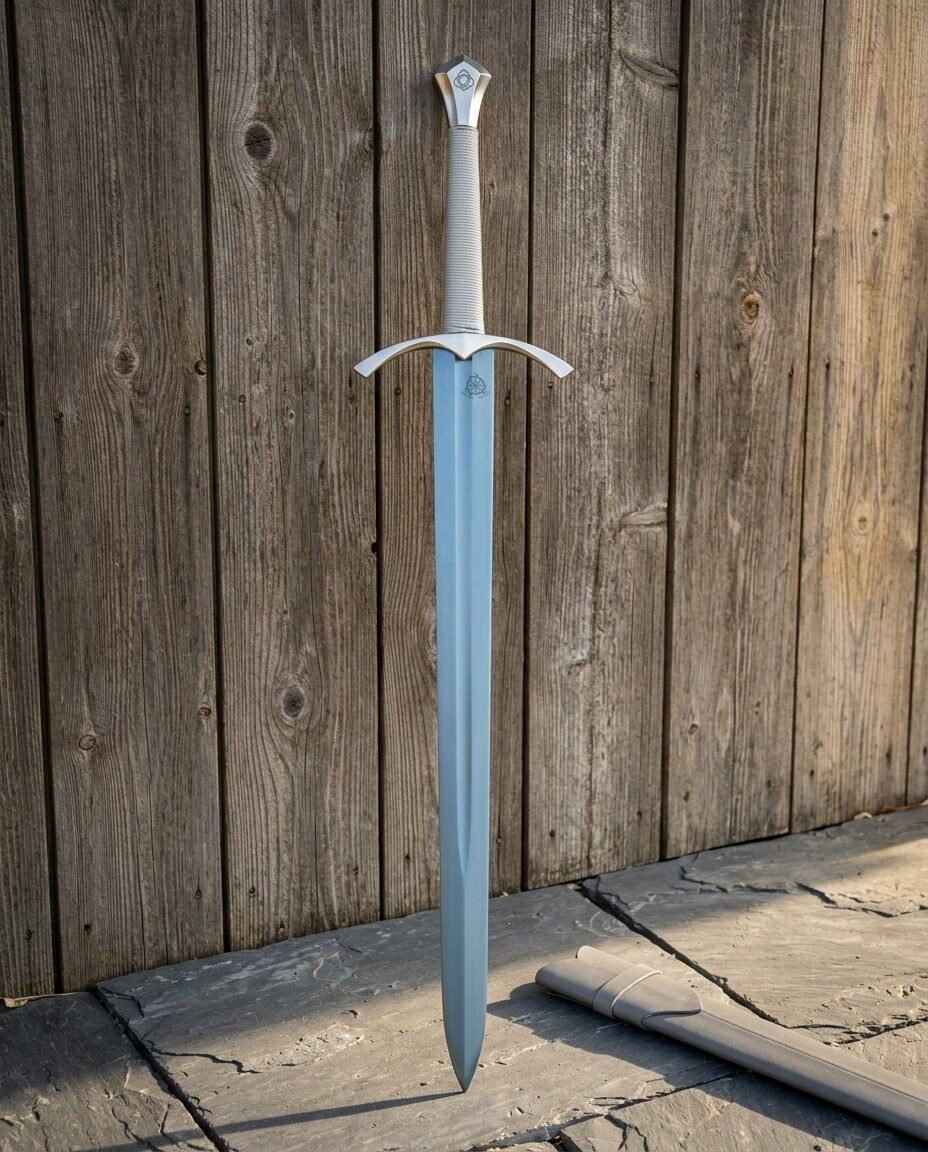
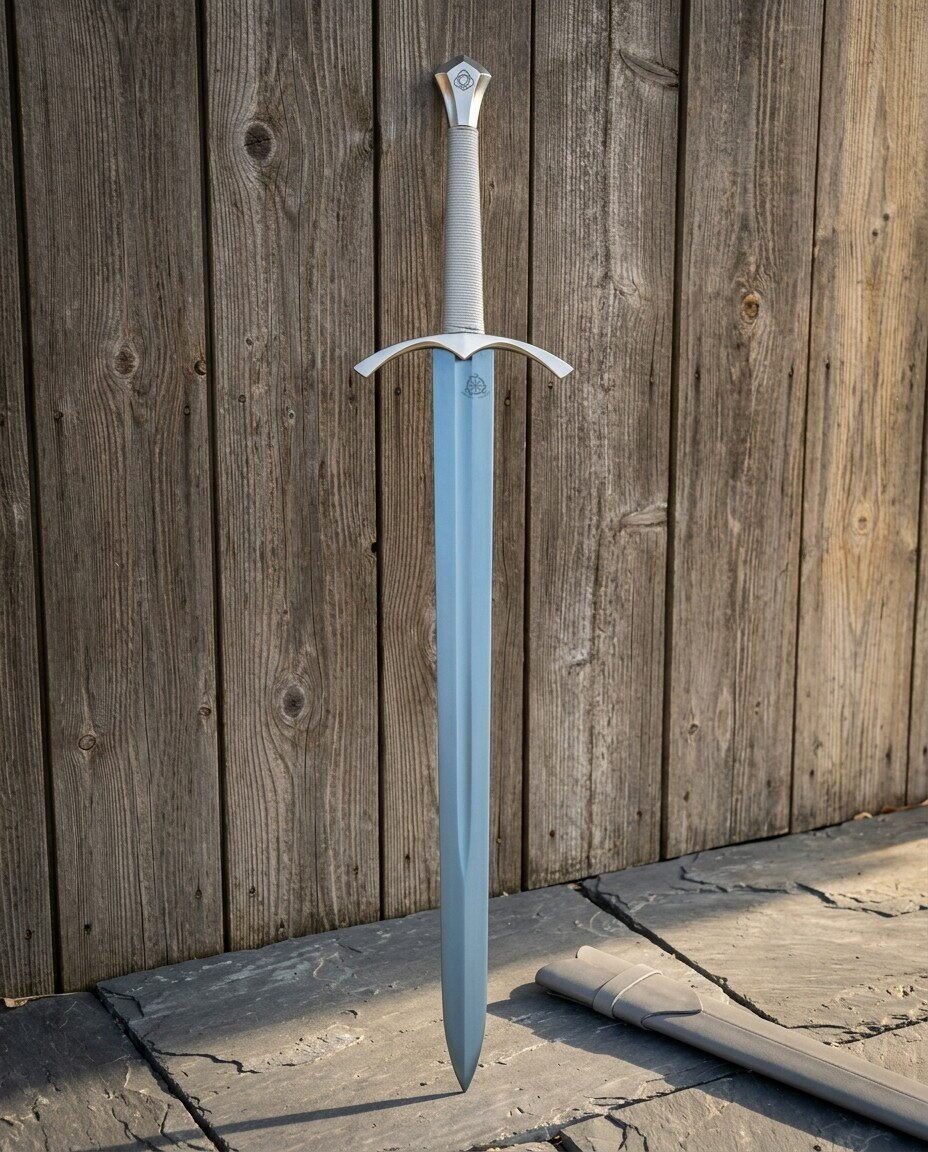
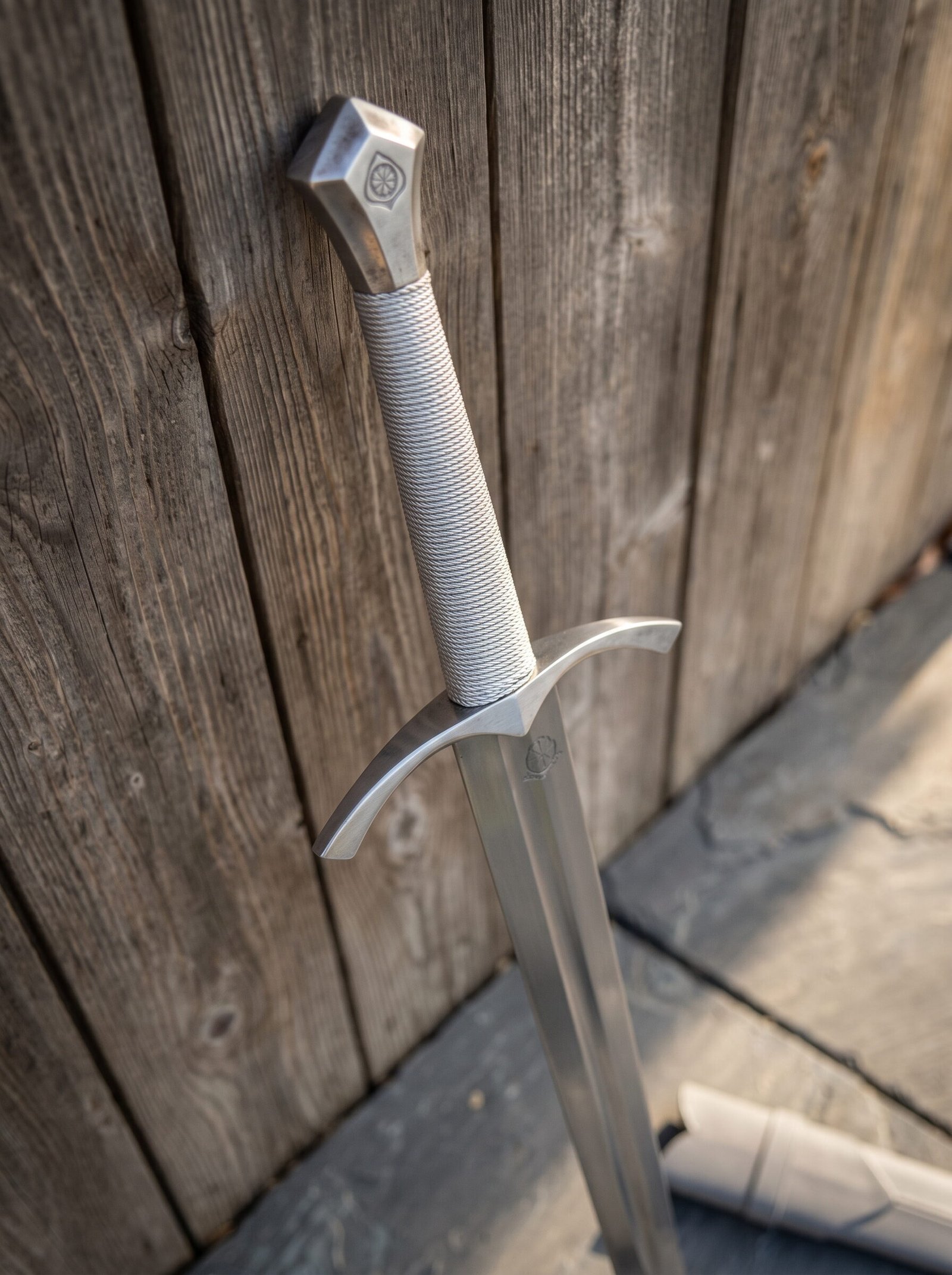
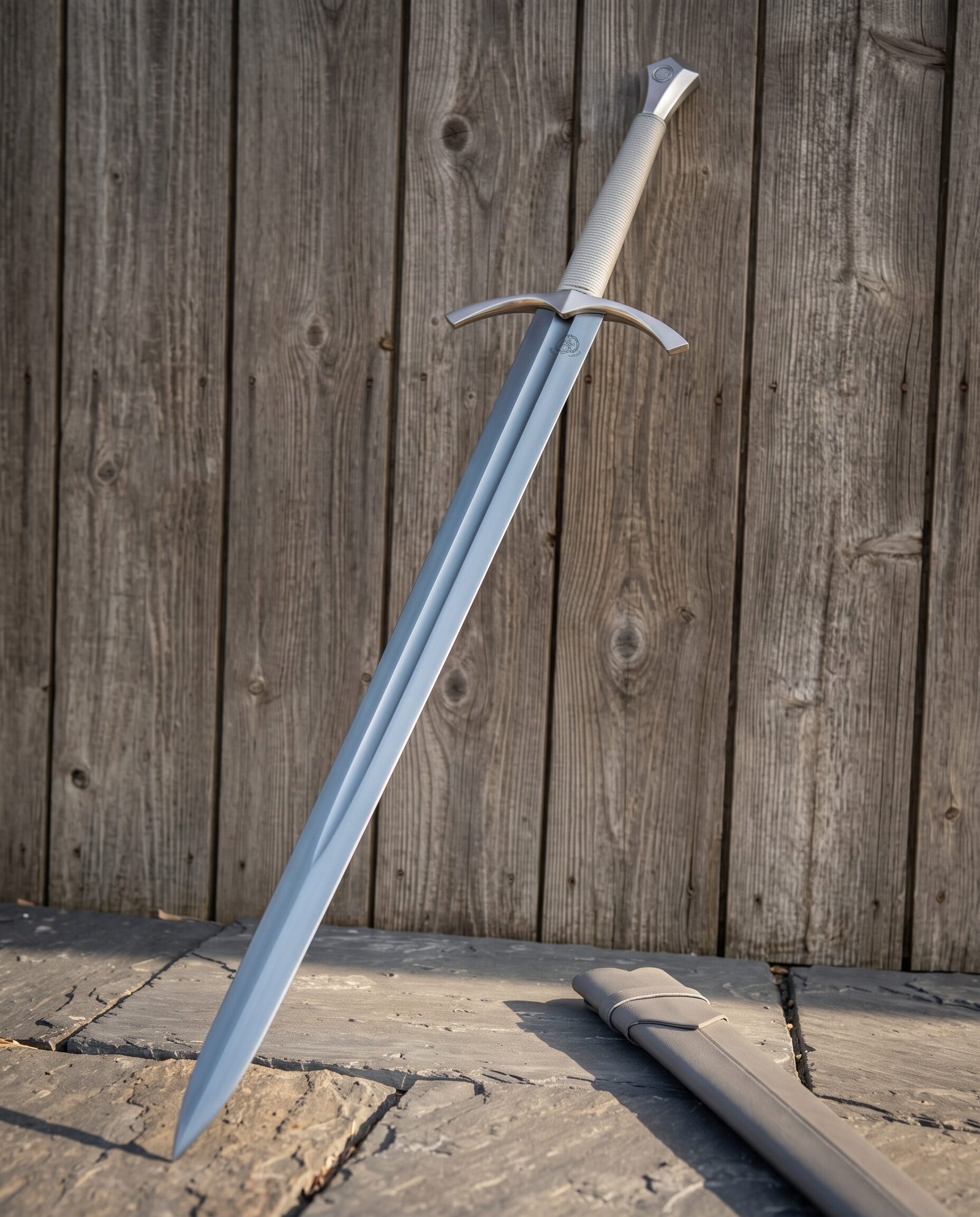
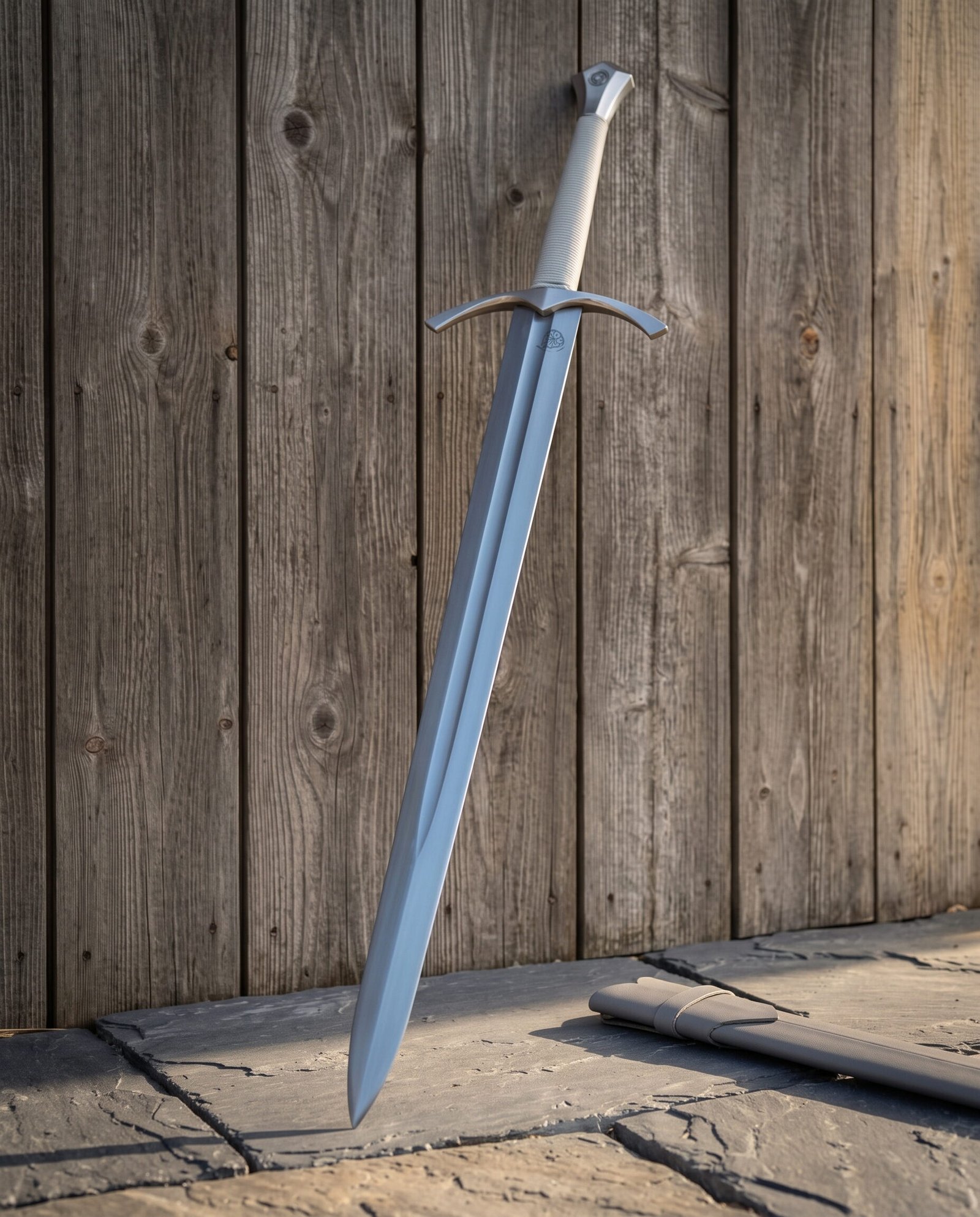
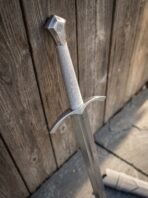
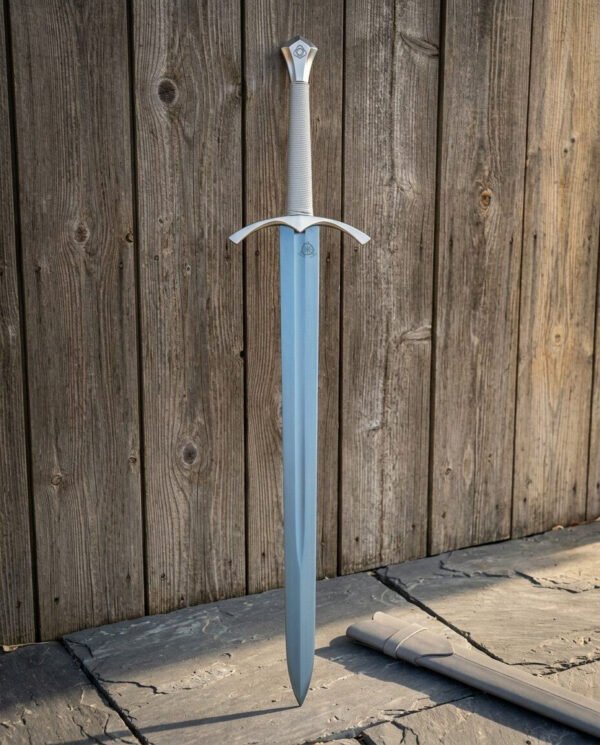
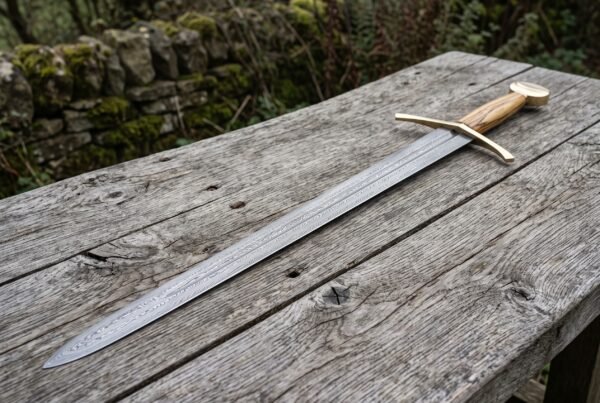
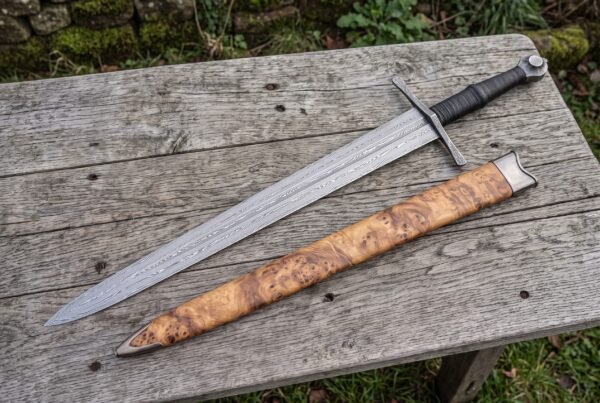
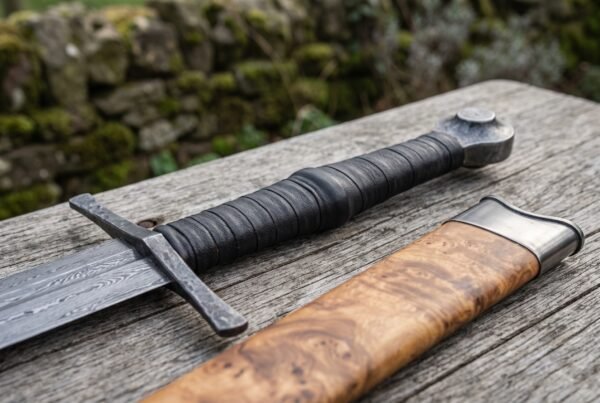
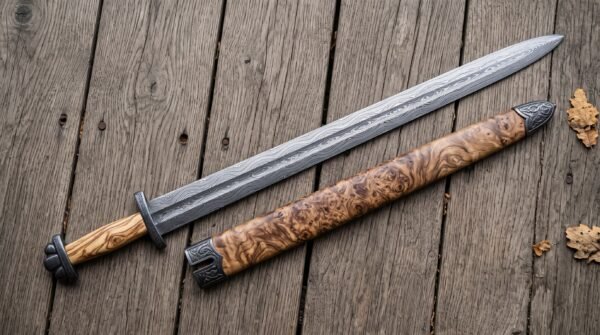
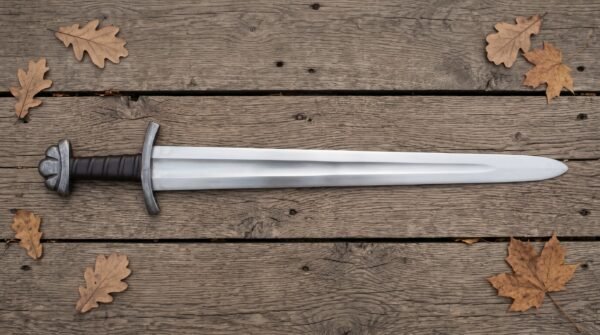
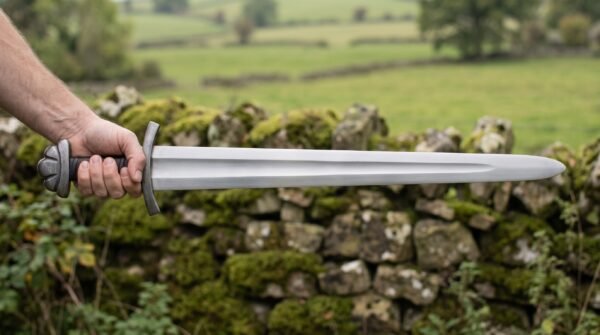
The Palethorn is a knightly longsword built around a long cord wrapped grip, a gently arched crossguard and a faceted shield shaped pommel carrying an engraved triquetra. The blade is plain high carbon steel finished bright, with a broad flat that catches the sky and a matching triquetra roundel etched just below the guard. Everything about the colour choice is deliberate: a bone pale cord wrap, pale polished furniture and a pale grey leather scabbard, which together give the piece a much quieter look than the usual black and brass.
The pommel shape is the interesting part historically. Faceted shield and heater pommels belong to the later medieval period, when the pommel stopped being purely a counterweight and started being a place to put heraldry. A flat facet gives an engraver a panel to work on, which is exactly why the form spread among knights who wanted their arms carried on the sword itself. The Palethorn is made by hand in the Czech Republic, imported and checked by Ransack Viking, and shipped from our Chicago, Illinois warehouse. It arrives with the pale grey leather scabbard shown in the photograph.
Long blades carry more legend than the rest, and the legend and what collectors buy separates the story from what people actually own. The triquetra is the three cornered knot, and it sits with the rest in the Norse symbols guide. For a grip that takes one hand or two, look at the bastard swords.
Specifications
| Type | Knightly longsword, hand and a half grip |
|---|
| Blade | 1095 high carbon steel, 54 to 58 HRC, bright polished |
|---|
| Blade profile | Straight double edged blade with a central line, tapering to an acute point |
|---|
| Blade etching | Small triquetra roundel below the guard |
|---|
| Guard | Polished steel crossguard, arched towards the blade with downswept tips |
|---|
| Grip | Cream cord wrapped over a shaped core, sized for one or two hands |
|---|
| Pommel | Faceted shield form in polished steel, engraved with a triquetra |
|---|
| Scabbard | Pale grey leather with a wrapped retaining band |
|---|
| Finish | Bright polished blade and fittings, pale cord and leather |
|---|
| Included | Longsword and fitted pale grey scabbard |
|---|
| SKU | RK-2073 |
|---|
Why a longsword grip is longer than one hand needs
The single feature that separates a longsword from an arming sword is not blade length, it is the grip. An arming sword grip is sized for one fist and stops. A longsword grip runs long enough that the second hand has somewhere to go, and that changes how the whole thing works.
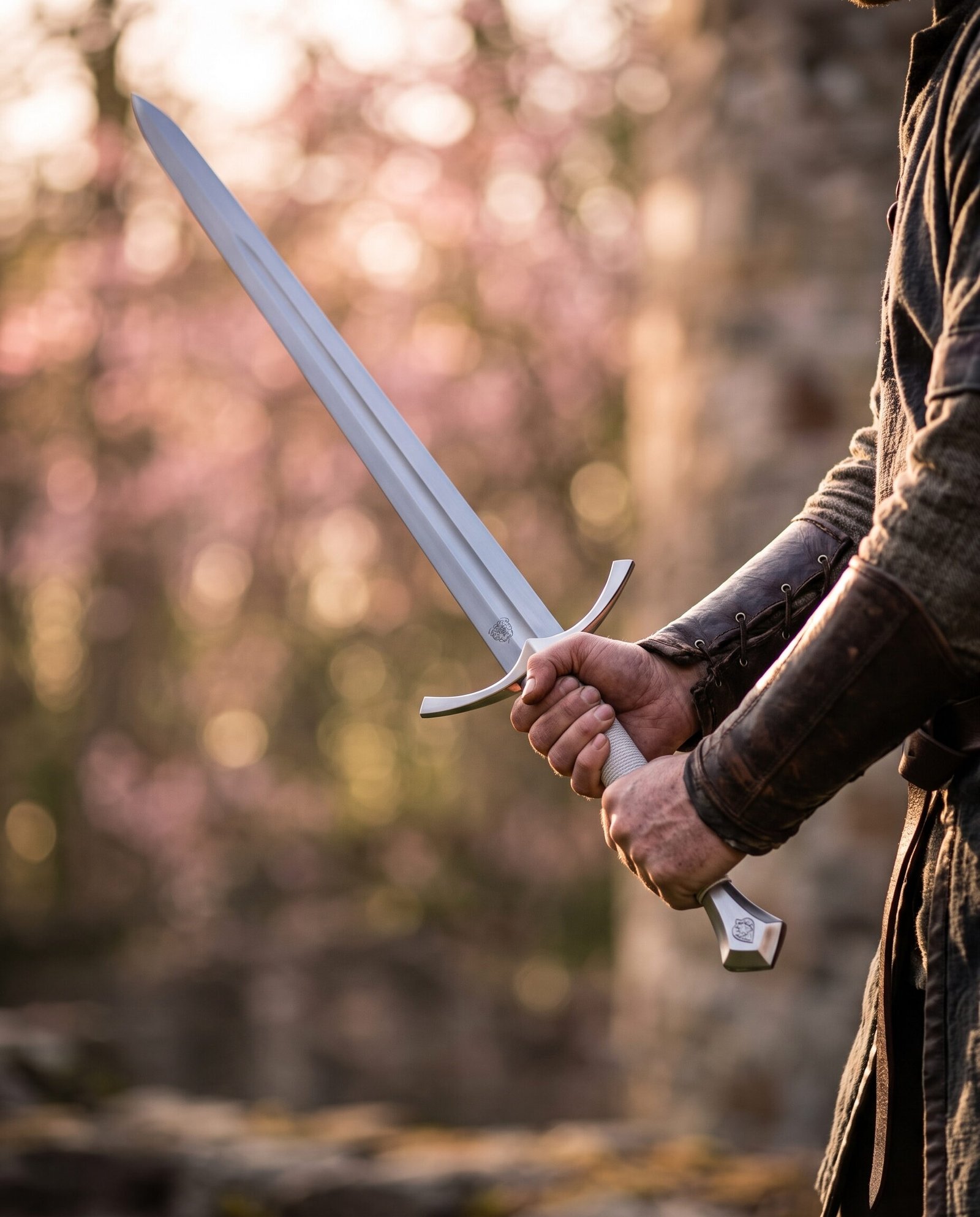
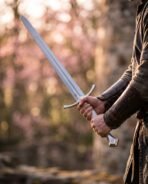
The second hand is not there to add strength. It is there to add leverage across a longer moment arm, which means finer control of the point at speed and a much faster recovery after a cut. In the surviving fencing treatises the two hands do different jobs: the leading hand near the guard steers the blade, and the trailing hand near the pommel acts as a pivot and a brake. On many longswords the trailing hand sits partly on the pommel itself rather than on the grip, which is why pommels of this period are shaped to be held rather than merely to sit there. The faceted shield form on this sword is comfortable in that position, with flats rather than a sharp edge against the palm.
The arched crossguard does something similar in miniature. A straight bar protects the hand, but a bar that curves gently towards the blade catches and directs an incoming edge outwards rather than letting it slide down the length of the guard towards the fingers. The downswept tips on this piece also keep the guard from snagging on clothing when the sword is drawn.
The triquetra, and what it actually meant
The triquetra is three arcs interlaced into a three cornered knot, drawn as one continuous line that never ends. It is one of the oldest surviving motifs in Insular art, appearing throughout the Book of Kells and the Lindisfarne Gospels and carved on Northumbrian and Irish stonework from the seventh century onwards.
Its meaning has shifted more than once. In Insular Christian manuscript work it was read as the Trinity, three in one, which is the reading that put it into so much church art and metalwork. Long before that the same three cornered interlace turns up in Germanic and Norse ornament, where it is sometimes associated with Odin and where it appears on Scandinavian runestones and coinage without any surviving explanation of what the carvers intended. Modern Norse revival has largely reclaimed it as a symbol of the three fold nature of things, land, sea and sky, or past, present and future.
What is honest to say is that it is a shared symbol rather than a Christian one or a pagan one. It travelled with the same artistic tradition that produced the interlace on Viking Age brooches and on Celtic high crosses, and it belongs equally to both. On this sword it appears twice, cut into the pommel facet and etched as a roundel on the blade below the guard.
The steel and the finish
This blade is plain 1095 high carbon steel at 54 to 58 HRC, ground and polished bright. It is not pattern welded and there is no Damascus figure in it, and the pale blue cast in the photograph is the sky reflecting off a mirror surface rather than a blued or coated finish.
A plain polished blade on a longsword is arguably the more historically correct choice. Medieval European blades were finished bright, and the whole point of a broad flat was that it reflected. It also makes the geometry readable: you can see the taper, the flat and the shallow bevel running to the edge without a pattern breaking up the surface. The trade is that a mirror polish shows every fingerprint, so plan on wiping it down each time you handle it.
Engraving, runes and your own design
Use the rune converter on this page to turn a name, a date or a short phrase into Elder Futhark and we will cut it into the steel, the leather or the wood. If you would rather have a Viking pattern than a rune line, choose your own design in the engraving option above the add to cart button and tell us where it goes. Where a piece already carries an engraved design, your chosen engraving replaces it rather than sitting alongside it. On the Palethorn the natural place for a rune line is the flat of the blade below the guard, which would take the place of the triquetra roundel there. The pommel facet can also be cut if you prefer. It is all set out on the engraving page.
Handling and balance
Longswords of this class balance a short distance forward of the guard, and the heavy faceted pommel is what pulls the point of balance back to where the sword feels responsive rather than tip heavy. Take a full grip with the leading hand tight under the crossguard and let the trailing hand sit loosely near the pommel. From there the sword turns with very little effort, which is the whole reason the form dominated European fencing for two centuries.
Because the grip is cord rather than leather, it grips well dry and stays cool. Keep it out of the rain, as wet cord takes a long time to dry and will mark.
This is a hand made collector and display longsword with a real edge. It is not sold as a full contact sparring sword and should not be used for contact against another blade or for cutting practice against hard targets.
Care
Wipe the blade after every handling and keep a thin film of oil on it. On a bright polish this matters more than on an etched blade, because skin acid leaves a visible print in the surface within a few days and it cannot be wiped off once it has etched in. Mineral oil or a purpose made blade oil on a soft cloth is all it takes.
Keep the cord grip dry and out of prolonged direct sun, which fades and weakens natural cord. Feed the scabbard leather with a light cream once or twice a year and never dry it with heat. Do not store the sword inside the scabbard for months at a time. More is set out in our steel care guide.
If it is going on a wall, hanging swords and axes safely covers mounts, fixings and what not to do.
Made in the Czech Republic
This longsword is made by hand in the Czech Republic. Ransack Viking imports it, checks the polish, the guard fit, the pommel seating and the grip wrap before it is listed, and ships it from our Chicago, Illinois warehouse. Nothing here is drop shipped straight from an importer catalogue. Shipping within the United States is free. Processing usually takes one to two weeks and engraving adds to that. Returns are accepted within seven days. The lifetime warranty against defects in forging, grind, heat treat and fittings carries no end date and needs no receipt.
A note on handmade variation
This sword is hand made rather than machine made or bulk produced, so what arrives will not be a pixel for pixel copy of the photograph. The cord wrap will differ slightly in pitch and in exact shade, since natural cord takes dye unevenly and no two spools match perfectly. The polish carries its own faint working marks, the engraved triquetra sits a fraction differently on each pommel, and the pale leather of the scabbard varies in grain and tone. The dimensions, the material and the build are the same every time. The character is not.
Frequently asked questions
Is this a longsword or an arming sword
A longsword. The grip is long enough to take two hands comfortably, which is the defining feature, and the blade is proportioned to match. An arming sword grip stops at one fist.
Why does the blade look blue in the photograph
Because it is mirror polished and it is reflecting an open sky. The blade is plain bright steel with no blueing, no coating and no colour treatment.
Can I use it two handed
Yes, that is what the grip is for. Leading hand under the crossguard, trailing hand near or on the pommel. It is a display and collector piece rather than a sparring sword, but the grip geometry is correct.
Does the scabbard hold the sword securely
It is a fitted scabbard with a wrapped retaining band and it holds the blade by friction at the throat. Carry it upright rather than inverted, as you would any scabbard without a strap.
Is the triquetra a Christian or a Norse symbol
Both, genuinely. It runs through Insular Christian manuscript art as a Trinity symbol and through Germanic and Norse ornament at the same time. Nobody can honestly claim it for one tradition alone.
How long does an order take
Processing runs one to two weeks from our Chicago warehouse, then free standard shipping inside the United States. Engraving is cut here after the sword arrives, so allow extra days if you add it.
What is in the box
- Palethorn polished steel knightly longsword
- Fitted pale grey leather scabbard
- Light protective oil film on the blade
- Hand made in the Czech Republic, shipped from our Chicago, Illinois warehouse
Explore the range
More in longswords, arming swords, swords and engraved and personalised pieces, or read the guides.
Compare it with these
Also in this group is the Grimfell longsword, 47 inches overall. Sitting beside it in the catalogue is the Weavecrest longsword, 38 inches overall. Another in the same line is the Wolfcrown longsword, forged from 1095.
For a different piece from the same family, look at the Valkshade Japanese sword. Pick the steel, the length and the fittings yourself on the custom Viking sword page.
Want something you can actually fence with? The Vindlaur feder is blunt and made for it, and our guide to blade flex is worth a look before you buy.
It’s okay. Not great not bad. Wouldn’t say no to it but wouldn’t rave about it either.