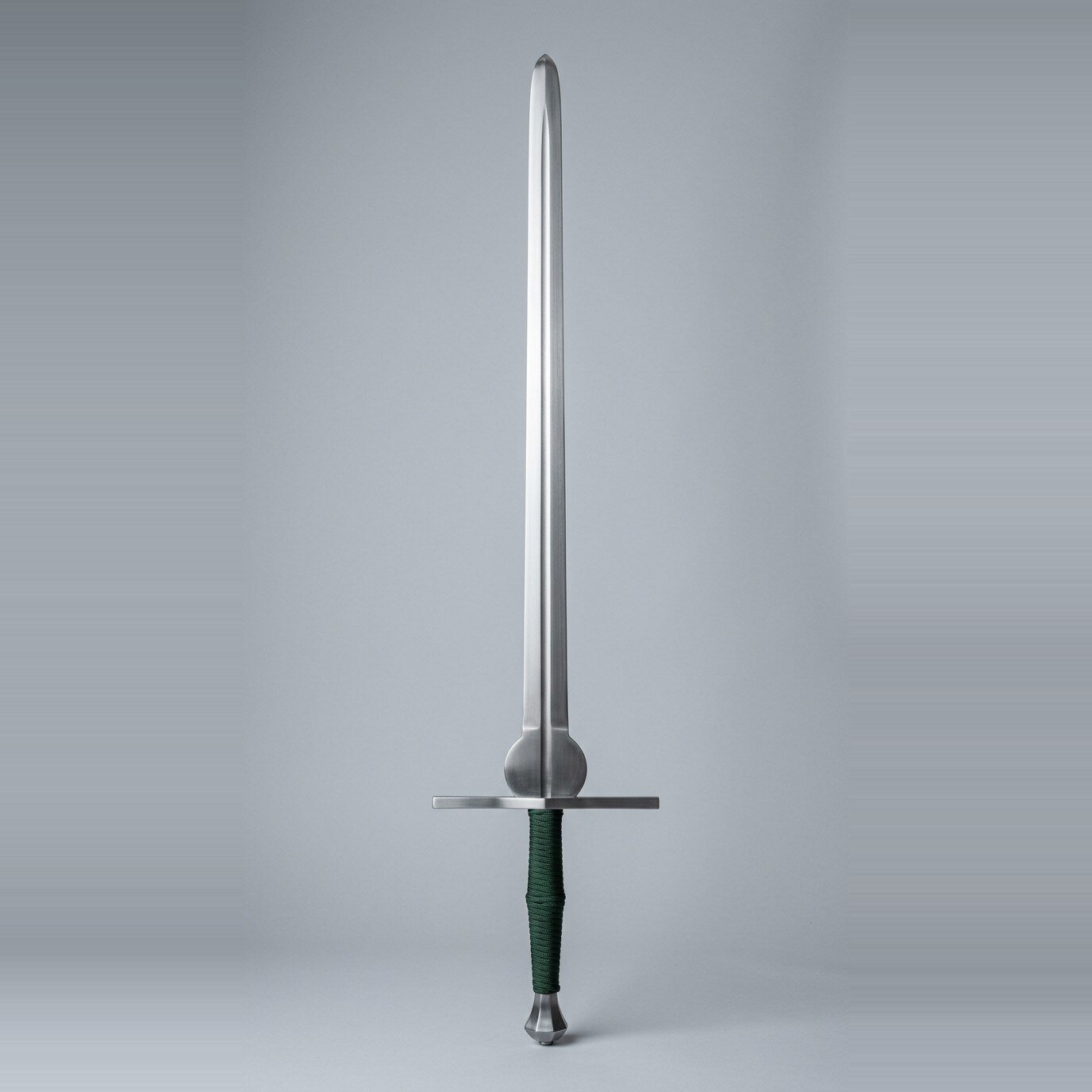
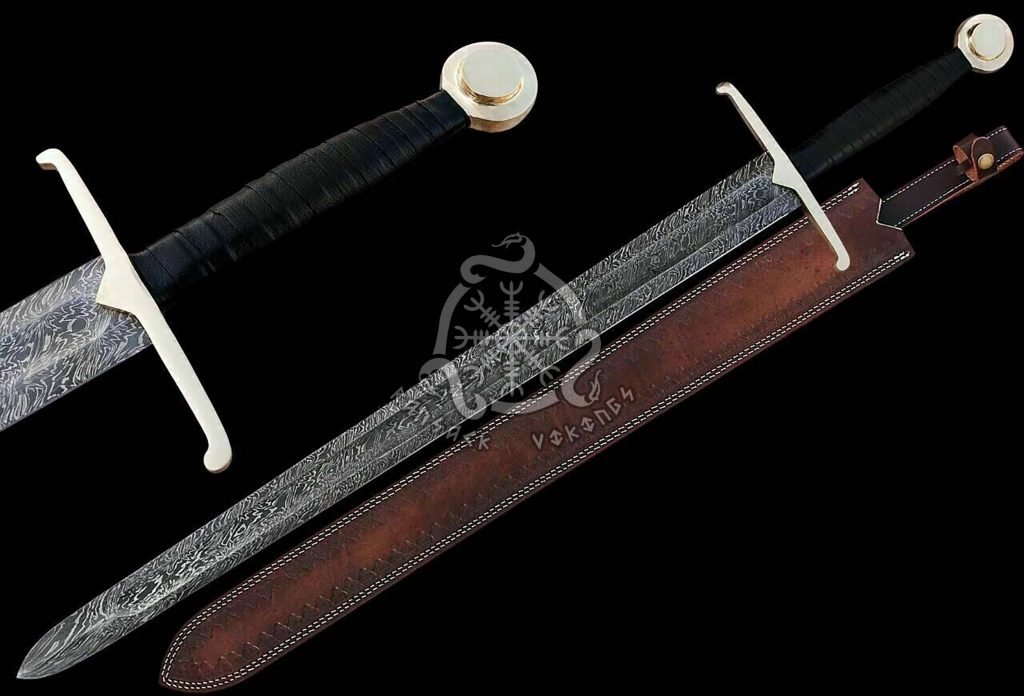
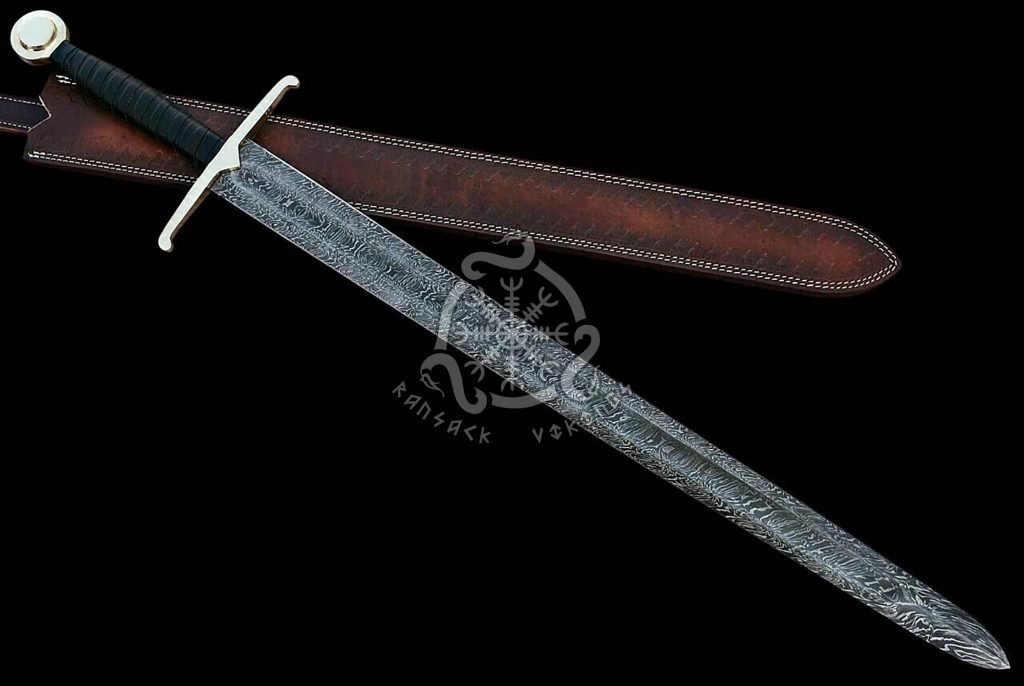
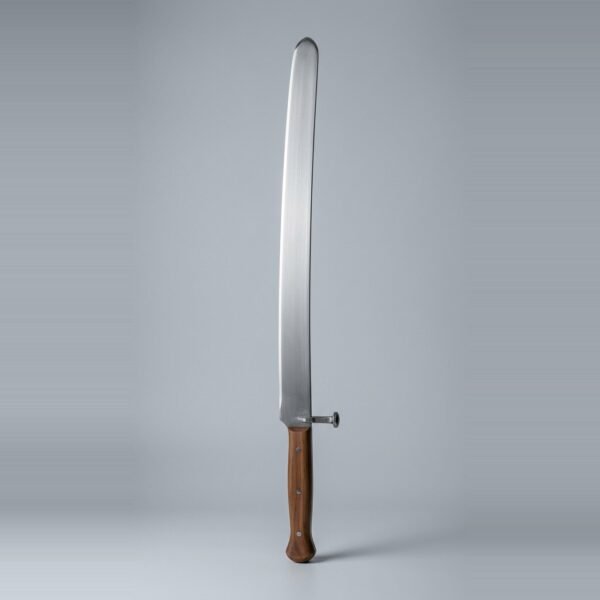
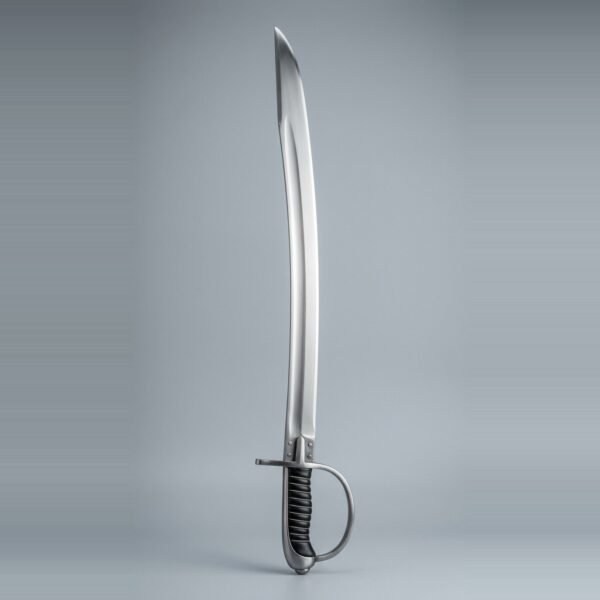
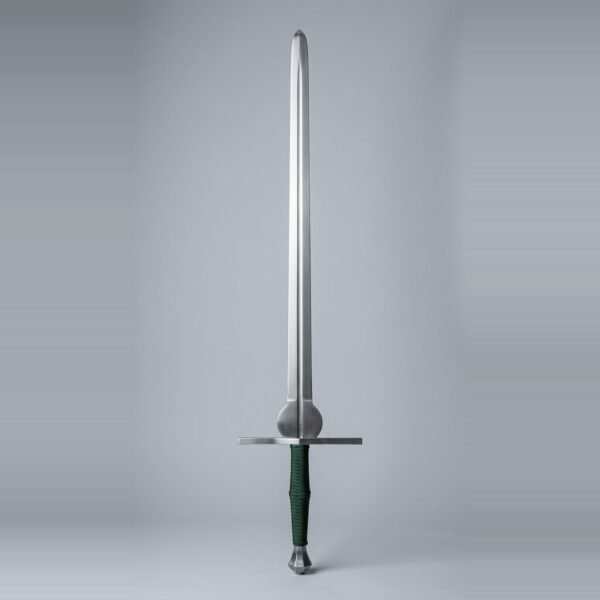
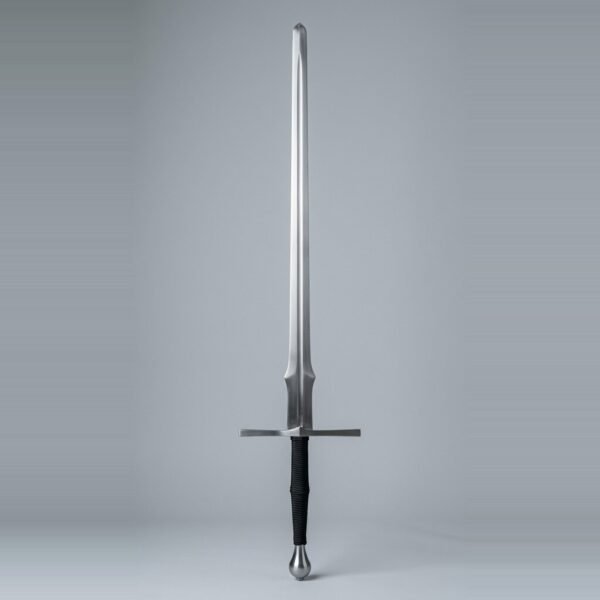
The Vindlaur is a feder, the purpose built training longsword of the German tradition, made in 51CrV4 spring steel. Above the cross the blade widens into a rounded schilt and then runs out as a long unfullered blade that narrows through the middle and ends blunted. The pommel is a scent stopper form, the grip is wrapped in dark green cord for two hands, built from the start to be hit rather than to cut.
A feder is not a blunted sword. It is its own object with its own geometry, and the fencers who used it knew that. Joachim Meyer illustrated them throughout his 1570 book, and the shape survived in German fencing schools long afterwards. The blade is thin through the middle so it will bow on a thrust, thick at the schilt so the hands are protected in the bind, and shaped so that a crossing feels close enough to a sharp sword to be worth practising with.
If you are buying your first one, read what a feder is and our explanation of sword flex, then compare across the feders. Schilt shape, flex tier and tip treatment are the three things that decide whether a feder suits your club, and they vary from piece to piece across that group.
Specifications
Every length is given as about, because this is ground and fitted by hand. We do not publish a weight or a point of balance, because we will not print a number we have not taken.
| Material | 51CrV4 spring steel, hardened to 49 to 52 HRC |
|---|
| Overall length | About 50 inches, hand made so it varies a little piece to piece |
|---|
| Blade length | About 39 inches |
|---|
| Blade type | Feder blade, no fuller, rounded schilt above the cross, narrowing through the middle |
|---|
| Edge | Blunted flat land, about 2 mm or more across, not sharpened |
|---|
| Tip | Blunted and turned over, measure it against your ruleset before an event |
|---|
| Guard | Straight steel cross with the schilt standing above it |
|---|
| Pommel | Scent stopper form, seated and peened over the tang |
|---|
| Grip | Dark green cord over a full tang, two hand length |
|---|
| Flex | Medium tier, the bow runs through the middle of the blade |
|---|
| Included | The feder only. No scabbard |
|---|
| SKU | RK-3007 |
|---|
What the schilt does and why a feder is not a blunt sword
The schilt is the widened section of blade sitting just above the cross, and it is the feature that defines the type. It does two jobs. It protects the hands, because in a bind the other blade slides down yours and stops somewhere, and you would rather that was a flared shoulder of steel than your fingers. It also puts mass and stiffness exactly where a sword needs it, so the ricasso area stays rigid while the rest of the blade is free to be thin and light.
That combination is what lets a feder be safe and still fence like a sword. A blunted sharp has its mass spread through the whole blade and no schilt, so it is stiff where you want flex and offers the hands nothing in a hard crossing. A feder concentrates the steel behind the cross and takes it out of the middle. The result crosses at the same measures and winds the same way, while bending on a thrust instead of driving the whole force into a mask.
Flex tiers, the tip rule and how to choose
This is 51CrV4 spring steel hardened to 49 to 52 HRC. Spring steel is chosen because it bends and returns instead of taking a set or snapping under a hard bind. The 1095 high carbon at 54 to 58 HRC we use for cutting swords is far too hard for this job. A feder that will not flex is not a safe feder, and a blade that takes a permanent set after a season is not one either.
Flex is sold in tiers and it is worth knowing them before you buy anything. Light sits around 15 to 21 lb, medium around 25 to 29 lb, strong or tournament around 30 to 43 lb, and a stiff blade with effectively no flex is for harnischfechten in armour. This one is a medium tier feder, which is the tier most clubs default to, because it bows visibly on a committed thrust without feeling limp in the bind. Light feders are gentler and less like a sword. Tournament feders are stiffer and less forgiving.
The tip is the other thing to check, and it is the rule people get caught by. The Berlin HEMA Cup gear requirements ask for spatulated or rolled tips with a minimum diameter of 1.5 cm. The point on this feder is blunted and turned over rather than flared into a wide spatula, so measure it against the rules for your event before you travel, and expect that many organisers will want a wider tip or a fitted rubber blunt on top.
Engraving, runes and your own design
Use the rune converter on this page to turn a name, a date or a short phrase into Elder Futhark and we will cut it into the steel or the grip. The schilt is the natural place for a short mark on a feder, the flat below it takes a rune line, and the scent stopper pommel will hold a single symbol. Text and runes are $19, a symbol is $39 and a family crest is $49, all cut in the United States after the piece has landed and been inspected.
If you would rather have your own design than a rune line, choose your own design in the engraving option above the add to cart button and tell us where it goes. Where a piece already carries an engraved design, your chosen engraving replaces it rather than sitting alongside it. More on the engraving page.
Handling and balance
No weight and no point of balance from us. Nothing in the photographs carries a scale, these are ground by hand, and a printed number would be a guess. What is honest to say is that a feder of this pattern puts more of its steel behind the cross than a sharp sword does, so it feels lively at the point and settled at the hands, which is the feel the type was made for.
The two hand cord grip is long enough to work the pommel hand properly, and that is where a lot of longsword technique actually lives. Winden, the change through the bind and the strong displacement all come from the lever between the two hands, and a grip that is too short costs you all of it. Dark green cord bites when wet and tells you where the edge is pointing by feel, which is exactly what you want in a crossing you are not looking at.
Care
Spring steel rusts. Wipe the blade at the end of the session and oil it thinly before it goes away, keeping the oil off the cord. Salt from the hands starts the pitting, and it works overnight in a closed bag.
Feders take more punishment than any other sword in a club and want checking accordingly. Look at the schilt shoulders and the peen on the pommel for movement, sight along the blade for a set that has not returned, and file off the burrs that hard binds raise along the blunt land. If a feder has taken a permanent bend and will not come back, retire it rather than straightening it cold. The routine is in the care guide.
Made in the Czech Republic
Made by hand in the Czech Republic and imported by Ransack Viking. Nothing here is drop shipped out of an importer catalogue straight to a customer. Every one is checked for hilt tightness, pommel seating and blade straightness at our North Babylon, New York warehouse, and ships from there. Shipping in the United States is free, returns run for seven days, and the lifetime warranty against defects in the forging, the grind, the heat treat and the fittings has no end date and needs no receipt.
We do not name the workshop and we do not print a town on the box. The same hands make the whole run, the blades reach us in batches rather than by the container, and anything that turns up with a loose hilt or a bend in it goes back. More on the country of origin page.
A note on handmade variation
This is hand forged. It is not machine made, not cast and not bulk produced, so what arrives will not be a pixel for pixel copy of the photograph on this page. The schilt is ground and blended by hand, so its exact curve differs a little between pieces, and the cord wrap is laid to feel rather than to a fixed count of turns.
Grain in the wood, the turn of a finial and the shade of the cord all move a little from piece to piece, and lengths are given as about because a hand made blade is ground to a shape rather than to a tolerance band. None of that is a defect. What is covered, for as long as you own it, is a failure in the forging, the grind, the heat treat or the fittings.
Frequently asked questions
The difference between a feder and a blunt longsword
A feder has a schilt, a thin flexible middle and a stiff ricasso. A blunt sword has none of that. Many tournaments accept only feders precisely because of it.
Whether this feder is tournament legal
Read the ruleset for your event before you buy on that basis. Many events want a spatulated or rolled tip of at least 1.5 cm, and this point is blunted and turned over rather than flared.
Which flex tier this one is
Medium tier. That is the usual club choice, stiff enough to feel like a sword in the bind and soft enough to bow on a committed thrust rather than transmit the whole force.
Whether beginners should start on a feder
Most clubs say yes, once the basics are in. A feder is the safest steel longsword for sparring and it teaches the bind honestly, which a nylon trainer only partly does.
Whether a scabbard is included
No. Feders do not take scabbards and nothing in the HEMA range ships with one. You get the feder, oiled and wrapped.
Whether it can be engraved
Yes. Runes, a name, a date or your own design, cut in the United States after the piece arrives and is inspected. Text and runes are $19, a symbol is $39, a family crest is $49.
What is in the box
- The Vindlaur feder training sword, one piece, full tang.
- A light film of protective oil on the blade for the journey.
- A printed care and storage card with the wipe down routine.
- Your lifetime warranty record against defects in the forging, grind and fittings.
Explore the range
Compare across the feders, look at the blunt longswords if your club does not run tournament rules, drop to the arming swords for single handed work, or browse the HEMA sword hub. Start at the guides if you are undecided.
Near neighbours in the shop
Its closest neighbours on the rack are Brimhalt feder, about 50 inches overall, Vandrekt feder, about 49 inches overall, Ravnstad feder, about 48 inches overall and Drakvend longsword, about 49 inches overall.
The feder category and the HEMA sword hub hold the remainder, and you can order a one off on the custom sword builder.







Reviews
There are no reviews yet