Blog
How to Choose Your First HEMA Sword

Your first HEMA sword is the purchase most people get wrong, usually by buying it far too early. The single most useful thing anybody can tell you about it is that your club will decide for you, and that the sooner you ask the fewer mistakes you make.
Still, somebody has to buy the thing, and a shop that refuses to give an opinion is not being helpful, it is being careful. So this is the opinion. It covers what to buy first, what the discipline you have joined demands, what the specs on a listing mean in practice, and which claims should make you close the tab.
If you do not yet know what any of this is, start with what HEMA is. If you already know you are buying for longsword, what a feder is is the more specific read. The whole range sits under HEMA swords.
Rule one: ask the club before you buy
Clubs have accepted gear lists, and they are not suggestions. Some will not let a blunt longsword into free play. Some require a particular flex tier. Some have a loan rack and would rather you used it for six months. Instructors have watched a lot of people buy the wrong sword and they will tell you exactly what to get if you ask.
The second reason to wait is that your preferences will change. Nobody knows after three sessions whether they want a stiff tournament blade or something softer for drilling, because nobody has felt the difference yet. Six months of loan gear answers that question for free.
Rule two: the sword is usually the last purchase
The normal order is mask, gloves, jacket, then gorget and limb protection, then steel. A sword you cannot spar with because you have no mask is a very expensive ornament. Most clubs will not put you in free play without full kit regardless of what you are holding.
The exception is a nylon trainer. They are cheap, they are accepted for drilling almost everywhere, and they let you get your hands on a longsword shape months before you commit to steel. If your club is happy with one, buy that first and buy steel later.
Rule three: buy for the discipline you actually train
This sounds obvious and it is the most common expensive error. People buy the sword they think looks best, then discover their club runs Bolognese sidesword on the night they can attend.
If you train longsword
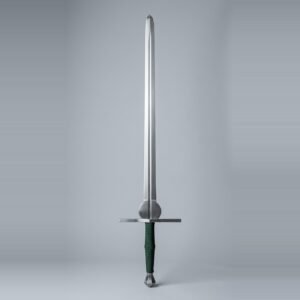
Buy a feder. Standard flex, standard schilt, nothing decorative. Longsword is the largest discipline and the feder is its tool. A blunt longsword is a legitimate purchase for drilling and reenactment, but many longsword tournaments ban blunts outright and accept only purpose built feders or sword shaped feders, so if competition is anywhere in your plans the feder is the safer money.
If you train messer or dussack
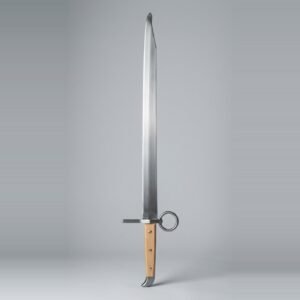
Buy a langes messer with a proper nagel. The construction matters: a flat tang sandwiched between two scales and riveted, not a through tang with a peened pommel. Messer blades run roughly 45 to 90 cm and the family overlaps messily with grosses messer, so do not agonise over the label. Kriegsmesser is the genuinely separate one because it is two handed.
If you train rapier or sidesword
Length and fit matter more here than anywhere else. The period rule is that with the point resting on the floor the quillons sit at your navel. Rapier blades average around 104 cm with Italian examples running far longer, and historical mass sits around 1 kg. A sidesword is shorter and broader and cuts properly, which makes it the friendlier first purchase for anybody who also wants to do cutting drills.
If you train sabre or smallsword
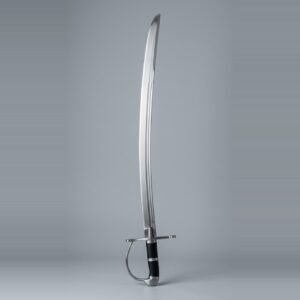
The most fragmented corner of the art, with military patterns, Italian sabre, szabla, duelling sabre, spadroon and smallsword all going their own way. Ask which manual your club works from and buy to that, because a Radaelli sabre and a Pattern 1796 trainer are not interchangeable in feel. Smallsword is also the one discipline where an ornate hilt is period correct rather than a red flag.
Rule four: read the spec sheet properly
A HEMA listing that does not publish numbers is telling you the seller does not expect an informed buyer. Here is what each figure is actually for.
Blade length and total length
These set your measure, which is the distance at which the fight happens. A longer blade is not better. It is different, and in a small training hall it is worse.
Weight and point of balance
Weight alone tells you almost nothing. A 1400 g sword with the balance 6 cm from the cross feels quicker than a 1250 g sword balanced 12 cm out. Point of balance is the number that predicts how a sword feels in the hand, and it is the one most sellers omit.
Flex
The safety property. Light sits around 15 to 21 lb, medium around 25 to 29 lb, strong or tournament runs 30 to 43 lb and upward, and stiff or minimal flex is for harnischfechten and buhurt. Higher numbers mean stiffer blades, which trips up nearly everybody the first time. Full explanation in the flex guide.
Tip and edge
A training blade should have a widened blunt tip and a flat edge land of roughly 2 to 3.5 mm that catches the light as a visible stripe. If the edge looks like a line rather than a stripe, it is sharp. That difference is covered in blunt against sharp training swords.
Steel
Spring steel: 51CrV4, 6150, 9260 or 1095, typically 49 to 52 HRC. Softer than a cutting blade on purpose, so it bends and returns instead of taking a set or snapping. The steel glossary has the longer version, including what the hardness numbers mean and why a sparring blade is deliberately kept below them.
Rule five: know the warning signs
Stainless steel is the loudest one. It is used on decorative swords because it never needs oiling, and it is too hard and brittle to be hit repeatedly. A stainless training sword is a wall piece with the wrong label on it. The same goes for a rat tail tang, cast furniture, chrome plating and an etched fake damascus pattern.
Fantasy ornament is the second sign. Gemstones in the pommel, dragon head finials, spikes, a leather thong hanging off the pommel. Training gear is plain because plain survives contact and because anything glued on becomes a projectile. The single exception is the smallsword, where decoration is genuinely historical.
The third is any listing that claims tournament legality without naming the ruleset. Tournament legal on its own is a marketing phrase. Berlin HEMA Cup, for instance, permits spatulated or rolled tips at a minimum diameter of 1.5 cm, does not allow rounded tips on rapier and sabre, requires a clearly distinguishable edge, back and flats on longsword blades, and supplies its own tip caps. That is a specific document you can read. Detail sits in the tournament gear guide.
The fourth is subtle and worth knowing anyway. If the product photograph crops the tip out of frame, the seller probably does not own the piece. The tip is the part the rules care about most.
Rule six: budget over eighteen months, not over one evening
A student who trains regularly spends across the first year and a half, with the mask and gloves early, the jacket next, and steel typically arriving around month twelve. That spread is worth planning because it changes what you buy first.
The other budget factor is lead time. Several of the best known HEMA makers quote three to five months, some are longer, and at least one well regarded workshop has stopped producing entirely. In this market, something on a shelf is worth more than something better on a waiting list, particularly for a first sword you want to be training with this season rather than next.
Rule seven: buy one good piece, not three cheap ones
The cheapest steel sword you can find will be too stiff, badly balanced, poorly finished at the tip and made of something nobody will name. It will also be the sword your instructor quietly asks you not to spar with. Buying one properly made piece once is less expensive than buying twice.
Then mark it. Club racks are full of identical blades and a short line engraved on the ricasso ends the confusion permanently. Name, date or Elder Futhark, cut in the United States after the piece arrives, explained on the engraving page.
Where to see these
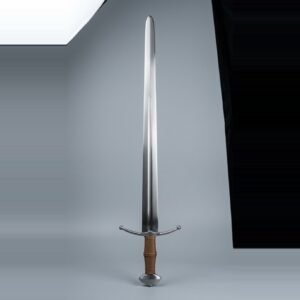
For longsword, the Vindlaur feder is the plain standard shape with a rounded schilt and nothing decorative on it. For anyone starting single handed, the Mirlaug arming sword is a broad fullered blunt with a simple cruciform hilt. The Brenvald langes messer shows the nagel and riveted scale construction that defines the messer family, and the Kaldrast sabre trainer covers the curved single edged side. Wider ranges are under feders, HEMA arming swords and HEMA messers.
First sword questions
What is the best first HEMA sword?
For longsword, a standard flex feder with a plain schilt. For anything single handed, a blunt arming sword or a langes messer depending on which system your club teaches. In every case, ask the instructor before you order.
Should I buy nylon or steel first?
Nylon if your club accepts it, because it is cheaper, safer to learn with and accepted for drilling almost everywhere. Steel when your control is good enough that the club will put you in free play with it.
How do I know what size to buy?
For longsword, a 100 cm blade suits most adults and shorter blades exist for smaller fencers and low ceilings. For rapier, rest the point on the floor and check the quillons sit around your navel. For messer and sabre, grip fit matters more than blade length.
Is a blunt longsword acceptable for tournaments?
Often not. Many longsword events ban blunts and allow only purpose built feders or sword shaped feders. Read the gear document for the specific competition rather than trusting a product description.
Why are HEMA swords more expensive than decorative ones?
Because they are made to be hit. Spring steel at a controlled hardness, a properly ground blunt edge land, a tip shaped to a rules specification and a hilt that stays tight under repeated impact all cost money. Decorative swords skip every one of those.
Can I use one sword for sparring and for cutting?
No. A sparring blade is blunt and flexible at 49 to 52 HRC. A cutting blade is sharp and stiffer at 54 to 58 HRC. Using either for the other job is unsafe and ruins the blade.
How long will my first sword last?
Years of normal club use with basic care. Wipe it down after training, keep a thin film of oil on the steel, check the hilt for movement and file off burrs before they become cracks.
Do I need left handed stock?
For most double edged types, no. For messers and sabres with an asymmetric nagel or knuckle bow it can matter, and left handed options are thin across the whole market. Ask before ordering rather than after.
Once you have picked a type, the two follow up reads are the feder guide and the flex guide. Everything else this shop has written is listed in guides.