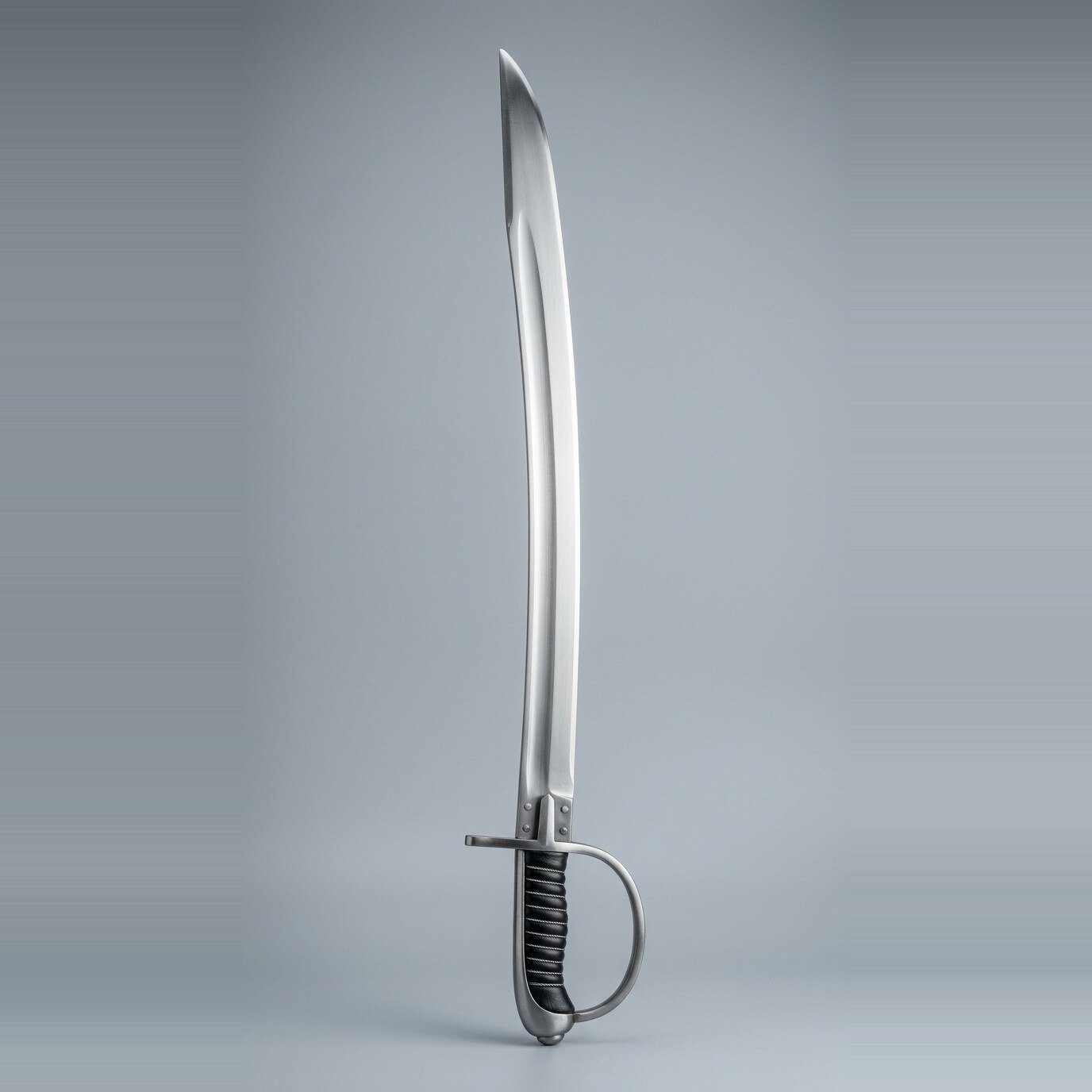
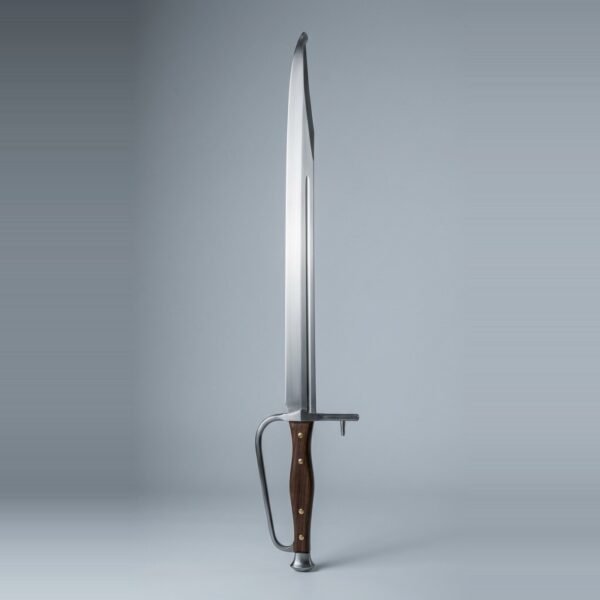
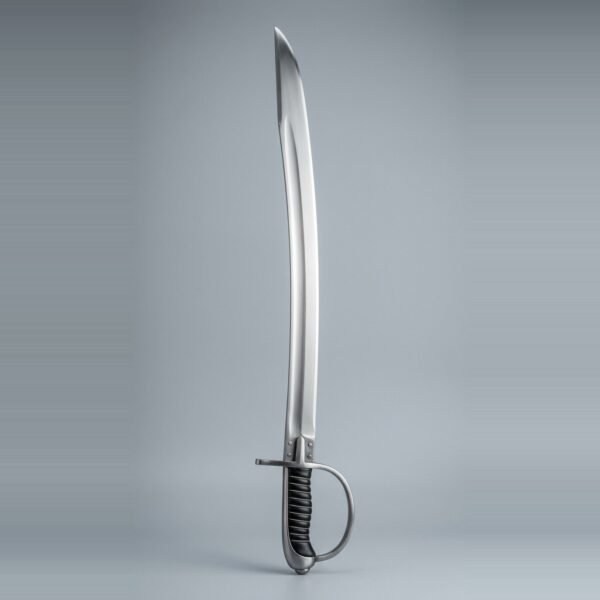
The Kjeldhar is the plainest sabre we make. One quillon runs out on one side of the hilt, one D shaped knuckle bow sweeps from the quillon block down to the backstrap, and that is the whole guard. No side bars, no shell, no basket. This is the stirrup hilt, named for the shape the bow makes, and it is the pattern that armed more light cavalry across Europe than any other single design.
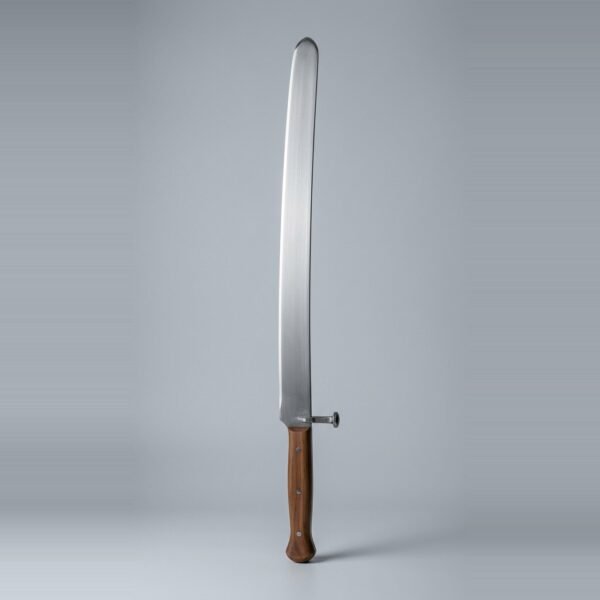
The blade is curved and single edged, with a fuller that begins at the hilt and runs out well before the point. Where the blade meets the guard there is a steel plate riveted through the root, which takes the load off the shoulder of the blade and stops the hilt working loose under repeated shock. It is a small detail and it is the reason these hilts survived hard service.
This is a blunt trainer with a rolled safety tip. Before you buy, read the HEMA sabre guide for how the form is fenced, and blunt versus sharp training swords if you are weighing this against a cutting sabre. The rest of the curved steel sits in HEMA sabres. The practice dussack belongs in the same single edged family and is covered in the dussack guide.
Specifications
Read these as the proportions of the piece. It is hand work, so the figures are close rather than exact.
| Material | 51CrV4 spring steel, hardened to 49 to 52 HRC |
|---|
| Overall length | About 36 inches, hand made so it varies a little piece to piece |
|---|
| Blade length | About 30 inches |
|---|
| Blade type | Curved and single edged, fuller from the hilt that stops well short of the point |
|---|
| Edge | Blunted, about 2.5 mm flat land, not sharpened |
|---|
| Tip | Rolled and flared, about 15 mm across |
|---|
| Guard | Stirrup hilt, one D shaped knuckle bow and one straight quillon |
|---|
| Pommel | Backstrap cap carried down the spine of the grip |
|---|
| Grip | Wire bound over leather, single handed, riveted plate at the blade root |
|---|
| Flex | Light tier |
|---|
| Included | Cloth wrap and a care card, no scabbard |
|---|
| SKU | RK-3040 |
|---|
Stirrup hilt sabres and the drill they were built for
A stirrup hilt is the least metal you can put around a hand and still call it protected. One bar from the quillon block to the backstrap, one quillon to stop a blade running down the other side, and nothing else. It was cheap to make, light on a tired arm and quick out of a scabbard from the saddle, which is why light cavalry across Europe carried this pattern for the best part of a century.
That economy has a consequence for practice. The hand is open on the inside, so the sabre systems that go with this hilt are built around covering with the blade rather than trusting the guard. The parries are taken high and forward, the point stays live, and the whole body of work rewards a fencer who keeps the opponent’s blade out rather than letting it in and relying on steel around the fingers.
In modern clubs this is the shape used for cavalry drill, for single stick work translated back onto steel, and for the nineteenth century military sabre curriculum. It is worth saying that nothing on this hilt is a messer feature. There is no nagel through the tang and there are no slab scales riveted to the sides of the grip. The grip is wrapped, the guard is forged and fitted, and the family it belongs to is the sabre, not the long knife.
One quillon, one bow and what the steel has to do
The blade is 51CrV4 spring steel hardened to 49 to 52 HRC. Every blunt in this line uses it because spring steel bends and returns instead of taking a set or snapping under a hard bind. On a sabre with an open hilt that property matters twice over, because more of the incoming force is taken on the blade rather than distributed into a cage of bars.
The curve is shallow. It puts the cutting section ahead of the hand for a draw cut while keeping the point low enough that the thrust stays available, which is the compromise most service patterns settled on. A deeper curve would cut better and thrust worse, and this one is not trying to be a shamshir.
The fuller starts at the hilt and stops well short of the point. That leaves the last stretch of blade solid, which stiffens the forward section, steadies the point through a cut and keeps the tip from whipping when the blade is thrown out at speed. It also pushes the flex back into the middle of the blade, which is where you want it on a trainer.
The tip is rolled and flared to about 15 mm across. The Berlin HEMA Cup gear requirements ask for spatulated or rolled tips of at least 1.5 cm in diameter and do not accept merely rounded tips on rapier and sabre, so that dimension is not arbitrary. Flex is in the light tier, which is the usual place for sabre. We give the tier rather than a number because we do not test each blade on a scale.
Engraving, runes and your own design
Use the rune converter on this page to turn a name, a date or a short phrase into Elder Futhark and we will cut it into the steel or the grip. On this hilt the flat of the blade just forward of the guard is the obvious place for a rune line, and the backstrap will take a short symbol if you want the blade left plain.
If you would rather have your own design than a rune line, choose your own design in the engraving option above the add to cart button and tell us where it goes. Where a piece already carries an engraved design, your chosen engraving replaces it rather than sitting alongside it. More on the engraving page.
Handling and balance
With so little metal in the guard, this is the lightest sabre in the line and the quickest on the point. The weight that is there sits behind the hand in the backstrap and the pommel cap, so the blade comes back on line fast and the moulinet turns with very little effort from the wrist.
That lightness is also a warning. An open stirrup hilt gives your knuckles and the inside of your hand no cover at all, so gloves are not optional here even for slow drill. A hit that a three bar hilt would have shrugged off will land on your fingers with this one.
The grip sets the thumb up the backstrap, with the last two fingers doing most of the holding. Keep the front of the hand loose. If you squeeze with the whole fist the blade stops rotating cleanly and every cut arrives flat. We do not publish a weight or a point of balance, because there is no scale in the photograph and every piece is finished by hand.
Care
51CrV4 is not stainless and the blade is bare. Wipe it down after every session and keep a light film of oil on the steel. Mineral oil or a light gun oil is enough, and it takes under a minute.
The riveted plate at the blade root is the spot that needs a second look. Water sits under the plate where it meets the shoulder of the blade and a cloth will not reach it. Work oil into that junction and the quillon block, and check the rivets for movement once or twice a year.
The wire binding over leather wears with use. Look for lifted wire ends and loose turns before each session, because a lifted end will cut a glove. Let the grip dry after use rather than sealing it in a bag, and treat the leather once or twice a year with a leather balm. The full method is in the knife care guide.
Made in the Czech Republic
Made by hand in the Czech Republic and imported by Ransack Viking. Nothing here is drop shipped out of an importer catalogue straight to a customer. Every one is checked for hilt tightness, pommel seating and blade straightness at our North Babylon, New York warehouse, and ships from there. Shipping in the United States is free, returns run for seven days, and the lifetime warranty against defects in the forging, the grind, the heat treat and the fittings has no end date and needs no receipt.
A note on handmade variation
This is hand forged. It is not machine made, not cast and not bulk produced, so what arrives will not be a pixel for pixel copy of the photograph on this page. The knuckle bow is bent by hand, so the sweep of the D and the gap between the bow and the grip are a little different on every piece. The curve of the blade is set on the anvil and is close rather than mathematical. The wire binding is wound by hand and its pitch varies along the grip. None of that is a fault and none of it changes how the sabre fences.
Frequently asked questions
Whether this sabre is sharp
No. It is a blunt trainer with a flat edge land of about 2.5 mm and a rolled, flared tip. It is not a cutting sabre and we will not sharpen it on request.
What a stirrup hilt actually is
One D shaped knuckle bow running from the quillon block to the backstrap, plus a single quillon on the other side. It is the simplest guard on any sabre pattern and it leaves the inside of the hand open.
Why the fuller does not reach the point
Stopping it short leaves the forward section solid, which stiffens the blade near the tip, steadies the point through a cut and moves the flex back into the middle.
Whether it has a nagel or scales
No to both. Those belong to the messer and dussack family. This is a sabre with a forged guard and a wire over leather grip.
Whether a scabbard is included
No. Nothing in this line ships with a scabbard. It arrives wrapped for transit with a care card in the box.
Whether it can be engraved
Yes. Runes, your own text or your own design, cut in the United States after the piece lands here. Text and runes are $19, a symbol is $39 and a family crest is $49.
What is in the box
- One Kjeldhar sabre trainer, hand made in the Czech Republic.
- A cloth wrap for transit.
- A care and storage card.
- Your warranty and returns information.
Explore the range
The rest of the curved steel is in HEMA sabres, the wider catalogue of the same family is in sabres, the whole training line is in HEMA swords and the thrusting blades are in HEMA rapiers. Every guide we have written sits in the guides hub.
Compare it with these
Worth setting next to this one: Sturvang three bar sabre, about 37 inches overall, Reifholm leather dussack, about 26 inches overall, Kaldrast hanger sabre, about 36 inches overall, Brenvald langes messer, about 37 inches overall and Lindmoor smallsword, about 39 inches overall.
Look through the HEMA sabre category and the HEMA sword hub for the rest, then try the custom sword builder if you want something specific.








Reviews
There are no reviews yet