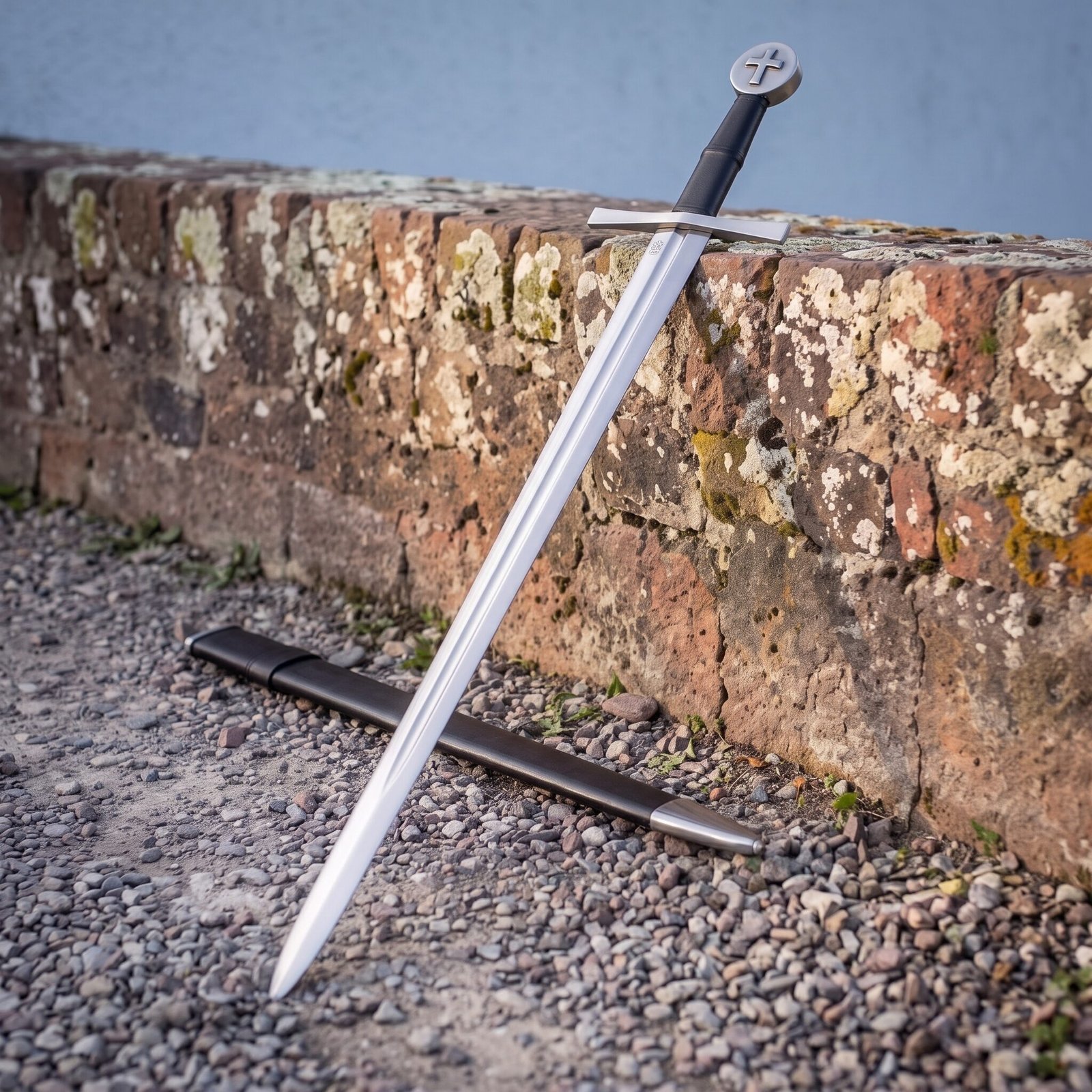
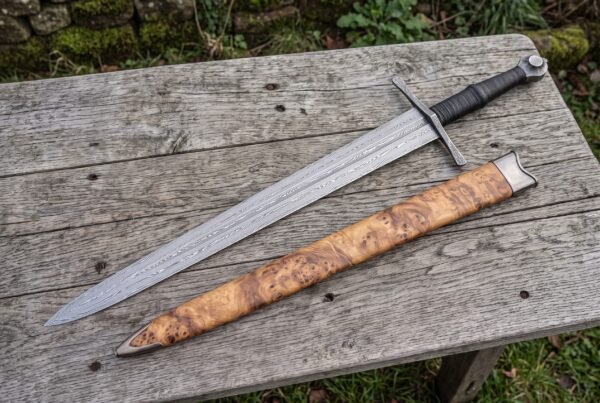
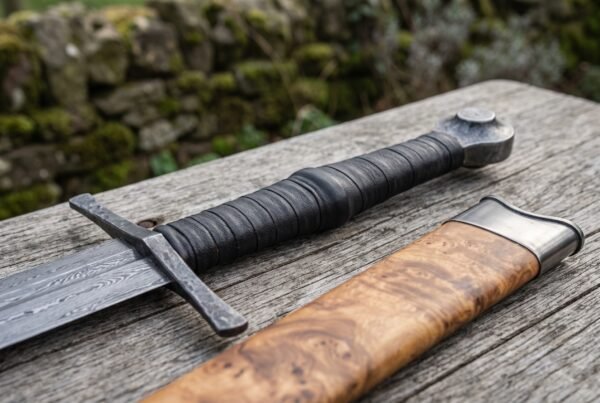
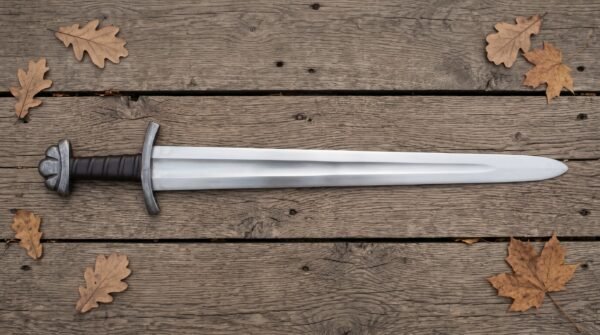
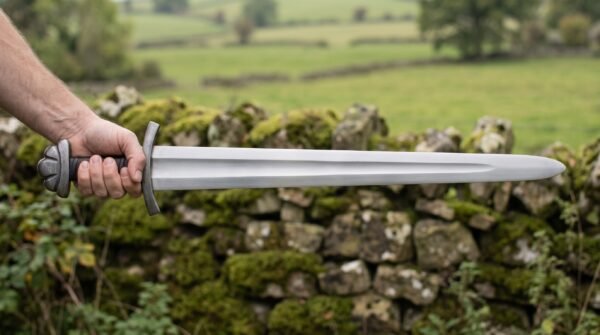
A forty inch knightly sword built around the look of the Teutonic Order: a long straight blade, a plain bar of a cross guard, a black leather grip and a flat wheel pommel with a cross raised on its face. Nothing on it is there to show off. The Order wore a black cross on white and kept its gear severe, and this sword follows the same line. The interest is in the proportions and in the one piece of decoration it allows itself, which sits right where your hand would rest at the top of the grip.
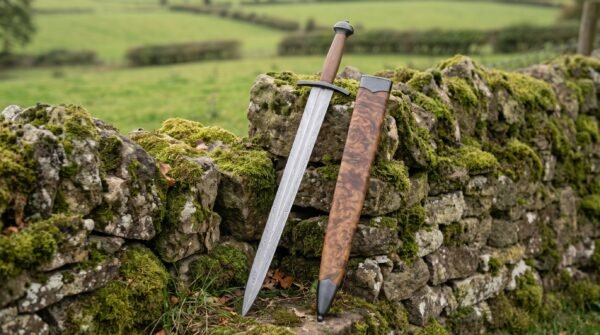
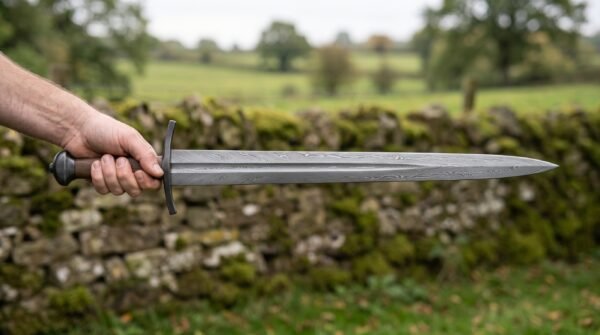
The blade is 1095 high carbon steel, hand forged and hardened to 54 to 58 HRC, with a single fuller down the centre and an even taper to the point. The guard is a straight steel bar with square cut ends. The grip is black leather over a wooden core, and the pommel is peened over the tang so the whole hilt is held tight by the steel itself rather than by glue or a screw. It comes with a fitted black leather scabbard with a steel chape.
If this is your first proper sword, how to buy your first sword is worth ten minutes before you choose. The difference between a wall piece and a cutting sword is set out plainly in display sword vs battle ready, and the rest of the knightly blades are in arming swords.
Specifications
| Blade steel | 1095 high carbon steel, hand forged |
|---|
| Hardness | 54 to 58 HRC |
|---|
| Overall length | Approximately 40 inches |
|---|
| Blade length | Approximately 32 inches |
|---|
| Blade | Straight, double edged, single central fuller, tapering point |
|---|
| Guard | Straight steel cross guard with square cut ends |
|---|
| Grip | Black leather over a wooden core, single hand |
|---|
| Pommel | Steel wheel pommel with a raised cross on the face, peened over the tang |
|---|
| Scabbard | Black leather with a steel chape, included |
|---|
| Edge | Finished edge, not honed to shaving sharpness |
|---|
| Type | Collector, display and reenactment display piece |
|---|
| SKU | RK-2211 |
|---|
Who the Teutonic Knights were
The Order started life as a field hospital. German pilgrims and crusaders set it up at the siege of Acre around 1190 to look after their own sick and wounded, and within a few years it had been turned into a military order on the model of the Templars and the Hospitallers. The brothers took vows, lived under a rule, and wore a white mantle with a black cross.
What makes the Teutonic Knights different from the other two big orders is where they ended up. The Holy Land was never their strongest ground. Through the thirteenth century their weight shifted north and east, to Prussia and the Baltic, where they fought long campaigns against the pagan Prussians and Lithuanians and built a state of their own out of the conquered land. Their headquarters moved to the great brick castle at Marienburg, now Malbork in Poland, in 1309. A hundred years later the Order lost badly to a Polish and Lithuanian army at Grunwald in 1410, and it never quite recovered its old reach.
So when people say Teutonic sword, they usually mean a knightly sword of the thirteenth and fourteenth centuries as carried by a brother of the Order. There was no special Teutonic pattern. The brothers used the same kind of sword every other knight in Christendom used, which is what this one is.
Reading the shape of the sword
Swords of this period sort into families by blade shape, and the useful thing to notice here is the taper. The blade is broad at the guard and narrows steadily to a point that is still strong enough to thrust with. That gives you a sword that cuts well near the middle of the blade and can still drive a point, which is about what a mounted or dismounted knight of the time would want from one weapon.
The fuller is the shallow channel down the middle. It is not a blood groove, whatever the films say. It takes metal out of the centre of the blade where it does least work and leaves it at the edges and the spine, so the sword gets lighter without getting floppy. On a blade this long that matters, because a thirty two inch blade with no fuller would feel like it was trying to pull your wrist toward the floor.
The wheel pommel is a counterweight. Its mass sits behind your hand, so it pulls the balance point back up the blade toward the guard. A sword that balances a few inches in front of the guard comes round quickly and stops where you mean it to. One that balances halfway down the blade is tiring to hold out straight for more than a few seconds.
The cross on the pommel
The cross on the face of the wheel is the one piece of decoration on this sword. It is raised slightly above the surface of the pommel so it catches light at an angle, and it is plain on purpose. A pommel is the part of a sword most likely to get gripped, knocked and rubbed against a belt, and fine detail there wears down quickly. A simple raised cross keeps its shape.
Crosses and religious marks on pommels and blades turn up again and again on medieval swords, sometimes as inlaid letters, sometimes as small struck marks, sometimes cut into the face of the pommel. We have kept it to one clear symbol and left the rest of the steel bare.
1095 steel and the fittings
1095 is a plain high carbon steel with roughly ninety five hundredths of one percent carbon in it. It has no chromium to speak of, which means it will rust if you neglect it, and in exchange it takes a clean heat treatment and holds a good edge. At 54 to 58 HRC it is hard enough to hold its shape and soft enough not to snap if it is knocked. Long blades are usually left at the softer end of what a steel can take for exactly that reason. If you want the longer version, the steel glossary explains the numbers.
The guard and pommel are plain steel with a brushed finish. The grip is black leather wrapped over a shaped wooden core and closed neatly at each end. The tang runs right through the grip and is peened over the top of the pommel, which is the old way of holding a hilt together.
Engraving, runes and your own design
Use the rune converter on this page to turn a name, a date or a short phrase into Elder Futhark and we will cut it into the steel. If you would rather have a different pattern than a rune line, choose your own design in the engraving option above the add to cart button and tell us where it goes. Where a piece already carries an engraved design, your chosen engraving replaces it rather than sitting alongside it. On this sword the usual place for a name is the flat of the blade just below the guard, on one side or both. There is more detail on the engraving page.
Handling and display
This is a collector and display sword, and a reenactment display piece for a costume or a stand. It arrives with a finished edge that is not honed to shaving sharpness. It is not built or sold for sparring or for cutting practice, and it should not be used for either.
On a wall, hang it horizontally on two hooks set under the guard and toward the end of the blade, or at a slight angle with the hilt high. Keep it out of direct sun over a long period, which dries the leather, and away from a bathroom or a kitchen, where the steam will find the steel. How to display swords and axes on a wall safely covers fixings, heights and the usual mistakes.
The scabbard is meant to protect the blade in storage and to finish the look in costume. Slide the sword in and out along the line of the scabbard rather than at an angle, and the throat will stay tight for years.
Care
Wipe the blade after handling. Skin leaves salt and moisture on steel, and 1095 will show a fingerprint as a brown mark within a week in a damp house. A soft cloth with a few drops of light machine oil or mineral oil, run down both faces, is all it needs. Do it every couple of months on the wall and after any time you have held it.
If you do find a spot of light rust, take it off with oil on a fine nylon pad rather than wire wool, which scratches the finish. Then oil the area well.
Feed the leather grip and scabbard with a leather conditioner once or twice a year. Do not store the sword in its scabbard for months on end in a damp room, because leather holds moisture against the steel. More on looking after high carbon blades is in the care guide.
Made in the Czech Republic
This sword is made by hand in the Czech Republic, in a small workshop that forges, grinds, hardens and fits each sword in short runs. It is not drop shipped from a catalogue somewhere and it is not stock we have never seen. Ransack Viking brings the swords in, checks every one for a tight hilt, a straight blade and a properly fitting scabbard, and keeps them in our Chicago, Illinois warehouse until they sell. Processing takes one to two weeks, a little longer when there is engraving to lay out and approve with you first. Shipping within the United States is free, returns are open for seven days, and the lifetime warranty against defects in forging, grind, heat treat and fittings has no end date and needs no receipt.
A note on handmade variation
This sword is made by hand, not machine made or bulk produced, so what arrives will not be a pixel for pixel copy of the photograph. The cross on the pommel will stand a fraction higher or lower. The ends of the guard are cut and dressed by hand and will not be identical to the ones shown. Leather is a natural material, so the black of the grip and the scabbard can carry a slightly warmer or cooler tone from batch to batch. Polish lines and the exact run of the fuller vary. The length, the steel, the heat treat and the build are the same every time. The character is not.
Frequently asked questions
Is this an original Teutonic Order pattern
No sword survives that we could call the official Teutonic pattern, because there was not one. This is a knightly sword in the style the brothers would have carried in the thirteenth and fourteenth centuries, with a cross on the pommel as a nod to the Order. It is our own design, not a copy of a museum piece.
Is it sharp
It arrives with a finished edge that is not honed to shaving sharpness. It is a display and collector piece. Treat it with the same care you would give any long blade, and keep it away from children.
Can I use it for sparring or cutting
No. It is not built, tested or sold for contact or for test cutting. If you want a sword for training, look at the blunt trainers in the HEMA swords range.
Is the scabbard included
Yes. A black leather scabbard with a steel chape comes with the sword.
Why does it ship oversized
Anything forty inches and longer goes in an oversized box so the blade and scabbard travel flat and protected. It does not change the price of shipping to you, which is free within the United States.
Can I have a name engraved on it
Yes. Use the engraving option on this page. Names, dates and short lines in Elder Futhark or plain English both work well on the flat of the blade below the guard.
What is in the box
- One hand forged 1095 high carbon steel Teutonic style knightly sword, approximately 40 inches overall
- Fitted black leather scabbard with a steel chape
- Engraving where ordered
- Care card for the steel and the leather
Explore the range
See the rest of the arming swords, the longer longswords and the full sword collection. If you want something built to your own drawing, the custom sword page explains how it works.
Close to this one
For a plainer knightly sword with a similar wheel pommel, see the Discthane knightly arming sword. If the military orders are what drew you here, the Pattecross Knights Templar sword carries a cross pattee on its pommel, and the Crossmarch Templar kite shield sits well beside either on a wall.





Reviews
There are no reviews yet