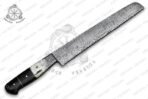
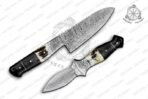
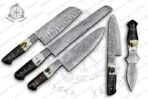
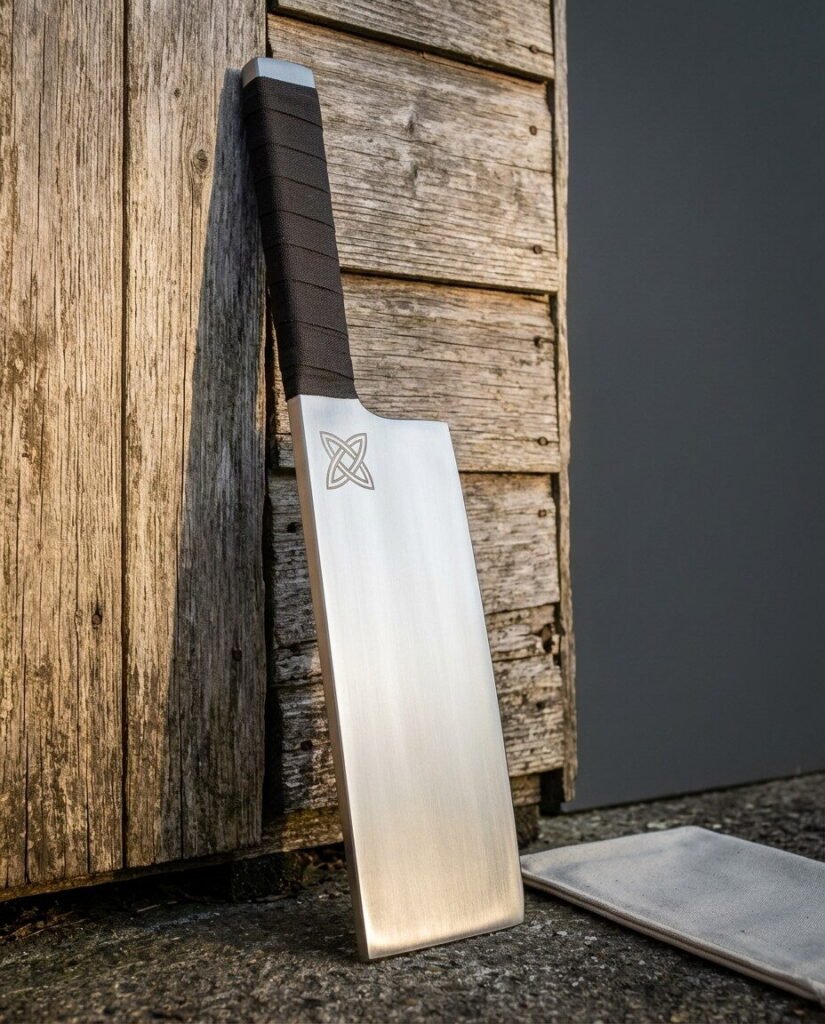
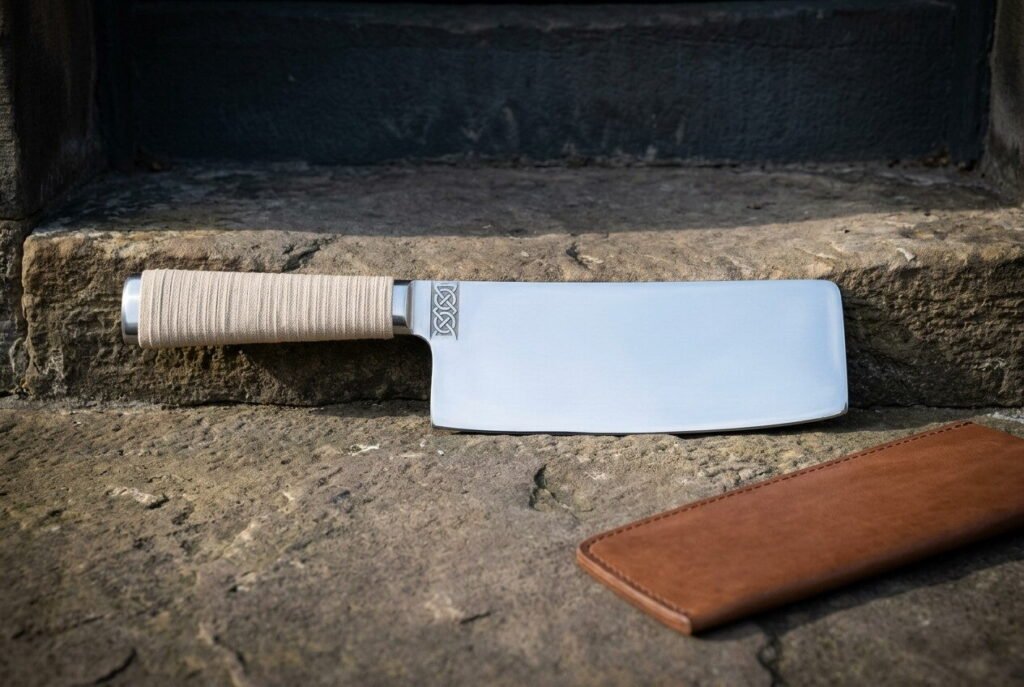
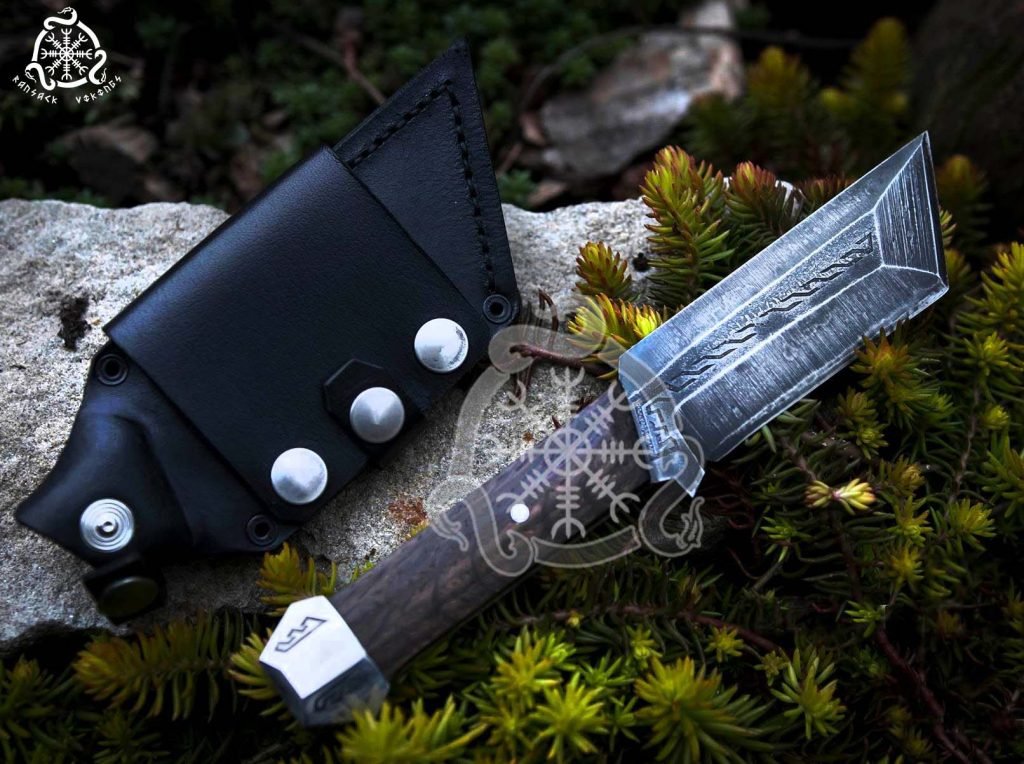
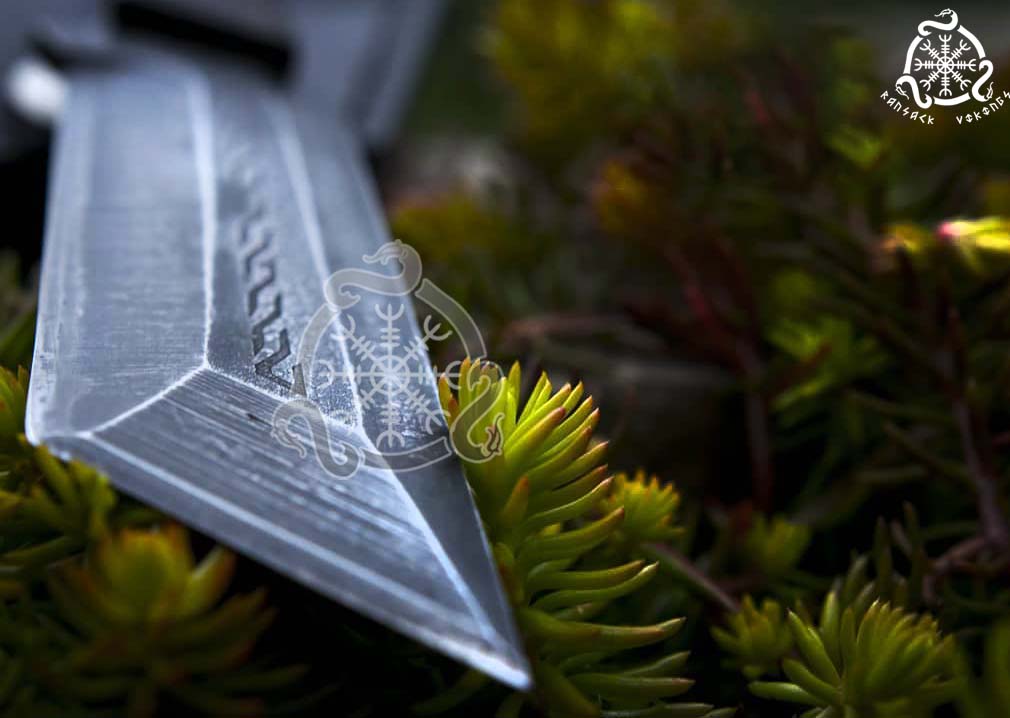
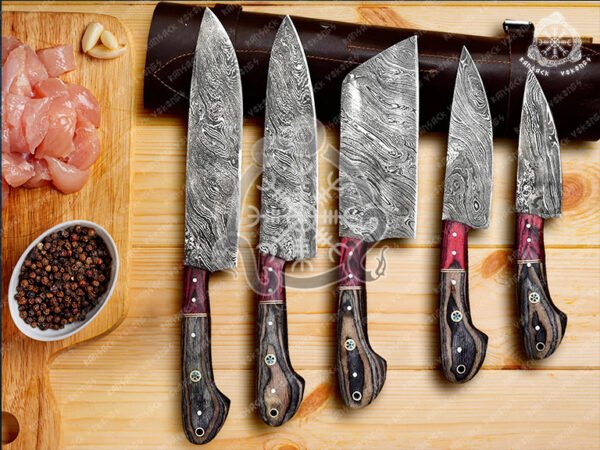
Kitchenskald Hand Forged Damascus Santoku Chef Knife with Buffalo Horn Handle & Leather Sheath | Kitchen and Chef Gift | RK-364

Key Features:

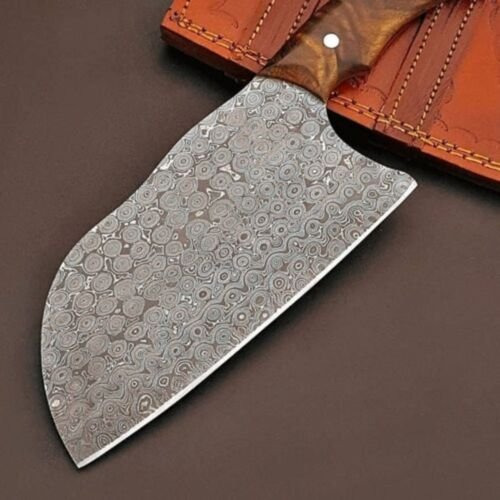
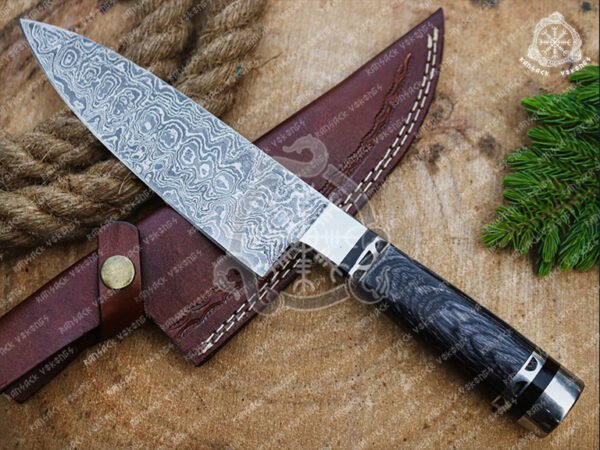
  • Steel: Hand forged Damascus, 1095 and 15N20, oil tempered to 58 to 60 HRC
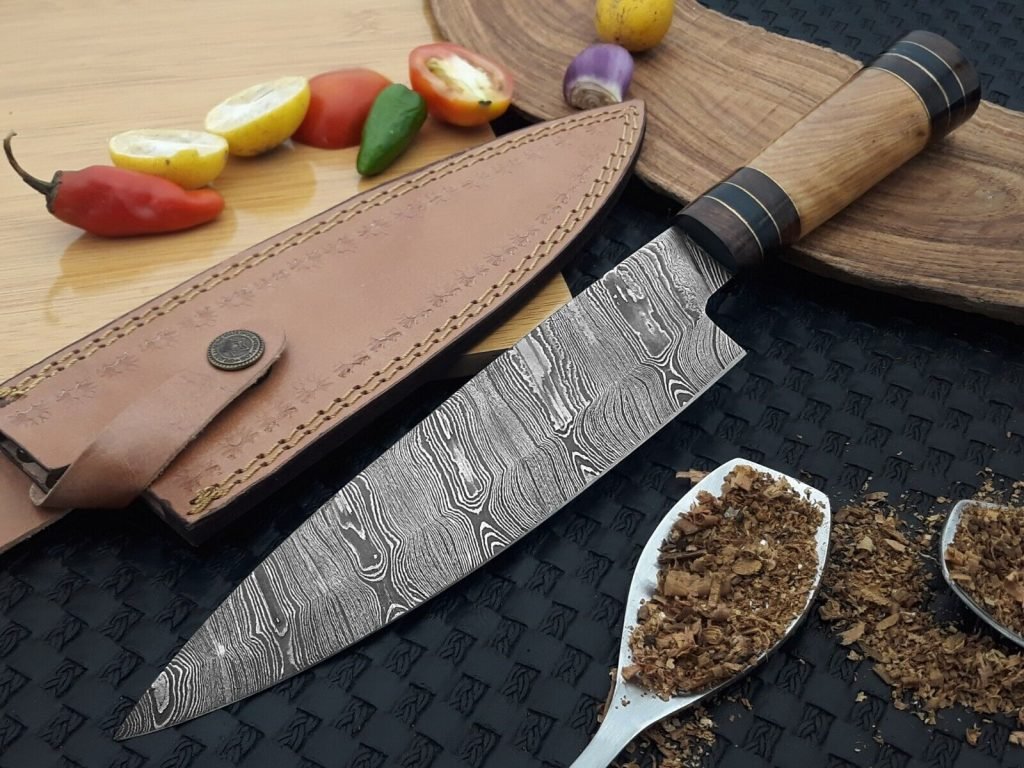
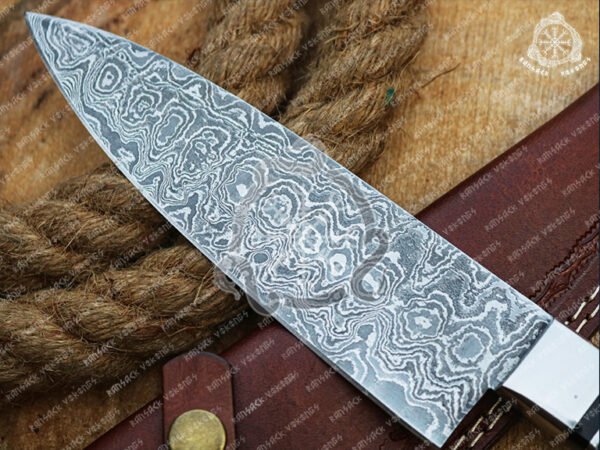
  • Pattern: Fire pattern Damascus, different on every blade
  • Blade: Santoku profile, flat edge and dropped tip, ground thin behind the edge
  • Overall length: 11.5 inches
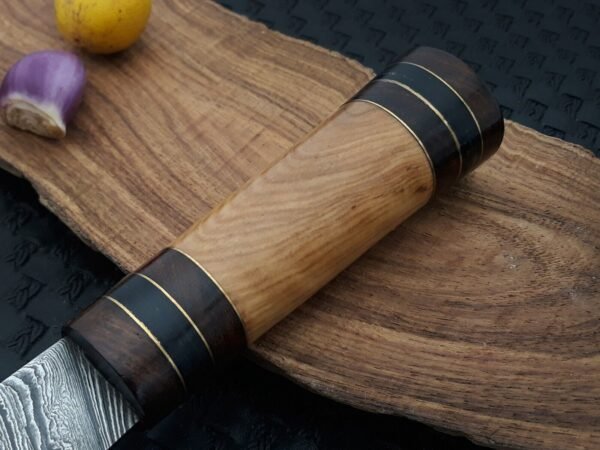
  • Handle: Buffalo horn, hand cut and polished
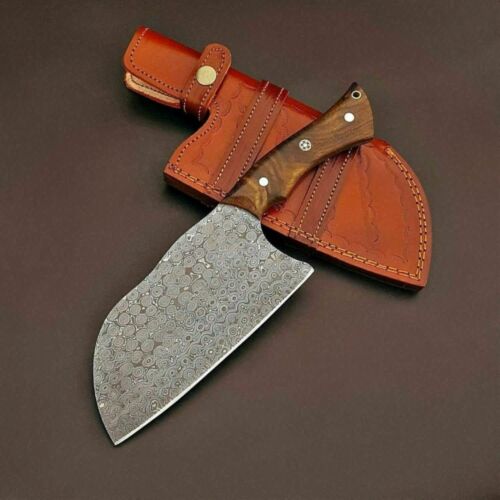
  • Included: Fitted leather sheath
  • Personalisation: Elder Futhark rune line or your own design engraved on request
  • Made in: the Czech Republic, free US shipping

We ship worldwide, and we pay the import duty and the VAT ourselves.

  • Shipping cost. Shipping on this piece is free in the United States and 69 dollars everywhere else.
  • Nothing to pay on delivery. No customs bill, no handling fee, no parcel held at the depot waiting for money.
  • No need to ask first. Place the order. We check it before it ships, and if it cannot reach your country we cancel it and refund you in full.
  • Handmade in the Czech Republic, inspected and shipped from Memphis, Tennessee.

See every country we ship to

Original price was: $229.00.Current price is: $194.65.

(1 customer review)
Personalise this piece

Charged per piece and added at checkout.

See the full engraving page for the rune chart, where the mark sits on each piece, and what makes a crest reproduce well in steel.

  • Free US shippingOn most pieces, worldwide duty paid
  • Lifetime warrantyAgainst any defect, forever
  • Hand ForgedShips from Memphis, no import duty or customs delay
  • Secure checkout256-bit SSL encrypted

Features & Compatibility

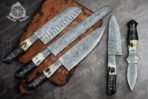
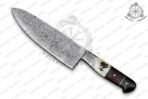
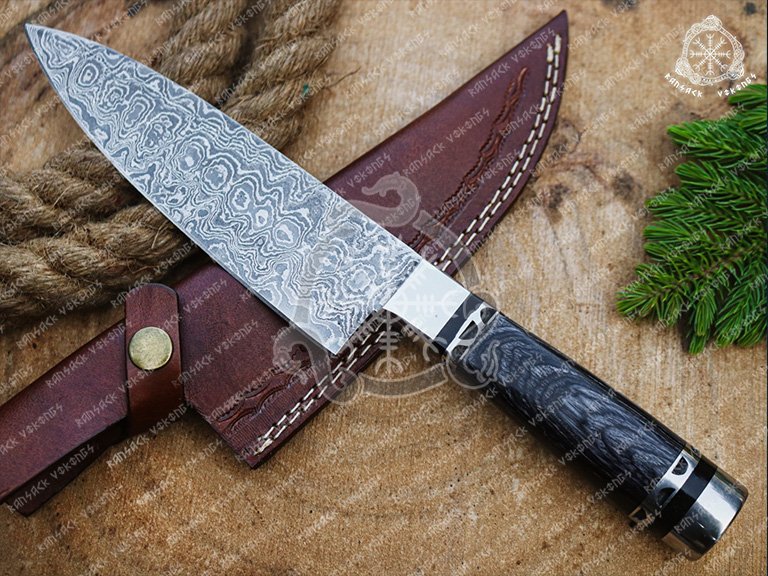
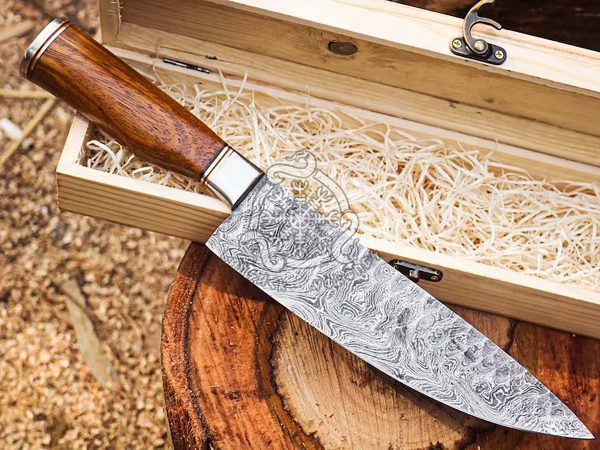
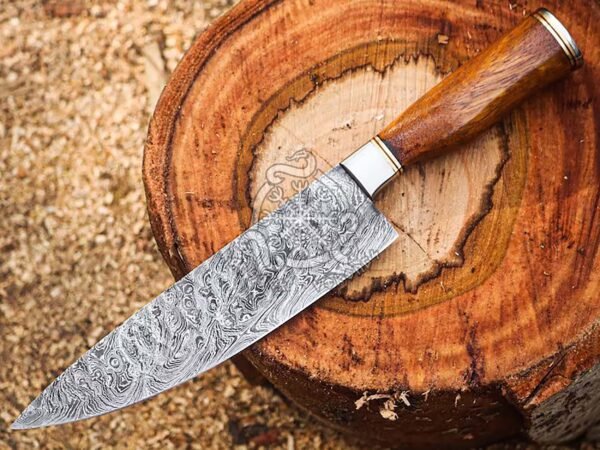
Kitchenskald is a hand forged Damascus santoku chef knife, 11.5 inches overall, with a fire pattern blade oil tempered to 58 to 60 HRC and a buffalo horn handle fitted and finished by hand. It is a kitchen knife first. The Norse name is on the piece, not in the geometry. How this sits against the rest of the kitchen range is covered in the kitchen range compared.

Santoku means three virtues, and the three are meat, fish and vegetables. The shape was worked out in Japan in the middle of the twentieth century as a domestic answer to the Western chef knife, which was designed around a rocking cut on a long curved belly. A santoku is flatter along the edge and taller at the heel, with the spine dropping to meet the edge near the tip rather than sweeping up to a point. That changes how you use it. You are not rocking through a pile of herbs, you are lifting the whole blade and bringing it straight down, and the flat edge means the whole length lands on the board at once instead of leaving an uncut hinge behind. For most home cooks it is a faster and safer motion to learn than the French rock chop.

This knife is forged, ground, handled and sheathed in the Czech Republic. It ships with a fitted leather sheath, free within the United States, sharp and ready to use.

Specifications

SteelHand forged Damascus, 1095 and 15N20 forge welded
HardnessOil tempered to 58 to 60 HRC
PatternFire pattern Damascus
Overall length11.5 inches
BladeSantoku profile, flat edge with a dropped tip
HandleBuffalo horn
SheathLeather sheath included
SKURK-364

What makes a santoku cut the way it does

Three features do the work, and they are all consequences of each other. The first is the flat edge. Lay a santoku on a board and almost the whole edge touches it. Lay a French chef knife down and only an inch or two touches, because the rest is curved up to allow the rocking motion. A flat edge means a push cut or a straight chop severs cleanly along the full contact length, so you are not going back to finish the last strand of an onion.

The second is blade height. A santoku is tall at the heel relative to its length, which gives you knuckle clearance over the board and a broad face for scooping what you have cut. That height is also why the blade feels stable in a straight downward cut.

The third is the grind. A santoku is ground thin behind the edge, much thinner than a stamped supermarket knife, and thin geometry is most of what people are actually praising when they say a knife is sharp. A thick blade with a keen edge still wedges its way through a potato and splits it. A thin blade parts the food and keeps going. That is why this knife will out cut a heavier Western knife on the first onion and keep doing it, and it is also why you do not use it on bone, frozen food or squash rind, all of which want a heavier tool.

The dropped tip is the last piece. It keeps the point low and controllable for fine work, which is the part of the three virtues that covers fish and detail cutting.

Why Damascus and not stainless

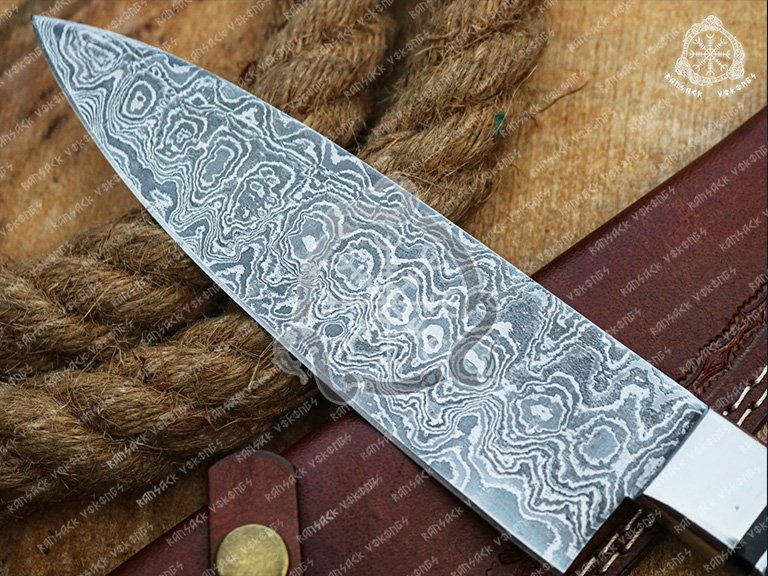
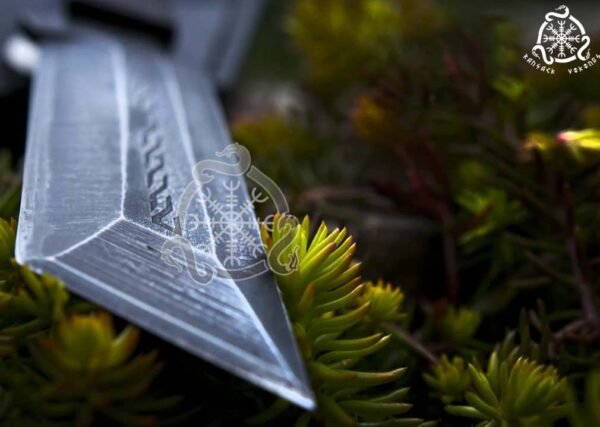
The blade is pattern welded Damascus, built by forge welding 1095 high carbon steel and 15N20 nickel steel into one billet, then folding and drawing it out until the layers are fine enough to show as a pattern. The two steels harden together and etch differently, which is where the light and dark bands come from. The pattern is structural. It goes through the blade and sharpening will never remove it.

In a kitchen this is a real choice with a real cost. Oil tempered to 58 to 60 HRC, the edge on this knife is harder than the soft stainless in a supermarket block, so it stays keen through far more work and comes back quickly on a stone. In return it is carbon steel underneath and it will spot if you leave it wet on a board or, worse, put it in a dishwasher. Cutting tomatoes, lemons and onions will grey the surface over time, which is a patina and is protection rather than damage. If you want a knife you can abandon in a sink, buy stainless and be honest with yourself about it. The trade off is set out in full in Damascus versus stainless.

The buffalo horn handle

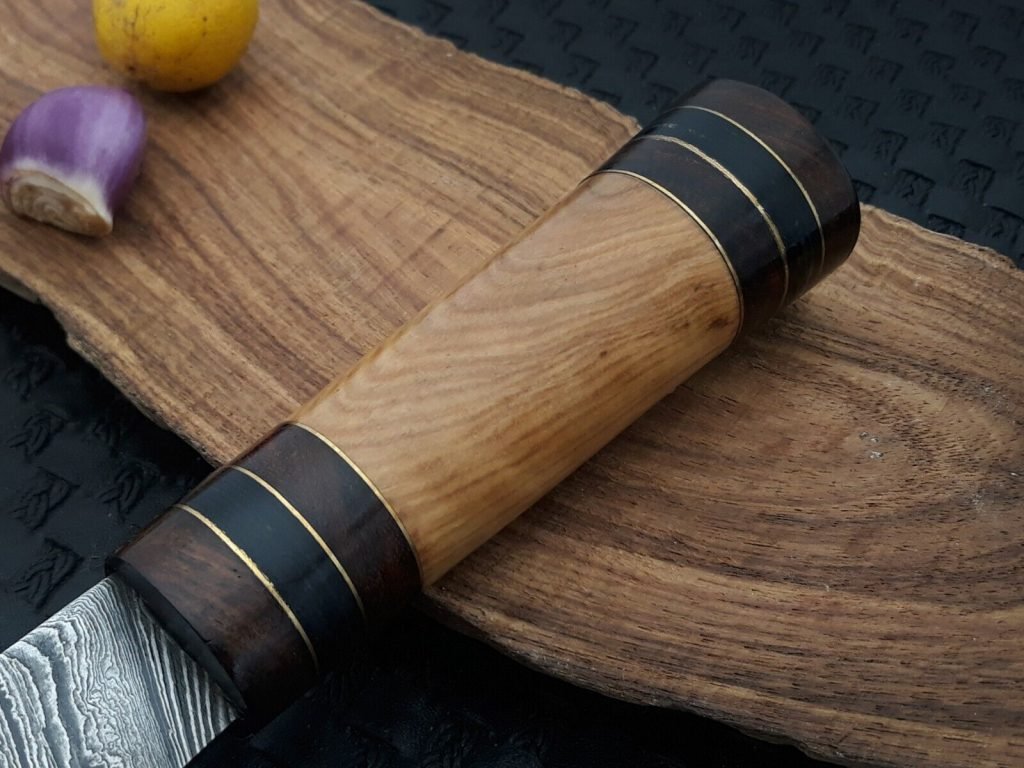
Buffalo horn is a natural material and it behaves like one. Colour runs from near black through smoky grey to amber, sometimes in the same handle, and no two are marked the same way. It is dense enough to balance the blade without adding bulk, it warms in the hand faster than steel or micarta, and it takes a deep polish that plastic can only imitate.

It also has one rule. Horn does not like prolonged soaking or heat. Do not leave the knife in a bowl of water, do not put it in a dishwasher and do not leave it on a warm hob. Wash the blade, dry the handle, and two or three times a year work a small amount of mineral oil or a wax based conditioner into the horn with your fingers and buff it off. That keeps it from drying and crazing. The same routine is described for wood and horn together in wooden handle care.

Engraving, runes and your own design

Use the rune converter on this page to turn a name, a date or a short phrase into Elder Futhark and we will cut it into the steel or the handle. If you would rather have a Viking pattern than a rune line, choose your own design in the engraving option above the add to cart button and tell us whether it goes on the blade or the handle. Where a piece already carries an engraved design, your chosen engraving replaces it rather than sitting alongside it. On a santoku the broad flat above the edge is the natural field for a line of runes, and horn takes a fine engraved initial well. Placement, lettering and what fits in the space are covered on the engraving page.

Care and sharpening

Wash by hand in warm water, dry immediately, and put the knife away dry. Never the dishwasher, for the steel and for the horn. If it is going into a drawer, the sheath keeps the edge off other metal. If it is going on a magnetic bar, lay the spine on first and roll the blade to it rather than slapping the edge against the magnet.

Sharpening is ordinary whetstone work. A 1000 grit stone to set the edge and a 3000 or 6000 to refine it will keep this blade in better shape than any pull through gadget, which grinds a rough shoulder onto a thin Japanese style edge and undoes exactly what you paid for. Hold roughly 15 degrees a side rather than the 20 or 22 a Western knife wants, because the grind here is thinner. Method and angles are in sharpening with a whetstone, and the rust and patina questions are answered in steel care.

Made in the Czech Republic

This is a handmade piece from the Czech Republic, made in a workshop that still forges, grinds and finishes by hand instead of stamping parts out. The smiths there have kept the older way of working, and the wood, horn and leather are shaped and fitted by hand as well. Two pieces of the same design will never be identical, and that is part of what you are buying.

Ransack Viking is a United States company. We handle the import ourselves, look over every piece when it lands and ship from our warehouse in Memphis, Tennessee. Engraving is done in the United States after the piece arrives, so your design goes on before we send it out.

A note on handmade variation

This santoku is hand forged. It is not machine made and it is not bulk produced, so the knife that arrives will not be a pixel for pixel copy of the photograph. The fire pattern is a property of the individual billet, so the swirl, the layer density and the contrast between light and dark bands change from blade to blade. The buffalo horn is a natural material and its colour, streaking and translucency are particular to the piece of horn it was cut from, which means one handle can be almost black and the next can carry amber through it.

The dimensions are the same every time, the steel is the same every time and the build is the same every time. The character is not, and on a handmade knife that is the feature rather than the fault.

Frequently asked questions

What is the difference between a santoku and a chef knife?

A chef knife has a long curved belly and is designed to rock through food with the tip staying on the board. A santoku is flatter, shorter and taller at the heel, and is designed for a straight down push cut. Most people find the santoku motion easier to learn and better for vegetables, and the chef knife better for breaking down large cuts of meat.

Is it sharp out of the box?

Yes. It is sharpened on a stone before it is boxed and it arrives ready to cook with.

Can it go in the dishwasher?

No. The detergent will pit high carbon steel and the heat and moisture will dry out and crack buffalo horn. Wash it by hand and dry it straight away.

Will the blade discolour?

It will. Acidic food and normal use build a grey or blue grey patina on carbon Damascus. That layer protects the steel underneath and most cooks come to prefer the look. Orange rust is a different thing and only appears if the knife is stored wet.

Can I have my own design engraved rather than runes?

Yes. Choose the engraving option above the add to cart button and send the design or the wording. Runes, a name, a date or a Norse pattern all work, and we will tell you what will read clearly at the size available.

How long until it arrives?

Processing is one to two weeks in the shop, plus transit time. Shipping inside the United States is free and returns are accepted within 7 days.

What is in the box

  • One Kitchenskald Damascus santoku chef knife, 11.5 inches overall
  • Fitted leather sheath
  • Protective packaging
  • Forged and finished in the Czech Republic

Explore the range

Other kitchen and working blades sit in chef knives, fish fillet knives, Viking knives and folding pocket knives. Steel, heat treat and sharpening are covered in the guides.

Additional information

SteelHand Forged Damascus
HandleBuffalo Horn
SheathIncluded
Overall length11.5″

Customer Reviews

1 review for Kitchenskald Hand Forged Damascus Santoku Chef Knife with Buffalo Horn Handle & Leather Sheath | Kitchen and Chef Gift | RK-364

5.0
Based on 1 review
5
100
100%
4
0%
3
0%
2
0%
1
0%
1-1 of 1 review
  1. Was nervous ordering something like this online but so glad I did. Already telling my friends to check this out.

    (0) (0)
Add a review
You must be logged in to post a review Log In

Add these too

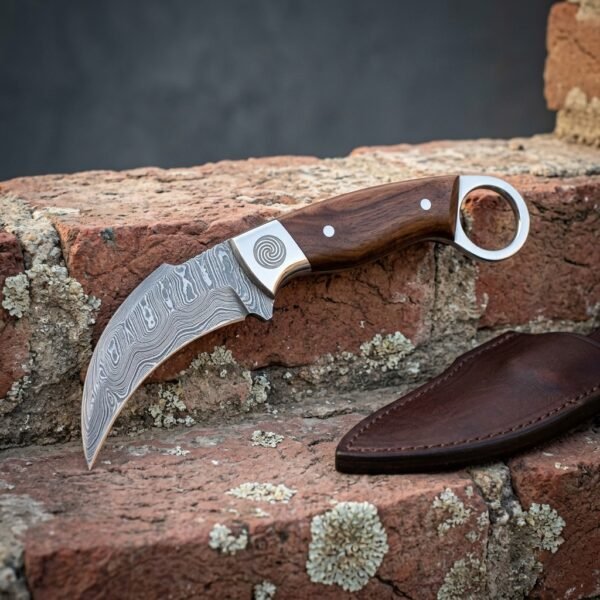
Rosewood Damascus karambit with a rolling wave hawkbill blade, spiral engraved bolster and steel finger ring set on weathered red brick beside a brown leather sheath
Clawfold Hand Forged Damascus Karambit Knife | 8 Inch Original price was: $289.00.Current price is: $245.65. Add to cart
Hand forged damascus karambit knife with curved layered blade, green micarta scales, brass bolster and steel finger ring resting on a brick wall above its leather sheath
Talonveil Hand Forged Damascus Karambit Knife with Green Micarta Original price was: $269.00.Current price is: $228.65. Add to cart
Shipping, returns and ageBlades are sold to adults aged 18 and over. Delivery times are on the shipping page, the lifetime warranty and returns process are on the returns page, and storage advice is on safety and storage. Every piece is handmade in the Czech Republic, then inspected and shipped from Memphis, Tennessee. US orders pay no import duty and wait for no customs clearance. See country of origin.

Know what you are buying