Blog
Ulfberht Swords: The Mystery of the Best Viking Blades

The Ulfberht sword is the closest thing the Viking Age has to a brand name, and like most brand names it was being faked within a generation. Roughly 170 surviving early medieval swords carry the inlaid inscription +VLFBERH+T (or a close variant) on the blade, and metallurgical testing has shown that the best of them were made from steel far cleaner and higher in carbon than almost anything else produced in Europe at the time. Who Ulfberht was, where that steel came from, and why so many medieval knock-offs exist are questions archaeologists are still working on, and the honest answers are a good deal more interesting than the internet’s “impossible supersword” version of the story.
What Is an Ulfberht Sword?
Ulfberht swords are double-edged Viking Age swords, typically around 35 to 37 inches overall, with the maker’s name forge-inlaid in pattern-welded iron letters into the blade’s fuller. They date from roughly the 9th century through the early 11th, and they have been found across the entire Viking world, Scandinavia, the British Isles, the Baltic, the rivers of Eastern Europe, with especially heavy concentrations in Norway and along trade routes.
The name itself is Frankish, not Norse. Most researchers place the original workshop in the Frankish empire, likely the Rhineland region, which was the premier sword-making center of early medieval Europe. That means the most famous “Viking sword” was, in most cases, an import: Frankish rulers repeatedly banned arms exports to the Norse, and those bans worked about as well as bans on profitable trade usually do. Vikings acquired Ulfberhts through trade, plunder, and service as mercenaries.
The Inscription and Its Variants
The name is not stamped, etched or scratched on. It is inlaid. The smith cut channels into the hot blade along the fuller, laid twisted rods of iron or steel into them, and forge welded the whole thing so the letters became part of the blade rather than a mark on its surface. That is a difficult, expensive way to sign your work, and it is one reason the inscription still reads on blades that spent a thousand years in a river. On heavily corroded finds the letters are often invisible and only show up on an X-ray, which is how several Ulfberhts were identified long after they were excavated.
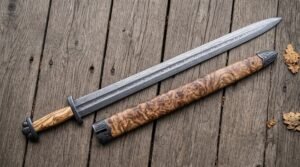 Sealord Hand Forged Damascus Viking Sword | 35 Inch Overall with 29 Inch Blade | Olive Wood Handle and Olive Burl Wooden Scabbard | Norse Collector and Display Gift | RK-509
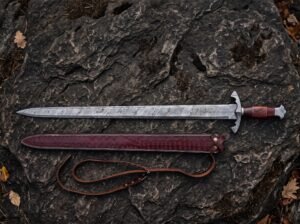 Rosewarden Hand Forged Damascus Viking Sword | 35 Inch Overall with 29 Inch Blade | Rosewood Handle and Damascus Steel Guard | Norse Collector and Display Gift | RK-677
 Tenthcentury Hand Forged Steel Viking Sword | 35 Inch Overall | Reenactment Collector Gift | RK-661
The inscriptions are not all identical, and the differences are the whole argument. The form that matters most is where the crosses sit. Blades reading +VLFBERH+T, with the second cross before the final T, are the group that Alan Williams’ testing found to be the exceptional steel. Blades reading +VLFBERHT+, with both crosses bracketing the whole name, and the many variants with letters dropped, reversed or scrambled, generally tested as ordinary metal. There are also blades where the letters are clumsy, unevenly spaced or run out of room before the end, which is what you would expect from someone copying a mark they could not read.
Two cautions are worth keeping in mind. The sample is small, and a tidy rule drawn from a few dozen tested blades may not survive the next few dozen. And Ulfberht was not the only inscribed name of the period; the INGELRII group is the other well known family of inlaid maker’s names on early medieval blades, so this was a recognized practice rather than one workshop’s quirk. What made the name worth copying was that buyers knew it.
The Steel Mystery
The modern fascination with Ulfberht begins with the metallurgist Alan Williams, who analyzed dozens of the surviving blades. His key finding: a subset of Ulfberht swords were forged from high-carbon steel with very few slag inclusions, a quality profile resembling crucible steel, which was produced in Central Asia and the Middle East but, as far as the evidence shows, not manufactured in Europe until centuries later.
The leading explanation is trade. During exactly the period the best Ulfberhts were made, the Volga trade route connected Scandinavia with the Islamic world, moving silver, furs, and goods in both directions in enormous quantities. Ingots of crucible steel could plausibly have traveled north and west along the same routes and been forged into blades in a Frankish workshop. When that route declined in the 11th century, the highest-quality blades faded from the record too, a suggestive, though circumstantial, piece of the puzzle.
It is worth being precise about what is evidence and what is hypothesis. The measured carbon content and cleanliness of certain blades is laboratory fact. The Central Asian origin of the steel is a well-argued inference, not a settled conclusion; some researchers argue exceptional European bloomery practice could account for part of the picture. What no serious researcher endorses is the pop-history framing of a sword “800 years ahead of its time” made by unknowable means. The smiths were superb, the materials were rare, and the trade networks were real. That is a better story than magic, and it has the advantage of being true.
What Crucible Steel Actually Means
The phrase does a great deal of work in this story, and most accounts use it without ever explaining it. Almost all European iron of the period came from a bloomery: a small clay furnace where ore was reduced below the melting point of iron. What came out was a spongy mass of iron mixed with slag, which the smith hammered repeatedly to squeeze the slag out. The process works, and it built everything from nails to swords, but it never fully cleans the metal and gives poor control over carbon content. Under a microscope, bloomery steel shows stringers of slag running through it like grain in wood.
Crucible steel is made a different way. Iron and a carbon source are sealed in a clay crucible and heated until the metal genuinely melts. Molten steel lets the slag float clear and mixes the carbon evenly through the batch. The result is clean, consistent, and capable of a harder and springier blade than bloomery steel of the same weight. It was made in Central Asia, India and the Middle East well before it was made in Europe.
So when the tests show a blade with high carbon and very few slag inclusions, that is a real, measurable difference. What the tests cannot show is where the metal was smelted. The Volga argument is that Scandinavian traders were moving huge quantities of silver and goods between the north and the Islamic world during exactly the decades the best Ulfberhts were made, so ingots could have travelled the same way, and that the best blades leave the record as that route declines. It fits. It is also circumstantial, and other researchers argue unusually careful bloomery work, or a particularly good ore source, could account for some of the results. Treat the crucible origin as the strongest available explanation rather than a proven one.
Genuine Ulfberhts and Medieval Counterfeits
Perhaps the best proof that Ulfberht was a prestige brand is that it was faked, in its own era. Many surviving blades carry misspelled or rearranged inscriptions, and Williams’ testing found a striking pattern: blades with the inscription form +VLFBERH+T were consistently the high-carbon outliers, while many blades marked +VLFBERHT+ or with garbled spellings were ordinary, sometimes poor, medieval steel.
| Feature | Top-Tier Ulfberht | Medieval Imitation |
|---|---|---|
| Inscription | +VLFBERH+T (second cross before the T) | +VLFBERHT+, misspellings, scrambled letters |
| Steel | High-carbon, few slag inclusions | Bloomery iron or low-carbon steel, more slag |
| Behavior in combat | Held a hard, flexible edge | Softer edge; some examples could bend or break under stress |
| Likely buyer | Elite warriors who could verify quality | Buyers paying for the name |
A warrior who paid for the name and got a counterfeit found out at the worst possible moment. Brand fraud is at least a thousand years old. Only the consequences have softened.
How Ulfberht Compares to Other Viking Swords
Most Viking Age swords were pattern-welded: smiths twisted rods of iron and mild steel together and forge-welded harder cutting edges onto the composite core, producing the rippling surface patterns that modern Damascus-style steel echoes today. Pattern-welding was brilliant engineering with inconsistent raw material, it spread the risk of any single bad billet.
The finest Ulfberhts made pattern-welding unnecessary. With clean, homogeneous high-carbon steel, a smith could forge a lighter, better-balanced blade that flexed under stress and sprang back, and took a keener, longer-lasting edge. Against a typical sword of the era, that meant a real but not magical advantage: better edge retention, better resilience, less weight for the same strength. The wielder still mattered more than the metal.
These blades were hilted in the full range of Viking Age styles, the same families of hilts you see across surviving swords of the period, and they fought alongside the everyday arsenal of axes and spears rather than replacing it. A sword of any grade remained an elite possession; an Ulfberht was an elite blade with a reputation.
Where You Can See Real Ulfberht Swords
Surviving Ulfberhts are scattered across European museums. Notable examples live in the National Museum of Germanic history collections in Nuremberg, the museums of Oslo and Stockholm, and the National Museum of Finland, and river finds continue to surface, a well-preserved example was pulled from the Vistula in Poland as recently as 2014. Because most were recovered from rivers and graves, condition varies from near-complete blades to corroded fragments that still show the tell-tale inlaid letters under X-ray.
Why a Modern Sword Is Not an Ulfberht, and What It Is Instead
Plenty of swords are sold as Ulfberht swords. None of them are, and the ones worth owning do not need to be.
An Ulfberht is a specific archaeological object: a blade from a particular workshop tradition, in a particular part of Europe, carrying an inlaid name that meant something to the people buying it. That workshop is gone, the name cannot be inherited, and the metal it was famous for is no longer rare. A modern blade carrying those letters has a decorative inscription, which is fine if you like it, but it is a reference rather than a reproduction.
The part that tends to disappoint people is this. Judged purely as steel, the thing that made a top tier Ulfberht remarkable is now completely ordinary. It was clean, consistent, high carbon steel, and every piece of modern carbon steel is clean, consistent and high carbon. Our plain carbon blades are 1095 hardened to 54 to 58 HRC, which is a known steel at a measured hardness through the whole blade. Our Damascus is 1095 and 15N20 forge welded in layers and finished at 58 to 60 HRC, with the nickel in the 15N20 drawing the bright lines once the blade is etched. A ninth century smith would have regarded either as extraordinary material and would have had no way to make it.
What no maker can buy off a shelf is the rest of it: the distal taper, the fuller, the balance point, the way a blade behaves when it is moved rather than measured. That is still hand work, and it is what separates a sword from a sword-shaped object. Every piece we sell is handmade in the Czech Republic by smiths working the old way, then imported, inspected and shipped from Chicago, Illinois, with engraving done in the US.
So the useful lesson from Ulfberht is the one buyers can act on: ask what the steel is, ask what hardness it was taken to, and ask who shaped it. Those three answers tell you more than any name on the blade. If you are looking at functional reproductions, the Viking swords range covers the hilt families of the period, the wider sword collection runs beyond the Norse world, and the Damascus knives show the same layered pattern work on a scale you can hold in one hand. Companion pieces like seaxes come from the same tradition, and our guide to Damascus steel vs stainless steel covers the steel decision in full.
Buying a modern sword to a comparable standard is a different exercise, set out in how to approach a first sword purchase. For a blade whose reputation outran its evidence in the other direction, see Excalibur and its replicas.
Questions people ask
What does Ulfberht mean?
Ulfberht is a Frankish personal name, not a Norse one. It probably began as the name of a master smith or workshop founder in the Frankish Rhineland, and then persisted for two centuries as something much like a brand or trademark, applied by successors, licensees, and outright counterfeiters.
How many Ulfberht swords have been found?
Around 170 blades bearing the inscription or a close variant are known, found from Ireland to the Volga trade routes. The count shifts slightly as new river and grave finds surface and as corroded blades are re-examined under X-ray, which can reveal inlaid letters invisible to the eye.
How was the inscription put on the blade?
It was inlaid, not stamped or etched. The smith cut channels into the fuller, laid twisted rods of iron or steel into them and forge welded them in, so the letters became part of the blade. That is why the name still reads on blades recovered from rivers, and why X-rays sometimes reveal an inscription that corrosion has hidden completely.
Were Ulfberht swords really made from crucible steel?
Testing by metallurgist Alan Williams showed a subset of blades were made from unusually clean, high-carbon steel consistent with crucible steel, which Europe did not produce at the time. The favored explanation is steel imported along the Volga trade routes, but this origin remains a strong hypothesis rather than proven fact.
Did the Vikings make Ulfberht swords themselves?
Almost certainly not. The name is Frankish and the workshop was most likely in the Rhineland, inside the Carolingian empire, which repeatedly banned selling arms to Norsemen. The Norse acquired them anyway, through trade, raiding, ransom and mercenary service, which tells you roughly how much attention was paid to the ban.
How can you tell a genuine Ulfberht from a medieval fake?
The strongest single clue is the inscription: blades reading +VLFBERH+T, with the second cross before the final T, tested as the high-carbon originals in Williams’ study, while +VLFBERHT+ and misspelled variants were usually ordinary steel. Spelling was the medieval buyer’s only quality check, and it was not a dependable one. Only metallurgical analysis settles the question definitively.
Can you buy an Ulfberht sword today?
Not a real one, and anyone who offers you one is telling you something useful about themselves. Authentic Ulfberhts are archaeological artifacts held almost entirely in museums and they essentially never come to legal private sale. Swords sold under the name today are modern blades carrying a decorative inscription. Judge those on their steel, their hardness and who shaped them, which is the only comparison that means anything.
For one built to your own measurements, build a custom sword and choose the type, the blade length, the crossguard, the pommel and the scabbard.
Where to see these
Closest to this in the shop, the Wolfmark Ulfberht Viking sword and the Wolfrune Ulfberht Viking sword. Alongside them, the Runewhet Futhark Viking sword and the Cairnbrand Viking sword.
Swinging one yourself
Nobody is lending you an Ulfberht for the weekend, sadly. The nearest thing you can swing at a friend is a blunt trainer like the Skarnvik arming sword, and HEMA sword flex explained covers why a training blade is meant to bend when it lands. The rest sit under HEMA arming swords.
Shop the range
Sealord Hand Forged Damascus Viking Sword | 35 Inch Overall with 29 Inch Blade | Olive Wood Handle and Olive Burl Wooden Scabbard | Norse Collector and Display Gift | RK-509Rosewarden Hand Forged Damascus Viking Sword | 35 Inch Overall with 29 Inch Blade | Rosewood Handle and Damascus Steel Guard | Norse Collector and Display Gift | RK-677Tenthcentury Hand Forged Steel Viking Sword | 35 Inch Overall | Reenactment Collector Gift | RK-661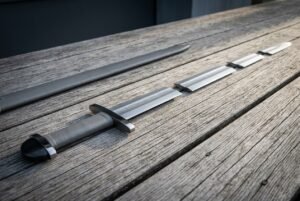 Runewhet Hand Forged 1095 Steel Elder Futhark Viking Sword | 35 Inch Overall | Grey Leather Grip and Tea Cosy Pommel | Norse Collector Gift | RK-1856
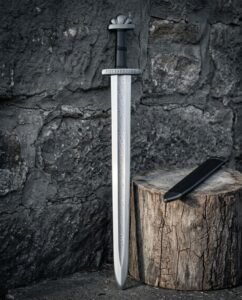 Wyrmweave Hand Forged Pattern Welded Viking Sword | 36 Inch Overall with a 30 Inch Damascus Blade | Five Lobed Pommel, Rune Cut Guard and Black Scabbard | Norse Collector Gift | RK-1743
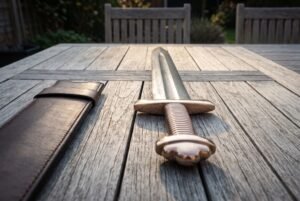 Runeflame Hand Forged Damascus Viking Sword with Five Lobed Pommel & Rune Etched Fuller | 37 Inch Overall | Twisted Wire Grip and Brown Leather Scabbard | Norse Collector Gift | RK-1991
40 thoughts on “Ulfberht Swords: The Mystery of the Best Viking Blades”
Comments are closed.