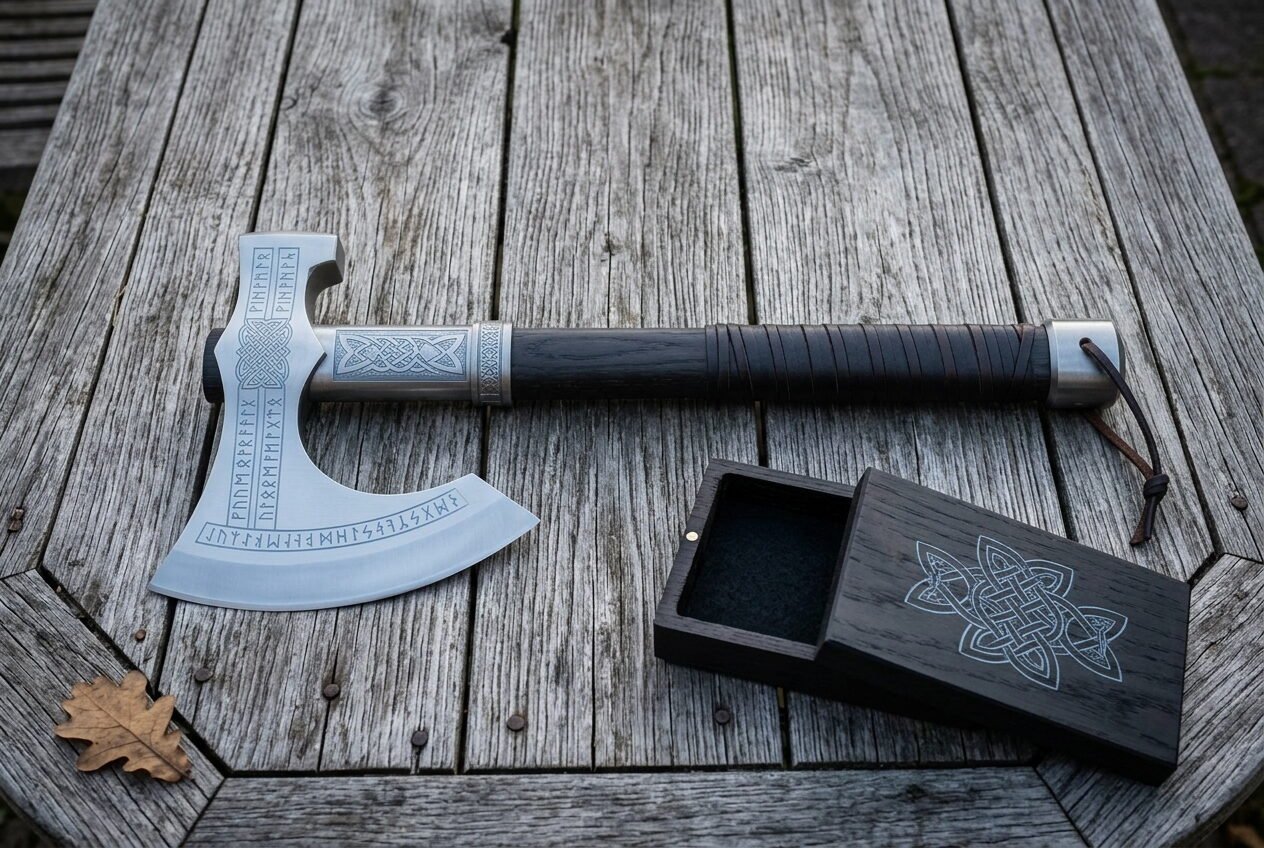
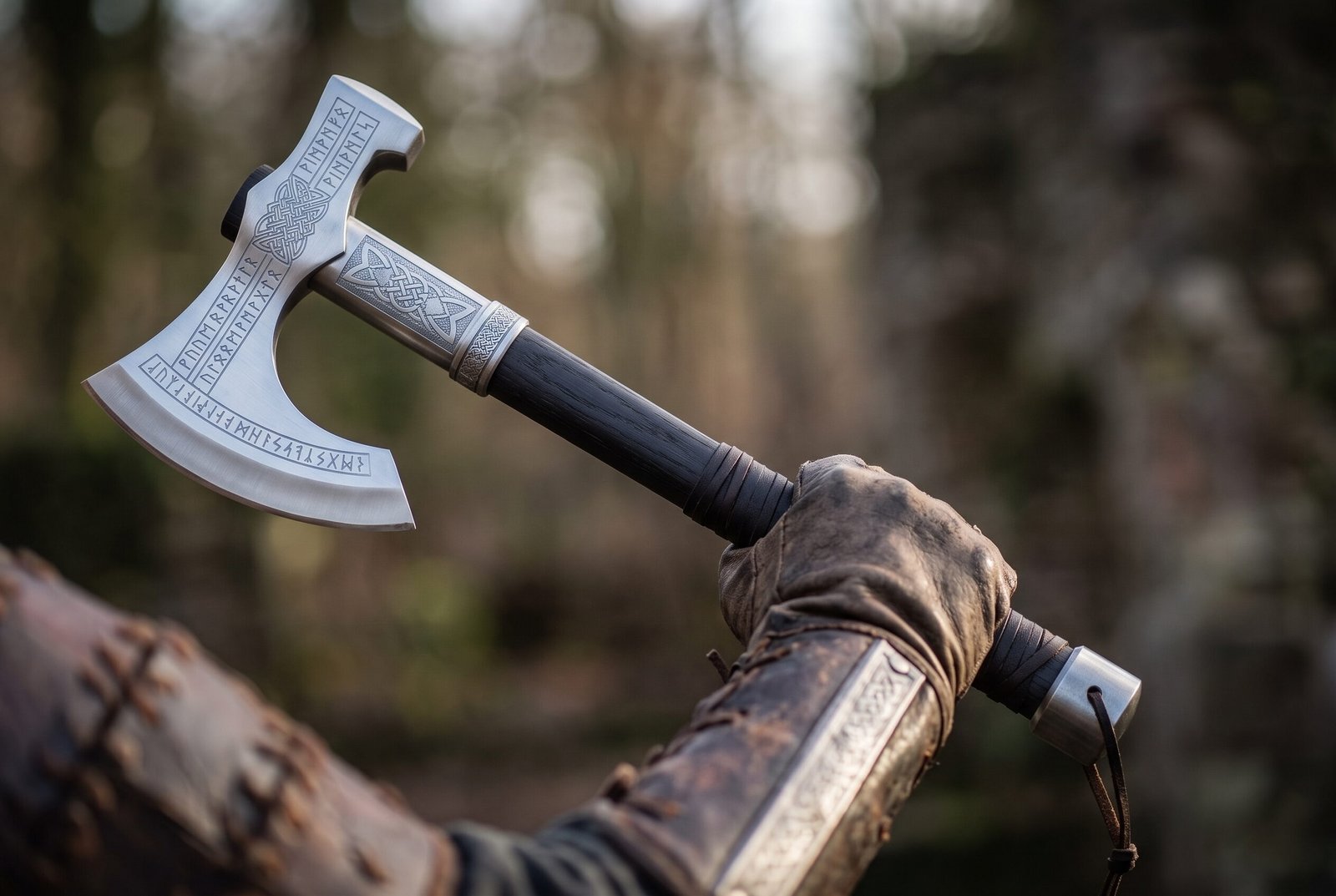
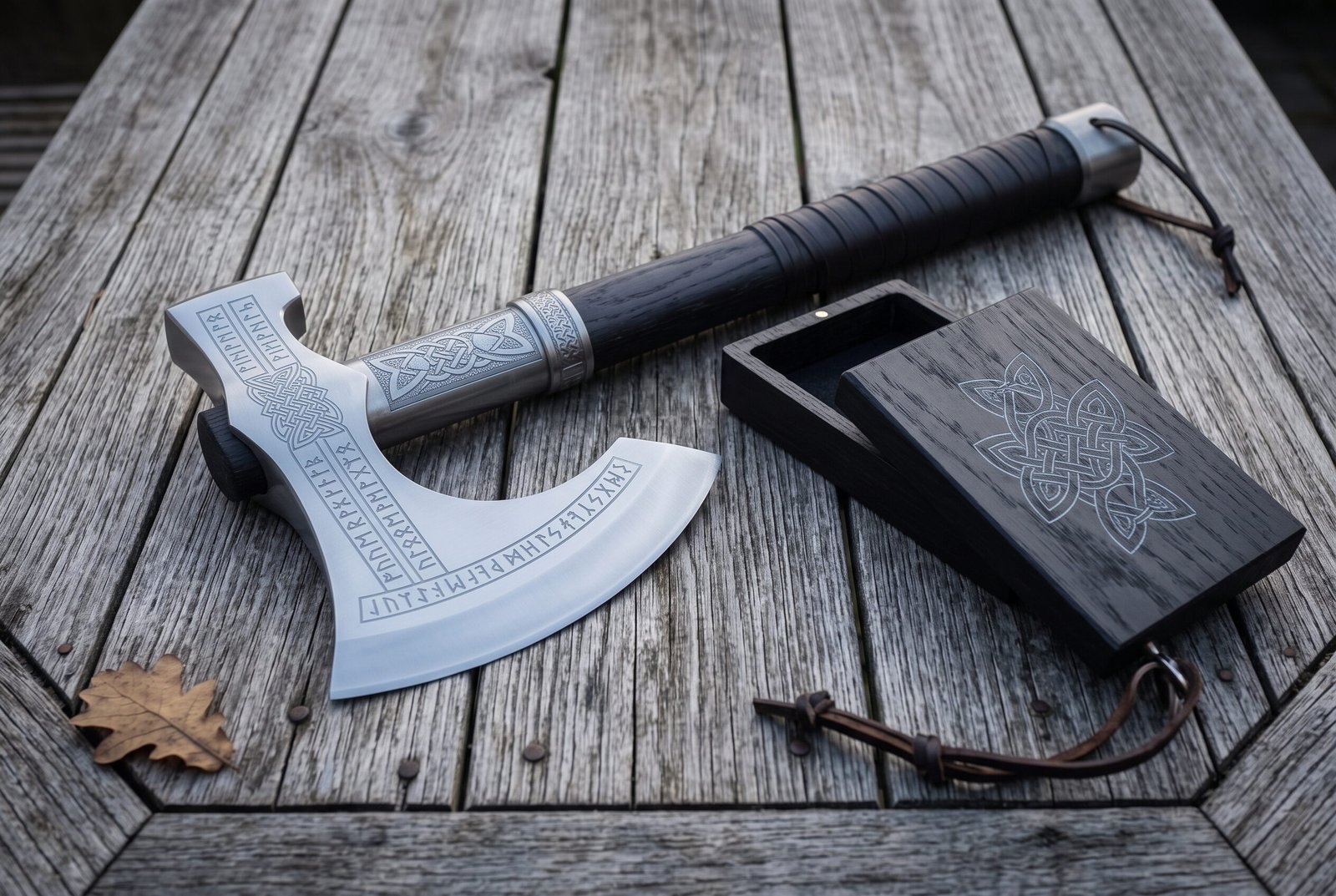
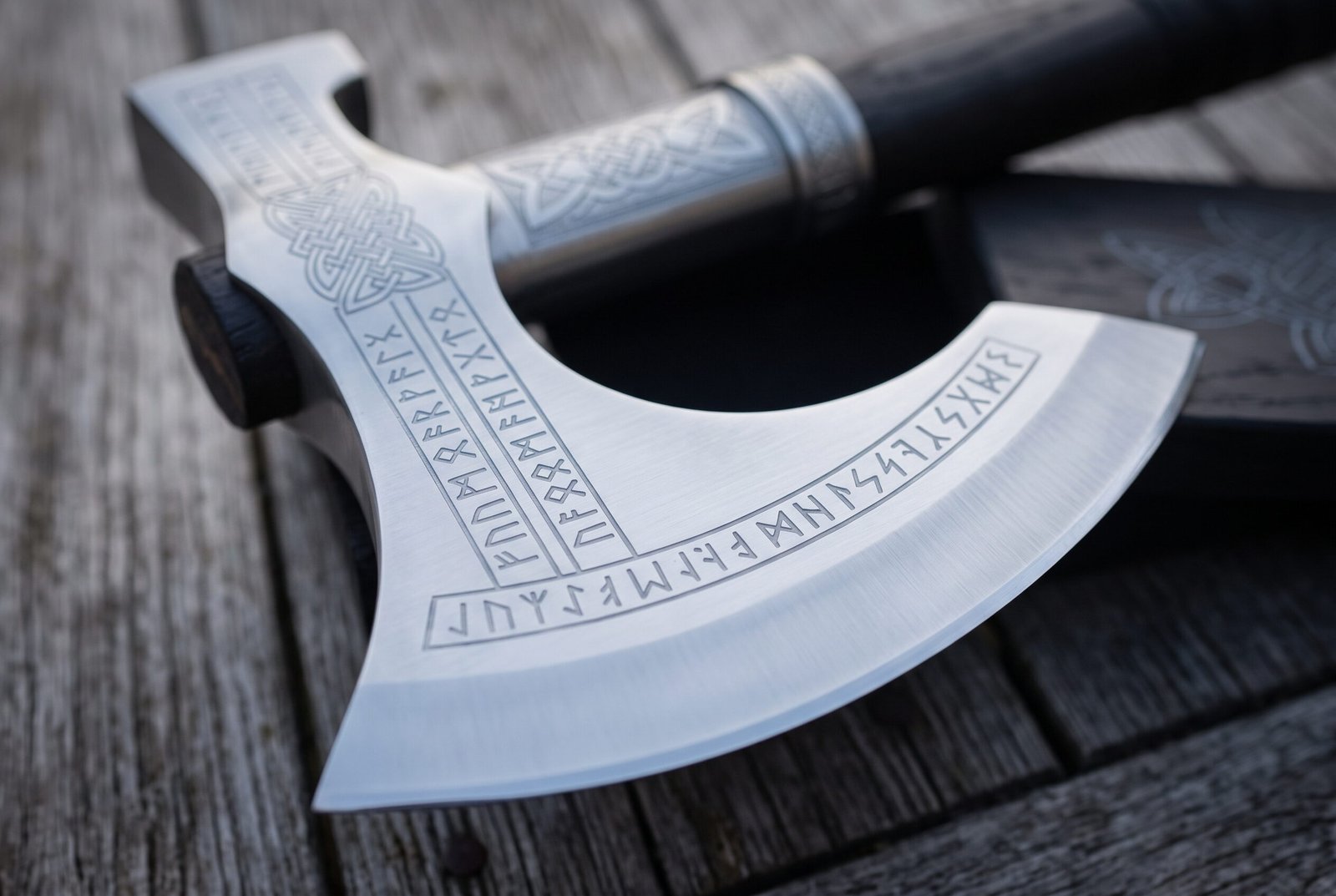
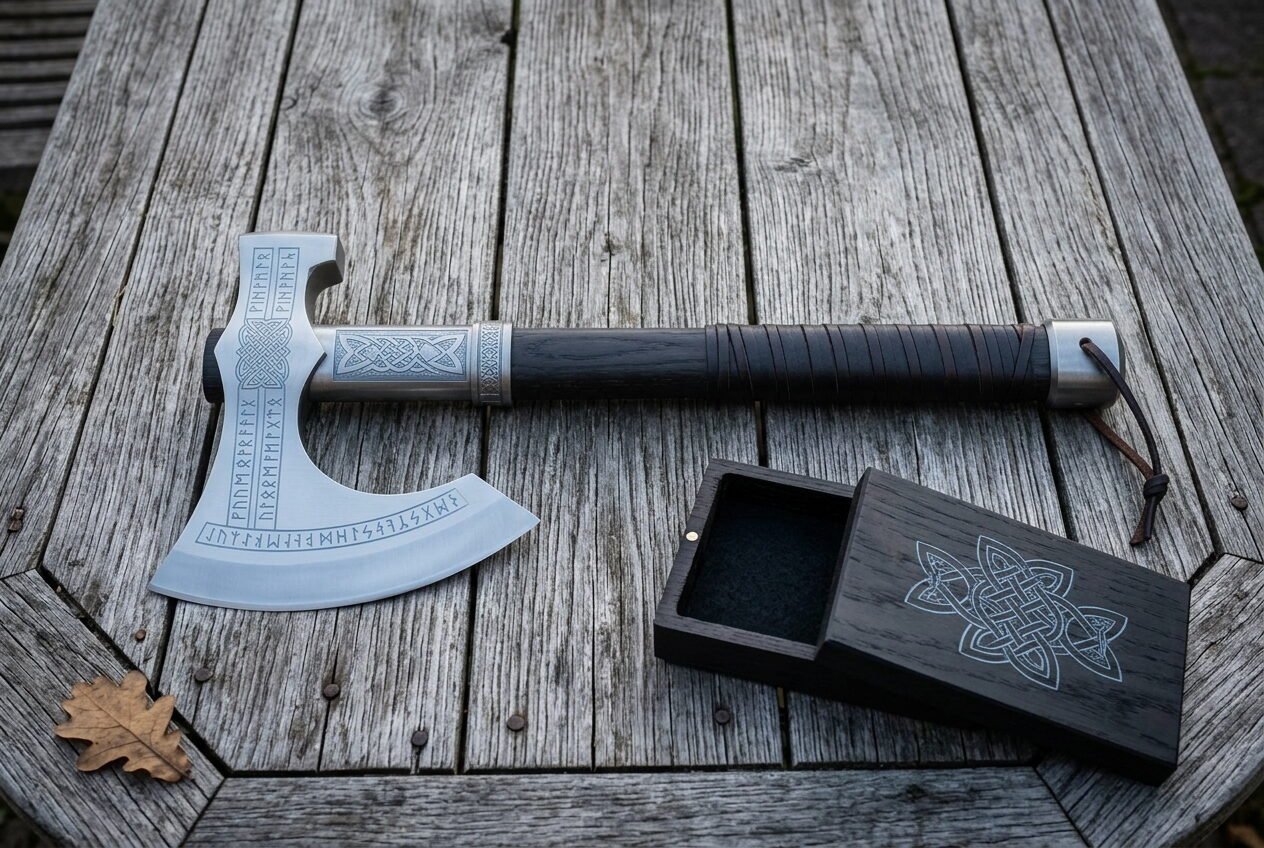
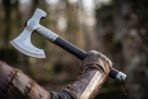
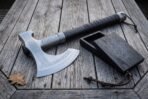
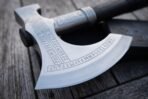
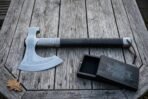
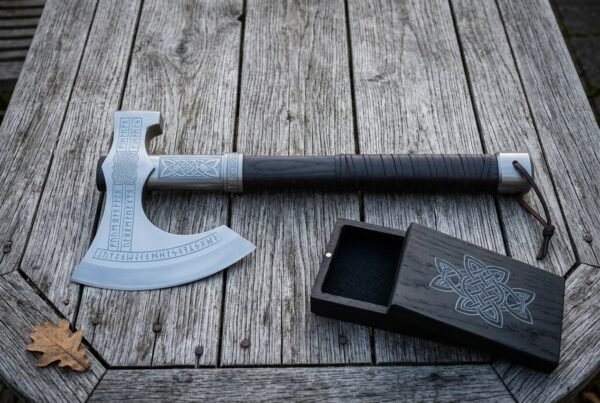
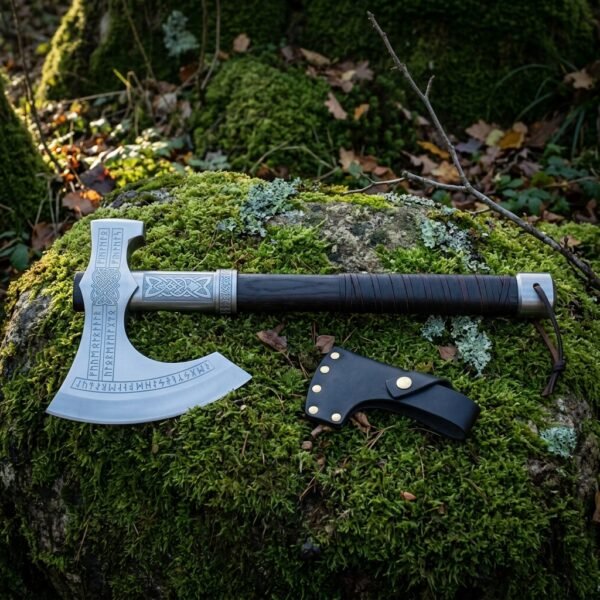
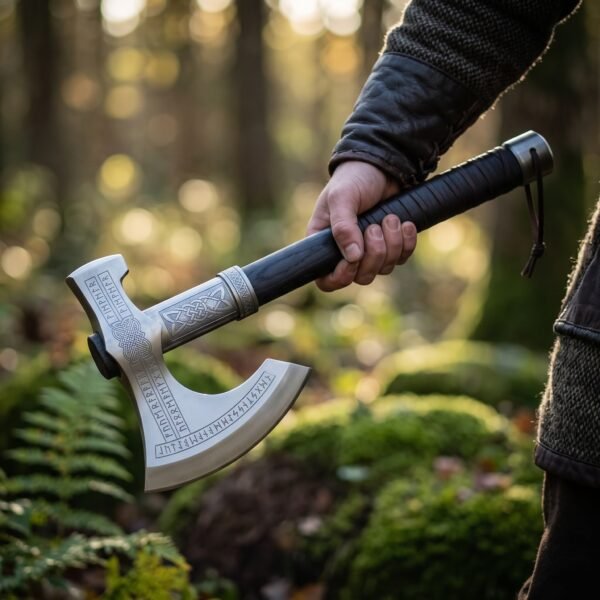
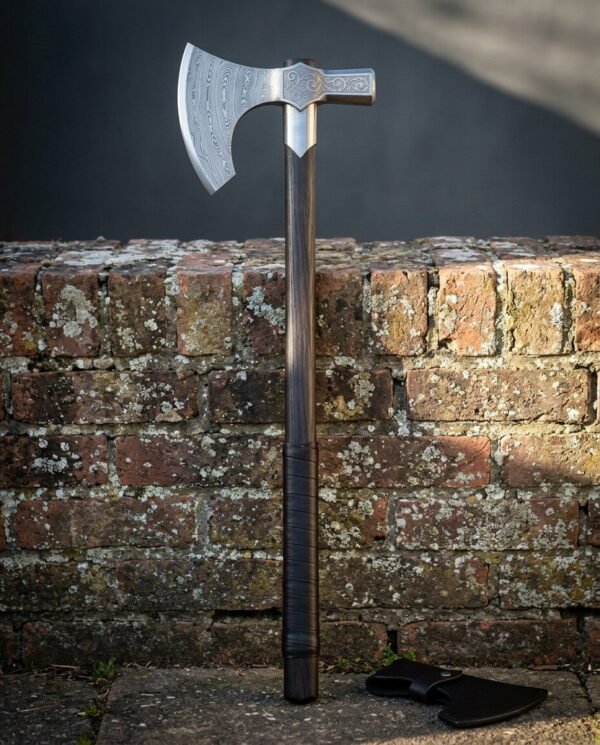
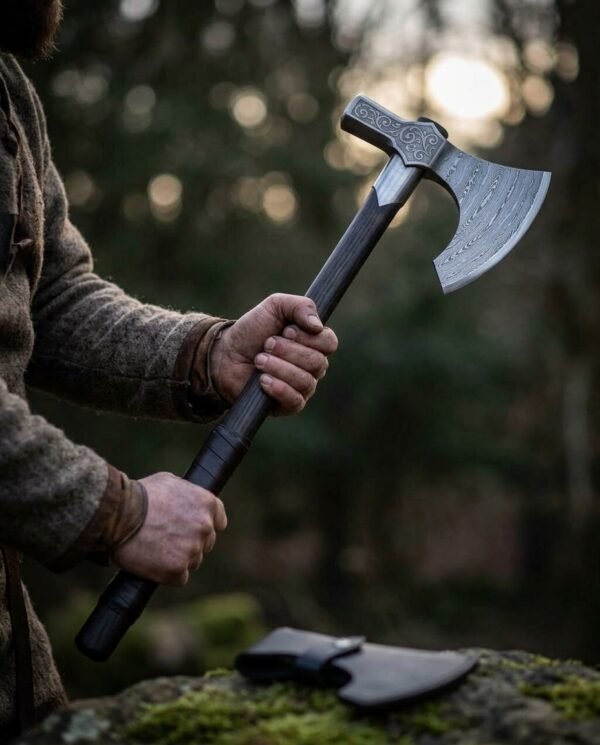
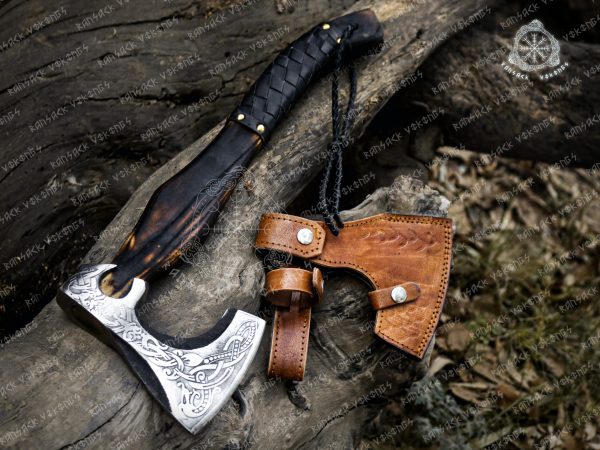
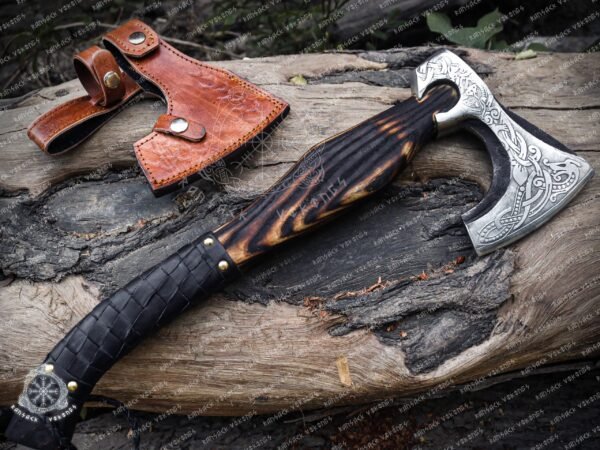
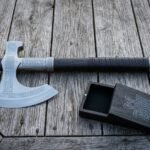
Runecask is our Norse runic bearded hand axe, supplied with a small dark wooden keepsake box that has a Celtic knot inlaid in the lid. The axe is about 18 inches overall, with a broad crescent bit, an etched Elder Futhark rune band and a knotwork panel on the head, a knotwork engraved steel collar below the eye, and a dark ash haft with oiled leather wrapped over the rear half of the grip and a steel butt cap with a leather lanyard. Presentation boxes are not a modern invention bolted onto a Viking object. The Oseberg ship burial and the Mastermyr find on Gotland both gave up worked wooden chests with iron fittings, and the Mastermyr chest was a smith keeping his own tools in a fitted box. Each rune has a name and a sound, all set out in every rune and its meaning.
Both pieces of this set are made in the Czech Republic. The head is forged, punched and ground in that workshop, the rune band and knotwork are cut into the steel, the haft is fitted and wrapped, and the box is made and inlaid there as well. The set ships together with a care card covering both the steel and the timber, and free shipping inside the United States. It is the version most people choose when the axe is going to somebody else rather than onto their own wall.
Specifications
| Steel | 1095 high carbon steel, hand forged, hand ground |
|---|
| Hardness | 54 to 58 HRC at the edge, softer through the eye and poll |
|---|
| Overall length | About 18 inches for the axe |
|---|
| Cutting edge | About 6 inches along the crescent, beard to upper horn |
|---|
| Head | Bearded crescent bit, about 7 inches horn to horn, bright satin finish |
|---|
| Decoration | Etched Elder Futhark rune band following the edge and the beard, Celtic knotwork panel behind the eye |
|---|
| Collar | Steel collar with knotwork below the head |
|---|
| Haft | American ash, dark stained, oiled leather wrap over the rear half of the grip |
|---|
| Butt cap | Steel butt cap with leather lanyard |
|---|
| Keepsake box | Small dark wooden box, Celtic knot inlaid lid, black lined interior |
|---|
| Finish | Bright satin on the steel, oiled and waxed timber on the box |
|---|
| SKU | RK-1221 |
|---|
Why the head is bearded and what that shape actually does
The bearded axe, the skeggox of the sagas, is the shape most people picture when they hear the words Viking axe, and the beard is a piece of engineering rather than a flourish. Dropping the lower corner of the edge down and back below the eye adds cutting length without adding a matching amount of steel, so this head carries a long edge for its size while staying light enough to swing fast on a single hand grip. The recess it leaves behind the beard has two uses. In a fight it is a hook, and Norse accounts are explicit about an axe corner being caught over a shield rim and dragged down. In a workshop it lets a carpenter slide his hand right up under the head and hold the haft directly behind the cut, which is why the shape outlived the shield wall by several hundred years in Scandinavian joinery.
The curve matters as much as the beard. Only a short arc of a crescent edge is in contact at any instant, so the whole energy of a swing lands on two or three inches of steel rather than being spread along a straight edge. The bit is ground thin behind that edge and thickens quickly toward the eye, which is the opposite of a splitting axe. A splitter wants a fat wedge to burst wood apart. A war axe wants a lean section that parts what it meets and carries on through.
The keepsake box
The keepsake box is dark wood with a Celtic knot inlaid in pale lines across the lid, a black lined interior and a leather tie. It is much smaller than the axe and does not hold it. It sits beside the axe on a shelf or a desk and turns the set into a gift rather than a tool.
The design language across both pieces owes something to Norse mythology and a good deal to the way modern Norse fantasy and video game art have taught people to picture a Viking axe, with heavier rune ornament and colder colour than any excavated original carried. We are straightforward about that. The methods are traditional. The look is contemporary Norse, not a museum reproduction of a specific find.
Why high carbon steel and not stainless
Stainless steel resists rust because it carries a lot of chromium, and that chromium forms hard carbides that get in the way of everything an axe needs to do. Stainless is stubborn under the hammer, difficult to bring to a fine edge by hand, and more inclined to chip when a heavy head lands wrong. High carbon 1095 behaves the opposite way. It moves cleanly when forged, hardens deep and even, takes a keener edge than any stainless in this price band, and comes back on a stone in minutes instead of demanding diamond abrasives. The trade is that it will rust if it is left wet. Wipe it, oil it, and it will be fine for a lifetime. The longer version of that argument, applied to pattern welded blades, is in our note on Damascus versus stainless.
The ash haft, the leather wrap and the box
The haft is American ash, picked for long straight grain that runs with the swing. Ash is springy where hickory is stiff, so it absorbs the shock of a hard landing before it reaches your hands, and it stays stable through the swing from dry winter heat to summer humidity. The head is seated on a shoulder and wedged from the top, and the rear half of the haft is wrapped in oiled leather, finished at the butt with a steel cap and a leather lanyard.
Both the haft and the box are wood, and both want the same small attentions. Keep the set out of direct sunlight and away from a radiator or a heat vent, since dry heat is what opens joints and lifts an inlay. Wipe the box with a dry cloth and wax it once a year. Work a little leather conditioner into the haft wrap on the same schedule. If you ever strip the haft back to bare wood, our guide to wooden handle care covers oiling and sealing properly.
Engraving, runes and your own design
Use the rune converter on this page to turn a name, a date or a short phrase into Elder Futhark and we will cut it into the steel or the handle. If you would rather have a Viking pattern than a rune line, choose your own design in the engraving option above the add to cart button and tell us whether it goes on the blade or the handle. Where a piece already carries an engraved design, your chosen engraving replaces it rather than sitting alongside it. On this set that means your runes are cut into the same band on the head that the stock design occupies, in the same style. A wedding date, a name or a short line of Havamal is the usual choice when the set is a gift. What we can and cannot cut is set out on the engraving page.
Care and sharpening
Wipe the head with a dry cloth after handling and put a light film of mineral oil, camellia oil or paste wax over the steel. Fingerprints are mildly acidic and will etch a shadow into bare carbon steel inside a week. Do not put it away damp inside a leather cover, because leather holds moisture against steel. The soft grey patina that comes up over years is protective and worth keeping. Orange rust is not, and it lifts with fine steel wool and oil.
Sharpen a curved bit by following the arc rather than fighting it. Work in short sections with a coarse stone or an axe puck held flat to the existing bevel, travel along the curve, then finish with a fine stone and a few light strop passes. Keep it off a high speed grinding wheel, which will draw the temper out of the edge before there is any visible colour change. Our guides to steel care and sharpening with a whetstone take both jobs step by step.
Made in the Czech Republic
This piece is made by hand in the Czech Republic, in a workshop that still works the old way. The steel is forged, ground, heat treated and finished by smiths who learned the trade from the people before them, and the wood, horn and leather are cut and fitted by hand rather than pressed out on a line. That is also why no two pieces come out exactly the same.
Ransack Viking is a United States company. We import these pieces ourselves, check every one when it lands and ship from our warehouse in Chicago, Illinois. Engraving is done here in the United States after the piece arrives, so your runes or your own design go on before it leaves for you.
A note on handmade variation
This set is hand forged and hand built. It is not machine made and it is not bulk produced, so what arrives will not be a pixel for pixel copy of the photograph on this page. The grain of the ash runs differently in every haft, the timber of the box takes the stain differently board to board, the knot inlay on the lid sits slightly differently each time, the leather takes the oil at its own pace and the hammer texture across the cheeks of the head falls where the hammer fell. The dimensions, the steel, the hardness and the build are the same every time. The character is not, and that is the whole reason to buy something a person made.
Frequently asked questions
What is the box like?
It is a small dark wooden box with a Celtic knot inlaid in the lid and a black lined interior. It is a keepsake box that ships alongside the axe, not a case the axe fits inside.
Can the axe still be used, or is this display only?
The axe is a functional forged tool with a hardened edge and a wedged ash haft, so it will chop. Most owners of this set keep it on display. It is not a throwing axe and it is not built for sparring, so never throw it and never use it in contact work.
Can I have a name or a date engraved for a gift?
Yes, and it is the most common request on this set. Run the name or date through the rune converter on this page and we cut it into the rune band on the head. Your engraving replaces the stock rune design rather than being crowded in beside it.
Will mine look exactly like the photographs?
It will match on every measurement and differ in character. Wood grain in the haft and the box, the tone the stain lands at, the depth of the rune cuts and the hammer marks on the head all vary from one set to the next because a person made each one.
How is this different from buying the axe on its own?
The axe is identical. This set adds the small knotwork keepsake box, and it arrives ready to give without any further wrapping. The axe sold on its own comes with a black leather head sheath instead, which suits somebody who wants to hang it on a wall or carry it.
How long does shipping take and can you ship it as a gift?
Shipping inside the United States is free and takes three to five business days once the set leaves the shop. Add three to four weeks if yours has to be built. Tell us at checkout if it is a gift and we will leave the paperwork out of the box and send the receipt to you by email instead.
What is in the box
- One Runecask hand forged high carbon steel Norse runic bearded axe, about 18 inches overall
- One small dark wooden keepsake box with a Celtic knot inlaid lid
- Care card covering the steel, the leather and the timber
- Protective oil film on the steel for transit
- Double boxed for shipping
- Forged and finished in the Czech Republic
Explore the range
See the rest of the Viking axes, the full run of bearded axes, the wider Norse arms range and everything in engraved and personalised. If you are choosing between shapes or sizes, start with the guides.
Other pieces in this group
Also in this group is the Gleambeard bearded axe, forged from 1095. Sitting beside it in the catalogue is the Runebite bearded axe, high carbon steel. Another in the same line is the Wayfarrow bearded axe.
For a different piece from the same family, look at the Walnutskeg bearded axe. Nothing here exactly right, build one to your own spec on the custom Viking axe page.


Feels way more premium than the price suggests. Shipping was fast and everything arrived well packaged.
Bought this on a whim and it turned out to be one of my favorite purchases this year. Can’t recommend this enough.
Got this as a gift and now I want one for myself too. Came in a nice gift box which made it feel even more special. Beyond happy with how this turned out.