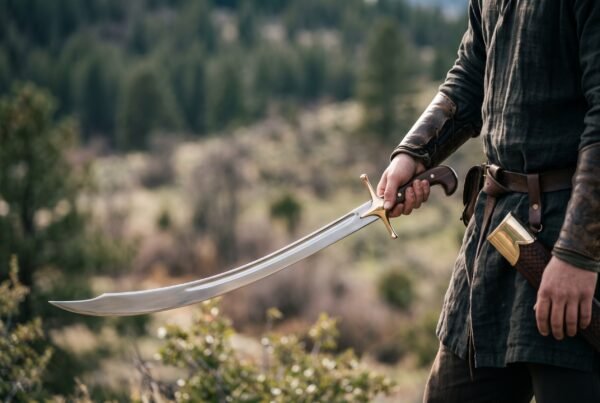
The Sandspire is built to the pattern of the Arabian saif, the curved sword of the Arabian peninsula and the wider Islamic world. It is worth clearing up one thing straight away: the earliest Arab swords were not curved at all. The sword of the seventh century Hejaz was straight, broad and double edged, closer to a Roman spatha than to anything in this photograph. The curve arrived later, carried west by Turkic and Mongol horsemen from the steppe during the twelfth and thirteenth centuries, and it took hold because it suited cavalry. By the time European travellers were writing home about the swords of Arabia, the curved saif had been the standard for three hundred years and everyone had forgotten it was an import.
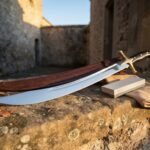
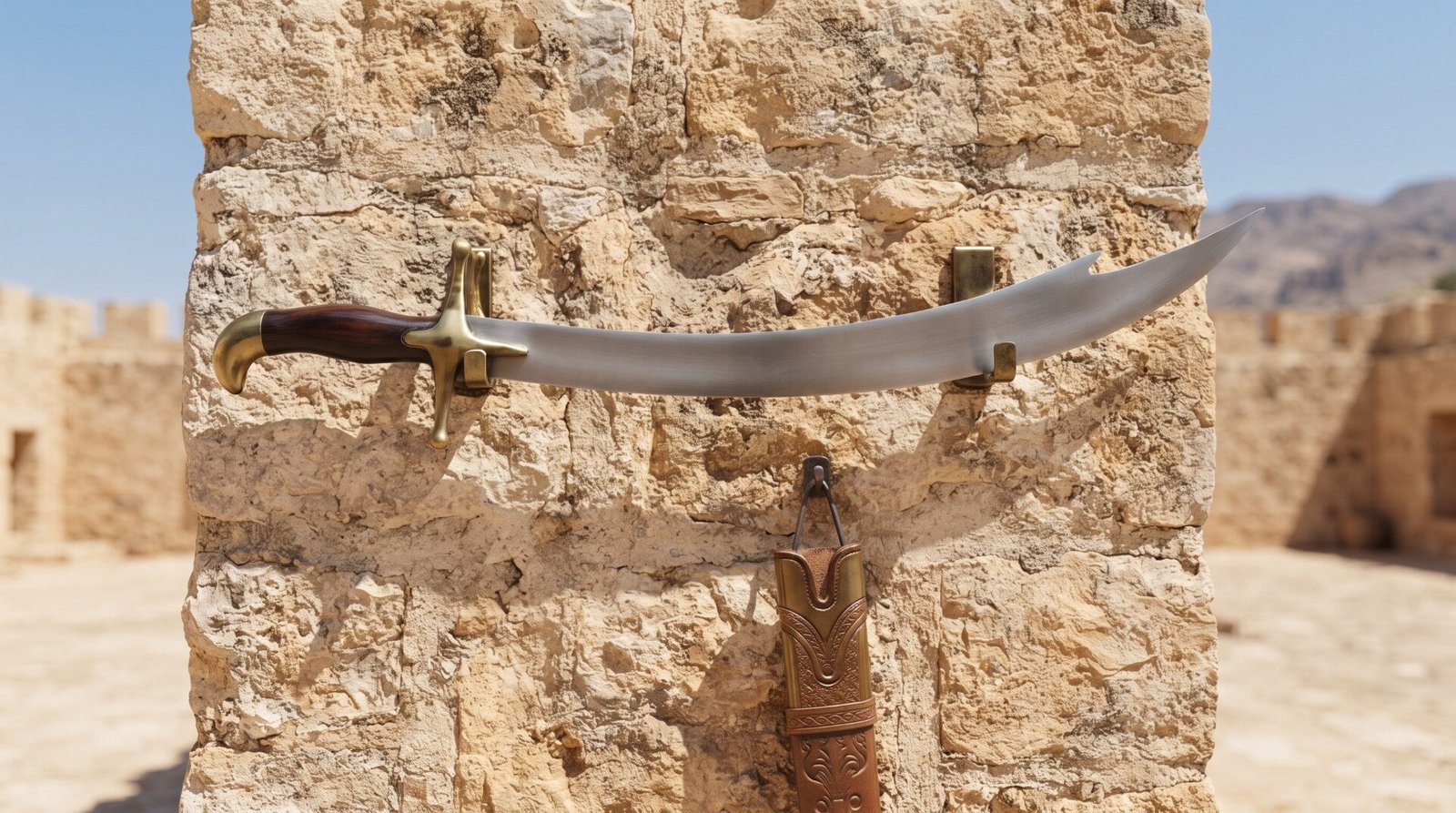
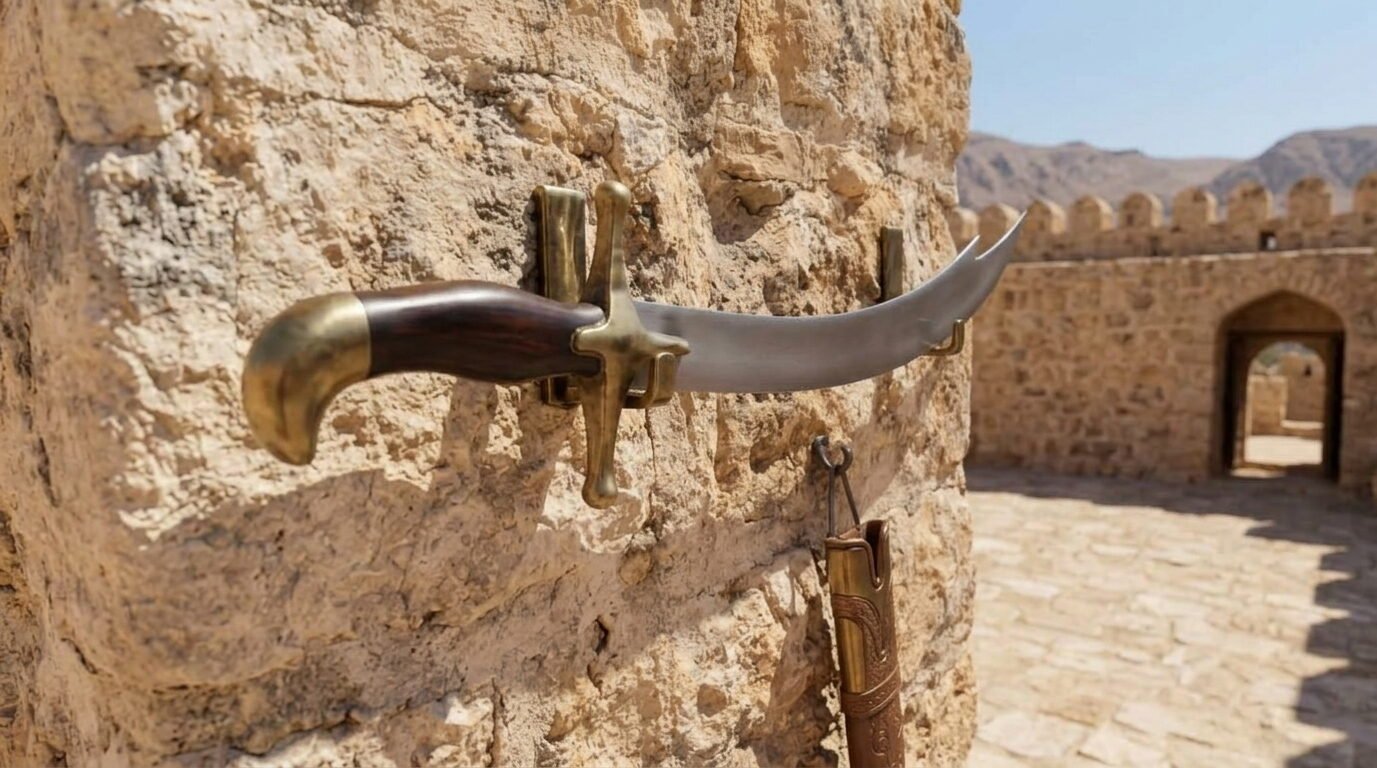
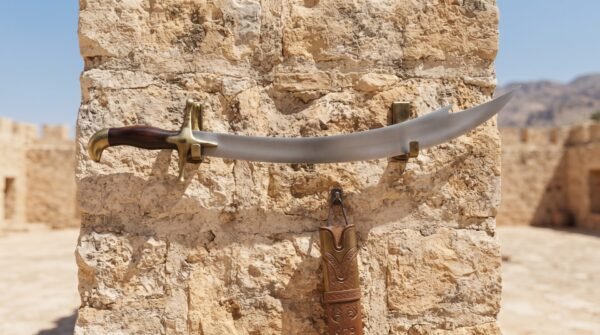
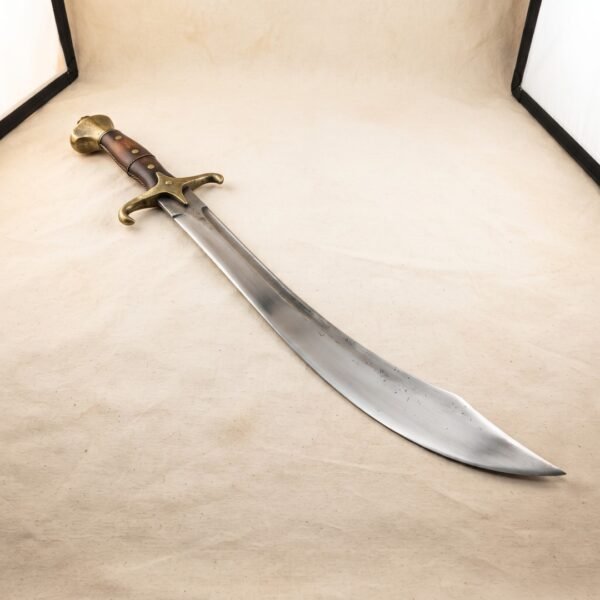
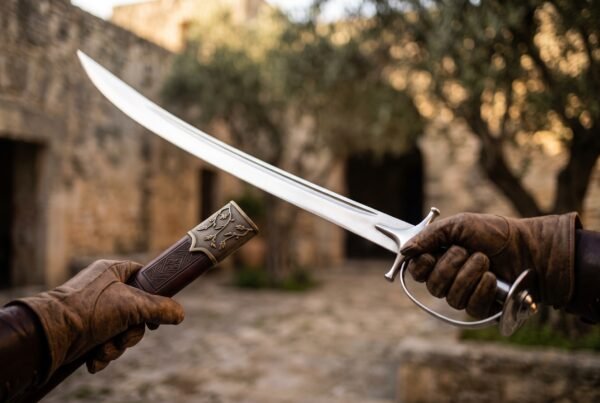
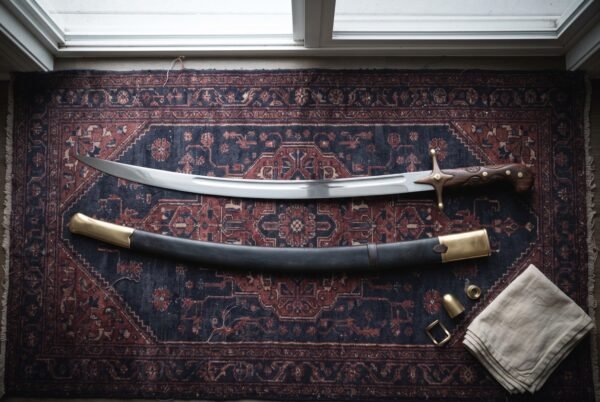
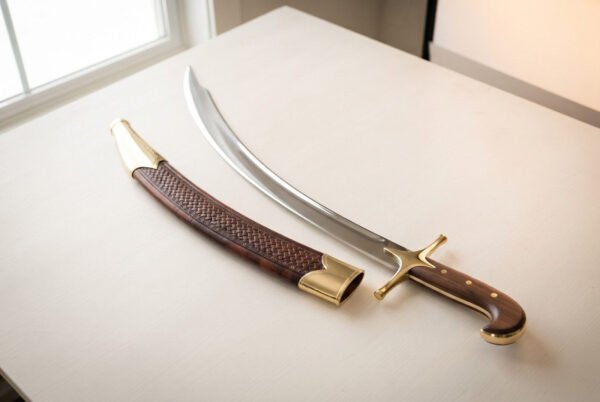
This one is forged and finished in the Czech Republic. The blade is 1095 high carbon steel, curved evenly from the guard and flaring into an upswept point, polished bright. The hilt is rosewood between brass quillons with a downturned brass pommel. It ships in a tooled leather scabbard with brass fittings, with a care card, and shipping inside the United States is free.
Specifications
| Steel | 1095 high carbon steel |
|---|
| Hardness | 54 to 58 HRC |
|---|
| Overall length | 35 inches |
|---|
| Blade length | 29 inches |
|---|
| Blade | Polished, even curve flaring into an upswept point with a stepped notch on the back edge |
|---|
| Guard | Straight brass cross guard with ball tipped quillons and short langets |
|---|
| Grip | Rosewood |
|---|
| Pommel | Hooked brass pommel cap |
|---|
| Scabbard | Tooled brown leather with a brass throat and hanging ring |
|---|
| SKU | RK-1387 |
|---|
What the hooked pommel is actually for
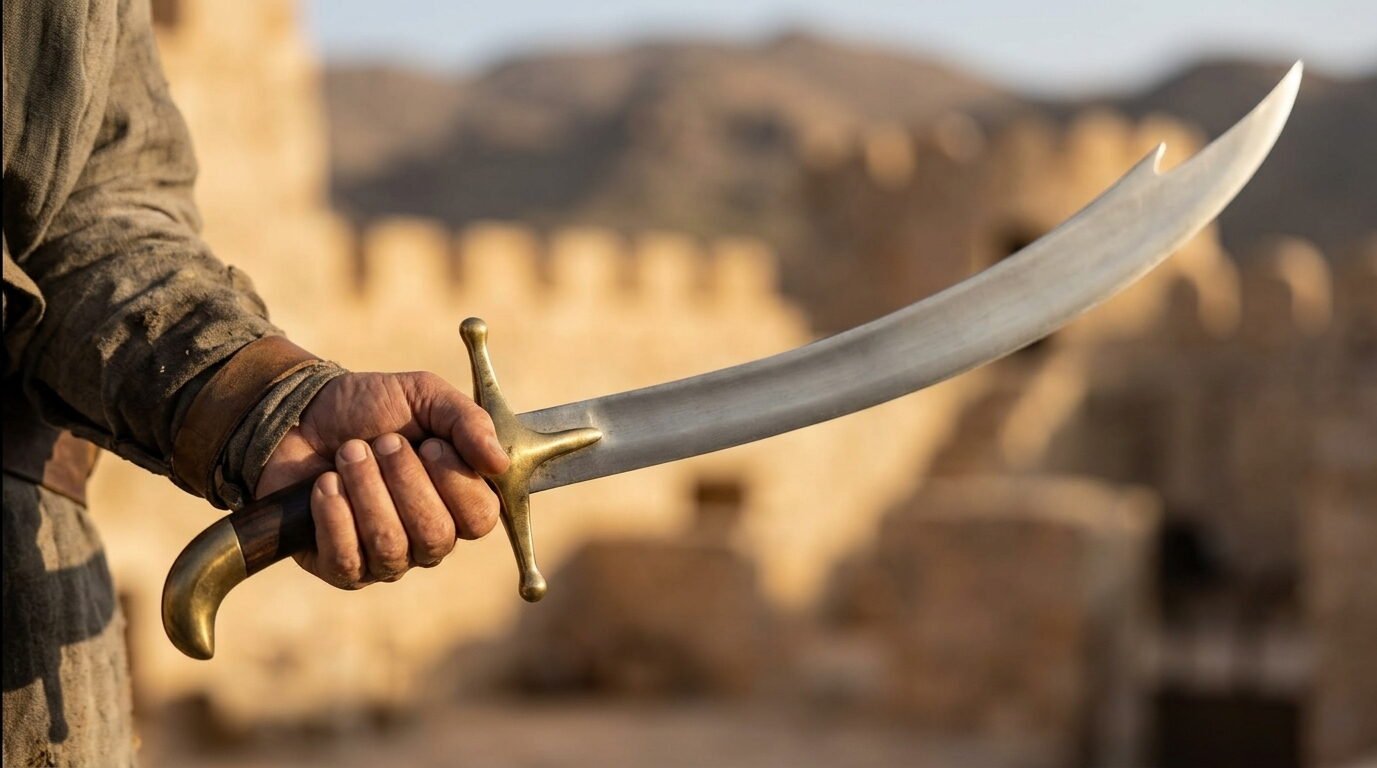
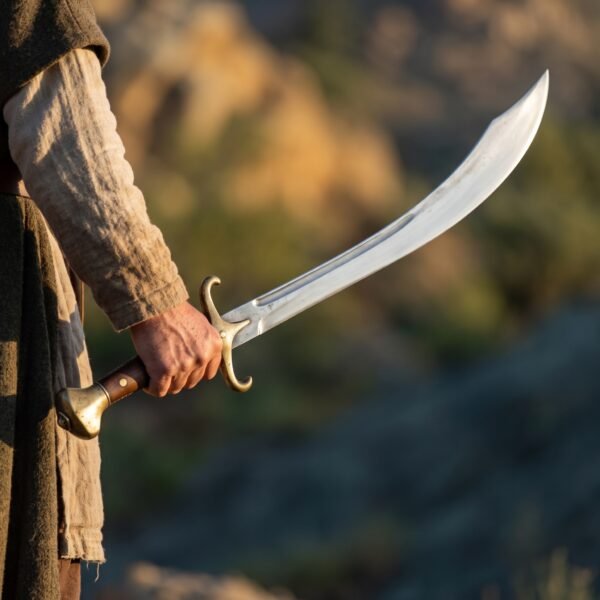
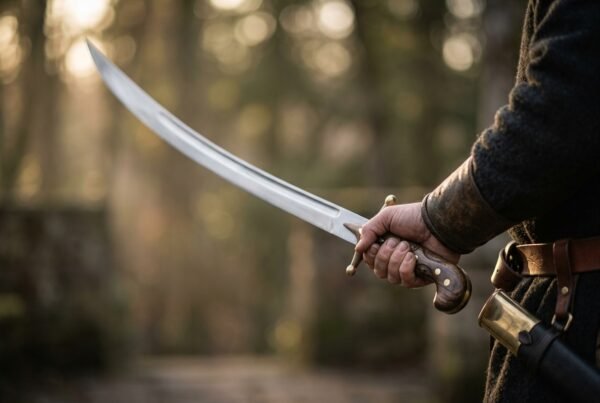
The most useful thing to understand about a sword like this is the pommel, because it looks decorative and is not. It curves down and back over the outside of the hand, and it exists to solve a specific problem created by the curve of the blade.
When a curved sword lands a cut, the impact is off the axis of the grip, so the sword tries to rotate in the hand and pull itself forward out of your fingers. A straight sword with a heavy round pommel solves this by counterweighting. A curved sword cannot afford that counterweight, because the whole design depends on keeping mass forward. The hooked pommel is the alternative answer: instead of balancing the rotation it physically blocks it, catching against the heel of the hand so the sword cannot travel. That is why you find some version of this hook on Persian shamshirs, Arabian saifs and Indian tulwars alike, and why the grip on all of them can be much slimmer than a European sword hilt of the same period. You are not gripping hard. The hilt is holding you.
Why 1095 high carbon steel and not stainless
1095 is a plain carbon steel with just under one percent carbon. There is no chromium in it, no vanadium, nothing exotic. That is exactly what you want in a sword blade. It hardens predictably right through a blade this thick, it holds a keen edge because the grain is fine and the carbides are small, and it stays tough enough at 54 to 58 HRC to take a bad impact without cracking.
Stainless steel adds chromium for corrosion resistance and pays for it with hard carbides that make a long blade brittle. It is the right answer in a kitchen and the wrong answer in a sword. What you accept in return with 1095 is that it will rust if left wet or handled and not wiped down, which is why every one of these ships with oil on it and a card explaining the routine. The full argument is on Damascus versus stainless.
The rosewood grip
Rosewood is dense, oily by nature, and takes a polish that does not go slippery, which is why it has been the standard hilt timber for curved swords across Persia, India and Arabia for centuries. It is heavy for a wood, but a curved sword wants a little weight in the hand to sit against all the mass out in the blade, so that works in its favour here.
The grip is shaped to the hand rather than turned round, with a slight swell in the middle so your fingers find the same position every time you pick it up, and it is fitted between a brass ferrule at the guard and the pommel cap at the butt so there is no exposed end grain to split. Rosewood is stable but it is still wood, and if the sword hangs in a room with dry winter heating it will benefit from a wipe of oil once or twice a year. There is more on that on wooden handle care.
Engraving, runes and your own design
Use the rune converter on this page to turn a name, a date or a short phrase into Elder Futhark and we will cut it into the steel or the handle. If you would rather have a Viking pattern than a rune line, choose your own design in the engraving option above the add to cart button and tell us whether it goes on the blade or the handle. Where a piece already carries an engraved design, your chosen engraving replaces it rather than sitting alongside it. On this sword the natural place for a line of text is the flat of the blade just forward of the guard, where it reads without competing with the curve. See the engraving page.
Care and sharpening
Wipe the blade down after anyone handles it and keep a thin film of oil on the steel. That is the entire routine. Skin oil is mildly acidic and a fingerprint left on polished carbon steel will etch a permanent grey mark in a week or two, so this matters more on a bright blade than a satin one. A light machine oil applied monthly with a rag is enough for a sword displayed indoors.
Leather scabbards need a mention of their own. The tanning residues in leather hold moisture against steel, so a sword left sheathed for months will corrode where it sits even in a dry house. Store this one drawn, on a stand or a wall mount, and use the scabbard for carrying and display rather than long term storage. Full details are on steel care. For putting an edge back on a curved blade, work in short sections along the arc and finish on a fine stone, as set out on sharpening with a whetstone.
Made in the Czech Republic
This is a handmade piece from the Czech Republic, made in a workshop that still forges, grinds and finishes by hand instead of stamping parts out. The smiths there have kept the older way of working, and the wood, horn and leather are shaped and fitted by hand as well. Two pieces of the same design will never be identical, and that is part of what you are buying.
Ransack Viking is a United States company. We handle the import ourselves, look over every piece when it lands and ship from our warehouse in Chicago, Illinois. Engraving is done in the United States after the piece arrives, so your design goes on before we send it out.
A note on handmade variation
This sword is hand forged. It is not machine made and it is not bulk produced, so what arrives will not be a pixel for pixel copy of the photograph on this page. Rosewood varies from board to board and no two grips will have the same figure. The brass will patina differently. The tooling on the scabbard is cut by hand and the depth of it changes with the leather. The exact curve of the blade shifts a fraction between pieces because it is drawn out under a hammer. Dimensions, steel and build stay the same. The character does not.
Frequently asked questions
Does it come sharp?
Yes, with a working edge. It is not razor honed out of the box, which is the right call for a thirty five inch sword that most people will be handling indoors. Ask and we will take it further before shipping.
Can I use it for test cutting?
It will cut mats and bottles without complaint. It is not a sparring sword and must never be edge to edge with another blade, and it should not be used on hard targets.
What is the difference between an Arabian saif and a Persian shamshir?
A shamshir is narrower and curves evenly along its whole length with no widening at all. A saif of this type carries a fuller belly and flares toward the point, so it hits harder at the cost of a slower recovery.
Will the scabbard fit if I have engraving done?
Yes. Engraving is cut into the surface and removes no material that affects fit. The scabbard is made to the blade after the engraving is finished in any case.
Will mine look like the photograph?
Closely, but not identically. Rosewood grain, brass tone and the hand tooled pattern on the scabbard all vary. The size, the steel and the build do not.
How long does shipping take?
Free in the United States. Two to three business days to dispatch a stock sword, two to three weeks to make one to order or to engrave it.
What is in the box
- Sandspire hand forged 1095 high carbon steel Arabian sword
- Tooled leather scabbard with brass fittings
- Care card with oiling and storage instructions
- Certificate of hand forging
- Forged and finished in the Czech Republic
Explore the range
See the rest of the scimitars, the whole swords collection, the sabres and the scabbards and sheaths, or read the guides.
Also in this part of the catalogue
Worth putting side by side with this is the Slatecrown scimitar, 36 inches overall. In the same category sits the Ironlotus scimitar, 34 inches overall. A near match for this one is the Nightwheel scimitar, 35 inches overall.
For a different piece from the same family, look at the Stonelark Chinese sword. Or start from a blank sheet on the design your own page.
Training at a HEMA club? Look at the Reifholm leather dussack for drills and free play, and check our synthetic trainer guide as well.

I collect stuff like this and this sword is on another level. Fit and finish is museum quality. You can tell real craftsmen made this by hand. Shipping was fast and everything arrived well packaged.