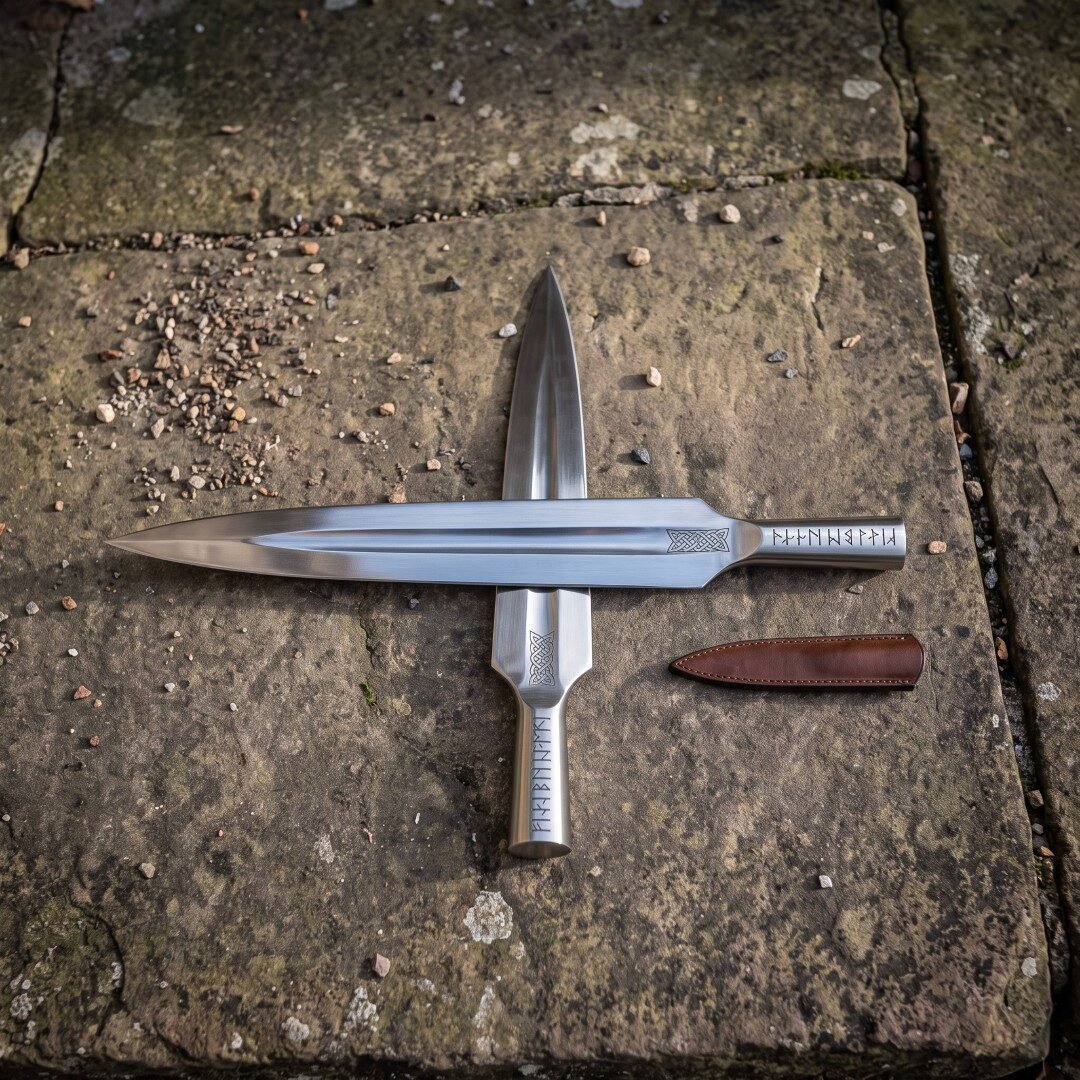
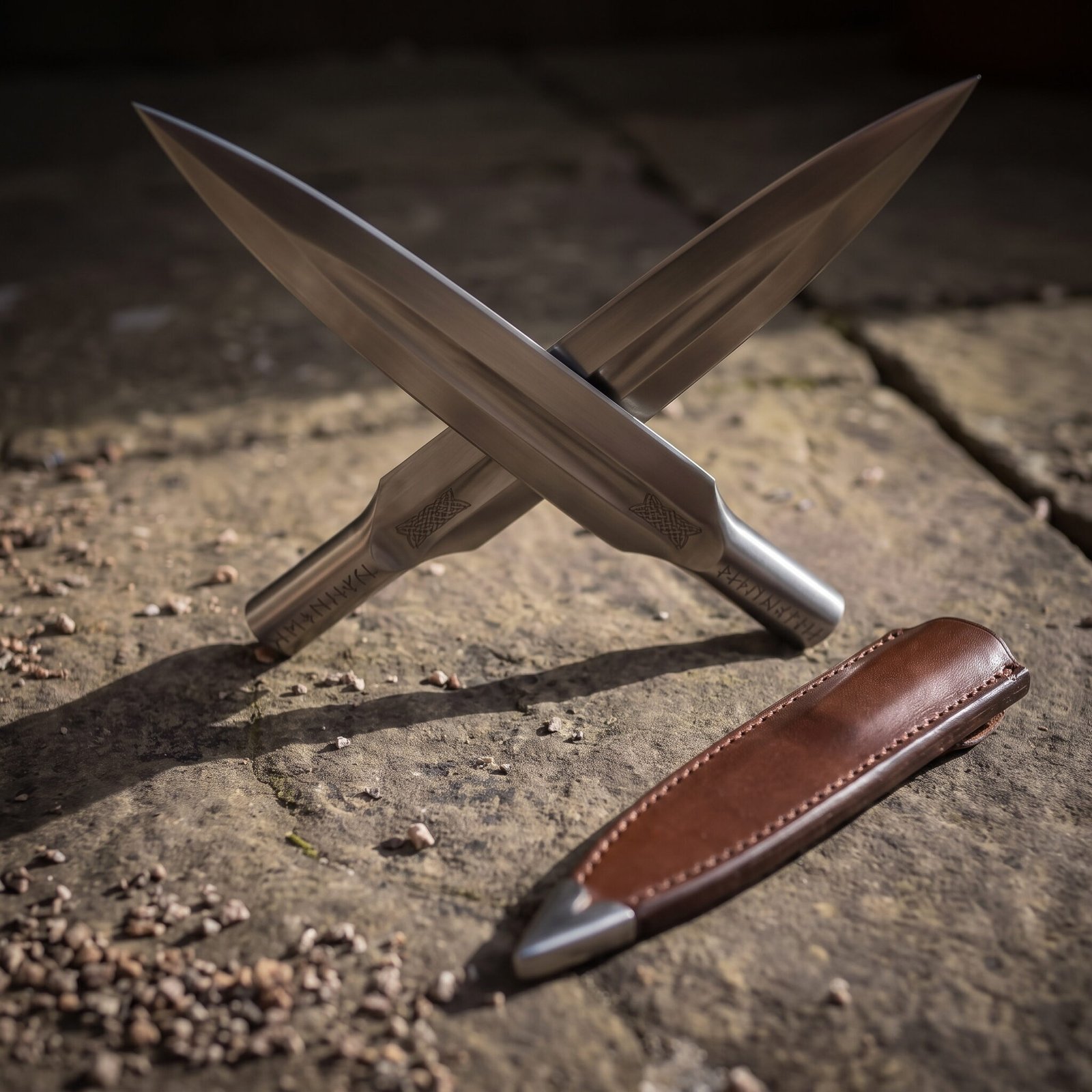
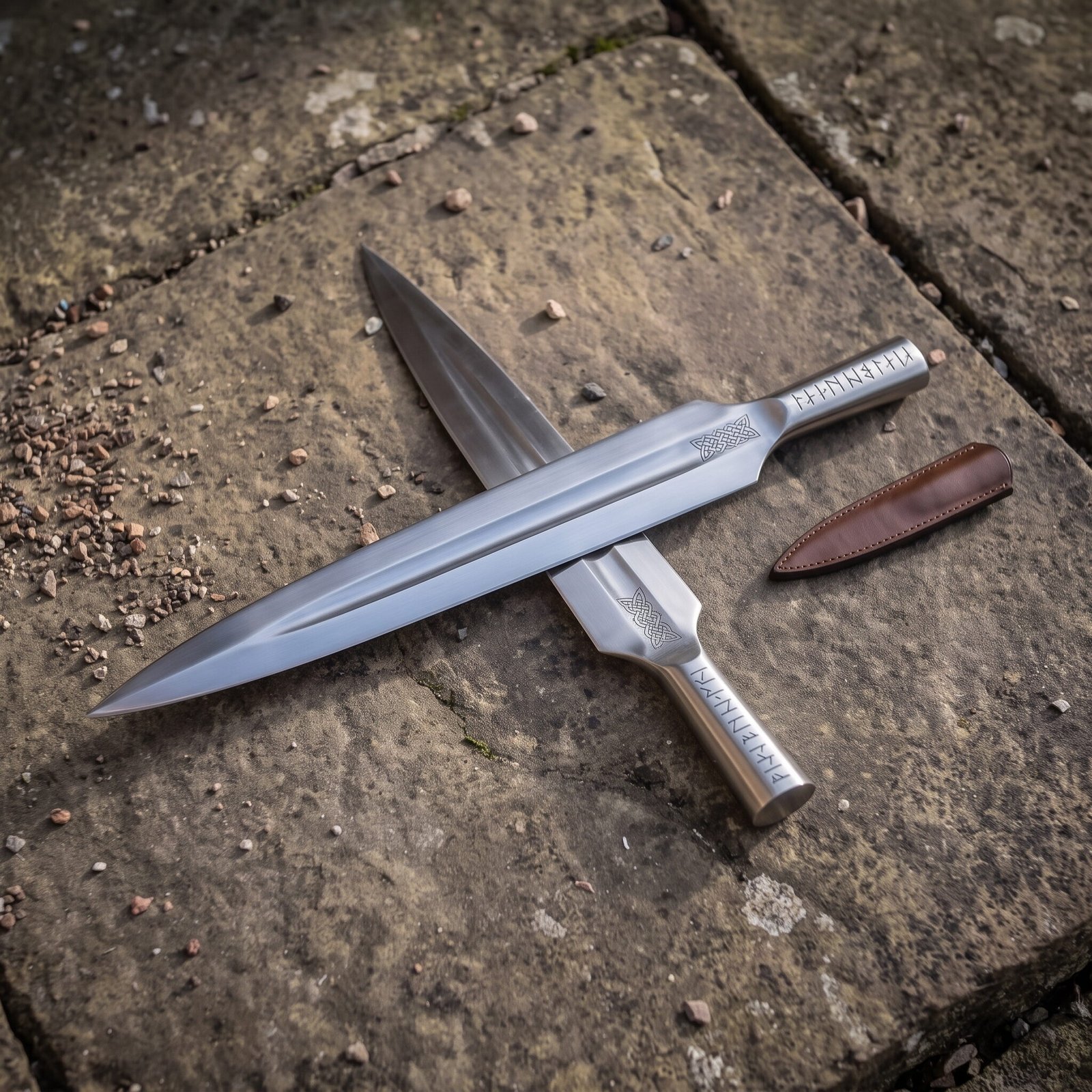
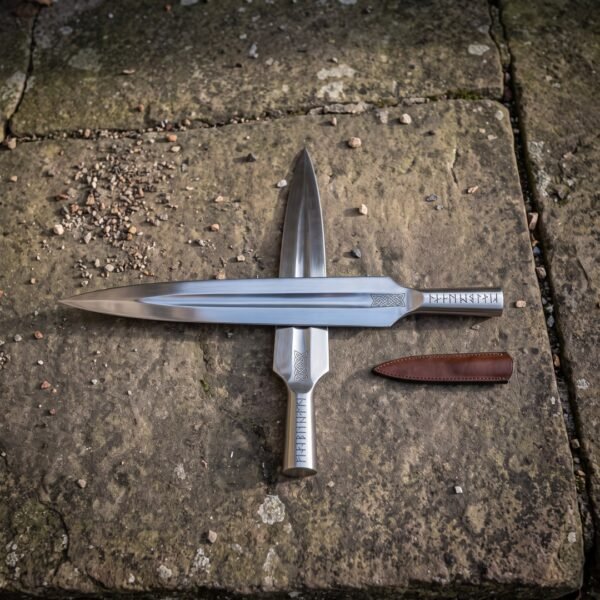
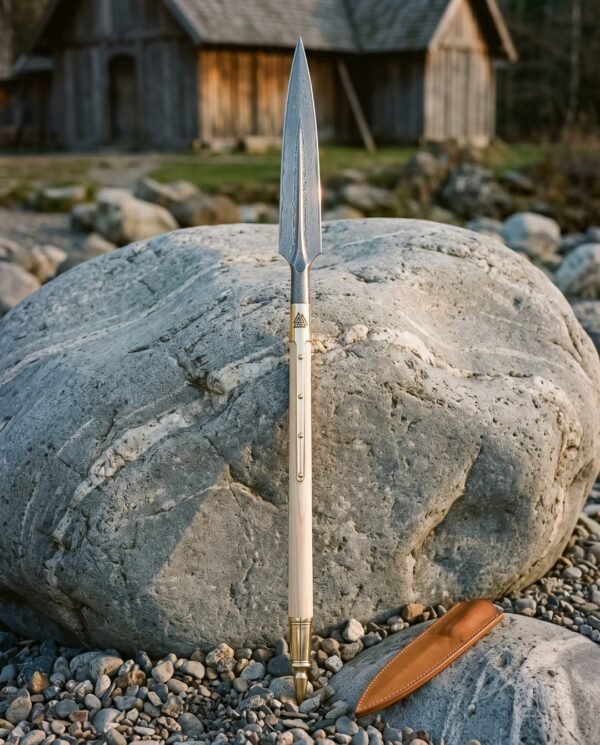
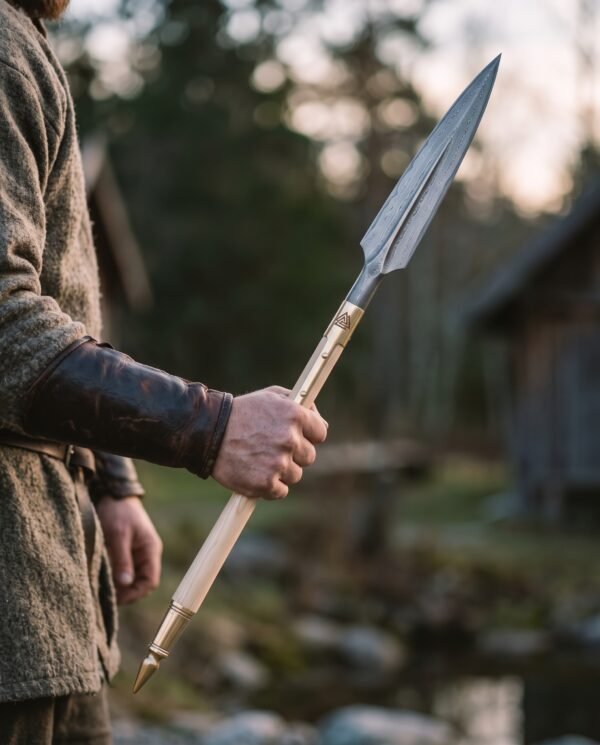
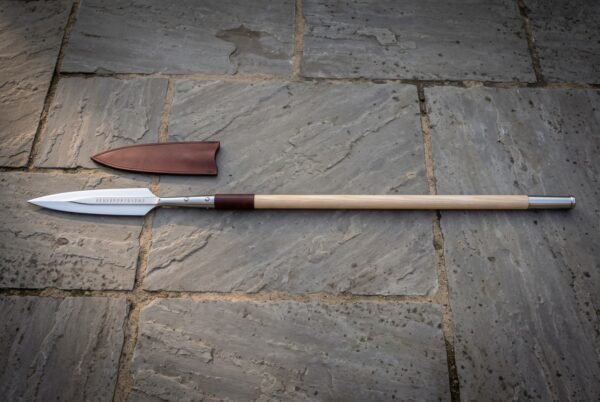
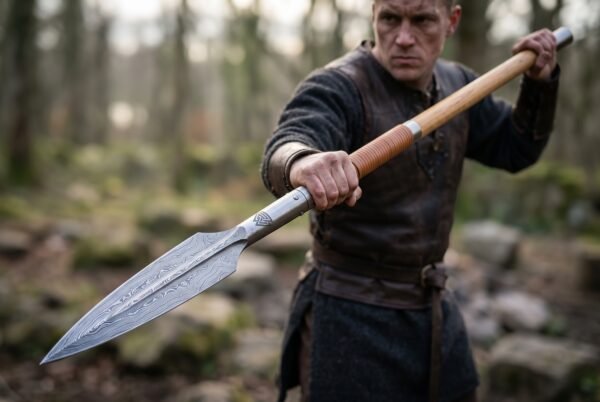
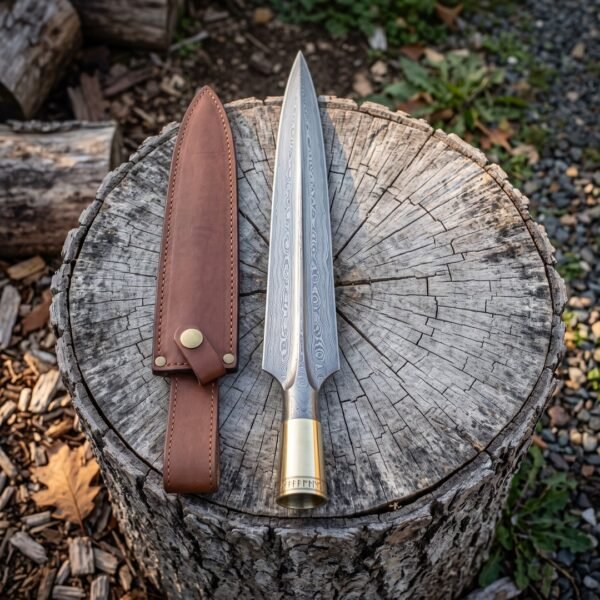
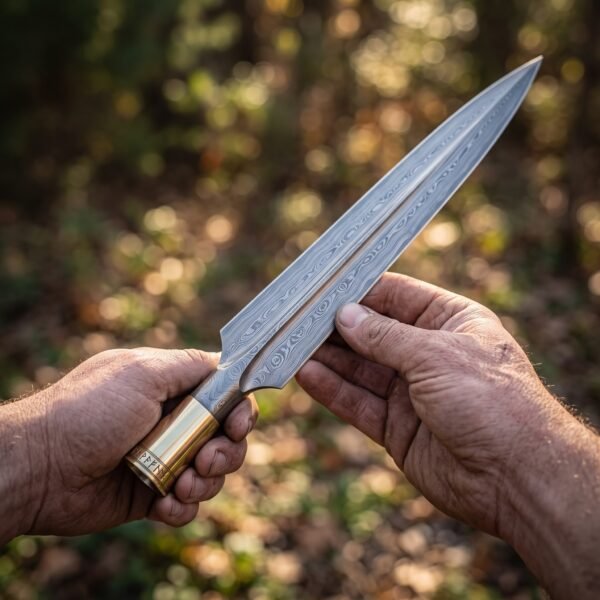
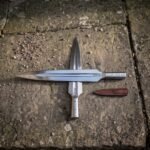
Two socketed spearheads forged as a matched pair, one broad and leaf shaped for hewing, one narrow and long for thrusting, both ground with a shallow central fuller down each face and both cut with a knotwork panel at the base of the blade and a line of Elder Futhark on the socket. A single leather blade sheath comes with them so whichever head is mounted can be carried covered. Both heads are polished bright, so the fullers and the cut lines catch the light.
Runes on a spear are not a modern invention. Two of the oldest datable runic inscriptions in Scandinavia are cut into spearheads. The Ovre Stabu head from Norway, around the year 200, carries the single word raunijaz, which means roughly tester or the one that tries, and the Kragehul shaft from Denmark carries a longer charm. Naming a spear and cutting the name into the steel was ordinary practice for the men who owned the best ones. These two are forged, ground, heat treated and engraved by hand in the Czech Republic, and they ship as a pair with the sheath. The paving in the photograph is scenery, and neither head ships with a shaft. The spear was the arm most Norsemen actually carried, and our piece on the Viking spear covers the types.
Specifications
| Material | 1095 high carbon steel, hardened and tempered to 54 to 58 HRC |
|---|
| Heads supplied | Two, one broad leaf hewing head and one narrow thrusting head |
|---|
| Broad head | Approximately 15 to 16 inches overall, double edged with a central fuller |
|---|
| Narrow head | Approximately 17 to 18 inches overall, long tapering double edged blade with a central fuller |
|---|
| Finish | Bright polished blades and sockets |
|---|
| Decoration | Engraved knotwork panel at the base of each blade and an Elder Futhark rune line on each socket |
|---|
| Sockets | Forged closed round sockets with a rivet hole, sized for shafts of about 1.1 inches |
|---|
| Sheath | One brown vegetable tanned leather blade sheath with stitched edge |
|---|
| Shafts | Not included |
|---|
| SKU | RK-1513 |
|---|
Why two shapes, and what each one does
The Norse did not have one spear, they had a family of them, and the blade shape tells you what the spear was for. A broad leaf head with a wide belly is a cutting head as much as a thrusting one. The sagas describe men hewing with the spear, taking off a limb or opening a shield rim, and you can only do that with a head that has enough width and enough edge behind the point to carry a cut. That is the wide head in this pair.
The narrow head is the other half of the argument. Length and a slim section mean it drives deeper for the same effort and it slips between the boards of a shield or through the rings of mail rather than glancing off. It is a hunting and battlefield thrusting head, less useful for cutting and far better at getting through something. Owning both is not indulgence, it is how a spear owner in the period would actually have equipped himself, one shaft and a choice of heads depending on the day.
The shallow fuller down each blade is doing the same work as the flute in a girder. Removing metal from the middle of the face and leaving the edges and the spine full makes the blade stiffer for its weight, so a long narrow head does not flex on a hard thrust.
The steel and the heat treat
Both heads are 1095 high carbon steel, quenched and tempered to 54 to 58 HRC. That is the right window for a spear. Harder than that and a point that hits bone or a shield boss chips instead of bending. Softer and the edge rolls the first time you cut something firm. It is a plain carbon steel rather than stainless, which means it takes and holds a genuinely fine edge and it will also rust if you neglect it. The sockets are forged rather than welded tube, closed around the mandrel, with a single rivet hole through the wall for a pin.
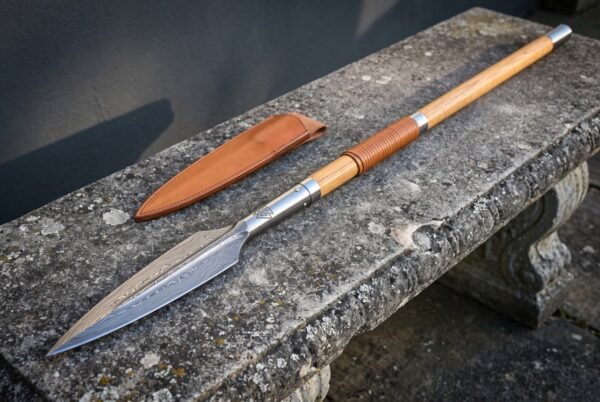
These are not Damascus. There is no folded pattern here and we are not going to imply one. They are honest monosteel heads, which is what the overwhelming majority of real spearheads were, and the engraving is a cut line rather than an etched or printed surface effect.
Engraving, runes and your own design
Use the rune converter on this page to turn a name, a date or a short phrase into Elder Futhark and we will cut it into the steel or the leather. If you would rather have a Viking pattern than a rune line, choose your own design in the engraving option above the add to cart button and tell us where it goes. Where a piece already carries an engraved design, your chosen engraving replaces it rather than sitting alongside it. On this pair you can have the same line on both sockets or a different line on each, which is what most buyers choose when the pair is a gift. Examples of the cut depth are on the engraving page.
Mounting and hafting
Neither head ships with a shaft. Ash is the traditional wood and hickory is heavier and tougher. Plane the top of the shaft to a slow taper, dry fit, and stop when the socket is about a quarter inch from full seating so the last of the travel is a friction fit, then drive it home and pin it through the rivet hole. If you are mounting a single shaft and swapping heads, a pin rather than a screw makes the change quick, and a light smear of beeswax in the socket keeps water out of the end grain.
For display, both heads sit well on an oak plaque with the sockets on turned wooden stubs, crossed or parallel. Keep them out of direct sun through glass, because a south facing window will cook the leather sheath long before it hurts the steel.
Care
1095 is not stainless. Wipe both heads down after handling and keep a light film of mineral oil or camellia oil on the blades and inside the sockets, because the inside of a socket is where rust starts unseen. Store the heads outside the sheath, since leather holds damp against steel. Feed the sheath with a neutral dressing twice a year. If a bloom of surface rust does appear, it lifts with fine oil and a nylon pad without touching the engraving. The routine we set out on steel care is exactly what these want. If you are kitting out for the field, our notes for reenactors cover what actually gets used.
Made in the Czech Republic
Every piece we sell is made by hand in the Czech Republic. The smiths there work the way the trade has been worked for a long time, heating and hammering the steel, taking the bevels down by eye, and fitting the handle and the leather one at a time. There is no automated line anywhere in it, so small differences from one piece to the next are normal and expected.
Ransack Viking is a United States company based in Chicago, Illinois. We bring the pieces in ourselves, inspect them on arrival and ship them from our own warehouse. If you add engraving, that is carried out here in the United States before your order goes out.
A note on handmade variation
This is hand made, not machine made or bulk produced, so what arrives will not be a pixel for pixel copy of the photograph. The exact width of a leaf, the depth of a fuller, the length of a socket by a fraction and the tone and grain of the leather sheath will all vary a little, because every head is forged and ground by hand from natural materials. The dimensions, the material and the build are the same every time. The character is not.
Frequently asked questions
Do I really get both heads
Yes. This listing is the pair, the broad hewing head and the narrow thrusting head, plus one leather sheath. If you only want one head, message us before ordering and we will price it as a single.
Are they sharp
They arrive with a working edge and a fine point. We will blunt them to a rebated edge free of charge if your reenactment group requires it, so put that in the order notes.
Is this Damascus steel
No. Both are 1095 monosteel with a bright polished finish. If you want a folded pattern welded head, we make those separately and we will never call a plain blade Damascus.
What shaft diameter do I need
Both sockets are sized for a shaft of about 1.1 inches at the head end. Standard ash spear stock in that range fits with a light taper cut on the top few inches.
Can I have a different rune line on each
Yes, at no extra cost. Give us both lines in the order notes and tell us which belongs on which head.
How long before it ships
One to two weeks of processing because each head is forged and engraved to order, then free shipping inside the United States.
What is in the box
- One broad leaf hewing spearhead in 1095 carbon steel
- One narrow thrusting spearhead in 1095 carbon steel
- Engraved knotwork and rune sockets on both heads
- One vegetable tanned leather blade sheath
- Care sheet and lifetime warranty against defects
- Forged and finished in the Czech Republic
Explore the range
See more in viking spears, Norse arms, glaives and polearms and battle axes, or read the guides on hafting a spear.
Others in the same line
Worth putting side by side with this is the Wyrmfang Viking spear, pattern welded Damascus. In the same category sits the Runeleaf Viking spear, 72 inches overall. A near match for this one is the Ashreaver Viking spear, forged from 1095.
For a different piece from the same family, look at the Wyrmtooth Norse arms. You can have this made your way instead on the custom Norse arms page.

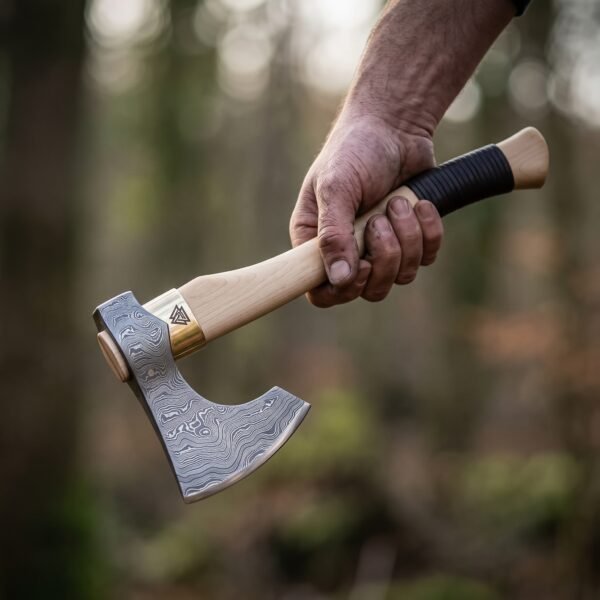
This thing is a beast in the best way. Haft feels sturdy and well balanced for the size of the head. 10/10 would buy again.