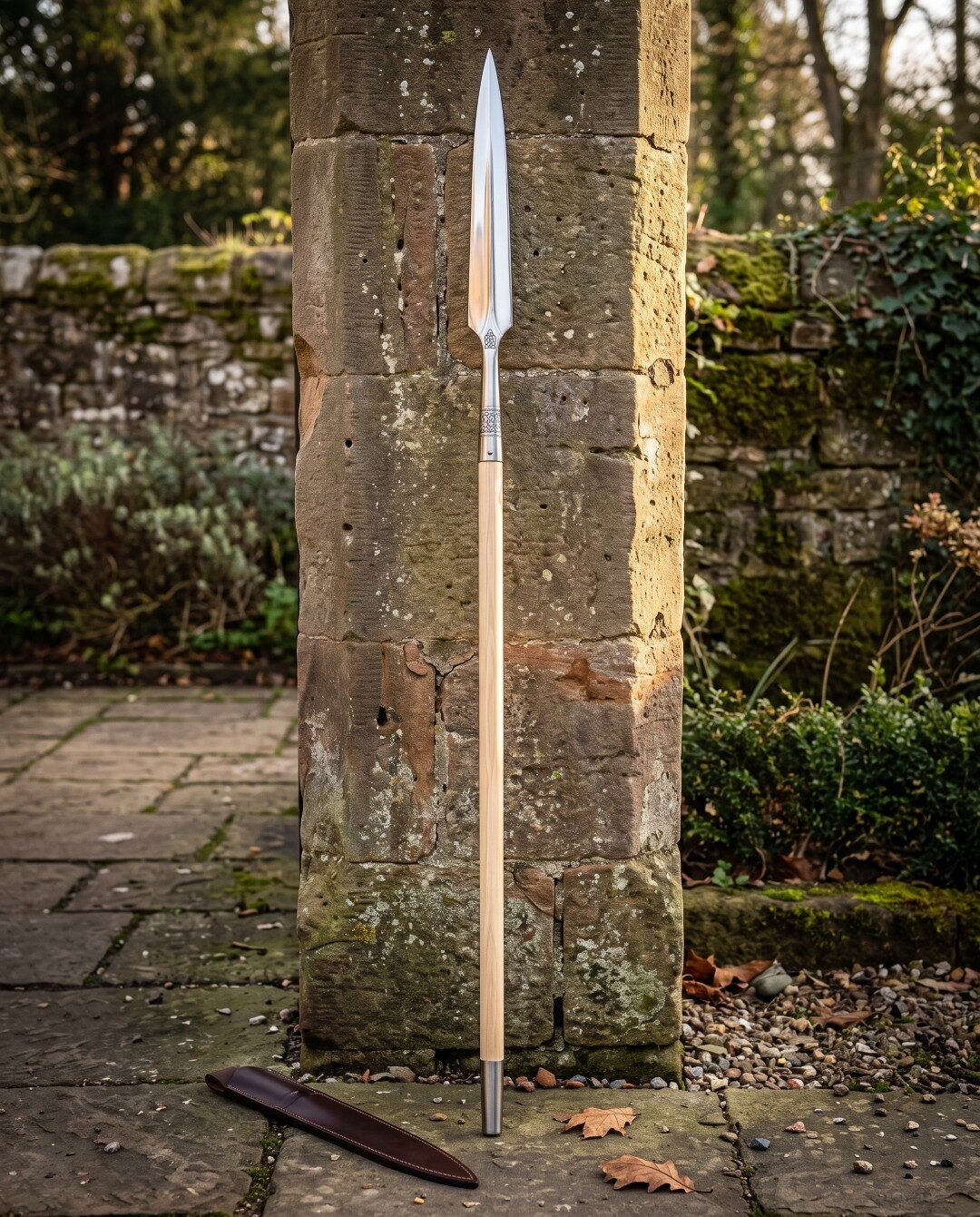
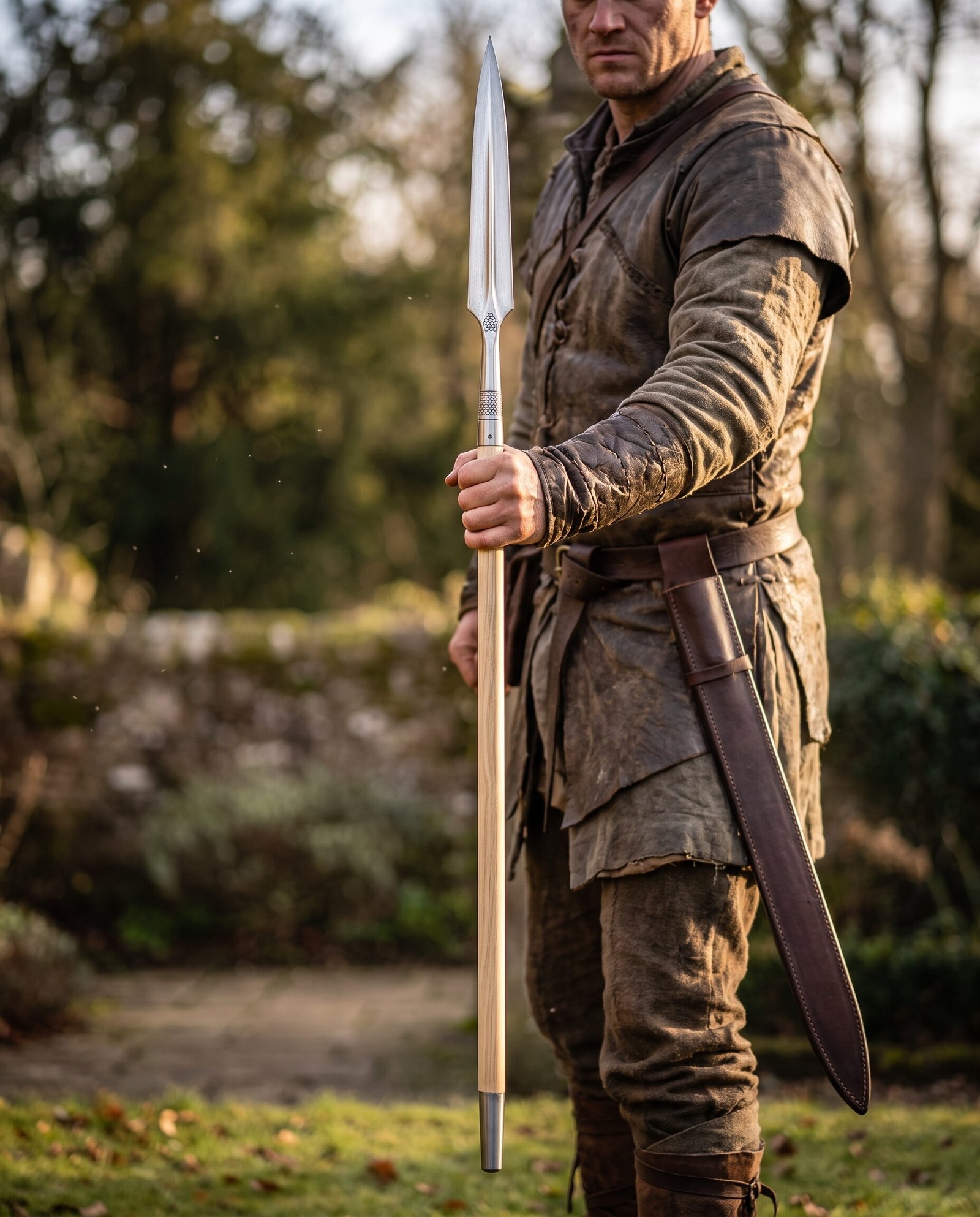
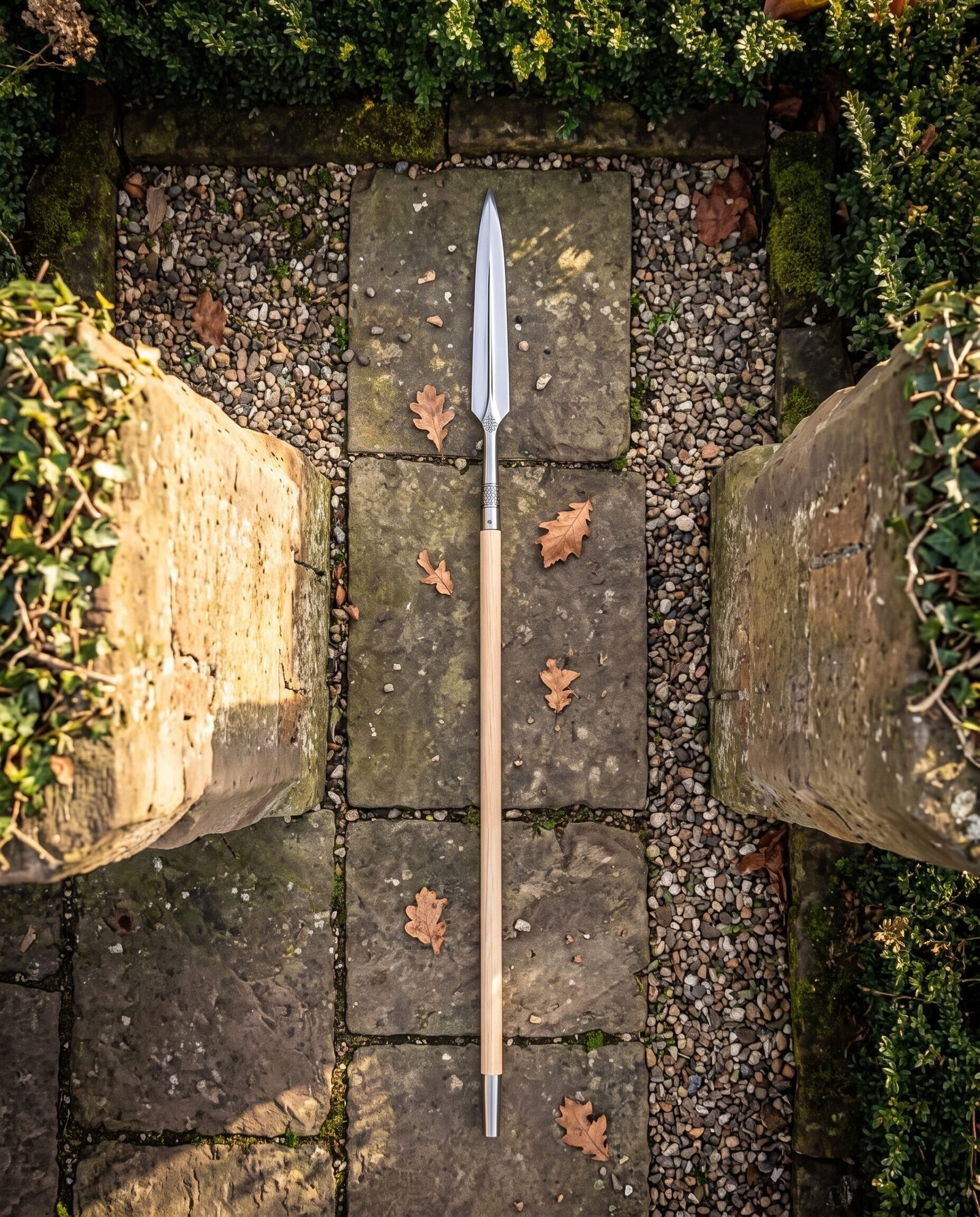
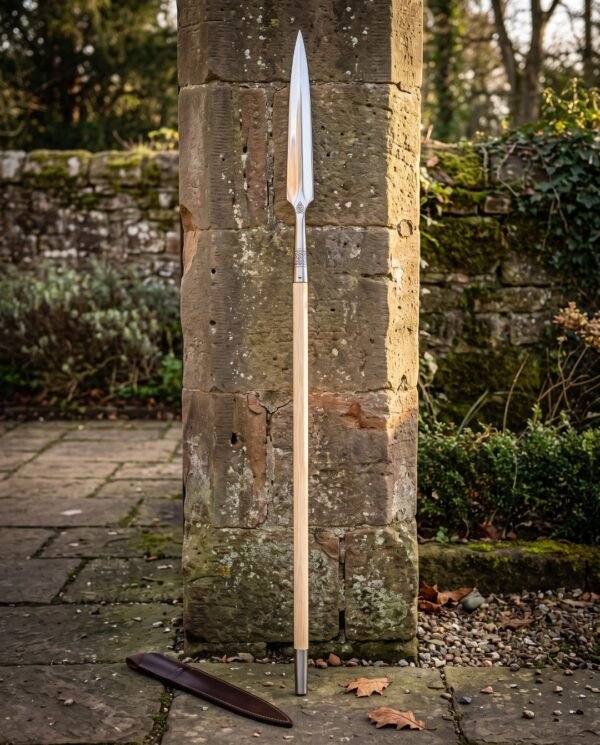
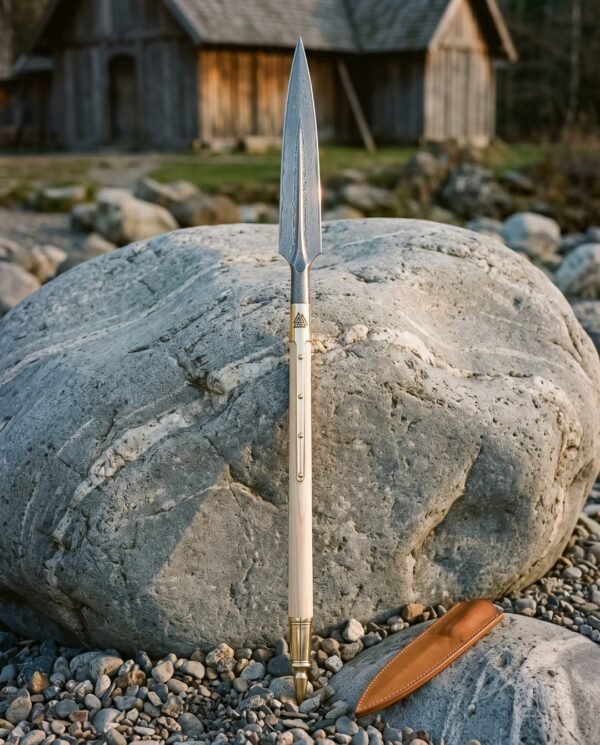
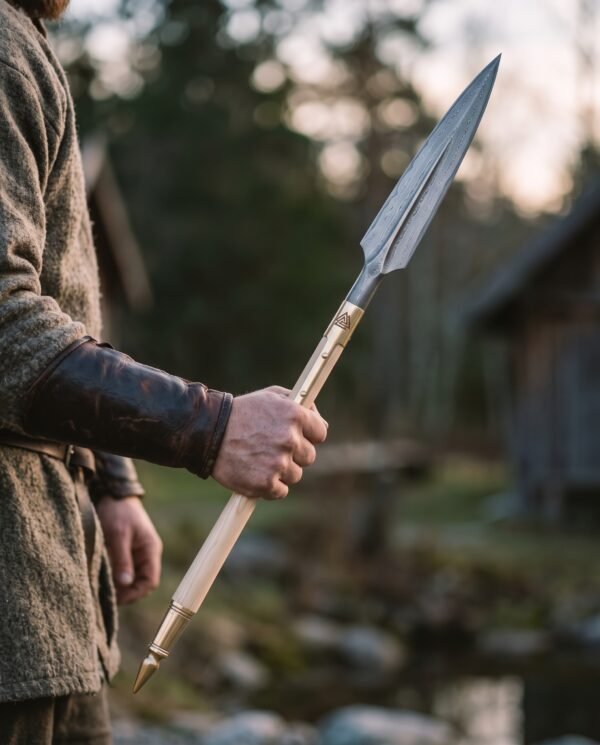
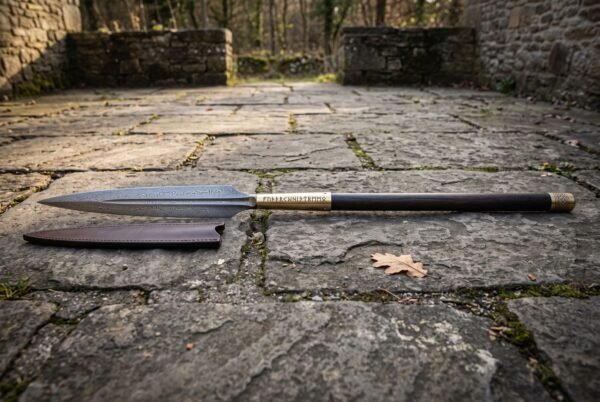
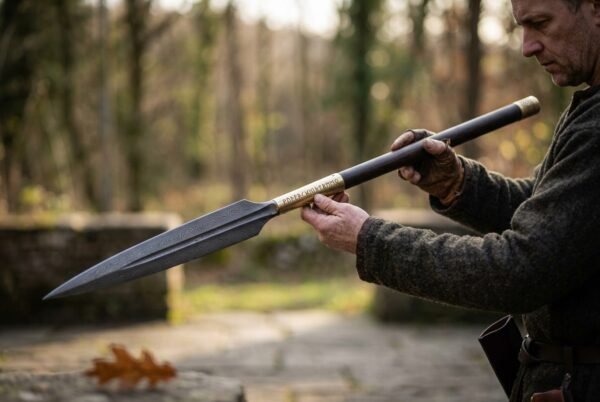
A complete spear rather than a head on its own. The blade is long and narrow with a diamond section and a raised spine, drawn out to a fine point, with a small panel of cut knotwork where the blade meets the socket. It is hung on a straight ash shaft of about four and a half feet, which brings it to about six feet overall, and finished at the bottom with a steel ferrule so the butt end can be planted in the ground without splitting the wood. Satin polish on the steel, oiled ash on the shaft, and a leather cover for the blade when it is stored or carried.
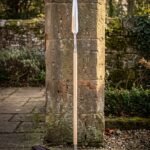
The spear carried a weight in the Norse world that nothing else did, and not only because it was cheap. Odin owned a spear, and the poems describe him casting it over an enemy host to dedicate them to himself before the fighting started. That gesture appears again in the sagas as a real human ritual, one man throwing a spear over the opposing line to open a battle. A spear that ordinary and that sacred at the same time is unusual. This one is forged, ground, heat treated, hafted and engraved in a Czech Republic workshop. The stone pillar and the garden in the photograph are scenery and are not part of the order. The spear was the arm most Norsemen actually carried, and our piece on the Viking spear covers the types.
Specifications
| Head material | 1095 high carbon steel, hardened and tempered to 54 to 58 HRC |
|---|
| Head form | Long narrow lanceolate blade with a diamond section and a raised spine |
|---|
| Head length | Approximately 27 inches including the socket, with a blade of about 20 inches |
|---|
| Socket | Long round steel socket with a cut knotwork band |
|---|
| Shaft | Straight grained ash, approximately 4.5 feet, oiled finish, about 1.1 inches thick |
|---|
| Butt | Steel ferrule fitted to the base of the shaft |
|---|
| Fixing | Socket pinned through a drilled rivet hole |
|---|
| Decoration | Small cut knot at the base of the blade and a cut knotwork band on the socket |
|---|
| Overall length | Approximately 6 feet assembled |
|---|
| Cover | Dark brown stitched leather blade cover |
|---|
| SKU | RK-1518 |
|---|
What the butt ferrule is actually for
Most people assume the metal cap at the bottom of a spear is a spike for stabbing, and on some period spears it was. On a shaft like this one it is doing three quieter jobs that matter far more in daily use.
First, it stops the end grain of the shaft splitting. Wood is weakest where you can see the growth rings, and the bottom of a spear spends its life being thumped into earth, gravel and flagstones. A ferrule turns that end grain into a protected face. Second, it lets you plant the spear. A spear stood upright in soft ground is a spear you can pick up in one motion, and a line of them planted at the front of a shield wall is faster to take up than a bundle laid flat. Third, it balances the spear. Adding a few ounces at the very bottom pulls the point of balance back toward your hands, which makes a long spear feel far lighter and quicker than it has any right to.
The pin through the socket does the last part of the job. A friction fit alone will hold a head on the push and can let it walk off on the pull back, and a single pin through a drilled rivet hole stops that permanently while still allowing the head to be driven off if a shaft ever needs replacing.
Steel, wood and finish
The head is 1095 high carbon steel, quenched and drawn to 54 to 58 HRC. Hard enough to hold a fine point and an edge, soft enough that the tip will take a knock without shattering. Plain monosteel, not Damascus, and we say so rather than let the satin finish imply layers that are not there. The knotwork is a cut line rather than an etch or a print.
The shaft is ash, chosen for straight grain with the growth rings running the length rather than out through a face, because a shaft with run out is a shaft that breaks at the run out. Ash is the traditional choice for good reason. It is springy rather than brittle, so it absorbs shock and returns instead of snapping, which is why it was used for spears, tool handles and oars alike. The finish is oil rather than varnish, so the wood can be re oiled and does not develop the sticky peeling skin a lacquered shaft gets after a wet season.
Engraving, runes and your own design
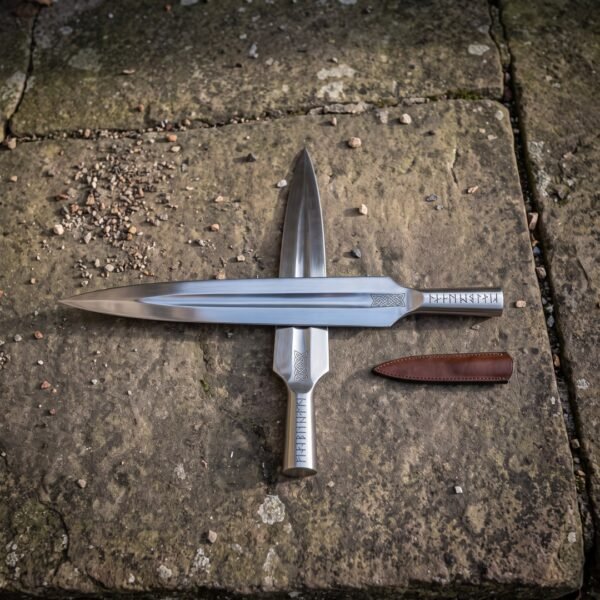
Use the rune converter on this page to turn a name, a date or a short phrase into Elder Futhark and we will cut it into the steel or the leather. If you would rather have a Viking pattern than a rune line, choose your own design in the engraving option above the add to cart button and tell us where it goes. Where a piece already carries an engraved design, your chosen engraving replaces it rather than sitting alongside it. On this spear the socket takes a rune line neatly and the existing knotwork panel at the blade base is what a chosen design would replace. We can also brand or cut a mark into the ash shaft itself, which is a good option for a named gift. See the engraving page.
Mounting, display and shipping length
A spear this long is a real object in a room, so plan where it goes before it arrives. Two horizontal wall brackets set about four feet apart will carry it safely, and the leather cover on the blade is worth keeping fitted if it hangs anywhere near head height or where children can reach. Vertically it needs a floor stand with real weight in the base, because six feet of spear falling over is a long lever.
It ships in a single long carton with the head unpinned and packed separately from the shaft, which is what keeps the point safe in transit. Fitting it at home takes a minute. Slide the socket down, line up the drilled hole, tap the pin through, done.
Care
Wipe the head after handling and keep a light film of mineral oil on it, paying attention to the inside of the socket where damp collects unseen. Re oil the ash shaft once or twice a year with boiled linseed, especially at the ends, and take particular care of the wood inside the ferrule since that is where rot would start if the spear were left standing in a wet corner. Store it out of the leather cover rather than sealed in it. Check the pin every season. The oiling and rust routine on steel care covers the steel. If you are kitting out for the field, our notes for reenactors cover what actually gets used.
Made in the Czech Republic
The work behind this piece happens in a Czech Republic workshop that has kept to the old methods. Steel is forged and heat treated by hand, the grind is taken down by eye rather than by machine, and the handle, fittings and sheath are cut and finished one at a time. Because of that, every piece carries small marks of the hand that made it.
Ransack Viking is a United States company. We import direct, check each piece when it reaches us, and ship from our Chicago, Illinois warehouse. Engraving is added here in the United States after arrival, so the piece you receive is finished to your order.
A note on handmade variation
This is hand made, not machine made or bulk produced, so what arrives will not be a pixel for pixel copy of the photograph. Ash grain and colour differ from shaft to shaft, the blade profile is ground by eye so its taper is its own, and the knotwork panel is cut by hand. The dimensions, the material and the build are the same every time. The character is not.
Frequently asked questions
Does the shaft come as one piece
Yes, one continuous piece of ash at about four and a half feet, shipped in a long carton with the head packed separately so the point is protected. We do not make a two part screw together shaft because a joint in the middle of a spear is a weak point.
Is the head sharp
Yes, with a fine point and a working edge. We will rebate the edge and round the point at no charge if your reenactment group requires blunt edges, so say so in the order notes.
Can I use this in a shield wall
For a display line or drill, yes, provided the group allows sharp or has us blunt it. For full contact combat, follow your group rules on spear tips, which usually require a rebated or padded head, and tell us what standard you need.
How heavy is it
Assembled it is light for its size, because most of the weight is spread down the shaft. The butt ferrule pulls the balance back toward the hands, so it handles far quicker than the length suggests.
Can I get a shorter shaft
Yes. Six feet for a one handed spear used with a shield, seven for general use, eight if you want the reach. Tell us the length you want and we will cut and fit it.
How long until it ships
Processing is one to two weeks because each head is forged and each shaft is fitted to it, then shipping is free inside the United States even at this length.
What is in the box
- One hand forged 1095 spearhead with a cut knotwork panel
- One ash shaft of about four and a half feet with an oiled finish
- Steel butt ferrule, fitted
- Fixing pin for the socket
- Vegetable tanned leather blade cover
- Care sheet and lifetime warranty against defects
- Forged and finished in the Czech Republic
Explore the range
See more in viking spears, Norse arms, glaives and polearms and round shields, or read the guides.
Compare it with these
Also in this group is the Twinfang Viking spear. Sitting beside it in the catalogue is the Ashreach Viking spear, pattern welded Damascus. Another in the same line is the Skyrend Viking spear, pattern welded Damascus.
For a different piece from the same family, look at the Silverleaf Norse arms. Pick the steel, the length and the fittings yourself on the custom Norse arms page.

Nice piece for the price. Glad I made this purchase.
This thing is a beast in the best way. So worth it.
My husband was speechless when he opened this. Came in solid packaging and arrived in perfect condition. Love that this is Czech craftsmanship and shipping from the US meant it showed up in just a few days. If you’re on the fence just get it. You won’t regret it.
Been eyeing this polearm for months and it did not disappoint. I keep coming back to Ransack Viking because it’s always this good.
Was nervous ordering something like this online but so glad I did. Great for reenactment or just display. Either way it looks amazing. Shipping was fast and everything arrived well packaged.