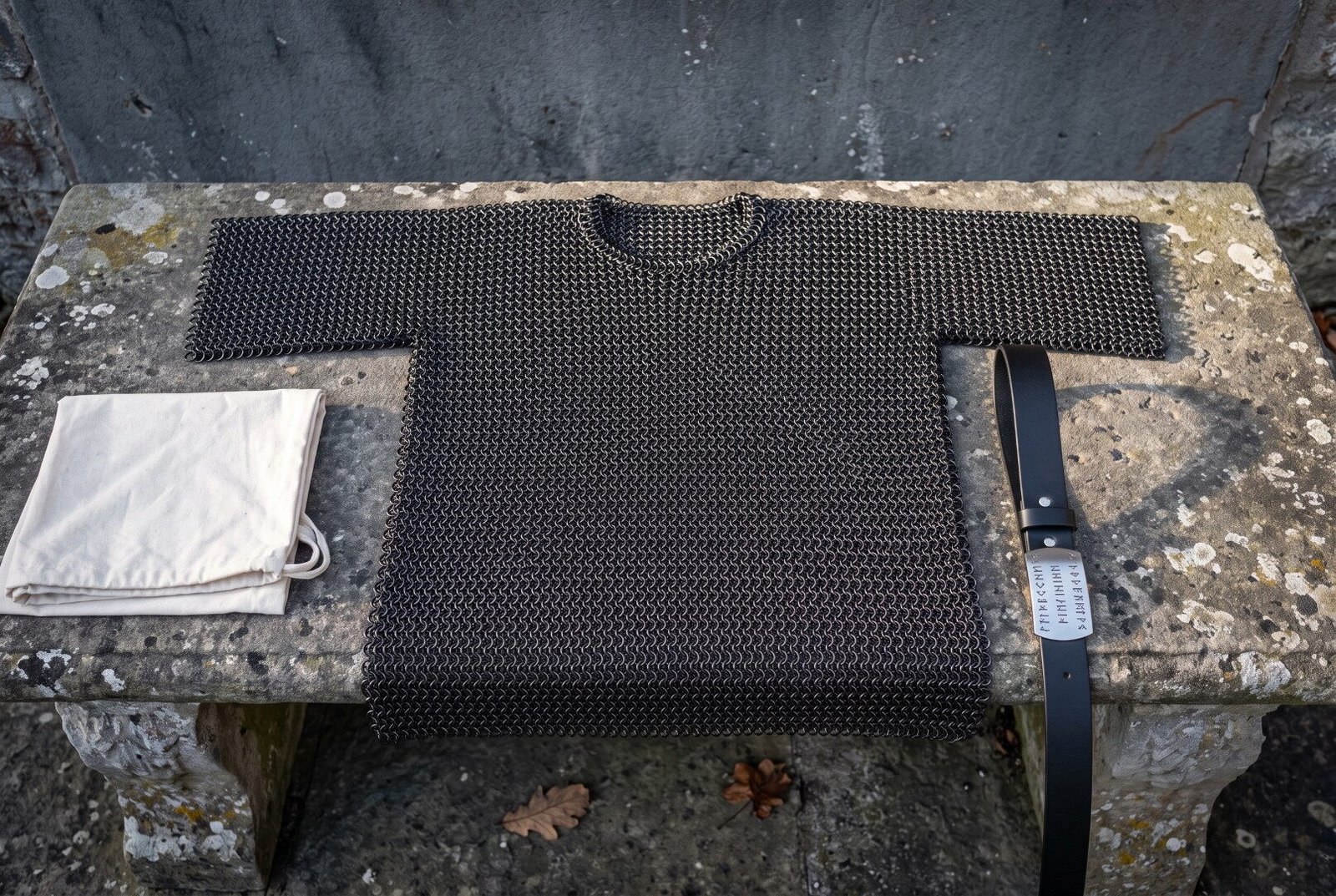
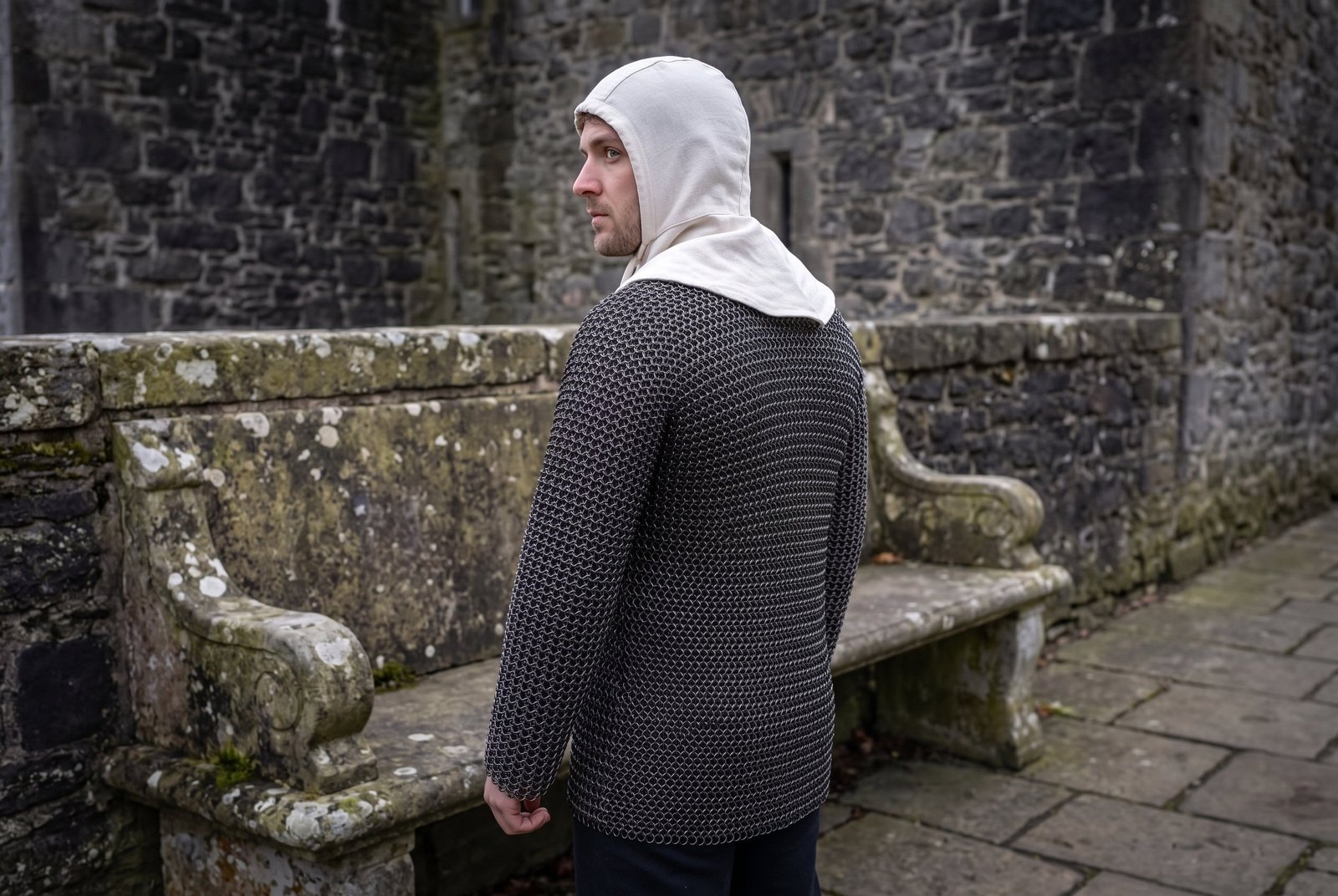
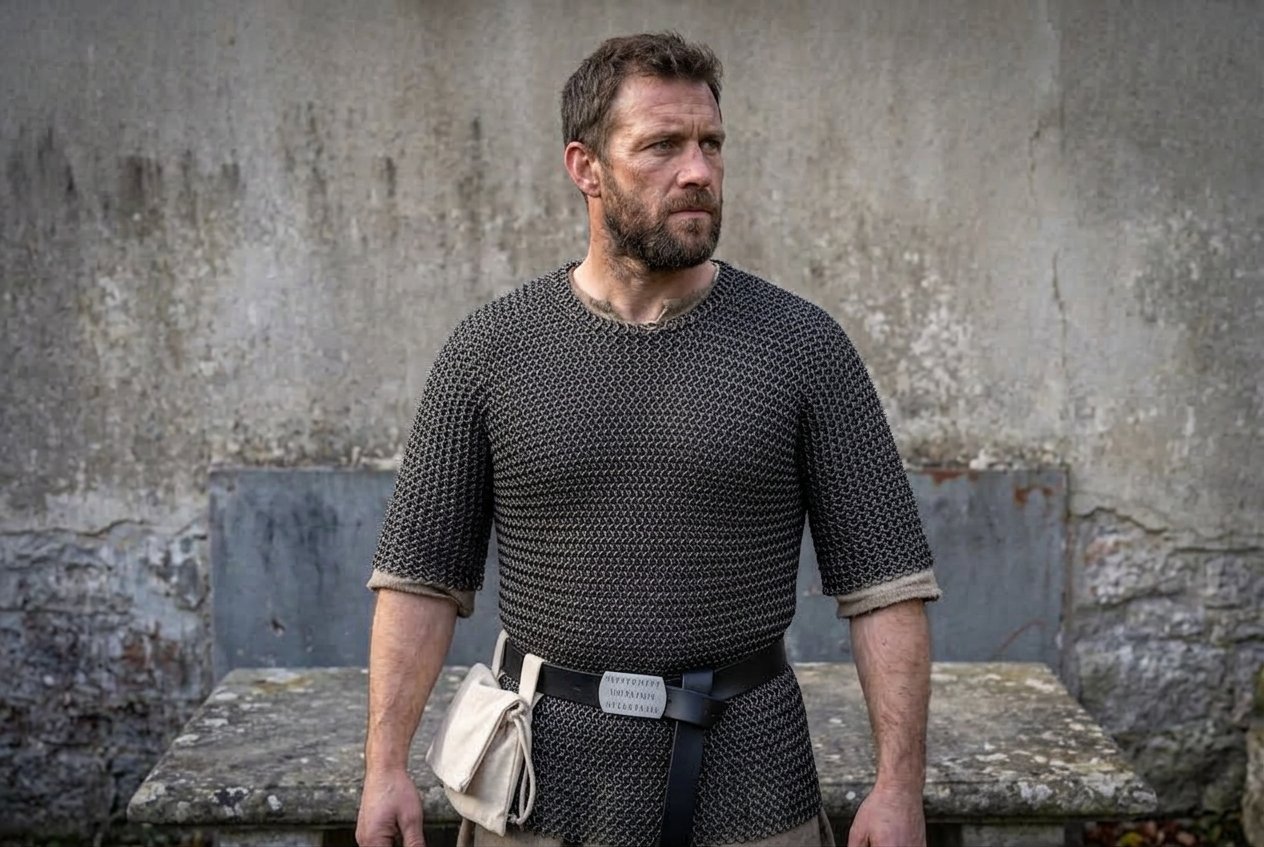
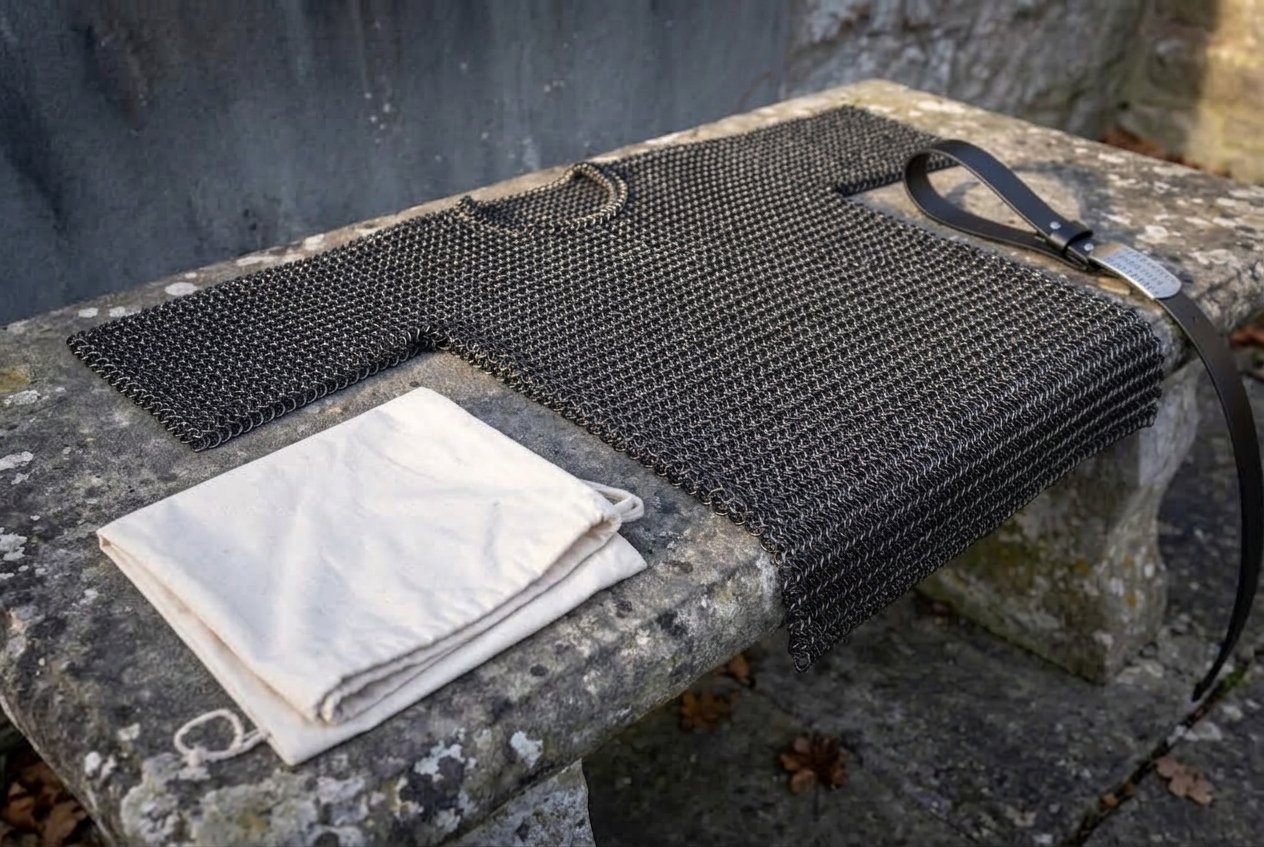
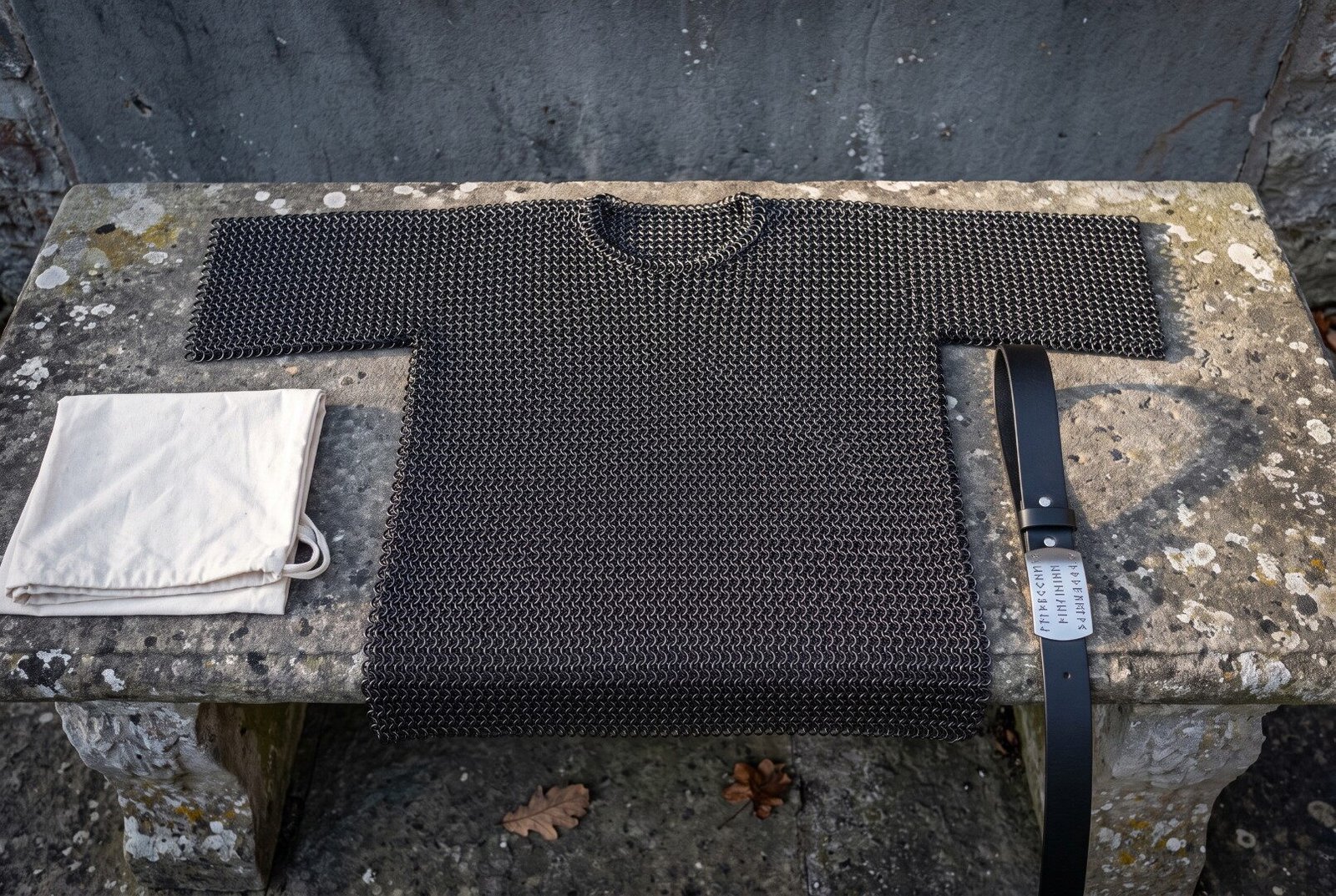
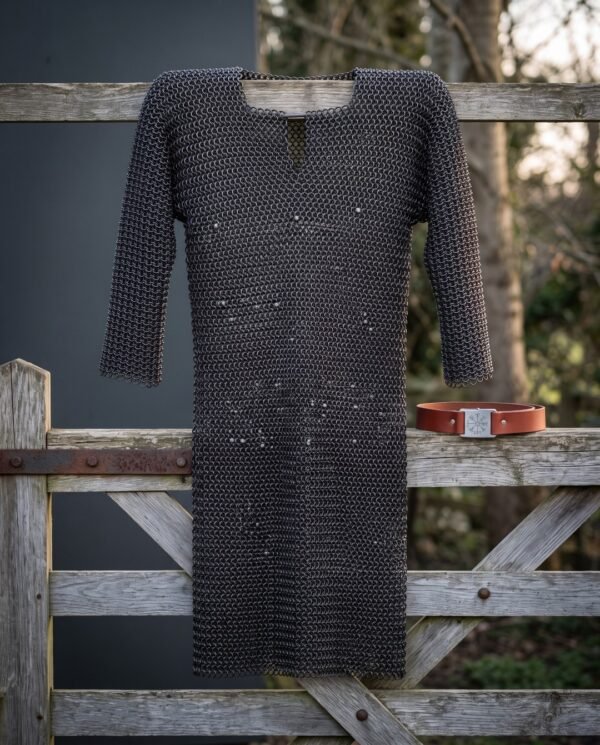
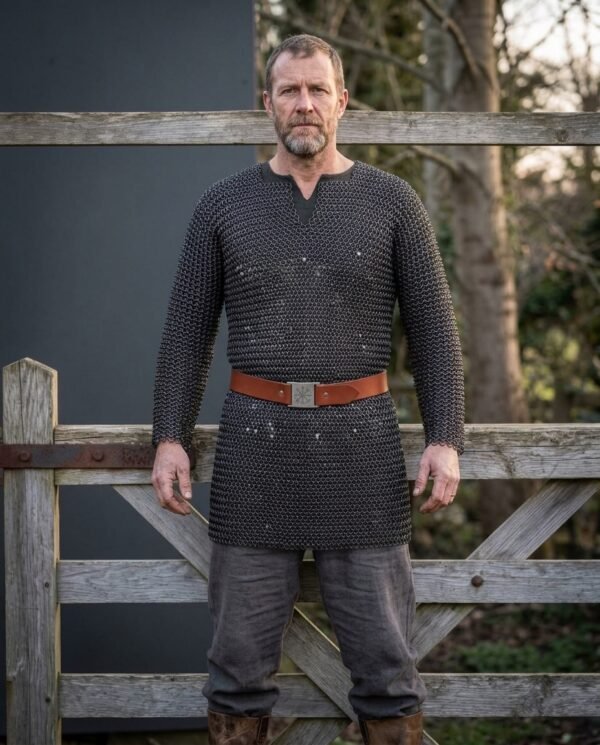
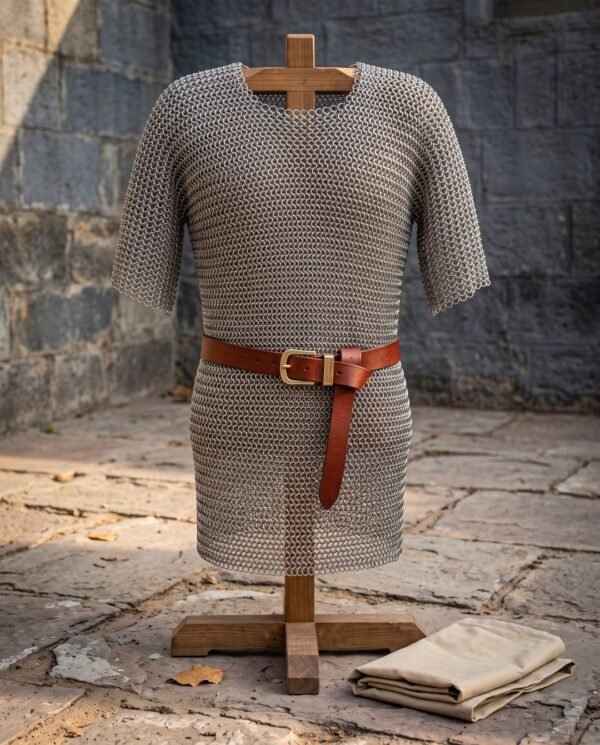
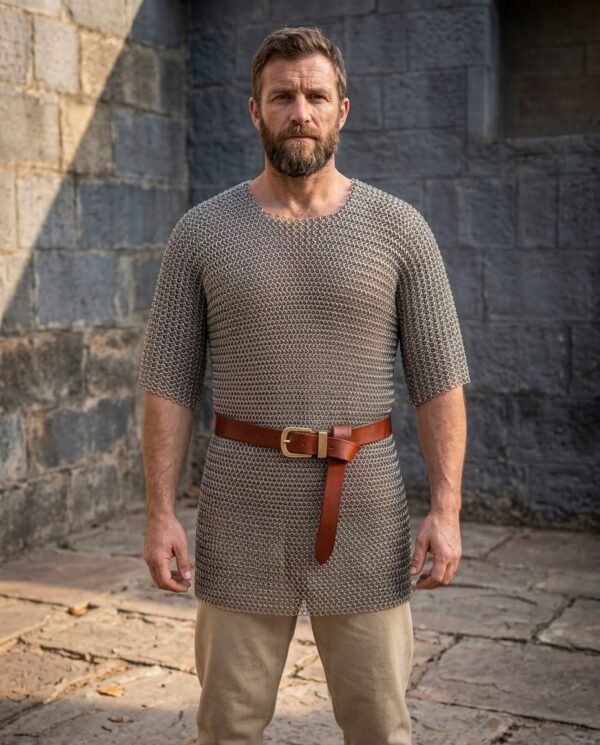
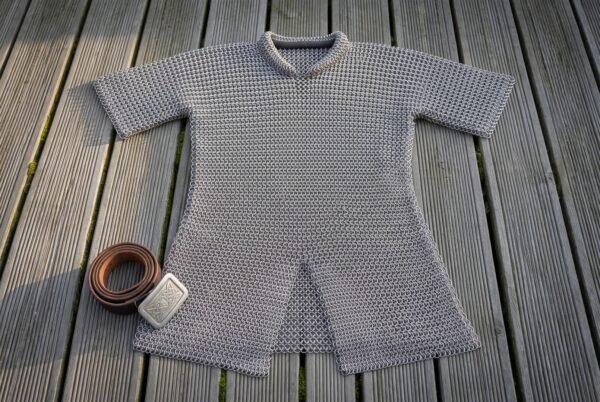
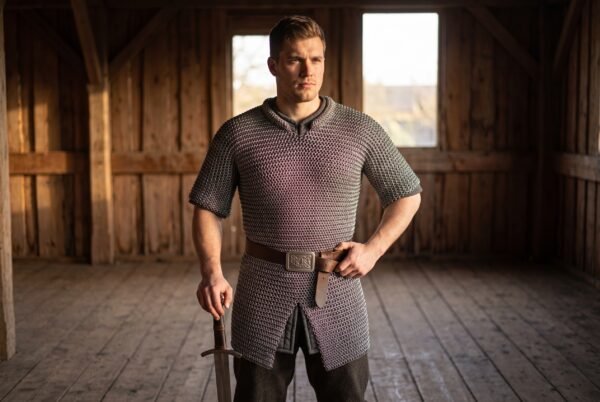
A short sleeved mail shirt cut to hip length, woven ring by ring in the 4 in 1 European pattern from blackened mild steel and finished with a plain round neck. The Old Norse word for it is brynja, and the word we use in English is simply mail, from the Latin macula, meaning a mesh or a net. Chainmail is a nineteenth century coinage that stuck, and every medieval source just says mail, because to the people wearing it there was nothing else it could be confused with.
It is also far older than the Vikings. Mail turns up in Northern Europe in the Iron Age, and the Vimose bog deposit in Denmark produced mail fragments dating to the second or third century, centuries before the first longship. The Romans wore it as the lorica hamata and never stopped, and it stayed in service in one form or another for the better part of two thousand years, which no other armour type can claim. The reason is simple. Mail is flexible, it covers a body without needing to be fitted to it, and it defeats a cut absolutely. This shirt is woven and closed by hand in a Czech Republic workshop. The folded cloth and the black belt in the photograph are studio props and are not included. What was worn over mail and what went under it is set out in our piece on Viking armour.
Specifications
| Material | Mild steel rings, blackened and lightly oiled |
|---|
| Ring type | Butted round wire rings. The ends are closed against each other and are not riveted |
|---|
| Weave | 4 in 1 European, each ring passing through four others |
|---|
| Ring size | Approximately 9 mm internal diameter in 16 gauge wire |
|---|
| Neck | Plain round neck, no opening or lacing |
|---|
| Sleeves | Short, ending at about the elbow |
|---|
| Body | Hip length with a straight hem |
|---|
| Size or fit | Standard build cut for a 46 inch chest |
|---|
| Weight | Approximately 16 lb |
|---|
| Lining | Unlined. A padded gambeson is worn underneath and is not included |
|---|
| Intended use | Display, living history, costume, film and light reenactment. Not safe for full contact combat |
|---|
| SKU | RK-1581 |
|---|
Butted mail and riveted mail, and why the difference matters
This is the most important paragraph on the page, so we will not bury it. This shirt is butted mail. Every ring is bent closed so the two cut ends meet, and nothing holds them together except the spring of the wire. Riveted mail, which is what every surviving historical shirt actually is, takes each ring, overlaps the two ends, punches or pierces a hole through the overlap and sets a tiny rivet through it. That rivet is the whole difference.
A butted ring will open. Put a spear point, an arrow or a thrusting sword into the face of butted mail and the point goes between four rings and pushes them apart, because the only thing resisting it is a wire joint with nothing through it. A riveted ring cannot open without shearing the rivet, which takes far more force than any sword or axe delivers. That is why period mail is riveted, why it was worth two months of a smith labour to make, and why a mail shirt was one of the most expensive things a Norse warrior could own.
So be clear about what this shirt is for. It looks correct, it hangs correctly, it moves and sounds like mail and it is right for display, living history impressions, costume, photography and film. It is not safe for full contact reenactment combat and it should not be relied upon to stop anything. If you need combat rated mail, you need riveted mail, and you should talk to us before ordering rather than after.
Steel, rings and the blackened finish
The rings are mild steel in 16 gauge wire at roughly 9 millimetres internal diameter. That combination is the practical middle ground for a wearable shirt. Smaller rings look finer and drive the weight and the price up sharply because the ring count climbs fast. Larger rings drop the weight but start to look coarse and gappy. At 9 millimetres a full shirt of this cut runs to tens of thousands of individual rings, every one of which has been closed by hand.
The finish is blackened rather than bright, which is what gives the dark charcoal tone in the photographs. Blackened mail photographs beautifully, hides handling marks and does not need polishing, but it is still bare steel underneath and it still needs oil. Mild steel is used here rather than a hardened alloy because mail wants to be ductile. Rings that are hard are rings that snap rather than deform, and a shirt with brittle rings sheds them.
Engraving, runes and your own design
Use the rune converter on this page to turn a name, a date or a short phrase into Elder Futhark and we will cut it into the steel or the leather. If you would rather have a Viking pattern than a rune line, choose your own design in the engraving option above the add to cart button and tell us where it goes. Where a piece already carries an engraved design, your chosen engraving replaces it rather than sitting alongside it. Mail itself cannot be engraved, so on this piece the engraving option produces a small stamped steel tag or a tooled leather tab woven into the hem, which is where owners have marked kit for centuries. Tell us in the order notes which you would prefer. See the engraving page.
Fit and sizing
Mail does not fit the way a coat fits. It hangs from the shoulders and it follows whatever is under it, so the number that matters most is not your chest measurement on its own but your chest measurement with everything you intend to wear beneath it. The standard build here is cut for a 46 inch chest, which in practice suits someone with a 40 to 44 inch chest wearing a padded gambeson under it. Mail worn directly over a shirt is uncomfortable, it pinches, and it transmits every impact straight into you, which is why nobody in history wore it that way.
Height matters as much as girth. This shirt is cut to hip length with short sleeves, so a taller wearer will find it sitting higher on the waist and a shorter wearer will find it lower. Send us your chest measurement over your padding, your height and the sleeve length you want and we will tell you honestly whether the standard build works for you or whether the shirt needs to be woven to your size. Adding or removing rows changes the price, so ask before you order.
Care
Mail rusts, and it rusts everywhere at once because there is more surface area in a mail shirt than in almost anything else you own. Keep it lightly oiled. After any damp event, hang it up and let it dry properly before storing. Do not fold it away wet and do not seal it in a plastic tub, because that is how a shirt comes out orange in the spring.
The traditional cleaning method still works and is worth knowing. Put the shirt in a strong sack or a barrel with a few handfuls of clean dry sand and roll or tumble it for a few minutes. The rings scour each other, the rust comes off as dust, and the shirt comes out grey and even. Shake the sand out thoroughly, then oil the shirt again. For storage, hang it on a broad shouldered hanger or lay it flat rather than hanging it on a thin hook, which will stretch the shoulders over time. General oiling and rust guidance is on the steel care page. The sand tumble and the rest of the routine are set out in caring for chainmail and steel armour.
Made in the Czech Republic
The work behind this piece happens in a Czech Republic workshop that has kept to the old methods. Steel is forged and heat treated by hand, the grind is taken down by eye rather than by machine, and the handle, fittings and sheath are cut and finished one at a time. Because of that, every piece carries small marks of the hand that made it.
Ransack Viking is a United States company. We import direct, check each piece when it reaches us, and ship from our Chicago, Illinois warehouse. Engraving is added here in the United States after arrival, so the piece you receive is finished to your order.
A note on handmade variation
This mail shirt is hand made, not machine made and not bulk produced, so what arrives will not be a pixel for pixel copy of the photograph. Every ring is closed by hand, so the tightness of individual joints varies, the blackening sits differently across the weave, the drape of the shoulders settles in its own way and the hem line finds its own row. The dimensions, the material and the build are the same every time. The character is not, and mail more than anything else we make is a record of the hours that went into it.
Frequently asked questions
Is this riveted or butted mail?
Butted. Each ring is closed by bending the ends together with nothing through the joint. Riveted mail has a rivet set through an overlap on every ring and is far stronger. We list which one every shirt is, in the specifications and in the title.
Can I wear it for full contact reenactment?
No. Butted rings open under a thrust and this shirt is not safe for full contact combat. It is right for display, living history, costume, photography and film. If you need combat rated mail you need a riveted shirt and you should contact us first.
Do I need a gambeson under it?
Yes, in practice. Mail worn over a shirt pinches, chafes and transmits every knock. A padded gambeson underneath is how it was always worn, it makes the shirt far more comfortable and it changes the fit, so size for it. A gambeson is not included.
How heavy is it and how does the weight sit?
About 16 lb, and almost all of it hangs from the shoulders. A belt worn over the shirt at the waist takes a surprising amount of that load off the shoulders and onto the hips, which is why period images almost always show a belt over mail.
How do I stop it rusting?
Keep it lightly oiled, dry it properly after wet events and never store it damp or sealed in plastic. If surface rust appears, tumble the shirt with clean dry sand in a sack, shake it out and re oil it. That method is centuries old and it still works better than anything modern.
Can you make it to my size?
Yes. Send us your chest measurement taken over the padding you intend to wear, your height and the sleeve length you want. We will tell you honestly whether the standard 46 inch build works or whether it needs to be woven to your measurements, and what that changes.
What is in the box
- One hand woven butted chainmail shirt in blackened mild steel, short sleeved and hip length
- Light protective oil already applied to the rings
- Care card covering oiling, drying, sand tumbling and storage
- Optional stamped steel tag or tooled leather tab at the hem if engraving was chosen
- Forged and finished in the Czech Republic
Explore the range
More ring work is in chainmail armor, the padded layers that go underneath are in brigandine and gambeson, the Norse body kit is in Viking armor, and the head gear is in Viking helmets. Ring types, weaves and fit are covered in the guides.
Compare it with these
In the same category sits the Ringwarden chainmail armor. A near match for this one is the Ravenmail chainmail armor. Closest to this in the range is the Nightweave chainmail armor.
Fitting out further, the Palecross buckler belongs with it. Pick the steel, the length and the fittings yourself on the design your own page.







Can’t stop showing this off to everyone who comes over. Highly recommend this one.
Been eyeing this armor piece for months and it did not disappoint. Fit is excellent and the steel gauge feels genuinely protective. Beyond happy with how this turned out.
Knew this armor piece was special the second I opened the box. Padding and straps make it comfortable to wear for hours. Highly recommend this one.
This armor piece is a genuine work of art. Looks incredible with the rest of my reenactment kit. Ordered from Ransack Viking before and the quality stays consistent every time. Will definitely order again for another gift.
Five stars isn’t even enough honestly. Rivets and trim are all solid. Nothing feels flimsy. This is going straight into my display case.
My husband was speechless when he opened this. This is my third order from Ransack Viking and they never disappoint. Looks incredible with the rest of my reenactment kit. This is going straight into my display case.
This is exactly what I wanted and then some. Rivets and trim are all solid. Nothing feels flimsy. 10/10 would buy again. Nice touch that it ships from within the US even though it’s crafted in the Czech Republic.
So happy I finally pulled the trigger on this one. Love that this is Czech craftsmanship and shipping from the US meant it showed up in just a few days. Rivets and trim are all solid. Nothing feels flimsy. This will be a family heirloom for sure.
Best armor piece I’ve ever owned. This is my third order from Ransack Viking and they never disappoint.
Absolutely blown away by this armor piece. Looks incredible with the rest of my reenactment kit. Couldn’t be happier with this.