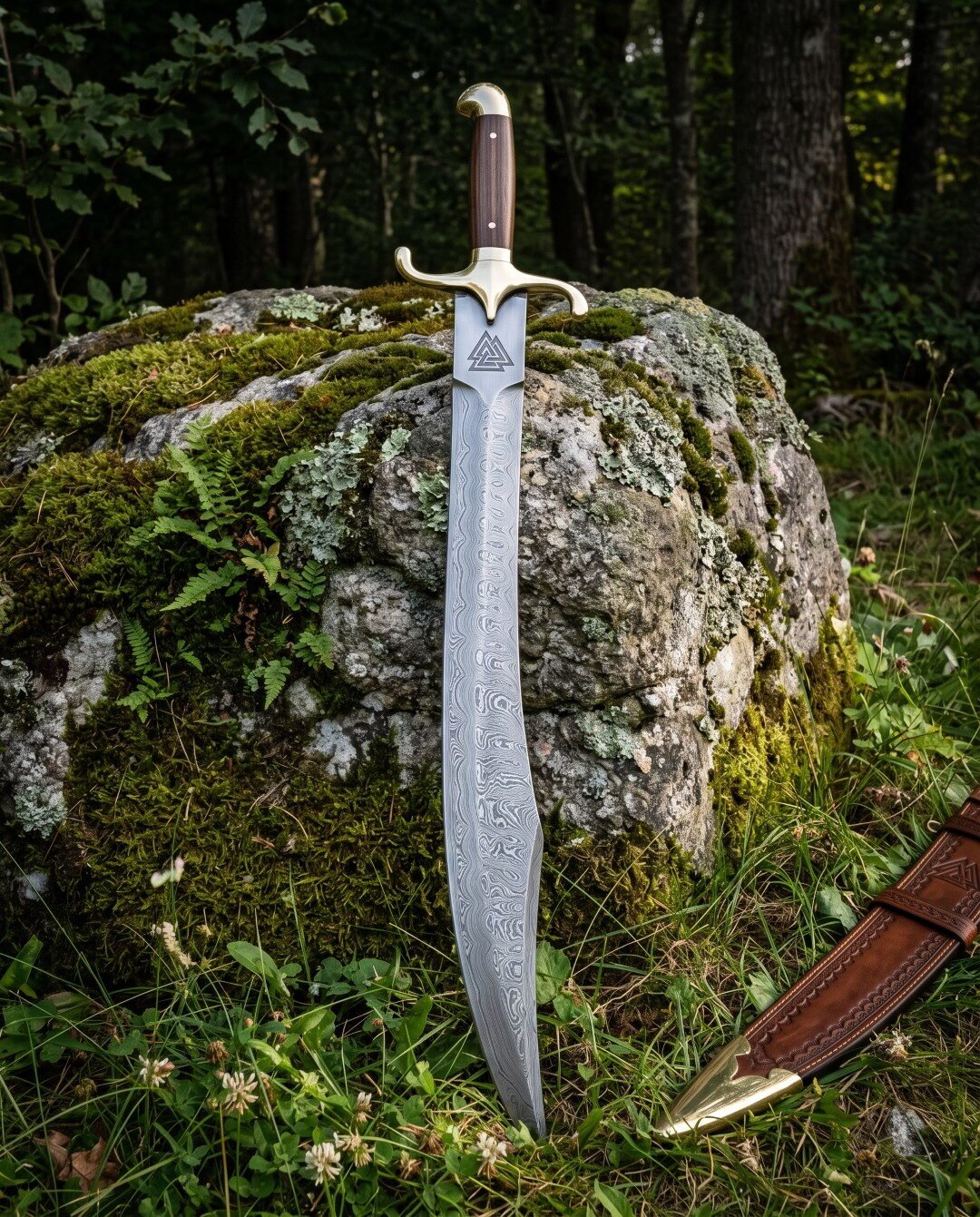
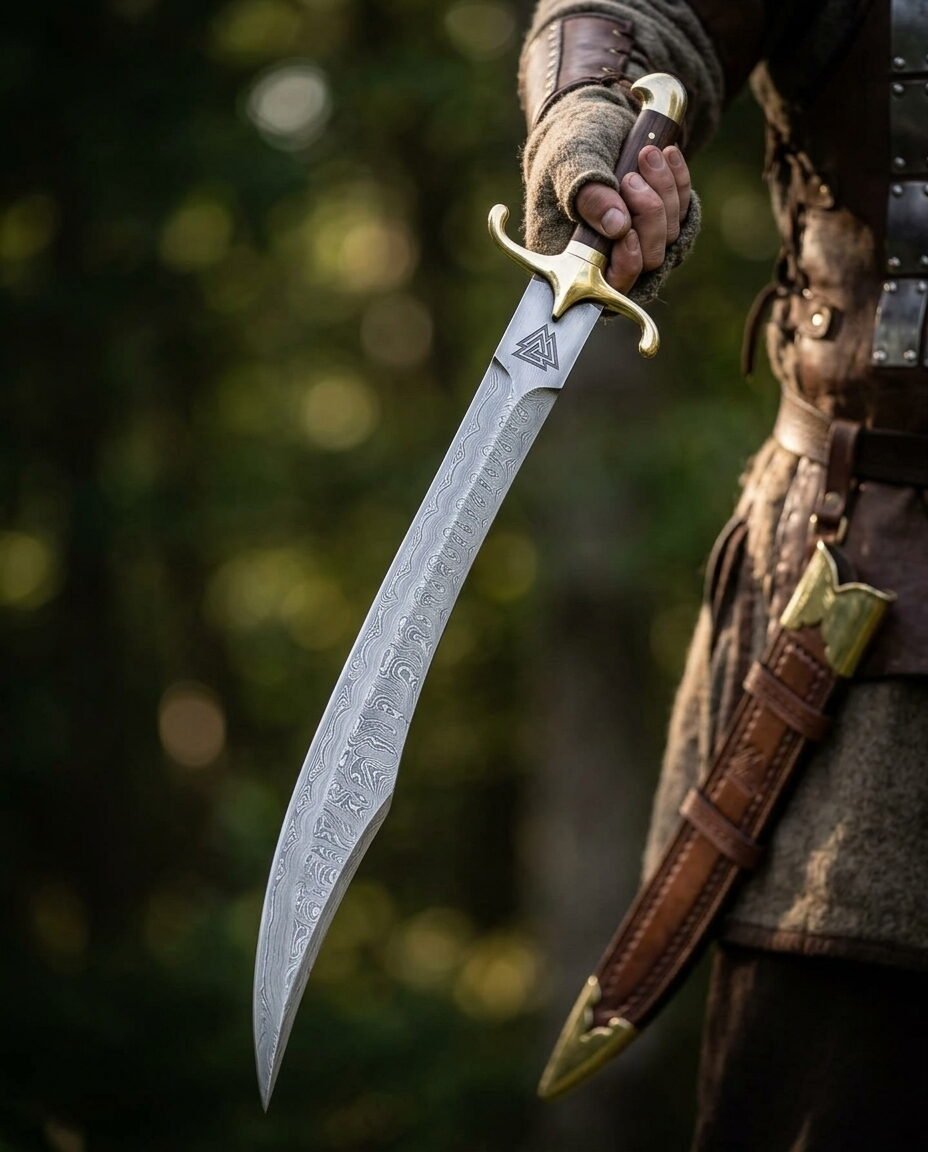
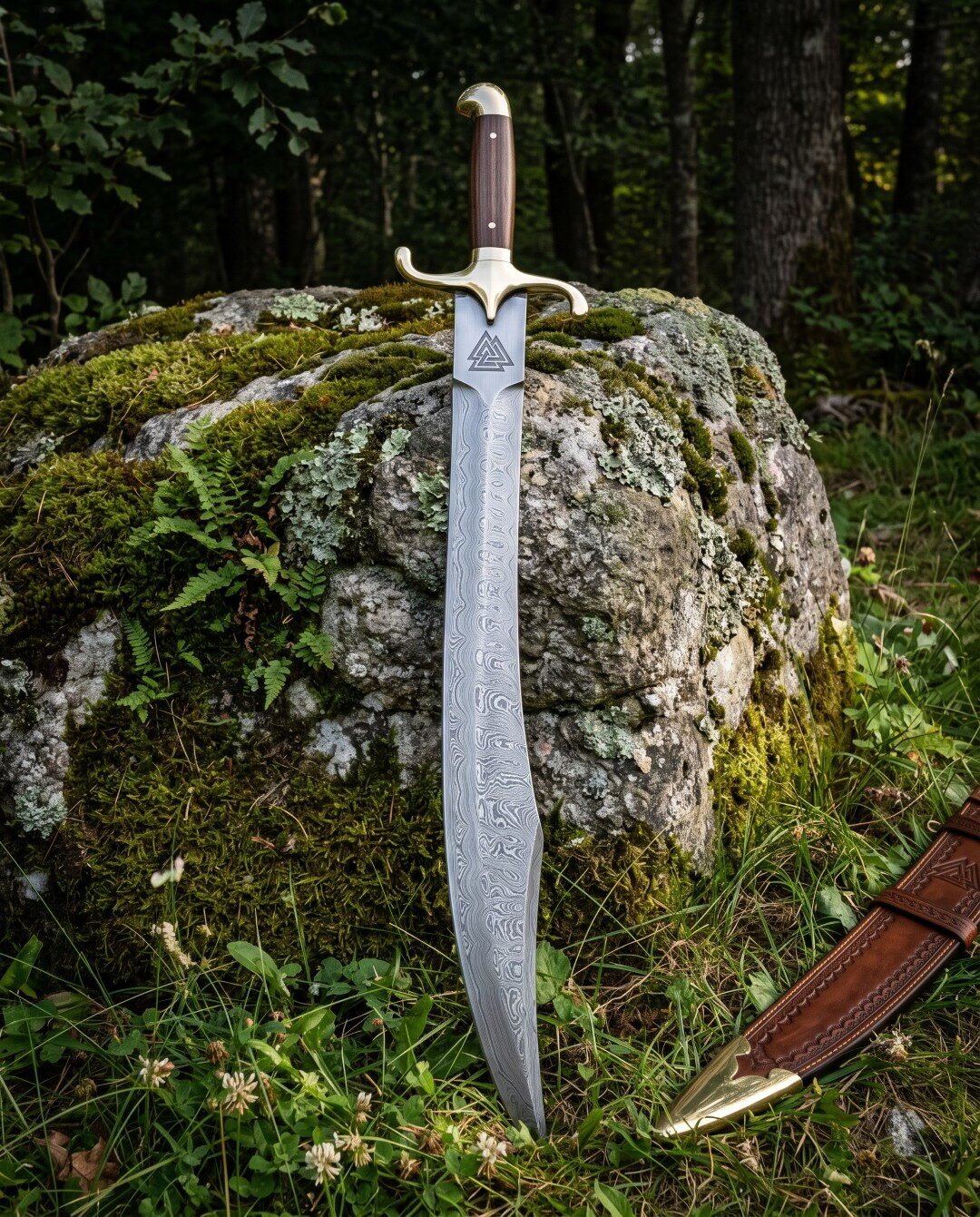
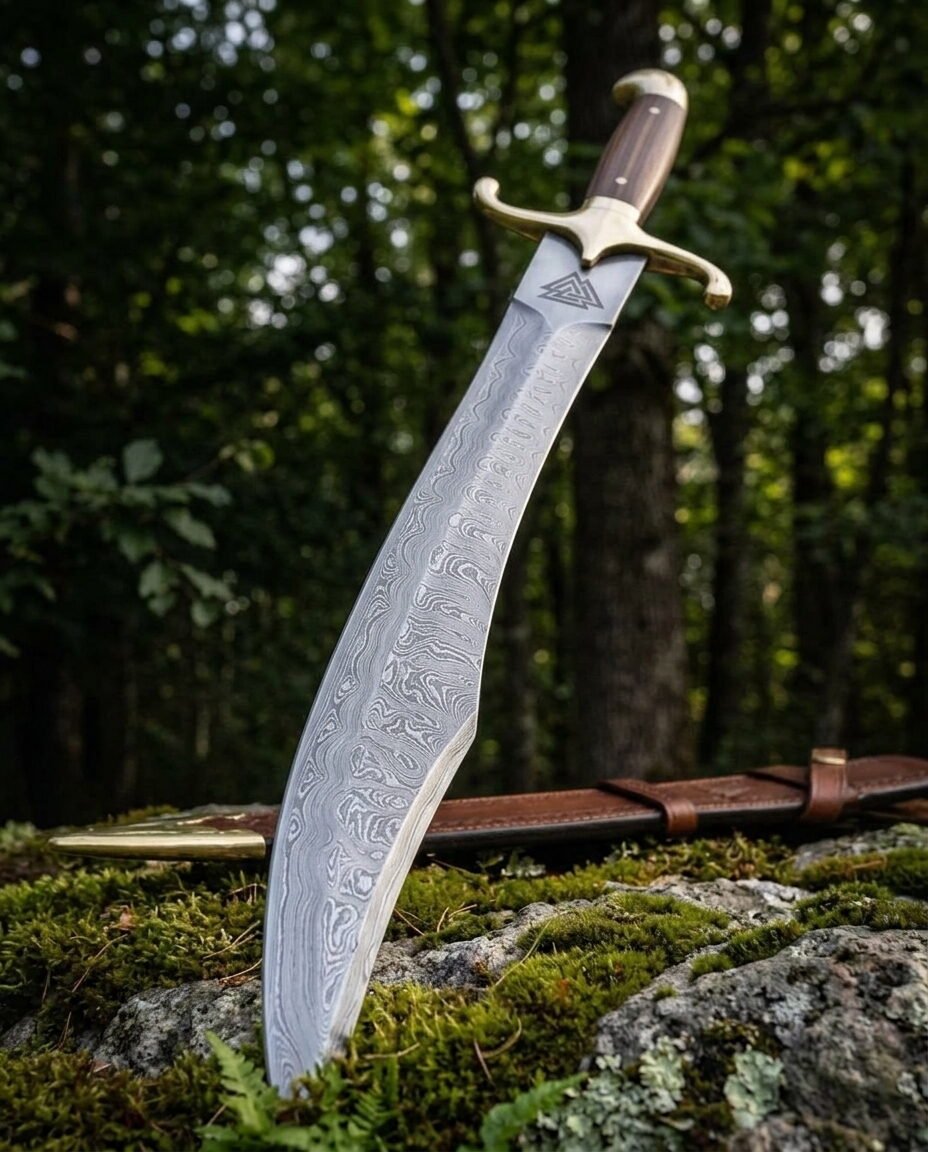
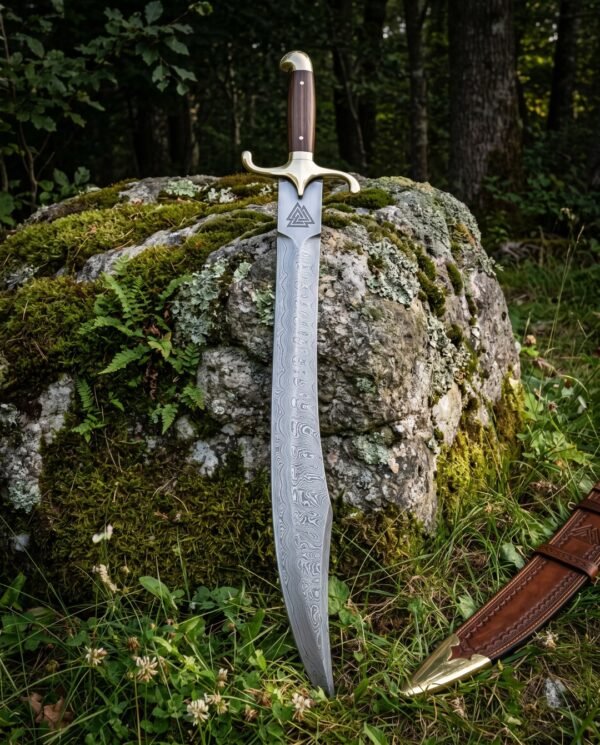
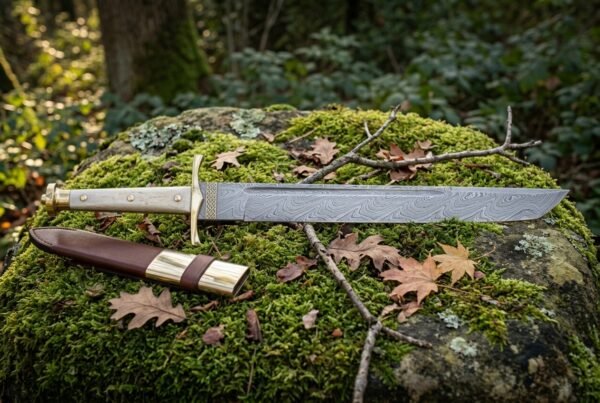
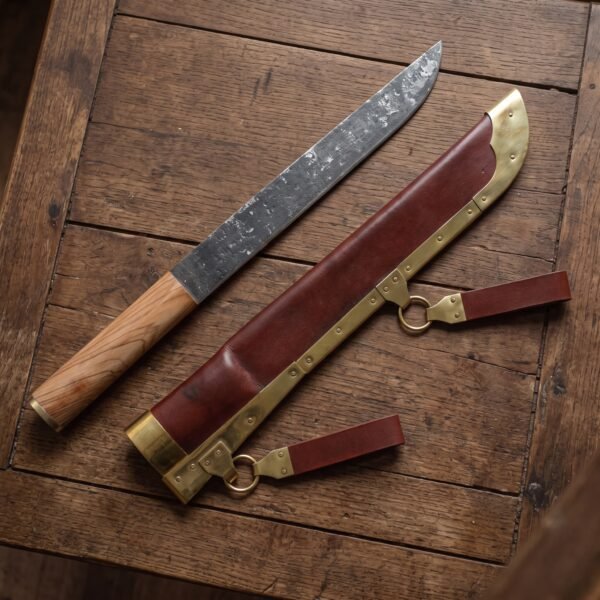
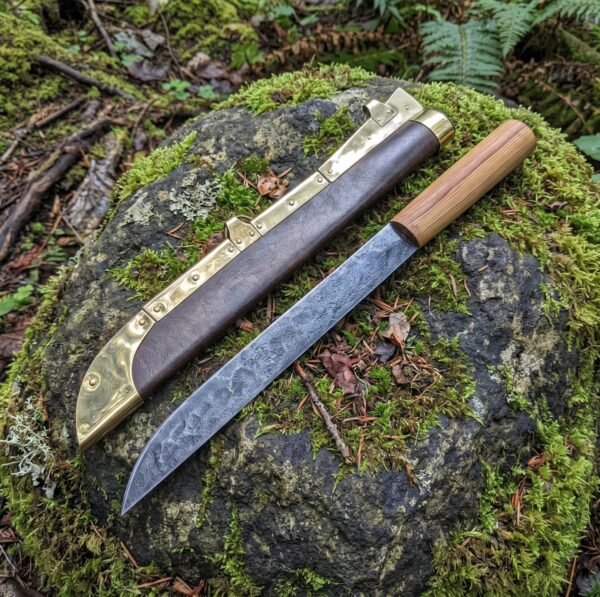
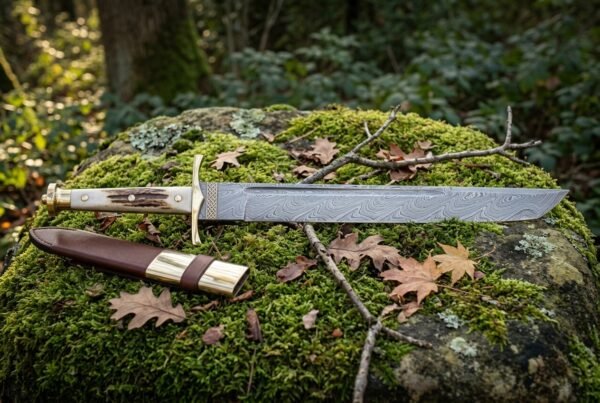
The Wolfnotch is a long seax, the big single edged blade that sat between a knife and a sword in the Norse and Anglo Saxon world. On this one the blade is curved, the edge sweeping in a long arc from the guard and the back rising into a short clip at the point. The blade is layered damascus, etched to show the fold, with a Valknut cut into the flat below the guard and a band of engraved decoration running down the spine side.
Seaxes are the most common blade find of the whole early medieval period in northern Europe, and the reason is that a seax was never only for fighting. It was the tool a free man carried for butchery, woodwork, eating and defence, worn horizontally across the front of the belt with the edge upward so it could be drawn across the body with one hand. The curve on this one puts more of the edge to work in a draw cut, and the clip at the end keeps the point fine enough to take a thrust. Ours is forged, ground, heat treated and fitted in the Czech Republic, and it ships in a tooled leather sheath with brass throat and chape. This one is kept with the Damascus swords, and the Damascus knives sit right beside it.
Specifications
| Blade steel | 1095 and 15N20 Damascus, hardened to 58 to 60 HRC, hand etched |
|---|
| Blade profile | Curved single edged blade with a clipped point and a plain polished ricasso |
|---|
| Engraving | Valknut cut into the polished ricasso below the guard, engraved band running down the blade |
|---|
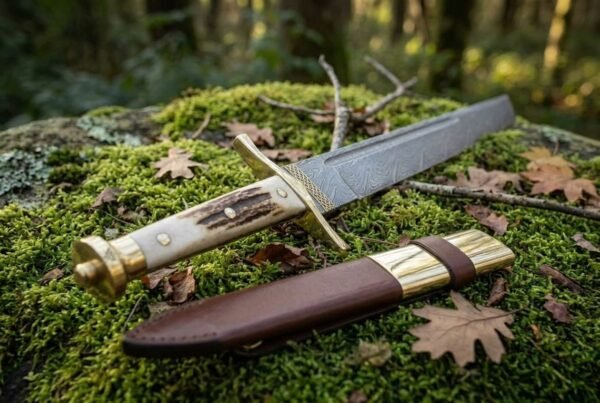
| Guard | Brass, with two forward curved quillons |
|---|
| Grip | Rosewood scales on a full profile tang, fixed with two brass pins |
|---|
| Pommel | Brass hooked pommel cap |
|---|
| Finish | Etched Damascus blade, satin brass, oiled rosewood |
|---|
| Edge | Ground and sharpened by hand, arrives keen |
|---|
| Sheath | Tooled brown leather with brass throat and chape |
|---|
| SKU | RK-1613 |
|---|
The curved blade
Look at the spine. It follows the edge in a long, even curve away from the guard and then rises into a short clip just before the point. The curve brings more of the edge into contact during a draw cut, so the blade slices instead of chopping, and the clip thins the tip so it still goes in cleanly on a thrust. Most surviving seaxes are straight backed, so think of this one as a curved take on the long seax and not a copy of any single excavated find.
Archaeologically the type runs through several sizes, from the small hand seax up to the langseax, which was long enough to be counted as a sword in its own right. This one sits at the long end of the family, which is why it wears a guard and a pommel rather than a plain grip.
The steel and the fittings
The blade is 1095 and 15N20 forge welded in alternating layers, folded, drawn out and ground to shape, then etched so the two steels separate visually. The 15N20 carries nickel and resists the etch, so it stays bright. The 1095 darkens. What you are looking at is the real internal structure of the billet, not a printed or laser marked pattern. Hardened and tempered to 58 to 60 HRC, the blade holds an edge through hard use and still has the toughness a broad single edged blade needs when it is levered rather than sliced.
The guard and the hooked pommel cap are brass, filed and finished by hand, and the two forward curved quillons on the guard are there to catch and turn a blade sliding down your edge. The scales are rosewood, a dense and oily tropical hardwood that takes a polish and does not swell and shrink much with humidity, pinned through a full profile tang so the handle cannot work loose. The sheath is vegetable tanned leather, tooled with a border and a running pattern, stitched and fitted with a brass throat and chape.
Engraving, runes and your own design
Use the rune converter on this page to turn a name, a date or a short phrase into Elder Futhark and we will cut it into the steel, the leather or the wood. If you would rather have a Viking pattern than a rune line, choose your own design in the engraving option above the add to cart button and tell us where it goes. Where a piece already carries an engraved design, your chosen engraving replaces it rather than sitting alongside it. On this seax that means your engraving takes the place of the Valknut or the spine band rather than being added under it, and the leather sheath can be stamped as well. See the engraving page.
Handling and balance
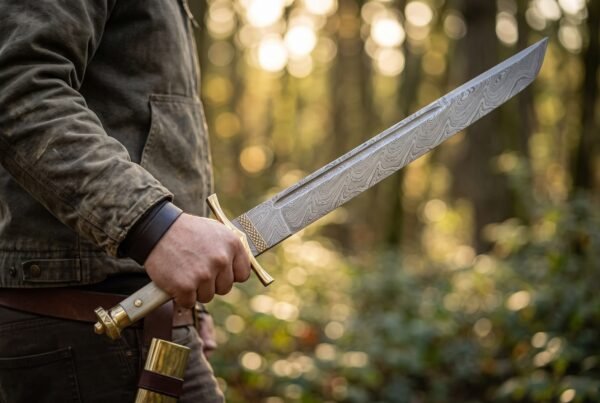
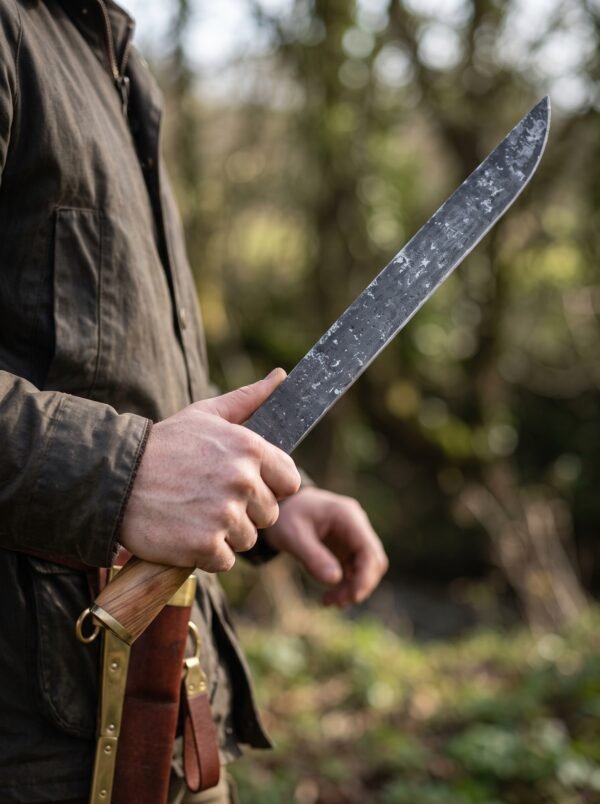
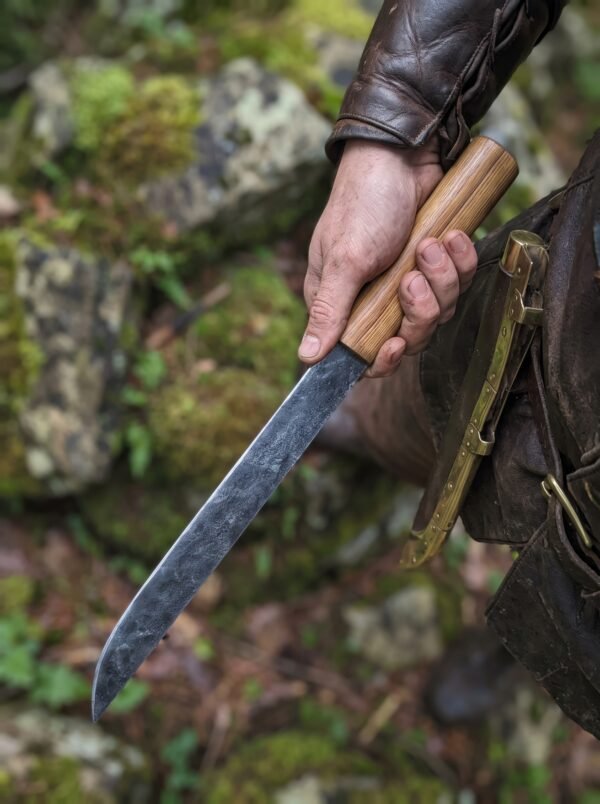
A long seax balances forward of a sword of the same length because there is no counterweight pommel doing the work, only a cap. That is deliberate. The mass sits out toward the widest part of the blade, so the seax wants to chop and to cut on the draw rather than to fence at the point. Hold it with your index finger up against the guard and let the hooked pommel sit in the heel of your palm, and the blade will track through a cut without you having to fight it back on line.
For utility work, choke up so your thumb rides the spine. For heavier cutting, drop your hand back against the pommel hook and use the length. This is a real cutting blade rather than a display piece, so treat the edge with the respect you would give an axe.
Care
High carbon damascus rusts. Wipe the blade after every handling session, because fingerprints are acidic enough to etch themselves into the surface within a day in a humid room, and keep a light film of mineral oil or blade oil over the flats. Never store a carbon steel blade inside a leather sheath for months at a time. Leather holds moisture and the tanning is slightly acidic, so long term storage should be in the open, oiled, with the sheath kept separately. Full detail sits in steel care.
The rosewood wants a wipe of a light oil once or twice a year. Brass will dull to a warm gold and can be polished back or left. Feed the leather sheath with a leather conditioner about twice a year so the fold at the throat stays supple.
Made in the Czech Republic
The work behind this piece happens in a Czech Republic workshop that has kept to the old methods. Steel is forged and heat treated by hand, the grind is taken down by eye rather than by machine, and the handle, fittings and sheath are cut and finished one at a time. Because of that, every piece carries small marks of the hand that made it.
Ransack Viking is a United States company. We import direct, check each piece when it reaches us, and ship from our Chicago, Illinois warehouse. Engraving is added here in the United States after arrival, so the piece you receive is finished to your order.
A note on handmade variation
This is hand made, not machine made and not bulk produced, so what arrives will not be a pixel for pixel copy of the photograph. Grain, tone, hammer texture and exact profile vary because each piece is worked by hand from natural materials. Rosewood in particular runs from a light red brown to a deep near purple depending on the board, and the damascus pattern is unique to your billet. The dimensions, the material and the build are the same every time. The character is not. Read the seax guide when you have a minute, and choosing a Viking knife if you are still comparing.
Frequently asked questions
Is it sharp out of the box
Yes. It is hand ground and sharpened and arrives keen enough to cut paper. Handle it the way you would handle a large chef knife with a point on it.
Is a seax a knife or a sword
This size sits in between, which is exactly why the type existed. It is long enough to be used as a side arm and short enough to be a serious cutting tool, and historically the same blade did both jobs.
Is the sheath belt mounted
The sheath is built to be worn on a belt in the traditional horizontal carry across the front, edge up. It ships as a sheath rather than as a belt rig, so use your own belt through the loops.
Can I have my own runes instead of the Valknut
Yes. Your engraving replaces the Valknut rather than sitting beside it. Use the rune converter on this page to see how your text will read in Elder Futhark.
Will the damascus pattern rub off
It cannot, because it is not on the surface. The pattern is the layered structure of the steel itself, so it runs all the way through and sharpening will never remove it.
How long before it arrives
Processing is one to two weeks in the shop plus transit. Engraved orders sit at the longer end. Shipping within the United States is free.
What is in the box
- One Wolfnotch damascus long seax with rosewood scales and brass fittings
- One tooled brown leather sheath with brass throat and chape
- Care card covering blade oiling and leather feeding
- Forged and finished in the Czech Republic
Explore the range
See more in Viking seaxes, damascus swords, Viking knives and Norse arms, or read the guides.
Compare it with these
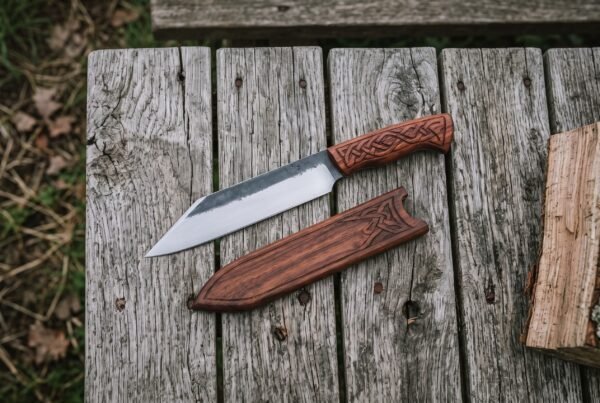
Closest to this in the range is the Ravenspine Viking seax, 12 inches overall. If this one is not quite right, there is the Knotsax Viking seax, 14 inches overall. Also in this group is the Langfell Viking seax, forged from 1095.
If you are putting a set together, the Curvefang kukri knife sits alongside it. Pick the steel, the length and the fittings yourself on the custom Damascus knife page.

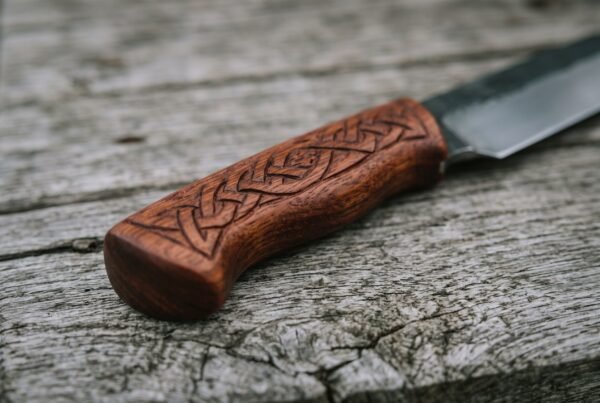
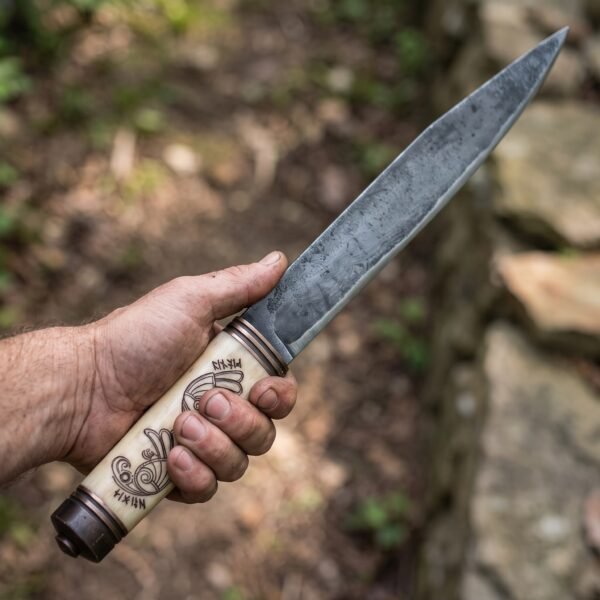
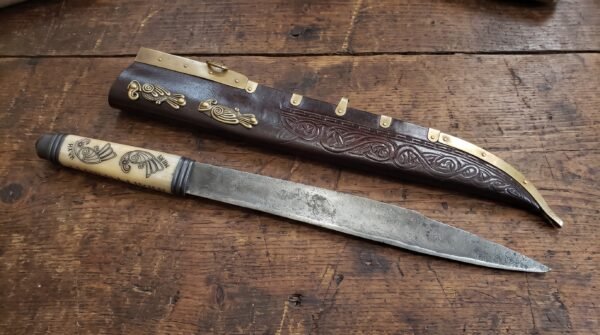
Absolutely blown away by this knife. Leather sheath is thick and well stitched. Not the cheap stuff you usually get. Even the small engravings are crisp and clean. Weight and balance make it feel like a real functional piece not some cheap replica. Already planning my next purchase from this shop.
Perfect gift. Perfect quality. No complaints. Fit and finish is museum quality. You can tell real craftsmen made this by hand. Came in a nice gift box which made it feel even more special. Edge retention has been great even after regular use. Beyond happy with how this turned out.
This one was a letdown compared to the listing. Build quality felt cheaper than the pictures suggested. Considering asking for a return.
This is exactly what I wanted and then some. Leather sheath is thick and well stitched. Not the cheap stuff you usually get. Even the small engravings are crisp and clean. Already telling my friends to check this out.
I collect stuff like this and this knife is on another level. The rosewood handle feels amazing and the balance is perfect. Fit and finish is museum quality. You can tell real craftsmen made this by hand. So worth it. Ransack Viking is quickly becoming my go to shop for anything Norse themed.
Got this as a gift and now I want one for myself too. Damascus blade holds a razor edge right out of the box. Great buy overall.
Can’t stop showing this off to everyone who comes over. Leather sheath is thick and well stitched. Not the cheap stuff you usually get. Weight and balance make it feel like a real functional piece not some cheap replica. Already telling my friends to check this out.
Was nervous ordering something like this online but so glad I did. Ransack Viking’s attention to detail is honestly unmatched.
Good quality knife for the price. Blade quality is solid. Arrived a bit less sharp than expected but a few passes on a strop fixed it. Sheath is nice. Wish it had more padding but it does the job. Glad I made this purchase.
Feels way more premium than the price suggests. The rosewood handle feels amazing and the balance is perfect. Leather sheath is thick and well stitched. Not the cheap stuff you usually get. Edge retention has been great even after regular use. If you’re on the fence just get it. You won’t regret it.