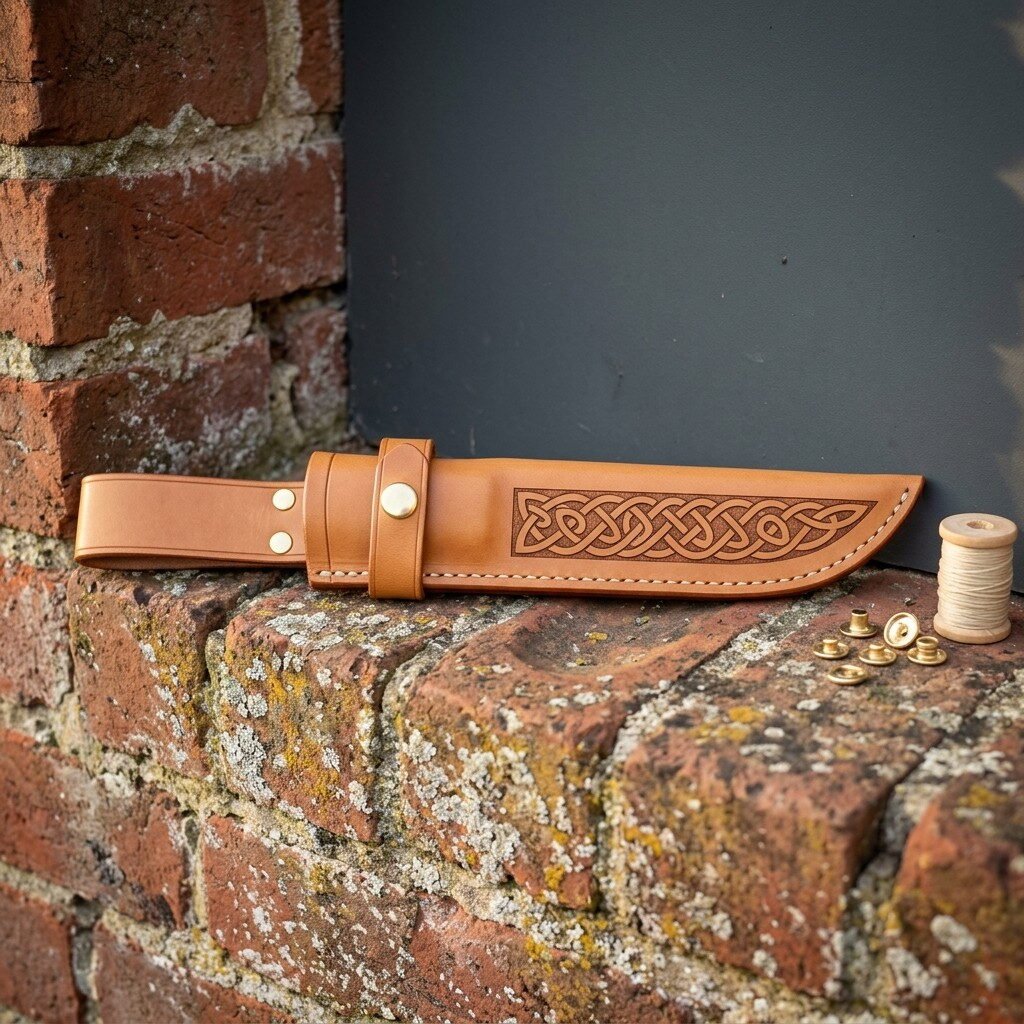
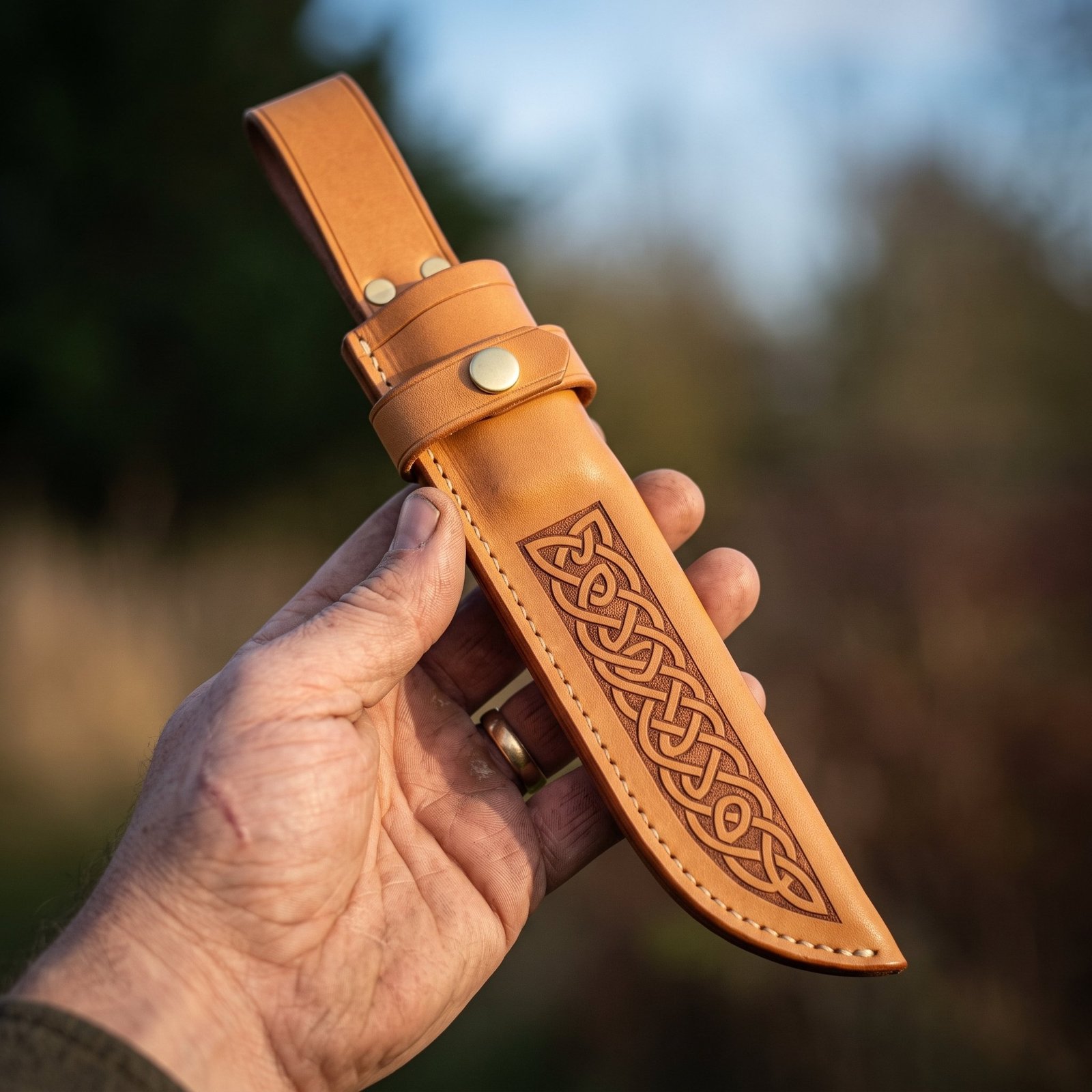
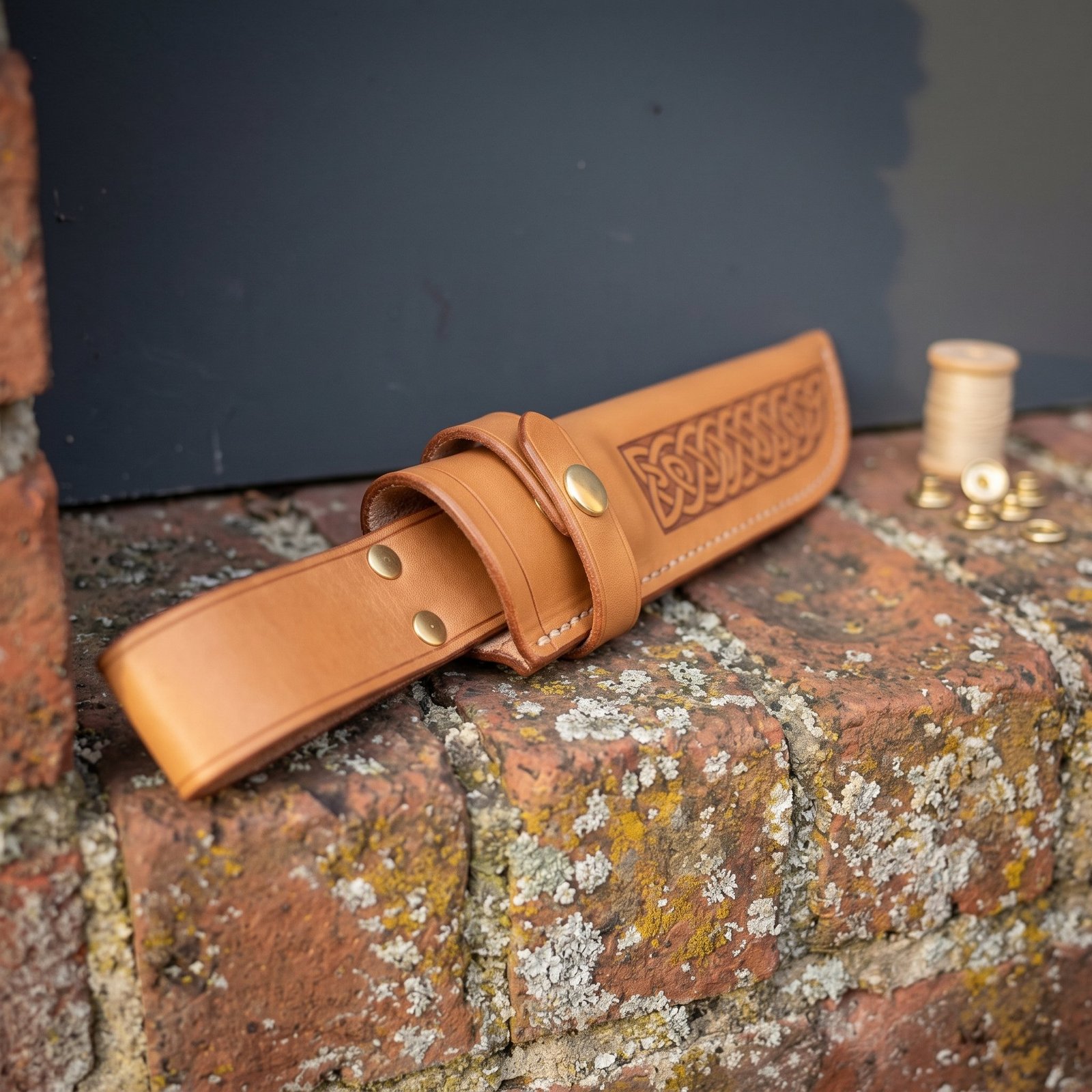
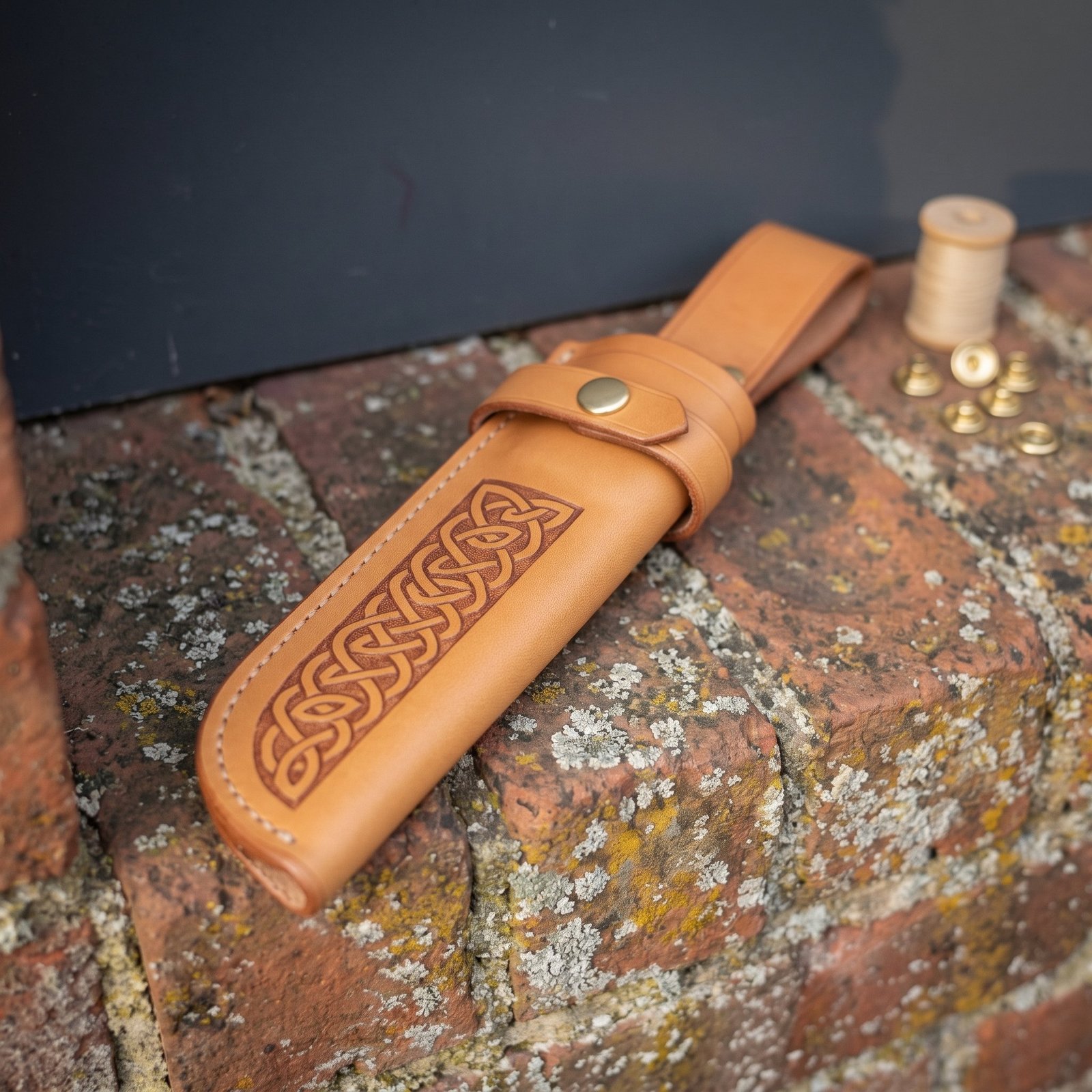
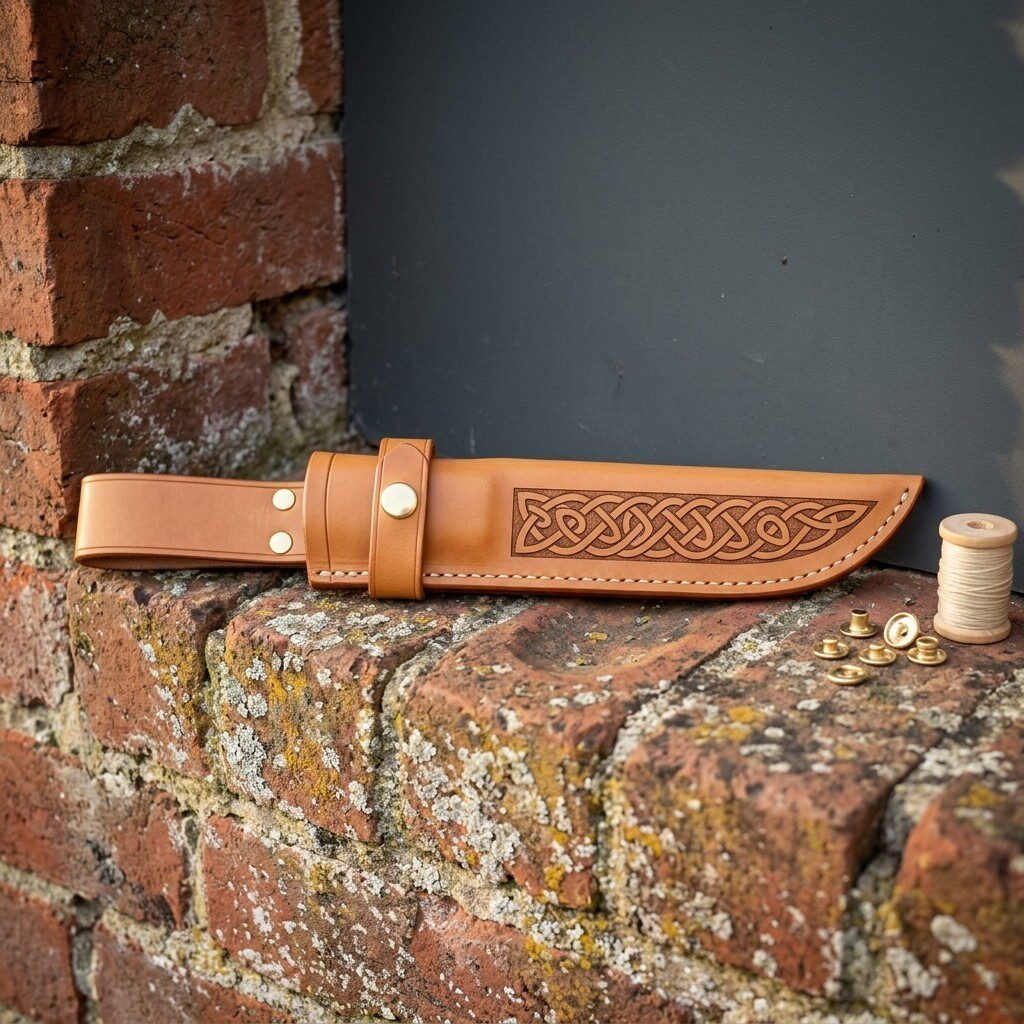
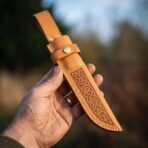
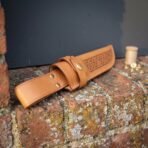
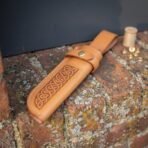
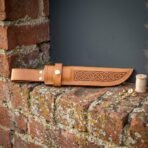
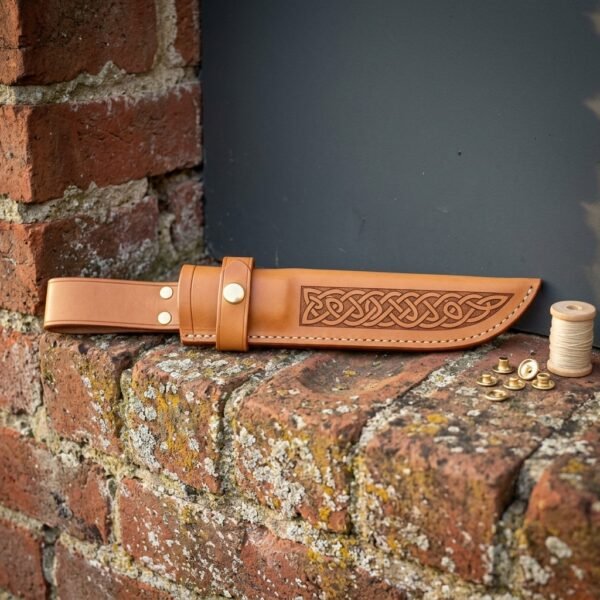
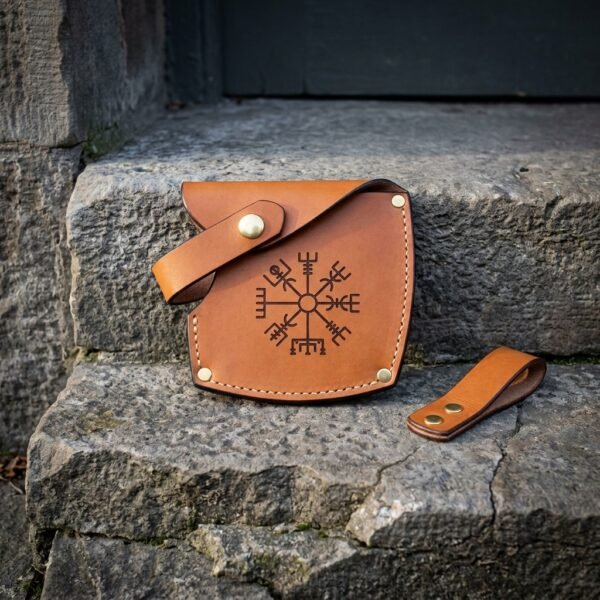
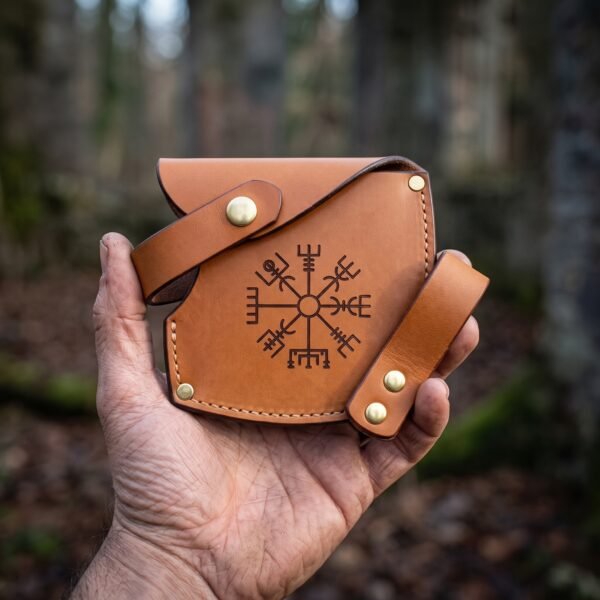
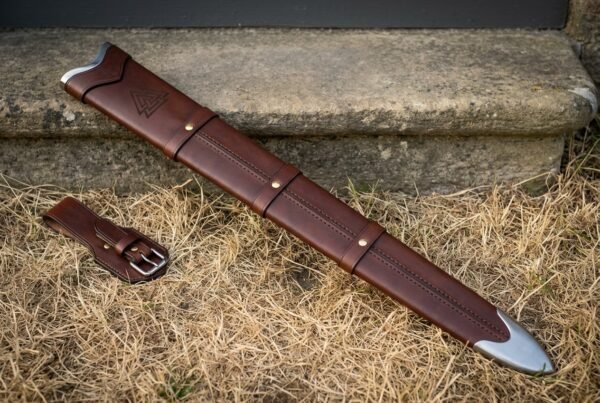
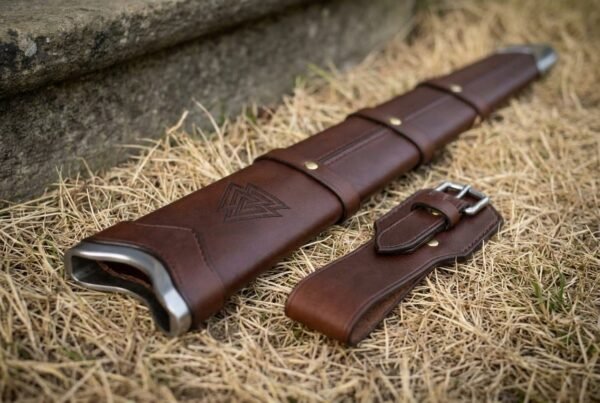
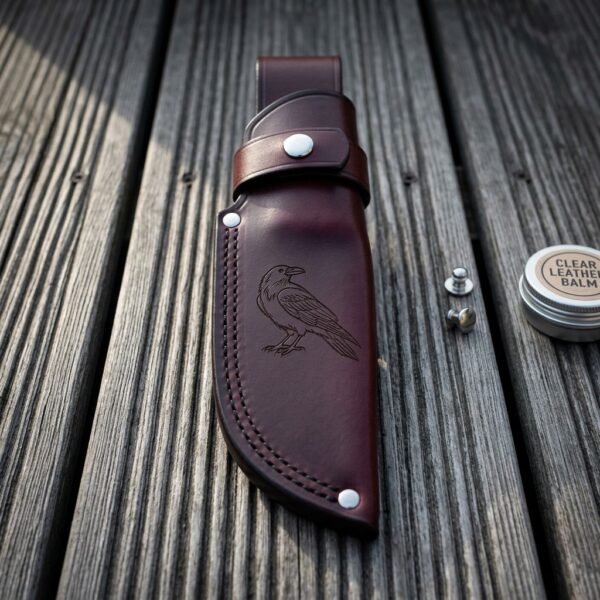
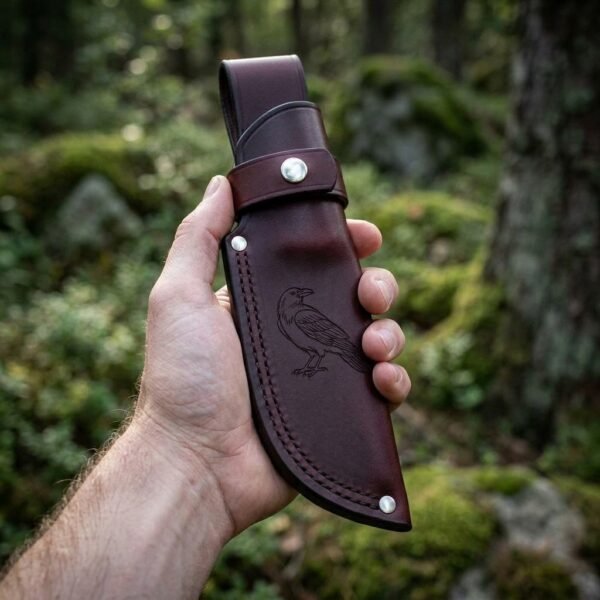
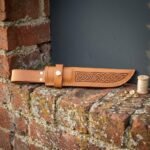
This is a belt sheath sold on its own, cut and stitched from vegetable tanned cowhide in a natural tan, with a long interlaced Celtic knotwork panel tooled down the face, a wrapped retention strap and solid brass rivets and a brass stud. It is built for a straight bladed knife or a short seax, and it is the sort of sheath people buy when the blade they already own came with something thin and floppy that will not survive a season.
Sheaths are one of the places where the Viking age is unusually well documented, because waterlogged town deposits at Jorvik and Dublin preserved leather that would normally have rotted away. What those finds show is that decorated knife sheaths were completely ordinary. Ordinary people carried a knife and the sheath it lived in was tooled, stamped or incised with interlace, and it was worn at the front of the belt where it could be seen. Decoration on working kit was not an indulgence in that world. It was how you signalled who made your things and how well.
Each sheath is cut, tooled, wet formed, stitched and finished by hand in a Czech Republic workshop. It ships flat with a care card and a small tub of leather balm. It is catalogued with the scabbards and sheaths, and the sword stands and displays sit one click away.
Specifications
| Material | Vegetable tanned cowhide, approximately 3 to 4 mm thick |
|---|
| Overall length | Approximately 12 inches |
|---|
| Fits | Straight blades to approximately 10 inches long and 1.75 inches wide |
|---|
| Tooling | Interlaced Celtic knotwork panel tooled down the face from below the strap to near the tip |
|---|
| Retention | Leather strap wrapped around the throat, closed with a brass stud |
|---|
| Belt loop | Integral loop fixed with two brass rivets, takes belts up to about 2 inches wide |
|---|
| Stitching | Hand saddle stitched in natural waxed thread through a full welt |
|---|
| Finish | Natural tan, burnished edges, no plastic top coat |
|---|
| Included | Sheath, leather balm, care card. No knife |
|---|
| SKU | RK-1694 |
|---|
What a welt is and why it decides whether a sheath is any good
Run a finger down the stitched edge of this sheath and you will feel a third layer of leather sandwiched between the front and the back. That is the welt, and it is the single feature that separates a sheath that lasts from one that does not. Without a welt, the edge of the blade sits directly against the stitching, and every time the knife goes in or comes out the edge saws at the thread. A sheath built that way will cut its own seam open, usually within a year, and then the blade comes through the side.
The welt holds the two faces apart by the thickness of a strip of leather, so the edge never touches thread. It also gives the sheath its shape and its rigidity, which is why a welted sheath keeps its mouth open when the knife is out instead of collapsing flat. It costs more leather, more time and more awkward stitching around the curve at the tip. It is worth all three.
The retention here is a wrapped strap over the handle with a brass stud, rather than a snap. A stud is quieter, it does not corrode into a lump, and it can be re seated with a punch if it ever works loose, none of which is true of a cheap spring snap.
The leather and the tannage
This is vegetable tanned cowhide, roughly 3 to 4 mm through the body, which is what the trade calls 8 to 10 ounce leather. Vegetable tanning uses tannins from bark and wood rather than chromium salts, and it takes weeks in the pits rather than hours in a drum. That is why it costs more and why it is the only sensible choice for a sheath.
Two properties matter. First, vegetable tanned leather can be wet formed. Soak it, press it around the blade, and it dries holding that shape, which is how a sheath grips a knife without a strap doing all the work. Chrome tanned leather will not do this. Second, vegetable tanned leather is chemically kind to steel. Chrome tanned leather carries residual salts and can hold a slightly acidic character that will pit a carbon blade left sitting in it. If you have ever pulled a knife out of a cheap sheath and found the blade freckled with rust, that is usually why.
The tan colour is the natural colour of the hide with nothing but a light finish over it. It will darken with sun and handling into a deeper honey and eventually a russet brown. That patina is the point of buying natural rather than dyed.
Engraving, runes and your own design
Use the rune converter on this page to turn a name, a date or a short phrase into Elder Futhark and we will cut it into the steel, the leather or the wood. If you would rather have a Viking pattern than a rune line, choose your own design in the engraving option above the add to cart button and tell us where it goes. Where a piece already carries an engraved design, your chosen engraving replaces it rather than sitting alongside it.
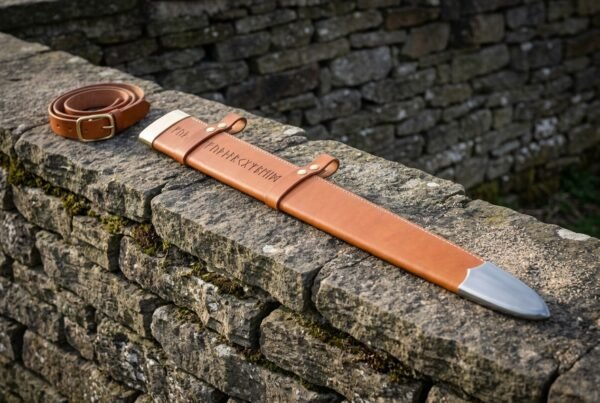
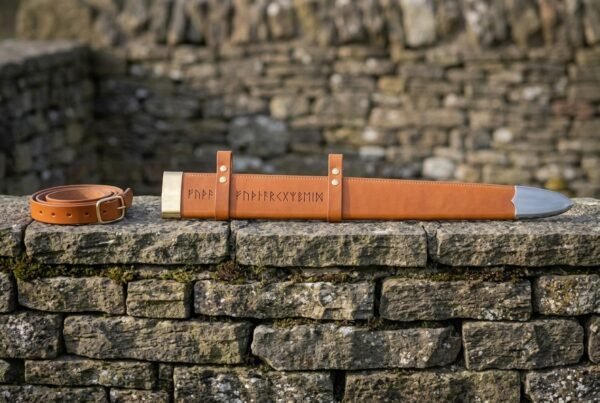
Leather takes a rune line beautifully because it is tooled while damp and the impression stays crisp once it dries. On this sheath the knotwork panel runs down the face, so a chosen rune line replaces the knotwork rather than sitting beside it. If you want both, ask for the runes on the back panel and say so in the order notes. See the engraving page for lettering and lead time.
Fit and sizing
This sheath takes a straight bladed knife up to about 10 inches of blade and about 1.75 inches of blade width, which covers most seaxes, hunting knives, bowies and camp knives of that class. It will not take a heavily curved or recurved blade, and it will not take a blade wider than the mouth, so measure before you order. Measure blade length from the front of the handle or guard to the tip, and blade width at the widest point.
The belt loop is riveted and takes a belt up to about two inches wide. It is a fixed vertical loop, so the sheath rides in the traditional position, hanging at the hip with the handle forward. If you want it to sit at a cant, thread it onto a belt slightly off the vertical or ask us about a dangler loop in the order notes. A new sheath is deliberately tight. Work the knife in and out twenty or thirty times and the leather will settle to your blade.
Care
Feed the leather two or three times a year with the balm supplied, or any neutral leather conditioner. Warm the sheath slightly first, work a thin coat in with your fingers, leave it an hour and buff it off. Do not use mink oil or heavy greases in quantity, because they soften vegetable tanned leather and a soft sheath loses its grip on the blade.
If it gets soaked, let it dry slowly at room temperature away from any heat source, and put the knife back in only once it is fully dry. Never dry leather on a radiator or in an oven. Do not store a carbon steel blade in the sheath long term, in any sheath from any maker, because leather holds moisture against steel. Oil the blade and keep it out of the sheath if it is going into a drawer for a year. There is more on blade protection in steel care.
Made in the Czech Republic
This is a handmade piece from the Czech Republic, made in a workshop that still forges, grinds and finishes by hand instead of stamping parts out. The smiths there have kept the older way of working, and the wood, horn and leather are shaped and fitted by hand as well. Two pieces of the same design will never be identical, and that is part of what you are buying.
Ransack Viking is a United States company. We handle the import ourselves, look over every piece when it lands and ship from our warehouse in Chicago, Illinois. Engraving is done in the United States after the piece arrives, so your design goes on before we send it out.
A note on handmade variation
Every sheath is hand made rather than machine made or bulk produced, so what arrives will not be a pixel for pixel copy of the photograph. Leather is a natural material and no two hides are the same. Grain, pore pattern, small healed scars and the exact depth of the natural tan all vary from panel to panel. The knotwork is tooled by hand with a swivel knife and bevellers, so the interlace has the slight variation of a human line. Edge burnish takes a different sheen depending on how the fibres in that piece lie. The dimensions, the leather weight, the fittings and the build are the same every time. The character is not. If you want the longer version, look at the knife care guide and then at keeping Damascus from staining.
Frequently asked questions
Will it fit the knife I already own?
If your blade is up to about 10 inches long, up to about 1.75 inches wide and straight rather than deeply curved, yes. Measure before ordering, and message us with dimensions if you are unsure.
Does it come with a knife?
No. This listing is for the sheath on its own. It is sold as a replacement or an upgrade for a blade you already have.
Is it left or right hand?
It is a vertical belt sheath with an integral loop, so it works on either hip. Thread it wherever you want it on the belt.
Will the tan colour stay this light?
No, and that is intended. Natural vegetable tanned leather darkens with light and handling into a deeper honey and then a russet. It develops that patina over months, unevenly and pleasingly.
Can I have runes tooled on it?
Yes. Use the rune converter on this page. On the face panel the runes replace the knotwork, or ask for them on the back if you want to keep both.
How long does shipping take?
Making time is one to two weeks and United States shipping is free. Custom tooling adds a few days.
What is in the box
- One hand tooled vegetable tanned leather knife sheath with Celtic knotwork panel
- Brass stud retention strap and riveted belt loop
- Small tub of leather balm
- Care card covering feeding, drying and long term blade storage
- Lifetime warranty against defects in the making
- Made and finished in the Czech Republic
Explore the range
Browse the rest of the scabbards and sheaths, the accessories and the Viking knives that fit them, or read the guides for more on leather weight, welts and tannage.
Worth a look beside this
Next along the rack is the Grimhold sheath. For a straight comparison, see the Staveguard sheath. Worth putting side by side with this is the Quillhide sheath.
If you are putting a set together, the Knotpein blacksmith tool sits alongside it. Or start from a blank sheet on the design your own page.

Reviews
There are no reviews yet