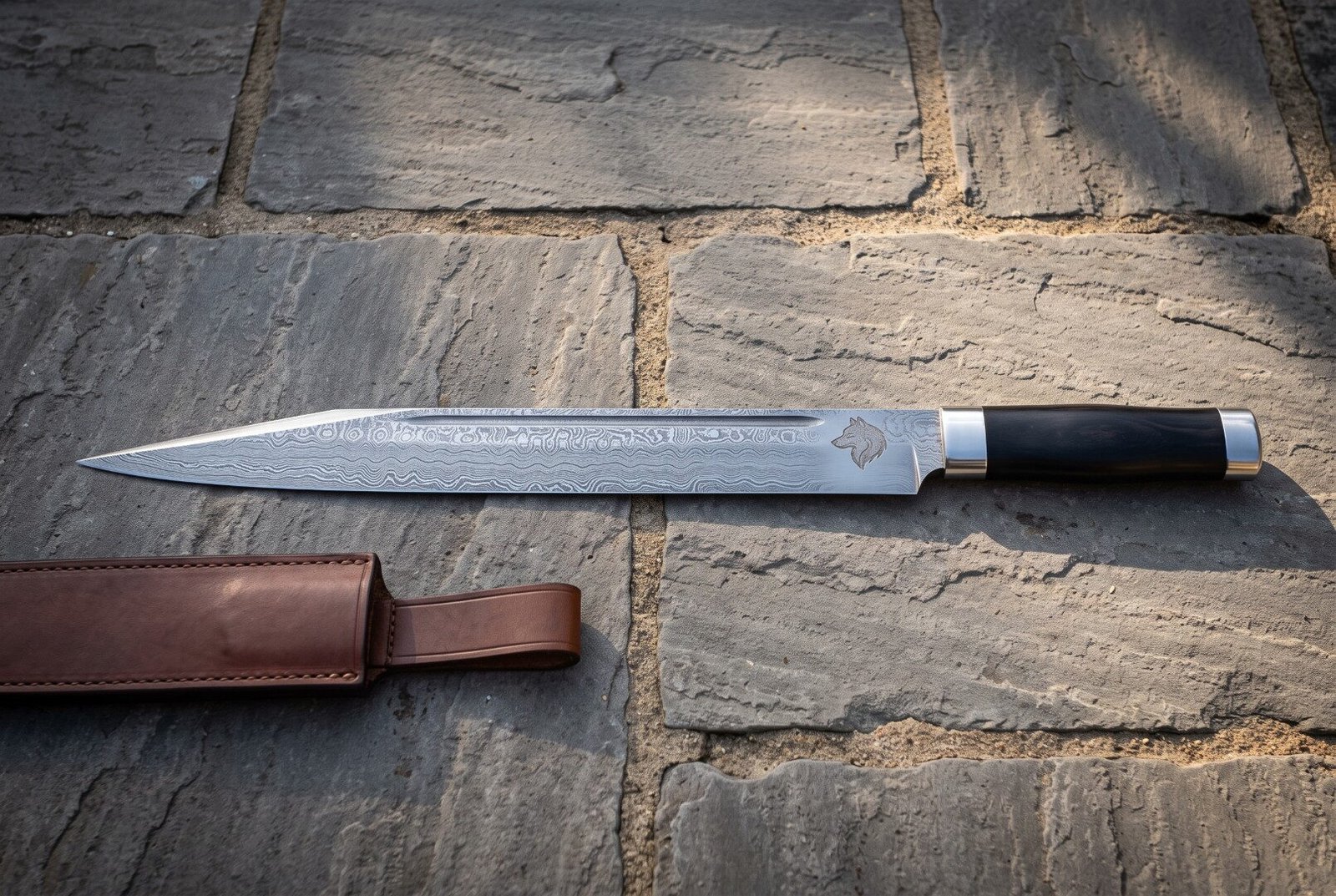
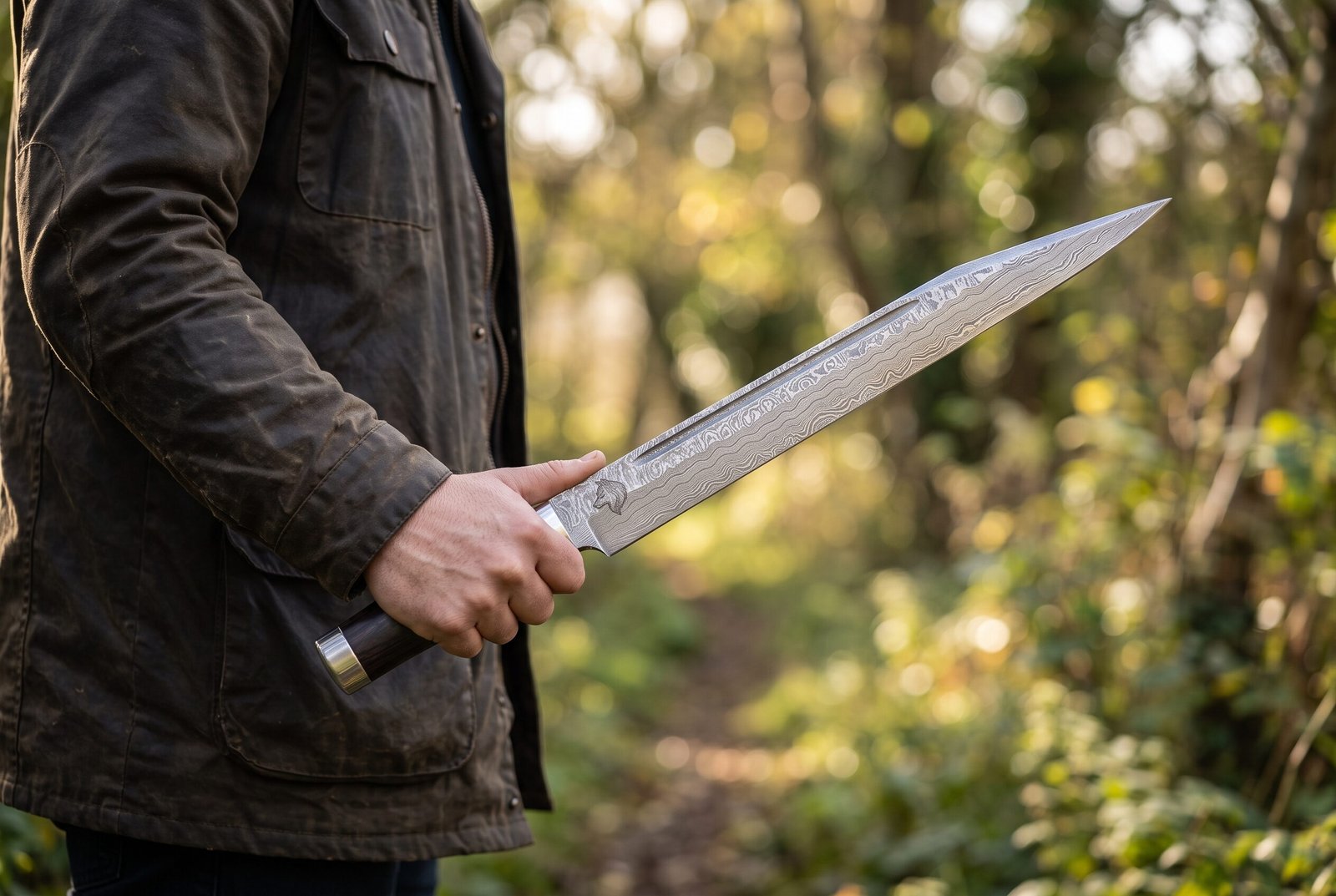
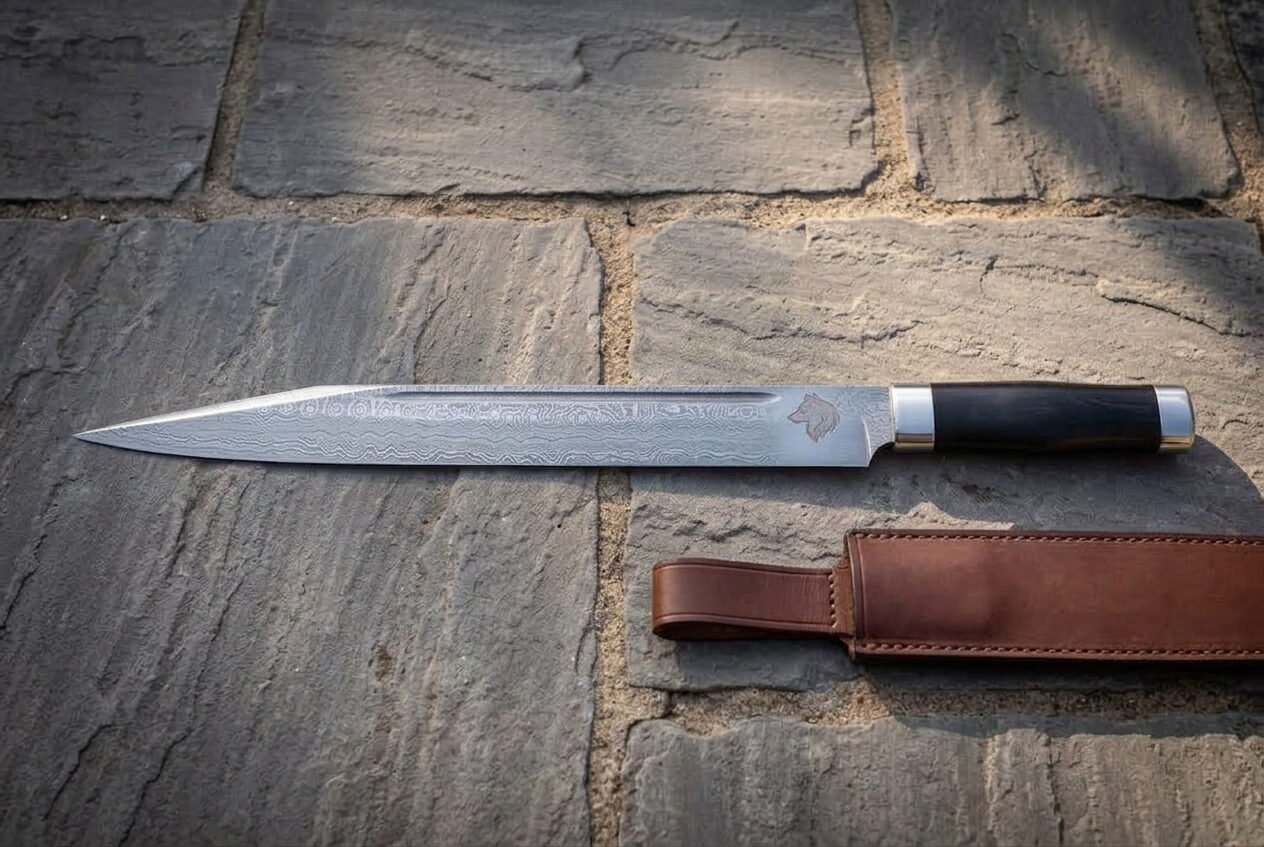
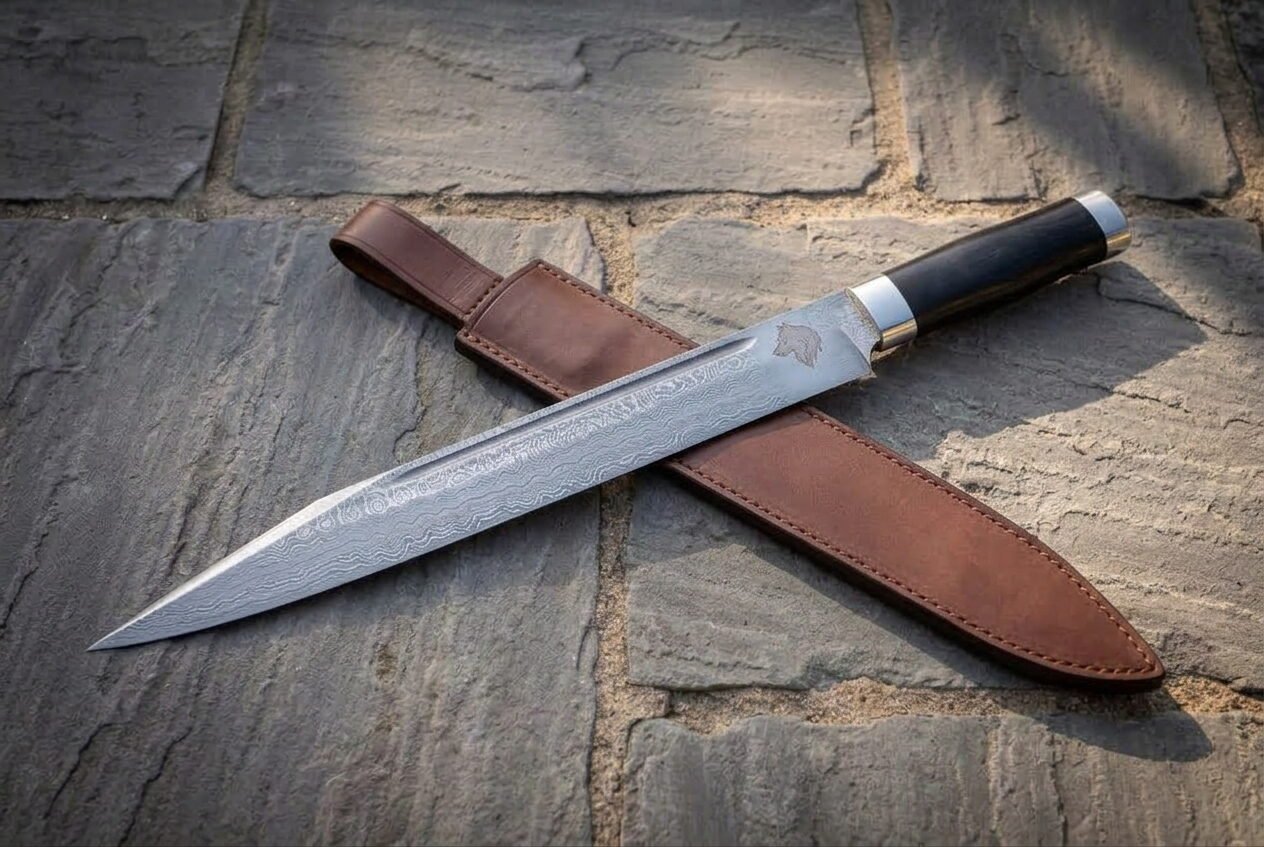
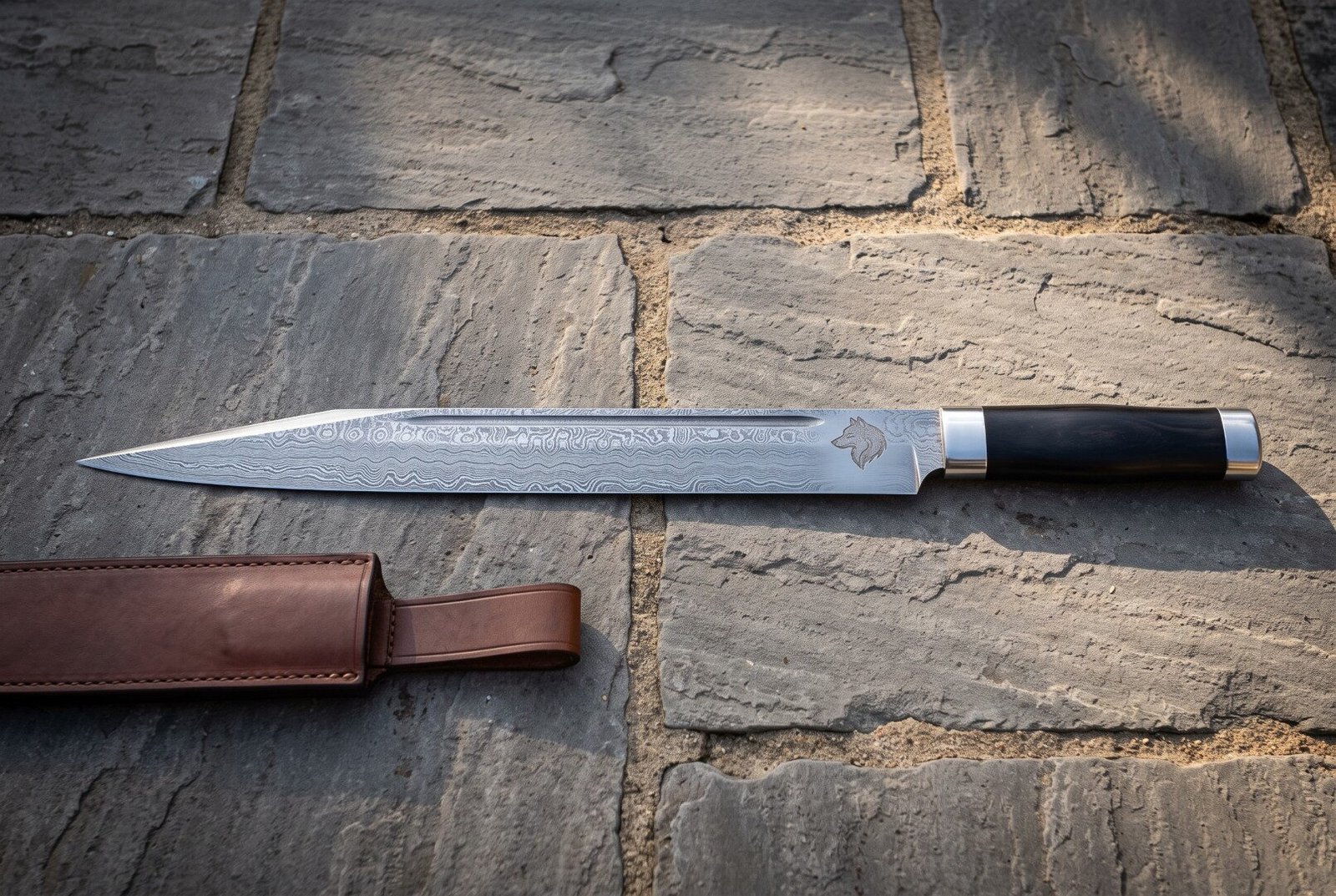
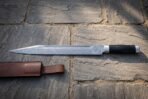
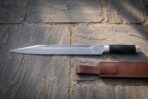
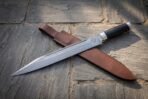
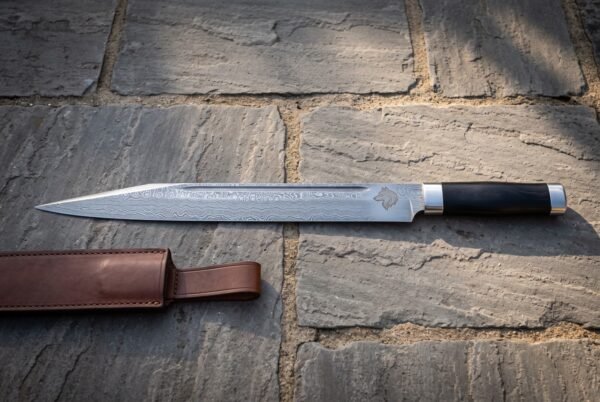
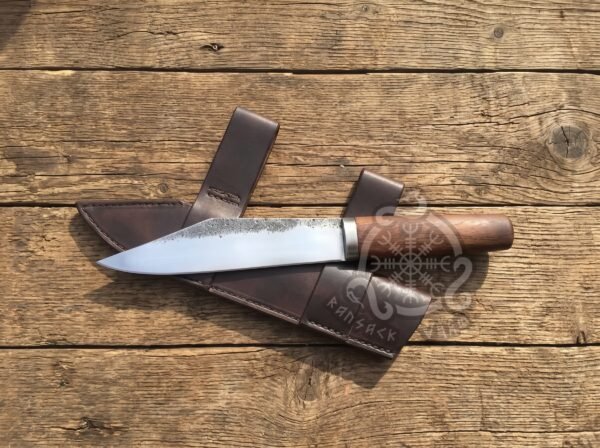
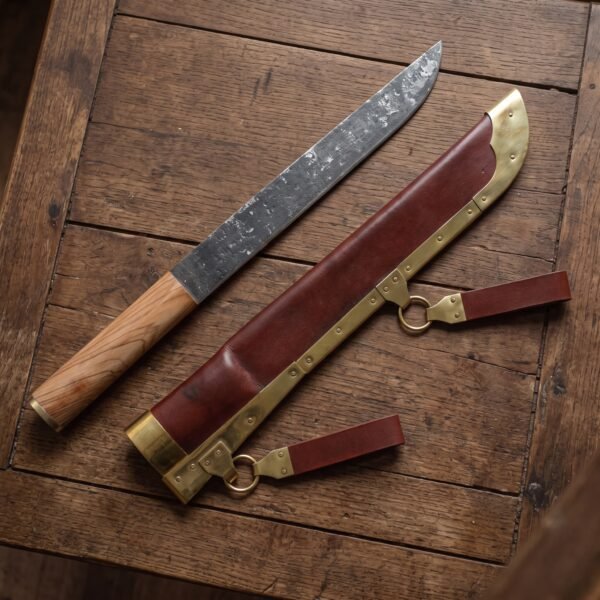
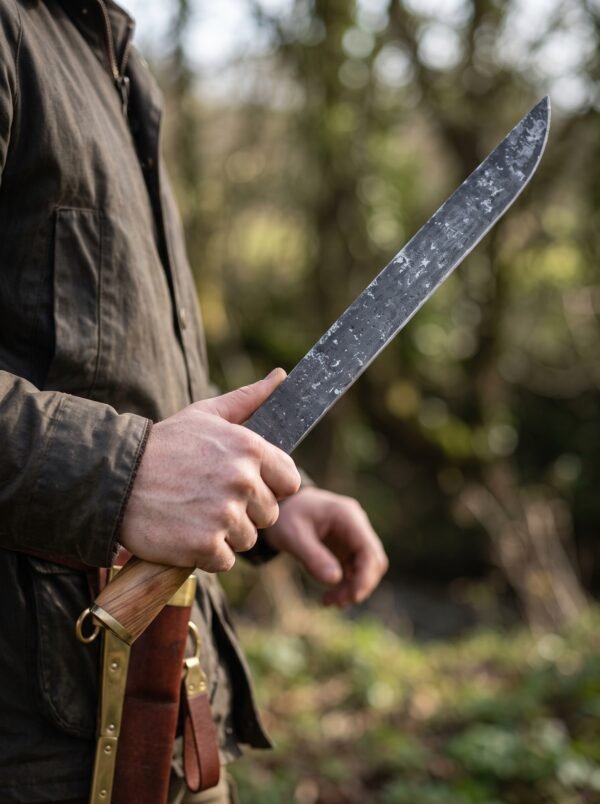
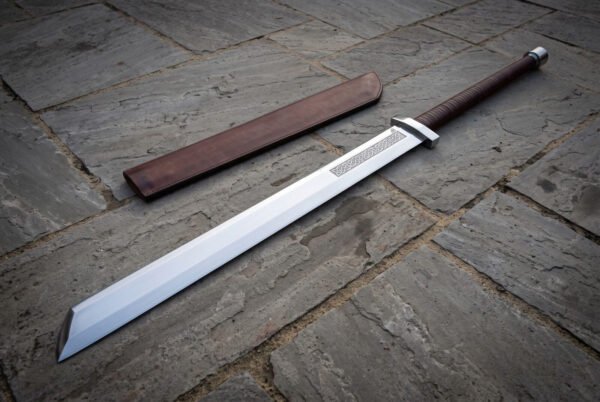
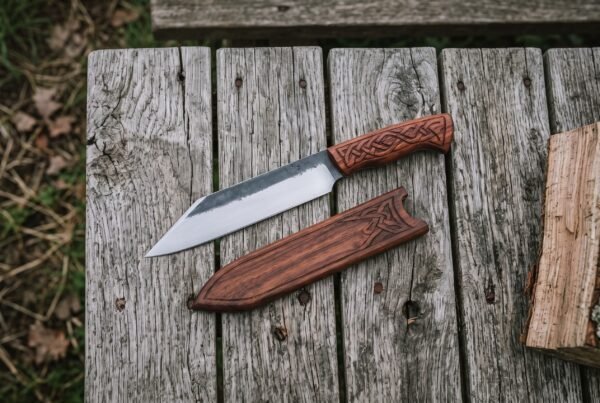
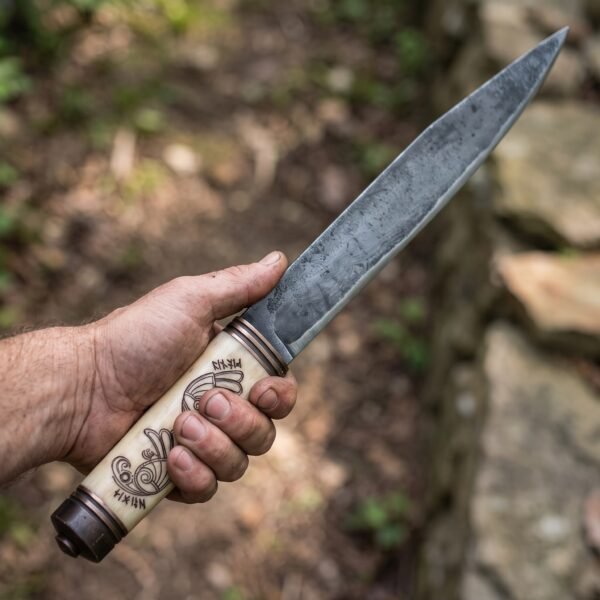
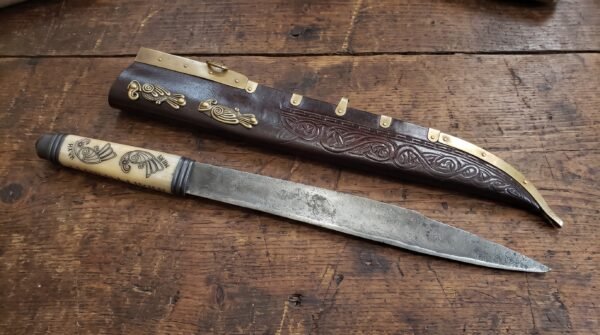
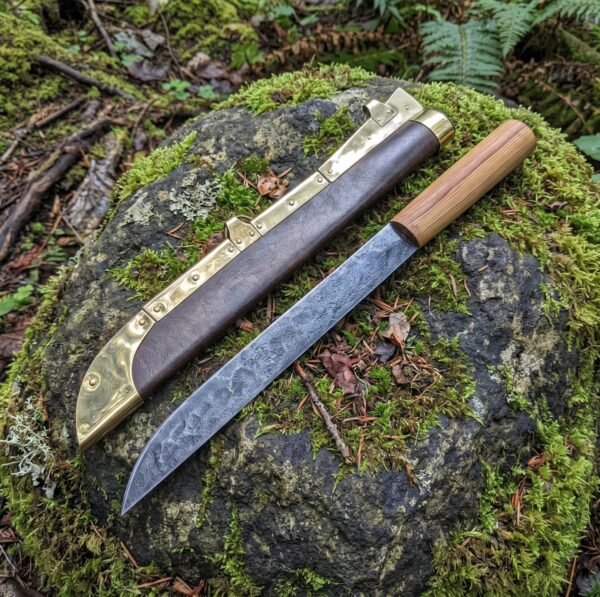
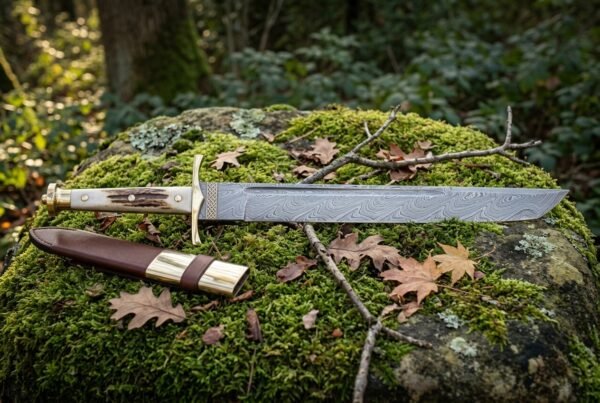
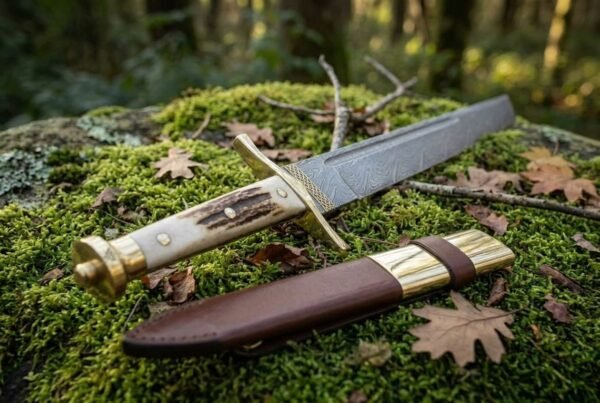
The Wolfmark is a Damascus seax knife with a thirteen inch single edged blade, a straight spine, and a long forward taper to a needle fine point. The steel is 1095 folded with 15N20 and etched so the pattern reads clearly across the whole flat, and a wolf head is cut into the blade just ahead of the bolster. The handle is dark buffalo horn between a polished steel bolster and a steel butt cap, and it ships in a stitched leather belt sheath.
Pattern welded blades are not a modern invention dressed up in Norse clothing. They are the single most characteristic technology of early medieval northern European smithing, and the reason is practical rather than aesthetic. Bloomery iron came out of the furnace in wildly variable lumps, some of it high in carbon and some of it barely steel at all. Folding and welding those pieces together evened out the composition and gave a smith usable material from unusable stock. The pattern was a by product that people then learned to control and show off. This Wolfmark is welded, forged, ground, etched and fitted in a Czech Republic workshop, and it carries our lifetime warranty against defects in forging, grind, heat treat and fittings, with no end date and no receipt needed. Kept with the seax knives, and worth setting against the Bowie knives before you decide.
Specifications
| Blade material | 1095 and 15N20 Damascus, 58 to 60 HRC |
|---|
| Blade length | Approximately 13 inches |
|---|
| Overall length | Approximately 18 inches |
|---|
| Blade width | Approximately 1.5 inches at the ricasso |
|---|
| Grind | Single edge, flat ground, straight spine angling down to a fine point |
|---|
| Fuller | One long fuller running under the spine |
|---|
| Etching | Wolf head cut into the blade ahead of the bolster |
|---|
| Handle | Black buffalo horn, oval section, hand shaped and polished |
|---|
| Bolster | One polished steel bolster |
|---|
| Butt cap | Polished steel |
|---|
| Sheath | Stitched brown leather belt sheath |
|---|
| SKU | RK-1597 |
|---|
Why Norse smiths pattern welded, and what has changed since
A modern smith buying a bar of certified 1095 has something no Viking age smith ever had, which is steel of known and consistent composition. Before that existed, every bloom was a gamble. A smith would break a bloom apart, sort the pieces by how they behaved under the hammer and at the grindstone, and then weld selected pieces together to build a bar with the properties he actually wanted. Hard high carbon material went where the edge would be. Tougher lower carbon material went into the core and the spine.
Twisting and folding those laminations produced the herringbone and serpent patterns visible on so many excavated blades from Scandinavia and the Rhineland. Norse writers clearly noticed. Poetic descriptions of blades that shine like a snake or carry a serpent in them are describing exactly this, and the effect is much more obvious on a lightly etched blade than on a polished one.
Today the metallurgy is inverted. We do not need to weld two steels to get a usable bar, so pattern welding is done for the pattern, and the steels are chosen for how they react to acid rather than how they came out of a furnace. 1095 gives the carbon and the hardness. 15N20 carries about two percent nickel, resists the etchant, and stays bright while the 1095 goes dark. That contrast is the pattern.
The steel, the horn and the fittings
The billet is folded to several hundred layers, then forged to shape, normalised, hardened in oil and tempered to 58 to 60 HRC. A seax at this hardness holds an edge through long cutting sessions, and the flat grind means there is enough steel behind the edge that it does not chip on bone or a hidden knot.
The handle is buffalo horn, which is worth a word. Horn is keratin, the same protein family as your fingernail, and it is worked by heating, pressing and shaping rather than by carving alone. It takes a deep gloss straight off the abrasive, it is warm in the hand in cold weather in a way steel and stone are not, and it is genuinely tough. Every piece has its own colour, from near black to a smoky grey brown with pale streaks. The bolster and butt cap are polished steel, fitted tight to the horn to seal the joint.
Engraving, runes and your own design
Use the rune converter on this page to turn a name, a date or a short phrase into Elder Futhark and we will cut it into the steel, the leather or the wood. If you would rather have a Viking pattern than a rune line, choose your own design in the engraving option above the add to cart button and tell us where it goes. Where a piece already carries an engraved design, your chosen engraving replaces it rather than sitting alongside it. On the Wolfmark that means a custom mark takes the place of the wolf head, so if you want to keep the wolf and add a name, say so in the order notes and we will price it separately. See the engraving page.
Balance and handling
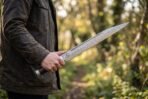
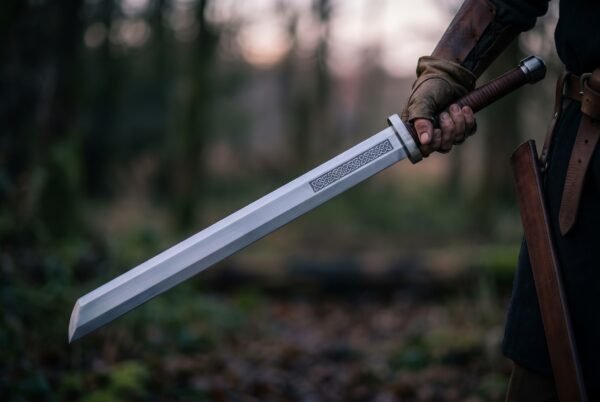
The steel bolster and butt cap pull the balance back to about the width of a thumb ahead of the bolster, which makes a thirteen inch blade feel far more controllable than its length suggests. The horn handle is a plain oval with a slight palm swell, so it does not force a grip on you. It works in a hammer grip for chopping and rolls into a pinch grip for close carving.
It arrives sharp. This is a working forged knife rather than a display copy, and it is not sold for battle ready or full contact sparring. It should not be used against another person. As a field dressing, camp and utility blade at the large end of the scale it is very hard to beat, and the fine point makes it more precise than a chopper this size normally is.
Care
Damascus is high carbon steel, so it will rust if you put it away wet, and an etched surface shows a rust spot much more clearly than a satin one does. Wipe the blade after use, keep a thin film of mineral oil, camellia oil or paste wax on it, and do not store it long term inside the leather sheath. Horn needs its own attention. Keep it out of direct sun and away from radiators, because horn can dry and check if it is baked, and a wipe of neutral wax once or twice a year keeps it fed. Never put it in a dishwasher. Our steel care page covers the blade side in full.
Made in the Czech Republic
This piece is made by hand in the Czech Republic, in a workshop that still works the old way. The steel is forged, ground, heat treated and finished by smiths who learned the trade from the people before them, and the wood, horn and leather are cut and fitted by hand rather than pressed out on a line. That is also why no two pieces come out exactly the same.
Ransack Viking is a United States company. We import these pieces ourselves, check every one when it lands and ship from our warehouse in Chicago, Illinois. Engraving is done here in the United States after the piece arrives, so your runes or your own design go on before it leaves for you.
A note on handmade variation
This is hand made, not machine made or bulk produced, so what arrives will not be a pixel for pixel copy of the photograph. The Damascus pattern is unique to the billet and to where in the bar your blade was cut. Buffalo horn varies enormously, and yours may be jet black, streaked grey, or brown with pale bands running through it. Leather takes dye differently on every hide. The dimensions, the material and the build are the same every time. The character is not. We wrote up how a seax differs from a Bowie separately, and there is a piece on the blade shapes guide as well.
Frequently asked questions
Is the Damascus pattern real or etched on top
Real. It is 1095 folded with 15N20, and the layers run through the full thickness. Sharpening the blade exposes new pattern rather than removing a surface print.
How sharp is it out of the box
Shaving sharp. It is sharpened, stropped and then sheathed, and the fine point is genuinely fine, so unbox it carefully.
Is buffalo horn fragile
No. It is tough and slightly flexible. What it does not like is prolonged dry heat, so keep it off a hot dashboard and away from a radiator.
Can I use it for field dressing
Yes. The length suits large game and the fine point gives you control for the close work. Rinse and dry it the same day, because acids from blood will mark carbon steel quickly.
Will the wolf head be on mine
Yes, unless you order custom engraving, in which case your design takes its place rather than sitting next to it.
How long is the wait
One to two weeks of processing, then free shipping inside the United States. Engraved orders take a few days more.
What is in the box
- One Wolfmark Damascus seax knife with a buffalo horn handle
- One stitched vegetable tanned leather belt sheath
- Care card and lifetime warranty note
- Forged and finished in the Czech Republic
Explore the range
See the Viking seax range, the Viking knives, the hunting knives, or read the guides.
Close to this one
Another in the same line is the Runescar Viking seax, forged from 1095. Next along the rack is the Bonewarden Viking seax, 24 inches overall. For a straight comparison, see the Stagwarden Viking seax, 5 inches overall.
The Bullhorn folding pocket knife covers the other half of the same kit. Nothing here exactly right, build one to your own spec on the custom Damascus knife page.
So happy I finally pulled the trigger on this one. Leather sheath is thick and well stitched. Not the cheap stuff you usually get. This is going straight into my display case.
Five stars isn’t even enough honestly. Weight and balance make it feel like a real functional piece not some cheap replica. Even the small engravings are crisp and clean. Edge retention has been great even after regular use. This shop clearly takes pride in their work.
Happy with this one for the most part. Sheath is nice. Wish it had more padding but it does the job. Would still tell others to give this a try.