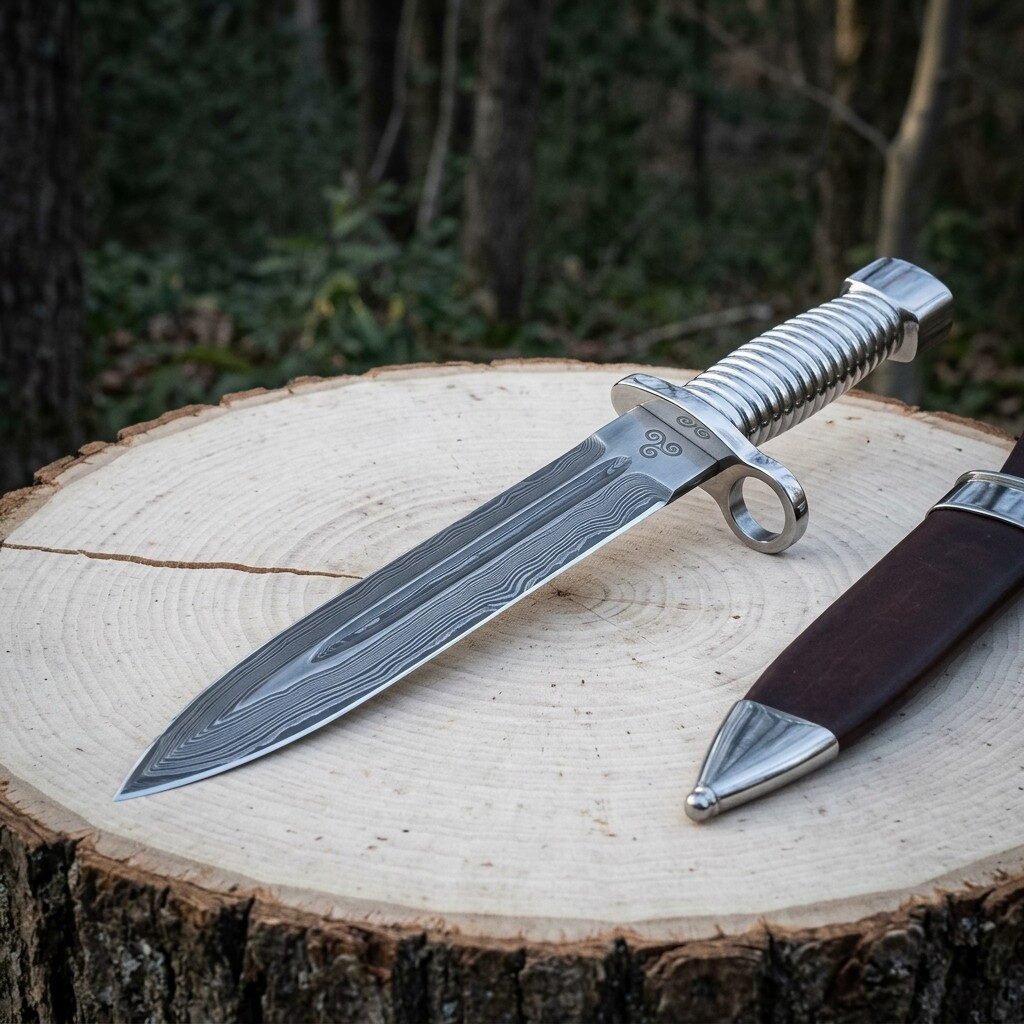
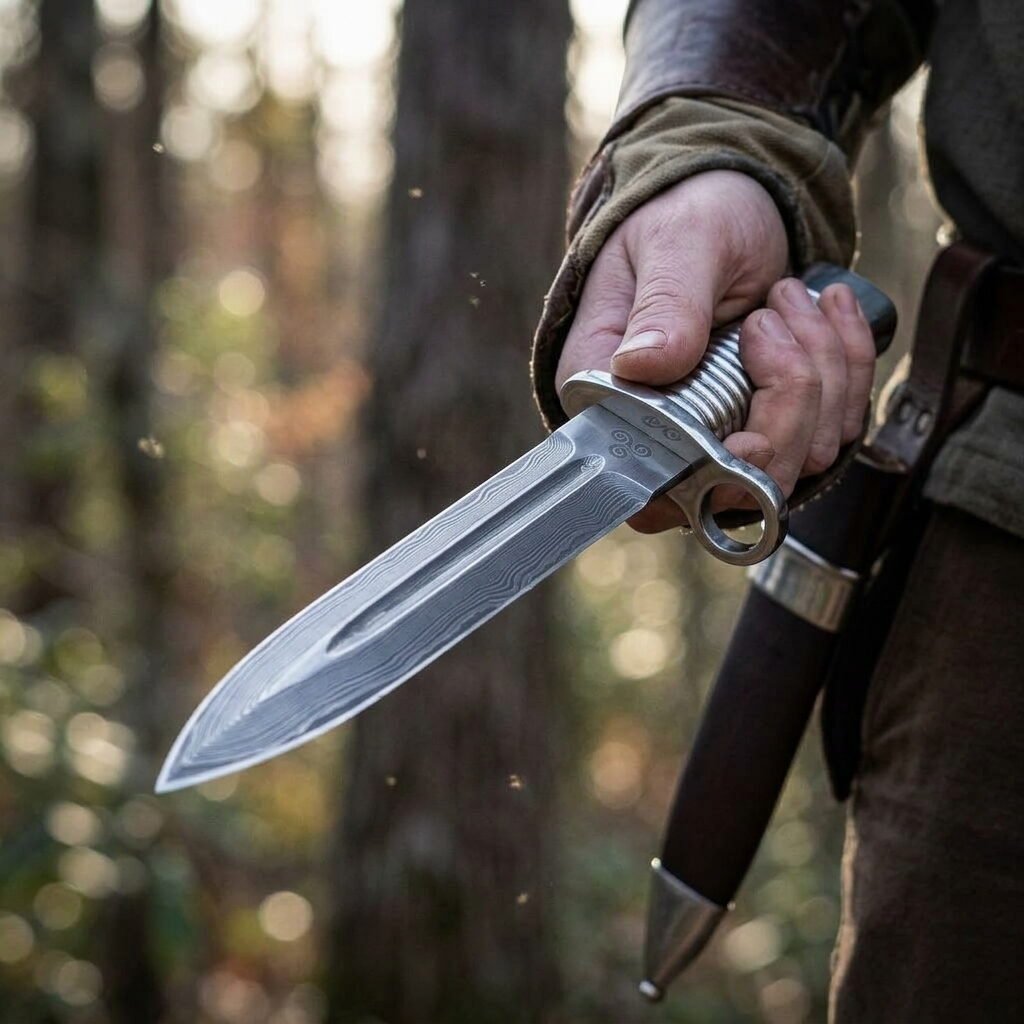
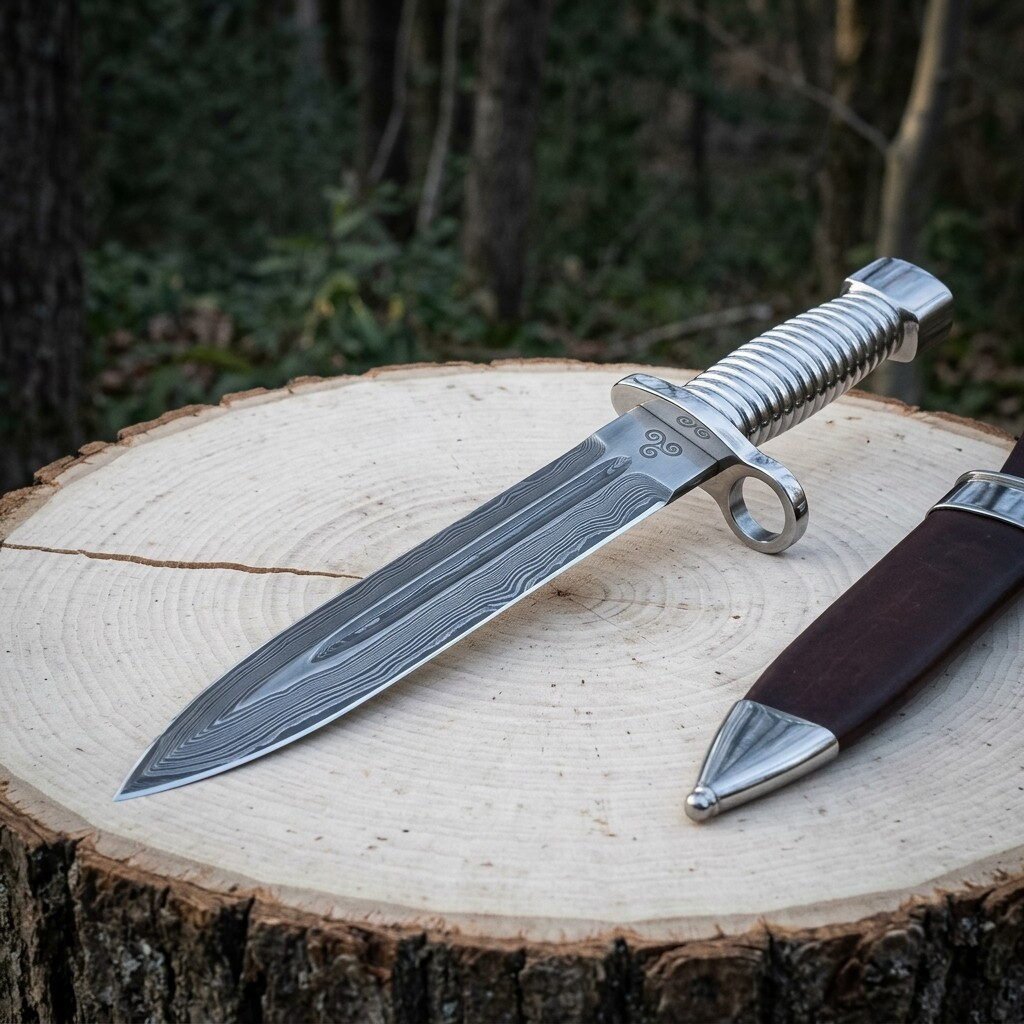
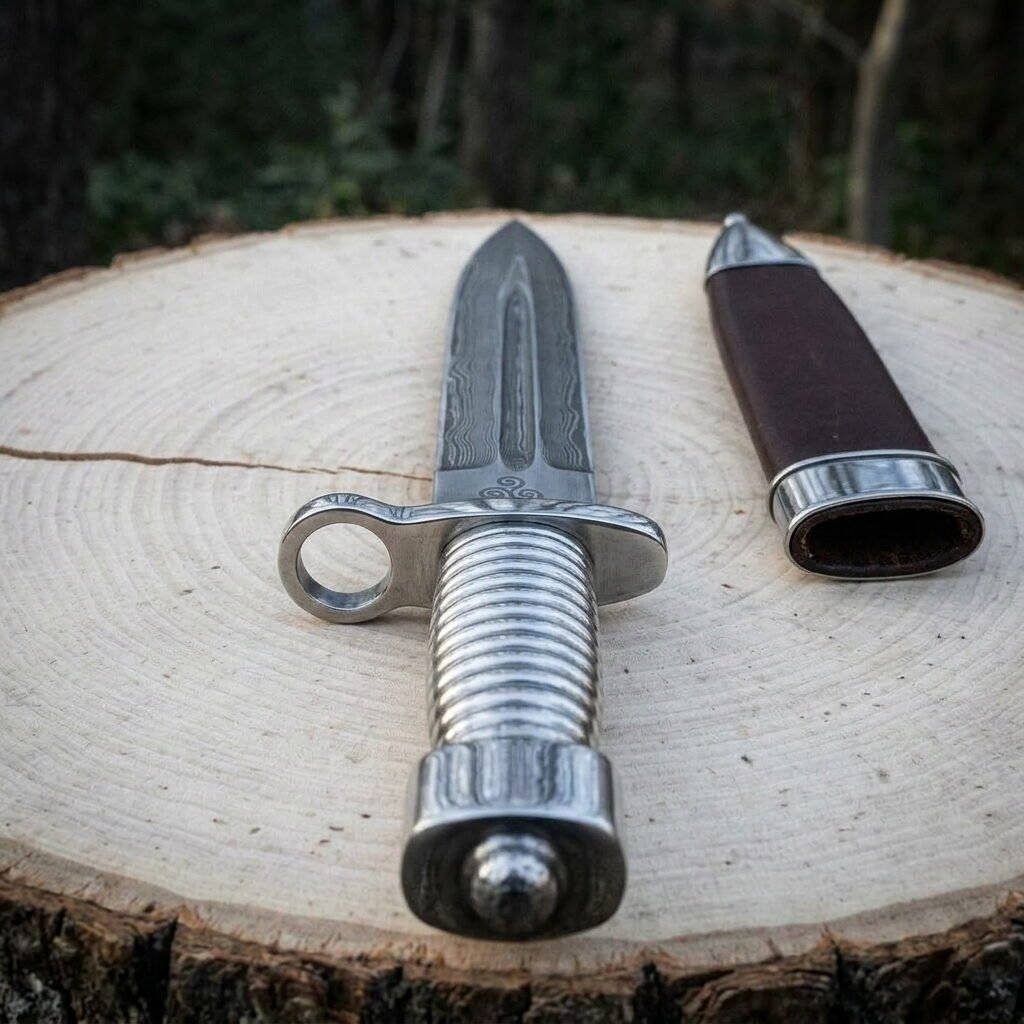
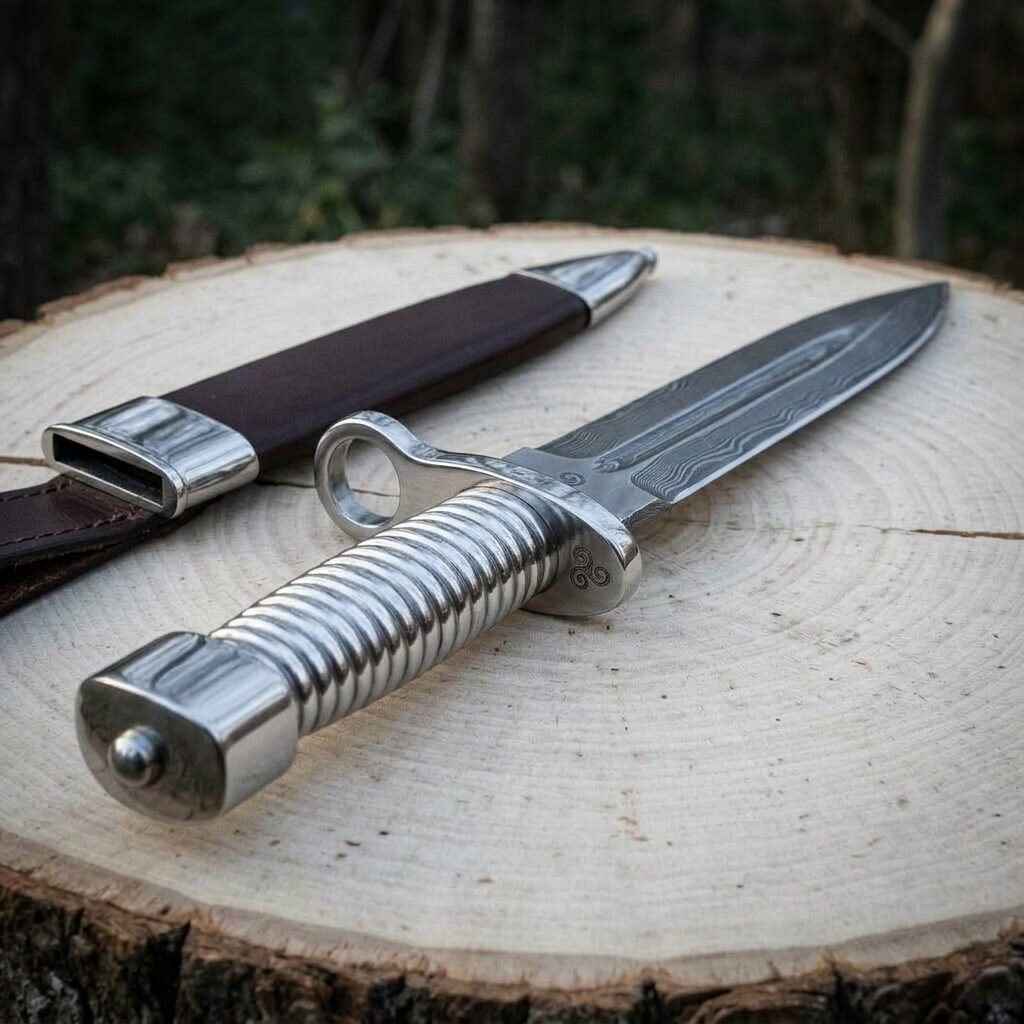
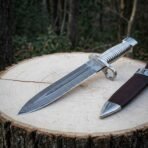
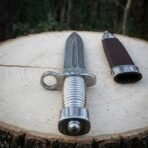
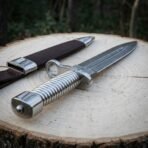
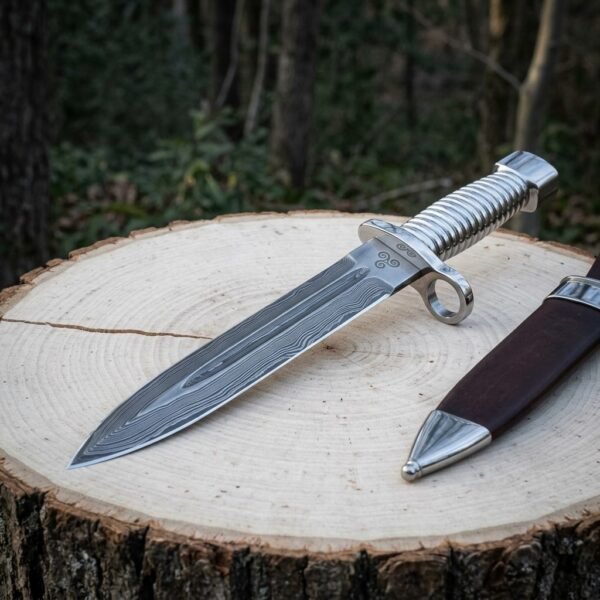
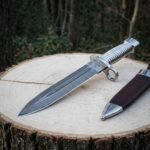
The Ringspike is a double edged fighting dagger built in the pattern of an old military bayonet. The blade is pattern welded Damascus in a long spear point with a narrow central fuller running most of its length, ground so both edges taper evenly to the tip. The grip is solid steel turned into deep parallel flutes so the hand locks into it, capped with a plain steel pommel, and the crossguard carries the feature that gives the piece its name: a full round ring cut through one arm of the guard. Small spiral engravings and a triskele sit on the flat of the blade where it meets the guard.
That ring is not decoration borrowed from nowhere. On a real bayonet it is the muzzle ring, and it exists because of a problem soldiers had in the seventeenth century. The original plug bayonet was a dagger with a tapered wooden handle that was rammed directly into the barrel of a musket, which turned the gun into a short pike and stopped it firing. The fix, credited to French armouries in the 1680s, was the socket bayonet: a sleeve that slid over the outside of the barrel and a ring that located it, leaving the muzzle clear so the soldier could still shoot. Every ringed guard on every bayonet since is a descendant of that idea. This dagger is forged and finished in the Czech Republic, and ships with a fitted leather sheath with a polished steel throat and chape.
Daggers vary more than people expect, and a run through the dagger types is a run through the main ones. The pattern is real forge welding rather than a print, and five checks before you buy shows you how to tell. The throwing knives sit nearby if you want something to put in a stump.
Specifications
| Blade | Pattern welded Damascus in 1095 and 15N20, hardened to 58 to 60 HRC |
|---|
| Blade profile | Double edged spear point with a narrow central fuller running most of its length |
|---|
| Overall length | Approximately 14 inches |
|---|
| Blade length | Approximately 9 inches |
|---|
| Grip | Turned steel with deep parallel flutes |
|---|
| Pommel | Squared polished steel pommel cap |
|---|
| Guard | Steel crossguard with a full round muzzle ring on one arm |
|---|
| Engraving | Triskele and spiral detail at the base of the blade |
|---|
| Finish | Acid etched and polished Damascus, bright polished fittings |
|---|
| Sheath | Dark brown leather with a polished steel throat and a steel chape with ball tip |
|---|
| Included | Dagger and leather sheath |
|---|
| SKU | RK-1871 |
|---|
Why the ring is on the guard
The muzzle ring did two jobs. It carried the blade concentric with the barrel so the point sat clear of the line of fire, and it took the shock of a thrust straight into the barrel rather than into the thin socket walls. Bayonets that lost their ring, and there were designs that tried, tended to bend at the socket the first time someone put weight behind them. On a knife with no rifle to mount to, the ring becomes something else useful. It gives you a positive index point under the forefinger, so the hand knows without looking which way the edge is facing, and it takes a lanyard cleanly without drilling the pommel.
The rest of the geometry follows the same military logic. A spear point blade with a central fuller stays stiff for its weight, because the fuller takes steel out of the middle where it does least work and leaves the thicker shoulders either side to carry the load. That is why thrusting blades from the Roman pugio through to twentieth century fighting knives keep coming back to the same shape. Both edges are ground, so the blade cuts on the draw and the back cut alike, and the point stays supported right up to the last half inch.
The steel and the pattern
The blade is forged from alternating layers of 1095 high carbon steel and 15N20. The two are chosen for what they do in acid rather than for anything mystical. 1095 has a high carbon content and takes a hard, fine edge. 15N20 carries roughly two percent nickel, and nickel resists the acid etch, so after the blade is finished and dipped the 15N20 layers stand out bright and silver while the 1095 darkens. The wavy, contour line pattern you can see running the length of this blade is the record of how the billet was drawn out, folded and ground back, so no two blades come off the anvil identical.
Hardened to 58 to 60 HRC, the blade holds an edge well and takes a fine finish. That hardness is the reason it also demands respect: this is a carbon steel dagger, not stainless, and it will rust if it is left wet. See the care section below.
Engraving, runes and your own design
Use the rune converter on this page to turn a name, a date or a short phrase into Elder Futhark and we will cut it into the steel, the leather or the wood. If you would rather have a Viking pattern than a rune line, choose your own design in the engraving option above the add to cart button and tell us where it goes. Where a piece already carries an engraved design, your chosen engraving replaces it rather than sitting alongside it. On this dagger the natural place is the flat of the blade near the guard, which is where the triskele currently sits, or across the leather of the sheath. See the engraving page for what is possible and how long it adds.
Handling and balance
A steel grip changes how a dagger feels in the hand. The mass sits further back than it would on a wood or leather handled knife of the same blade, so the balance point falls close to the guard and the point feels quick rather than heavy. That suits a thrusting blade. The flutes are cut deep enough that the fingers seat between them, which gives grip without any wrap or texture, and the ring gives the forefinger somewhere definite to sit.
Steel grips are also cold and, when wet, slick. Anyone used to a stacked leather or micarta handle will notice both. If you plan to handle this piece regularly rather than display it, a lanyard through the guard ring is worth adding.
Care
Wipe the blade dry after every handling and put a light film of oil on it before it goes away. Fingerprints etch into carbon steel faster than most people expect, and the acid etched surface shows them clearly. A soft cloth and a few drops of mineral oil or a dedicated blade oil is all it needs. Do not store the dagger inside the leather sheath for long periods; tanned leather holds moisture and will mark the finish. Feed the sheath twice a year with a leather balm and let it dry naturally away from heat. Full instructions are on our steel care page.
Damascus wants oil more than plain steel does, because the etch that shows the pattern also opens the surface, and caring for a Damascus pattern covers what to use.
Made in the Czech Republic
Every piece we sell is made by hand in the Czech Republic. The smiths there work the way the trade has been worked for a long time, heating and hammering the steel, taking the bevels down by eye, and fitting the handle and the leather one at a time. There is no automated line anywhere in it, so small differences from one piece to the next are normal and expected.
Ransack Viking is a United States company based in Chicago, Illinois. We bring the pieces in ourselves, inspect them on arrival and ship them from our own warehouse. If you add engraving, that is carried out here in the United States before your order goes out.
A note on handmade variation
This is hand made, not machine made or bulk produced, so what arrives will not be a pixel for pixel copy of the photograph. The Damascus pattern is the biggest variable of all: the way the layers stack, the depth of the etch and the exact flow of the contour lines change from billet to billet and from blade to blade. Flute spacing, the polish on the fittings, the tone of the leather and the exact profile of the point vary a little because each one is worked by hand. The dimensions, the material and the build are the same every time. The character is not.
Frequently asked questions
Is it sharp out of the box
Yes. Both edges arrive sharpened and ready to cut. If you are buying this as a display or collector piece and would prefer it blunted, say so in the order notes and we will leave the edges unsharpened.
Is this a real bayonet that will fit a rifle
No. It is a dagger built in the bayonet pattern. There is no socket, no locking catch and no lug slot, so it will not mount to any firearm. The ring is a design feature and a finger index, nothing more.
Will the Damascus pattern wear off
No. The pattern is structural, not printed or coated. It goes all the way through the steel, because it is made of the layers themselves. Sharpening or polishing may lighten the contrast at the surface, and a light etch brings it straight back.
Can I put a name on the blade
Yes. Use the rune converter on this page for Elder Futhark, or choose your own design and tell us where you want it. The engraving replaces the triskele that is there now rather than sitting next to it.
Will it rust
It can, because 1095 and 15N20 are both carbon steels with no chromium to protect them. Kept dry and lightly oiled it will stay clean for years. Left wet or stored in the sheath it will spot.
How long does shipping take
Processing takes one to two weeks because the piece is made by hand, then US shipping is free. If you need it for a fixed date, tell us in the order notes before you buy and we will confirm whether we can make it.
What is in the box
- Ringspike Damascus bayonet dagger with fluted steel grip and ring guard
- Fitted leather sheath with polished steel throat and chape
- Care card for carbon steel and leather
- Lifetime warranty against defects in forging, grind, heat treat and fittings
- Forged and finished in the Czech Republic
Explore the range
See more in dagger knives, Viking knives and Damascus swords, or read the guides for how pattern welded steel is made and how to look after it.
Others in the same line
Next along the rack is the Bonespire dagger knife, pattern welded Damascus. For a straight comparison, see the Longspire dagger knife, pattern welded Damascus. Worth putting side by side with this is the Hornspire dagger knife, pattern welded Damascus.
If you are putting a set together, the Ramwhorl bowie knife sits alongside it. You can have this made your way instead on the custom Damascus knife page.


This is exactly what I wanted and then some. This is my third order from Ransack Viking and they never disappoint. Weight and balance make it feel like a real functional piece not some cheap replica. The wood handle feels amazing and the balance is perfect. Couldn’t be happier with this.
Feels way more premium than the price suggests. Leather sheath is thick and well stitched. Not the cheap stuff you usually get. Couldn’t be happier with this. Ordered from Ransack Viking before and the quality stays consistent every time.
Feels way more premium than the price suggests. You can tell it’s real Czech blacksmith work and shipping from the States made delivery painless. This is going straight into my display case.
Got this as a gift and now I want one for myself too. Edge retention has been great even after regular use. Beyond happy with how this turned out.
Good quality knife for the price. Blade quality is solid. Arrived a bit less sharp than expected but a few passes on a strop fixed it. Still very happy with it and would recommend.
Knew this knife was special the second I opened the box. Edge retention has been great even after regular use. Beyond happy with how this turned out. Love that this is Czech craftsmanship and shipping from the US meant it showed up in just a few days.
So happy I finally pulled the trigger on this one. Highly recommend this one. You can tell it’s real Czech blacksmith work and shipping from the States made delivery painless. Ordered from Ransack Viking before and the quality stays consistent every time.
Turned out better than I expected going in. Made in the Czech Republic but ships from the US. Delivery was quick even so.
Perfect gift. Perfect quality. No complaints. The wood handle feels amazing and the balance is perfect. Highly recommend this one.
This is exactly what I wanted and then some. If you’re on the fence just get it. You won’t regret it.