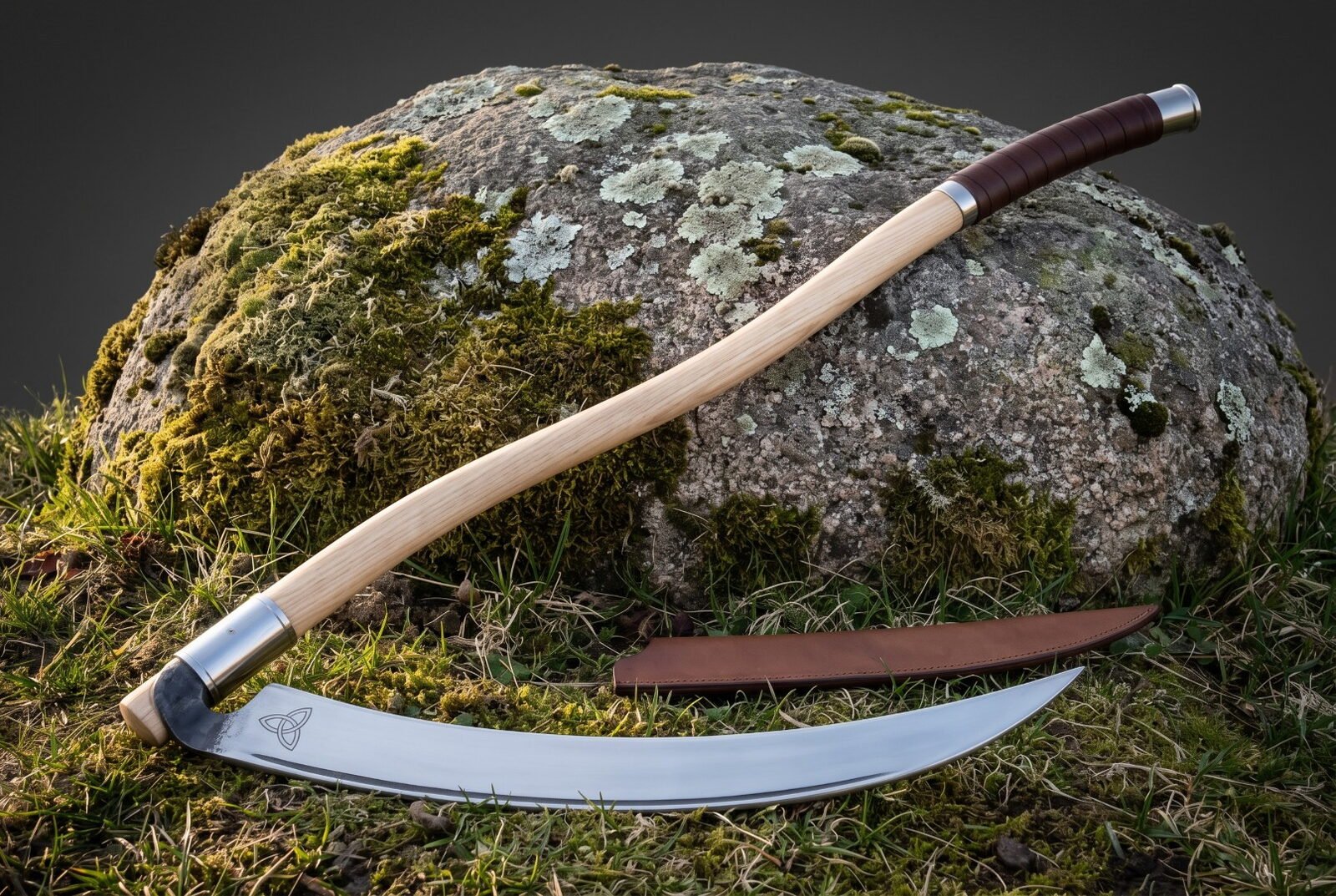
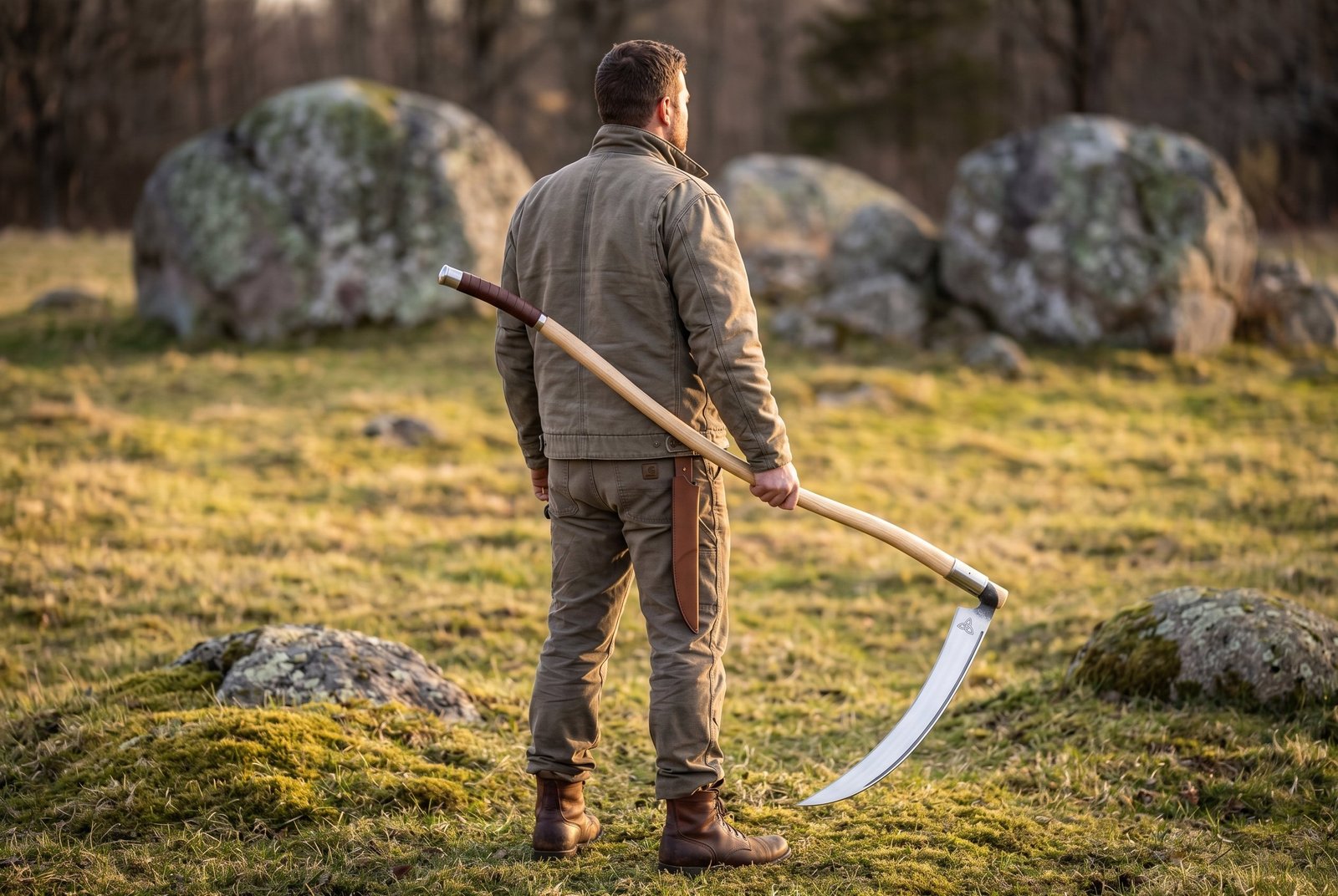
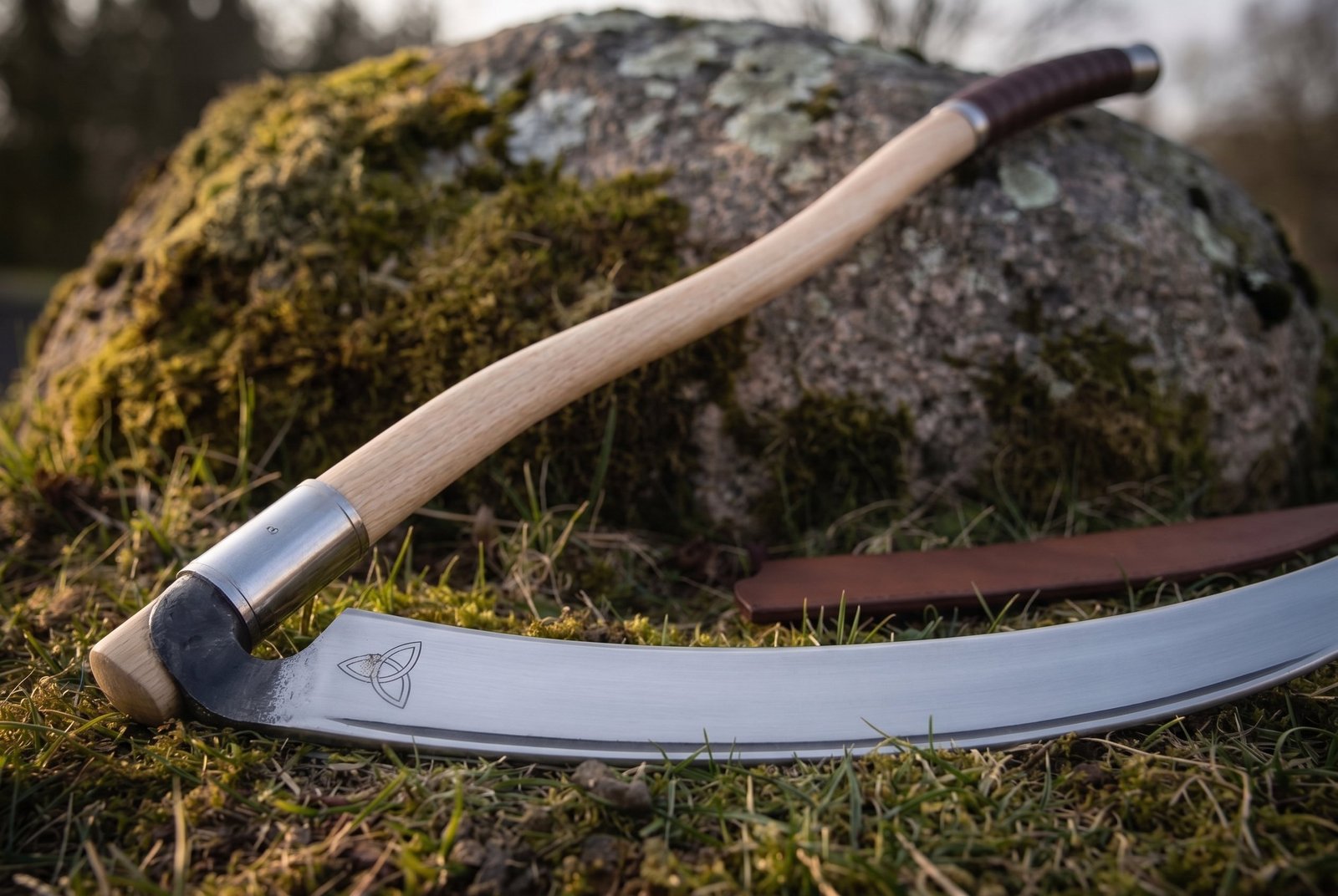
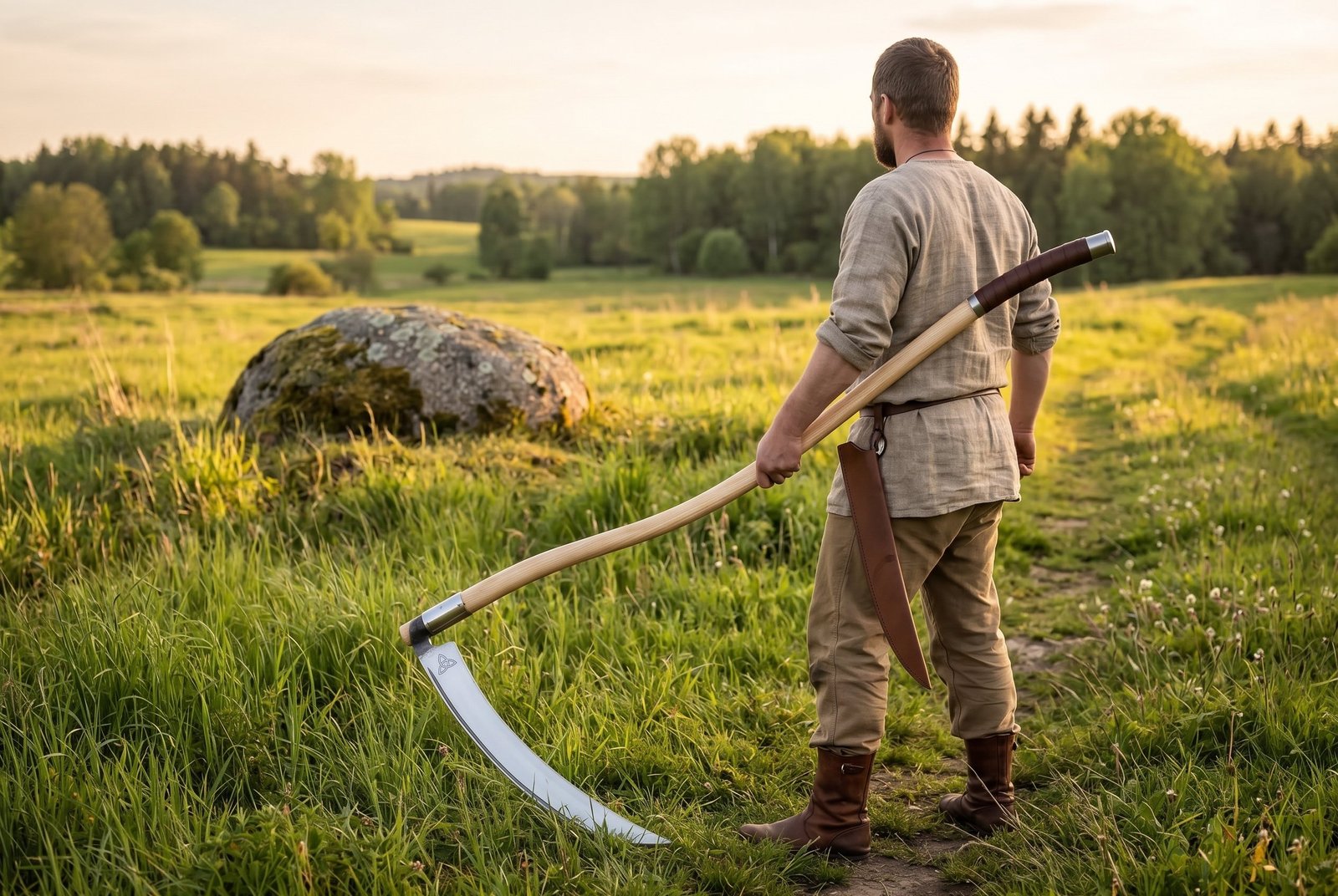
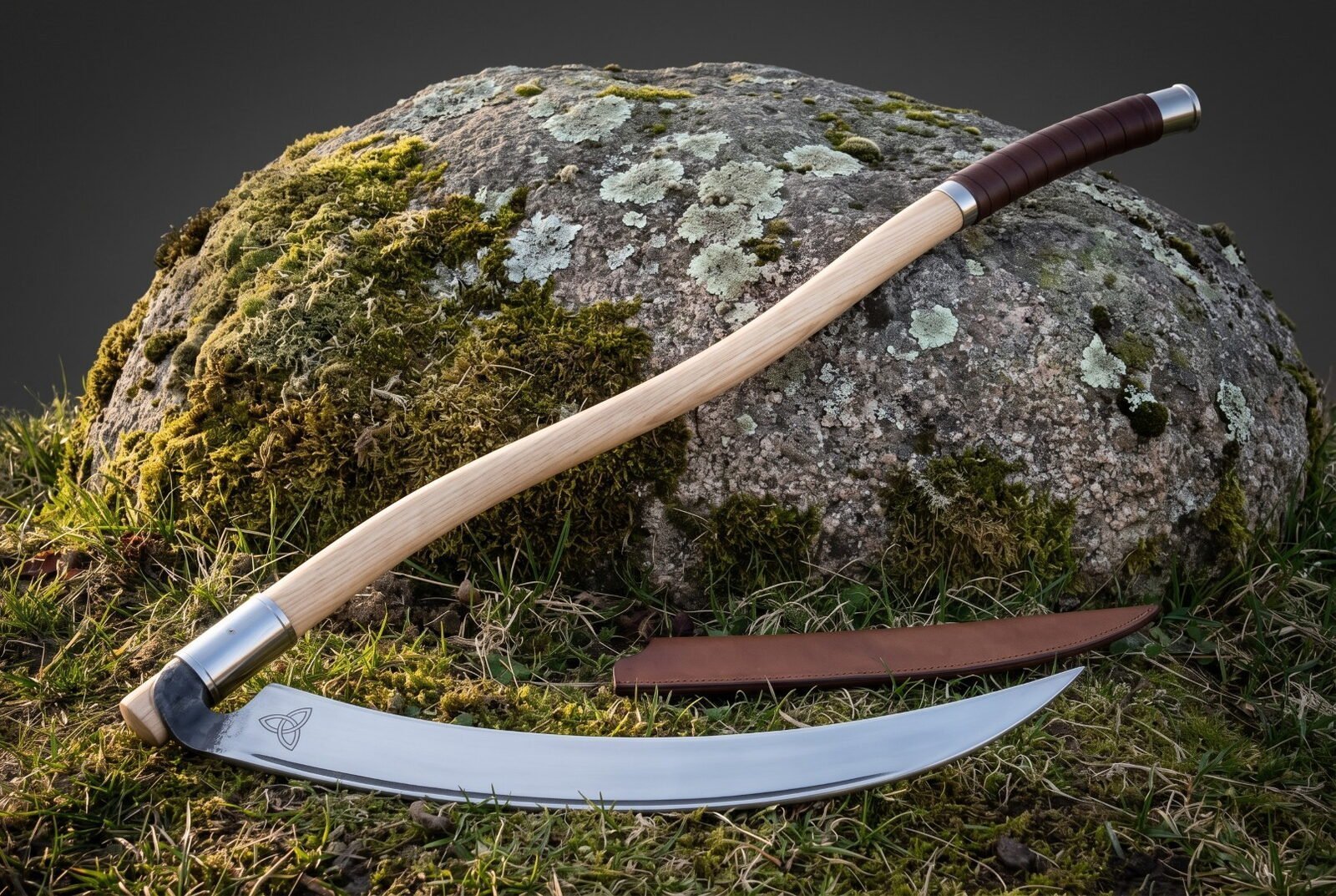
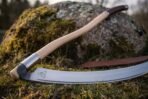
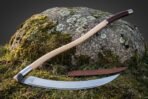
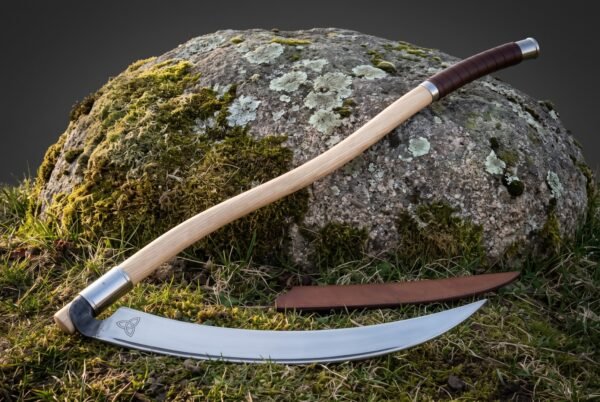
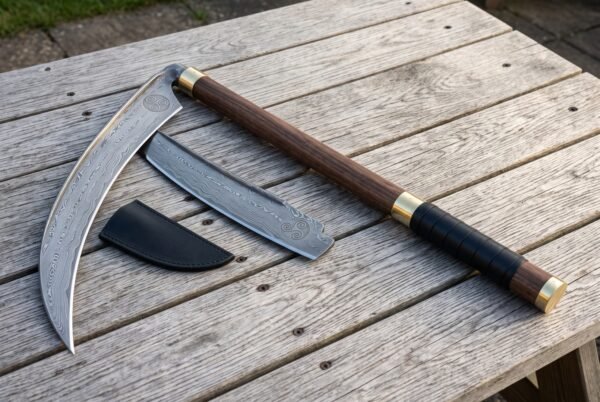
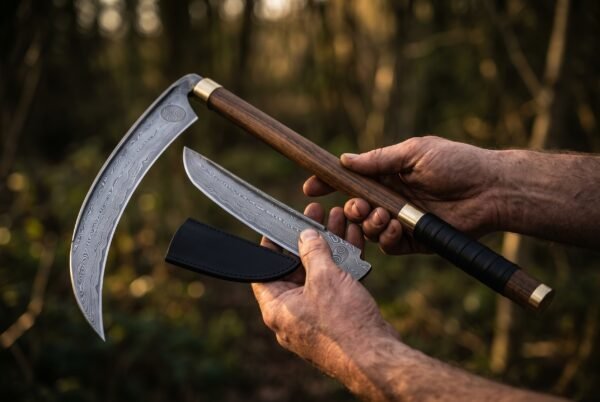
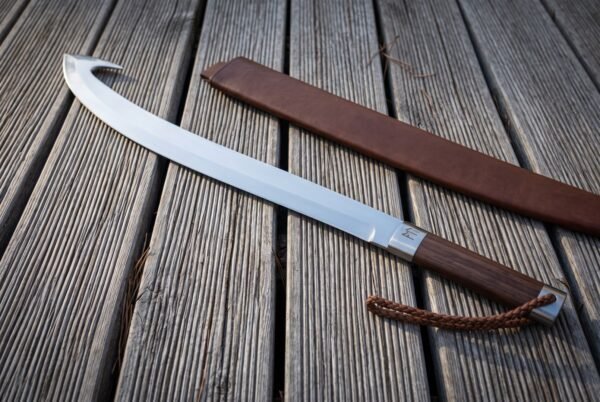
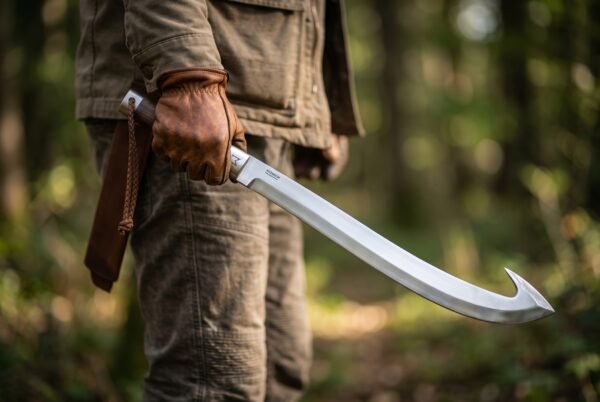
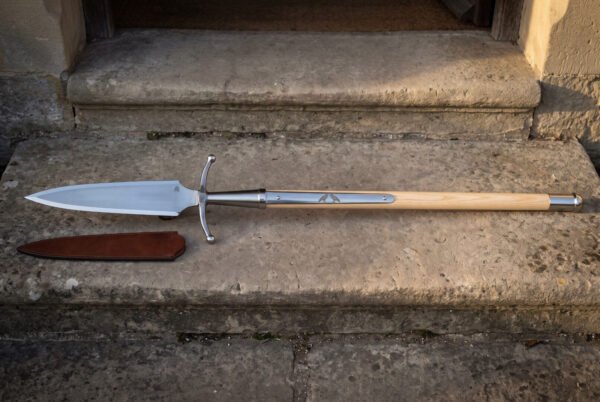
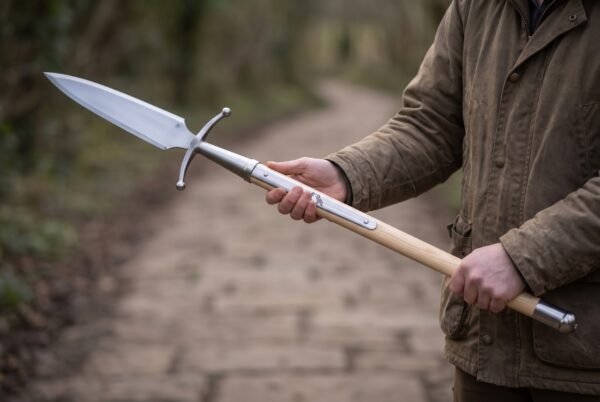
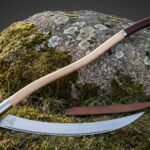
The Harrowsweep is a war scythe. A long single edged blade with a deep forward sweep is socketed into a steel ferrule at the foot of a pale ash haft, and the haft runs roughly five feet back to a leather wrapped grip and a second steel collar at the butt. A triquetra is etched into the polished flat of the blade close to the socket. A shaped leather cover slips over the edge for storage and transport.
The war scythe is one of the few things in history that started life as farm equipment and stayed useful. A harvesting scythe hangs its blade sideways off the snath so it sweeps along the ground. Turn that blade so it lines up with the shaft, socket it properly instead of wedging it, and you have a polearm with a long reach and a terrible cutting arc. Polish peasant levies used them in earnest. At Raclawice in 1794 the kosynierzy, the scythemen, took Russian gun positions with them, and the scythe stayed on Polish battle rolls into the risings of the nineteenth century. Ours is forged, ground, heat treated, hafted and finished in a Czech Republic workshop and ships with the leather blade cover shown, plus our lifetime warranty against defects in forging, grind, heat treat and fittings.
Hafted blades this long are display pieces, and display or battle ready spells out what that phrase means. That three cornered knot is a triquetra, one of several covered in our run through the Norse symbols. Shorter hafted heads of the same family sit with the poleaxes.
Specifications
| Blade material | 1095 high carbon steel |
|---|
| Hardness | 54 to 58 HRC |
|---|
| Overall length | About 60 inches |
|---|
| Blade length | About 25 inches measured along the curve |
|---|
| Blade type | Single edged with a deep forward sweep, set at close to a right angle to the haft |
|---|
| Haft | Gently curved ash haft, straight grained, natural oiled finish |
|---|
| Grip | Brown leather wrap at the butt end of the haft |
|---|
| Fittings | Steel socket ferrule at the blade and a steel cap at the butt |
|---|
| Engraving | Triquetra etched on the blade near the socket |
|---|
| Finish | Satin polished blade, oiled ash haft |
|---|
| Cover | Fitted brown leather blade cover |
|---|
| SKU | RK-1953 |
|---|
Why the blade is socketed and not wedged
The joint is the whole argument with a scythe. On a farm scythe the blade sits in a tang and ring arrangement designed to be knocked loose and re set every season, because the angle needs adjusting for the height of the person mowing. That joint is fine for grass and hopeless for anything that hits back. The first thing peasant smiths did when a scythe was going to war was to change the joint.
Ours is a socket. The tang runs up inside a forged steel collar that grips the haft over several inches of length rather than at one point, and the load spreads down the shaft instead of concentrating at a single pin. That is the same principle behind a socketed spear head, and it is why socketed heads outlived tanged ones almost everywhere. A tang that is simply driven in will lever itself loose over time. A socket that surrounds the wood cannot.
The blade is set off the haft at close to a right angle, the way a mowing scythe carries its blade, rather than turned in line with it. That angle is what gives a scythe its drawing cut. As the blade sweeps it slices along its own length instead of chopping straight in, which is exactly how a scythe takes down standing grass and why the same geometry is so effective on a battlefield.
Steel and ash
The blade is 1095 high carbon steel at 54 to 58 HRC. On a blade this long and this thin through the section, toughness matters more than the last point of edge holding, and this is the hardness band where a long blade flexes and comes back rather than snapping. The steel is normalised before hardening to settle the grain after forging, then quenched and tempered in house.
The haft is American ash, which is the same wood used for tool handles, oars and baseball bats, and for the same reasons. Ash grows a long straight grain, it is springy rather than brittle, and it absorbs shock through the length of the shaft instead of transmitting all of it to your hands. We pick hafts with the grain running true from end to end, since a haft with grain running out at an angle across the shaft has a built in break line. The wood is oiled rather than lacquered, so it grips better and can be re oiled rather than stripped.
Engraving, runes and your own design
Use the rune converter on this page to turn a name, a date or a short phrase into Elder Futhark and we will cut it into the steel or burn it into the wood. If you would rather have a Viking pattern than a rune line, choose your own design in the engraving option above the add to cart button and tell us where it goes. Where a piece already carries an engraved design, your chosen engraving replaces it rather than sitting alongside it. On the Harrowsweep the triquetra near the socket is that place, though there is also room to burn a rune line into the ash haft above the grip if you would rather keep the blade as it is. See the engraving page for what is possible.
Handling and reach
A war scythe is used two handed and it is built for reach. The lower hand stays near the butt collar and does very little except anchor. The upper hand sits on the leather wrap and does the steering. Because the mass is concentrated at the far end, the scythe wants to keep sweeping once you have started it, which is a strength in a wide arc and a weakness if you try to change direction halfway through.
The balance point sits well forward, roughly two thirds of the way along the haft. That is normal for the type and it is why the leather grip is placed where it is rather than in the middle. This is a sharp forged blade on a five foot shaft. It is a collector and display piece and a cutting practice tool, not for sparring, and it must never be used in contact work against a person.
Care
Wipe the blade after handling and keep a light film of mineral oil or camellia oil on it. A long polished blade shows a rust freckle sooner than a dark one does, so the habit matters more here than on a blackened piece. Store the leather cover on the edge but do not leave the blade tightly wrapped in damp leather for months, since leather holds moisture against steel. Our full notes are in the steel care guide.
The ash haft wants a wipe of boiled linseed oil or a hard wax once or twice a year. It will darken slowly with handling, which is what oiled ash does and what makes an old tool handle look the way it does. Do not leave it standing in a damp garage or leaning against an outside wall. If the haft ever picks up a raised whisker of grain, knock it back with fine paper and re oil the spot.
If it is going on a wall, hanging swords and axes safely covers mounts, fixings and what not to do.
Made in the Czech Republic
This is a handmade piece from the Czech Republic, made in a workshop that still forges, grinds and finishes by hand instead of stamping parts out. The smiths there have kept the older way of working, and the wood, horn and leather are shaped and fitted by hand as well. Two pieces of the same design will never be identical, and that is part of what you are buying.
Ransack Viking is a United States company. We handle the import ourselves, look over every piece when it lands and ship from our warehouse in Chicago, Illinois. Engraving is done in the United States after the piece arrives, so your design goes on before we send it out.
A note on handmade variation
This is made by hand and not machine made or bulk produced, so what arrives will not be a pixel for pixel copy of the photograph. Ash is a natural material and no two hafts carry the same grain, so the streaking, the colour and the pattern of the wood will be yours alone. The exact sweep of the blade, the tone of the polish, the depth of the triquetra etch and the way the leather grip is wound all vary slightly. The length, the steel, the heat treat and the joint are the same every time. The character is not.
Frequently asked questions
Is the blade sharp out of the box
Yes. It ships with a working edge along the outer curve. Treat the whole sweep as live, because on a curved blade the part you are not looking at is usually the part nearest your hand.
Does it come apart for shipping or storage
No. The head is socketed and fitted to the haft as a permanent joint, which is what makes it solid. It ships assembled in a long box.
Can I hang it on a wall
Yes, and most owners do. Two hooks under the haft, one near the butt and one below the socket, will carry it safely. Do not hang it by the blade.
Is this usable or is it display only
It is a real forged and heat treated blade on a real ash haft, so it will cut. It is not for sparring or reenactment and must not be used in contact against another person.
Can I get runes burned into the haft instead of the blade
Yes. Say so in the engraving option and tell us where on the haft you want the line to sit. Wood takes a rune line beautifully.
How long will it take to arrive
One to two weeks of processing and then transit. Shipping inside the United States is free. Engraved orders take a few days longer.
What is in the box
- Harrowsweep war scythe with a 1095 high carbon steel blade
- Ash haft with leather wrapped grip and steel collars
- Fitted leather blade cover
- Care card and lifetime warranty against defects in forging, grind, heat treat and fittings
- Forged and finished in the Czech Republic
Explore the range
More in glaives and polearms, Viking spears and Norse arms, or read the guides on hafting and heat treat.
Worth a look beside this
Worth putting side by side with this is the Reaphook polearm, 72 inches overall. In the same category sits the Moonreave polearm, 54 inches overall. A near match for this one is the Whitecrest polearm, 56 inches overall.
For a different piece from the same family, look at the Brassmaul poleaxe. Or start from a blank sheet on the custom Norse arms page.


Happy with this one for the most part. Good overall quality. Just a couple very minor details off. Solid piece. Packaging could’ve been a bit sturdier. Would buy from this shop again.
This thing is a beast in the best way. Packaging was excellent and it arrived in perfect condition. Can’t recommend this enough.
Average quality for the price honestly. Decent quality overall though not amazing. It’s fine for the price. Nothing that stood out. Wouldn’t say no to it but wouldn’t rave about it either.