
Blog
What Is a Kukri? The Curved Nepalese Blade Explained

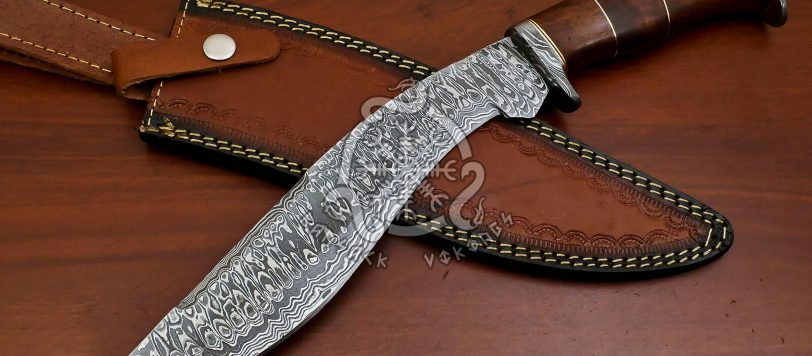
A kukri is a Nepalese knife with a forward curving blade, the edge on the inside of the curve and most of the mass out near the tip. That shape is the whole point, and it does more work than any of the folklore attached to it. It swings like a small axe and cuts like a knife, which is why it has been the working blade of Nepal for centuries and the signature blade of Gurkha regiments since the early nineteenth century.
The shape and what it does
Hold one and the first thing you notice is where the weight sits. A straight knife balances near your hand. A kukri balances forward, past the bend, so the head of the blade carries momentum into whatever it meets. Add the angle: because the edge sweeps forward, the blade meets the target at a slant rather than square on, and a slanted edge slices as it bites instead of wedging.
The result is a tool that chops far above its size. A kukri with a 12 inch blade will get through green wood that would stop a straight knife of the same length, and it still has a fine section near the handle for the small jobs. That inner section, close to the grip, is where you carve, peel and cut cord. The belly out at the front is for chopping. One blade, two working zones.
The parts, named
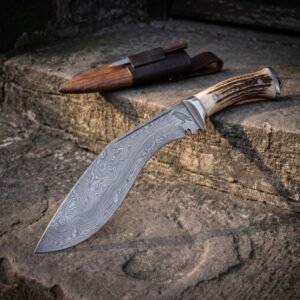 Stagvane Hand Forged Damascus Kukri Knife with Stag Antler Handle | 15 Inch Overall and 10 Inch Blade | Steel Bolster and Leather Sheath Holding Karda and Chakmak | Outdoor Gift | RK-2123
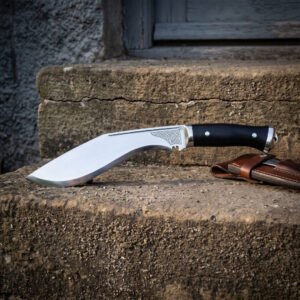 Pitchgrove Hand Forged 1095 Steel Kukri Knife with Black Micarta Handle | 16 Inch Overall and 11 Inch Blade | Knotwork Engraved Blade, Steel Bolster and Pommel and Leather Sheath | Outdoor Gift | RK-2128
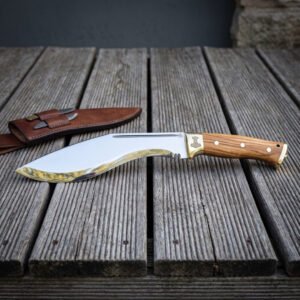 Hammergrove Hand Forged 1095 Steel Kukri Knife with Olive Wood Handle | 16 Inch Overall and 11 Inch Blade | Mjolnir Cut Brass Bolster and Leather Sheath | Norse Outdoor Gift | RK-2133
The cho
Look at the base of the edge, just in front of the handle, and you will find a notch cut into the blade. Nepali speakers call it the cho or the kaudi. Explanations for it are many, all of them are offered confidently, and not one of them is settled. Some read it as a religious mark, a trident of Shiva or a cow’s hoof. Some say it keeps liquid off the grip. Metallurgists usually point out that a rounded notch terminates the edge cleanly and stops a crack running back into the tang. All three may be true at once, and the honest answer is that nobody can tell you with certainty what the first smith who cut one had in mind.
Karda and chakmak
Traditional sheaths carry two small companions in pockets on the back. The karda is a little knife for fine work that would be silly to attempt with the main blade. The chakmak is a blunt tool, sometimes used as a burnisher to straighten and touch up the edge, sometimes struck against flint to make a spark. Not every kukri comes with them, and their presence is a fair sign that a maker is following the tradition rather than approximating it.
The dap
The scabbard is usually a pair of shaped wooden slabs bound together and covered in buffalo hide, with a chape at the tip and a frog or loop for a belt. Dress kukris, the type known as kothimora, carry silver mounts over the leather and are given as presentation pieces rather than carried to work, which is a polite way of saying they are for looking at.
How they are made
Traditional kukri smiths in Nepal, the kami, work with recycled high carbon steel, historically from leaf springs, heated in a charcoal fire and beaten to shape with a hammer and a helper on a sledge. The blade is forged thick along the spine and thin at the edge, so a cross section looks like a long wedge rather than a flat plate.
Hardening is done by eye and by hand. Rather than quench the whole blade, the smith heats it and pours water along the edge in a thin stream, so the edge cools fast and hardens while the spine cools slowly and stays soft. That gives a hard cutting edge on a tough body, which is what keeps a chopping blade from snapping. It is the same principle behind the differential hardening used on Japanese blades, reached by a different route.
The handle is buffalo horn, hardwood or, on military patterns, a riveted full tang sandwiched between scales. Traditional hidden tangs are set with laha, a natural resin used as a hot glue, which holds well and can be softened and reset if it fails. A full flat tang with visible rivets, the panawal style, is stronger and is what most modern buyers should look for.
Where it came from
The origin of the forward curved blade is old and argued over. Similar shapes appear across a wide stretch of the ancient world, and people often link the kukri to the Greek kopis and the Iberian falcata, both of which put the edge on the inner curve for the same mechanical reasons. Whether that is descent or independent invention nobody can prove, and you should treat any confident family tree with suspicion.
What is solid is the modern history. Nepal fought Britain between 1814 and 1816, and the British came away impressed enough to begin recruiting Nepalese soldiers into their own service. Gurkha regiments have carried the kukri ever since, and the standard issue military patterns of the twentieth century are the blades most people outside Nepal have actually handled. Meanwhile, in Nepal itself, the kukri never stopped being a household tool. It splits kindling, butchers meat, clears brush and does the work a machete does elsewhere.
Types you will meet
Sirupate blades are long, slim and lightly curved, named for the leaf of the siru grass. They are faster in the hand and better for slicing than heavy chopping. Ang khola blades go the other way, with a very thick spine and a deep belly, built for splitting wood and for people who want mass. Bhojpure and budhume patterns sit between the two, and the panawal is a construction type rather than a blade shape, meaning a full tang with rivets through the scales.
If blade profiles interest you generally, our guide to knife blade shapes puts the kukri alongside the drop point, the clip point and the rest, and explains why each curve exists.
What to look for when you buy
Length and weight
A blade of 10 to 12 inches with a total weight in the range of 500 to 900 grams covers most uses. Shorter than that and you lose the chopping advantage that makes a kukri worth owning. Much heavier and it becomes a specialist splitting tool you will admire from a distance and rarely take anywhere. Check the published blade length and overall length rather than judging from a photograph, because the curve makes these blades look smaller than they are.
Tang
Full tang with visible rivets is the safest choice for a knife you intend to swing hard. A hidden tang set in resin is traditional and works well when it is done properly, but you cannot inspect it from outside, and a chopping blade puts real stress on that joint. Tradition is a poor substitute for a rivet you can see.
Edge geometry
A kukri edge is usually convex, ground with a slight curve from the bevel to the apex rather than a flat V. That convex shape is what lets it bite into wood without sticking. It also means sharpening on a flat stone will slowly flatten the geometry, so a strop or a slack belt is a better tool for maintenance. Our knife care guide covers oiling, storage and edge maintenance for carbon steel blades in general.
Sheath
The scabbard should hold the blade with friction rather than rattling around, and the leather should be stitched or bound rather than glued at the seams. If karda and chakmak are included, check that the pockets actually hold them.
The kukris we make
Our kukris are Damascus, forge welded from 1095 and 15N20 and finished at 58 to 60 HRC, so you get the layered pattern along a blade that is genuinely hard at the edge. The range covers a stag horn and wood handled chopper with Damascus guard and butt cap, a rosewood handled blade with brass fittings, and a buffalo horn model that ships with the traditional karda and chakmak companion set in the sheath. All three come with a leather sheath. You will find them among the Viking knives and alongside our dagger range, and if you like a big blade with a working history behind it, the seax range is the northern European answer to the same problem. Every piece with that layered pattern is explained in our post on what Damascus steel actually is, which is worth reading before you spend on pattern. Ransack Viking is a US company in Chicago, Illinois. Every piece is handmade in the Czech Republic the old way, then imported, inspected and shipped from Chicago. Engraving is done in the US after arrival.
The kukri is a curved chopper, and keeping that edge is covered in how to sharpen a curve. For a much smaller curved blade with the same problem, see the karambit, and for the sword sized version see the scimitar and where it came from.
Questions people ask
What is the notch on a kukri blade for?
That notch is the cho or kaudi, and there is no single agreed answer. It is read as a religious mark, as a way of keeping liquid off the grip, and as a rounded stop that keeps a crack from travelling back from the edge into the tang. The engineering explanation is sound and the symbolic ones are old. Any source that gives you one definite reason is overstating what is known.
Is a kukri a knife or a small sword?
It sits between the two and is best thought of as a chopping knife. The forward curve moves the weight past your hand, so it swings with axe-like authority, while the section near the grip stays fine enough for carving and food work. Blades of 10 to 12 inches are the common working size, which is longer than most knives and far shorter than a sword, whatever the listing chooses to call it.
What are the two small knives in a kukri sheath?
The karda is a small utility knife for jobs too fine for the main blade. The chakmak is blunt and serves as a burnisher for touching up and straightening the edge, and it can be struck against flint to throw a spark. They sit in pockets on the back of the scabbard. Not every kukri includes them, so check the listing rather than the photograph if you want the full set.
How do you sharpen a kukri?
Most kukri edges are convex, curved from the bevel to the apex rather than flat. Work them on a strop loaded with compound, on a slack belt, or with sandpaper over a leather backing, keeping the curve rather than grinding a flat bevel into it, which is the usual way a good kukri gets quietly ruined. A ceramic rod or the traditional chakmak will straighten a rolled edge between proper sharpenings.
Do Gurkhas still carry kukris?
Yes. Britain began recruiting Nepalese soldiers after the war of 1814 to 1816 and the kukri has been part of that kit ever since, both as an issued blade and as a regimental symbol. It is also a working tool in Nepal itself, used daily for firewood, butchery and clearing brush, which is why the form has stayed so consistent.
What steel do you use for your kukris?
Damascus, forge welded from 1095 and 15N20 and finished at 58 to 60 HRC. The two steels take etching differently, which is what makes the layers visible. Each blade is handmade in the Czech Republic the old way, then imported, inspected and shipped from our base in Chicago, Illinois, with any engraving carried out in the US after arrival.
Pieces in the catalogue
Closest to this in the shop, the Hornstag kukri knife and the Wolfcurve kukri knife. Alongside them, the Runecurve kukri knife and the Gurkhastag kukri knife.
Shop the range
Stagvane Hand Forged Damascus Kukri Knife with Stag Antler Handle | 15 Inch Overall and 10 Inch Blade | Steel Bolster and Leather Sheath Holding Karda and Chakmak | Outdoor Gift | RK-2123Pitchgrove Hand Forged 1095 Steel Kukri Knife with Black Micarta Handle | 16 Inch Overall and 11 Inch Blade | Knotwork Engraved Blade, Steel Bolster and Pommel and Leather Sheath | Outdoor Gift | RK-2128Hammergrove Hand Forged 1095 Steel Kukri Knife with Olive Wood Handle | 16 Inch Overall and 11 Inch Blade | Mjolnir Cut Brass Bolster and Leather Sheath | Norse Outdoor Gift | RK-2133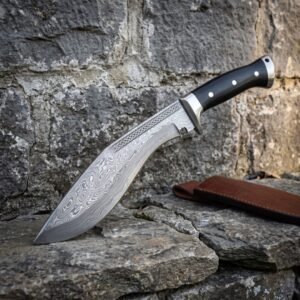 Coalspine Hand Forged Damascus Kukri with Black Micarta Scales | Full Tang Deep Belly Blade | Steel Bolster and Knotwork Engraved Spine | Bushcraft Gift | RK-2170
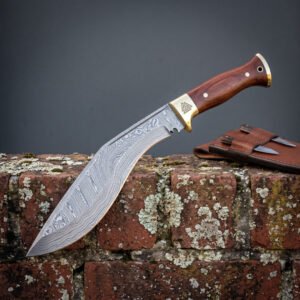 Trineknot Hand Forged Damascus Kukri Knife | 17 Inch Overall | Rosewood Scales and Brass Bolster with Etched Valknut, Leather Sheath and Two Companion Blades | Norse Camp Gift | RK-2106
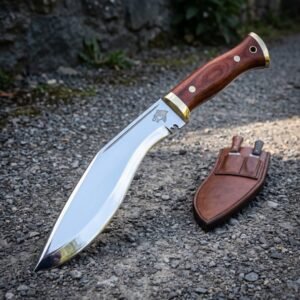 Greyfang Hand Forged Gurkha Kukri Knife with Rosewood Scales & Etched Wolf Head | About 16 Inches Overall | Brass Fittings and Leather Sheath Holding Two Companion Knives | Camp Gift | RK-2202