
Blog
Display Sword vs Battle Ready: What the Words Mean and What You Need

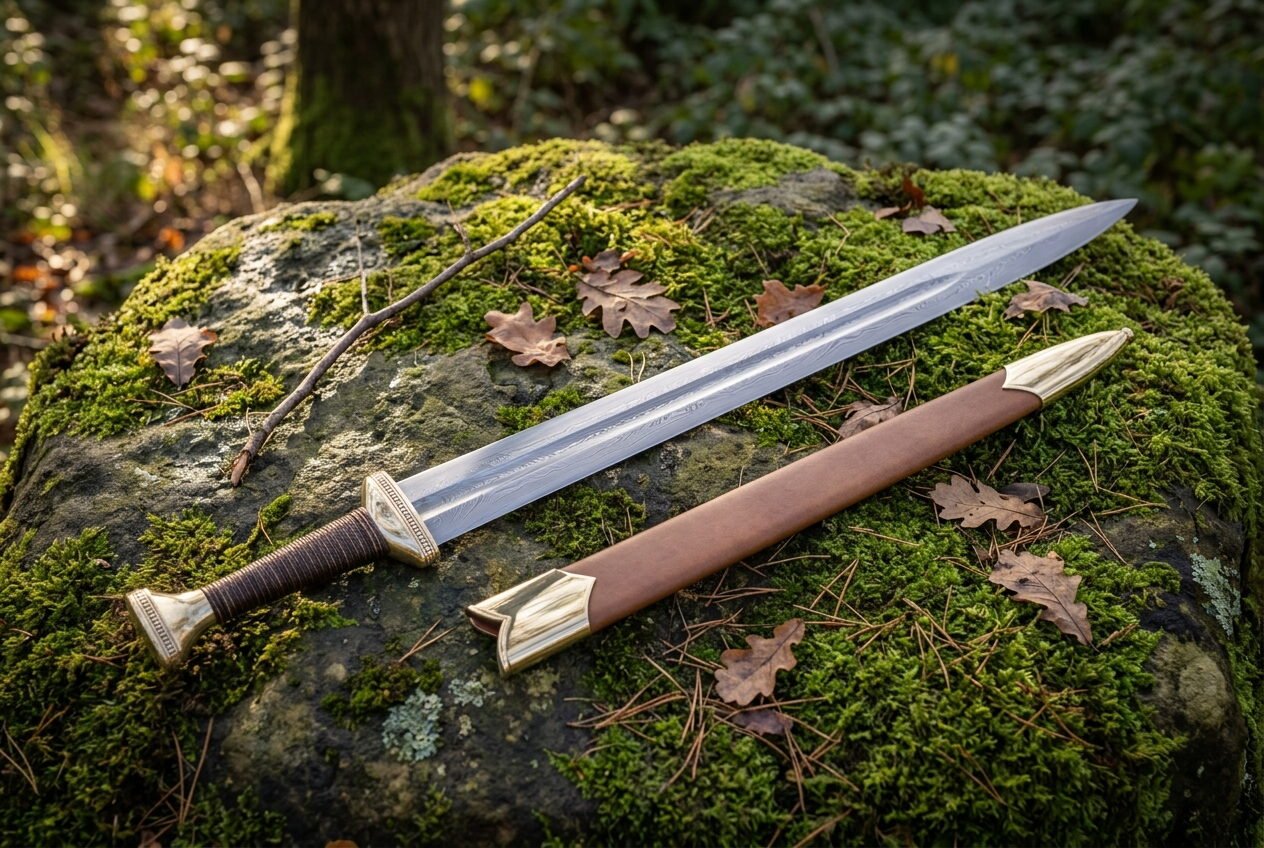
Battle ready means whatever the person selling it wants it to mean. There is no standard, no test and nobody checking. In ordinary trade use it means a sword with a full tang, made from hardened carbon steel, whether sharpened or left blunt. A display sword usually means a narrow rat tail tang, softer steel and a blade built to be looked at. Judge the tang, the steel and the hardness, and ignore the phrase.
That is the honest version, and it saves a lot of money. Two swords can carry the same three words on the listing and be completely different objects. What follows is what actually separates them, and what to check before you hand over any money.
Quick comparison
| Display sword | So called battle ready | |
|---|---|---|
| Tang | Often a narrow rod welded or threaded on | Full width tang running the length of the grip |
| Steel | Frequently stainless or unhardened mild steel | Carbon steel, heat treated |
| Hardness | Not specified, usually soft | Stated as a hardness range |
| Edge | Blunt, often thick | Sharpened or left blunt to order |
| Fittings | Cast, glued or screwed | Fitted and peened or tightly threaded |
| Safe to swing | No | Yes, within the limits of any sword |
| Cost | Low | Higher, because of the steel and the labour |
| Best for | Wall pieces, costume, film props | Collecting, cutting practice, serious display |
What battle ready actually means in the trade
The phrase came out of the reproduction market in the late twentieth century, when a lot of what was sold as a sword was a stainless steel blade on a cast handle that would snap at the grip if you swung it hard. Sellers who were producing something better needed a way to say so, and battle ready became the shorthand. It has been used loosely ever since, and the looseness turned out to suit everybody except the buyer.
 Tidebrand Hand Forged Damascus Norse Short Sword | 28 Inch Overall with 21 Inch Blade | Collector Display Gift | RK-1334
 Hammerwake Hand Forged High Carbon Steel Arming Sword | 37 Inch Overall with 31 Inch Blade | Black Leather Grip and Straight Steel Cross and Wheel Pommel | Norse Display Gift | RK-1338
 Mosscrown Hand Forged Damascus Arming Sword with Scabbard | 38 Inch Overall and 32 Inch Blade | Collector and Display Gift | RK-1341
Nobody owns it. There is no governing body, no minimum specification and no inspection. A seller can print it on any listing, and a good many do. That does not make the phrase useless, because most reputable sellers use it to mean something consistent: a monosteel blade of hardened carbon steel, a tang that runs the full width and length of the grip, and fittings assembled so the sword holds together under load. It just means the words are a starting point for questions rather than an answer.
Three things to check instead
The tang. This is the single most important structural fact about a sword and the one most often hidden. A full tang is one continuous piece of steel from the point back through the guard, the grip and into the pommel. A rat tail tang is a thin rod, often welded to the blade at the shoulder or threaded on, and it is where cheap swords fail. If a listing does not mention the tang, ask. If a seller cannot tell you, that is your answer.
The steel. There is a real difference between a stated grade and a vague description. Stainless steel is fine on a kitchen knife and a poor choice for a long blade, because the properties that resist rust also make it more prone to snapping at length. Plain high carbon steels are the standard for swords for good reason. Our steel glossary sets out what the common grades actually mean, and Damascus against high carbon steel compares the two families a buyer is most likely to meet.
The hardness. Carbon steel does nothing useful until it has been hardened and tempered, and the result is quoted on the Rockwell C scale. A sword left soft will bend and stay bent. A sword taken too hard will chip or break. A listing that gives you a hardness range is telling you the maker controlled the process. A listing that gives you nothing is telling you something too.
The display sword
Display swords are not a scam and they are not a lesser thing by definition. They are a different product with a different job. If a sword is going on a wall in a room where nobody will take it down and swing it, the tang and the heat treatment do nothing for you, and paying for them is paying for something you will not use.
What it does well
Cost is the obvious one. A decorative piece with a cast guard and a stainless blade can look excellent at a fraction of the price of a forged sword, and from six feet away nobody can tell. Many fantasy and film inspired designs only exist as display pieces, because the shapes were drawn for a screen rather than for use. Weight is another advantage that people do not expect: display pieces are often lighter, which makes them easier to hang on drywall.
Where it falls down
It cannot be used, and that limit is absolute. A rat tail tang under a swing can release the blade from the handle, which is the most dangerous failure mode a sword has. Soft steel takes a permanent bend from a single hard contact. Cast fittings crack. None of these are theoretical. They are the standard failure modes, and they arrive without warning. A display sword should never be swung, never be used against a target, and never be handed to someone who does not know what it is.
Sharpened or unsharpened
This is a separate question from battle ready, and the two get confused constantly, often by the people selling them. A forged, hardened, full tang sword can be delivered blunt, and plenty are. Blunt does not mean decorative. It means the maker left the edge thick, which is what reenactment groups require, what most collectors prefer, and what makes a piece safer to own around a house.
Sharp is the right choice if you intend to cut targets and you know what you are doing. Blunt is the right choice for almost everyone else. Either way, the structure of the sword is the same, and the structure is what you are actually paying for.
Fittings, and why peening matters
Look at the pommel. On a well made sword the tang passes through it and is either peened over, meaning the end is hammered into a rivet head that locks everything together, or threaded and tightened onto the tang itself. Both are sound. What is not sound is a pommel glued on, or held by a screw into a short stub. Guard fit matters for the same reason: a guard that rattles against the shoulder of the blade will loosen everything above it over time.
What we make
Every sword we sell is hand forged, and the steel is stated on each listing. Plain blades are 1095 high carbon steel hardened to 54 to 58 HRC. Damascus blades are 1095 and 15N20 forge welded together and taken to 58 to 60 HRC. Each listing states the construction, so you can check what a piece is before you buy rather than after. You will find the historical shapes in Viking swords, the later European forms in longswords and arming swords, and the Japanese types in katana and Japanese swords. The full sword range covers everything from gladius to scimitar. If the piece is going on a wall, the sword stands and displays section has table racks and wall mounts built for the job. Every piece is handmade in the Czech Republic the old way, then imported, inspected and shipped from Chicago, Illinois, with engraving done in the US after arrival.
Choose this if
Choose a display sword if the piece is going on a wall and staying there, the design only exists as a fantasy or film shape, your budget is tight, or you are buying for a costume that has to survive one night.
Choose a forged, full tang sword if you want an object that will still be sound in thirty years, you may want to cut with it, you are buying for reenactment, or you simply want the thing itself rather than a picture of it.
The recommendation
Buy the forged sword, and stop reading the phrase battle ready as though it means anything on its own. Find the tang description, find the steel grade, find the hardness figure. If all three are on the listing, you are dealing with a maker who knows what they made. If none of them are, the price is telling you what you are getting regardless of what the headline says.
The one honest exception is a fantasy design that was never a real sword. If you want a shape from a film, buy the display piece, hang it, and enjoy it for what it is. For everything historical, spend the extra and buy once. Our guide to the best Viking swords for collectors covers what to look for in the Norse forms, and what is a katana does the same for the Japanese side.
Either way the mount matters, and we cover it in how to display swords and axes. The same argument applies to shields, which we take up in choosing a shield for a wall.
There is a third category that neither label covers, the purpose built training blade, and blunt versus sharp training swords sets out where it sits and why it is built the way it is.
Questions people ask
Is battle ready an official standard?
No, and it never has been. There is no certifying body, no test and no minimum specification behind the phrase. Any seller can print it on any listing. Most reputable sellers use it to mean a hardened carbon steel blade with a full tang, but you have to confirm that yourself from the listing rather than trusting the words.
What is a rat tail tang and why does it matter?
It is a narrow rod, much thinner than the blade, that runs through the handle, usually welded or threaded at the shoulder. It is cheap to make and it is where display swords fail. Under a hard swing the weld or the thread can let go and release the blade from the grip. A full tang, the same width as the blade through the handle, avoids that failure entirely.
Can I sharpen a display sword?
You can put an edge on it, but it will not make the sword safe to use. The problem with a display piece is the tang and the heat treatment, not the edge. Sharpening a soft stainless blade on a rat tail tang gives you a dangerous object rather than a functional one. Leave display pieces blunt and on the wall, which is the job they are genuinely good at.
Should I buy my sword sharpened or blunt?
Blunt, unless you specifically intend to cut targets and have somewhere safe to do it. A blunt edge on a properly forged sword changes nothing about the structure or the value, it is what most reenactment groups require, and it is far safer to own around a house. Sharpening later is straightforward; unsharpening is not.
Is stainless steel bad for a sword?
It is the wrong tool for the length. Stainless resists rust well and works excellently on kitchen and pocket knives, but in a long blade the same properties make it more likely to snap rather than bend under stress. Sword makers use plain high carbon steels for that reason. Stainless is fine on a wall piece and a poor idea on anything you plan to swing.
How can I tell what I am actually buying?
Look for three things on the listing: the tang construction, the steel grade, and a hardness figure on the Rockwell C scale. A maker who controls the process will publish all three without being asked, because those are the parts worth boasting about. If a listing describes finish and appearance at length and says nothing about steel or tang, assume it is a decorative piece and price it accordingly.
If you would rather have one made to your own spec, build a custom sword and choose the type, the blade length, the crossguard, the pommel and the scabbard.
Where to see these
The catalogue carries the Serpentward display sword and the Oathstone knightly arming sword. So do the Duskbrand Norse warrior sword and the Thornhelm Viking sword.
The category nobody mentions
Display and battle ready both leave out the sword most people actually swing, which is the blunt trainer, built to be hit rather than to cut. How HEMA sword flex works explains why those blades bend on purpose, and the Draugmar arming sword is a fair example from the HEMA training sword range.
Shop the range
Tidebrand Hand Forged Damascus Norse Short Sword | 28 Inch Overall with 21 Inch Blade | Collector Display Gift | RK-1334Hammerwake Hand Forged High Carbon Steel Arming Sword | 37 Inch Overall with 31 Inch Blade | Black Leather Grip and Straight Steel Cross and Wheel Pommel | Norse Display Gift | RK-1338Mosscrown Hand Forged Damascus Arming Sword with Scabbard | 38 Inch Overall and 32 Inch Blade | Collector and Display Gift | RK-1341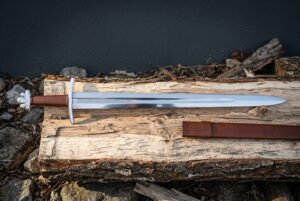 Splitcrown Hand Forged 1095 Steel Viking Battle Sword | Lobed Pommel and Straight Crossguard | Etched Lattice Fuller with Brown Leather Scabbard | Norse Reenactment Gift | RK-1805
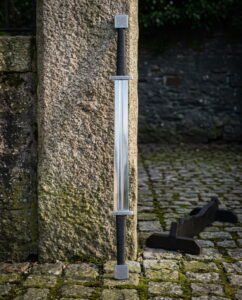 Twinreave Hand Forged Double Ended Viking Sword with Knotwork Pommels | 44 Inch Overall Length | Twin Cord Wrapped Grips and Wooden Display Stand | Norse Fantasy Gift | RK-1820
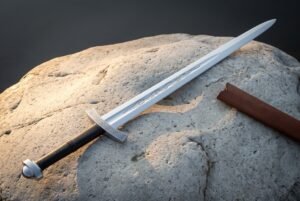 Coilwyrm Hand Forged 1095 Steel Arming Sword | Serpent Etched Fuller | Knotwork Engraved Guard and Brown Leather Scabbard | Norse Display Gift | RK-1874