
Blog
How to Buy Your First Sword Without Wasting Money

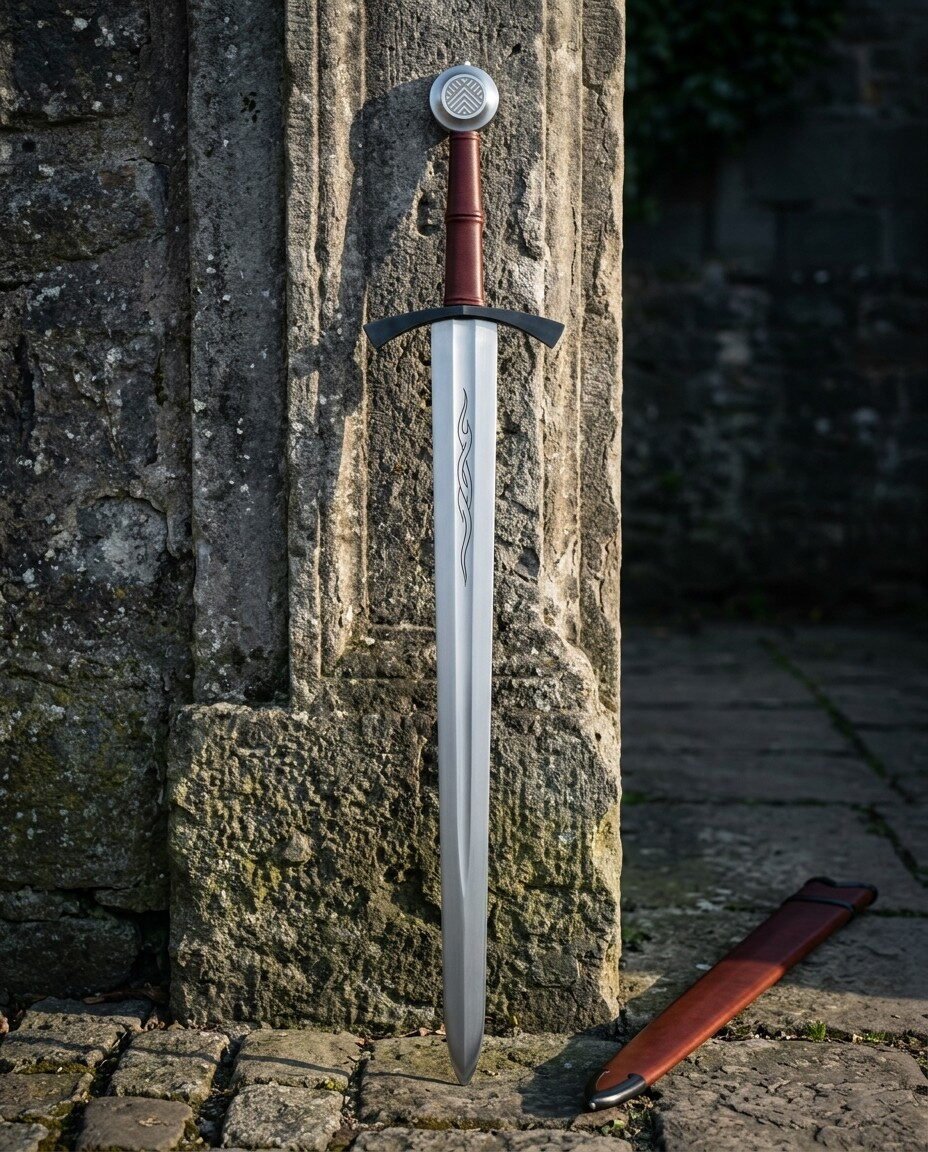
Buy the boring one first. A hand forged carbon steel single hander with a full tang, a fitted scabbard and a stand, somewhere in the 30 to 38 inch overall range, covers display, photography and most reenactment kit lists. Skip stainless wallhangers, and skip anything sold without a stated tang, because the ornate bargain is the one people later call a learning experience.
That is the short answer, and for most buyers it is the whole answer. The rest of this guide explains why it works, so you can tell when it does not apply to you.
Work out what the sword is actually for
Nearly every bad first purchase starts the same way. Someone buys a sword for one reason and then uses it for another. A blade built to hang on a wall gets swung at a tatami mat and the handle loosens, which surprises only the owner. Decide honestly which of these you are, because the answer changes everything downstream.
Display and collecting
This is the biggest group by a wide margin, whatever people say at checkout. You want something on a wall, over a mantel, or in a stand on a desk. What matters is how the piece looks at two feet and at ten: the finish on the blade, the fit of guard and pommel, whether the grip wrap is even. Weight matters less, edge geometry hardly at all. What you must avoid is the piece that looks fine in a product photo and reveals its gaps and wobble once it is in your hand.
Reenactment and living history
If you are joining a group, ask them for their kit rules before you spend anything. Most groups have written standards covering blade thickness at the edge, tip radius, permitted materials and period. A sharp sword will usually be refused outright for any contact drill. Buy after you know the rules, not before. A great sword that fails inspection is worth less to you than a modest one that passes.
Costume, film-inspired and gifting
Here the priority is silhouette and drama. Nobody at a convention or a wedding is measuring your distal taper. Weight becomes the real concern because you may carry the thing for hours. A lighter piece in the low 30 inch range beats a magnificent 48 inch two hander that you end up leaning against a wall by noon.
Actual cutting
Test cutting is a real hobby with real risk. It needs a sharp blade, a tang that runs the full length of the grip, secure fittings, space, and ideally an instructor for the first sessions. Do not assume a display sword will hold up to it, and never assume a sword not sold as cutting-ready can be sharpened into one.
The decisions you actually have to make
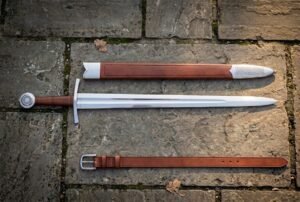 Oathgird Hand Forged High Carbon Steel Arming Sword with Scabbard and Belt | 36 Inch Overall and 30 Inch Blade | Collector and Display Gift | RK-1335
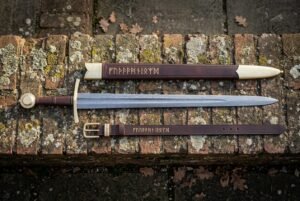 Runegird Hand Forged Damascus Arming Sword with Scabbard and Belt | 36 Inch Overall and 30 Inch Blade | Collector and Display Gift | RK-1336
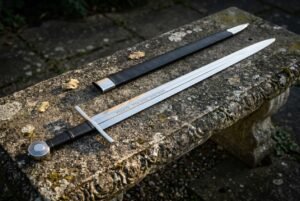 Stavemark Hand Forged High Carbon Steel Arming Sword | 35 Inch Overall with 29 Inch Blade | Collector and Display Gift | RK-1337
Which type of sword
Type is the first fork in the road and it is mostly about taste and period. A Viking age sword has a broad, fullered, double edged blade, a short straight guard and a lobed or brazil nut pommel. It is stocky, direct and unmistakable on a wall. A medieval arming sword is a slimmer cousin, cruciform, with a longer guard and a disc or wheel pommel. A longsword is used in two hands and typically runs past 42 inches overall, so measure your wall before you order one. A katana is a different tradition entirely, curved, single edged, with its own fittings vocabulary, and our piece on what a katana actually is is worth reading before you buy one.
If you cannot decide, the Viking age single hander is the safest first sword. Short enough to hang anywhere, heavy in the hand in a way people enjoy, and cheaper than a longsword of the same quality.
Blade steel
Two families matter for hand forged blades. Plain high carbon steel, usually 1095, gives you a hard, tough, monolithic blade that takes and holds an edge and polishes to a clean grey. Damascus is 1095 and 15N20 forge welded together in layers, then etched so the two steels show as light and dark bands. Damascus is a pattern in real steel, not a coating, and it costs more because of the labour in the billet. Neither is stainless, so both will rust if you neglect them, and neglect is easy.
Stainless swords exist and they are almost always decorative castings or stock removal pieces built for a display rack. They are fine if you want a cheap prop and know that is what you are getting. They are not fine if the seller implies otherwise. If steel names confuse you, our steel glossary defines the common ones in plain terms, and Damascus against plain high carbon lays out the trade in more detail.
Tang construction
The tang is the part of the blade that runs back into the handle. A full tang, peened or threaded at the pommel, is what you want. A rat tail tang is a thin rod welded to the base of the blade, and it is the single most common failure point in cheap swords. If a listing does not say what the tang is, assume the worst and ask. A seller who builds proper tangs will always tell you.
Sharp or blunt
Decide this before you order, because it is hard to undo in either direction. Sharp is right for cutting practice and for collectors who want an honest edge. Blunt is right for reenactment, for anywhere children visit, and for anyone nervous about handling. A blunt sword is not a toy: a 2 pound bar of steel swung hard still breaks bones. Blunt only removes the cutting risk.
Length, weight and balance
Real single handed swords generally sit between about 2 and 3 pounds. If a listing quotes 6 pounds for a one hander, either the number is wrong or the sword is badly made. Length drives where it can live: under 36 inches fits almost any wall, over 42 inches needs planning. A balance point a few inches ahead of the guard feels alive; one much further out feels like an axe on a stick.
Scabbard, fittings and stand
A fitted leather scabbard roughly doubles how finished a sword looks and protects the blade from knocks. Buy one with the sword if it is offered, because retrofitting later is fiddly and often costs more. A stand is the cheapest upgrade in the whole hobby. A good sword lying flat on a shelf looks like an object; the same sword in a stand or display mount looks like a piece someone chose.
The traps, and how to spot them
The first trap is vague steel. Listings that say “high carbon steel” and nothing else, or worse “440 stainless” alongside claims of battle readiness, are telling you the seller either does not know or does not want you to. A real maker names the steel and states the hardness.
The second trap is the missing tang. Look for a photograph of a peened pommel or a threaded pommel nut. If every photograph carefully avoids the pommel top, that is an answer.
The third trap is the fake pattern. Acid printed or laser etched patterns are sold as Damascus every day. Real forge welded pattern is continuous through the blade and shows on the edge bevel and the tang; a print sits on the surface and stops where the surface stops. Our guide to telling real Damascus from fake shows the tells, and what Damascus steel actually is covers how the billet is built.
The fourth trap is licensing language. If a seller calls a piece the official or licensed sword from a film or a game, be sceptical. Genuine licences are expensive, loudly advertised and rare at low prices. A film-inspired piece can be a perfectly good sword; it just is not an official anything.
The fifth trap is a too-good price on something described as hand forged. Forging, grinding, heat treating and fitting a sword is many hours of skilled work. Below a certain price that work did not happen, and you are buying a casting with a bright finish.
What to spend
Prices change, so treat these as bands rather than quotes. At the bottom of the market sit decorative stainless pieces and unbranded castings, fine as props and nothing else. Moving up, you reach the entry level for genuinely hand forged carbon steel single handers with a real tang and a leather grip. That band is where most first buyers should land, and where a plain 1095 Viking or arming sword with a fitted scabbard sits.
Above it you pay for pattern welded blades, engraved fittings, tooled scabbards and more careful finishing. Damascus costs more than plain carbon steel for the same shape, always, because of the labour in the billet. At the top you find long two handers and heavy decoration, which are collector purchases rather than first swords.
Budget for two extras that everyone forgets and then buys anyway: a stand, and a small tin of oil with a cloth. Both are cheap, and both change how long you enjoy the sword.
What I would buy
For a first sword, I would take a hand forged 1095 Viking age single hander, around 36 inches overall, full tang peened at the pommel, leather wrapped grip, with the fitted leather scabbard, and a wall mount or table stand to go with it. It hangs anywhere, it feels right in the hand, and it does not need a hobby built around it to justify itself.
If the budget stretches and the sword is going somewhere people will look closely, I would move to a Damascus blade in the same shape rather than to a longer sword. Pattern reads better at close range than length does. And if you are buying for someone joining a reenactment group, buy nothing until you have their group’s kit rules in writing.
What we stock leans toward that first recommendation. The Viking swords are the core of it, with arming swords for a medieval look and Damascus swords for anyone who wants the pattern. Every blade is plain 1095 at 54 to 58 HRC, or 1095 and 15N20 forge welded Damascus at 58 to 60 HRC. Ransack Viking is a US company in Chicago, Illinois. Every piece is handmade in the Czech Republic the old way, then imported, inspected and shipped from Chicago, and engraving is done in the US after arrival. If you want to see which pieces collectors pick most often, our roundup of the best Viking swords for collectors is a reasonable place to start browsing.
The single decision that changes the price most is covered in display sword or battle ready. Once it arrives, hanging it properly is dealt with in displaying a sword or an axe at home.
If the sword is for a club night rather than a wall, the training side of the shop answers a different set of questions, and how to choose your first HEMA sword walks through them in order.
Questions people ask
Is a stainless steel sword ever worth buying?
As a costume prop or a cheap wall piece, yes, and there is no shame in it. As a sword you intend to handle often, swing, or keep for years, no. Stainless blades in this market are usually cast or cut from bar stock and left soft, and the alloys used are chosen for shine and rust resistance rather than strength at length. Buy one knowing it is a prop, and it will do the job it was built for.
How long should my first sword be?
Around 30 to 38 inches overall for a single hander. That range hangs on any wall, fits a standard stand, stays under about 3 pounds and handles comfortably in one hand. Longswords start near 42 inches and two handers go well past that, which is fine if you have the space and want the presence, but it is more sword than most first buyers need.
Do I need a sharp edge?
Only if you plan to cut. Sharp makes sense for target cutting and for collectors who want the blade honest. Blunt makes sense for display in a home with visitors, for reenactment where sharp edges are banned, and for anyone who would rather not think about it. Decide first, because converting a display sword into a cutting sword afterwards is rarely a good idea.
What does full tang actually mean?
The tang is the rear extension of the blade that the handle is built around. Full tang means it runs the entire length of the grip to the pommel, where it is peened over or threaded and nutted. The alternative, a thin rod welded to the blade base, is called a rat tail and it is where cheap swords break. Ask if the listing does not say, and treat a vague answer as the answer.
How do I stop a carbon steel blade rusting?
Wipe fingerprints off after handling, then put a thin film of mineral oil or a light gun oil on the blade with a soft cloth. Do that every couple of months, more often if you live somewhere humid or near the coast. Do not store a carbon steel blade sealed inside a leather scabbard for months at a time, because leather holds moisture against steel.
Can I hang a sword straight on a plaster wall?
Not on plasterboard alone. Even a light single hander plus mount is several pounds concentrated on two small points, and drywall anchors pull out over time as the fixing works. Find a stud, or use proper cavity fixings rated well above the actual weight. A table or floor stand avoids the problem entirely and lets you pick the sword up, which most owners end up doing more than they expected.
If you would rather have one made to your own spec, build a custom sword and choose the type, the blade length, the crossguard, the pommel and the scabbard.
What the shop carries
Ready to ship, the Grainhilt grip Viking sword and the Wolfbrand arming sword. The Trinecrown Viking short sword and the Palecourt Medieval longsword are the other two.
The cheaper first step
If the plan involves hitting another person on a Tuesday night, your first sword may not be steel at all. Nylon waster or steel weighs the two up, and the Tevrand nylon waster is what the plastic end of that argument looks like. When steel wins, the HEMA longswords are next door.
Shop the range
Oathgird Hand Forged High Carbon Steel Arming Sword with Scabbard and Belt | 36 Inch Overall and 30 Inch Blade | Collector and Display Gift | RK-1335Runegird Hand Forged Damascus Arming Sword with Scabbard and Belt | 36 Inch Overall and 30 Inch Blade | Collector and Display Gift | RK-1336Stavemark Hand Forged High Carbon Steel Arming Sword | 35 Inch Overall with 29 Inch Blade | Collector and Display Gift | RK-1337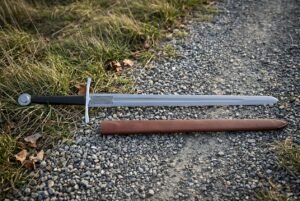 Knotbriar Hand Forged High Carbon Steel Oakeshott Type XII Arming Sword | 36 Inch Overall with 30 Inch Blade | Collector and Display Gift | RK-1339
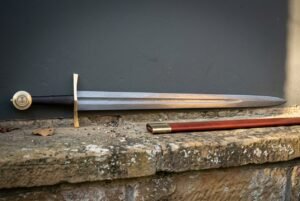 Brasswake Hand Forged Damascus Knightly Arming Sword | 37 Inch Overall with 31 Inch Blade | Collector and Display Gift | RK-1340
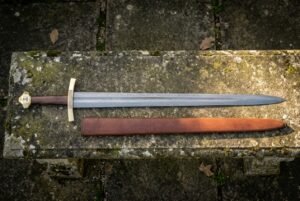 Rosehilt Hand Forged Damascus Medieval Sword | 37 Inch Overall with 31 Inch Blade | Collector and Display Gift | RK-1342