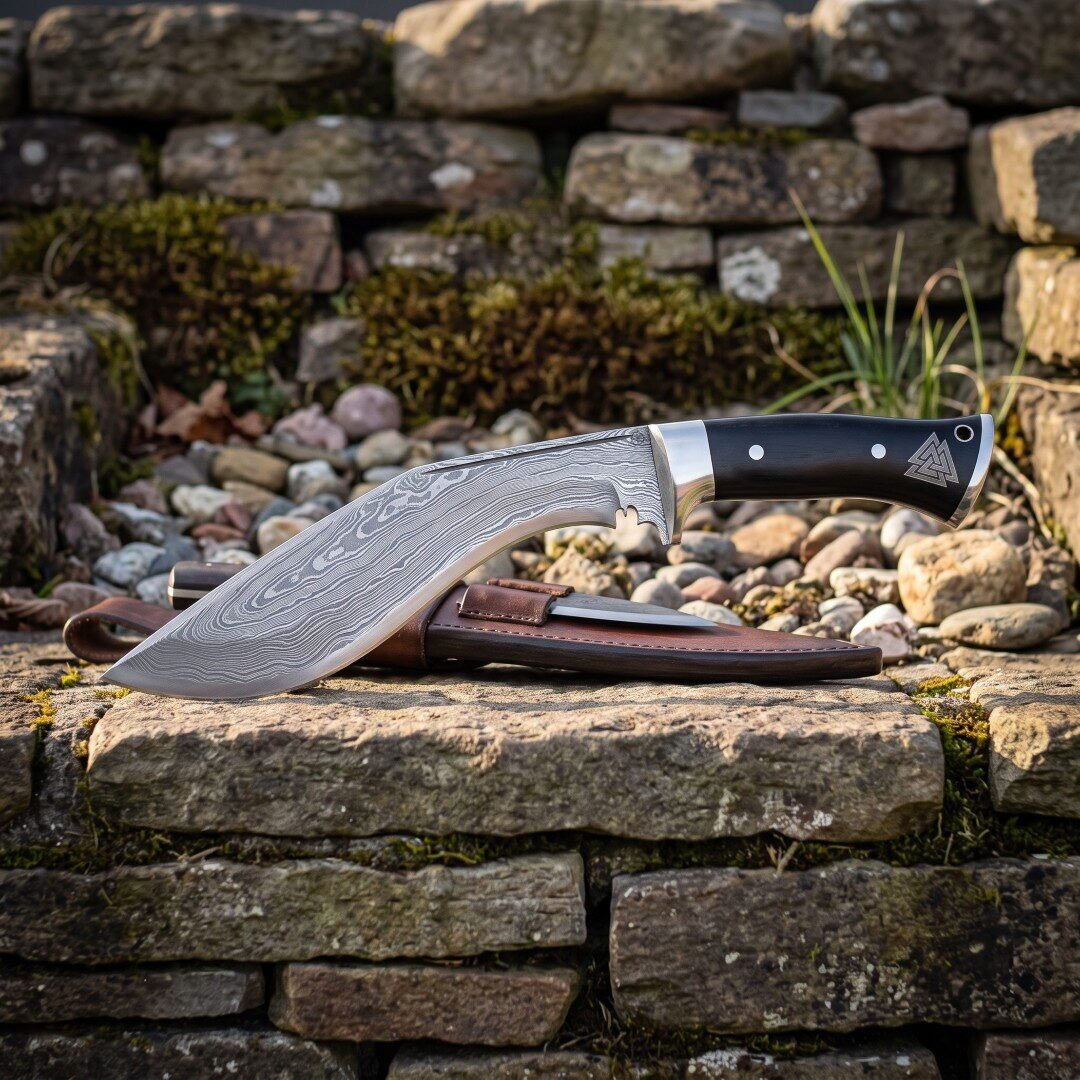
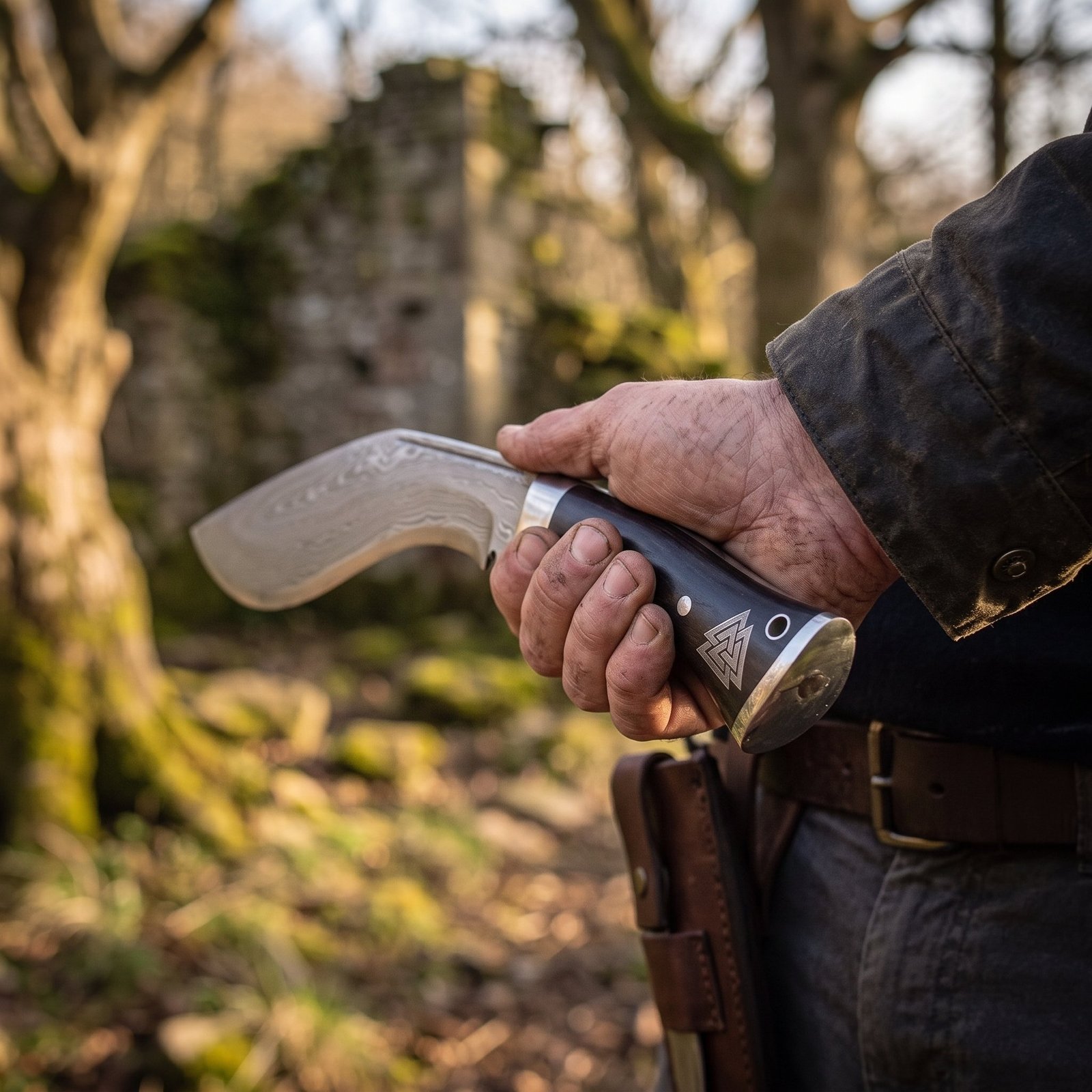
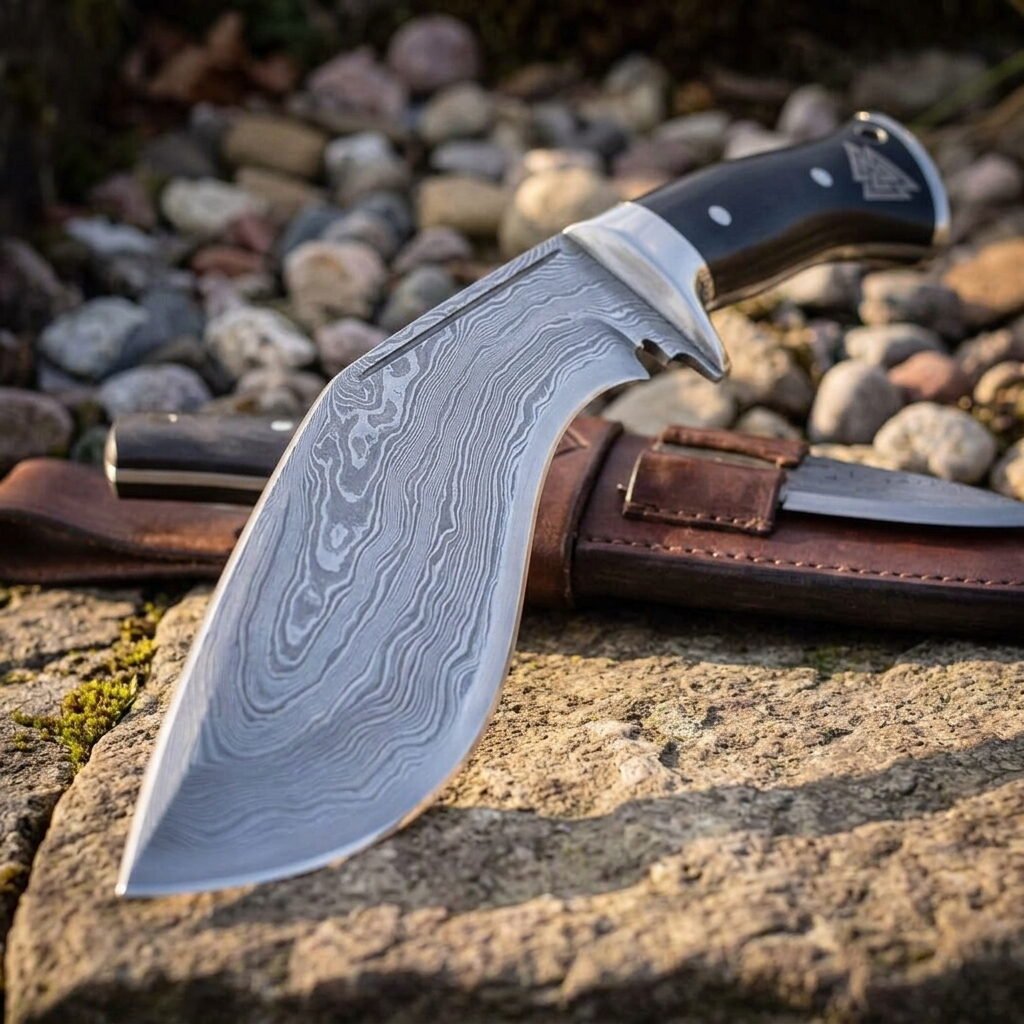
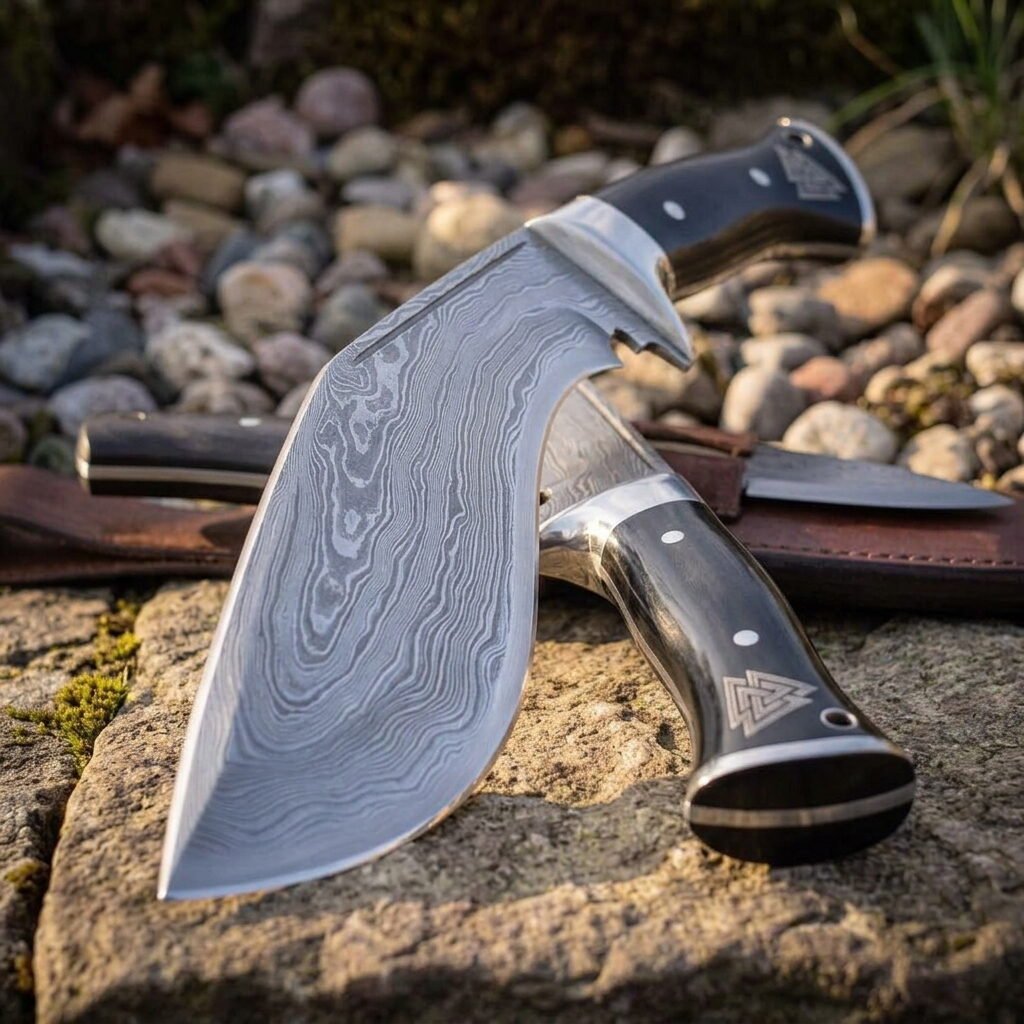
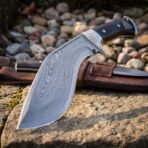
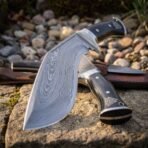
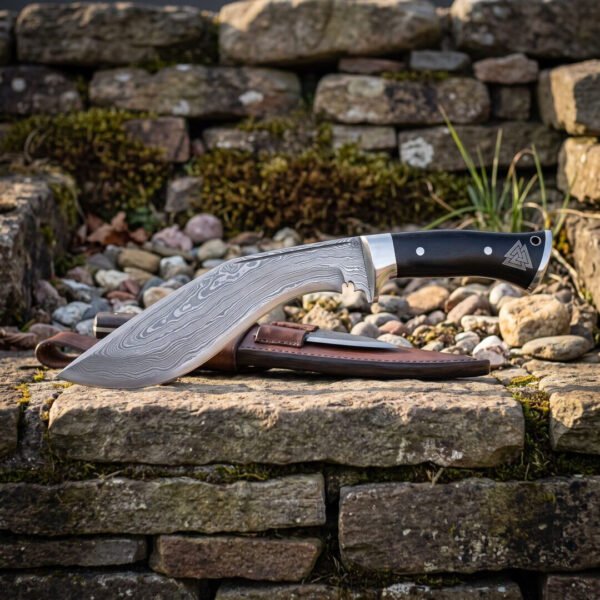
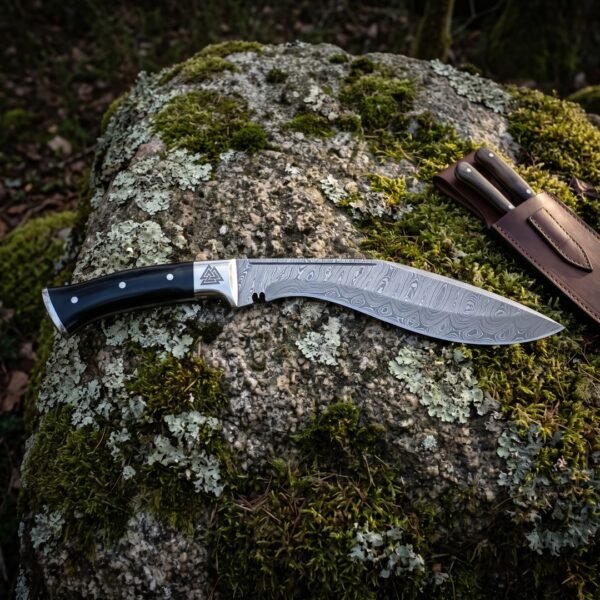
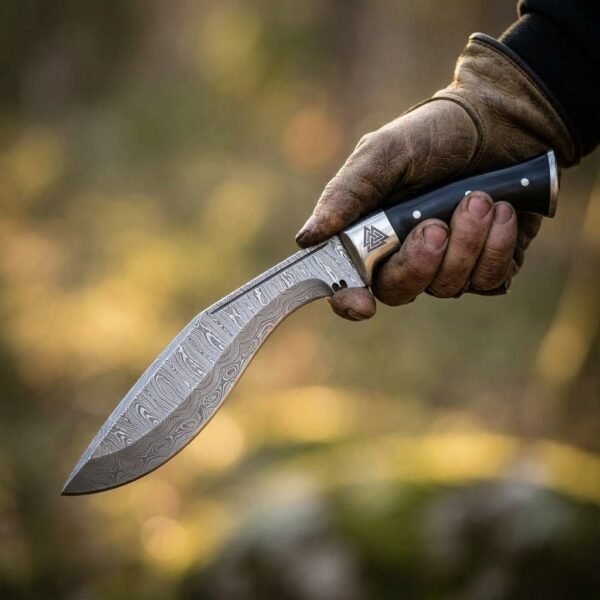
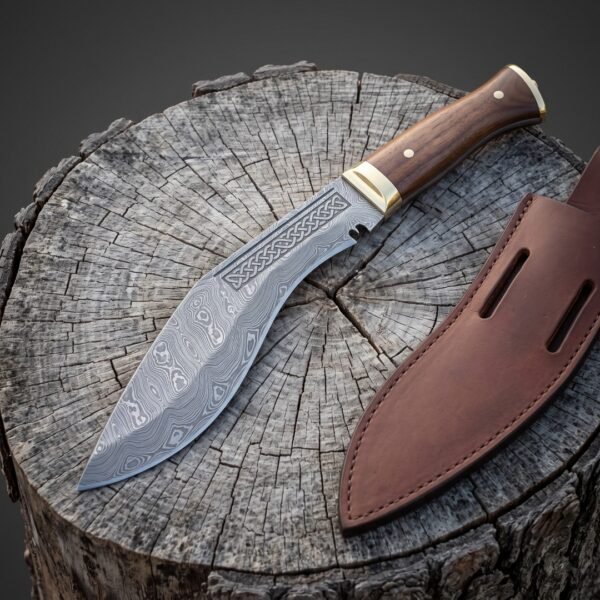
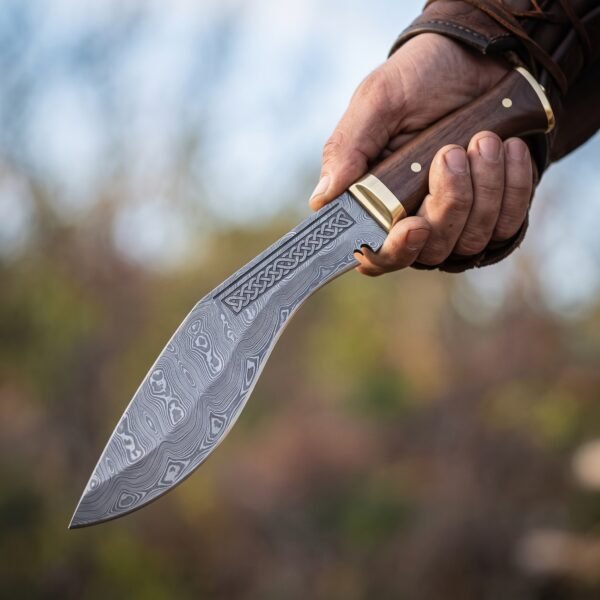
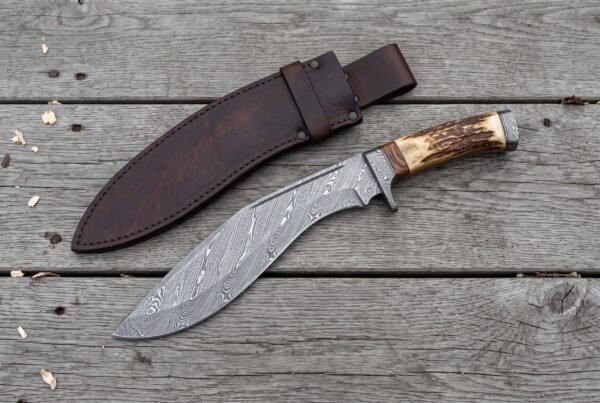
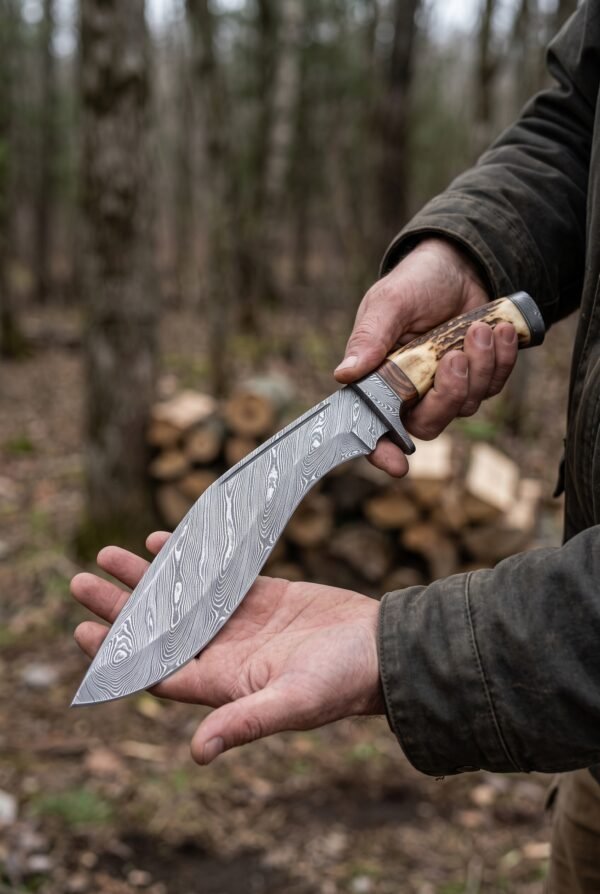
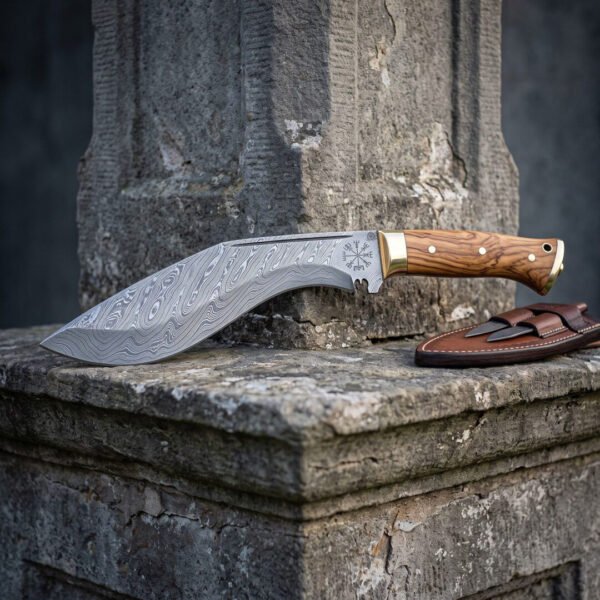
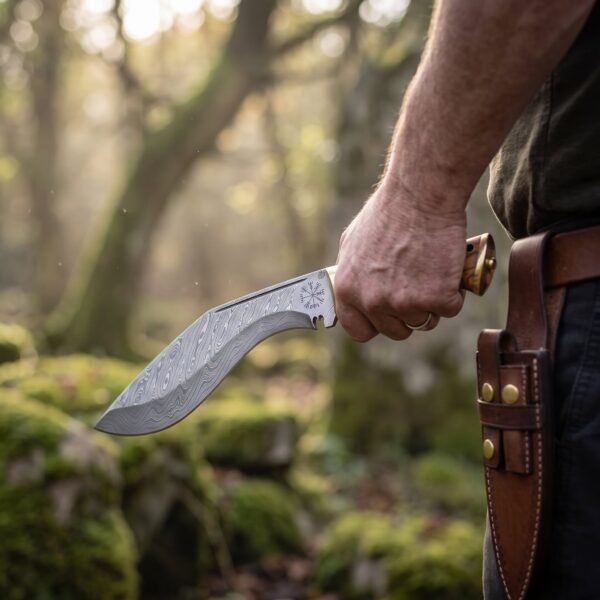
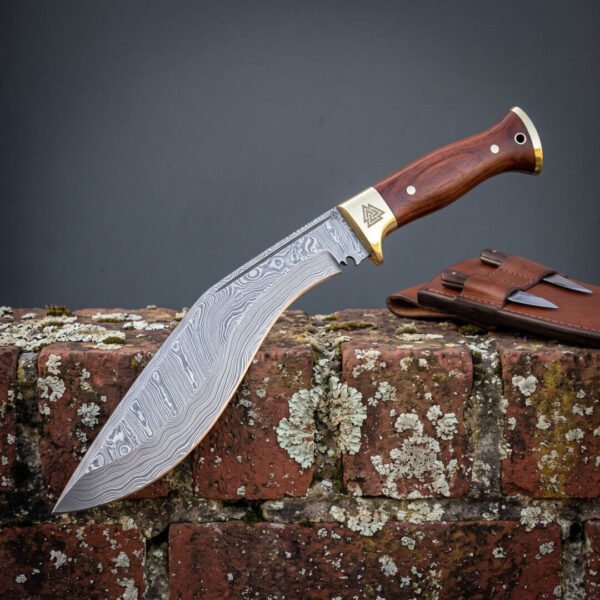
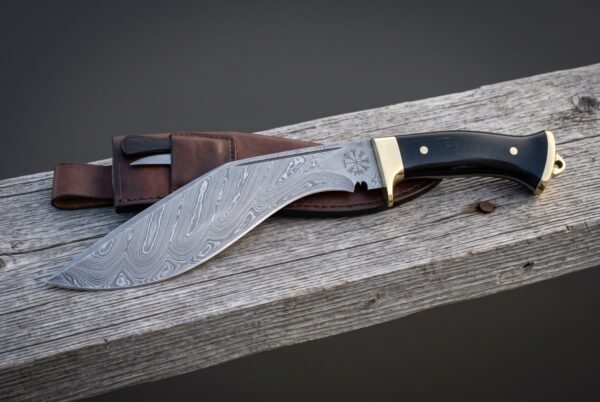
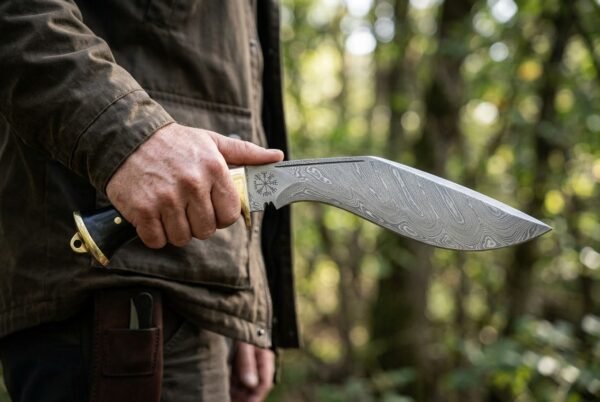
The Sablecurve is the quietest kukri in our range and probably the most serious looking. Deep black scales, polished so smooth that no grain shows at all, sit between a bright steel bolster and a bright steel butt cap, and the Valknut is engraved into the black scale near the butt, just ahead of the lanyard hole in the cap. The blade is pattern welded Damascus with a broad belly and a very deep recurve, ground so that the bright edge line runs as a thin ribbon under the darker etched pattern.
Kukris entered the English speaking world’s imagination through the Anglo Nepalese War of 1814 to 1816, when British East India Company troops met Gorkha soldiers carrying them and came away impressed enough to start recruiting. The shape itself is far older than that meeting, and it is usually traced back through the Indian subcontinent to the forward curved kopis of the ancient Mediterranean, though the chain of descent is argued about and nobody can prove it. This one is made by hand in the Czech Republic, imported and checked by Ransack Viking, and shipped from our Chicago, Illinois warehouse.
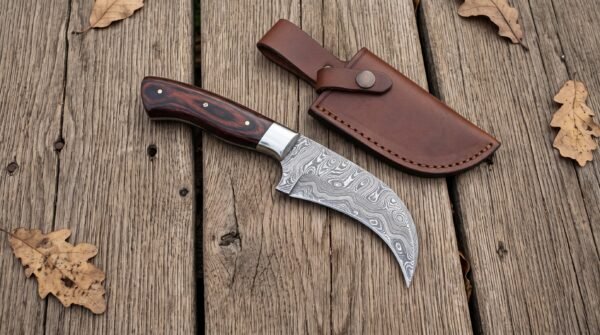
A kukri cuts on the belly rather than the tip, which is the argument the kukri explained makes at length. The valknut is the three interlocked triangles, and what we actually know about the valknut is a shorter list than the internet suggests. If you want a shorter belly for dressing game, the skinner knives cover that job.
Specifications
| Material | 1095 and 15N20 pattern welded Damascus, hardened to 58 to 60 HRC |
|---|
| Overall length | Approximately 16 inches |
|---|
| Blade length | Approximately 11 inches along the curve |
|---|
| Handle | Approximately 5 inches, polished black scales on a full tang |
|---|
| Blade | Deep recurve with a broad belly, a cho notch at the base and a bright ground edge under the etched pattern |
|---|
| Bolster | Polished steel |
|---|
| Butt cap | Polished steel with a lanyard hole |
|---|
| Pins | Steel pins through the scales |
|---|
| Engraving | Valknut engraved into the black scale near the butt |
|---|
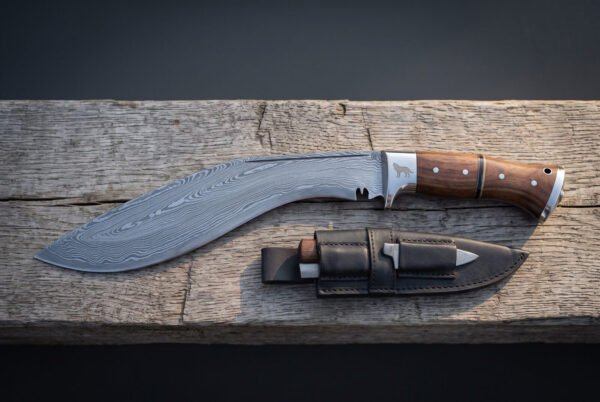
| Sheath | Brown leather belt sheath with pockets for the karda and chakmak |
|---|
| SKU | RK-2115 |
|---|
How a kukri sheath is built, and why it matters
A traditional kukri sheath is not a folded piece of leather. It is a pair of shaped wooden formers glued together to make a rigid shell in the shape of the blade, then covered in hide and stitched down the back edge. The leather is the skin. The wood is the structure, and it is what protects the edge, keeps the shape after years of use and lets the sheath hold a deeply curved blade without collapsing on itself.
The two small pockets on the front carry the karda and the chakmak, and they are placed at the throat rather than lower down for a practical reason. That is the part of the sheath with the most wood behind it, so the pockets can be stitched on without weakening the shell where the curve puts it under most stress. If your sheath ever loosens at the mouth after long use, a couple of stitches through the existing holes will tighten it up rather than requiring a new sheath.
Damascus, black scales and the steel fittings
The blade is forge welded from alternating layers of 1095 and 15N20, folded to build the layer count, ground and acid etched. The bright layers are the nickel bearing 15N20 and the dark ones are the 1095, and the pattern is the layer stack seen in cross section rather than anything applied on top. Hardened at 58 to 60 HRC, it holds a long edge and the layered structure carries that hardness without becoming brittle.
The scales are a dense black handle material polished to a smooth close surface with no visible open grain. We describe it as polished black scales rather than naming a species, because these are hand made in small batches and the stock used varies. If the exact material matters to you, message us before ordering and we will tell you what the specific knife we are about to send you is made from. The bolster, the butt cap and the pins are polished steel, and there is a lanyard hole through the butt.
Engraving, runes and your own design
Use the rune converter on this page to turn a name, a date or a short phrase into Elder Futhark and we will cut it into the steel, the leather or the wood. If you would rather have a Viking pattern than a rune line, choose your own design in the engraving option above the add to cart button and tell us where it goes. Where a piece already carries an engraved design, your chosen engraving replaces it rather than sitting alongside it, so runes ordered for the handle take the place of the Valknut. If you want to keep the Valknut, the bolster, the butt cap and the leather sheath all take a rune line well, and stamped leather in particular holds a long phrase that would not fit on the steel. Engraving is done here in the United States after the piece arrives. See the engraving page.
Handling and balance
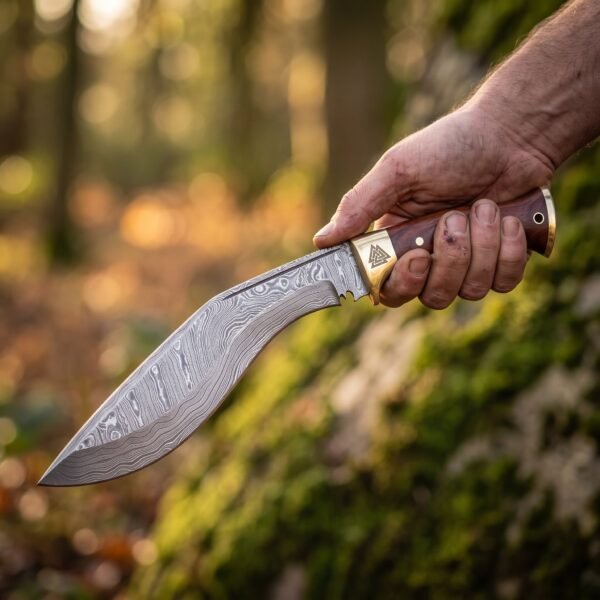
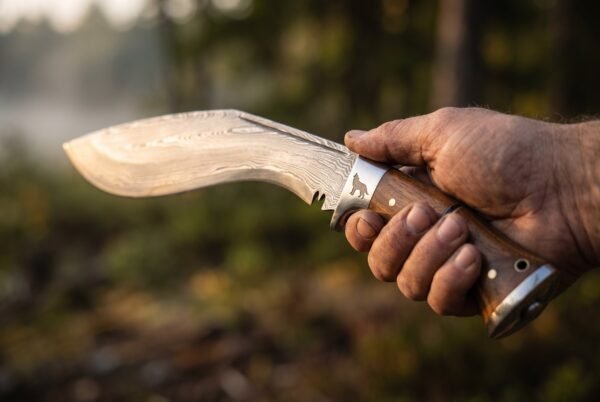
This is a slightly shorter kukri than the others in the range and it feels noticeably more agile as a result. The balance sits just ahead of the bolster, the deep recurve still delivers the angled bite that makes a kukri chop above its weight, and the shorter blade means less effort spent controlling the recovery. It is the one to choose if you want a kukri you will actually carry rather than one that mostly lives on a wall.
Choke up against the bolster for carving, skinning and food prep, drop back to the butt cap for chopping, and use the lanyard hole if you are working hard or working wet. The blade is full tang and hardened, so avoid prying and avoid metal and stone.
Care
Carbon steel Damascus rusts and pitting kills the pattern contrast, so wipe the blade dry after use and keep a thin film of mineral or camellia oil on it. Never store the knife in the sheath for long stretches, because leather over a wooden core holds moisture particularly well and that is exactly what you do not want against etched steel. If the etch dulls, a short pass with diluted vinegar followed by a full neutralise, rinse, dry and oil brings it back. Feed the leather with a balm two or three times a year and give the black scales an occasional wipe with the same oil you use on the blade. Sharpening a recurve is covered in our steel care notes.
Damascus wants oil more than plain steel does, because the etch that shows the pattern also opens the surface, and caring for a Damascus pattern covers what to use.
Made in the Czech Republic
The Sablecurve is made by hand in the Czech Republic. It is not a catalogue item drop shipped to you by a seller who has never opened the box. Ransack Viking buys these outright, brings them into the United States, unpacks and checks each knife for pin fit, bolster seating, edge and sheath stitching, and holds stock in our Chicago, Illinois warehouse. Welding, folding and grinding a Damascus billet by hand is slow, so allow one to two weeks of processing before your order ships. Shipping inside the United States is free, and the lifetime warranty against defects in forging, grind, heat treat and fittings applies with no end date and no receipt needed.
A note on handmade variation
Hand made is not machine made or bulk produced, so what arrives will not be a pixel for pixel copy of the photograph. Damascus never repeats, because the pattern records how one particular billet was moved under the hammer, and on a deeply recurved blade like this the layers stretch through the belly in a way that is different every time. The black scales vary in depth of polish, the engraved Valknut on the handle sits a fraction differently, and the leather sheath takes dye unevenly. The dimensions, the steels, the heat treat and the build are the same on every one. The character belongs to yours.
Frequently asked questions
What are the black scales made of
They are a dense black handle material polished smooth with no open grain. We do not name a species on the listing because the stock varies between small hand made batches. Message us before ordering and we will confirm what your specific knife is made from.
Is the Damascus genuine
Yes, forge welded from 1095 and 15N20. The pattern runs through the blade rather than sitting on the surface, which is why it carries on across the bevels.
Is it sharp when it arrives
Yes, with a working edge ready for camp and outdoor use straight out of the sheath.
What is the hole in the butt cap for
A lanyard. On a heavy forward weighted blade a wrist loop is a sensible precaution rather than a decoration.
Can the sheath be worn on a belt
Yes. It is a wood cored leather covered sheath with a belt loop, and the karda and chakmak sit in pockets at the throat.
How soon does it ship
Processing runs one to two weeks, then free shipping inside the United States. Returns are accepted within seven days of delivery.
What is in the box
- Sablecurve kukri with a 1095 and 15N20 pattern welded Damascus blade
- Polished black scales on a full tang with steel bolster and butt cap
- Valknut engraved on the handle near the lanyard hole
- Karda utility knife and chakmak burnishing steel
- Brown leather belt sheath with pockets for both companion blades
- Lifetime warranty against defects in forging, grind, heat treat and fittings
- Hand made in the Czech Republic, shipped from our Chicago, Illinois warehouse
Explore the range
Browse the other kukri knives, the full Viking knives range and the engraved and personalized pieces. Sharpening and steel reading is in the guides.
Close to this one
Another in the same line is the Vegwarden kukri knife, pattern welded Damascus. Next along the rack is the Brasscrow kukri knife, high carbon steel. For a straight comparison, see the Inkbraid kukri knife.
The Gurkhastag bowie knife covers the other half of the same kit. Nothing here exactly right, build one to your own spec on the custom hunting knife page.

Got this as a gift and now I want one for myself too. The wood handle feels amazing and the balance is perfect. 10/10 would buy again.
This is exactly what I wanted and then some. Ransack Viking is quickly becoming my go to shop for anything Norse themed. Beyond happy with how this turned out.
This thing is a beast in the best way. Will definitely order again for another gift.