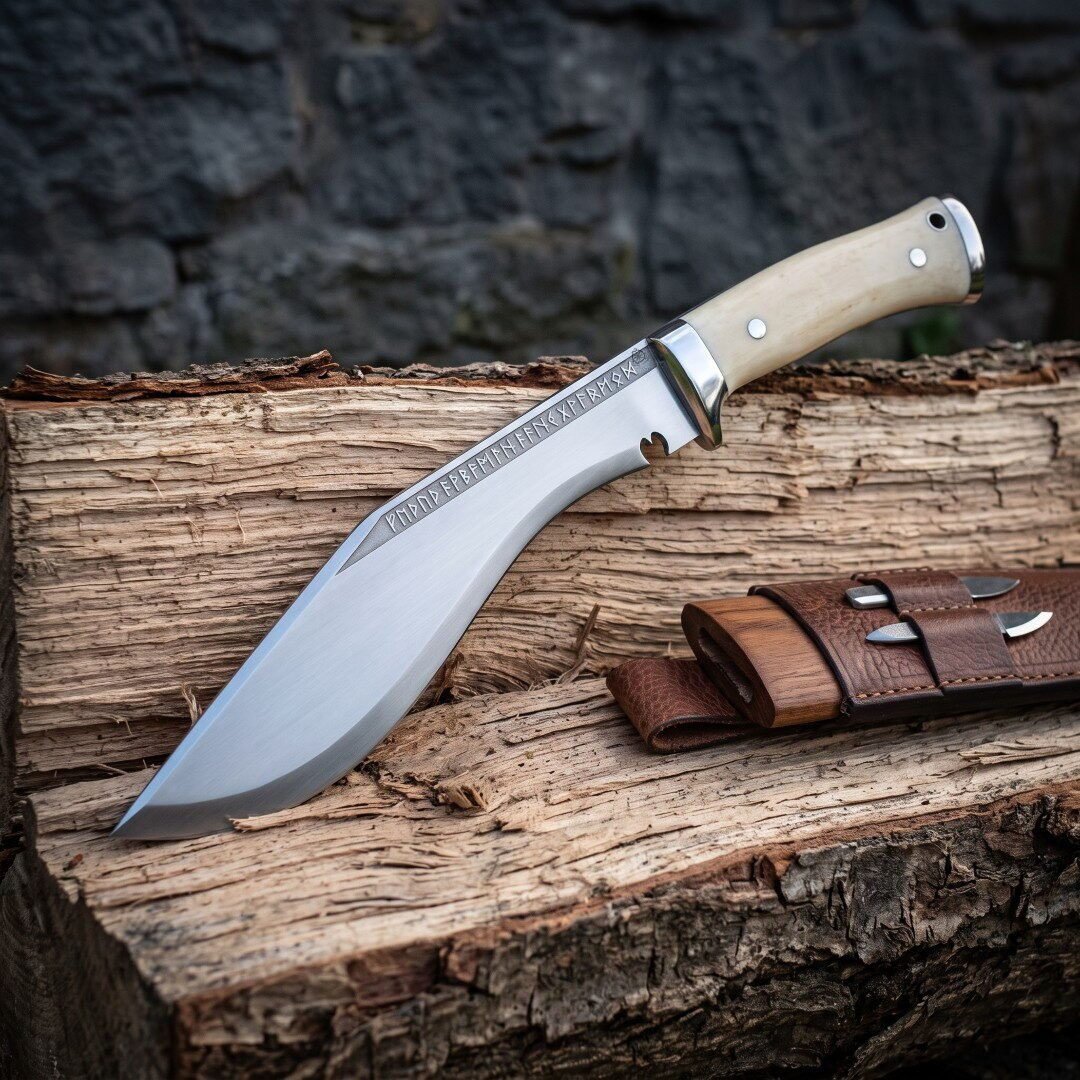
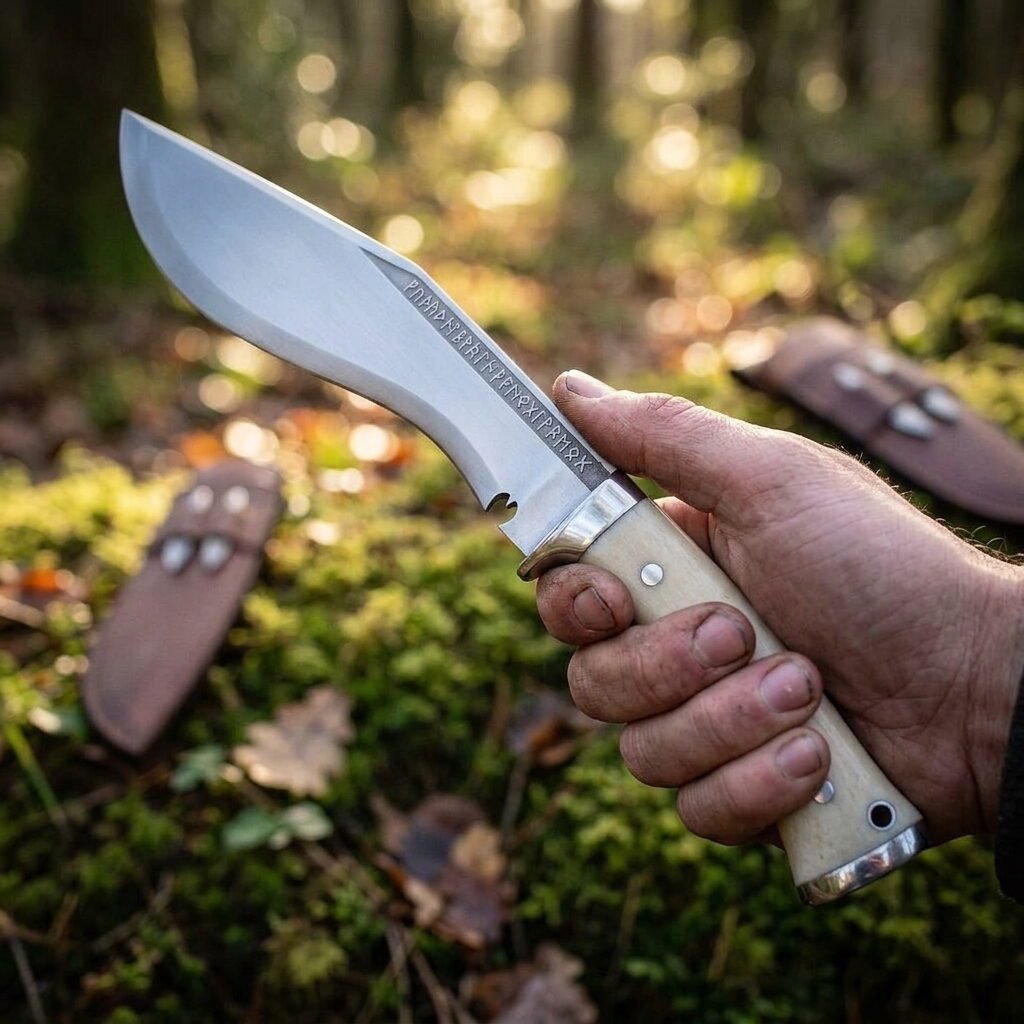
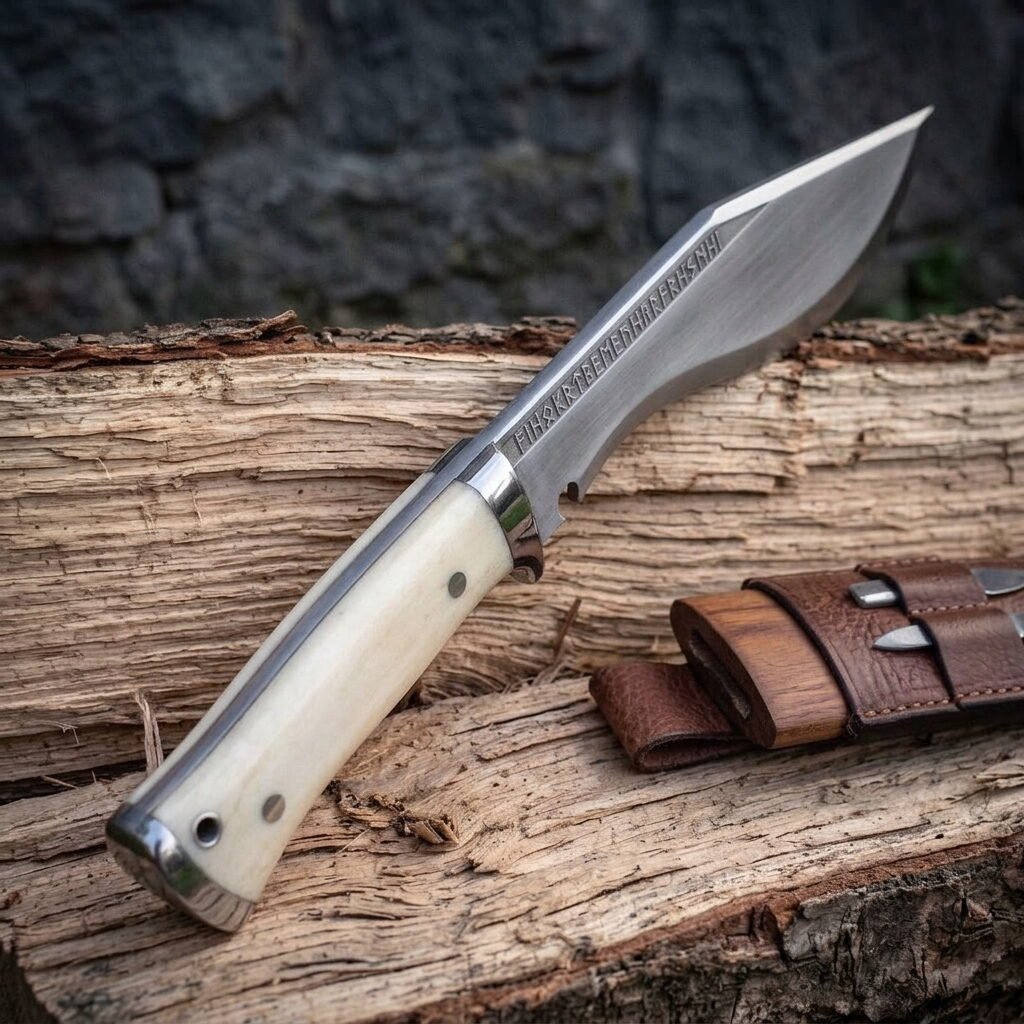
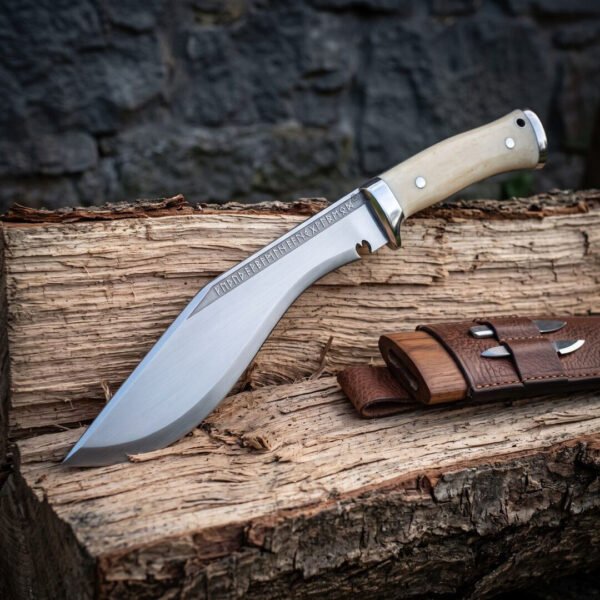
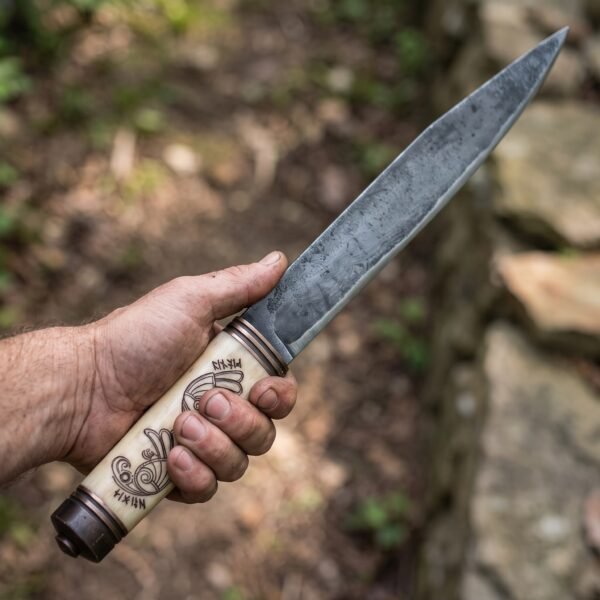
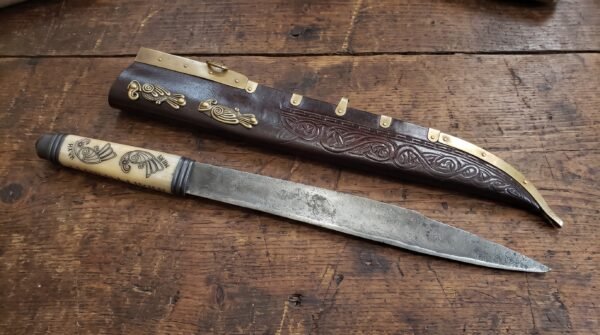
The Bonecurve is a working kukri built around a pale bone handle. Two round pins run through the scales into a full width tang, with a lanyard hole near the butt, a polished steel bolster caps the front of the handle and a shaped steel butt plate closes the rear, so the natural material is protected at both ends where handles usually fail. The blade is 1095 high carbon steel with a wide flat grind, a deep belly and a long band of Elder Futhark runes cut along the upper flat from the bolster forward. Below the throat sits the small cho notch that marks the start of the sharpened edge.
What separates a kukri from every other big knife is not the curve so much as the angle. The whole blade is set forward of the handle line by roughly twenty degrees, which turns the swing of your arm into a chopping arc without you having to cock your wrist. Nepali smiths arrived at that geometry with hammers rather than mathematics, and it is efficient enough that the shape has barely changed in two centuries. This knife is hand made in the Czech Republic. Ransack Viking imports it, checks the tang fit, the pins and the edge on arrival, and ships it from the Chicago warehouse. It comes in a leather belt sheath that carries two small companion knives at the front.
A kukri cuts on the belly rather than the tip, which is the argument the kukri explained makes at length. For where 1095 sits on the hardness scale and what that buys you, see the steel and hardness page. If you want a shorter belly for dressing game, the skinner knives cover that job.
Specifications
| Steel | 1095 high carbon steel |
|---|
| Hardness | 54 to 58 HRC |
|---|
| Overall length | Approximately 16 inches |
|---|
| Blade length | Approximately 11 inches along the curve |
|---|
| Blade features | Kukri profile with a forward angled belly, cho notch at the throat, wide flat grind, satin polish |
|---|
| Engraving | Long Elder Futhark rune band cut along the upper flat of the blade, starting at the bolster |
|---|
| Bolster | Single polished steel front bolster |
|---|
| Handle | Pale bone scales on a full width tang |
|---|
| Pins | Two steel pins, plus a lanyard hole near the butt |
|---|
| Butt | Shaped polished steel butt plate |
|---|
| Sheath | Brown leather belt sheath with two small companion knives |
|---|
| SKU | RK-2148 |
|---|
Where a kukri actually cuts
Every blade has a point along its length where a strike produces almost no shock back into your hand. Physicists call it the centre of percussion and woodsmen call it the sweet spot, and finding it is the single biggest difference between a kukri that feels brutal and one that feels effortless. On a blade this length the sweet spot sits in the widest part of the belly, roughly two thirds of the way from the handle to the point. Land a cut there and the knife rotates cleanly around your grip. Land it too close to the handle and you get a jarring shock through the wrist. Land it on the tip and the blade twists.
The forward weight bias is what makes that sweet spot so effective. Because the mass of the belly sits ahead of the handle, the blade carries momentum through the cut instead of stalling, and you can swing a kukri lazily and still get a deeper bite than a straight knife of the same weight would give you with a hard swing. That is also why the narrow section near the throat exists. Choke your hand up to the bolster and use that thin part for carving, feather sticks and skinning, jobs where the belly is far too much knife.
The steel and the bone
The blade is 1095 high carbon steel run to 54 to 58 HRC. A chopping blade takes shock rather than steady pressure, and a hardness in the middle fifties gives an edge that deforms and comes back under a stone instead of chipping out. It also means you can maintain this knife anywhere. Simple carbon steel like this has no chromium, so it sharpens easily on any stone and rusts if it is put away wet.
The handle scales are bone, and bone behaves differently from horn or wood. It is dense and hard, it does not compress under the pins the way timber can, and it stays cool in the hand. It is also more brittle than horn, which is exactly why this build puts steel at both ends and runs two pins rather than one. The bolster takes any knock at the front, the butt plate protects the end grain at the back, and the two pins spread the load through the tang rather than concentrating it on one hole. Bone is a natural material, so the pale cream colour carries its own faint marbling and small darker flecks, and that varies from knife to knife.
Engraving, runes and your own design
Use the rune converter on this page to turn a name, a date or a short phrase into Elder Futhark and we will cut it into the steel or the leather. If you would rather have a Viking pattern than a rune line, choose your own design in the engraving option above the add to cart button and tell us where it goes. Where a piece already carries an engraved design, your chosen engraving replaces it rather than sitting alongside it. On the Bonecurve there is generous room on the wide flat of the belly, and the leather sheath takes a stamped line very cleanly. Engraving is done here in the United States after the piece arrives, and the engraving page shows what each position will hold.
Handling and balance
Pick this knife up loosely rather than gripping it. The balance point sits well forward, so the head wants to drop, and a kukri is meant to be allowed to rotate into the cut rather than forced through it. A relaxed wrist and a heavy blade do the work. If your forearm is burning after ten minutes you are holding on too tight.
Use the belly for chopping, the narrow section near the bolster for detail work and the tip for piercing. Do not use the tip for chopping, because a kukri point is thin and it is the part most likely to bend or snap on a hidden knot. This is a functional camp and utility knife. It is not a sparring piece and it is not intended for full contact use against another person.
Care
Dry and oil the blade every time it goes away. High carbon steel will spot within a day in humid air. Do not store the knife inside the leather sheath for long stretches, because vegetable tanned leather holds moisture and is mildly acidic, and that combination pits carbon steel over months. Sharpen on a stone and stay on the existing bevel, and run the stone out through the cho so you do not roll a burr into the bolster. Bone scales want nothing more than a wipe with a barely damp cloth, and they should be kept away from prolonged heat and direct sun, which can dry and craze them. Give the sheath leather balm two or three times a year. Full detail sits in our steel care guide.
A curve like this does not sharpen the way a straight edge does, and sharpening a curved blade works through the stroke.
Made in the Czech Republic
The Bonecurve is made by hand in the Czech Republic and imported by Ransack Viking. Nothing here is drop shipped from an importer catalogue. Each knife is opened in Chicago, checked for tang fit, pin seating, edge condition and sheath fit, then repacked and shipped free within the United States. Processing runs one to two weeks because that check is genuine. Returns stay open for seven days, and every piece carries a lifetime warranty against defects in forging, grind, heat treat and fittings, with no end date and no receipt needed.
A note on handmade variation
These are hand made rather than machine made or bulk produced, so the knife that arrives will not be a pixel for pixel copy of the photograph. Bone is a natural material and every pair of scales is different, ranging from a clean ivory white through cream to a faintly honeyed tone, often with small darker specks or a soft grain running through it. The rune band is cut individually, the satin finish takes its own pattern under the belt, and the leather sheath will be a shade lighter or darker than the one shown. The dimensions, the material and the build are the same every time. The character is not.
Frequently asked questions
Is this sharp when it arrives
Yes. It comes with a working edge that will chop and carve straight away. Most owners refine it a little on a stone once they know how they want to use it.
Are the bone scales strong enough for real chopping
Yes, because the build accounts for the material. The tang is full width, two pins spread the load and steel caps both ends of the handle, so the bone is held rather than asked to take impact on its own.
Will the bone yellow over time
Bone can warm slightly in tone over many years, in the same way ivory coloured piano keys do. It is gradual and most people find it improves the look. Keeping it out of direct sunlight slows it.
What is the small notch near the handle for
That is the cho. It ends the sharpened edge in a rounded eye rather than a square corner, which is where stress cracks would otherwise start, and it gives your sharpening stone somewhere to run out.
Can I put a name on it in runes
Yes. The wide flat of the belly is the best position and it will hold a name and a short date comfortably. The existing rune band would be replaced rather than added to if you chose that spot.
How long does shipping take
Processing is one to two weeks while the knife is checked and any engraving is cut, then free shipping inside the United States.
What is in the box
- Bonecurve kukri knife with bone handle scales
- Leather belt sheath with two small companion knives
- Care card for high carbon steel, bone and leather
- Hand made in the Czech Republic, shipped from our Chicago, Illinois warehouse
Explore the range
Browse the rest of the kukri knives, the wider Viking knives, the Viking seax range and everything under engraved and personalised, or read the guides.
Near neighbours in the shop
If this one is not quite right, there is the Runecurve kukri knife, 16 inches overall. Also in this group is the Brasscrow kukri knife, high carbon steel. Sitting beside it in the catalogue is the Runehollow kukri knife, high carbon steel.
From the same corner of the shop, there is the Hornsax Viking seax. You can have this made your way instead on the custom hunting knife page.


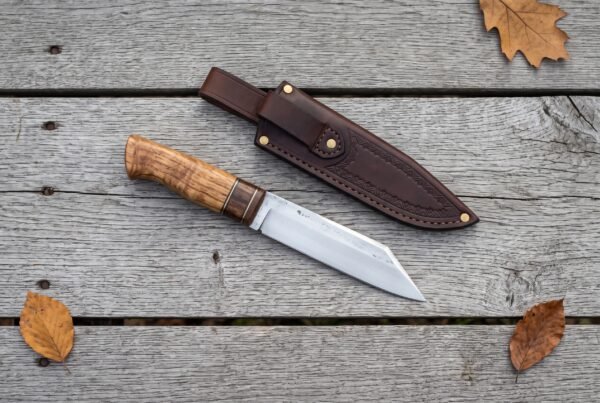
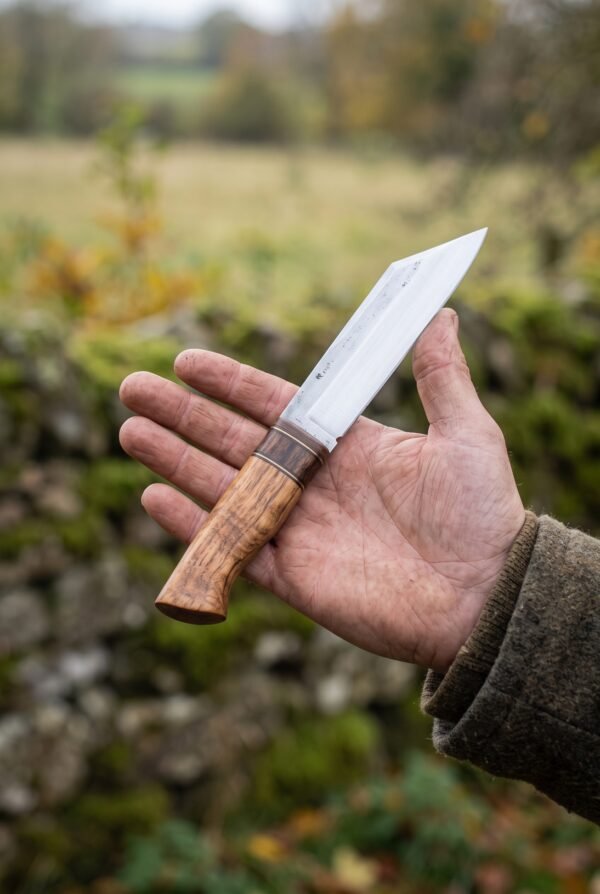
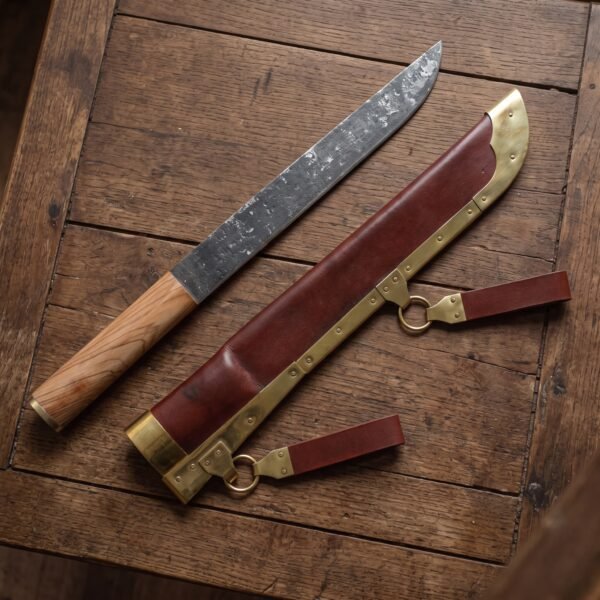
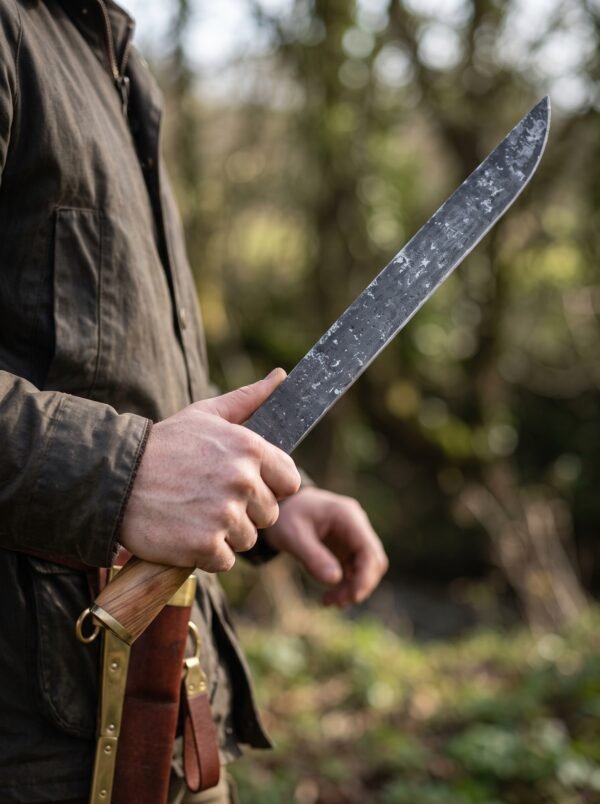
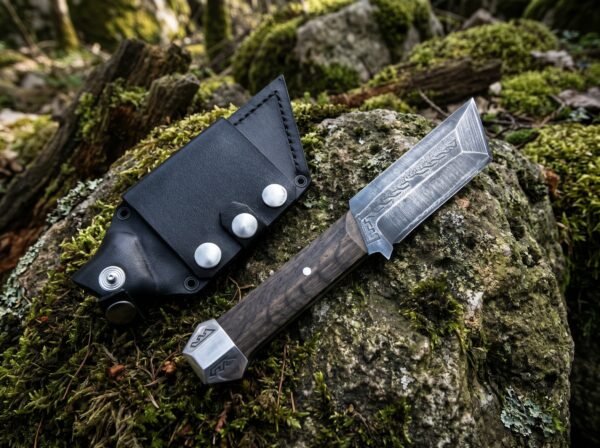
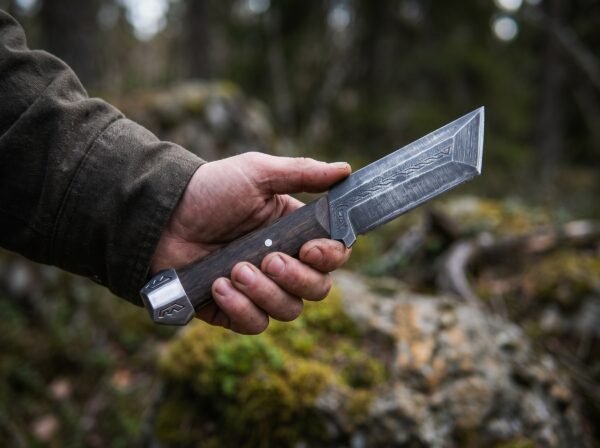
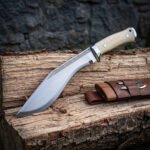
Perfect gift. Perfect quality. No complaints. Weight and balance make it feel like a real functional piece not some cheap replica. This shop clearly takes pride in their work.
This knife beat every expectation I had. Leather sheath is thick and well stitched. Not the cheap stuff you usually get. High Carbon Steel blade holds a razor edge right out of the box. Fit and finish is museum quality. You can tell real craftsmen made this by hand. Couldn’t be happier with this.
Knew this knife was special the second I opened the box. This will be a family heirloom for sure.