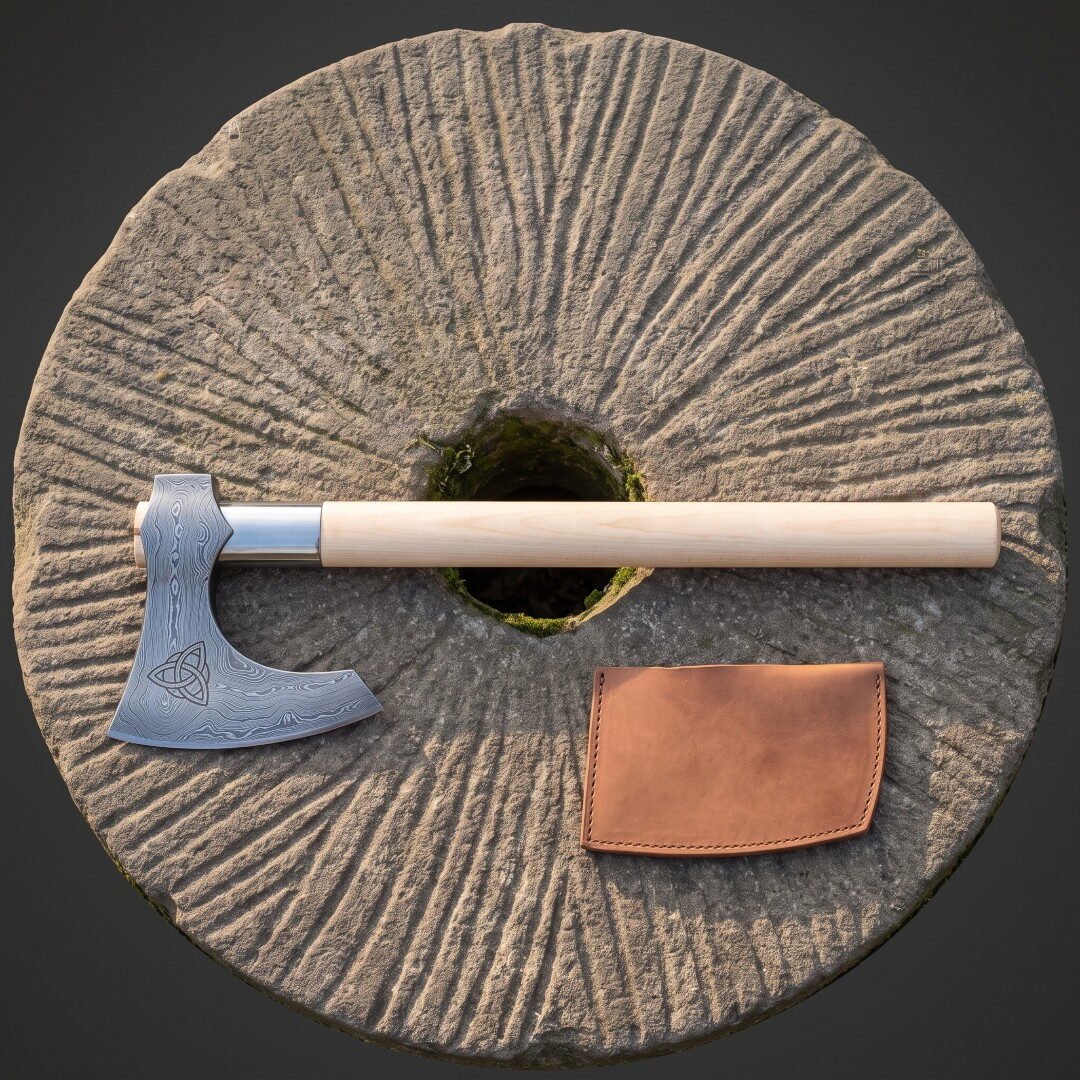
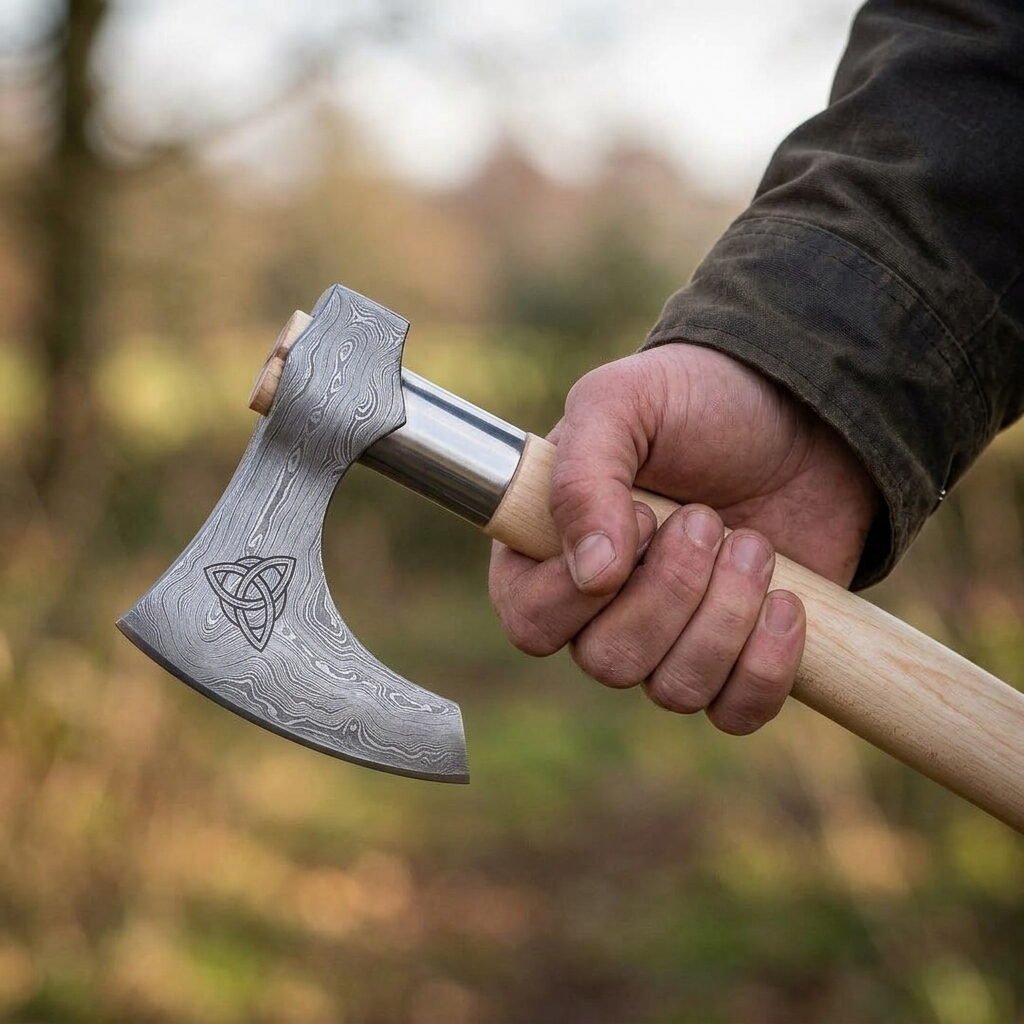
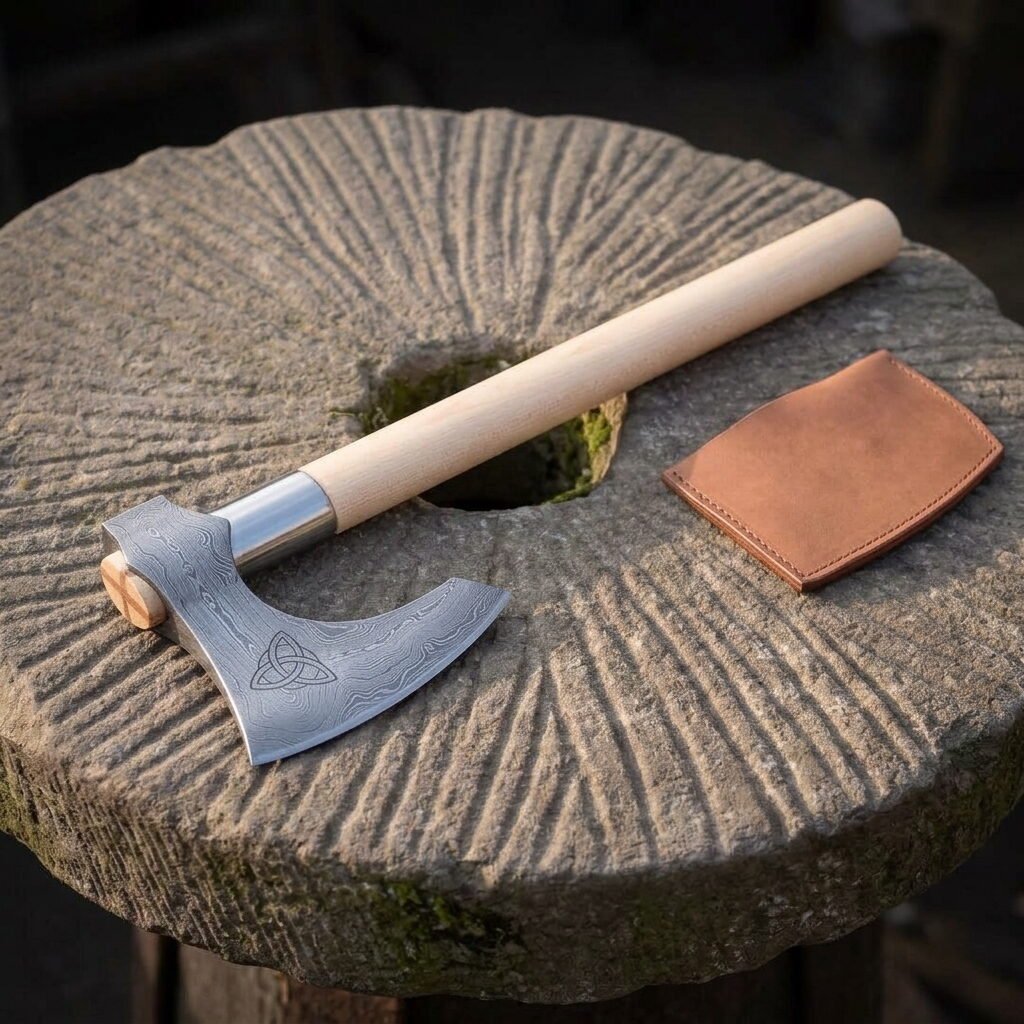
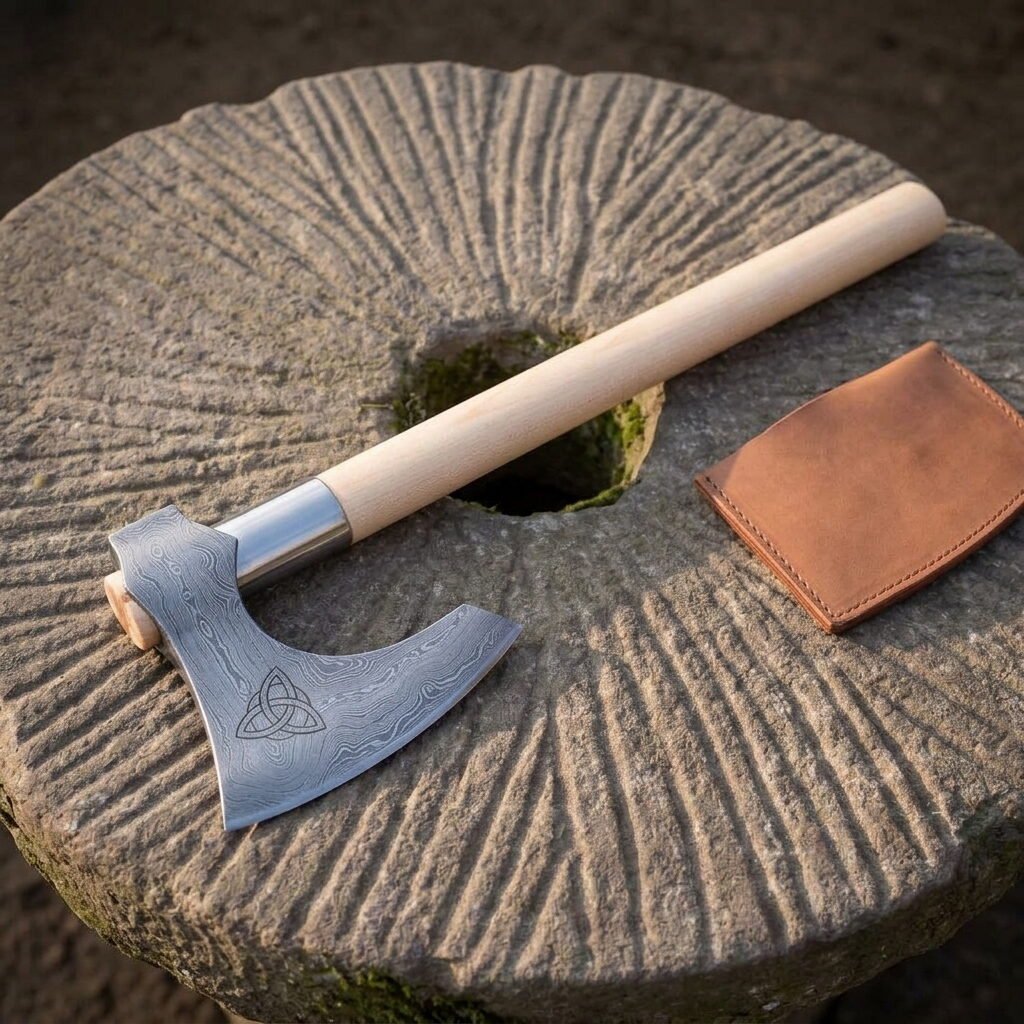
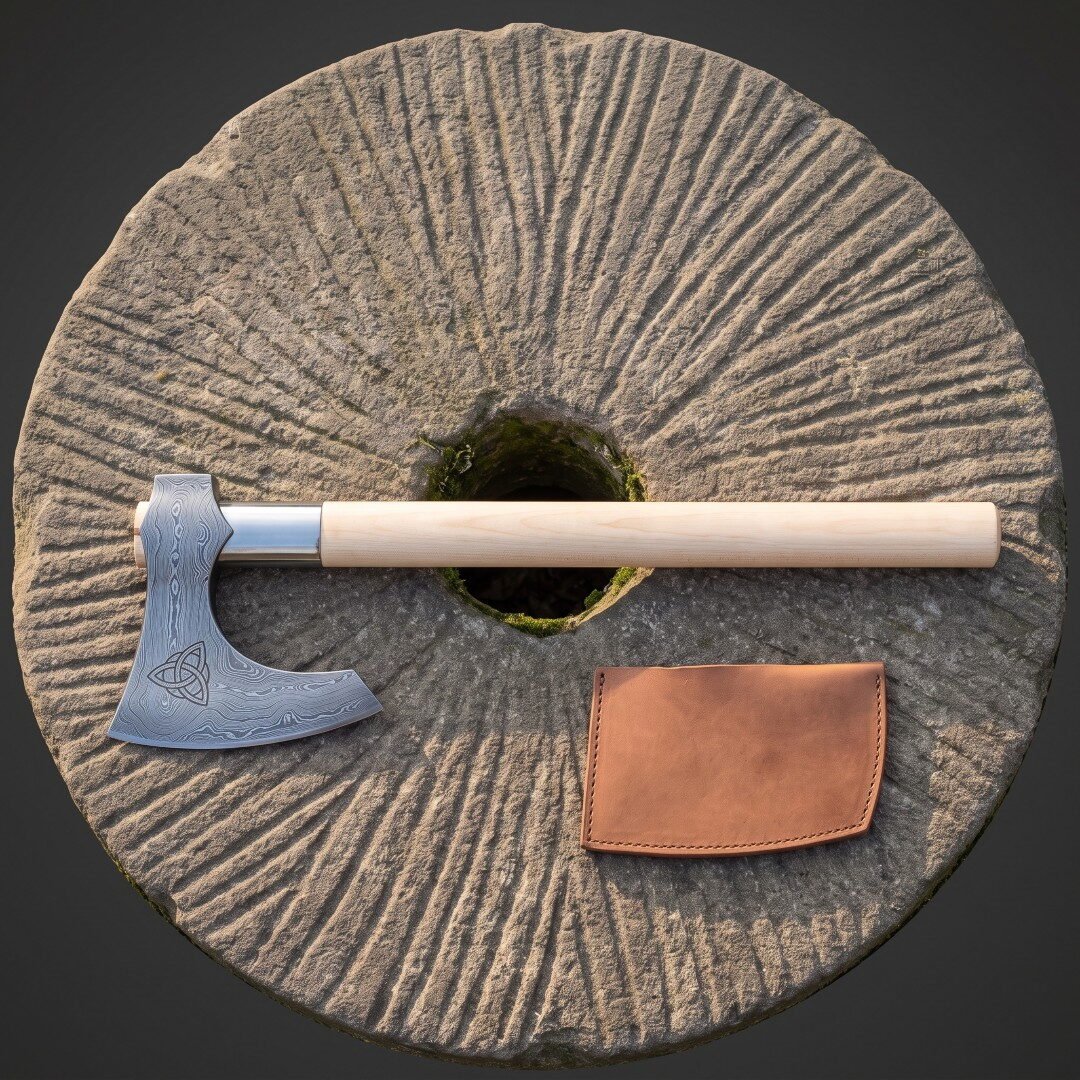
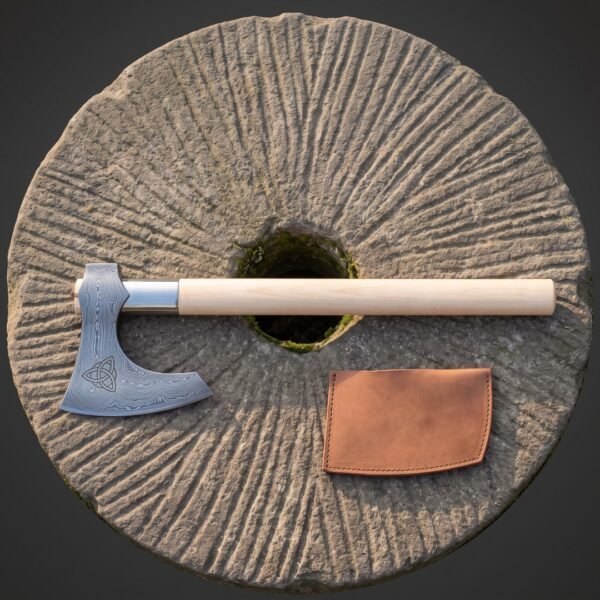
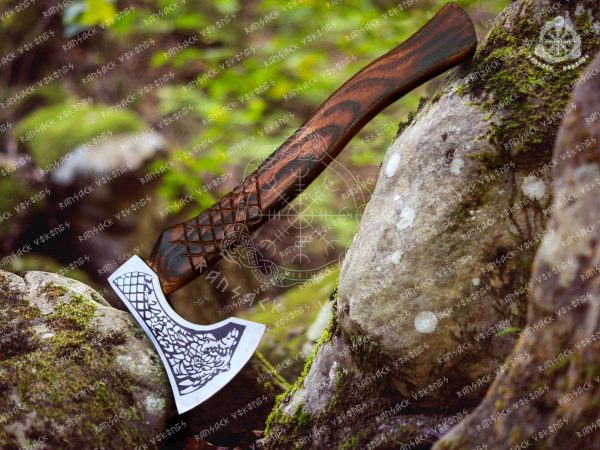
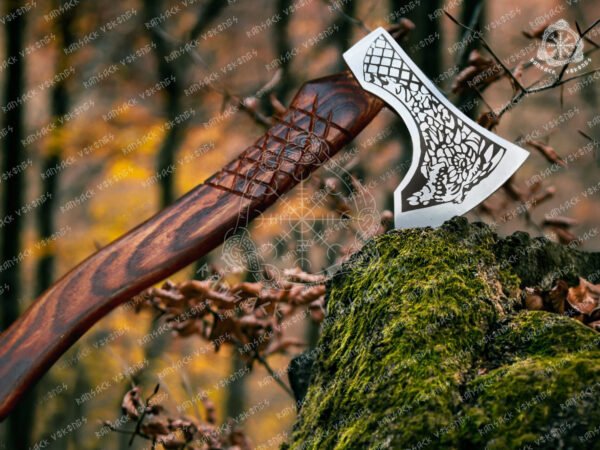
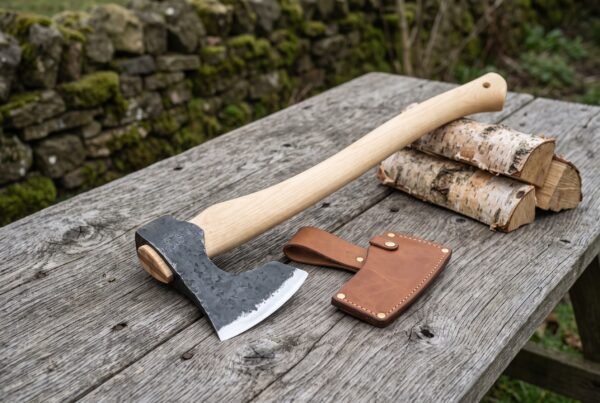
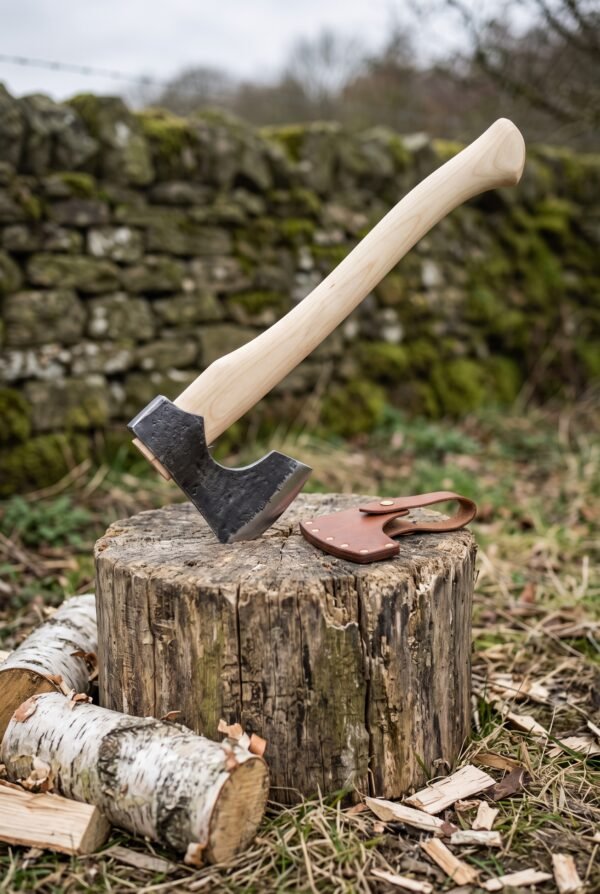
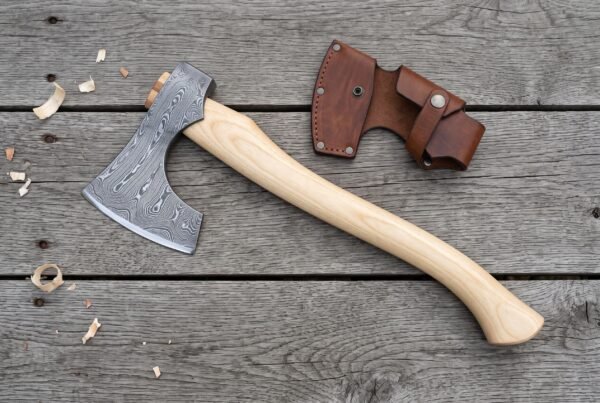
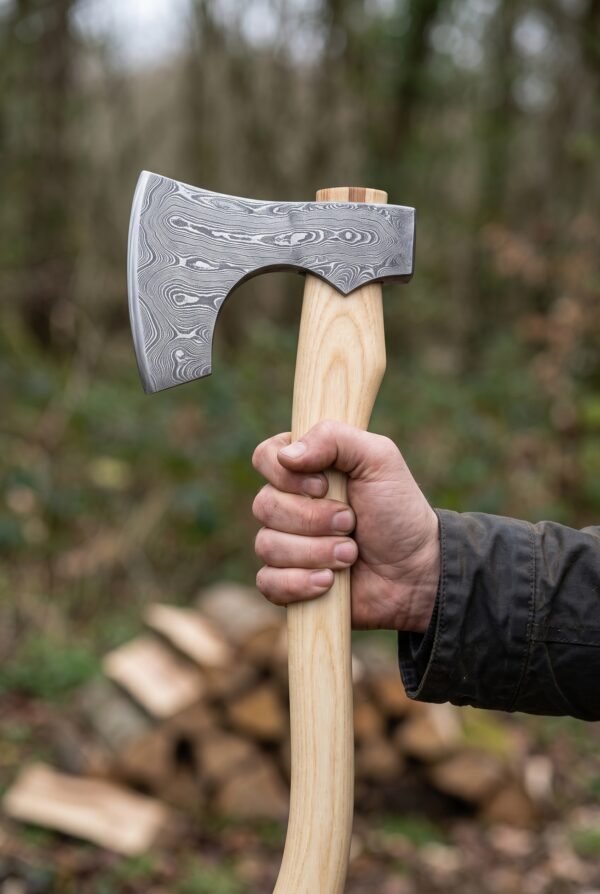
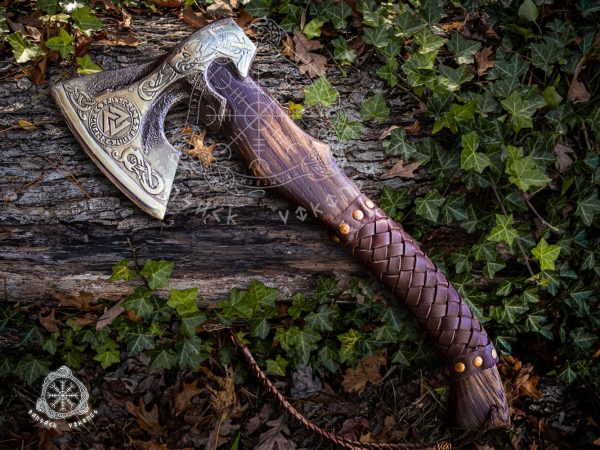
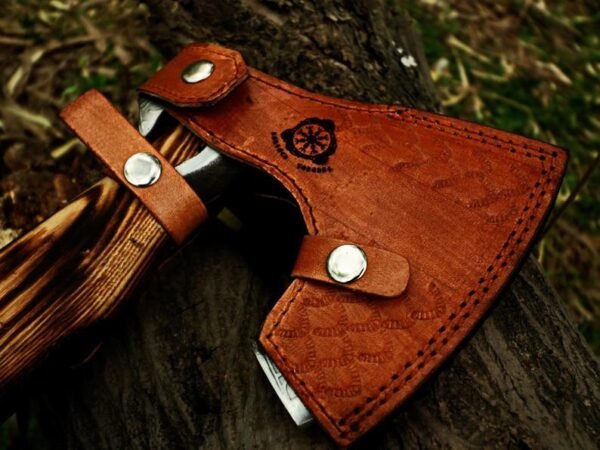
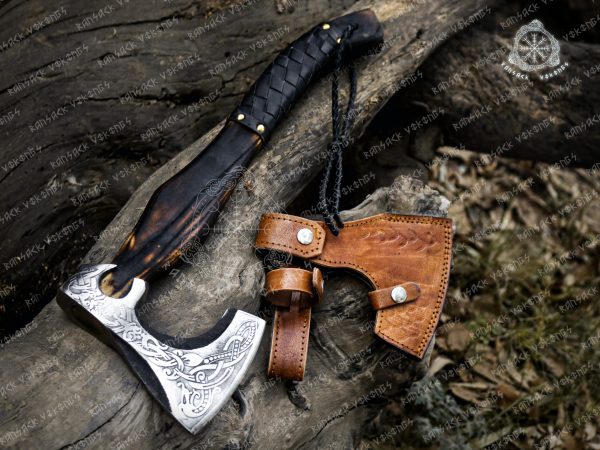
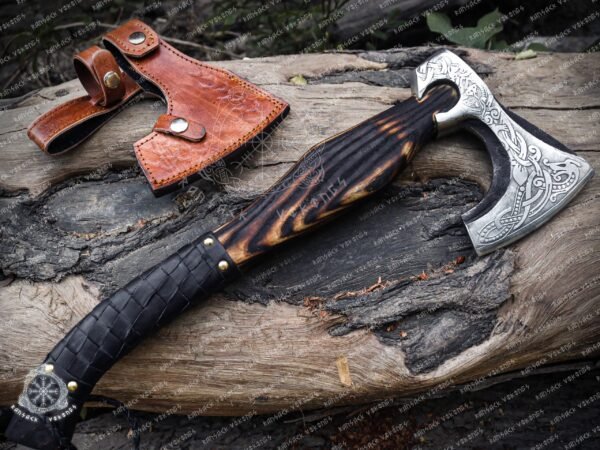
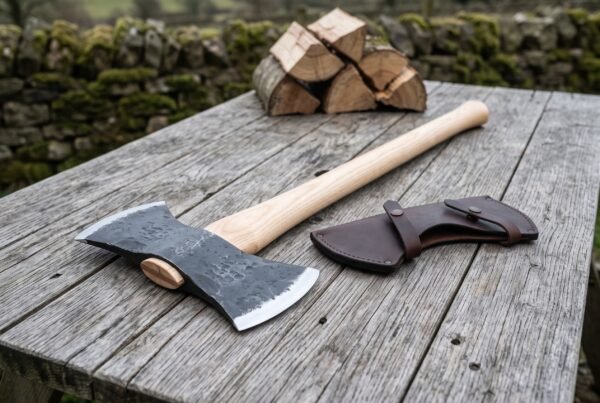
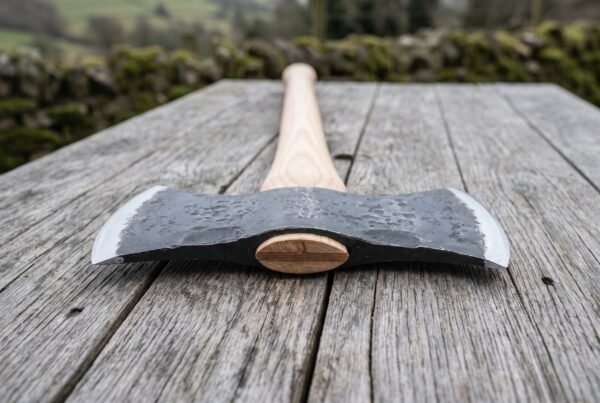
A bearded axe with a head forged from 1095 and 15N20 Damascus, the layers running in long waves across the cheek and swirling where the steel was drawn out around the eye. Cut into the cheek above the beard is a triquetra, the three cornered knot, its arcs interlacing over and under in a single unbroken line. The haft is pale ash, the collar is polished steel, and a stitched leather cover comes with it.
A pattern welded axe head is a much harder thing to make than a pattern welded knife, and it is worth knowing why. A knife blade is ground from a flat billet, so the layers stay tidy. An axe head has to be forged around an eye for the haft, which means the billet is punched, drifted and drawn out in three directions at once. Every one of those movements distorts the layer stack, and the result is the swirling pattern around the eye that you can see on this head. It cannot be produced by grinding, which is the clearest way to tell a genuine forged Damascus head from an etched imitation. Made by hand in the Czech Republic, imported and checked by Ransack Viking, shipped from our Chicago, Illinois warehouse.
If you are choosing between shapes, a battle axe against a bearded axe puts them next to each other. That three cornered knot is a triquetra, one of several covered in our run through the Norse symbols. Lighter heads meant for a target sit in the throwing axes.
Specifications
| Head | 1095 and 15N20 Damascus, 58 to 60 HRC at the edge |
|---|
| Head profile | Bearded Norse pattern with a hooked lower edge |
|---|
| Engraving | Triquetra knot cut into the cheek |
|---|
| Haft | Pale ash, straight, oiled finish |
|---|
| Fittings | Long polished steel collar below the head |
|---|
| Finish | Etched and polished Damascus head, bright collar |
|---|
| Cover | Tan stitched leather edge cover |
|---|
| SKU | RK-2181 |
|---|
The triquetra and what it is not
Three interlocking arcs, sometimes called the trinity knot. It appears on Insular metalwork and manuscript from the early medieval period, on Norse runestones and on Germanic ornament, and it is one of the oldest continuously used designs in northern Europe. It also gets muddled with the Valknut constantly, so it is worth being precise.
The Valknut is three interlocking triangles with straight sides and sharp corners, and it appears on picture stones from Gotland and on the Oseberg ship burial, usually in contexts connected to death and to Odin. The triquetra is three arcs, all curves, no corners, and it is far more widespread and far less specific in meaning. Where a Valknut carries a heavy and quite particular association, a triquetra is more open. It reads as three in one, and it has been used for a great many trinities across a great many centuries. On an axe cheek it fills a curved space naturally in a way an angular knot never quite does.
Damascus in an axe head
The head is layered 1095 and 15N20. After the head is forged, punched and drifted, it is ground and then etched, and the nickel in the 15N20 resists the acid so those layers stand bright against the darker 1095. Because the steel has been moved so much during forging, the figure is not the tidy parallel banding you get on a knife. It waves along the cheek and turns into itself around the eye.
The edge runs 58 to 60 HRC. That is harder than the plain carbon axe in the range, which is a considered trade. A harder edge holds longer and is more prone to chipping on a knot or a hidden nail, so this is a head to keep for clean wood rather than for grubbing about near the ground. Damascus is not stainless, and an etched surface holds moisture more readily than a polished one, so it needs oiling. Ash is used for the haft because it is stiff along the grain and flexible across it, so it takes shock out of a strike before it reaches the wrist.
Engraving, runes and your own design
Use the rune converter on this page to turn a name, a date or a short phrase into Elder Futhark and we will cut it into the steel, the leather or the wood. If you would rather have a Viking pattern than a rune line, choose your own design in the engraving option above the add to cart button and tell us where it goes. Where a piece already carries an engraved design, your chosen engraving replaces it rather than sitting alongside it. On this axe that means your design would take the place of the triquetra on the cheek. If you would rather keep the knot, we can cut your rune line into the ash haft instead, which reads very well on pale timber. Engraving is done here in the United States after the piece arrives. See the engraving page.
Handling and balance
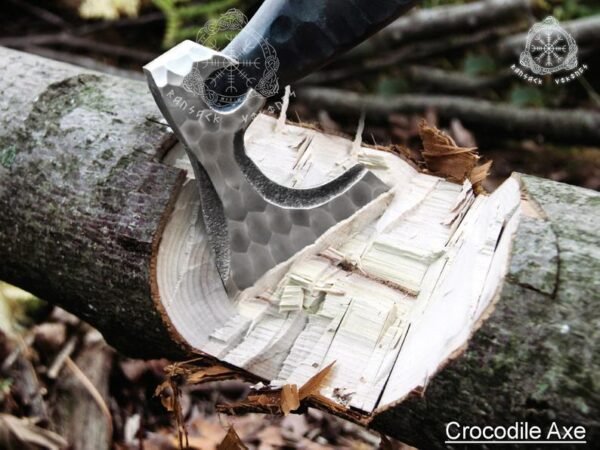
Hold it near the end of the haft for a full swing and let the head carry the work. For carving and shaping, choke right up into the hollow behind the beard and hold the axe just under the head with a thumb along the top of the haft. That is the whole reason a bearded head exists and it turns a chopping tool into a carving one in a second.
Because the edge is harder than usual, keep it off frozen wood, off anything with grit or old fasteners in it, and off the ground. A chip in a hard edge takes a lot of filing to remove. Used on clean seasoned or green timber it will out cut a softer head comfortably.
Care
Dry the head after use and put a light film of oil over the whole cheek, not just the edge, because the etched surface holds moisture across its entire face. Mineral oil, camellia oil or a light gun oil all work. Sharpen with a file and a stone. Do not use a powered wheel, because the thin edge on a hardened Damascus head will lose its temper long before the steel looks hot. Store it with the leather cover on the edge but not in a damp shed, since leather traps moisture. Feed the ash with boiled linseed oil once or twice a year and the haft will stay tight and splinter free. More detail is in steel care.
Damascus wants oil more than plain steel does, because the etch that shows the pattern also opens the surface, and caring for a Damascus pattern covers what to use.
Made in the Czech Republic
Made by hand in the Czech Republic. The billet is forge welded, the head punched, drifted and drawn, the cheek ground and etched, the triquetra cut, the haft shaped and hung and the leather cover stitched, all by the people who make it. Nothing here is drop shipped from an importer catalogue. Ransack Viking imports them into the United States, checks the hang and the wedge on every head and the edge finish on every axe, and holds stock in our Chicago, Illinois warehouse so orders leave from a shelf. Processing runs one to two weeks and sits at the longer end when an engraving has been ordered, because the cut is done after the axe arrives. Shipping within the United States is free, returns run seven days, and the lifetime warranty against defects in forging, grind, heat treat and fittings has no end date and needs no receipt.
A note on handmade variation
Hand made, not machine made or bulk produced, so what arrives will not be a pixel for pixel copy of the photograph. A forged Damascus axe head varies more than almost anything else in the range, because the pattern depends on exactly how the steel moved under the hammer as the eye was punched and drifted. No two heads swirl the same way. Ash hafts differ in grain, colour and figure from board to board. The triquetra is cut individually so its line weight varies. The steel, the hardness, the profile and the build are the same every time. The character is not.
Frequently asked questions
Is the pattern real Damascus or an etched print
It is real forge welded pattern, layered 1095 and 15N20 running all the way through the steel. The swirl around the eye is the giveaway, because that shape can only come from steel being moved by a hammer.
Is the triquetra the same as a Valknut
No. A triquetra is three interlocking arcs, all curves. A Valknut is three interlocking triangles with straight sides and sharp corners. They are frequently confused and they are not the same sign.
Can I actually chop with it
Yes, on clean wood. The edge is harder than a plain carbon axe, which holds longer but chips more readily, so keep it off grit, frozen timber and old nails.
Is it sharp when it arrives
Yes, it ships with a working edge. Keep the leather cover on it in transit and in storage.
Will the pattern wear away
No. It is structural and runs through the head. Heavy polishing lowers the surface contrast and a re etch restores it, but ordinary use and oiling will not remove it.
Can the haft be replaced
Yes, it is a standard hung head and a competent shop can rehang it. A haft broken through ordinary hard use is not a forging defect and sits outside the warranty.
What is in the box
- One Damascus bearded axe head with a triquetra engraved cheek
- One pale ash haft with a polished steel collar
- One stitched leather edge cover
- Your Elder Futhark rune line or chosen Viking design, if ordered
- Lifetime warranty against defects in forging, grind, heat treat and fittings
- Hand made in the Czech Republic, shipped from our Chicago, Illinois warehouse
Explore the range
More in bearded axes, Viking axes, Norse arms and engraved and personalised pieces, plus the guides.
Near neighbours in the shop
A near match for this one is the Grainbeard bearded axe, pattern welded Damascus. Closest to this in the range is the Wayfarrow bearded axe. If this one is not quite right, there is the Ashbite bearded axe.
The Grainwhorl battle axe covers the other half of the same kit. You can have this made your way instead on the custom Viking axe page.




This axe is well made. Just a couple small things kept it from 5 stars. Blade quality is solid. Arrived a bit less sharp than expected but a few passes on a strop fixed it. Made in the Czech Republic but ships from the US. Delivery was quick even so. Minor nitpicks aside, good quality piece.