Blog
Bjorn Ironside: The Great Raid and the Man in the Sagas

Bjorn Ironside has the best travel record of any Viking in the sagas and one of the thinnest files in the archives. A fleet really did leave northern France in 859, round Spain, raid North Africa, winter in the south of France and sack towns in Italy before limping home. Whether the man the sagas call Bjorn Ironside led it, or existed in quite the form they describe, is a harder question.
This page sets the record beside the legend and keeps them in separate columns. His saga brothers and the rest of the cast are covered in Famous Vikings: the people behind the sagas.
The Name
In Old Norse he is Björn járnsíða. Björn means bear, which was as ordinary a name then as it is in Scandinavia now. Járnsíða means iron side. Norman writers in Latin call him Bier Costae ferreae, which means the same thing and takes longer to say.
The earliest text to use the byname is Norman and dates from around 1070. The Icelandic sagas come later again. Like his supposed brother Ivar the Boneless, he has a nickname that nobody from his own lifetime is recorded using.
Berno on the Seine
The nearest thing to a contemporary sighting comes from the Annals of St Bertin, the court annals of the West Frankish kingdom. In the 850s Viking fleets were camped on the Seine, using an island at Oissel near Rouen as a base, and King Charles the Bald spent a good deal of effort failing to shift them. Under 858 the annals record that Berno, leader of one part of the Seine pirates, came to the king at the palace of Verberie, put himself in the king’s hands and swore loyalty to him.
Berno is a plausible Frankish spelling of Björn, and the date and the river fit the man the later writers describe. That is the full extent of it. The annals give no byname, no father and no further career, and an oath of loyalty to a Frankish king was not a promise many Viking leaders treated as binding for long.
The Great Raid of 859 to 861
The expedition itself is well attested, from both ends of the Mediterranean. Frankish annals record a Danish fleet sailing round Spain, through the strait into the Mediterranean, and later into the Rhone. Arab chroniclers in al Andalus, who called the raiders majus, describe a fleet of sixty two ships working down the Atlantic coast of the peninsula.
Pieced together, the route runs roughly like this. The fleet raided along the coasts of Galicia and the south of Iberia, where the Arab sources say the mosque at Algeciras was burned. It crossed to Morocco and sacked Nekor, a small emirate on the coast, taking captives who were later ransomed. It raided the Balearic Islands and the coast near Roussillon, then wintered on an island in the Camargue at the mouth of the Rhone. In 860 it went up the river as far as Valence before being pushed back, then turned to Italy, where Pisa was taken. On the way home in 861 the fleet met storms and the navy of Córdoba, and lost a good part of its ships.
Spanish and Arab sources also record a Norse force seizing the king of Pamplona around this time and releasing him for a large ransom, and that episode is usually tied to the same fleet. Taken as a whole it was a three year voyage of roughly the scale of a small invasion, and it returned with far less than it set out with. As a business venture it had mixed results. As a story it was excellent.
Luni and the Wrong City
The most famous episode is the one least likely to have happened as told. Dudo of Saint Quentin, writing a history of the Norman dukes around 1015, tells how the Viking leader Hastein, wanting to take Rome, landed instead at Luni on the Ligurian coast and mistook it for the great city. The walls were too strong, so Hastein had his men announce that he was dead and wished for a Christian burial. The townspeople let the funeral procession in, Hastein leapt out of his coffin, and the town was taken. Only afterwards did the Vikings discover they had sacked the wrong place.
The fake funeral is a wandering story. Snorri tells much the same trick of Harald Hardrada in Sicily, two hundred years later. Dudo’s version is about Hastein alone. It is William of Jumièges, reworking Dudo around 1070, who adds Bjorn to the expedition, describes him as the son of a king called Lodbrok, and makes Hastein his tutor. That is the first written link between Bjorn Ironside, the great raid and the Lothbrok family, and it comes about two hundred years after the events.
William also explains the byname. In his account Bjorn went into battle without a shield and came out unwounded, because his mother had dosed him with powerful potions. He then sends Bjorn home by way of a shipwreck off the English coast and has him die in Frisia. None of that can be checked, though it is at least a more modest ending than most heroes get.
The Bjorn of the Sagas
The Icelandic version arrives in the thirteenth century. In Ragnars saga loðbrókar and the shorter Tale of Ragnar’s Sons, Bjorn is a son of Ragnar and Aslaug and a full brother of Ivar the Boneless, Hvitserk and Sigurd Snake in the Eye. The brothers raid widely in the south, and in Ragnars saga they reach a town called Luna and plan to go on to Rome. They meet an old man who tells them he has worn iron shoes thin on the walk from Rome. The brothers decide Rome is too far and turn back. It is a better reason to abandon a campaign than most real ones.
After Ragnar’s death and the revenge on Ælla in England, the Tale of Ragnar’s Sons divides the inheritance, and Bjorn takes Uppsala and Sweden. The genealogies in Hervarar saga trace later Swedish kings back to him. A large mound on the island of Munsö in Lake Mälaren is known locally as Bjorn Ironside’s mound. The name is tradition; nothing found there connects it to him.
One Man or Several?
There are three Bjorns in play: Berno who swore an oath on the Seine in 858, the Bier of the Norman histories who sailed with Hastein, and the Björn of the sagas who ended up king in Sweden. The first two fit together reasonably well in time and place. The third is a saga writer’s arrangement, made to give the Swedish royal line a famous ancestor and to give Ragnar a son for every corner of the map.
The sensible position is that a Viking leader called Björn was active in France in the 850s and may well have shared command of the Mediterranean raid. Everything beyond that, including the father, the iron shoes, the Swedish crown and the invulnerable skin, is literature. It is good literature, which is why it lasted.
Bjorn on Screen, Briefly
As a side note, most people now know him from the History series Vikings, where Alexander Ludwig played him from a boy into a king of Kattegat. The series made him Ivar’s half brother, sent him to the Mediterranean, and borrowed freely from the sagas and the Norman writers while rearranging both. It is a drama, and it never claimed to be a lecture. How well its kit matches the period is graded in the arms of Vikings and The Last Kingdom.
Ships, Shields and the Kit of a Long Voyage
A three year voyage of sixty odd ships depended on the ship more than on any weapon. The open sea crossings, the river work up the Rhone and the beach landings in Morocco and Italy are all things a Viking longship was built to do, and how it did them is covered in Viking ships and the longship.
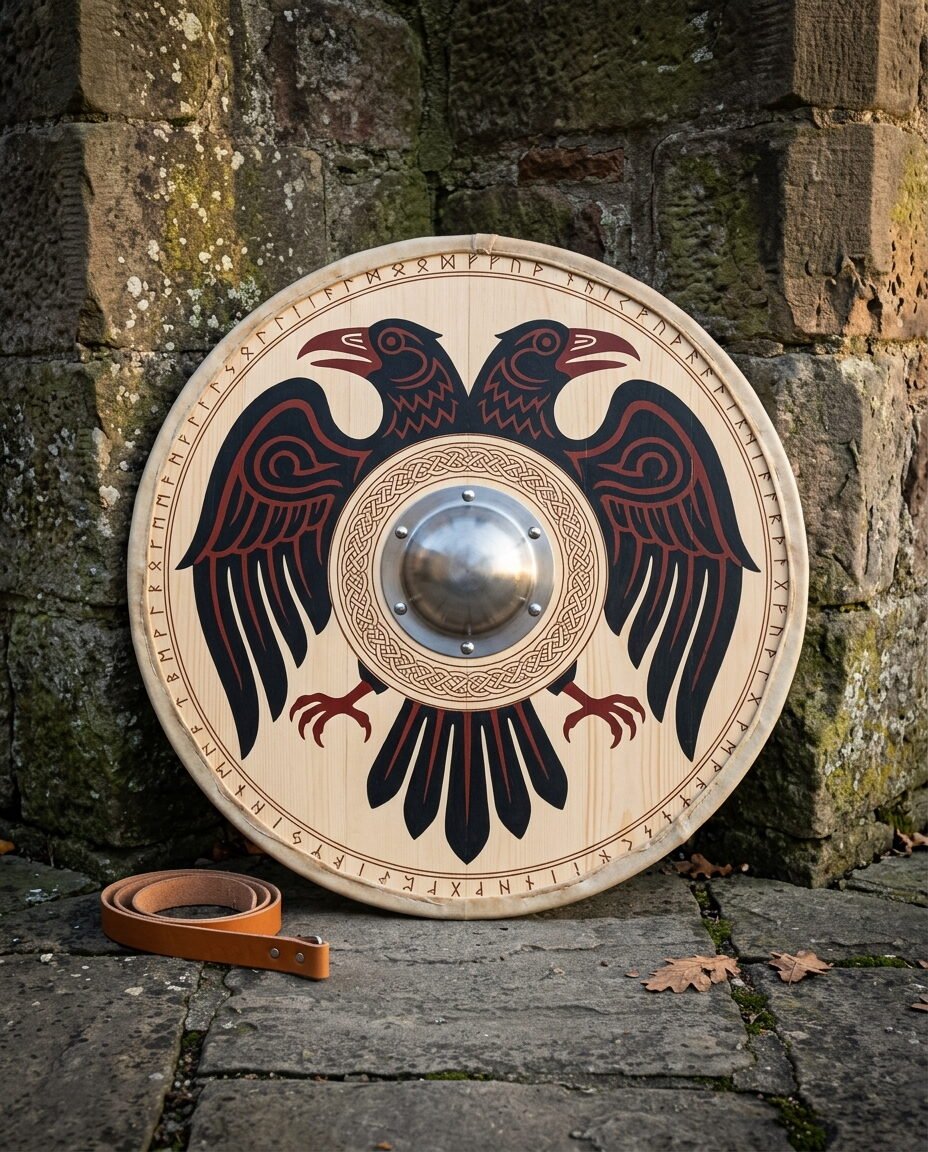
The men aboard carried the usual Viking kit. A round shield was the most important thing a man owned in a fight, and on a ship it was also hung along the rail. Ours are in round shields. A spear was the common arm, a sword the mark of a leader, and you will find the broad fullered blades of the period in our Viking swords. Helmets were rarer than films suggest, and none of them had horns; the shapes that did exist are in Viking helmets. Bjorn’s supposed brother, and the record behind him, has his own page at Ivar the Boneless.
Ransack Viking is a US company in Chicago, Illinois. The pieces are made by hand in the Czech Republic, then inspected and shipped from Chicago, and US orders ship free and tracked. The rest of the writing is in the guides.
Questions people ask
Was Bjorn Ironside a real person?
Probably, in part. Frankish annals record a Viking leader called Berno on the Seine in 858, and a fleet did raid the Mediterranean between 859 and 861. Norman writers of the eleventh century name a Bier Ironside as one of its leaders. His royal career in Sweden and his descent from Ragnar come only from the later sagas.
Why was he called Ironside?
William of Jumièges, writing around 1070, says he went into battle without a shield and was never wounded, because his mother had given him powerful potions. A simpler reading is a man who survived fights he should not have. No contemporary source explains it.
Was Bjorn Ironside the son of Ragnar Lothbrok?
The Norman histories and the Icelandic sagas say so, but no contemporary source names his father, and Ragnar himself is poorly documented. The link is first made around two hundred years after the events.
Did Bjorn Ironside attack Rome?
No. The story is that the fleet attacked Luni in Italy believing it was Rome. Dudo of Saint Quentin tells it of Hastein, and later writers added Bjorn. The fleet did take Pisa in 860, which is a real event, though not Rome either.
Where was the 859 raid going?
Wherever there was wealth to take. Its route ran along the coasts of Iberia, across to Morocco, to the Balearics and the south of France, up the Rhone, and on to Italy, before it returned through the strait in 861 with heavy losses.
Where is Bjorn Ironside buried?
Nobody knows. William of Jumièges says he died in Frisia. Swedish tradition attaches his name to a mound on Munsö in Lake Mälaren, but nothing found there identifies the burial.
What the shop carries
On the shelf in the same spirit, the Stormwheel Viking round shield and the Staveholm Viking sword. Next to those, the Skyglass Viking spectacle helmet.
