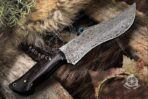
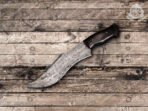
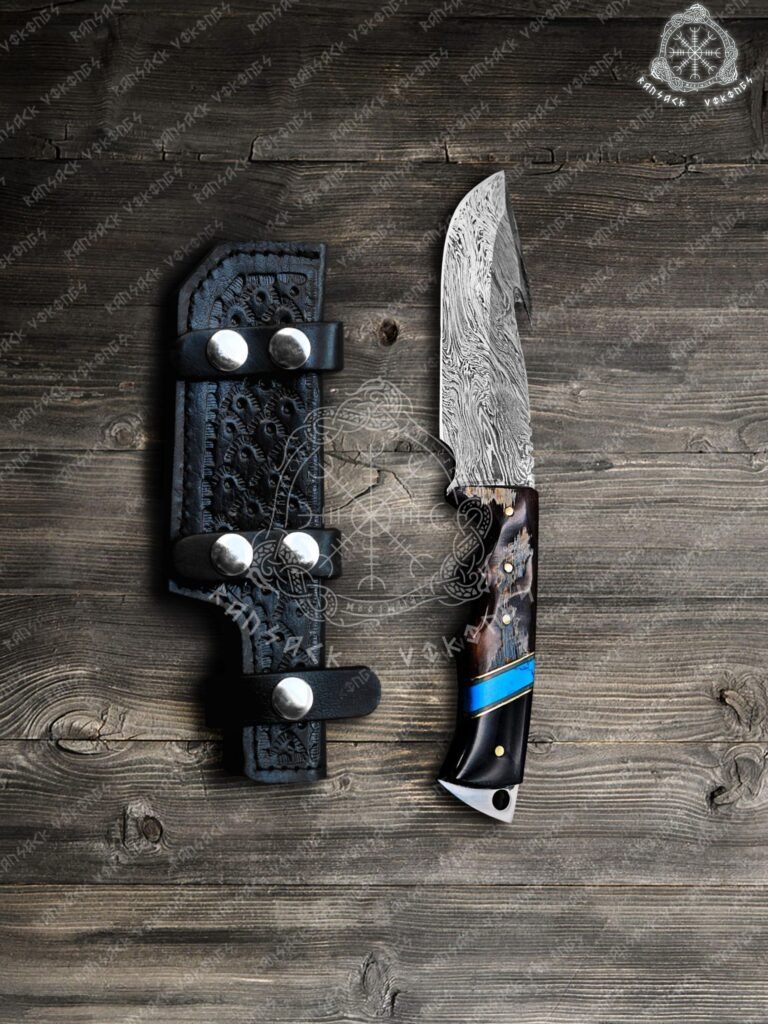
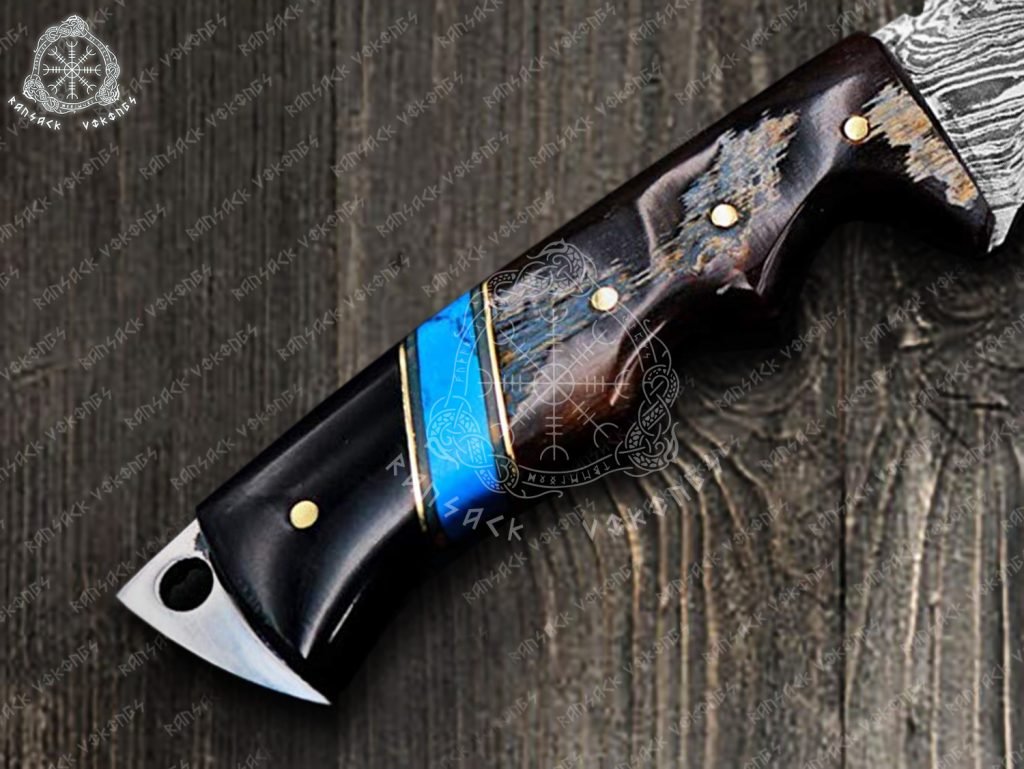
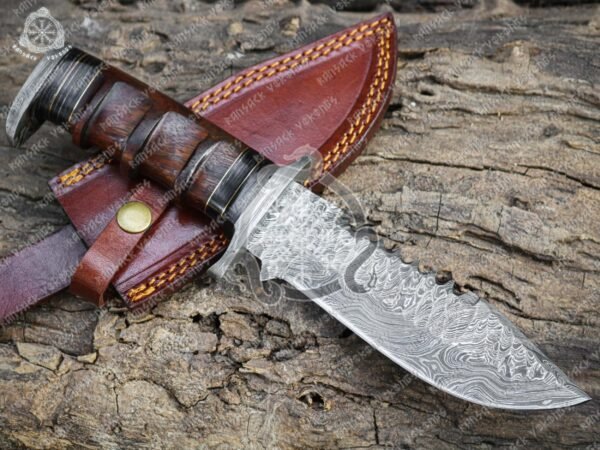
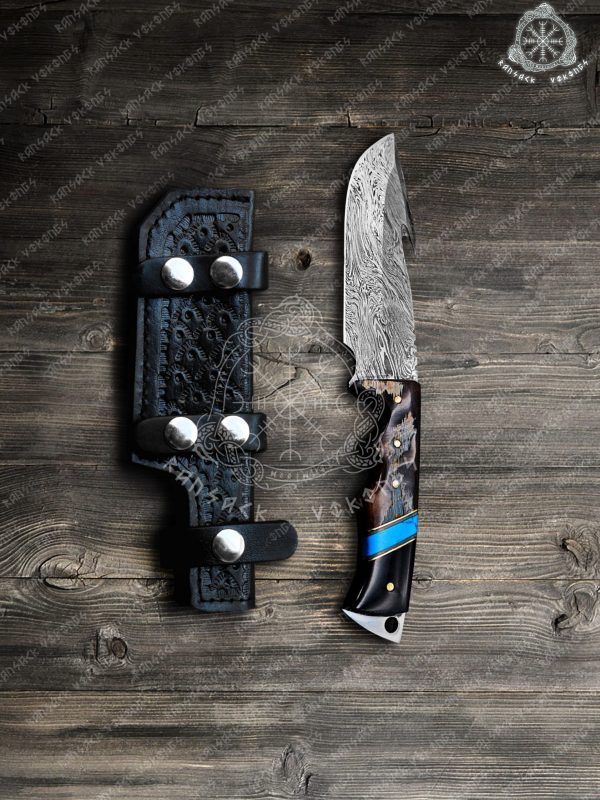
Wengehook is a hand forged gut hook skinning knife, pairing a fire pattern Damascus blade with a tropical wenge wood handle. It is 9 inches overall with a 5 inch blade and a 4 inch grip, weighs 3.5 oz, and carries custom brass file work along the spine. In the hand it feels denser than it looks on a screen, which is what most people notice first. The method matters more than the knife, and how to skin a deer walks through it.
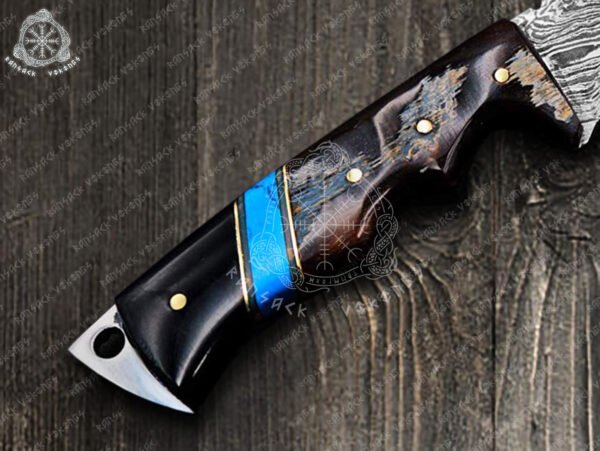
Wenge is worth knowing about if you have not handled it. It comes from central Africa, it is one of the darkest timbers in commercial use, running from chocolate brown to near black with fine black lines through it, and it is heavy and very hard. Guitar makers use it for fretboards, flooring people use it where a floor is going to be abused. It has a coarse open grain that gives a natural grip texture without any checkering being cut into it, which on a knife that will be used with wet hands is a genuine advantage rather than a decorative one.
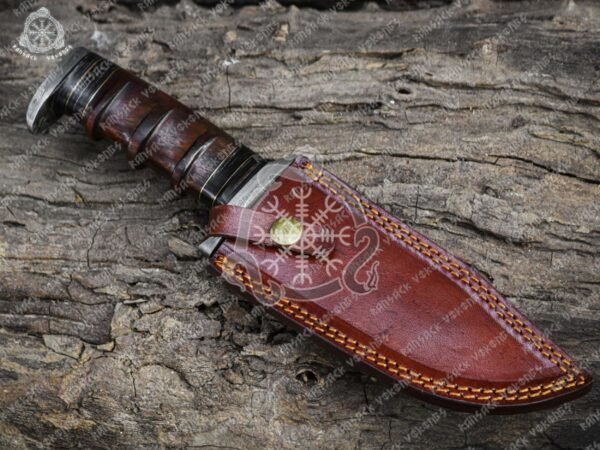
The knife is forged, ground, handled and sheathed in the Czech Republic. It ships with a fitted cowhide leather sheath, free within the United States, sharp on both the main edge and the inside of the hook.
Specifications
| Steel | Hand forged Damascus, 1095 and 15N20 forge welded |
|---|
| Hardness | 58 to 60 HRC |
|---|
| Pattern | Fire pattern Damascus with custom brass file work |
|---|
| Overall length | 9 inches |
|---|
| Blade length | 5 inches |
|---|
| Handle length | 4 inches |
|---|
| Weight | 3.5 oz |
|---|
| Handle | Tropical wenge wood |
|---|
| Sheath | Cowhide leather sheath included |
|---|
| SKU | RK-350 |
|---|
What a gut hook skinning knife does that a plain blade cannot, and when not to use one
The hook cut into the spine has a sharpened inside curve and a deliberately blunt nose. You make a short entry cut through the hide, slide the blunt nose under the skin so it rides against the underside, and pull. The hide opens from the inside outwards.
Two problems disappear when you work that way. The first is the paunch. A knife point pushed down into an abdominal cavity will eventually find the stomach or the intestine, and once either is opened the job becomes unpleasant and the meat is compromised. The rounded nose of a hook physically cannot present a point downwards, so it pushes the viscera clear instead of into them. The second is hair. A straight edge drawn down through hide pulls hair into the cut and onto the meat. A hook cutting from underneath pushes hair away.
It is worth being honest about the other side. A hook is not a universal answer. On a heavily furred animal it will pack with hair and fat in a long run and need clearing. It is harder to sharpen than a straight edge, because you need a round file or rod rather than a flat stone. And an experienced hunter using two fingers to guide a plain blade under the hide achieves the same result without one, which is why plenty of field knives have no hook at all. What the hook buys you is speed and a much lower chance of a mistake, and that trade is worth the most to people who dress a handful of animals a year rather than a hundred.
Away from the field it earns its place all year on rope, twine, packing strap, baling wire wrap and seat belts, because those materials are drawn into the curve rather than pushed away from a flat edge. The 5 inch main blade behind it is a full working length, so nothing is given up.
Why Damascus and not stainless
Real Damascus is a stack of steels, not a finish. Layers of 1095 high carbon and 15N20 nickel steel are forge welded into a billet, folded, drawn out and finally etched, which is when the pattern appears, because the two steels react differently to the acid. Every blade comes out of the billet at a different point in the layering, so the pattern on yours belongs to your knife.
Run at 58 to 60 HRC this holds a working edge through more hide, cartilage and rope than soft stainless, and it comes back on a stone quickly. The cost is that under the pattern it is carbon steel and it will rust if it is put away wet or left in a damp sheath. That is a fair trade for a knife that gets cleaned after use and a poor one for a knife that lives forgotten in a truck. The full comparison, including the cases where stainless is the better buy, is in Damascus versus stainless, and the background on the billet itself is in what Damascus steel is.
The wenge handle
Wenge is dense enough to balance a 5 inch blade without making the knife feel heavy, and its coarse open grain gives a dry grip that smooth close grained timbers do not. It is also close to black, which sets off an etched Damascus blade and brass file work about as well as any handle material can.
It has one habit worth knowing. Wenge is splintery when it is worked and it drinks oil unevenly at first, so an unfed handle can look patchy after a season. Feed it once or twice a year with a light coat of mineral or tung oil, worked in with a cloth and buffed back, and the colour evens out and deepens instead of drying and greying. Keep it out of standing water and away from a dishwasher. The routine is in wooden handle care, and the sheath is covered in leather sheath care.
Engraving, runes and your own design
Use the rune converter on this page to turn a name, a date or a short phrase into Elder Futhark and we will cut it into the steel or the handle. If you would rather have a Viking pattern than a rune line, choose your own design in the engraving option above the add to cart button and tell us whether it goes on the blade or the handle. Where a piece already carries an engraved design, your chosen engraving replaces it rather than sitting alongside it. On this knife the blade flat below the hook takes lettering most cleanly, since the wenge is dark enough that a cut line has less contrast than it would on a pale wood. Placement and sizing are covered on the engraving page.
Care and sharpening
Damascus is carbon steel underneath the pattern, so treat it like carbon steel. Wash and dry after use, put a thin film of mineral or camellia oil on the blade, and do not store it in the sheath for months at a time because leather holds moisture against steel. A grey patina will form and that is protection. Orange rust is not, and it should come off with a soft abrasive and oil before it pits.
The main edge sharpens on an ordinary stone at a consistent angle with light pressure. The hook needs a round ceramic rod, a small round diamond file or a chainsaw file that matches the inside radius, worked only on the inner curve. Never sharpen the outer nose, because it has to stay blunt to ride under hide, and never try to reach a hook with a flat stone. Detail in steel care and angles in sharpening with a whetstone.
Made in the Czech Republic
Every piece we sell is made by hand in the Czech Republic. The smiths there work the way the trade has been worked for a long time, heating and hammering the steel, taking the bevels down by eye, and fitting the handle and the leather one at a time. There is no automated line anywhere in it, so small differences from one piece to the next are normal and expected.
Ransack Viking is a United States company based in Memphis, Tennessee. We bring the pieces in ourselves, inspect them on arrival and ship them from our own warehouse. If you add engraving, that is carried out here in the United States before your order goes out.
A note on handmade variation
This knife is hand forged. It is not machine made and it is not bulk produced, so the knife that arrives will not be a pixel for pixel copy of the photograph. The fire pattern is a property of the individual billet, so the swirl and the density of the layers change from blade to blade. Wenge is a natural timber and no two blanks are marked alike, so the depth of the brown and the run of the black lines differ between handles. The brass file work is cut by hand, which means the spacing of the notches is close but never identical, and the exact radius of the hook shifts by a fraction because it is cut by eye.
The dimensions, the steel and the build are the same on every one. Only the character changes, and that is what you are buying from a forge rather than a factory.
Frequently asked questions
Is this the knife people search for as a king cobra knife?
It often turns up in those results, because the fire pattern in the steel and the hooked spine give it the look people are describing when they use that phrase. The correct name for this piece is the Wengehook, and it is a Damascus gut hook hunting knife rather than a fantasy or display blade.
Is it sharp out of the box?
Yes. Both the main edge and the inside of the hook are sharpened before the knife is boxed.
Is it full tang?
Yes. The tang runs the full length of the handle with the wenge scales fitted to it, which is what keeps a 5 inch blade solid under sideways load.
Will the wenge handle need looking after?
A little. Once or twice a year work a light coat of mineral or tung oil in with a cloth and buff it back. Wenge is dense but open grained, and feeding it keeps the colour even and deep rather than dry and patchy.
What is the difference between this and a plain drop point hunting knife?
The main edge and the point behave the same way. The difference is the hook on the spine, which opens hide from the inside outwards without risking the paunch and without dragging hair into the meat. A drop point does the same job with more care and more skill.
How long does it take to arrive?
One to two weeks of processing plus transit. Shipping inside the United States is free and returns are accepted within 7 days of delivery.
What is in the box
- One Wengehook Damascus gut hook hunting knife, 9 inches overall
- Fitted cowhide leather sheath
- Protective packaging
- Forged and finished in the Czech Republic
Explore the range
Comparable knives sit in hunting knives, Damascus skinner knives, Bowie knives and Viking knives. The steel, the file work and the leather are all explained in the guides.







Photos don’t do this knife justice at all. This is going straight into my display case.
This is exactly what I wanted and then some. Ransack Viking’s attention to detail is honestly unmatched.
Feels way more premium than the price suggests. Fit and finish is museum quality. You can tell real craftsmen made this by hand. Ransack Viking is quickly becoming my go to shop for anything Norse themed. So worth it.
Expected better quality for the price. Leather sheath was thinner than shown in the pictures. On the fence about ordering here again.
Was nervous ordering something like this online but so glad I did. Ransack Viking is quickly becoming my go to shop for anything Norse themed.
Middle of the road experience with this one. Wouldn’t say no to it but wouldn’t rave about it either.
This knife is well made. Just a couple small things kept it from 5 stars. Blade quality is solid. Arrived a bit less sharp than expected but a few passes on a strop fixed it. Sheath is nice. Wish it had more padding but it does the job. Glad I made this purchase.
Was nervous ordering something like this online but so glad I did. So worth it.
Perfect gift. Perfect quality. No complaints. Weight and balance make it feel like a real functional piece not some cheap replica. Already telling my friends to check this out.
Should have read more reviews before ordering. Handle was loose right out of the box. Not sure the Czech craftsmanship justifies the price given the shipping issues I had. Doubt I’ll be ordering from here again.