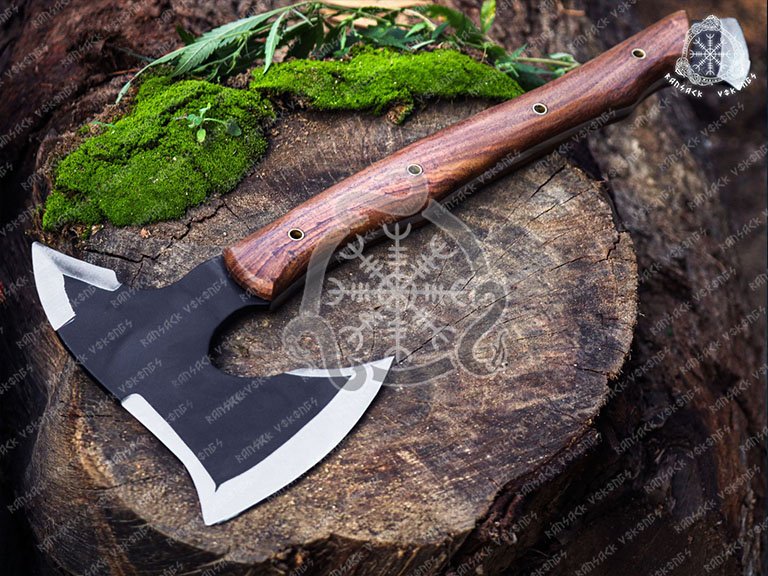
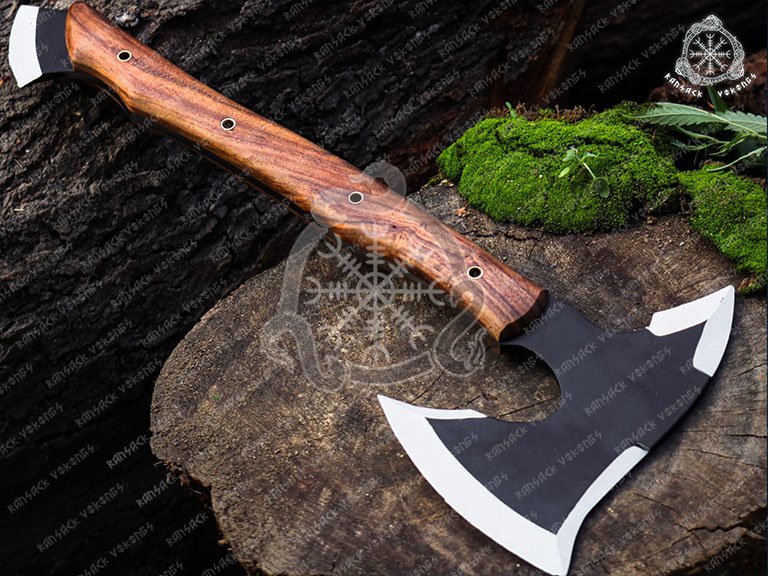
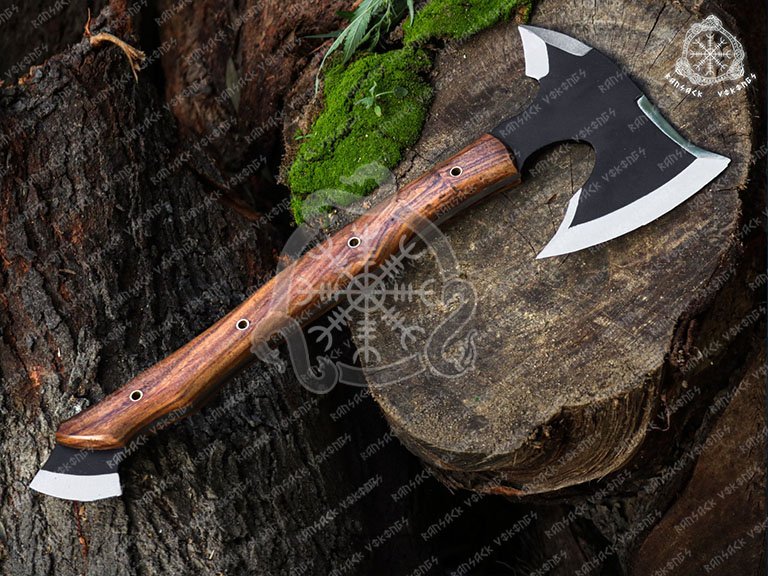
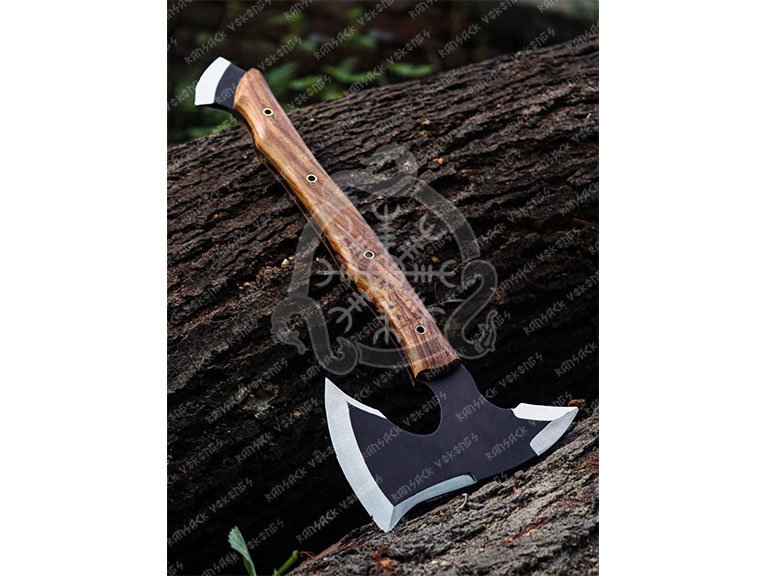
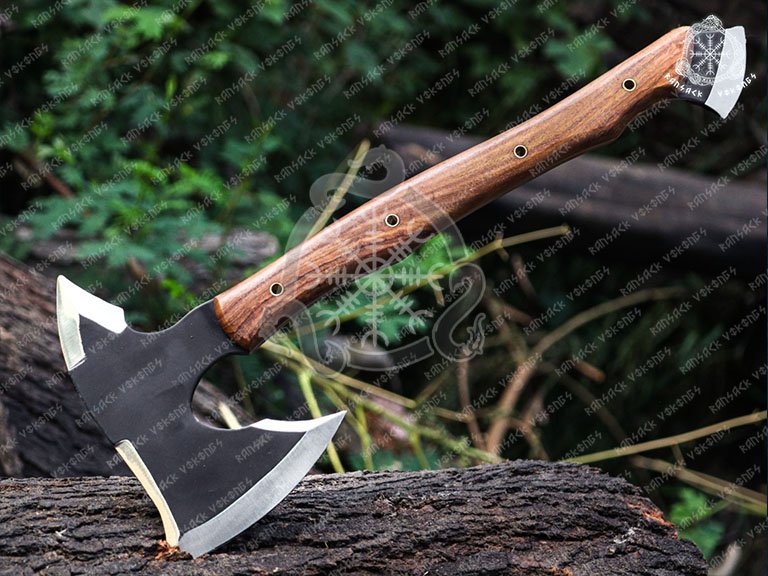
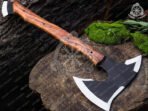
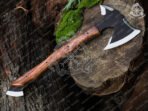
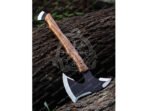
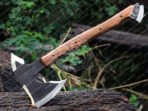
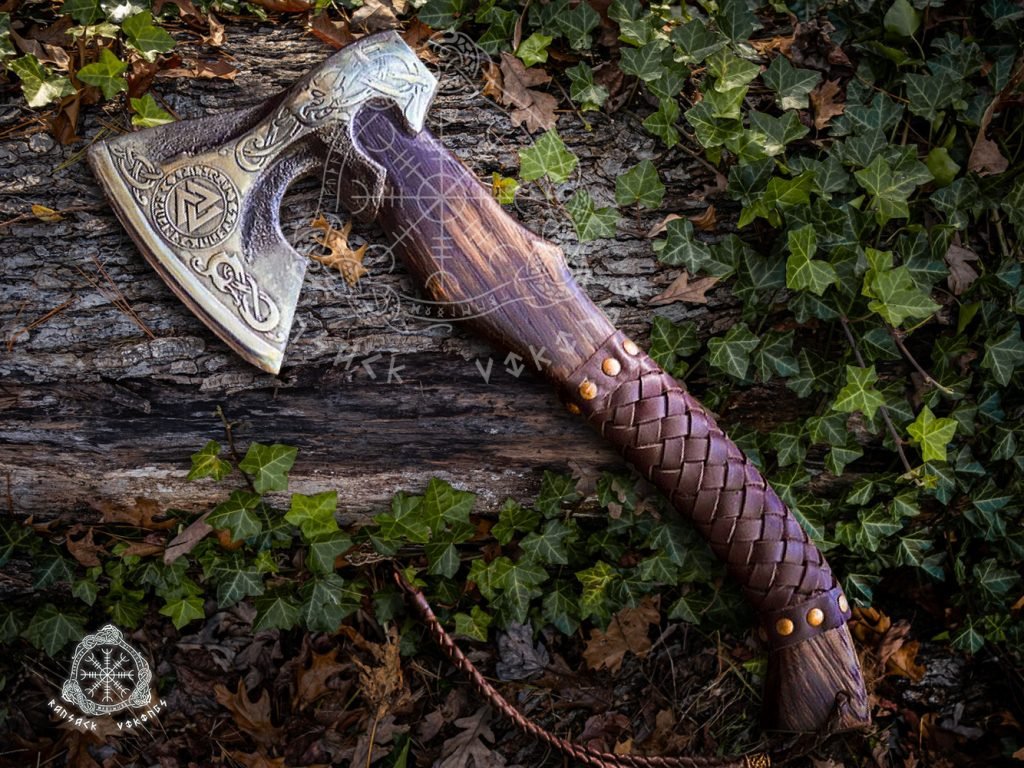
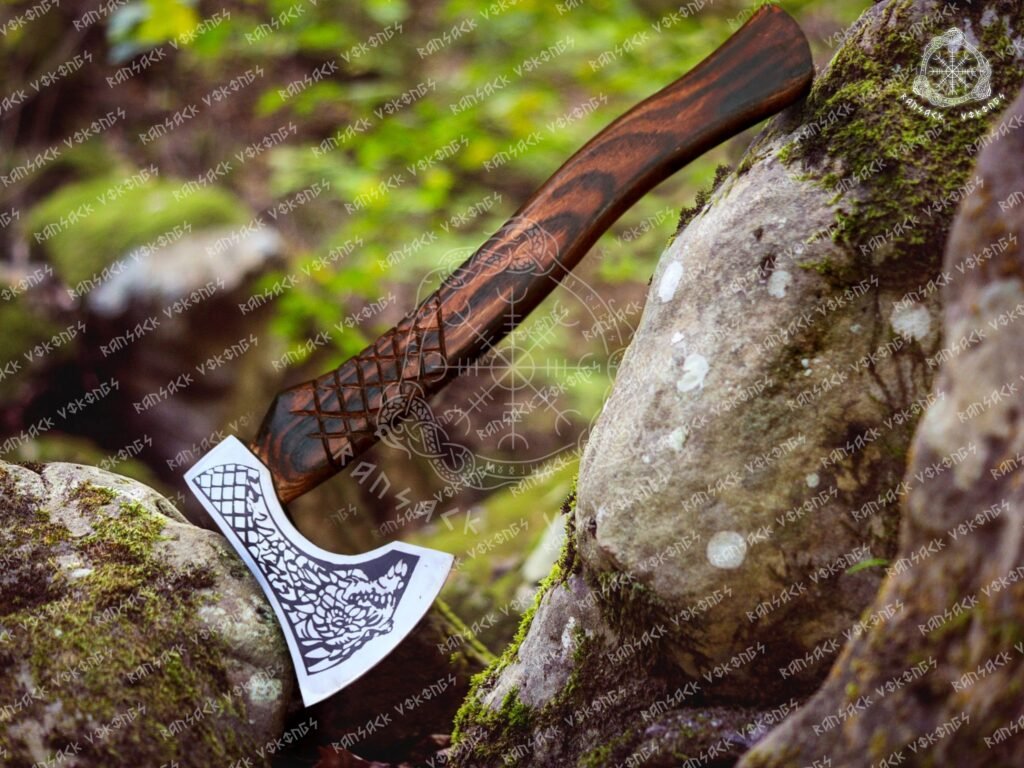
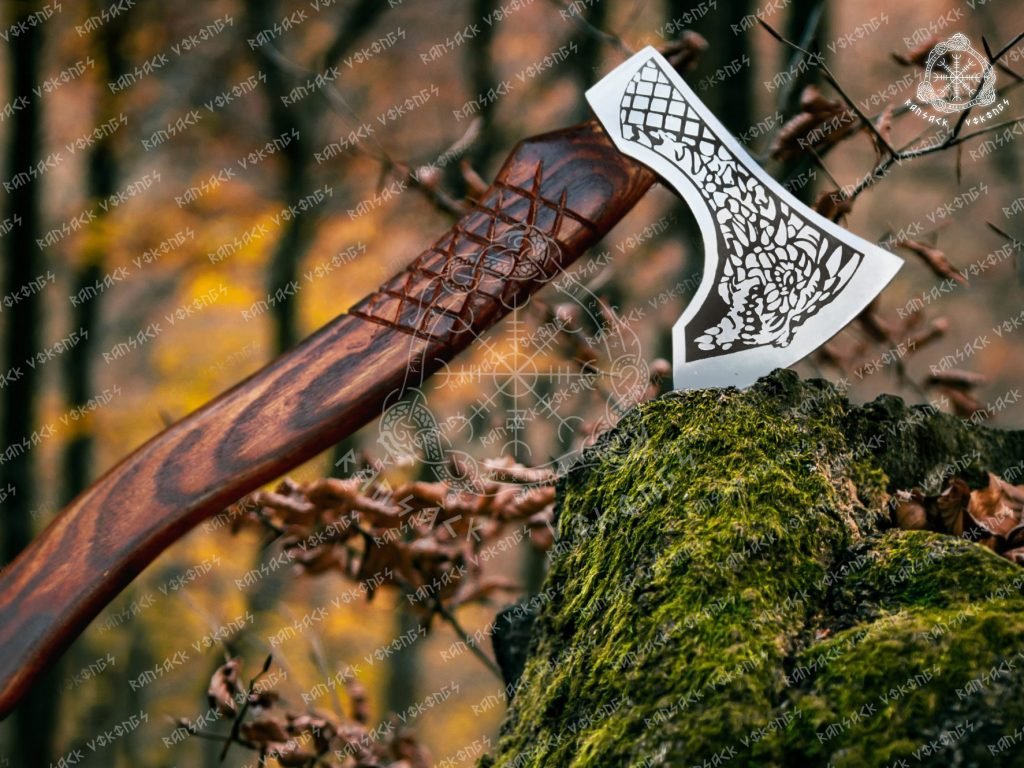
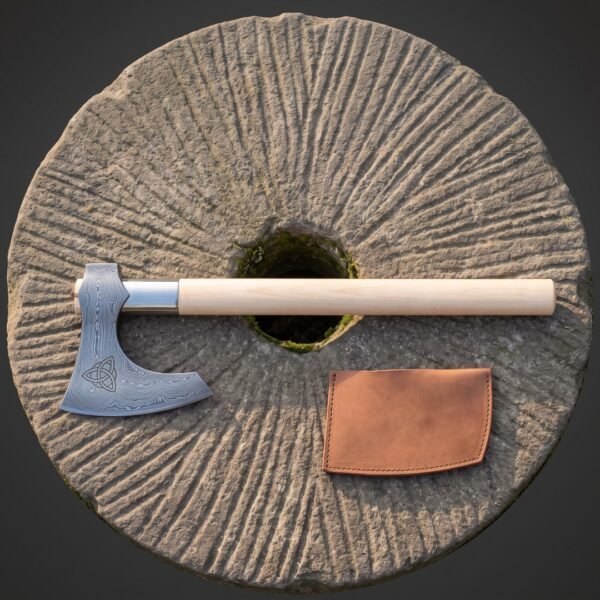
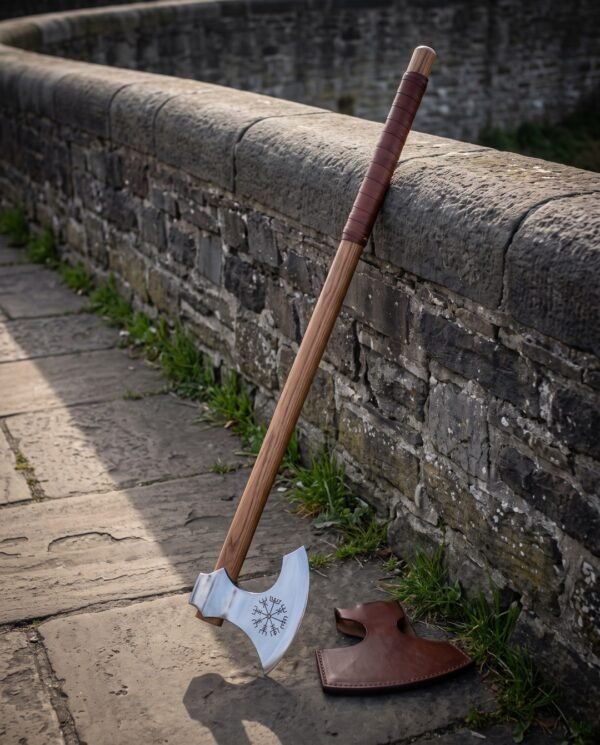
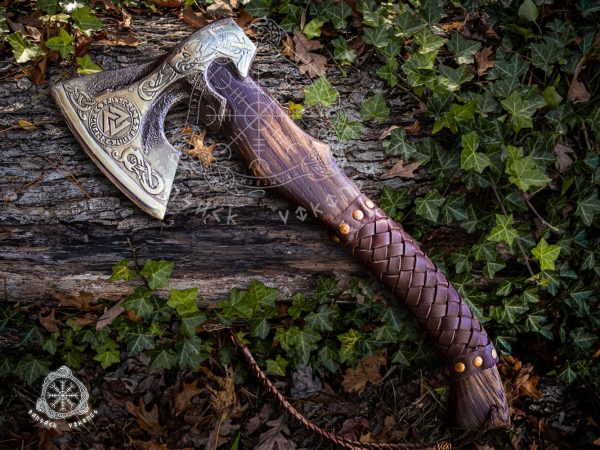
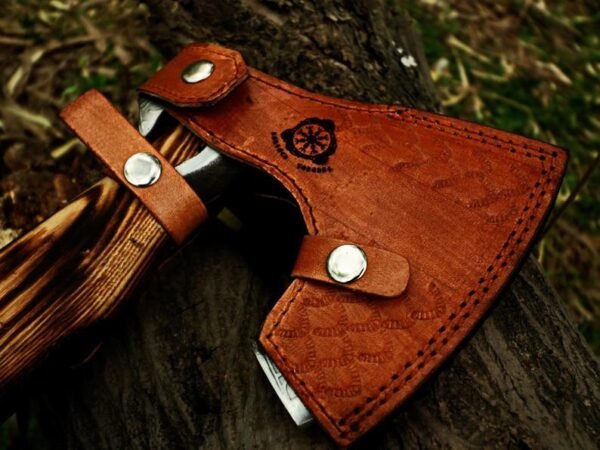
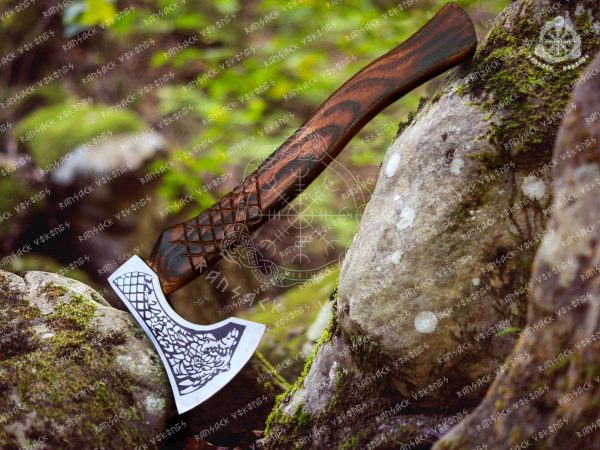
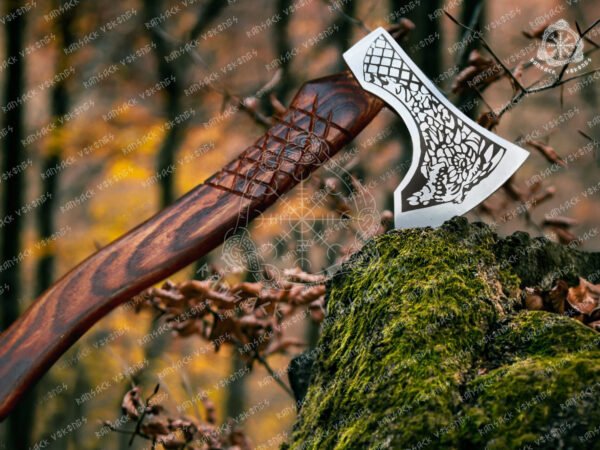
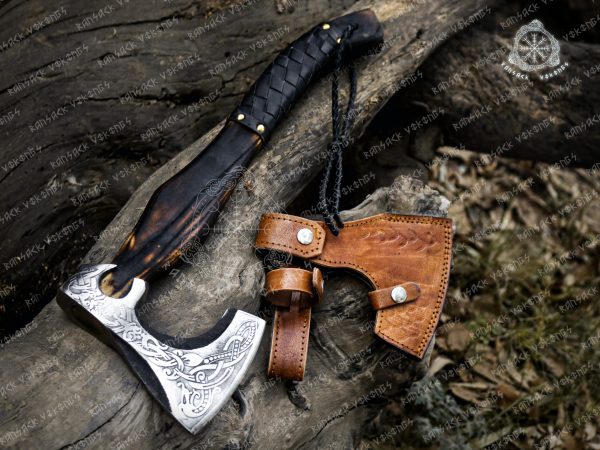
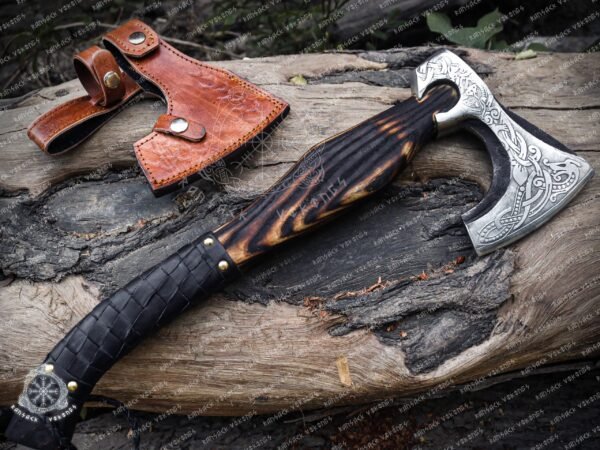
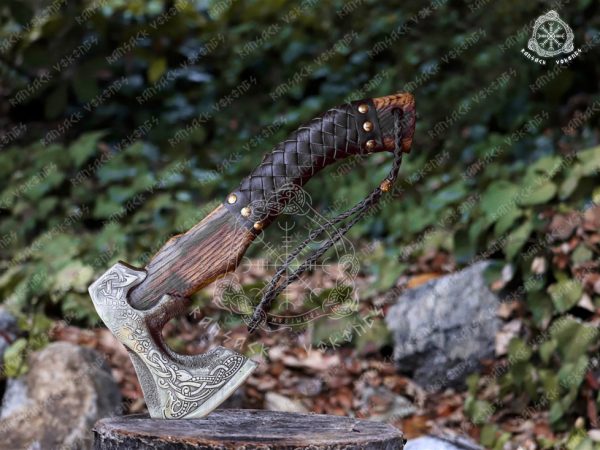
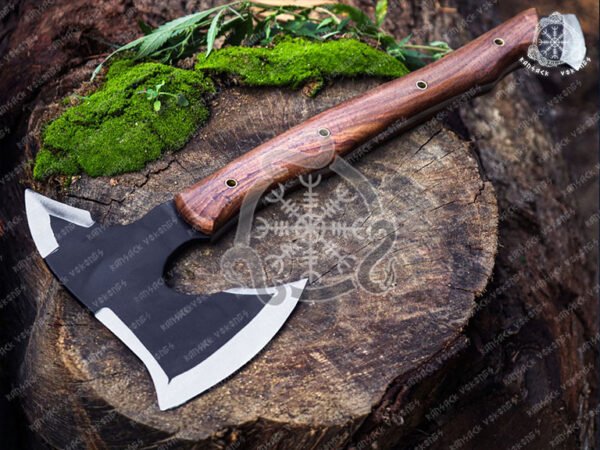
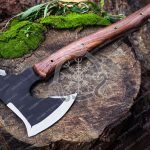
The Ragnar Lothbrok is a hand forged Viking bearded axe on a 19 inch rosewood handle, with a 5.3 inch cutting edge and a head taken to 58 to 60 HRC. All in it weighs 1.23kg, which is enough head weight to bite into seasoned wood without being a two handed felling axe. It ships in a gift box with a leather cover over the bit, and the edge is sharp when it arrives. What the axe on screen actually is, and how close this comes, is picked apart in the axe Ragnar carries on screen.
Norse smiths were careful with steel because steel was expensive. Analysis of surviving Viking age axe heads repeatedly shows the same construction: a body of relatively soft wrought iron, with a strip of harder carbon steel forge welded in at the bit and nowhere else. The soft body absorbed shock and could be reforged if the eye deformed; the hardened insert took and kept the edge. It was a deliberate engineering compromise made a thousand years before anyone could measure hardness, and it is why so many of these heads survived in the ground in usable condition. Modern steel lets us harden a whole head evenly, but the geometry those smiths settled on has barely changed.
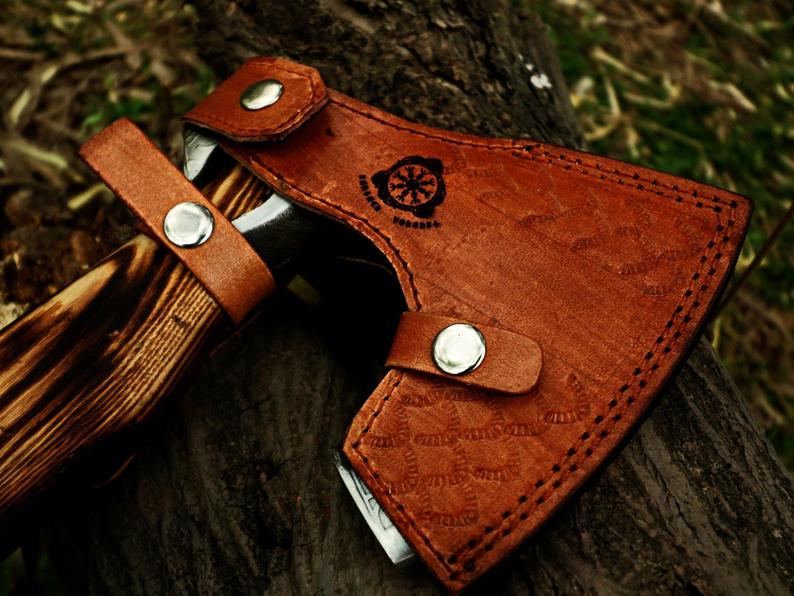
Forged and finished in the Czech Republic. It ships with a leather blade cover, a gift box and protective packaging.
Specifications
| Steel | Hand forged high carbon steel |
|---|
| Hardness | 58 to 60 HRC |
|---|
| Overall length | 19 inches |
|---|
| Cutting edge | 5.3 inches |
|---|
| Weight | 1.23kg |
|---|
| Handle | Rosewood |
|---|
| Included | Leather blade cover and gift box |
|---|
| SKU | RK-389 |
|---|
What the beard is actually for
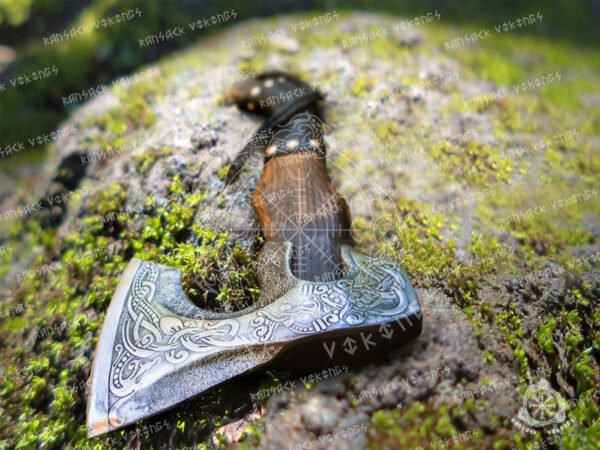
The beard is the part of the blade that hangs down and back below the eye, and it is the single feature that defines this pattern. It is not decoration and it is not there to look Norse. It does three specific things.
First, it buys cutting edge without buying weight. A conventional axe that wanted 5.3 inches of edge would need a much deeper, heavier head. Hanging the extra edge below and behind the eye adds length without adding much mass, so you get a long bite on a light axe. For a people who had to carry everything they owned onto a boat, that mattered.
Second, it creates a safe hand position. Because the beard curves back towards the handle, there is a protected pocket behind it. Choke up so your hand sits under the beard and against the head and you have a controlled carving grip with your fingers shielded by steel above them. That is how these axes were used for shaping wood, not just splitting it.
Third, the hook. A beard is a hook, and Norse sources describe using it to pull a shield rim aside or catch an opponent. That is history rather than a use we recommend, but it explains why the shape looks the way it does. In practice today the beard means one axe that will split kindling, carve a tent peg and hang on a wall convincingly.
Why high carbon steel and not stainless
The head is plain high carbon steel, hardened and tempered so it takes a keen edge and holds it through real work. Stainless is almost never used for axes, and there is a good reason for that. The chromium that makes steel stainless also makes it harder to get both hard and tough at the same time, and an axe head takes repeated shock loads that would chip a stainless edge. Carbon steel can be run hard at the bit and still absorb impact without cracking.
Carbon steel also sharpens quickly in the field with nothing more than a file, which matters on a tool you use outdoors. The trade is corrosion. A high carbon head will develop a grey patina, which is protective, and will show orange rust if it is put away wet. Keep a film of oil on it and keep the leather cover on the bit for storage. Damascus is the alternative for a display piece, and we compare the two directly in Damascus versus stainless.
The rosewood handle
The handle is rosewood, shaped and sanded to sit in the palm rather than to look good in a catalogue photograph. Rosewood is dense and heavy for a timber, which is exactly what an axe haft wants: the mass helps damp the shock that travels back down the handle at impact, and the tight grain resists the splitting that opens up a soft handle around the eye.
Wood moves with temperature and moisture, so a light coat of oil once or twice a year keeps the fibres fed and stops the handle drying and shrinking away from the head. This is the single most important piece of maintenance on any axe. A handle that dries out in a heated room over a winter is how heads work loose. Keep it out of direct sun, do not store it against a radiator, and feed it. We show the method in wooden handle care.
Engraving, runes and your own design
Use the rune converter on this page to turn a name, a date or a short phrase into Elder Futhark and we will cut it into the steel or the handle. If you would rather have a Viking pattern than a rune line, choose your own design in the engraving option above the add to cart button and tell us whether it goes on the blade or the handle. Where a piece already carries an engraved design, your chosen engraving replaces it rather than sitting alongside it. On an axe the cheek of the head gives the largest and clearest surface, and a rune line down the haft is the second most requested placement. See the engraving page.
Care and sharpening
An axe edge is maintained with a file first, a stone second and a strop last. Clamp the head, work the file in one direction along the bevel, follow the curve of the bit rather than flattening it, and finish with a few passes on a fine stone. There is no need to take the head down to a razor polish; an axe wants a tough edge that will survive hitting a knot.
After use, wipe the head dry and put a light film of oil on it, then put the leather cover back over the bit. Do not store the axe leaning against a damp wall or in an unheated shed through a winter without oiling it first. Feed the handle at the same time. The steel side of that routine is in steel care, and the technique for a keen edge is in sharpening with a whetstone.
Made in the Czech Republic
This piece is made by hand in the Czech Republic, in a workshop that still works the old way. The steel is forged, ground, heat treated and finished by smiths who learned the trade from the people before them, and the wood, horn and leather are cut and fitted by hand rather than pressed out on a line. That is also why no two pieces come out exactly the same.
Ransack Viking is a United States company. We import these pieces ourselves, check every one when it lands and ship from our warehouse in Memphis, Tennessee. Engraving is done here in the United States after the piece arrives, so your runes or your own design go on before it leaves for you.
A note on handmade variation
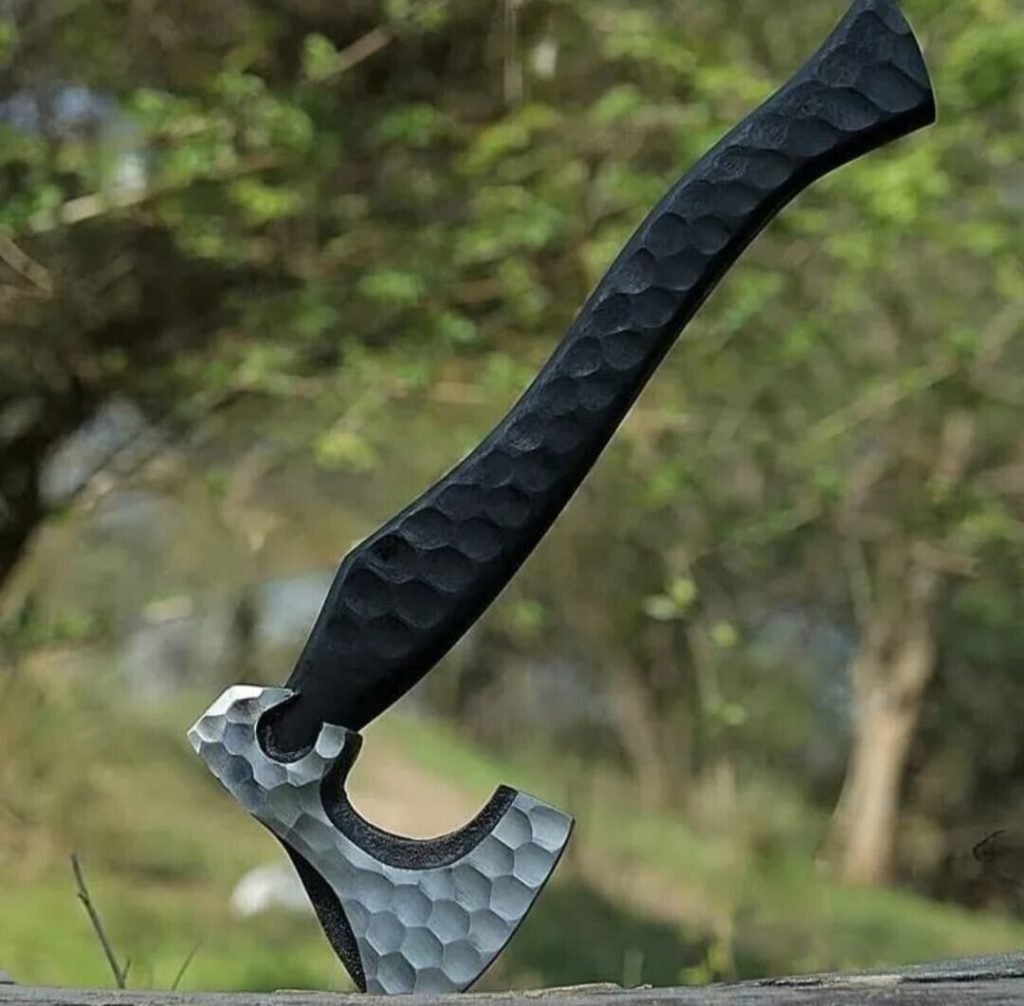
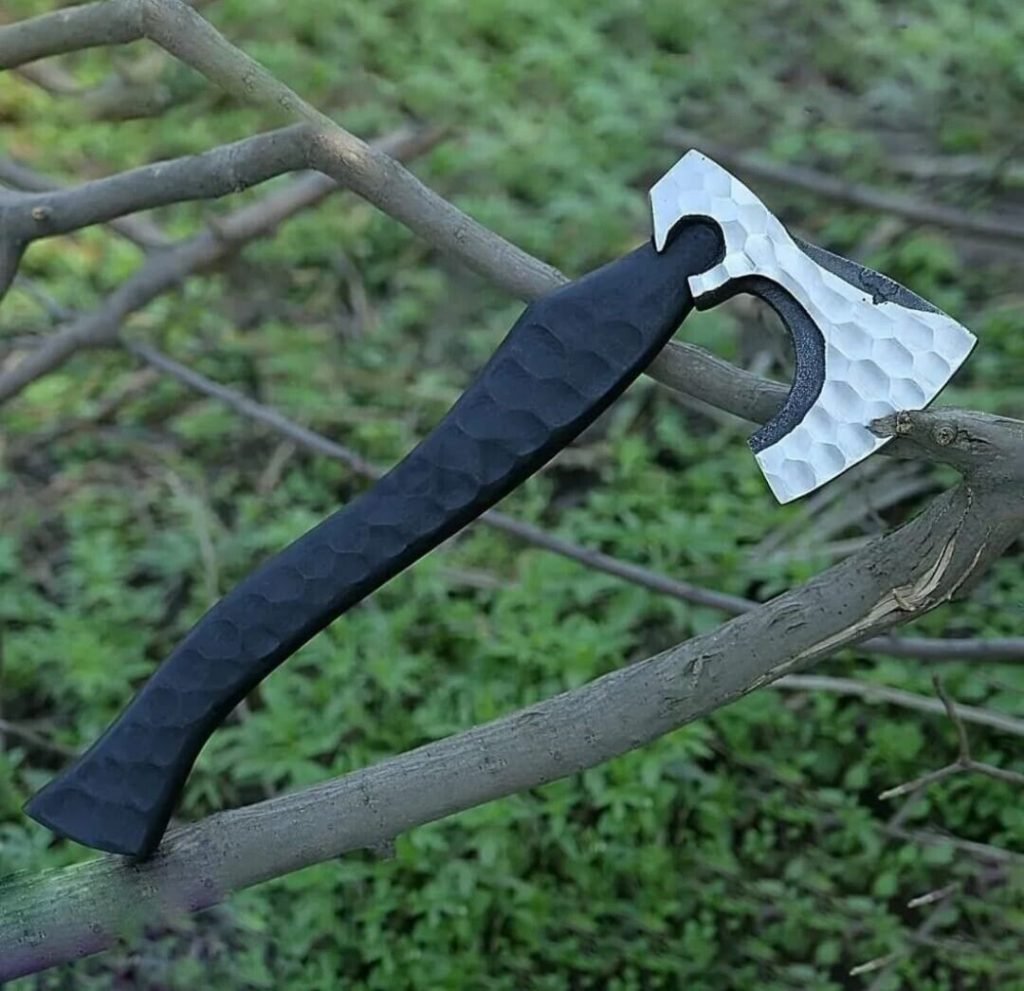
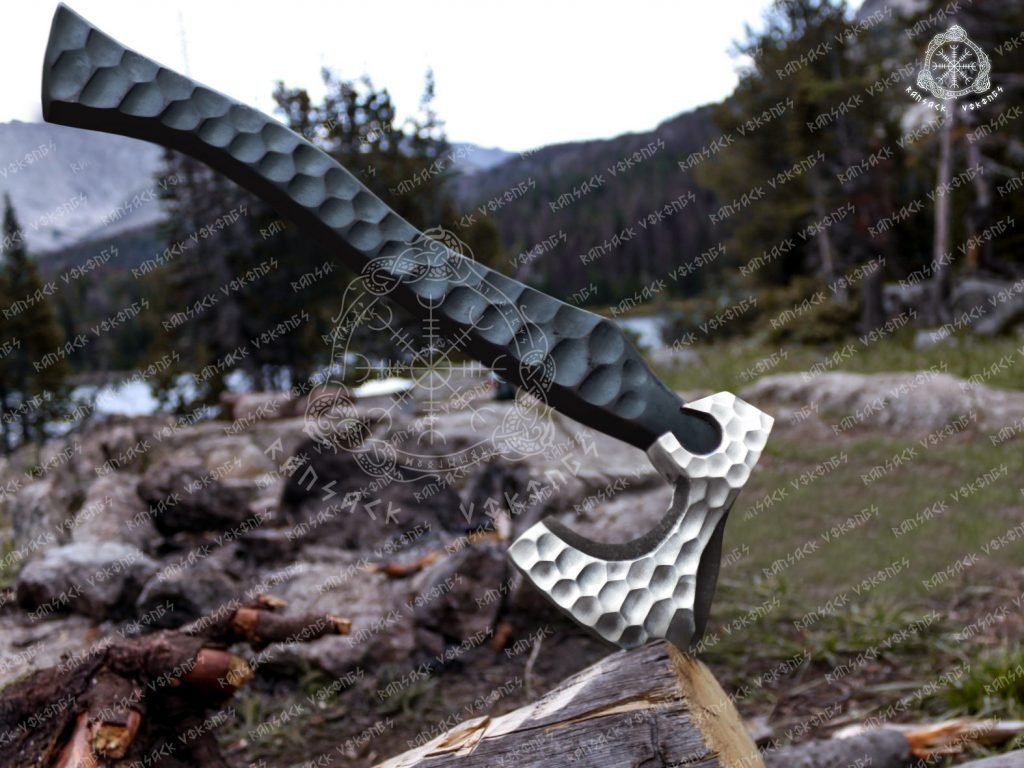
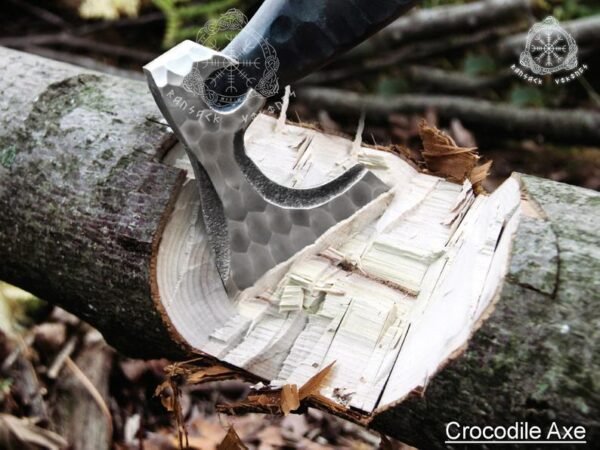
This axe is hand forged. It is not machine made and it is not bulk produced, so what arrives will not be a pixel for pixel copy of the photograph on this page. The hammer marks across the cheek fall where the smith put them, the curve of the beard is drawn by eye, the patina from the heat treat lands differently on every head, and the rosewood carries its own grain, colour and figure because it came from a tree.
The dimensions, the steel, the hardness and the build are the same every time. The character is not, because each one is worked by hand from natural materials.
Frequently asked questions
Is this axe sharp enough to use on arrival
Yes. The bit is ground and sharpened by hand before it is packed and it will take a shaving off a piece of pine out of the box. It is a working axe edge rather than a razor polish.
Can I throw it
It will hold a line in a target, but throwing is hard on any axe and hardest on the handle, because a miss puts the haft into the edge of the board. If you intend to throw regularly, expect to replace or re hang the handle eventually.
Will the head come loose over time
Only if the handle is allowed to dry out. Feed the rosewood with oil once or twice a year, keep it out of a heated room over a long winter, and the fit stays tight. A loose head is a maintenance problem, not a build problem.
How does a bearded axe differ from a tomahawk
A bearded axe has a longer, deeper cutting edge hanging below the eye and is built for wood work and carving. A tomahawk has a lighter, narrower head and a straighter handle, and is built for speed, throwing and one handed use.
Is 19 inches a one handed or two handed axe
One handed. Nineteen inches is a hatchet length haft, which suits kindling, camp work, carving and controlled chopping. It is not long enough to fell timber, and it is not meant to be.
Does it arrive ready to give as a gift
Yes. It comes in a gift box with a leather cover over the bit, so it can be wrapped as it is. Adding a rune line or a name is what most people do when it is bought as a present.
What is in the box
- One Ragnar Lothbrok Viking bearded axe
- Leather blade cover
- Gift box
- Protective packaging
- Care notes for high carbon steel and an oiled handle
- Forged and finished in the Czech Republic
Explore the range
See the rest of the Viking axes, the Viking knives and the hunting knives if you want a blade to go with it. Axe care, hanging and sharpening are covered in the guides.








My whole family was impressed when I unboxed it. Fit and finish is museum quality. You can tell real craftsmen made this by hand. The rosewood handle feels amazing and the balance is perfect. Came in a nice gift box which made it feel even more special. If you’re on the fence just get it. You won’t regret it.