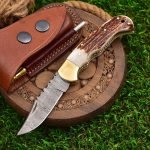
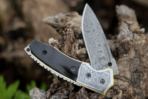
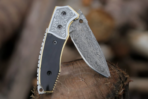
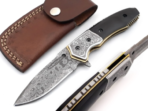
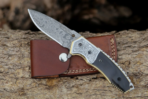
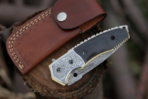
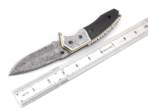
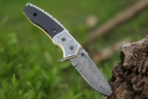
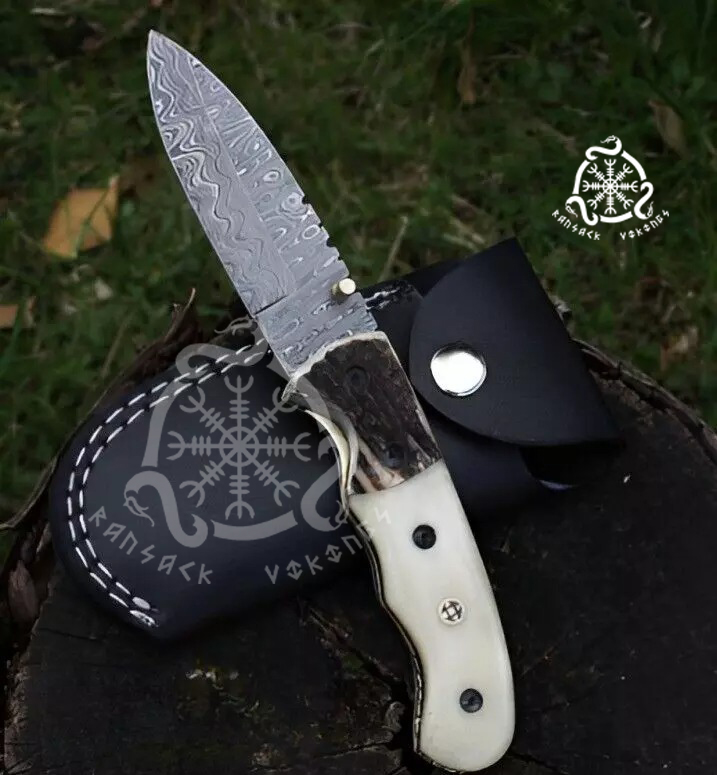
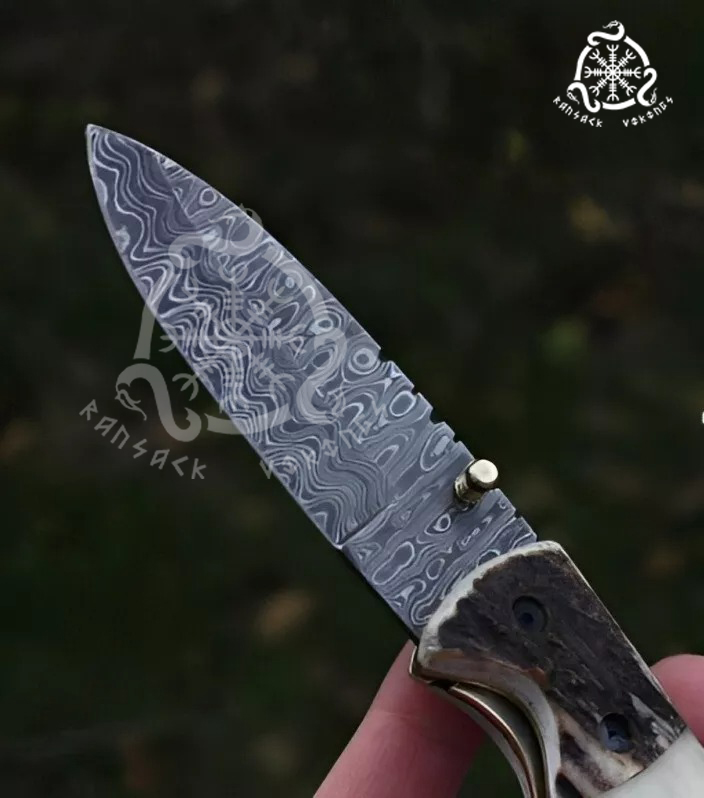
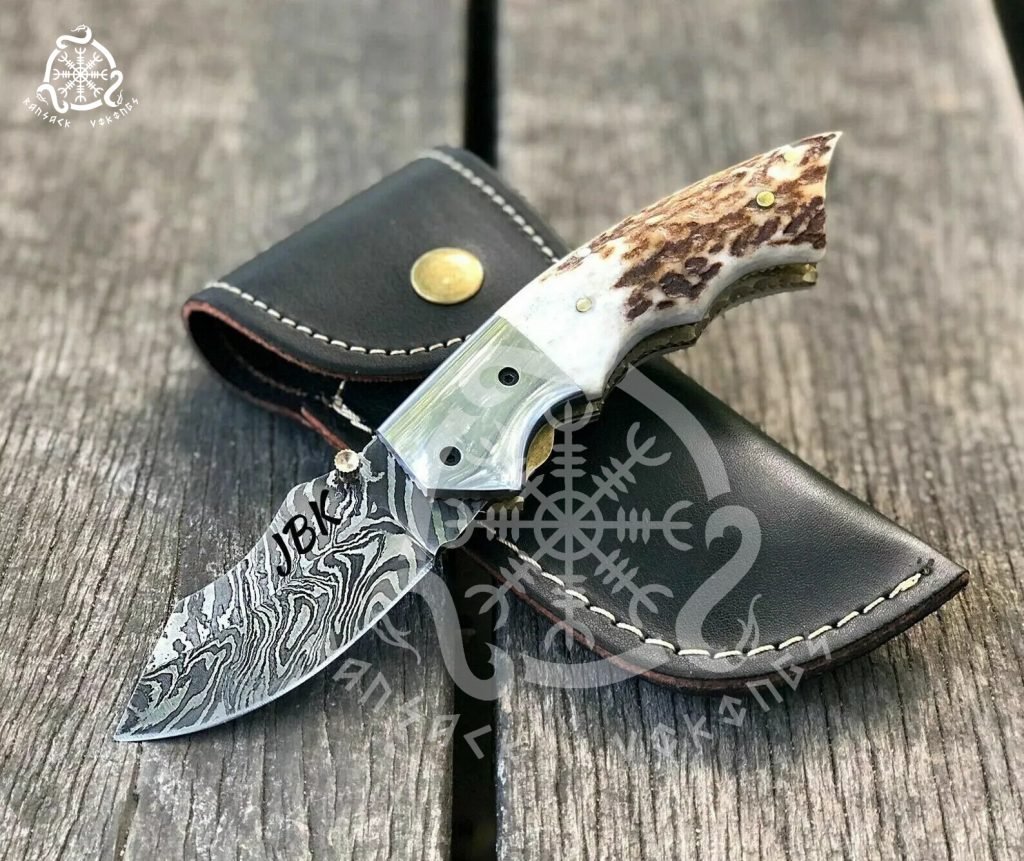
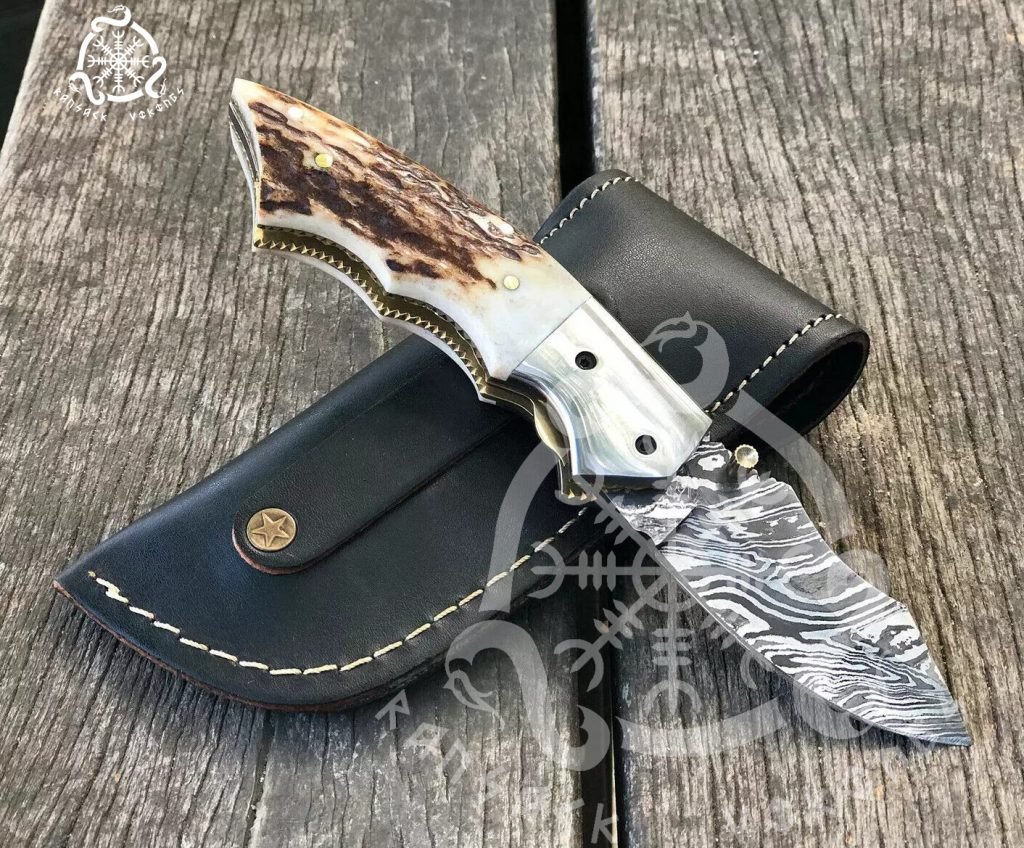
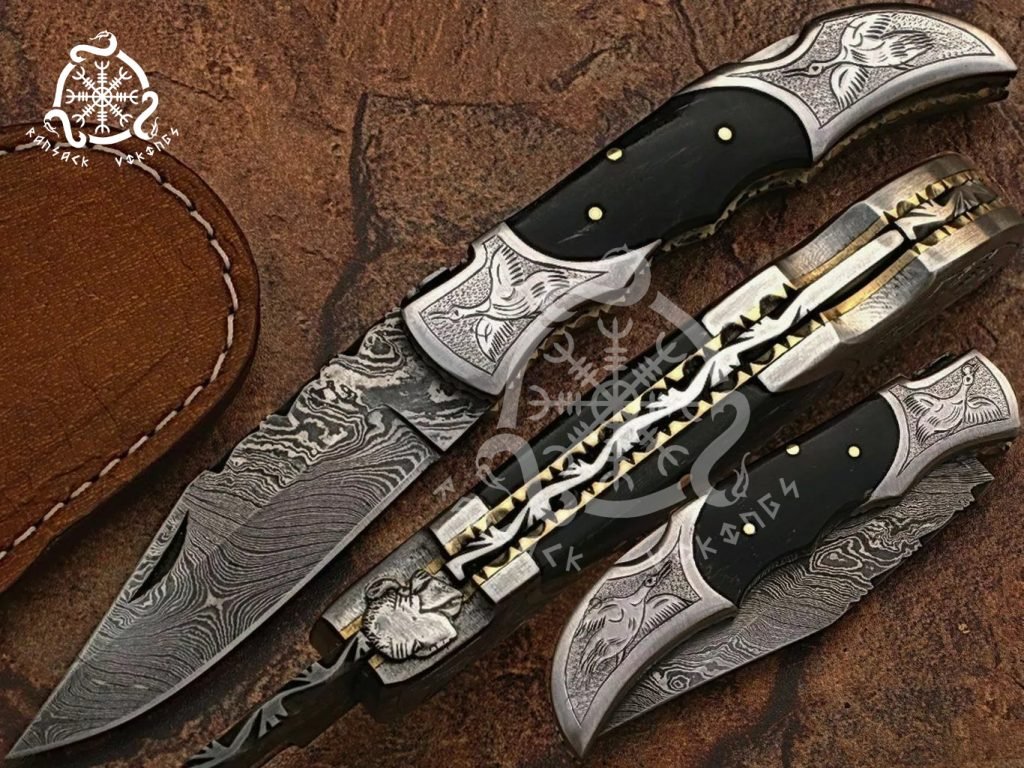
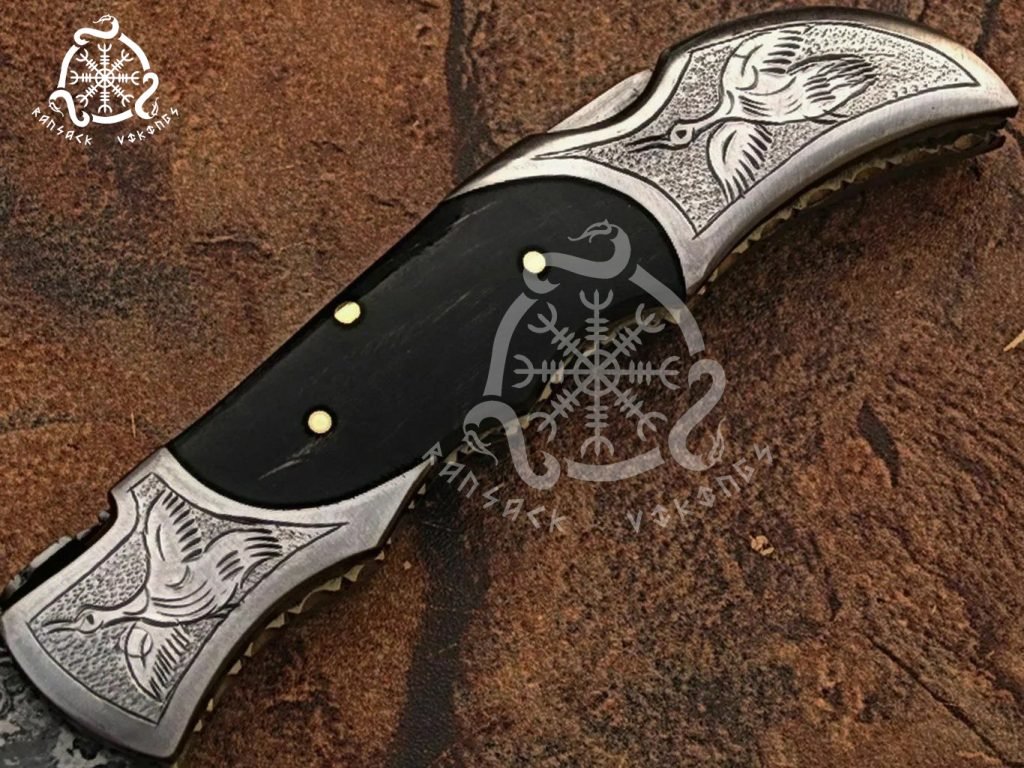
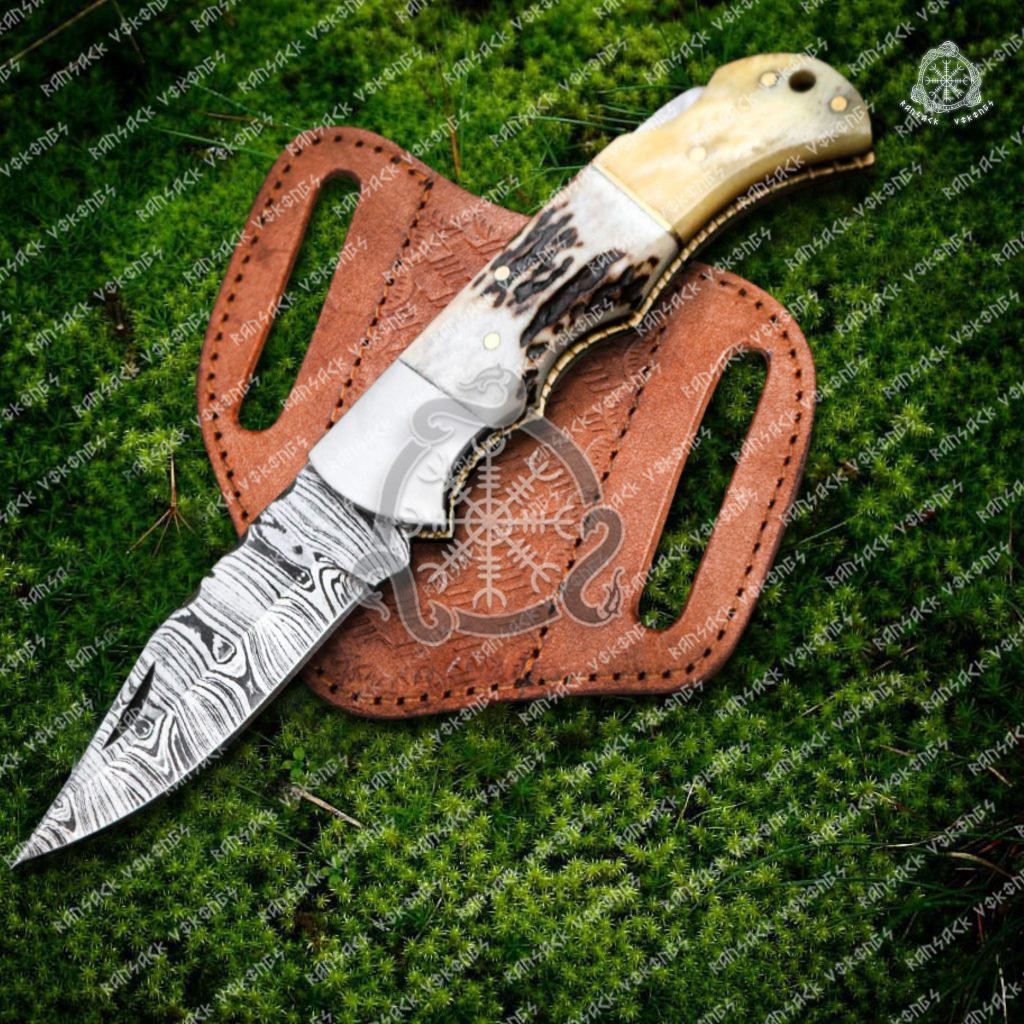
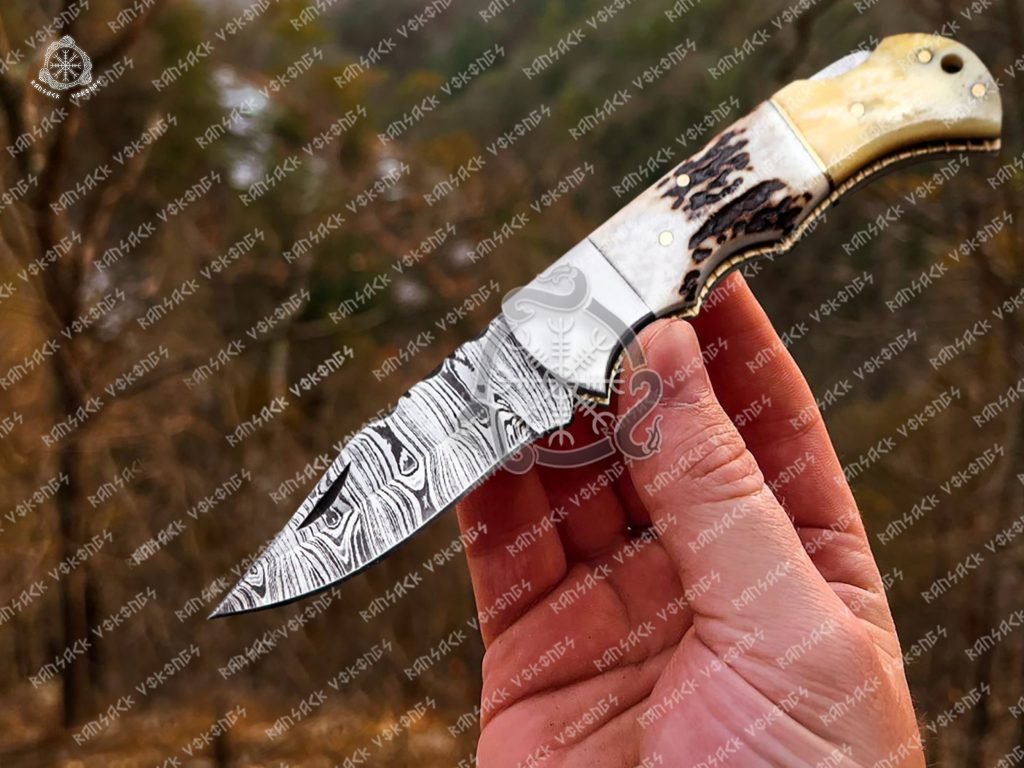
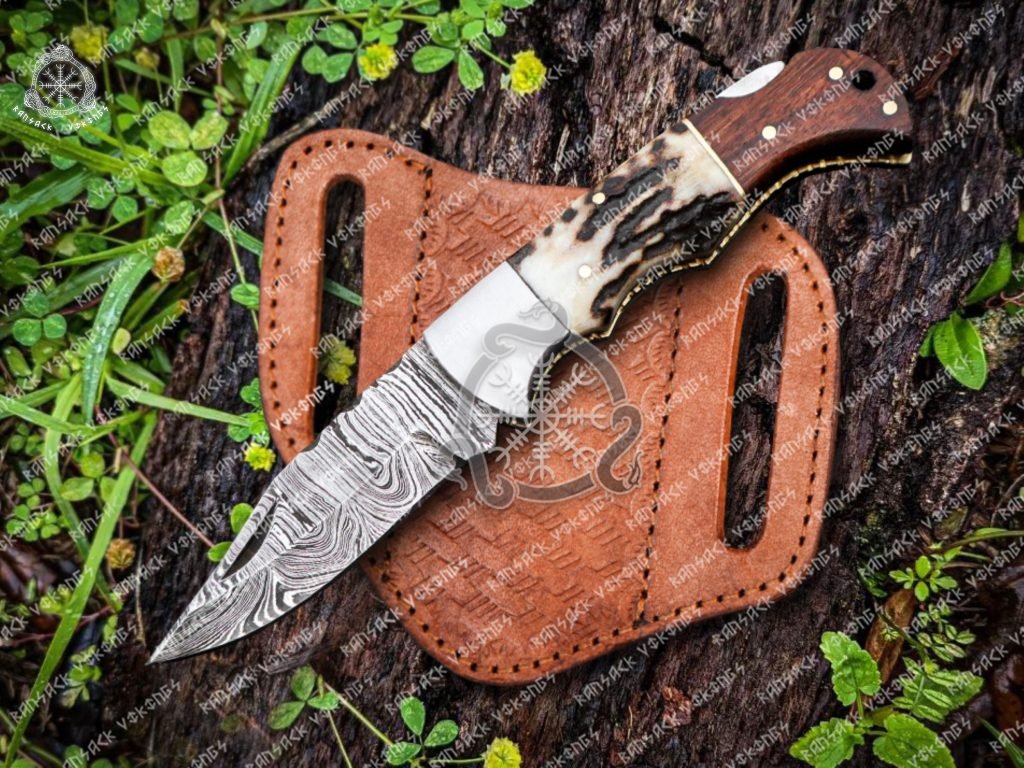
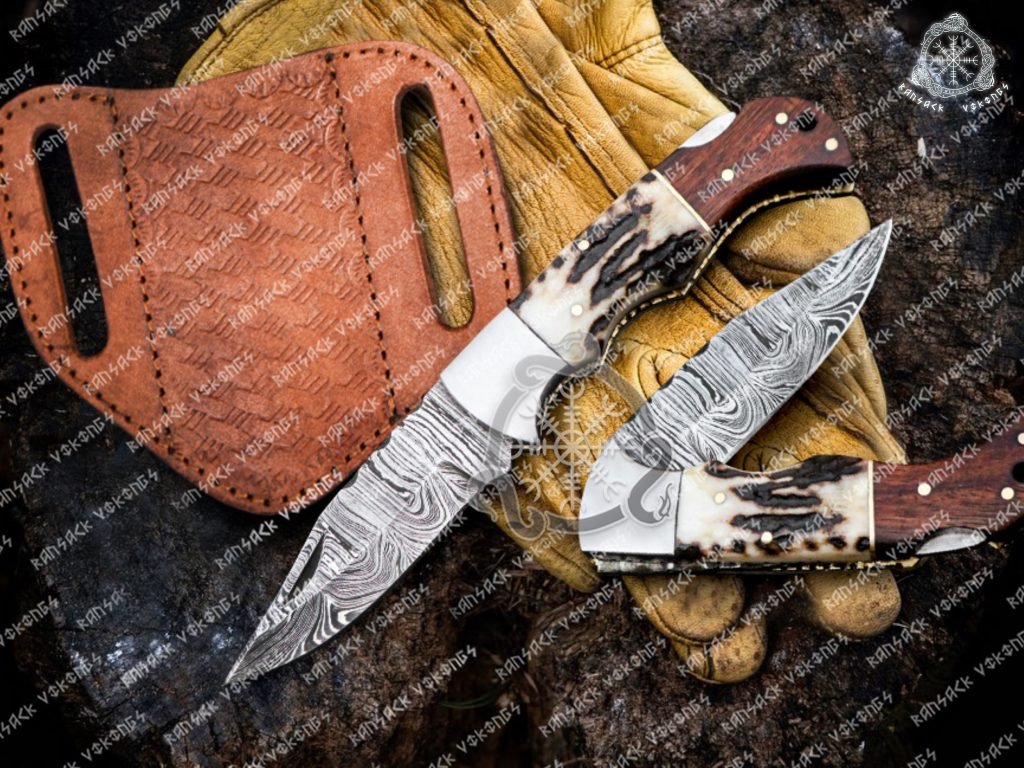
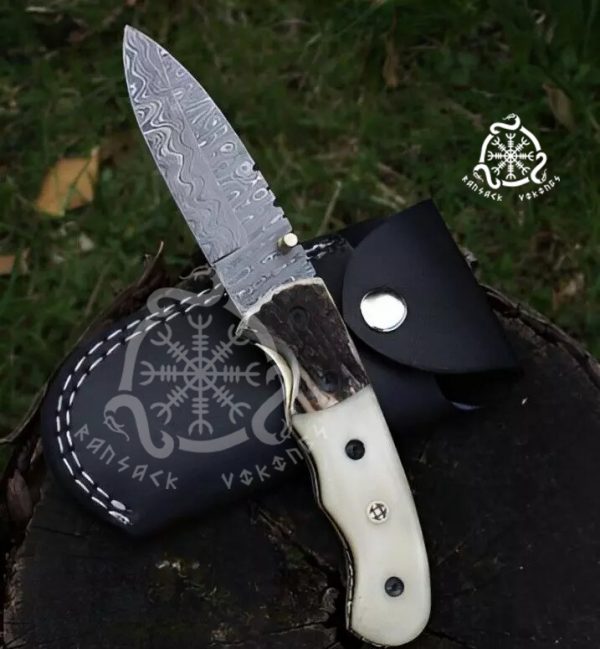
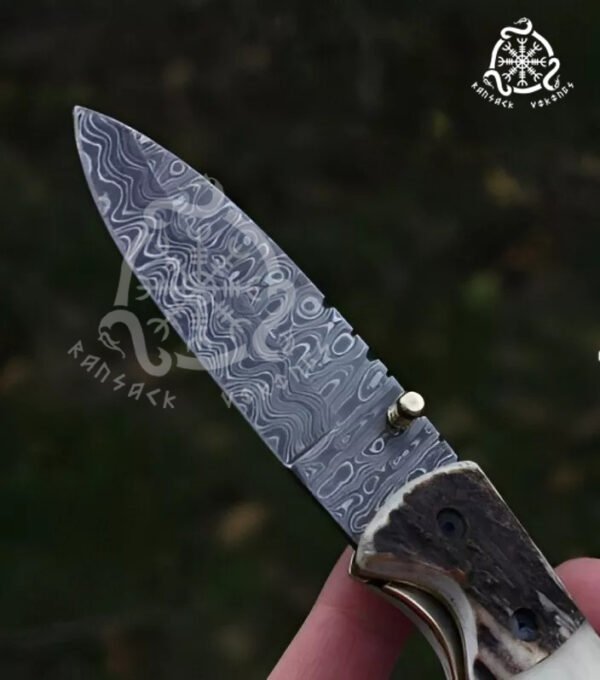
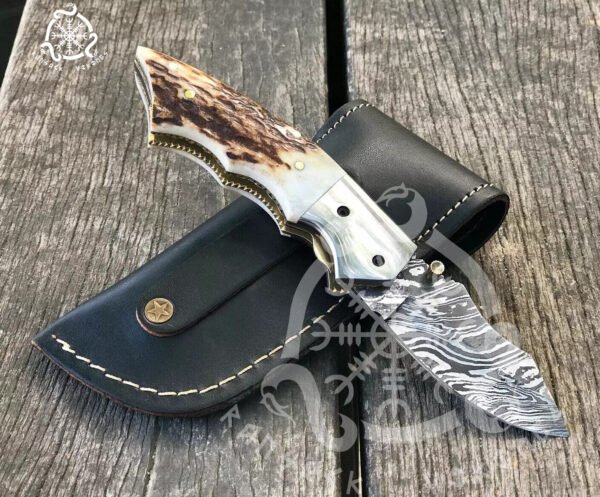
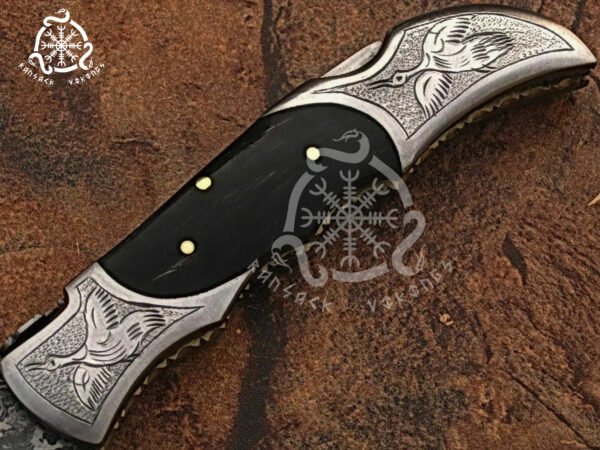
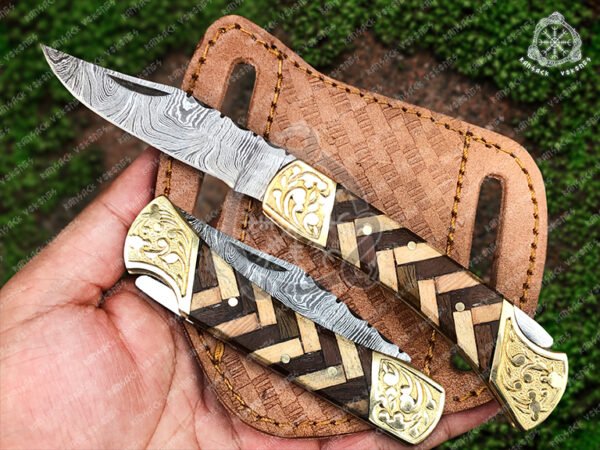
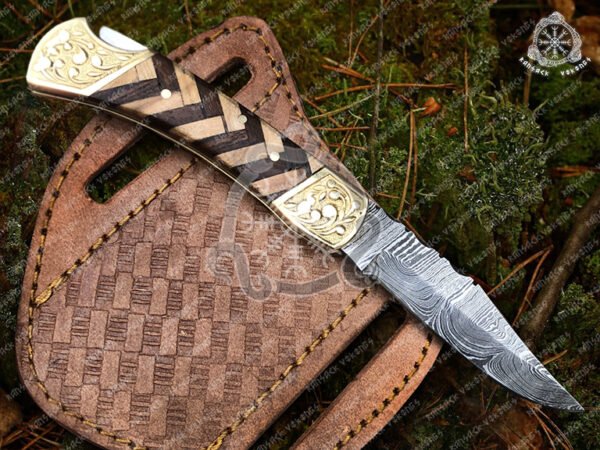
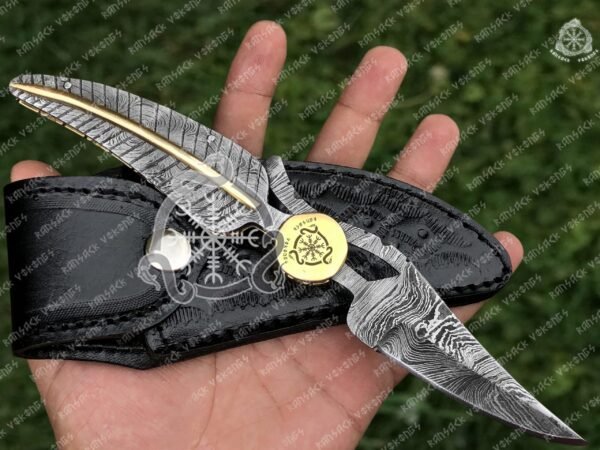
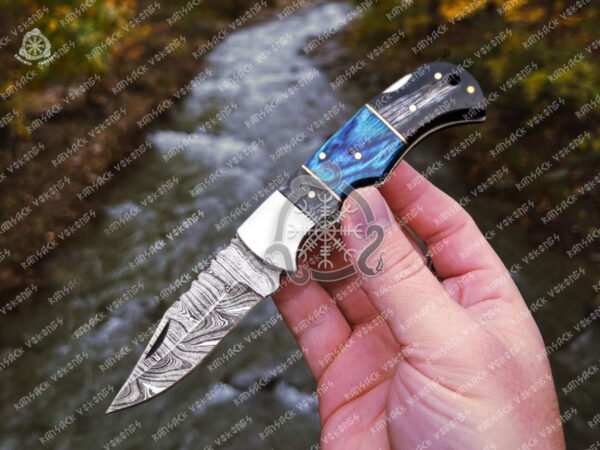
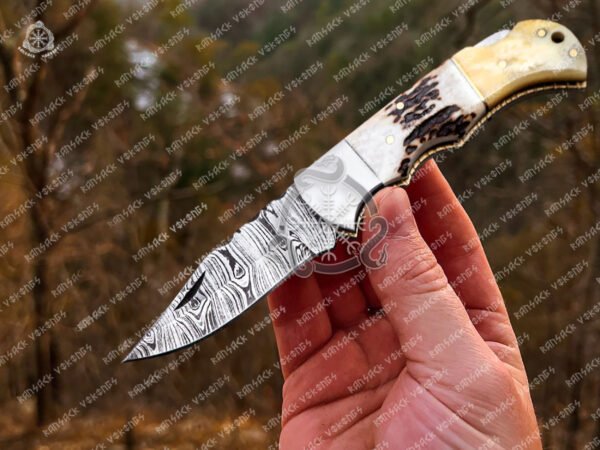
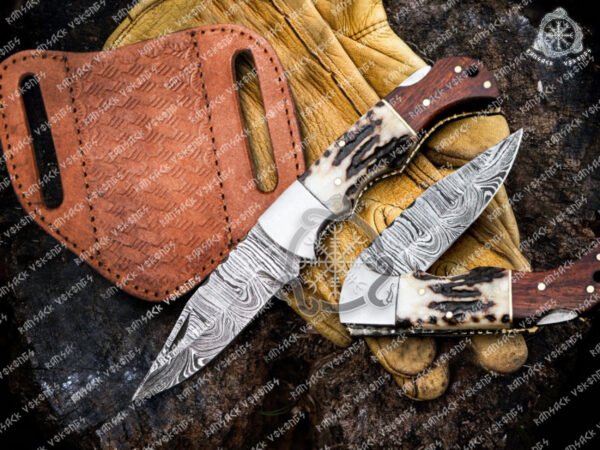
Nine inches open on a 4 inch blade, the Bullhorn is the largest folder in this part of the range and the handle is what people notice first. Camel bone and bull horn set together over the liners, with a hand forged Damascus blade left ready for engraving and brass file work along the spine. Six ounces in the pocket, and the fit is the kind you can feel before you look at it. What makes a folder worth carrying daily is set out in what makes a good daily folder.
The folding knife was one of the first objects to be built by a full division of labour, and Sheffield is where it happened. By the middle of the nineteenth century a single pocket knife passed through the hands of several specialists who each did one thing and nothing else: the forger drew out the blade, the grinder put the bevels on it sitting astride a wet stone, the hafter fitted the scales, and the cutler assembled and finished the whole thing. Most of them worked from their own small workshops rather than in a factory, paid by the dozen. A pocket knife looks like one object, but the traditional pattern is really an assembly designed to be made by four people, and that is why it comes apart into liners, springs, scales and pins in the way it does.
Forged and finished in the Czech Republic. It ships with a cowhide leather sheath, protective packaging and a working edge.
Specifications
| Steel | Hand forged Damascus, 1095 and 15N20 |
|---|
| Hardness | 58 to 60 HRC |
|---|
| Pattern | Fire pattern Damascus, ready for engraving |
|---|
| Overall length | 9 inches open |
|---|
| Blade length | 4 inches |
|---|
| Handle length | 5 inches |
|---|
| Weight | 6 oz |
|---|
| Handle | Camel bone and bull horn |
|---|
| Sheath | Cowhide leather sheath |
|---|
| SKU | RK-426 |
|---|
How a folder is built up in layers
A fixed blade is a piece of steel with something attached to the sides of it. A folder is a small mechanism, and understanding the stack explains why some of them last a lifetime and some develop a wobble in a year.
At the centre are the liners, two flat plates of metal that form the frame. Everything else is located from them. The backspring sits between the liners along the spine, held by its own pin, and it is the part that holds the blade open and closed. The blade runs on the pivot pin through both liners, and the amount of clearance there decides whether the blade sits centred or rubs. The scales, in this case camel bone and bull horn, are pinned to the outside of the liners; they carry no load, which is why an organic material can be used for them without weakening the knife.
That layered construction has one great virtue: it is repairable. Because everything is pinned rather than glued or welded, a pivot can be tightened, a scale can be replaced and a spring can be reset. It is also why the fit at assembly matters so much. A tenth of a millimetre of extra clearance at the pivot will not show on day one and will become a rattle by year three. On a 4 inch blade, which generates more leverage against the pivot than a small one, that tolerance matters more, and it is the main reason this knife is put together by hand and checked open, closed and half open before it leaves.
Why Damascus and not stainless
Real Damascus is a stack of steels, not a finish. Layers of 1095 and 15N20 are forge welded, folded, drawn out and finally etched, which is when the pattern appears. Because the layers run through the blade, sharpening reveals more pattern rather than removing it. Hardened to 58 to 60 HRC, this edge holds through far more work than the soft stainless in a factory folder.
Stainless asks less. It has enough chromium to survive being ignored, and if this knife were going to live in a damp toolbox untouched for a year that would be the sensible choice. What you give up is the edge and the depth of the pattern. Carbon steel will spot if left wet and will darken into a patina with use, which is protective rather than damaging. A wipe and a film of oil is the entire cost. We set both sides out in Damascus versus stainless.
Camel bone and bull horn in the hand
The handle pairs camel bone with bull horn, both cut, shaped and polished by hand. Camel bone is denser and less porous than cow bone, which is why cutlers across the Middle East and South Asia have favoured it for centuries: it polishes harder, stains less and holds its colour. Bull horn is keratin laid down in layers, so it is tough, waterproof and takes a deep dark polish, and it warms to hand temperature within a few seconds.
Neither is timber, so there is no grain to raise and nothing to swell in damp. What they do share with wood is the need to be kept from drying out. Keep the handle out of long soaks and away from radiators, heat sources and sunny windowsills, and give it a light coat of mineral oil or a soft wax once or twice a year so the horn does not check along its layers and the bone does not shrink away from the pins. Colour and figure vary from piece to piece because both materials came from animals. The routine is the same one we use on timber and it is in wooden handle care.
Engraving, runes and your own design
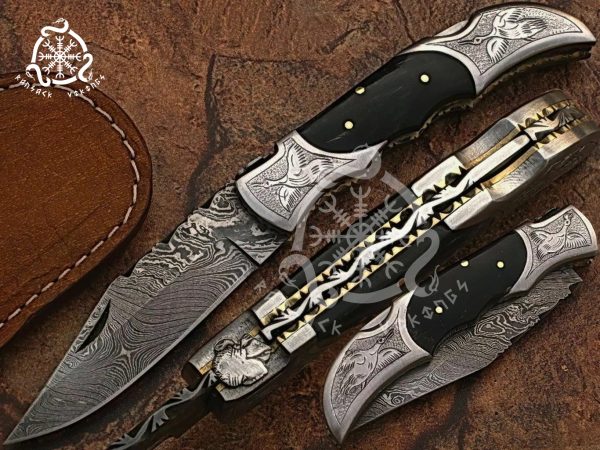
Use the rune converter on this page to turn a name, a date or a short phrase into Elder Futhark and we will cut it into the steel or the handle. If you would rather have a Viking pattern than a rune line, choose your own design in the engraving option above the add to cart button and tell us whether it goes on the blade or the handle. Where a piece already carries an engraved design, your chosen engraving replaces it rather than sitting alongside it. This blade is finished specifically with engraving in mind, and four inches of flat above the bevel will take a full name and a date or a rune line of a dozen characters at a readable size. See the engraving page.
Care and sharpening
Wipe it dry, oil it lightly, and store it out of the sheath for long periods so trapped moisture cannot work on the steel. Vegetable tanned leather holds moisture and tanning salts, which is fine for carrying and bad for storage. Put a drop of light oil into the pivot two or three times a year and work the blade open and shut to spread it and flush grit out of the joint.
Sharpening a 4 inch folder is straightforward stone work. A 1000 grit stone raises a burr, a 3000 refines it, and a strop finishes. Keep to the angle already on the blade rather than reprofiling, and take care near the ricasso where the edge runs up to the handle. Both jobs are covered in steel care and sharpening with a whetstone.
Made in the Czech Republic
Every piece we sell is made by hand in the Czech Republic. The smiths there work the way the trade has been worked for a long time, heating and hammering the steel, taking the bevels down by eye, and fitting the handle and the leather one at a time. There is no automated line anywhere in it, so small differences from one piece to the next are normal and expected.
Ransack Viking is a United States company based in North Babylon, New York. We bring the pieces in ourselves, inspect them on arrival and ship them from our own warehouse. If you add engraving, that is carried out here in the United States before your order goes out.
A note on handmade variation
The Bullhorn is hand forged. It is not machine made and it is not bulk produced, so what arrives will not be a pixel for pixel copy of the photograph on this page. There are two natural materials in the handle and both are highly variable: camel bone runs from near white to warm cream with its own streaking, and bull horn runs from grey through to near black, sometimes with pale banding through it.
The Damascus pattern comes out of the billet differently on every blade and the file work is cut by eye. The dimensions, the steel, the hardness and the build are the same every time. The character is not, because each one is worked by hand from natural materials.
Frequently asked questions
Is a 4 inch folder practical for daily carry
It depends on your pocket and your local law. Four inches gives real cutting capacity and a handle that fills an adult hand with gloves on, but you will notice it. Many owners carry it as a weekend and outdoors knife rather than an office one.
Will the bone and horn come loose over time
Only if they are allowed to dry out completely. Both are pinned to the liners rather than glued, and a light oil once or twice a year keeps them dimensionally stable. A loosening scale is a maintenance problem and it is repairable.
Can the pivot be tightened if it develops play
Yes. Pinned construction means the pivot can be adjusted rather than the knife being written off. Get in touch rather than trying to peen a pivot at home, since it is easy to overtighten and bind the blade.
What does ready for engraving mean on the blade
The blade flat is finished and left clear rather than being decorated, so there is a clean surface for lettering or a design. Order it plain and it stays that way.
Is bull horn the same as buffalo horn
Both are keratin and both behave similarly, but they differ in colour and figure. Bull horn tends to run darker and more uniform; buffalo horn often shows more banding. Care for both is identical.
Does it come sharp
Yes. It is finished on stones by hand before packing and it will cut paper straight out of the box. It is a working edge rather than a mirror polish, which is what a carry knife should have.
What is in the box
- One Bullhorn Damascus folding pocket knife
- Cowhide leather sheath
- Protective packaging
- Care notes for carbon steel, camel bone and bull horn
- Forged and finished in the Czech Republic
Explore the range
See the rest of the folding pocket knives, or look at the hunting knives and the Bowie knives if you want a fixed blade at this size. Steel, leather and handle care are covered in the guides.
Others in the same line
Next along the rack is the Bonecarry folding pocket knife, pattern welded Damascus. For a straight comparison, see the Bluegrain folding pocket knife, pattern welded Damascus. Worth putting side by side with this is the Pakkacarry folding pocket knife, pattern welded Damascus.
If you are putting a set together, the Woodgrain Damascus skinner knife sits alongside it. You can have this made your way instead on the custom Damascus knife page.









Bought this on a whim and it turned out to be one of my favorite purchases this year.
Incredible craftsmanship on this one. Even the small engravings are crisp and clean. Can’t recommend this enough.
So happy I finally pulled the trigger on this one. The bone handle feels amazing and the balance is perfect. Love it.
This knife beat every expectation I had. Made overseas in the Czech Republic yet shipped from a US location so no long customs wait. Damascus blade holds a razor edge right out of the box. Weight and balance make it feel like a real functional piece not some cheap replica. This will be a family heirloom for sure.
Absolutely blown away by this knife. The bone handle feels amazing and the balance is perfect. Fit and finish is museum quality. You can tell real craftsmen made this by hand. Leather sheath is thick and well stitched. Not the cheap stuff you usually get. Shipping was fast and everything arrived well packaged.