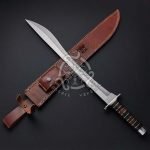
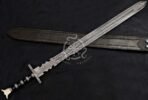
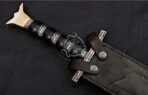
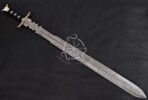
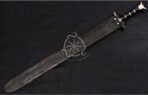
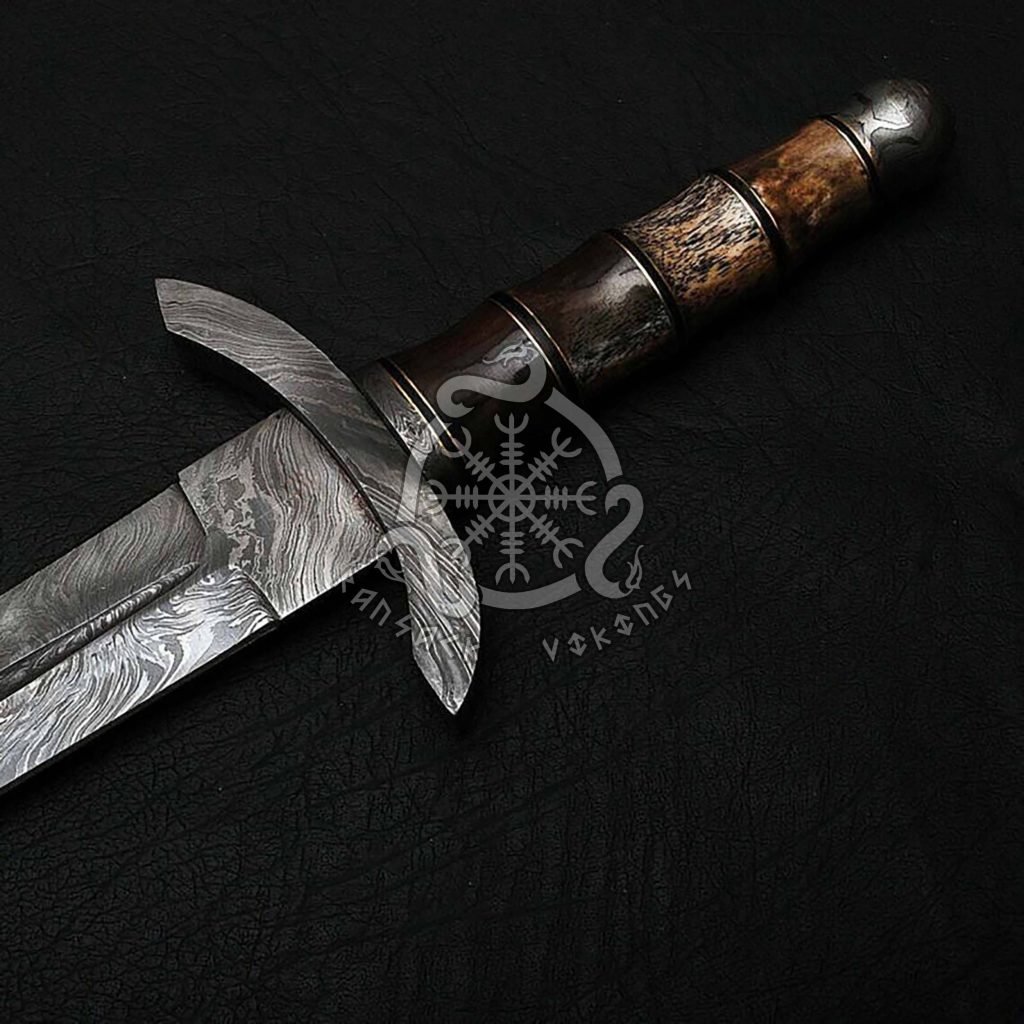
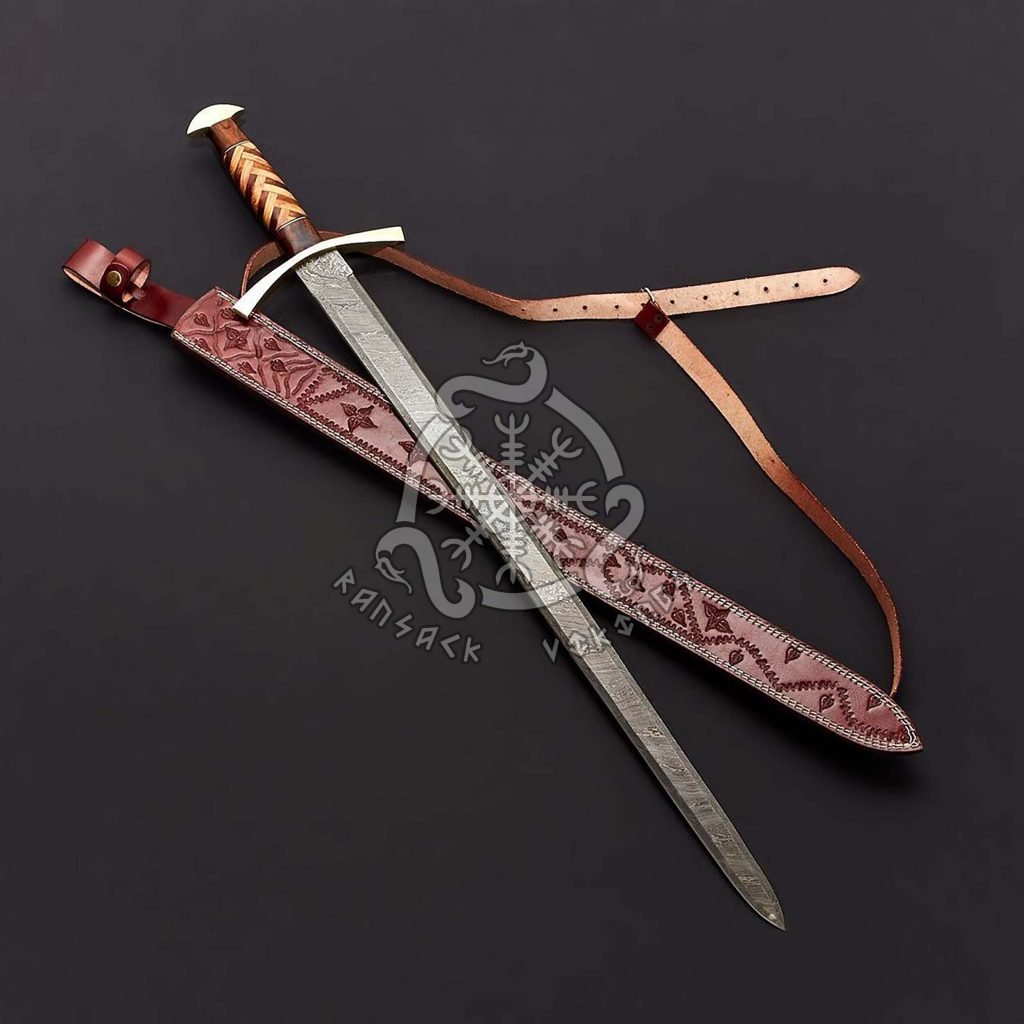
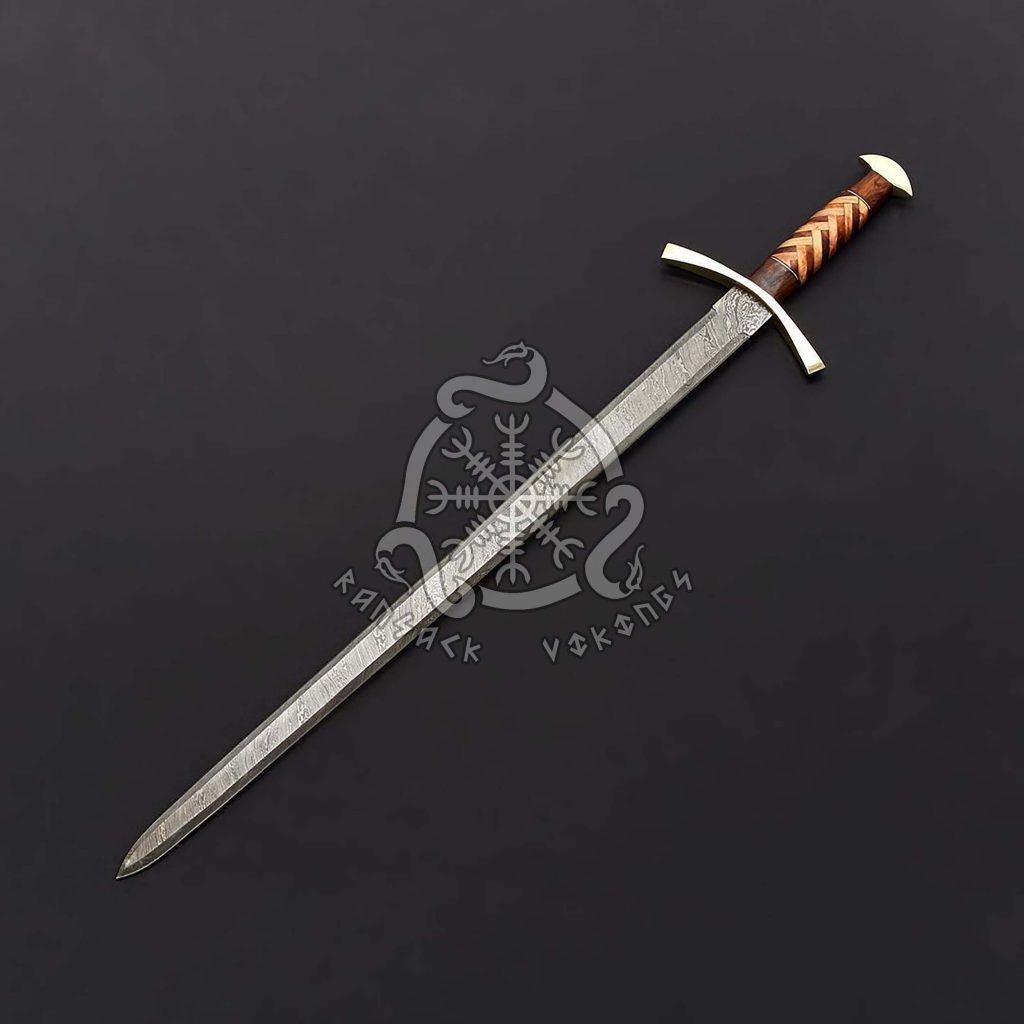
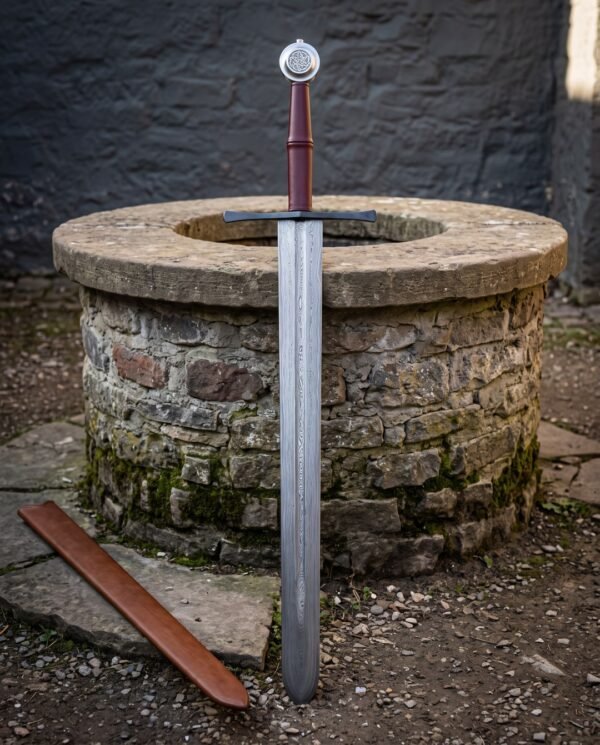
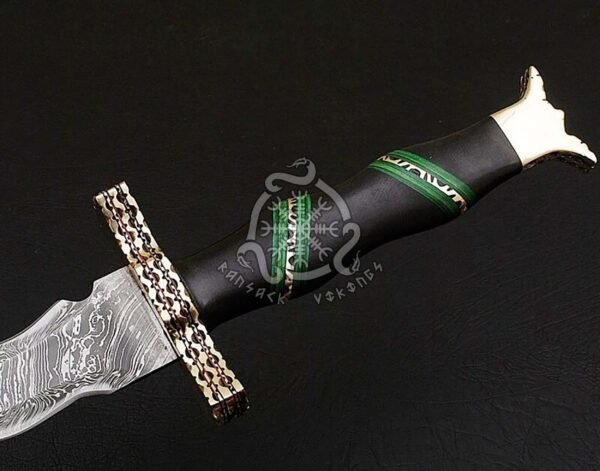
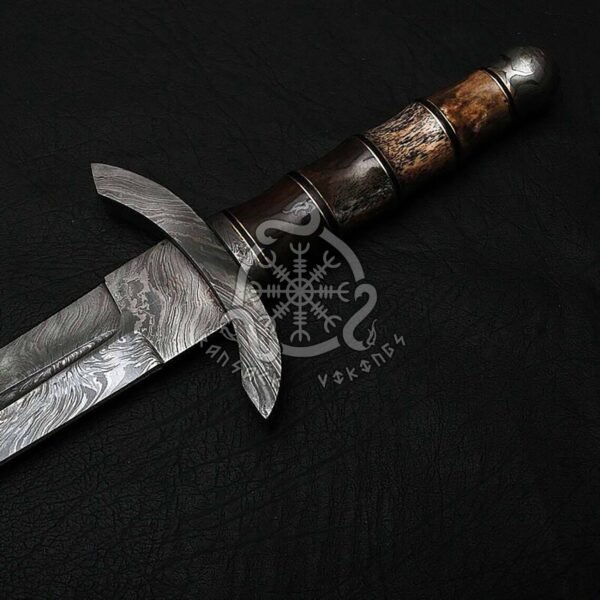
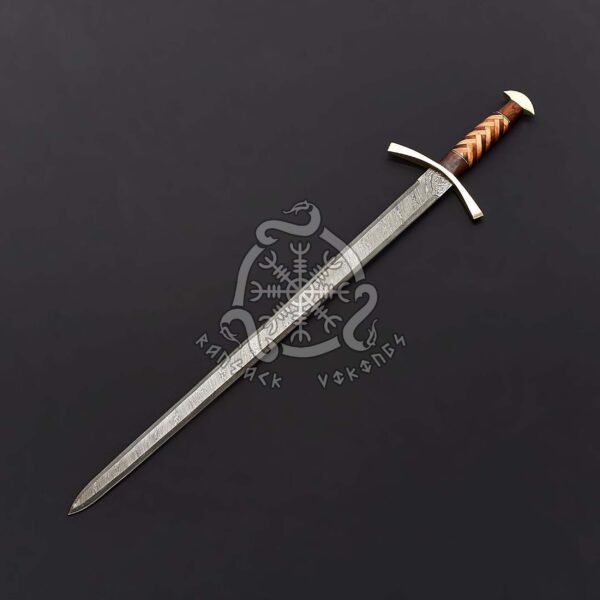
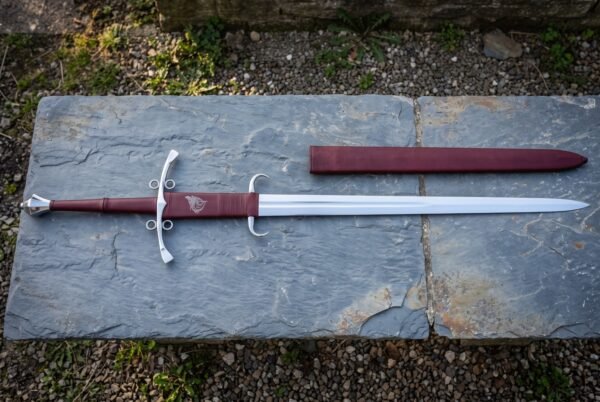
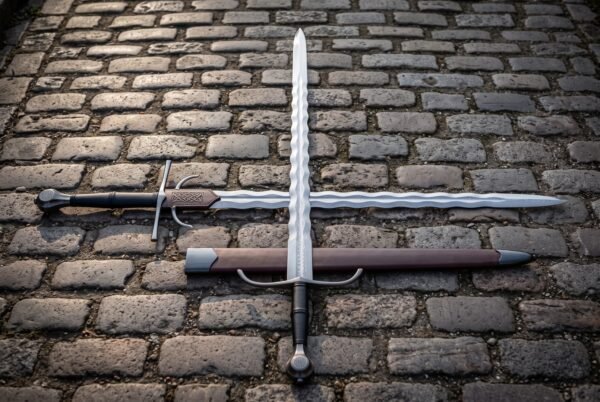
The Woodspine is a hand forged Damascus dagger sword with a wood grip, a 23 inch double edged blade and a 30 inch overall length. It is built for collectors, display and reenactment, and it is balanced so it does not feel dead in the hand. At 35oz it carries enough mass to feel like a real sword rather than a wall hanger, and the 7 inch handle gives room for a full hand plus a thumb on the ricasso. Rondel, bollock, dirk and stiletto are all different animals, sorted in the types of dagger.
A blade of this length sits in an old and slightly awkward category. Historically a fighting dagger with a blade past about 20 inches stopped being a dagger and became what English sources called an anelace or a baselard, and what Italian smiths of the fifteenth century turned into the cinquedea. These were civilian pieces, worn in town rather than carried on campaign, and they were made deliberately wide and deliberately showy because the person paying for one wanted it seen. That is exactly the tradition this piece belongs to. The Woodspine is a display and collector blade with a genuine double edge and genuine forge welded steel, not a costume prop.
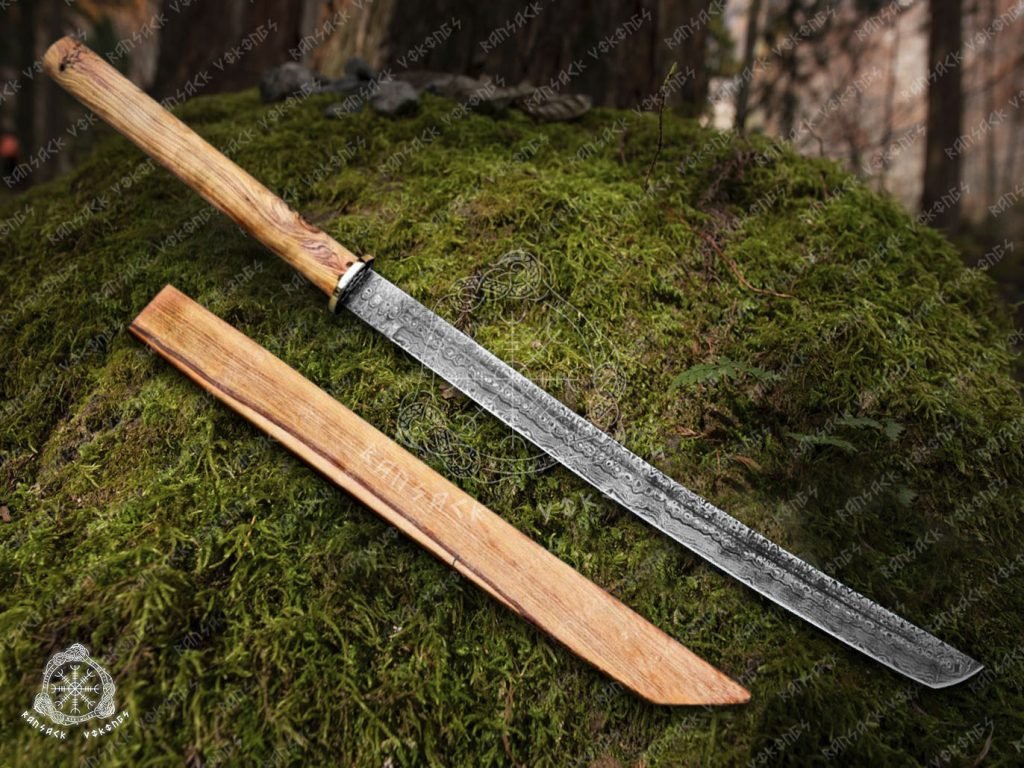
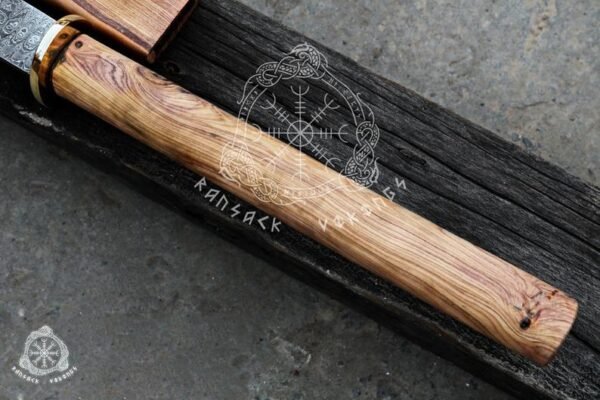
Every Woodspine is forged and finished in the Czech Republic. It ships with the olive burl wooden scabbard shown, packed to survive the courier, with free shipping inside the United States.
Specifications
| Steel | Hand forged Damascus, 1095 and 15N20 |
|---|
| Hardness | 58 to 60 HRC |
|---|
| Damascus layers | 352 layers |
|---|
| Overall length | 30 inches |
|---|
| Blade length | 23 inches |
|---|
| Handle length | 7 inches |
|---|
| Weight | 35oz |
|---|
| Handle | Wood |
|---|
| Sheath | Olive burl wooden scabbard |
|---|
| SKU | RK-520 |
|---|
What makes a dagger sword harder to forge than a single edged blade
A single edged sword forgives a lot. The spine hides errors, the grind only has to be right on one side, and a wandering centreline can be corrected late in the process. A double edged blade forgives nothing. The two bevels have to meet on a line that runs dead through the middle of the blade for the full 23 inches, and if the smith takes a few thousandths too much off one side near the tip, the whole blade has to be reground or scrapped. That symmetry is the reason double edged work is used as a test of a shop, and it is the reason a dagger sword costs what it does.
The second thing that separates a real piece from a decorative one is distal taper. The blade is thicker at the guard than it is at the point, which moves the balance back toward the hand. Without taper you get a blade that is heavy at the far end and tiring within a minute of picking it up. With taper you get something that pivots on the wrist. On this piece the balance sits a short way in front of the guard, which is where a thrusting blade of this size should sit.
Why Damascus and not stainless
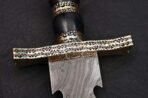
Damascus here means 1095 high carbon and 15N20 nickel bearing steel, forge welded into a single billet, folded, drawn out and finally etched so the two steels show as light and dark bands. The result runs 58 to 60 HRC, which is harder than the stainless used in mass produced display swords, so the edge holds and the blade rings rather than thuds. The trade is corrosion resistance. Stainless survives neglect, and this does not. Wipe it and oil it and the pattern stays crisp for decades. Leave it wet on a bench and it will spot inside a week. Our page on Damascus versus stainless sets the trade out plainly, and 1095 and 15N20 explains why those two steels are the pairing that works.
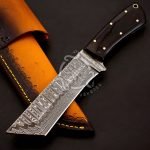
What you cannot get from stainless at any price is the pattern running through the steel rather than sitting on the surface. Printed and laser etched blades photograph well and fail a file test at the spine. This one is welded, and the pattern follows the grind because the layers are physically inside the blade.
The wooden handle and the olive burl scabbard
The handle is wood, shaped and sanded by hand to fill the palm rather than to look tidy in a photograph. Wood on a blade this size does something synthetics do not: it dampens vibration. A steel or resin grip transmits every knock straight into the wrist, while timber absorbs it. The trade is that wood moves with heat and humidity, so a light coat of oil once or twice a year keeps the fit tight and stops the grain drying out and shrinking away from the tang. The method is short and we set it out in wooden handle care.
The scabbard is olive burl. Burl is the growth where a tree has responded to injury or infection by throwing out dense knotted grain, which is why it figures the way it does and why no two are alike. It is also harder and less prone to splitting than straight grained timber, which matters on a scabbard that has to hold a 23 inch blade without flexing. Treat it the same as the handle: oil, no soaking, no sustained direct sun.
Engraving, runes and your own design
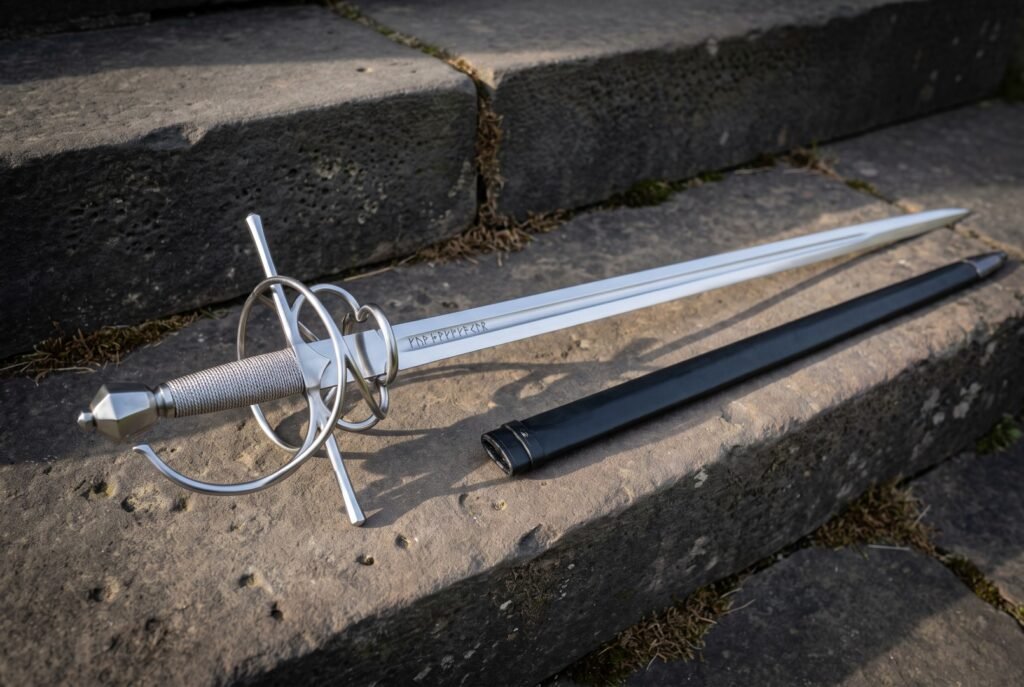
Use the rune converter on this page to turn a name, a date or a short phrase into Elder Futhark and we will cut it into the steel or the handle. If you would rather have a Viking pattern than a rune line, choose your own design in the engraving option above the add to cart button and tell us whether it goes on the blade or the handle. Where a piece already carries an engraved design, your chosen engraving replaces it rather than sitting alongside it. A blade of this length gives an engraver more room than almost anything else in the range, so a full name and date along the flat sits comfortably. Details of what we can and cannot cut are on the engraving page.
Care and sharpening
Treat it as high carbon steel, because underneath the pattern that is what it is. Dry it after handling, because skin oil is acidic and fingerprints etch into a polished Damascus flat within days. Wipe it with mineral oil or camellia oil before it goes back on the stand. Store it out of the scabbard for long periods, since any enclosed space traps moisture against the steel.
Sharpening a double edged blade of this length is ordinary stone work done twice. Set the angle on one side, work the full length in sections, then repeat on the other side and match the bevels. Do not attempt to do it on a powered wheel, which will overheat the thin edge and pull the temper out of it. Our guides on steel care and sharpening with a whetstone cover both jobs step by step.
Made in the Czech Republic
This is a handmade piece from the Czech Republic, made in a workshop that still forges, grinds and finishes by hand instead of stamping parts out. The smiths there have kept the older way of working, and the wood, horn and leather are shaped and fitted by hand as well. Two pieces of the same design will never be identical, and that is part of what you are buying.
Ransack Viking is a United States company. We handle the import ourselves, look over every piece when it lands and ship from our warehouse in North Babylon, New York. Engraving is done in the United States after the piece arrives, so your design goes on before we send it out.
A note on handmade variation
This is hand forged. It is not machine made and it is not bulk produced, so what arrives will not be a pixel for pixel copy of the photograph. The Damascus pattern comes out of the billet differently on every blade, the wood grain and tone in the handle and the burl scabbard are set by the tree they came from, and the exact profile shifts by fractions because a person ground it. The dimensions, the steel and the build are the same every time. The character is not, and that is the point of buying from a forge instead of a factory.
Frequently asked questions
Is this a functional sword or a display piece
It is a real forged blade with a real edge and real distal taper, and it is sold as a collector, display and reenactment piece. We do not sell it as a test cutting sword and we do not recommend using it against hard targets.
Where does it balance
A short way in front of the guard. At 35oz with the mass distributed back toward the hand, it feels lighter in use than the weight on paper suggests.
Can the olive burl scabbard be engraved as well as the blade
Yes. Burl takes a cut cleanly. Tell us in the engraving option whether you want the work on the blade, the handle or the scabbard.
Will the Damascus pattern match the photograph
No, and no two do. The photograph shows the pattern type and the finish, not the exact figure you will receive.
How is this different from a Viking sword
A Viking sword is longer, wider and built around a fuller for weight saving, with a lenticular cross section for cutting. This is shorter, thicker in section and biased toward the thrust, which is what the dagger heritage gives it.
How long before it ships
Processing is one to two weeks, plus transit. Engraving does not usually add to that, but tell us if you have a date to hit and we will confirm before you order.
What is in the box
- One Woodspine Damascus dagger sword
- Olive burl wooden scabbard
- Protective packaging
- Forged and finished in the Czech Republic
Explore the range
Compare it against the rest of Swords, the pattern welded blades in Damascus Swords, the Norse profiles in Viking Swords and the shorter pieces in Dagger Knives. The reasoning behind the steel, the leather and the timber is written up in the guides.
Worth a look beside this
Next along the rack is the Leatherspine sword, 30 inches overall. For a straight comparison, see the Brassguard sword, 30 inches overall. Worth putting side by side with this is the Drakefang sword, 32 inches overall.
If you are putting a set together, the Broadkeel zweihander sits alongside it. Or start from a blank sheet on the custom Viking sword page.









Reviews
There are no reviews yet