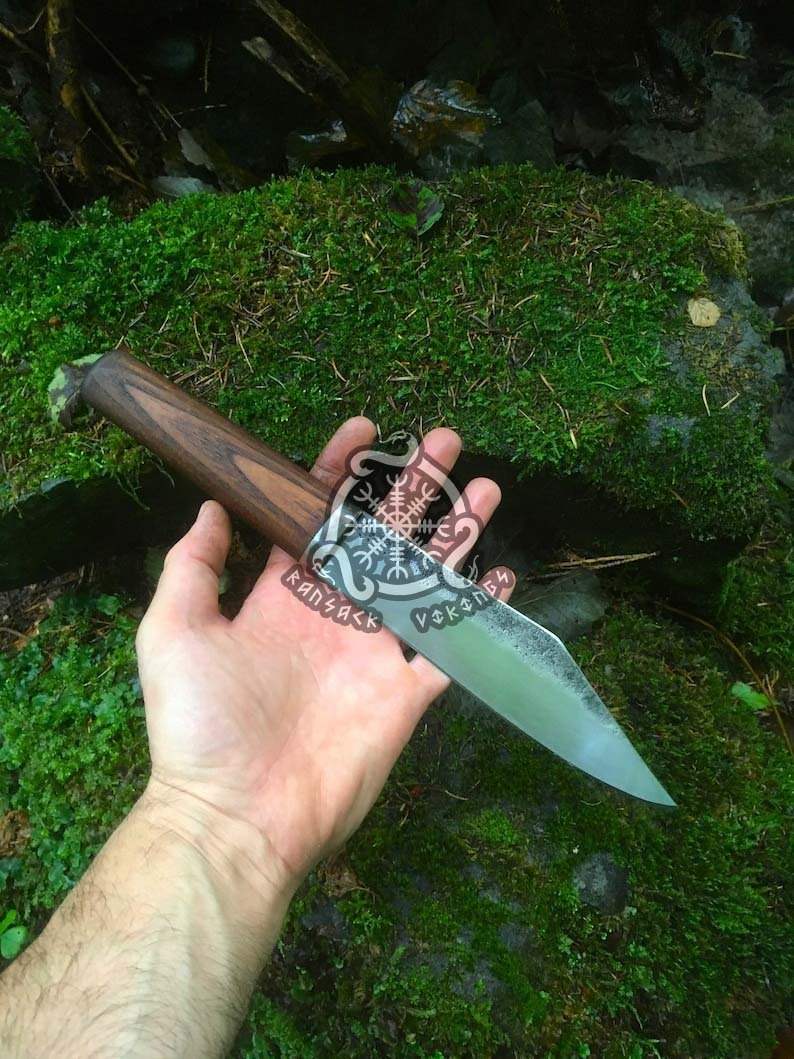
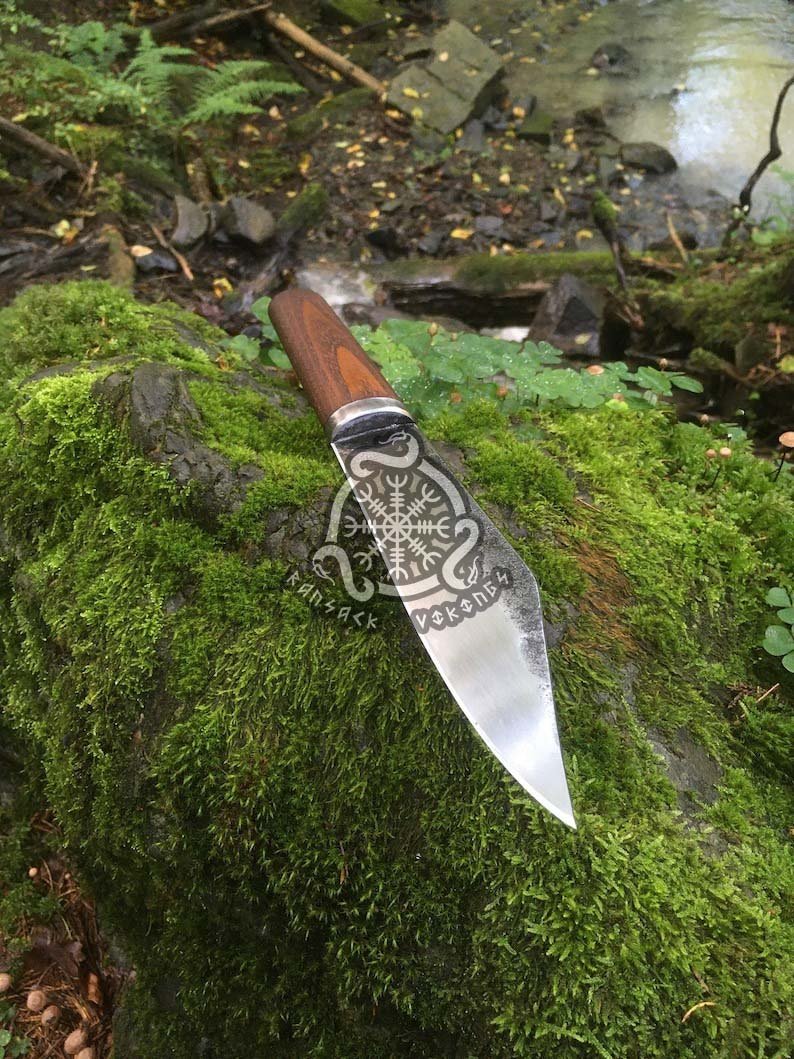
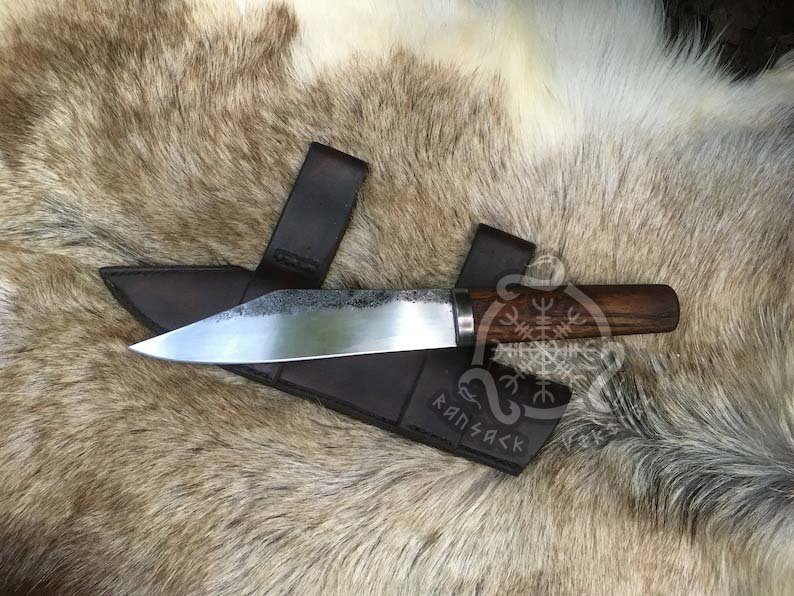
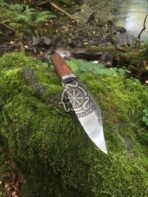
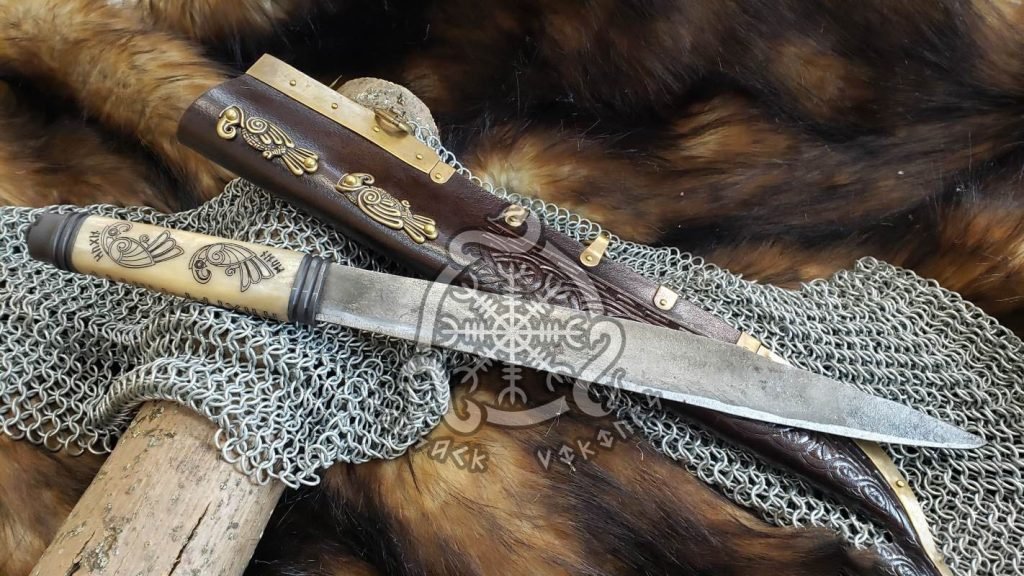
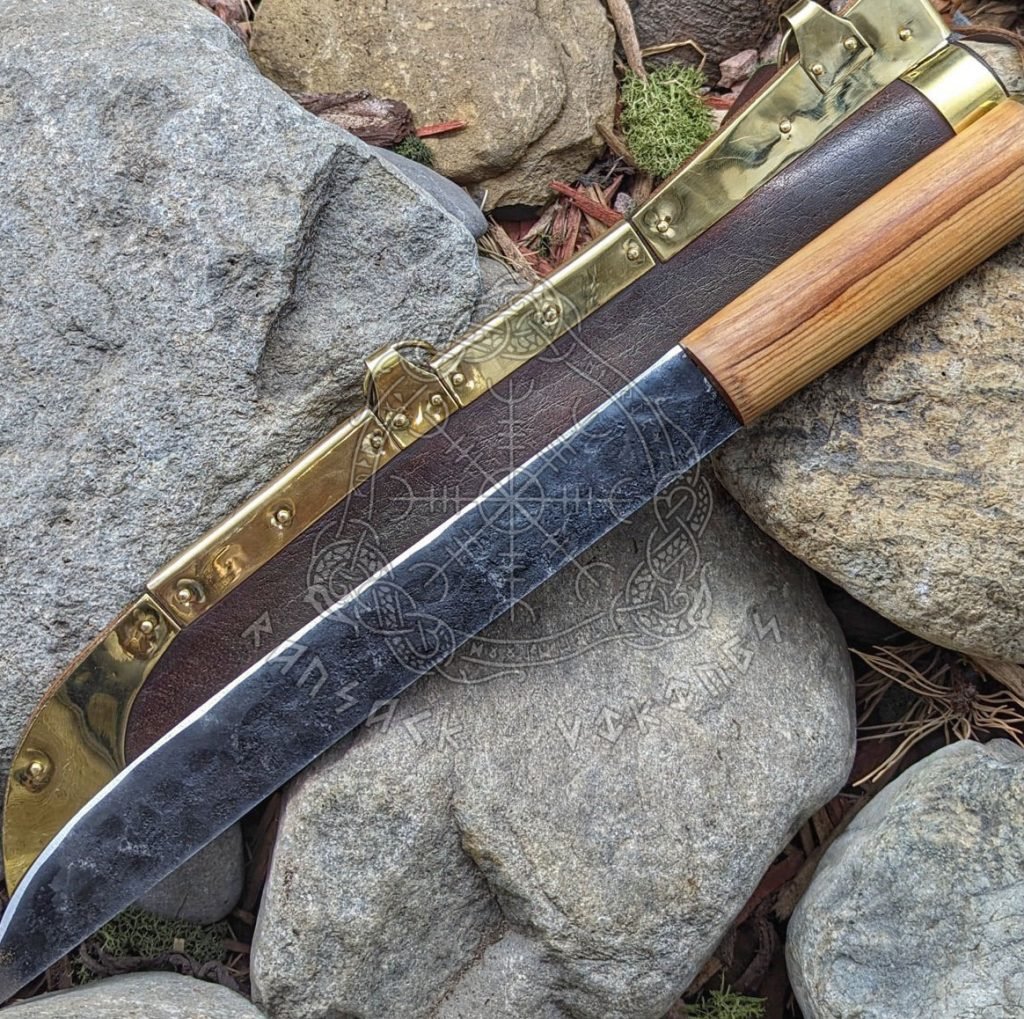
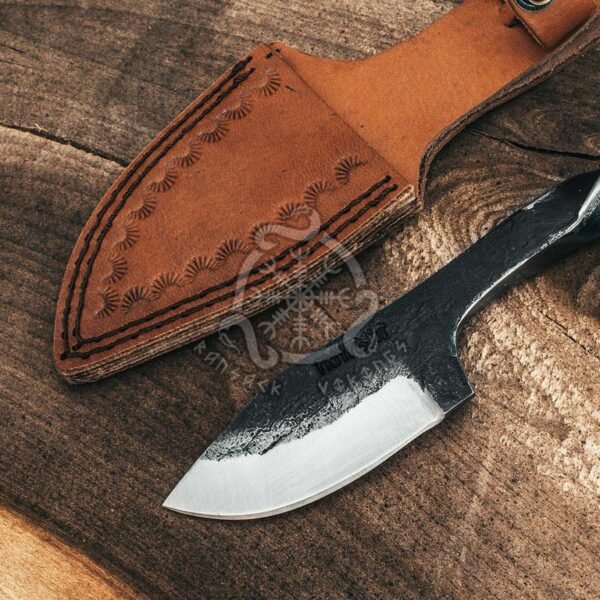
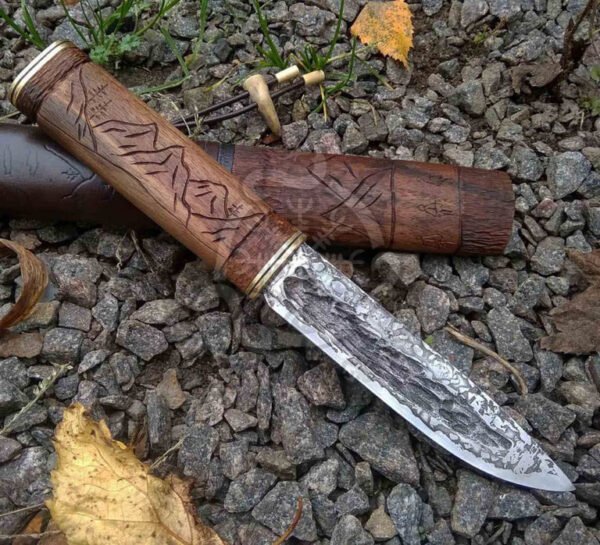
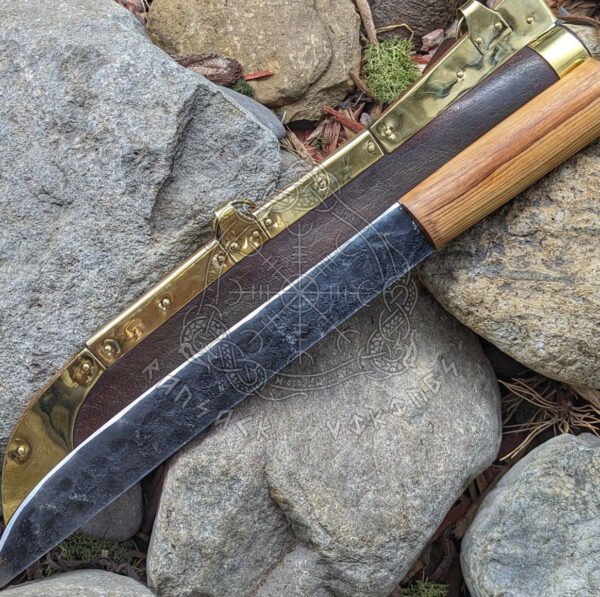
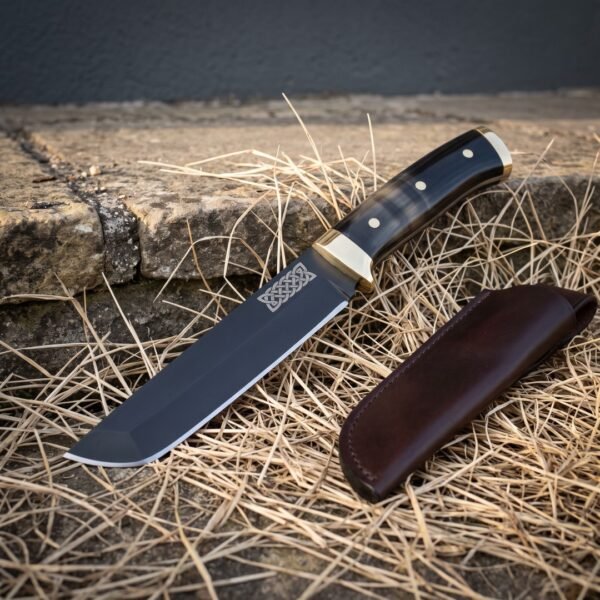
The Anglosaxon is a hand forged Norse Viking seax knife with a broad single edged blade 5 mm thick at the spine. It measures 11.8 inches overall, which is 30 centimetres, with a 6.9 inch blade, which is 17.5 centimetres. Those proportions put it squarely in the handseax range, the everyday size that turns up more often than any other in the graves and settlement layers of early medieval England and Scandinavia. The seax was the knife every Norseman carried, and the seax and its history explains why.
Archaeologists sort seaxes by blade length and profile, and the categories are worth knowing before you choose one. A narrow seax is small, slim and essentially a utility knife. A broad seax, the breitsax, is what you are looking at here, a wider heavier blade in the six to nine inch range that does everything from carving meat to holding its own in a fight. A long seax runs past a foot of blade and starts behaving like a short sword. The Continental term for the family is scramasax, and it comes from Gregory of Tours, who writing in the sixth century describes assassins carrying what he calls cultri validi quos vulgo scramasaxos vocant, strong knives which people commonly call scramasaxes. That is a Frankish bishop recording a slang word for a knife in the year 590, and it is the reason the term exists at all.
Every Anglosaxon is forged from bar, heat treated, ground, fitted and finished in the Czech Republic. Shipping inside the United States is free, processing takes one to two weeks, and returns are accepted within seven days.
Specifications
| Steel | Hand forged 1095 high carbon steel |
|---|
| Hardness | 54 to 58 HRC |
|---|
| Overall length | 11.8 inches, 30 cm |
|---|
| Blade length | 6.9 inches, 17.5 cm |
|---|
| Blade thickness | 5 mm, 0.2 inches |
|---|
| Handle | Shaped and fitted by hand |
|---|
| Intended use | Display and general outdoor use |
|---|
| SKU | RK-652 |
|---|
What five millimetres of spine actually buys you
Five millimetres is thick. A typical kitchen knife is under two, a good bushcraft knife is often three to four, and most decorative reproduction blades are thinner still because thin stock is cheaper and easier to grind. On a blade only 6.9 inches long, 5 mm of spine changes how the knife behaves in three concrete ways.
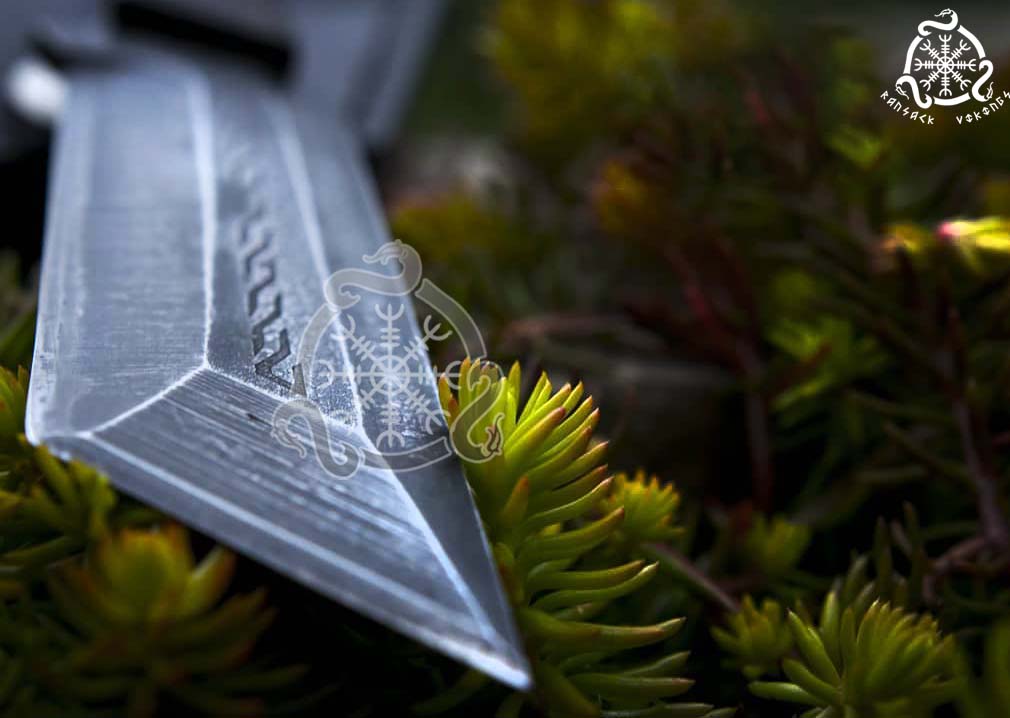
It makes the knife stiff. There is no flex at all in a blade this short at this thickness, which means the tip goes exactly where you push it and does not wander when you are drilling, prying gently or working through something dense. It puts weight forward, so the blade carries momentum through a cut rather than needing to be forced. And it gives the grind somewhere to go. A thick spine ground down to a fine edge produces a long shallow bevel, and a long shallow bevel is what separates cleanly rather than wedging.
It also creates a comfortable thumb platform. The seax is a single edged design, which means the entire spine is unsharpened and available as a place to put your thumb or the heel of your other hand. On a 2 mm blade that hurts within a minute. On a 5 mm blade you can lean on it properly and drive a cut through green wood, hide or a joint. That combination, one edge and a thick usable back, is the reason the seax stayed in service across northern Europe for six hundred years while sword designs came and went.
Why high carbon steel and not stainless
The blade is 1095, a straightforward high carbon steel with about one percent carbon and very little else, heat treated to 54 to 58 HRC. It is chosen for the same reasons a smith in the ninth century would have recognised. It hardens deep and predictably. It takes a very fine edge quickly on an ordinary stone. And it is easy to bring back with nothing more sophisticated than a rock and some patience, which matters more on a knife you intend to use outdoors than any laboratory figure.
Stainless resists corrosion because it contains a lot of chromium, and that chromium forms hard carbides in the steel. The result is a knife that survives neglect and a knife that fights you when you try to sharpen it, particularly at the budget end of the stainless market where the heat treatment is often mediocre. Carbon steel asks for a dry cloth and a wipe of oil, and it will grey over into a stable patina within a few months of real use. That patina is not damage. It is a protective oxide layer, and experienced users deliberately encourage it. The full comparison is in Damascus versus stainless.
The grip and how the knife is fitted
The handle is shaped and fitted by hand to the finished tang rather than being pushed onto a machined blank, which is what stops the movement and rattle that ruins a cheap fixed blade after a season of use. On a seax the grip is doing a slightly unusual job, because the blade is heavy for its length and the balance sits forward. The shaping has to give you something to hold onto during a hard pull cut without a guard getting in the way of choking up on the blade.
Whatever the grip material, the rules are much the same. Keep it dry, do not soak the knife or leave it standing in water, and do not put it anywhere near a dishwasher. If your handle is a natural material such as wood, horn or bone, feed it a light coat of oil once or twice a year and it will stay tight and stop drying out. The method is written up in wooden handle care.
Engraving, runes and your own design
Use the rune converter on this page to turn a name, a date or a short phrase into Elder Futhark and we will cut it into the steel or the handle. If you would rather have a Viking pattern than a rune line, choose your own design in the engraving option above the add to cart button and tell us whether it goes on the blade or the handle. Where a piece already carries an engraved design, your chosen engraving replaces it rather than sitting alongside it. There is a strong historical precedent for it on this shape. The Sittingbourne seax in the British Museum carries two inscriptions in silver and brass along the blade, one naming the maker and one naming the owner. Putting a name on a seax is what people did with them. See the engraving page.
Care and sharpening
Dry the blade after every use, including where the steel meets the handle, and wipe a thin film of oil on the steel before it goes into storage. Do not leave it in a closed sheath for months at a time, because leather holds moisture against steel. Surface rust lifts easily with fine abrasive and oil. The routine is in steel care.
Sharpening a thick single edged blade is easier than sharpening a thin double edged one, because there is only one bevel to track and it is wide enough to feel flat against the stone. Find the existing angle, keep it, work through a medium then a fine stone, and finish on a strop. Light pressure and consistency beat effort every time. Full walkthrough in sharpening with a whetstone. Do not use a powered grinder on a blade this thin at the edge.
Made in the Czech Republic
This piece is made by hand in the Czech Republic, in a workshop that still works the old way. The steel is forged, ground, heat treated and finished by smiths who learned the trade from the people before them, and the wood, horn and leather are cut and fitted by hand rather than pressed out on a line. That is also why no two pieces come out exactly the same.
Ransack Viking is a United States company. We import these pieces ourselves, check every one when it lands and ship from our warehouse in Memphis, Tennessee. Engraving is done here in the United States after the piece arrives, so your runes or your own design go on before it leaves for you.
A note on handmade variation
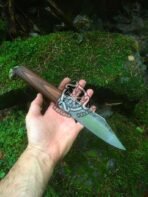
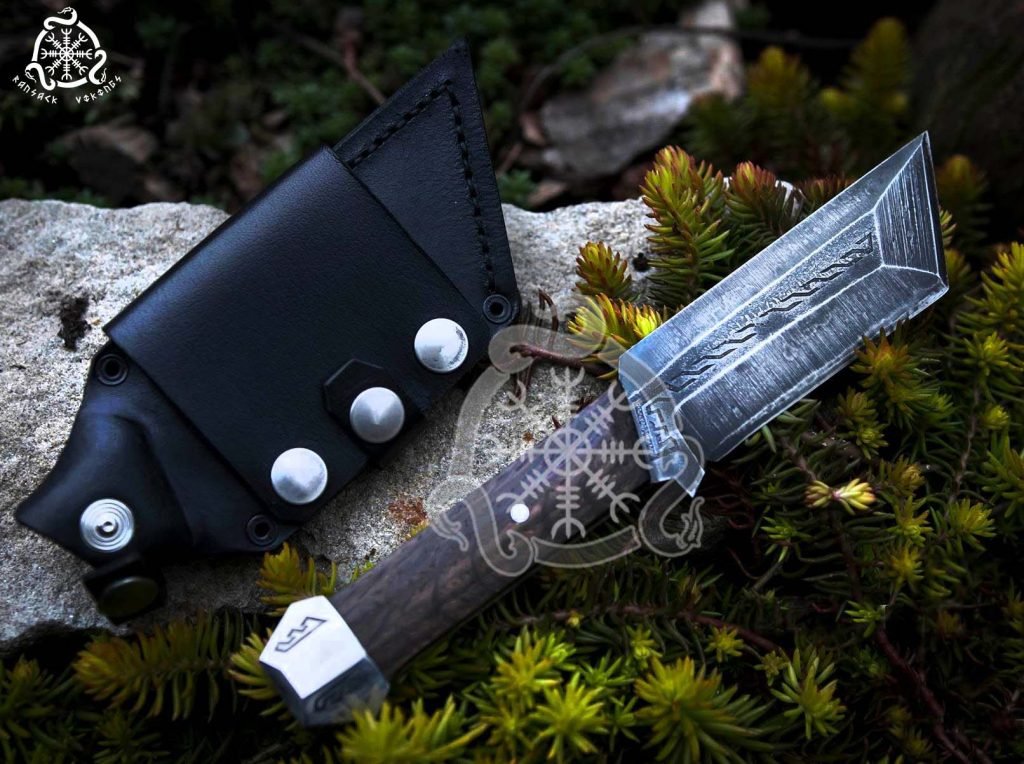
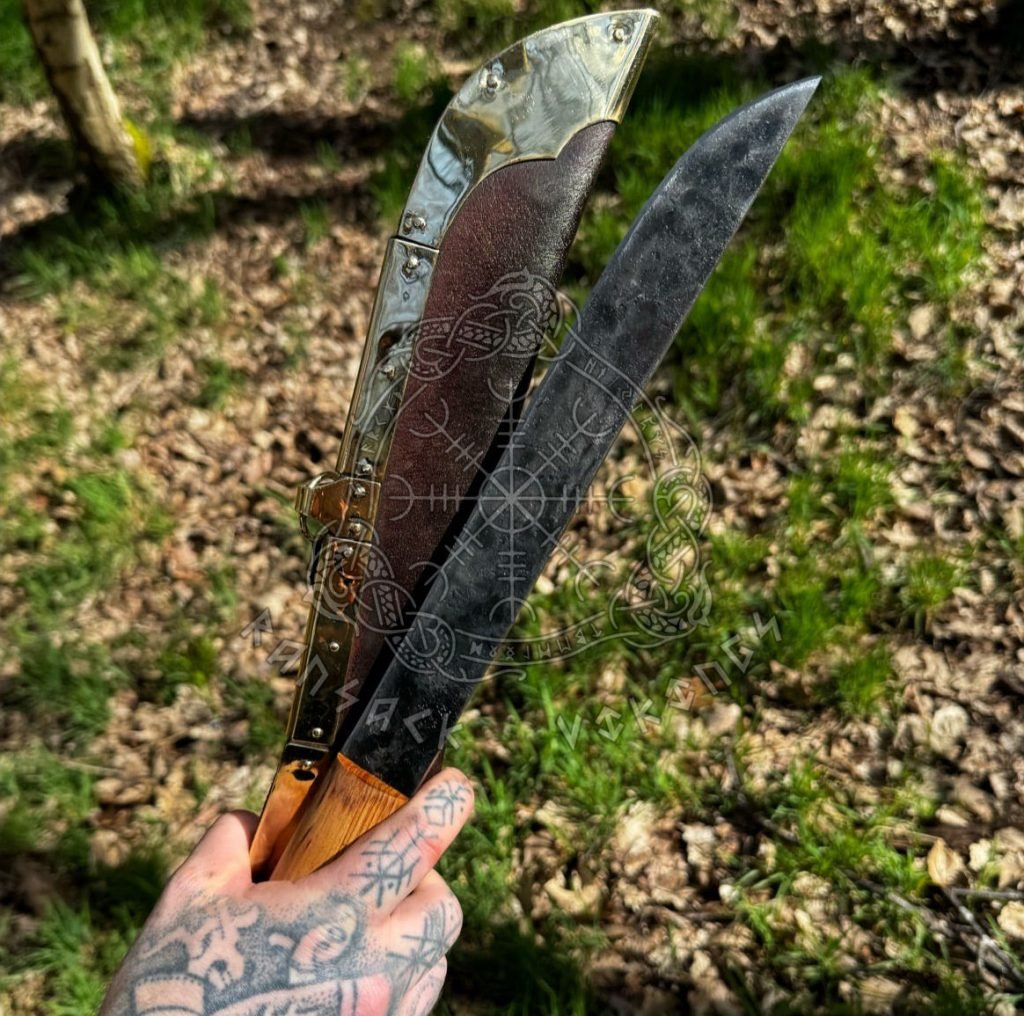
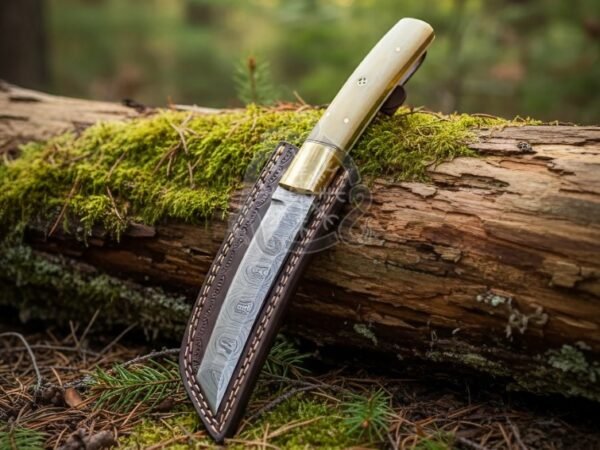
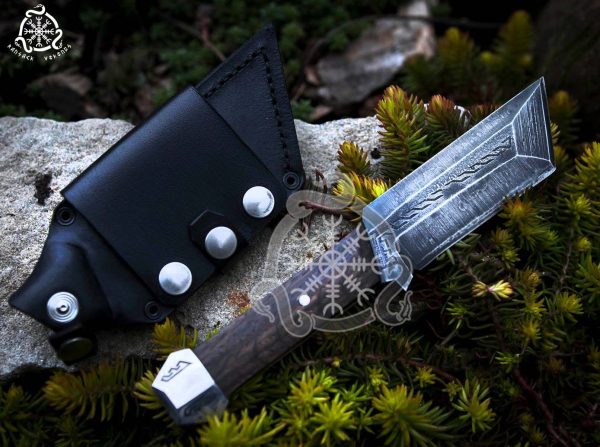
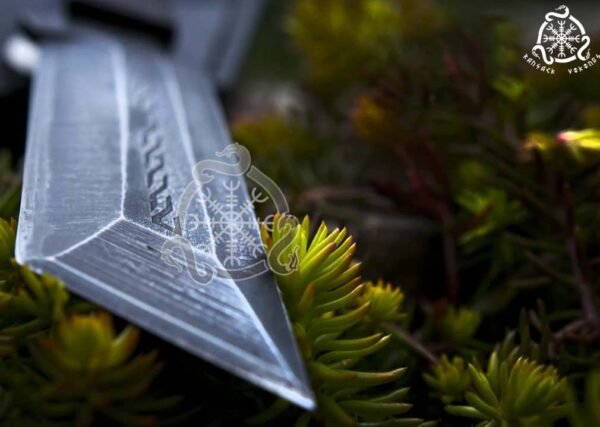
The Anglosaxon is hand forged. It is not machine made and it is not bulk produced, so what arrives will not be a pixel for pixel copy of the photograph. The finish left by the grinder, the exact line of the spine, the colour and grain of the handle and the tone of the steel all vary from one knife to the next, because each is worked by hand from natural materials. The dimensions, the steel, the hardness and the build are the same every time. The character is not.
Frequently asked questions
How big is it really?
It is 11.8 inches overall with a 6.9 inch blade, which is 30 and 17.5 centimetres. That is a substantial belt knife rather than a sword sized piece, and it is the size most seaxes in the archaeological record actually are.
Is it sharpened when it arrives?
Yes. The edge is put on by hand before packing and the knife will cut on arrival. It carries a working edge suited to outdoor use rather than a fragile shaving edge.
Why is the back of the blade so thick?
Five millimetres of spine gives the knife stiffness, forward weight and a comfortable place to put your thumb or your other hand when you need to force a cut. It is the defining feature of a broad seax.
Does it come with a sheath?
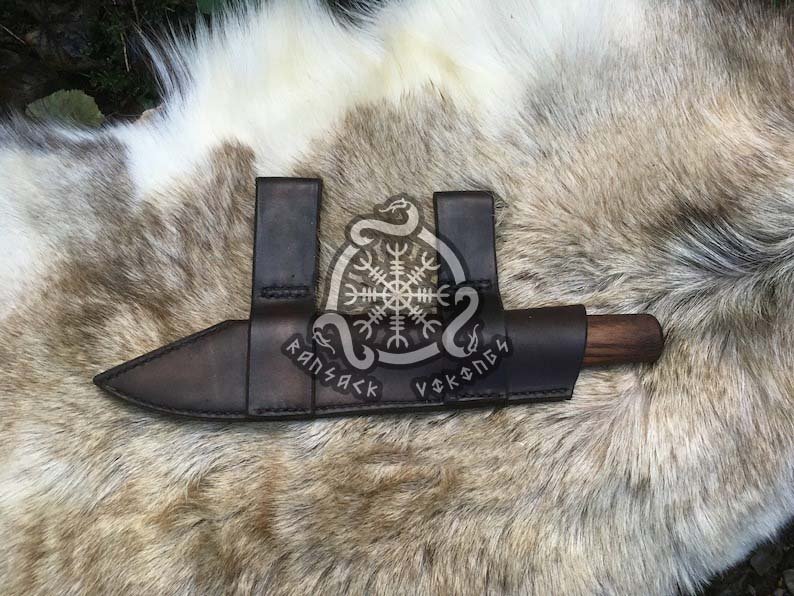
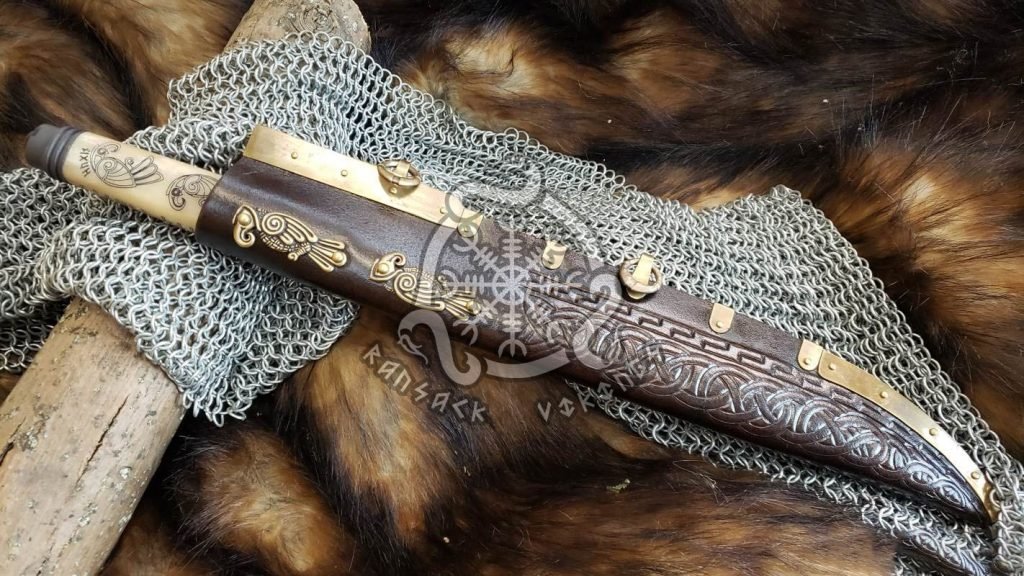
This listing is for the knife. Get in touch before ordering if you want to know what leatherwork we can cut for it.
How does it differ from a bowie knife?
A bowie has a clipped, often sharpened false edge on the spine and a pronounced guard, and it is a nineteenth century American design. A seax has a plain unsharpened back, usually no guard at all, and it is early medieval northern European. They overlap in size and diverge in almost everything else.
Can I carry it?
It is a functional fixed blade and it is legal to own. Rules on carrying a fixed blade of this length in public vary enormously between states and cities, so check your own local law before you put it on a belt.
What is in the box
- One Anglosaxon hand forged Viking seax knife
- Protective packaging
- Forged and finished in the Czech Republic
Explore the range
Related collections: Viking Seax, Viking Knives, Hunting Knives and Bowie Knives. The history and the sharpening technique are in the guides.











Reviews
There are no reviews yet