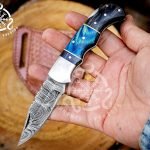
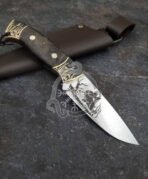
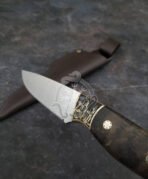
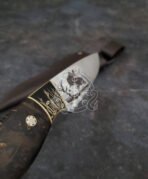
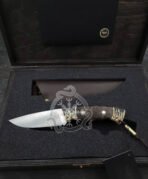
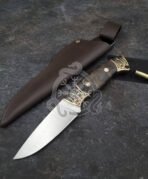
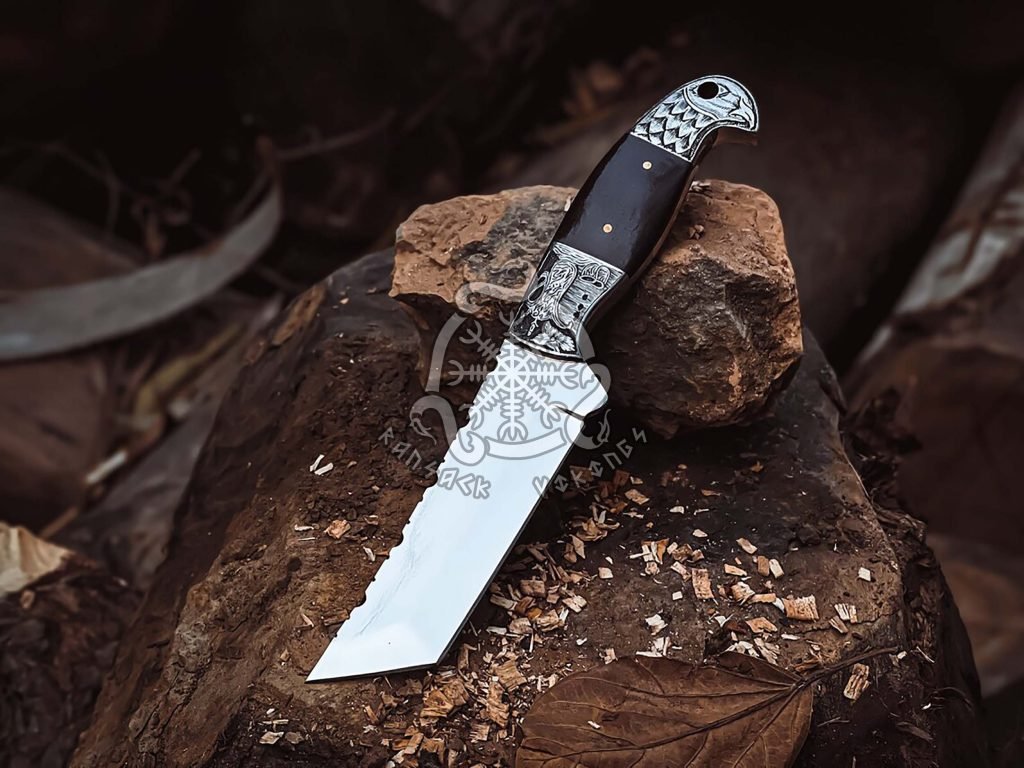
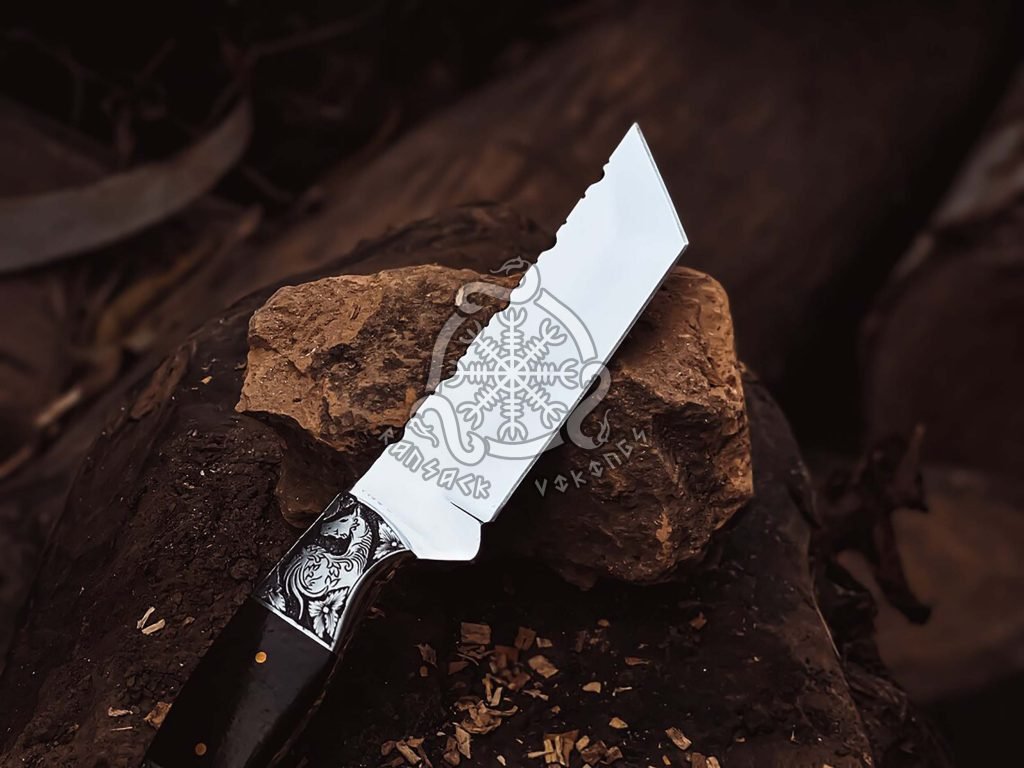
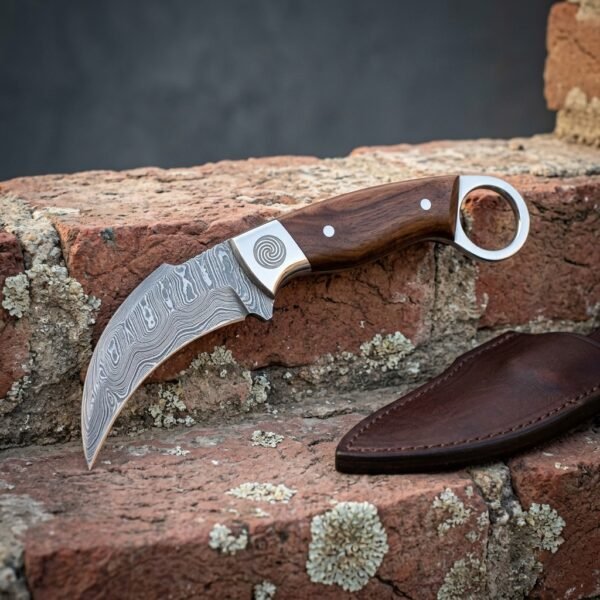
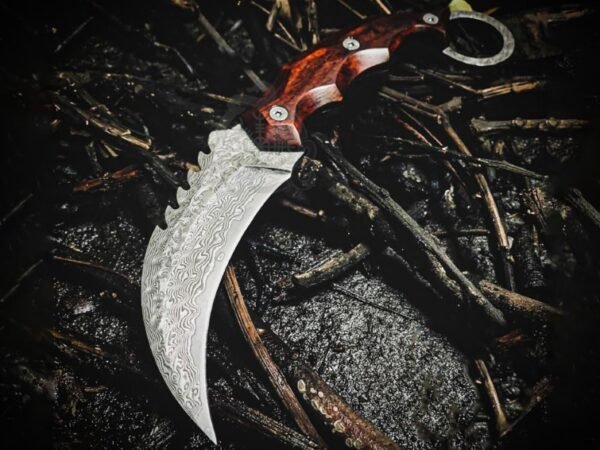
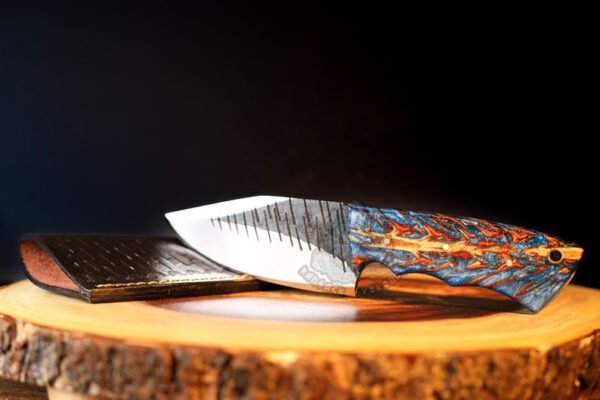
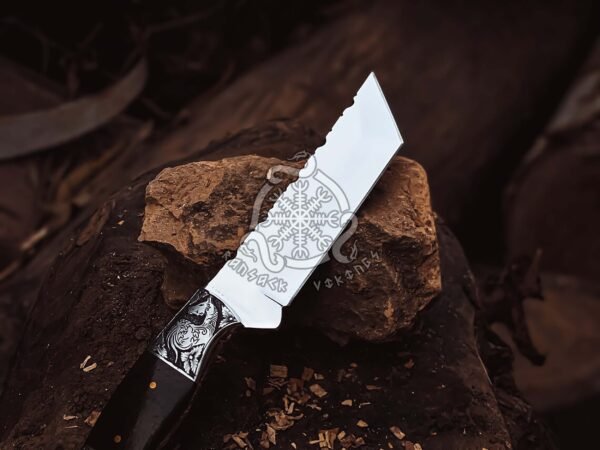
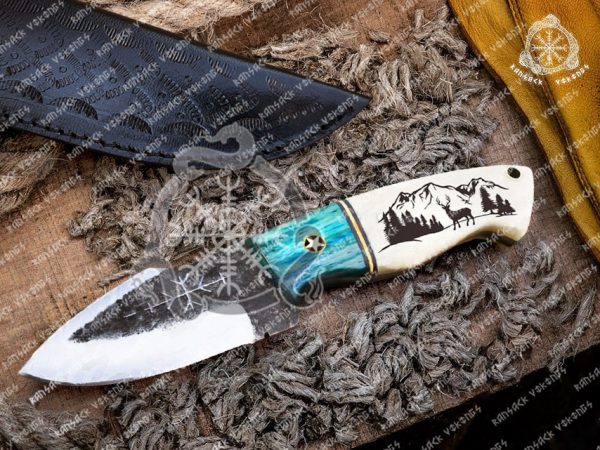
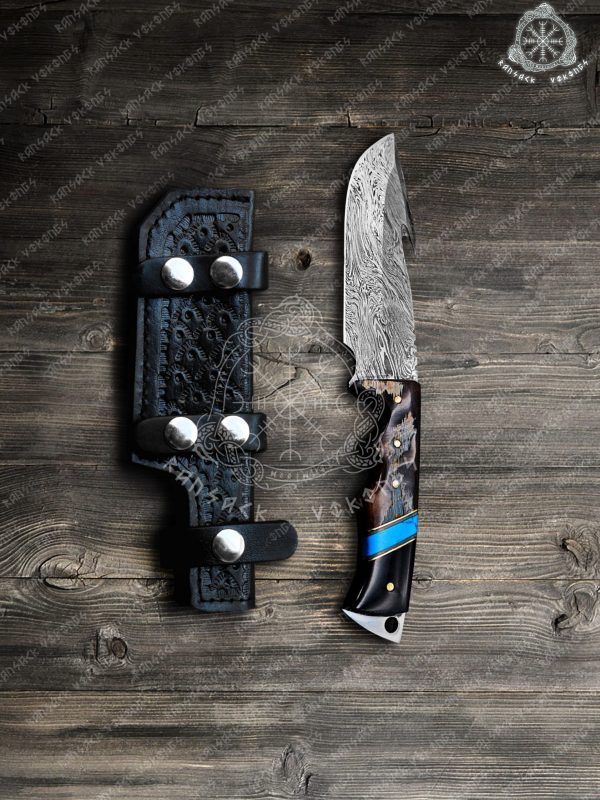
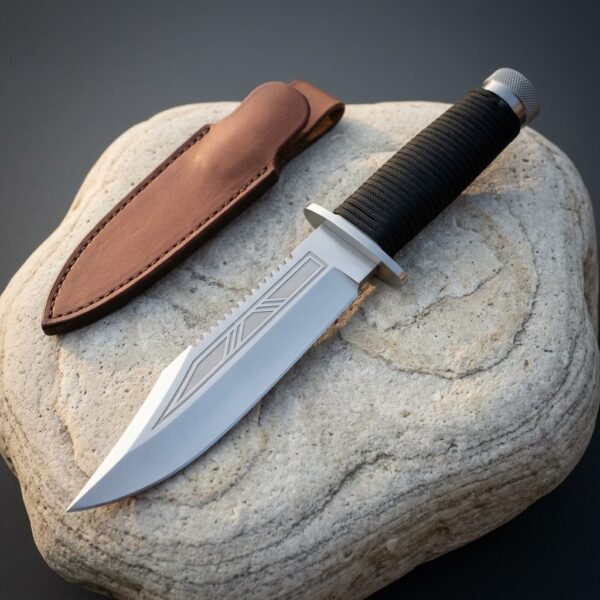
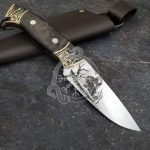
This Brasscamp is a working camp knife, not a drawer piece. A five inch hand forged Damascus blade, a walnut handle with an engraved brass bolster, nine and a half inches overall, and a fitted leather sheath so it can go on a belt and stay there. The edge arrives ready to cut. The overlap between hunter, skinner and bowie is untangled in which knife you actually need.
The camp knife is one of the few genuinely American blade categories, and it exists because of a gap. A hunting knife is specialised for game. A kitchen knife is useless outdoors. An axe is too much tool for most of what a camp actually needs. What people wanted was a single fixed blade long enough to split kindling and prepare food, stout enough to survive being levered and hammered, and short enough to control for fine work. Somewhere between four and six inches of blade turned out to be the answer, and it has stayed the answer for a century and a half. At five inches this sits in the middle of that band, which is where most experienced campers end up after they have tried both extremes.
It is forged and finished in the Czech Republic, from billet welding through heat treat, grinding, bolster and handle fitting, sheath making and final sharpening. It ships with the leather sheath and protective packaging.
Specifications
| Steel | Hand forged Damascus, 1095 and 15N20 |
|---|
| Hardness | 58 to 60 HRC |
|---|
| Overall length | 9.5 inches |
|---|
| Blade length | 5 inches |
|---|
| Handle length | 4.5 inches |
|---|
| Handle | Walnut wood with engraved brass bolster |
|---|
| Sheath | Leather sheath included |
|---|
| SKU | RK-704 |
|---|
What makes a camp knife different from a skinner or a bushcraft blade
These three get sold as if they were interchangeable and they are not, and the differences are all visible in the outline. A skinner has a trailing point, where the tip rises above the line of the spine, and a long sweeping belly. That shape exists to keep as much edge as possible in contact with a hide while holding the tip away from the meat underneath, and it is very good at that and mediocre at everything else. A bushcraft knife usually carries a scandi grind, a single wide bevel running to the edge, which is superb for controlled wood carving and awkward for slicing food.
A camp knife is the generalist. The blade is straighter through the belly than a skinner’s, so it slices food cleanly on a board. The point sits closer to the centreline, so you can drill, notch and pierce without the tip fighting you. And it is ground thicker at the spine than a kitchen knife, because it has to survive being pushed through a knot in a piece of firewood or tapped through a small branch. Five inches gives you enough edge for splitting kindling from a short round and enough control to butterfly a trout. That combination is why the camp knife became the one blade people actually pack.
Why Damascus and not stainless
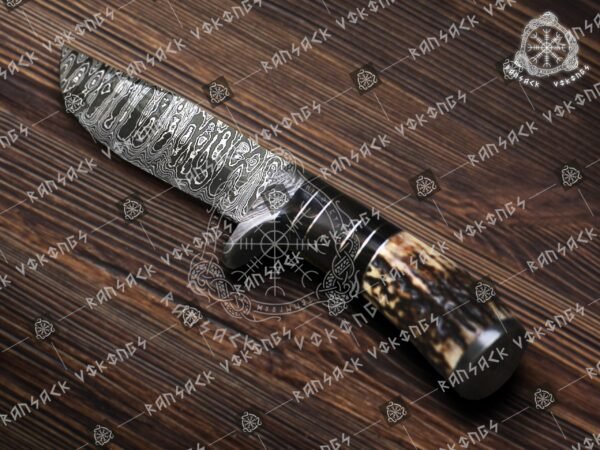
Forge welded from 1095 and 15N20, this blade carries a pattern that goes all the way through the steel. The 1095 supplies the carbon that lets the edge harden. The 15N20 supplies nickel, which resists the acid etch and shows as the bright bands. Printed and laser etched blades look similar in a photograph and fall apart under a file. If you are buying Damascus anywhere, run through our five checks for real Damascus first.
Stainless has one honest advantage for a camp knife: it does not care about being put away damp after a wet weekend, which is exactly what happens to camping gear. The reason we build this one in Damascus anyway is hardness. At 58 to 60 HRC the edge survives batoning and hard use in a way a soft stainless blade does not, and it sharpens back quickly on a stone in the field. The trade is that you have to dry it and oil it. That is a genuine cost and we would rather say so than pretend. The comparison in full is in Damascus versus stainless.
The walnut handle and brass bolster
The grip is shaped from walnut and finished by hand so it fills the palm rather than sitting flat in it. Walnut is the classic tool and stock timber for a reason: it is strong for its weight, it has enough grain texture to stay secure in a wet hand, and it is one of the few woods that is genuinely comfortable to grip in cold weather, when a metal or resin handle becomes unpleasant. It also takes an oil finish that ages rather than peels.
The brass bolster between the wood and the blade is engraved as part of the design. Brass is chosen because it is dense, easy to work into a decorative surface and it develops a warm patina over years of handling instead of looking tired. It caps the front of the handle where knocks land and gives the tang a solid seat. Keep the walnut fed with a light oil once or twice a year, wiped on and wiped off, and it will not dry out or shrink away from the brass. Care instructions are in wooden handle care.
Engraving, runes and your own design
Use the rune converter on this page to turn a name, a date or a short phrase into Elder Futhark and we will cut it into the steel or the handle. If you would rather have a Viking pattern than a rune line, choose your own design in the engraving option above the add to cart button and tell us whether it goes on the blade or the handle. Where a piece already carries an engraved design, your chosen engraving replaces it rather than sitting alongside it, and that applies directly here: the brass bolster on this knife is already engraved, so anything you choose for the bolster takes the place of that existing pattern rather than being added around it. If you want to keep the bolster as it is, put your line on the blade flat instead. See the engraving page for layout and lettering.
Care and sharpening
Two rules cover almost everything. Dry it, and oil it. Wipe the blade after use, especially after food or anything acidic, and put a thin film of light oil on before it goes back in a pack or a drawer. Do not store the knife in the leather sheath for long periods: leather is tanned with salts and holds moisture, and a blade left sheathed for a season will show it. Keep them apart in storage and together in the field. Full method in how to stop rust on Damascus, and sheath care in leather sheath care.
Sharpening a hard Damascus edge is quick. Match the existing bevel angle, work one side in overlapping passes until you feel a burr along the full length, turn the blade over and match it, then strip the burr with light alternating strokes. For a camp knife stop at a medium grit rather than chasing a polish: a slightly toothy edge cuts rope, bark and cooked meat better and survives longer between touch ups. The method is in sharpening with a whetstone.
Made in the Czech Republic
Every piece we sell is made by hand in the Czech Republic. The smiths there work the way the trade has been worked for a long time, heating and hammering the steel, taking the bevels down by eye, and fitting the handle and the leather one at a time. There is no automated line anywhere in it, so small differences from one piece to the next are normal and expected.
Ransack Viking is a United States company based in Memphis, Tennessee. We bring the pieces in ourselves, inspect them on arrival and ship them from our own warehouse. If you add engraving, that is carried out here in the United States before your order goes out.
A note on handmade variation
The Brasscamp is hand forged, not machine made or bulk produced, so the knife that arrives will not be a pixel for pixel copy of the photograph on this page. The Damascus pattern is decided by how that billet folded and where the blade came out of it. The walnut grain and colour are their own, the brass takes its finish by hand, and the leather sheath is cut to the individual blade. The dimensions, the steel and the build are the same every time. The character is not.
Frequently asked questions
Is the blade Damascus or stainless?
Damascus. It is forge welded from 1095 and 15N20 carbon steels, hardened to 58 to 60 HRC, with the pattern running through the full thickness of the blade. It is not stainless and it is not rust proof, so it needs drying and oiling.
Can I baton with it?
For splitting small rounds and making kindling, yes, which is part of what a five inch camp knife is for. Use a wooden baton, keep the strikes on the spine over the blade rather than out past the tip, and do not use it on knotty hardwood where an axe is the right tool.
Is the sheath included?
Yes. A leather sheath is cut and stitched to the finished blade and ships with the knife. Store the knife out of the sheath for long periods, because leather holds moisture against steel.
Can I replace the engraving on the brass bolster?
Yes. If you choose an engraving for the bolster, it replaces the existing pattern rather than sitting next to it. If you want to keep the bolster design as it is, put your rune line or your own design on the blade flat instead.
How is this different from a skinner?
Shape and purpose. A skinner has a trailing point and a deep sweeping belly for keeping edge on a hide. This has a straighter belly and a more central point, which makes it far better at food prep, notching and general camp work and slightly less specialised for skinning.
How long does it take to arrive?
Processing runs one to two weeks because the knife and its sheath are made rather than picked off a shelf. Shipping inside the United States is free, and returns are accepted within seven days of delivery.
What is in the box
- One Brasscamp hand forged Damascus camp knife
- One fitted leather sheath
- Protective packaging
- Forged and finished in the Czech Republic
Explore the range
See what else sits alongside it in Hunting Knives, Damascus Skinner Knives, Bowie Knives and Viking Knives. The material detail and the care routines are in the guides.











Good quality knife for the price. Blade quality is solid. Arrived a bit less sharp than expected but a few passes on a strop fixed it. Would still tell others to give this a try.